• 검색 결과가 없습니다.

Co-occurrence Patterns of Bird Species in the World

N/A
N/A
Protected

Academic year: 2021

Share "Co-occurrence Patterns of Bird Species in the World"

Copied!
5
0
0

로드 중.... (전체 텍스트 보기)

전체 글

(1)

─ 478 ─ ISSN: 2288-1115 (Print), 2288-1123 (Online)

ⓒ The Korean Society of Limnology. All rights reserved.

This is an open-access article distributed under the terms of the Creative Commons Attribution Non-Commercial License (http://creativecommons.org/licenses/by-nc/3.0/), which permits unrestricted non-commercial use, distribution, and reproduction in any medium, provide the original work is properly cited.

INTRODUCTION

Birds have long been a major focus of public attention and research interest. In particular, multinational collabora-

tion is now a major driver in bird conservation (Donald et al., 2007). Amongst researchers and environmental groups, the consensus about bird conservation is that a compre- hensive and cooperative international effort is needed to conserve viable bird populations (Williams et al., 2013).

Effective bird conservation globally will require far greater coordination amongst countries (Donald et al., 2007). The Individualistic implementation of bird conservation policies

Co-occurrence Patterns of Bird Species in the World

Kim, Young Min (0000-0003-3901-9123) , Sungwon Hong (0000-0002-2838-2464) , Yu Seong Lee 1 (0000-

0001-9734-1597) , Ki Cheol Oh 2 (0000-0001-5369-8420) , Gu Yeon Kim 3 (0000-0003-1071-0383) and Gea- Jae Joo * (0000-0002-5617-7601)

Department of Integrated Biological Science, College of Natural Sciences, Pusan National University, Busan 46241, Republic of Korea

1 Department of Biological Sciences and Biotechnology, Hannam University, Daejeon 34430, Republic of Korea

2 Nakdong River Basin Environmental Office, Changwon 30103, Republic of Korea

3 Department of Science Education, College of Natural Sciences, Kyungnam University, Masan 51767, Republic of Korea

Abstract In order to identify key nations and bird species of conservation concern we described multi- national collaborations as defined using network analysis linked by birds that are found in all nations in the network. We used network analysis to assess the patterns in bird occurrence for 10,422 bird inventories from 244 countries and territories. Nations that are important in multinational collaborations for bird conservation were assessed using the centrality measures, closeness and betweenness centrality. Countries important for the multinational collaboration of bird conservation were examined based on their centrality measures, which included closeness and betweenness centralities. Comparatively, the co-occurrence network was divided into four groups that reveal different biogeographical structures. A group with higher closeness centrality included countries in southern Africa and had the potential to affect species in many other countries. Birds in countries in Asia, Australia and the South Pacific that are important to the cohesiveness of the global network had a higher score of betweenness centrality. Countries that had higher numbers of bird species and more extensively distributed bird species had higher centrality scores; in these countries, birds may act as excellent indicators of trends in the co-occurrence bird network. For effective bird conservation in the world, much stronger coordination among countries is required. Bird co-occurrence patterns can provide a suitable and powerful framework for understanding the complexity of co-occurrence patterns and consequences for multinational collaborations on bird conservation.

Key words: bird co-occurrence pattern, centrality, multinational collaboration, network analysis

Manuscript received 11 December 2017, revised 18 December 2017, revision accepted 22 December 2017

* Corresponding author: Tel: +82-51-510-3344, Fax: +82-51-583-0172,

E-mail: [email protected]

(2)

may fail if previously identified interactions within the net- work between countries are ignored (Runge et al., 2015), also contributing to the limited success of bird conservation at the national level, conservation policies are rarely imple- mented in a uniform manner and research interest is often patchy due to its dependency upon the researcher.

Although countries located along migratory routes have established networks for the protection of migratory birds, based on flyway concepts that emphasize political and gov- ernmental processes in multinational collaboration, non-mi- gratory birds are not covered effectively in traditional fly- way models. Spatial co-occurrences for both migratory and non-migratory birds, may reveal complex interactions in a net work spanning many countries, based on the geographic patterns of bird co-occurrence among countries (Böhning- Gaese and Oberrath, 1999; Webb et al., 2002). The com- plexity of direct and indirect interactions linking birds amongst countries is so vast that their complete documenta- tion is beyond reach. Using network analysis to understand the drivers affecting the distributional dynamics that facil- itate bird conservation globally, as well as enable multina- tional collaboration, requires investigation using alternative approaches.

We use an approach based on network analysis to identify potential broad-scale interactions between birds from differ- ent countries, based on the geographical patterns of bird co- occurrence. Network analysis has traditionally had a strong synergy with business models in certain industries (Proulx et al., 2005), but we believe that it could be used to identify direct and indirect relationships linking birds from countries by analyzing the structure in the network (Scott, 2012).

Our specific objectives were to (i) propose multinational collaboration groups, defined by network analysis, that are linked by co-occurring birds, and (ii) to identify the key countries and birds of conservation concern in each net- work. First, we hypothesized that countries and birds with the potential to affect other countries and species will have higher closeness centrality scores. They can provide the clearest perspective of the state of the network. Second, we predicted that countries and birds that are important to the cohesiveness of the network would have a higher between- ness centrality score. Together, these indices can represent how each country can conduct bird conservation efforts independently and effectively relative to others.

METHODS 1. Data collection

We used 10,422 bird inventories from 244 countries and territories obtained from BirdLife International (2015, http://datazone.birdlife.org). The cumulative total contribu- tion (in US Dollars) for 193 countries from 1973 to 2013 to the Environment Fund of UNEP (United Nations Environ- ment Programme) was used to indicate conservation effort in each country including bird conservation.

2. Network analysis

We used network analysis to examine the patterns of bird co-occurrence and the structure and level of bird connected- ness. Network analysis uses a set of procedures to identify and measure the structural properties of social systems, based on relationships among entities in the system rather than on characteristics of the entities. A network can be thought of as a set of nodes with connections or links be- tween them. In our study, the nodes are countries and birds while the links are undirected connections between each country and species.

Centrality indices describe the importance of specif- ic nodes within the network (Newman, 2010). Different centrality indices measure different aspects related to the position of a node within its network. Closeness centrality expands the definition of degree by focusing on the dis- tance between nodes. A central node is thus characterized in the networks by numerous short connections. Betweenness centrality represents a different aspect of centrality: based on the number of times a particular node is found on the shortest path between any pair of nodes in the network.

Nodes that are highly central control information flow in

the network and thus receive a higher score of betweenness

centrality. A social network analysis and visualization soft-

ware application, Gephi (which uses the ForceAtlas 2 algo-

rithm as a type of force-directed layout algorithm, ver 0.9.2),

was used to determine the position of the participants and

develop network diagrams (sociograms) that indicate the

relationship ties and information flow between the individ-

ual nodes. The different centralities among the groups were

divided using the modularity index and were tested using a

one-way ANOVA and Duncan’s post-hoc test.

(3)

RESULTS 1. Bird co-occurrence

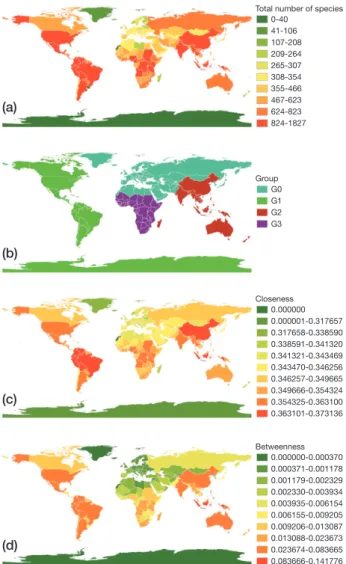
The average number of bird species for the 244 coun- tries was approximately 403 species. The median number of birds per country was 311 species. Countries in South America, such as Columbia (1,827 species), Peru (1,807 species), and Brazil (1,753 species), had the highest number of bird species (Fig. 1a). In Asia, Indonesia (1,615 species) also showed a high number of bird species. A total of 7,586 species occurred in more than two countries, while 2,836 species (27.2% of total bird species) were only recorded in one country. Arenariainterpres (221 countries), Hirundoru­

stica (213 countries), Falco peregrinus (210 countries), Num­

eniusphaeopus (209 countries), Calidrisalba (205 countries), and Pandion haliaetus (202 countries) had the broadest distributions across the world.

2. Bird network

The country-bird network consisted of 10,585 nodes and 97,419 edges (average degree, or node, connectivity=18.4, Fig. 2). The average network distance between all node pairs (average path length) was 3.63 (the longest distance was 6 edges). The modularity index was 0.596 (values > 0.4 suggest that the network has a strong modular structure).

Nodes were divided into 4 groups based on their modular- ity. Co-occurrence networks for four groups of birds reveal different relationships with biogeographical organization (Fig. 2). Group 0 (G0) accounted for 8.68% of the network;

it included 93 countries and 826 species in Europe, North Africa, the Middle East, and East Asia. Group 1 (G1) con- sisted of 60 countries and 4,220 species in America. G1 was the largest group in the network, with 40.44% of total nodes and edges. Group 2 (G2) accounted for 34.59% of the network, and included 48 countries and 3,613 birds in Asia, Australia and the South Pacific. Group 3 (G3) accounted for 16.29% of the network, and included 43 countries and 1,681 species in Sub-Saharan Africa.

Fig. 1c and 1d show that several countries within middle latitudes had higher centrality scores for both closeness and

Fig. 2. The network diagram for countries and birds. Each node (dot) represents a country or a bird. Nodes of same color belong to the same group. An edge (line) represents the re- lationship between two individuals.

Fig. 1. Maps of (a) the total number of bird species, (b) groups based on modularity from network analysis, (c) closeness centrality and (d) betweenness centrality of countries.

0.000000 0.000001-0.317657 0.317658-0.338590 0.338591-0.341320 0.341321-0.343469 0.343470-0.346256 0.346257-0.349665 0.349666-0.354324 0.354325-0.363100 0.363101-0.373136

0.000000-0.000370 0.000371-0.001178 0.001179-0.002329 0.002330-0.003934 0.003935-0.006154 0.006155-0.009205 0.009206-0.013087 0.013088-0.023673 0.023674-0.083665 0.083666-0.141776 G0

G1 G2 G3 0-40 41-106 107-208 209-264 265-307 308-354 355-466 467-623 624-823 824-1827 Total number of species

Group

Closeness

Betweenness

(a)

(b)

(c)

(d)

(4)

betweenness centrality. Closeness centrality of countries in G3 was significantly higher than in the other groups (Post-hoc test, P < 0.001) while betweenness of countries in G2 were higher than in the other groups (Post-hoc test, P < 0.05). Pakistan (G0), Brazil (G1), Indonesia (G2), and Congo (G3) had the highest closeness centrality in each group. Highest betweenness centralities were recorded in Japan (G0), Brazil (G1), Indonesia (G2), and Tanzania (G3) in each group.

Among all bird species, closeness and betweenness cen- tralities of G0 were significantly higher than they were for the other groups (Post-hoc test, P < 0.001). Porphyrio porphyria, Dendrocygnaviduata, Cisticolajuncidis, Ela­

nuscaeruleus, and Rostratulabenghalensis had the highest scores for closeness centrality. Comparatively, D. viduata, P.

porphyria, Nettaerythrophthalma, Laruscirrocephalus, and C. juncidis had the highest scores for betweenness central- ity. Arenariainterpres (G0), Butoridesstriata (G1), Fregata minor (G2), and P. porphyrio (G3) had the highest values for closeness centrality for each each group. A. interpres (G0), B. striata (G1), F. minor (G2), and D. viduata (G3) had the highest values for betweenness centrality for each each group.

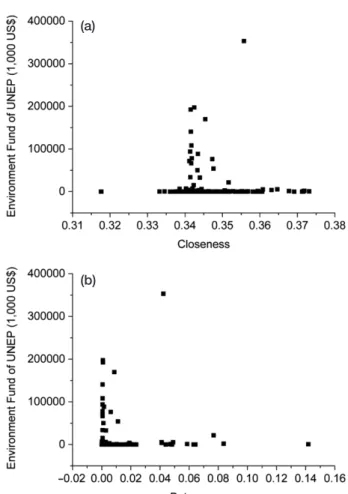
The allocation to the Environment Fund of the UNEP from each country was not an appropriate measure of the importance of each country, based on centralities in the network. Many countries with high-level centrality values made small contributions (Fig. 3). This result presents a paradox and emphasizes the importance of multinational collaboration in bird conservation (Donald et al., 2007;

Butchart et al., 2010).

DISCUSSION

The present study identifies groups of birds that can be targeted for multinational collaboration, using network analysis. In addition, we identify several countries and bird species that provide important links and are crucial for multinational bird conservation in the four regional groups and globally. The geographical distribution of the groups, based on bird co-occurrence patterns, corresponds with large zoogeographic regions such as Nearctic, Neotropical, African, Palearctic, Oriental, and Australian regions. The

zoogeographic region construct has already been used to highlight areas of the world that are most distinctive or represent high “value” and are, therefore, worthy of greater attention (Olson and Dinerstein, 1998; Olson et al., 2001).

A large multinational group can be more appropriately conceptualized as an international bird conservation group rather than a representation of local conservation (Sodhi et al., 2011). Each group in the network may overcome a limitation of the migratory bird flyway concept, in which east-west migration is not well-recognized (Favell, 2008).

However, conservation policies that are implemented across large biotic regions or hotspots often fail to discern smaller but highly distinctive areas; this can result in these areas receiving insufficient conservation attention (Olson et al., 2001). Bird conservation at the local level should also be strongly recommended, as careful attention to bird habitat may be improve the efficiency of conservation efforts.

Fig. 3. Relationships between centralities and their contributions to the Environment Fund of UNEP, which represent bird conservation efforts in each country.

(a)

(b)

(5)

Countries and species with high scoring closeness and betweenness centrality may act as excellent sentinels or in- dicators of trends in co-occurrence bird networks, although countries in mid-latitudes had high centralities that strongly correlated with the number of species. Bird species with high score centralities had extensive distributions across the world. Generalist birds that have broad distribution with large population are often not important issues in bird con- servation. However, these species could be important for identifying the current state of bird diversity and conserva- tion effectiveness at the local level, for these species have the great role of connecting habitats and countries (Cassey et al., 2004).

Sustained economic support for coherent global bird con- servation is essential to improve the effectiveness of these responses. We believe that a bird co-occurrence network provides a suitable and powerful framework to address the complexities of co-occurrence patterns and can pave the way to improving worldwide bird conservation.

ACKNOWLEDGEMENTS

This work was supported by the research fund of the Bu- san Green Environment Center (15-1-70-71).

REFERENCES

Bird species distribution maps of the world. BirdLife Interna- tional, Cambridge. UK and NatureServe 2015 [cited 2 February 2015]. Available from http://www.birdlife.org/

datazone/country.

Böhning-Gaese, K. and R. Oberrath. 1999. Phylogenetic effects on morphological, life-history, behavioural and ecological traits of birds. Evolutionary Ecology Research 1: 347- Butchart, S.H., M. Walpole, B. Collen, A. Van Strien, J.P. 364.

Scharlemann, R.E. Almond, J.E. Baillie, B. Bomhard, C.

Brown and J. Bruno. 2010. Global biodiversity: indicators of recent declines. Science 328: 1164-1168.

Cassey, P., T.M. Blackburn, D. Sol, R.P. Duncan and J.L. Lock- wood. 2004. Global patterns of introduction effort and establishment success in birds. Proceedings of the Royal Society of London B: Biological Sciences 271(Suppl 6):

S405-S408.

Donald, P.F., F.J. Sanderson, I.J. Burfield, S.M. Bierman, R.D.

Gregory and Z. Waliczky. 2007. International conserva- tion policy delivers benefits for birds in Europe. Science 317: 810-813.

Favell, A. 2008. The new face of East-West migration in Europe.

Journal of Ethnic and Migration Studies 34: 701-716.

Newman, M. 2010. Networks: an introduction. Oxford Univer- sity Press, UK.

Olson, D.M. and E. Dinerstein. 1998. The Global 200: a repre- sentation approach to conserving the Earth’s most bio- logically valuable ecoregions. Conservation Biology 12:

502-515.

Olson, D.M., E. Dinerstein, E.D. Wikramanayake, N.D. Bur- gess, G.V. Powell, E.C. Underwood, J.A. D’amico, I.

Itoua, H.E. Strand and J.C. Morrison. 2001. Terrestrial Ecoregions of the World: A New Map of Life on Earth A new global map of terrestrial ecoregions provides an in- novative tool for conserving biodiversity. BioScience 51:

933-938.

Proulx, S.R., D.E. Promislow and P.C. Phillips. 2005. Network thinking in ecology and evolution. Trends in Ecology and Evolution 20: 345-353.

Runge, C.A., J.E. Watson, S.H. Butchart, J.O. Hanson, H.P. Pos- singham and R.A. Fuller. 2015. Protected areas and global conservation of migratory birds. Science 350: 1255-1258.

Scott, J. 2012. Social network analysis. Sage, UK.

Sodhi, N.S., R. Butler, W.F. Laurance and L. Gibson. 2011.

Conservation successes at micro-, meso-and macroscales.

Trends in Ecology and Evolution 26: 585-594.

Webb, C.O., D.D. Ackerly, M.A. McPeek and M.J. Donoghue.

2002. Phylogenies and community ecology. Annual Re­

view of Ecology and Systematics 33: 475-505.

Williams, D.R., R.G. Pople, D.A. Showler, L.V. Dicks, M.F.

Child, E.K. Zu Ermgassen and W.J. Sutherland. 2013.

Bird Conservation: Global evidence for the effects of in-

terventions, Vol 2. Pelagic Publishing, UK.

수치

Fig. 1c and 1d show that several countries within middle  latitudes had higher centrality scores for both closeness and
Fig. 3.   Relationships between centralities and their contributions  to the Environment Fund of UNEP, which represent bird  conservation efforts in each country.

참조

관련 문서

Common corporate digital crimes include piracy, financial fraud, espionage, and theft of services.. _______________________________________ such as

1 John Owen, Justification by Faith Alone, in The Works of John Owen, ed. John Bolt, trans. Scott Clark, &#34;Do This and Live: Christ's Active Obedience as the

First, elementary school teachers were aware of the necessity to operate the English curriculum based on key competencies, but they perceived their efforts

There is well-rounded education based on the personality in the pursuit of the alternative school; for example, the study of ‘mind’ represents in the Won-buddhism, which

The daily variation of the extreme temperature, correlation between continentality and oceanity, and extreme value occurrence time were studied for the

This study was conducted to investigate the storage period and optimal temperature of seed potato which were based on technique of dormancy prolonging by

The surface of untreated Ti, SLA treated Ti, and AA plasma polymerized SLA/Ti were also examined for their proliferation and differentiation of

This study examined the achievement, satisfaction and interest of an English grammar class based on flipped learning in order to find out the effect of