• 검색 결과가 없습니다.

Endoscopic Mucosal Resection of a Colonic Schwannoma in a Patient with Idiopathic Thrombocytopenic Purpura

N/A
N/A
Protected

Academic year: 2021

Share "Endoscopic Mucosal Resection of a Colonic Schwannoma in a Patient with Idiopathic Thrombocytopenic Purpura"

Copied!
6
0
0

로드 중.... (전체 텍스트 보기)

전체 글

(1)

Departments of Internal Medicine, Keimyung University School of Medicine, Daegu, Korea

Jae Hyuk Choi, M.D., Kyung In Lee, M.D., Kyung Sik Park, M.D., Eun Soo Kim, M.D., Kwang Bum Cho, M.D., Jong Hwan Choi, M.D.,

Wang Yong Choi, M.D., Jun Yeon Jo, M.D., Jung Min Lee, M.D.

Endoscopic Mucosal Resection of a Colonic Schwannoma in a Patient with Idiopathic Thrombocytopenic Purpura

Corresponding Author: Kyung Sik Park, M.D., Department of Internal, Keimyung University School of Medicine 56 Dalseong-ro, Jung-gu, Daegu 700-712, Korea

Tel : +82-53-250-7088 E-mail: [email protected]

Abstract

Idiopathic thrombocytopenic purpura (ITP) is an acquired disorder that leads to the immune-mediated destruction of platelets and inhibition of platelet release from megakaryocytes. Although serious bleeding is uncommon in patients with ITP, when performing surgery in a patient with ITP, bleeding during or following the surgery is a major concern. Endoscopic mucosal resection (EMR) might be a good alternative to surgery; it can decrease the need for surgical intervention as well as the associated morbidity and mortality. However, reports on the EMR experience in patients with ITP are uncommon. Schwannomas are rare mesenchymal tumors that develop from the Schwann cells of peripheral nerves. Primary Schwannomas of the colon are extremely rare, and local surgical excision is the treatment of choice. This is the first case report of a patient with ITP and a large Schwannoma in the transverse colon that was removed by EMR.

Key Words : Endoscopy, Idiopathic, Purpura, Schwannoma, Tthrombocytopenic

Introduction

Although endoscopic mucosal resection (EMR) is a less invasive therapeutic technique that is used for lesions of the gastrointestinal tract [1-3]. It is unclear whether EMR is safe in patients with idiopathic thrombocytopenic purpura (ITP); reports

on EMR in patients with ITP are very rare.

Schwannomas are tumors that originate from any nerve that has a Schwann cell sheath. The colorectal Schwannoma is extremely rare [4].

Because most Schwannomas have a good

prognosis, surgical removal is usually sufficient

treatment [5-7]. However, the outcome of

(2)

endoscopic treatment of colorectal Schwannomas is not known.

This is the first case report of a patient with ITP and a large Schwannoma in the transverse colon that was removed by EMR.

Case Report

A 47-year-old asymptomatic woman was referred for the evaluation of a mass of the transverse colon. The patient was diagnosed with ITP at the age of 45. As the initial therapy for ITP, prednisone was administered, but it was not effective, and a splenectomy was performed at that time.

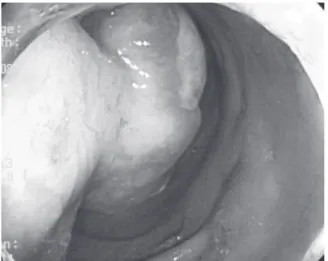
On admission, there were no specific abnormal findings on the physical examination or laboratory findings, except for a low platelet count (46,000 cells/mL). Colonoscopy revealed a large semi- pedunculated mass occupying the mid transverse colon (Fig. 1). Biopsy of the surface of the mass revealed only necrotic tissue. The abdominal computed tomography scan revealed an about 4 cm polypoid mass in the mid-transverse colon (Fig. 2).

In addition, the serum levels of tumor markers including carcinoembryonic antigen and CA 19-9 were within normal ranges. The patient received transfusions with seven pints of platelet concentrates before the procedure. The EMR was performed as follows (Fig. 3) with a colorectal surgeon on standby. Midazolam 3.5 mg, pethidine 50 mg and propofol 30 mg were injected before and during the procedure. An Olympus GIF-Q260 (Olympus, Tokyo, Japan) colonoscope was used. A transparent cap from the Stiegmann rubber and ligator system (Bard, Covington, Ga, U.S.A) was placed on the tip of the scope. The submucosal injection fluid was a mixed solution that contained 100 mL of 3% hypertonic saline, 1 mL of 1:1000

epinephrine, and 1mL of indigocarmine. A snare 3.5 cm in diameter (Medi-Globe, Achenmuhle, Germany) connected to the ERBE VIO 300D electrosurgical unit (ERBE USA, Marietta, Ga, U.S.A) Fig. 1. Colonoscopy. An intraluminal tumor

covered with necrotic tissue is noted in the transverse colon. The size was approximately 3.5 cm in diameter.

Fig. 2. Abdominal computed tomography. About a

4cm sized polypoid mass is located in the

mid-transverse colon.

(3)

was used for the resection. Using the forced coagulation mode (effect 1), the lesion was completely resected after 19 seconds.

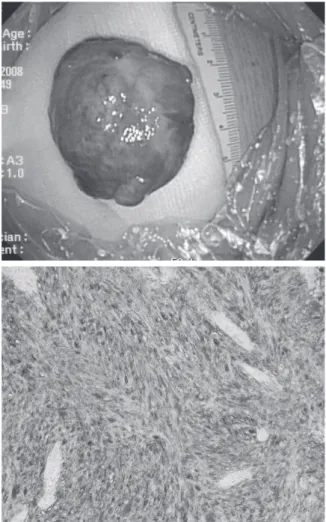
Grossly, the endoscopically removed tumor measured 3.7 × 3.5 × 2.5 cm and was globular and solid (Fig. 4A). Microscopically, spindle cells were proliferated primarily in the muscularis propria under the intact colon mucosa. Nuclear palisading and Verocay bodies were observed. The subsequent immunohistochemical examination showed tumor cells with strong and diffuse expression of the S-100 protein but negative for CD 117, CD 34, desmin and SMA (Fig. 4B). The above findings confirmed the histological diagnosis of a Schwannoma of the transverse colon.

The patient was discharged from the hospital on the 4

th

day after EMR without complications. Follow up colonoscopy was performed five months later, and there was no evidence of recurrence. The patient is doing well and being followed regularly as an outpatient.

Discussion

This is the first case report of a patient with ITP and a large Schwannoma in the transverse colon that was removed successfully by EMR.

Idiopathic thrombocytopenic purpura (ITP) is an autoimmune destructive thrombocytopenia associated with the production of antiplatelet antibodies. ITP is characterized by a low platelet count, normal bone marrow studies, and the Fig. 3. Endoscopic mucosal resection. The

procedure was performed without any complication.

Fig. 4. Pathology. A, Grossly, the resected tumor is

a globular and solid submucosal tumor. B,

Immunohistochemical staining demonstrates

diffuse strong positive cytoplasm reactivity

to S100 protein (X400).

(4)

absence of other causes of thrombocytopenia. Use of corticosteroids as immune suppressive therapy is recommended as standard therapy. Intravenous immune globulin (IVIG) or anti-Rh

0

D therapy, and additional immunosuppressive agents are also used for treatment. Splenectomy is the treatment of choice if a patient relapses after pharmacological therapy [8]. In this case, the patient had splenectomy due to failed medical treatment.

Patients with ITP undergoing surgery may have an increased risk of perioperative bleeding due to thrombocytopenia. If the platelet count is over 50,000 cells/mL, the risk for severe bleeding is low and surgical bleeding can be easily controlled by pressure or other surgical techniques. However in such cases with the platelet count lower than 50,000 cell/mL, minimally invasive therapeutic options are preferred to decrease the risk of bleeding. EMR is a useful therapeutic technique for lesions of the gastrointestinal tract; it is minimally invasive, safe and has excellent results. Therefore, EMR for colorectal tumors has become increasingly popular worldwide. In spite of its safety, the most frequent adverse event associated with EMR is bleeding.

However, the complication rate associated with EMR is low [1-3]. The safety of EMR in patients with ITP has not been determined; there are few reports on endoscopic surgical procedures, for lesions of the gastrointestinal tract, in patients with ITP. Therefore, when a patient with ITP needs an endoscopic procedure, endoscopists are often concerned about low platelet counts. However, even when the platelet count is low and refractory to all treatment, platelet transfusions and good technique usually allows for the endoscopic surgical procedure to be p e r f o r m e d s a f e l y. S o m e t i m e s h i g h d o s e immunoglobulin therapy and platelet transfusions are used to immediately increase the platelet count [9-11]. In the present case, because the initial platelet count was 46,000 cells/mL on admission, the

EMR was performed after platelet transfusion. A colorectal surgeon was on standby during the entire procedure. However, the lesion was removed without any unexpected event occurring during and after the procedure.

In general, Schwannomas of the colon are extremely rare and usually slow growing and benign [6-7]. They are clinically asymptomatic in the early stage, however, abdominal discomfort or pain, bowel habit changes, bleeding and a palpable mass can develop with disease progression [4, 7].

Schwannomas are not easily diagnosed because of their nonspecific symptoms and they are usually encased by normal mucosa on endoscopic findings.

In addition, it is difficult to obtain a sufficient specimen by forceps biopsy [12]. Endoscopic ultrasonography, abdominal ultrasonography, computed tomography, and magnetic resonance imaging may help to increase the rate of diagnosis [13-16]. However, the tumors usually involve the submucosa and muscularis propria, a definitive diagnosis is determined after complete tumor resection by microscopic examination, including immunohistochemistry. In the present case, the pathological diagnosis of Schwannoma also could be made after resection.

Grossly, Schwannomas appear as solid, well- encapsulated tumors often accompanied by surface ulceration [12]. They can be classified as Antoni type A with densely packed spindle cells (Verocay bodies) or Antoni type B with loosely organized spindle cells (absence of Verocay bodies) in the stroma. Immunohistochemically, they are strongly positive for the S-100 protein and stain negative for SMA, c-KIT, and CD34; these findings support that the tumor originated from Schwann cells [7,17,18].

This patient was strongly positive for the S-100 protein and negative for CD117, CD34, desmin and SMA.

Because most gastrointestinal Schwannomas are

(5)

benign, surgical resection with margins free of tumor, is the treatment of choice [4-7,19]. In this case, it was difficult to distinguish from other colon tumors on the first colonoscopy. A submucosal tumor was found during the endoscopic mucosal resection and the final diagnosis was based on the pathologic findings from the resected specimens.

Nevertheless, the lesion was removed completely and there was no evidence of recurrence on the follow up colonoscopy. There is another case report of successful endoscopic removal of a Schwannoma of the transverse colon in a patient without ITP [12].

In conclusion, this was a very rare case of endoscopically resected colon Schwannoma in a patient with ITP. The Schwannoma of the colon was completely removed by EMR without any complications. The postoperative course was without complications and there has been no evidence of tumor recurrence.

References

1. Bergmann U, Beger HG. Endoscopic mucosal resection for advanced non-polypoid colorectal adenoma and early stage carcinoma. Surg Endosc 2003;17:475-9.

2. Ahmad NA, Kochman ML, Long WB, Furth EE, Ginsberg GG. Efficacy, safety, and clinical outcomes of endoscopic mucosal resection: a study of 101 cases.

Gastrointest Endosc 2002;55:390-6.

3. Yokota T, Sugihara K, Yoshida S. Endoscopic mucosal resection for colorectal neoplastic lesions. Dis Colon Rectum 1994;37:1108-11.

4. Miettinen M, Sarlomo-Rikala M, Lasota J.

Gastrointestinal stromal tumours. Ann Chir Gynaecol 1998;87:278-81.

5. Yoon HY, Kim CB, Lee YH, Kim HG. Gastric Schwannoma. Yonsei Med J 2008;49:1052-4.

6. Lin CS, Hsu HS, Tsai CH, Li WY, Huang MH. Gastric Schwannoma. J Chin Med Assoc 2004;67:583-6.

7. Miettinen M, Shekitka KM, Sobin LH. Schwannomas in the colon and rectum: a clinicopathologic and immunohistochemical study of 20 cases. Am J Surg Pathol 2001;25:846-55.

8. George JN, el-Harake MA, Raskob GE. Chronic idiopathic thrombocytopenic purpura. N Engl J Med 1994;331:1207-11.

9. McMillan R. Therapy for adults with refractory chronic immune thrombocytopenic purpura. Ann Intern Med 1997;126:307-14.

10. Schmidt RE, Budde U, Schafer G, Stroehmann I.

High-dose intravenous gammaglobulin for idiopathic thrombocytopenic purpura. Lancet 1981;2:475-6.

11. Imbach P, Barandun S, d'Apuzzo V, Baumgartner C, Hirt A, Morell A, et al. High-dose intravenous gammaglobulin for idiopathic thrombocytopenic purpura in childhood. Lancet 1981;1:1228-31.

12. Inagawa S, Hori M, Shimazaki J, Matsumoto S, Ishii H, Itabashi M, et al. Solitary Schwannoma of the colon: report of two cases. Surg Today 2001;31:833-8.

13. Vinhais SN, Cabrera RA, Nobre-Leitao C, Cunha TM.

Schwannoma of the esophagus: computed tomography and endosonographic findings of a special type of Schwannoma. Acta Radiol 2004;45:718-20.

14. Fujii Y, Taniguchi N, Hosoya Y, Yoshizawa K, Yasuda Y, Nagai H, et al. Gastric Schwannoma: sonographic findings. J Ultrasound Med 2004;23:1527-30.

15. Stroh C, Manger T. Ultrasound diagnosis of rare retrorectal tumors. Zentralbl Chir 2003;128:1075-9.

16. Karabulut N, Martin DR, Yang M. Case report: gastric Schwannoma: MRI findings. Br J Radiol 2002;75:624-6.

17. Hou YY, Tan YS, Xu JF, Wang XN, Lu SH, Ji Y, et al.

Schwannoma of the gastrointestinal tract: a clinicopathological, immunohistochemical and ultrastructural study of 33 cases. Histopathology 2006;48:536-45.

18. Daimaru Y, Kido H, Hashimoto H, Enjoji M. Benign

Schwannoma of the gastrointestinal tract: a

clinicopathologic and immunohistochemical study.

(6)

Hum Pathol 1988;19:257-64.

19. Jacobson BC, Hirsch MS, Lee JH, Van Dam J, Shoji B, Farraye FA. Multiple asymptomatic plexiform

Schwannomas of the sigmoid colon: a case report and

review. Gastrointest Endosc 2001;53:801-4.

수치

Fig. 2.  Abdominal computed tomography. About a  4cm sized polypoid mass is located in the  mid-transverse colon
Fig. 4.  Pathology. A, Grossly, the resected tumor is  a globular and solid submucosal tumor

참조

관련 문서

In dangerous situations, it cuts off its tail and

In a prospective 2-year study by Kaandorp et al with 154 patients (adults and children), 21% of cases resulted in poor patient outcome (death or severe functional deterioration),

3) A comparison of the stoichiometric equation with the experimental kinetic expression can suggest whether or not we are dealing with an elementary reaction. 4) If one

6. Acute biliary pancreatitis: the roles of endoscopic ultrasonography and endoscopic retrograde cholangiopancreatography.. endoscopic ultrasonography in the

Lee, H.S., et al., Therapeutic efficacy of transcatheter arterial chemoembolization as compared with hepatic resection in hepatocellular carcinoma patients with compensated

Module Initialization function block is used in a program with setting of A/D conversion module located base number, slot number of located module on base, specifying a

아나필락시스양 자반증(anaphylactoid purpura) 또는 알레 르기 자반증(allergic purpura), 혈관 자반증(vascular purpura) 등으로도 불리는 헤노흐-쉔라인

This book contains hundreds of complete, working examples illustrating many common Java programming tasks using the core, enterprise, and foun- dation classes APIs.. Java Examples