• 검색 결과가 없습니다.

Influence of various concentrations of aflatoxin B<sub>1</sub> on in vitro rumen fermentation of a buffalo diet

N/A
N/A
Protected

Academic year: 2021

Share "Influence of various concentrations of aflatoxin B<sub>1</sub> on in vitro rumen fermentation of a buffalo diet"

Copied!
8
0
0

로드 중.... (전체 텍스트 보기)

전체 글

(1)

This is an Open Access article distributed under the terms of the Creative Commons Attribution Non-Commercial License (http: //creativecommons.org/licenses/by- nc/4.0/) which permits unrestricted non-commercial use, distribution, and reproduction in any medium, provided the original work is properly cited.

Copyright: © 2020 Korean Journal of Agrcultural Science

ANIMAL

Influence of various concentrations of

aflatoxin B 1 on in vitro rumen fermentation of a buffalo diet

Ram Singh

1,†,*

, Sungkwon Park

2

, Jin Su Koo

2

, Balamuralikrishnan Balasubramanian

2,†,*

1

Buffalo Nutrition Division, ICAR-Central Institute for Research on Buffaloes, Hisar-125001, Haryana, India

2

Department of Food Science and Biotechnology, College of Life Science, Sejong University, Seoul 05006, Korea

*

Corresponding authors: [email protected], [email protected]

These authors equally contributed to this study as first author.

Abstract

The aim of this study was to evaluate the effect of aflatoxin B

1

(AFB

1

) on in vitro rumen fermentation at various dose levels of 0 (T

1

), 100 (T

2

), 200 (T

3

), and 300 (T

4

) ppb in a wheat straw-based buffalo diet. The results show that the truly degradable dry matter, truly degradable organic matter, gas production, microbial biomass production and partitioning factor values in the control group (T

1

) were higher (p < 0.05) than those of the T

2

, T

3

, and T

4

groups. The total volatile fatty acids, acetate, propionate, and butyrate values in the control group (T

1

) were higher (p < 0.05) than those of the T

2

, T

3

, and T

4

groups. The partitioning factor value in the control group (T

1

) was higher (p < 0.05) than those of the T

2

, T

3

, and T

4

groups. The partitioning factor values of the T

2

and T

3

groups were higher (p < 0.05) than that of the T

4

group. There was no significant variation in the partitioning factor value between the T

2

and T

3

group. The acetate : propionate (A : P) ratio in the control group (T

1

) was lower (p < 0.05) than those of the T

2

, T

3

, and T

4

groups. The A : P ratio in the T

2

group was lower (p < 0.05) than those of the T

3

and T

4

groups. It was concluded that different levels of AFB

1

contamination in feed significantly affect the in vitro rumen fermentation characteristics. Thus, these findings could help to determine the influences of AFB

1

in a wheat straw-based buffalo diet. Additionally, it is necessary to manage AFB

1

contamination in ruminants.

Keywords: aflatoxin, In vitro, rumen fermentation, wheat straw

Introduction

Buffaloes are known to be more efficient in utilizing fiber component of coarse feed than cattle and they thrive well on crop residues, cropping native varieties, and agri-by products (Punia and Singh, 2001). Mycotoxin contaminations are serious issues in farming and animal husbandry. So far, various mycotoxins have been identified and over 25% of the world annual grain production is contaminated with mycotoxin (Smith et al., 2016). The OPEN ACCESS

Accepted: February 21, 2020 Revised: February 15, 2020 Received: January 08, 2020 Citation: Singh R, Park S, Koo JS, Balasubramanian B. 2020. Influence of various concentrations of aflatoxin B

1

on in vitro rumen fermentation of a buffalo diet. Korean Journal of Agricultural Science 47:131-138. https://

doi.org/10.7744/kjoas.20200005

(2)

optimum temperature for growth and production of aflatoxin by Aspergillus parasiticus and Aspergillus flavus is 25 to 35℃ and 28 to 30℃, respectively (Bhat et al., 2010), as highly mutagenic and carcinogenic to animals. As that optimum temperature is provided in warm-temperature zones, aflatoxins are a far greater problem in tropical regions than in temperate zones of the world. However, the movement of agricultural commodities around the globe has made almost every part of the world a target, and no region of the world is free from aflatoxins. Effects of aflatoxins in ruminants are dependent upon multiple factors that include: duration of exposure, type of diet (ruminant diets are quite complex and involve the use of different types of ingredient), status of the animal (age, sex, breed, dry matter intake, general health, immune status, nutritional strategies), and environmental parameters (farm management, hygiene and biosecurity). Aflatoxin B

1

is a carcinogen for both animals and humans (Jiang et al., 2012; Mojtahedi et al., 2013; Gallo et al., 2015) and is excreted in milk in the form of aflatoxin M

1

(AFM

1

). When dairy animals consume aflatoxin-contaminated feeds, they metabolically bio transform aflatoxin B

1

(AFB

1

) into a hydroxylated form called AFM

1

. The aflatoxin metabolite AFM

1

, is carried over into the milk from around 1 to 6% of the aflatoxin consumed (Pettersson, 2004). In addition, AFB

1

contaminated feed showed a reduction in gas production, ammonia and volatile fatty acids (VFA) concentrations, together with an increased bioavailability of AFB

1

in rumen fluid (Morgavi and Riley, 2007; Fink-Gremmels, 2008; Pulina et al., 2014). Aflatoxins are highly immunosuppressive as well and effects on animals can be significant, even at low doses (Fink-Gremmels, 2008; Pulina et al., 2014; Gallo et al., 2015). The AFB

1

is not only carcinogenic but also teratogenic, hepatotoxic, mutagenic, and immunosuppressive, and the main target organ is the liver (Eaton and Gallagher, 1994). Based on human epidemiological studies, AFB

1

is one of the most potent hepatocarcinogen among naturally occurring toxicants and known to cause increased hepatocellular carcinoma in populations exposed to AFB

1

via contaminated foods (Groopman et al., 1988). Hence, AFB

1

is classified by the International Agency for Research on Cancer (IARC) in Group 1, as carcinogenic to humans, whereas AFM

1

is listed in Group 2B, as possibly carcinogenic to humans (IARC, 1993). The objective of the present investigation was to study the impact of different concentration of AFB

1

on in vitro rumen fermentation in buffalo diet.

Materials and Methods

Production and determination of aflatoxin

Aflatoxin was produced using the fungal strain A. flavus NRRL 6513 (U.S Department of Agriculture, Illinois,

USA) culture was used as inoculant and produced on liquid medium according to method described by Singh and

Shamsudeen (2008). To get the fresh spores the culture was regularly sub-cultured on potato dextrose agar (PDA)

medium slants and stored at 5℃. Aflatoxin contents were finally quantified using UV-Visible Spectrophotometry

(model no: 117, Systronics, Kolkatta, India). Plates were inspected for aflatoxin B

1

in a chromate-viewer to find

the components by fluorescence. Quantification of AFB

1

was determined by visual comparison of fluorescence

zone with the known quantity of zone formed by the standards of aflatoxin. AFB

1

was separated by scratching

the chromatogram.

(3)

Experimental design and substrate

Feed sample (wheat straw) was ground to pass a 1 mm sieve and used for experimentation. The study categorized to one of four dietary treatments as basal diet included with 0 (T

1

), 100 (T

2

), 200 (T

3

), 300 (T

4

) ppb AFB

1

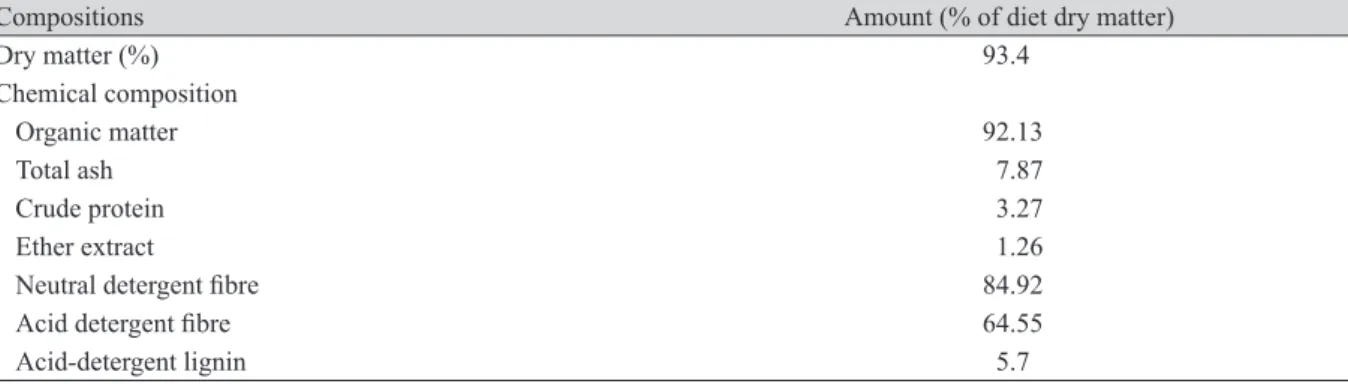
for further analysis. The wheat straw was analyzed for dry matter (DM), organic matter (OM), ash, crude protein (CP) and ether extract (EE), while neutral detergent fiber (NDF) and acid detergent fiber (ADF) were also determined as described by Van Soest et al. (1991) and mentioned in Table 1.

Collection of rumen liquor

Fistulated male buffalo, fitted with permanent rumen cannula, about 2 years-old having 250 kg body weight was used as donor animal for collection of rumen liquor. The animal was fed a basal diet of wheat straw offered and water was provided ad libitum and a standard concentrate mixture containing 20% CP and 70% TDN to meet the nutrient requirement for maintenance (AFRC, 1991). Animals were cared for according to the Council of Animal Care guidelines. Approximately 300 mL of rumen liquor was collected from different depths and directions of reticule rumen and transferred into pre heated thermos flask, strained through a fourfold muslin cloth and flushed with CO

2

. Rumen liquor was collected in the morning before feeding and watering of the animal as per standard procedure. Rumen fluid–medium mixture was prepared under continuous flushing with CO

2

to maintain anaerobic condition.

In vitro incubation of substrate and gas production

A total of 200 mg dry weight of each feed substrate was weighed into 100 mL calibrated syringes and incubated with 30 mL of mixed rumen inoculum at 39℃ for 24 h with parallel incubation of blanks (Menke et al., 1979; Menke and Steingass, 1988). Each substrate was incubated in triplicate. The syringes were regularly shaken by hand during the incubation period for proper mixing of feeds with rumen inoculum. After 24 h of incubation period, the gas production was recorded by the displacement of piston during incubation period for test substrate and blank syringes. The net gas produced due to fermentation of substrate was calculated by subtracting the value of gas produced in blank syringes from that of test substrates.

Table 1. The chemical composition of wheat straw.

Compositions Amount (% of diet dry matter)

Dry matter (%) 93.4

Chemical composition

Organic matter 92.13

Total ash 7.87

Crude protein 3.27

Ether extract 1.26

Neutral detergent fibre 84.92

Acid detergent fibre 64.55

Acid-detergent lignin 5.7

(4)

In vitro dry matter degradability (IVDMD)

After 24 h of incubation period, the content of the syringes was transferred to 500 mL spoutless beakers, which was extracted in 100 mL of neutral detergent solution (NDS) by boiling for one hour, followed by filtration on pre-weighed gooch crucibles (G

1

), and washing in hot distilled water and acetone to recover true undigested residue as per the method of Van Soest et al. (1991). Crucibles with undigested residue were dried at 100℃

overnight and weighed to determine true undigested residue. Residue was ashed at 500 ℃ for 3 h to determine true undigested OM, which was corrected for the appropriate blanks. At 24-h post inoculation, a set of samples was determined in vitro true digestibility of truly degradable dry matter (TDDM) and truly degradable organic matter (TDOM) according to Van Soest and Robertson (1985) as the difference between OM incubated and the undigested OM recovered in the residue of ND extraction. The microbial biomass production (MBP) and partitioning factor was calculated as per the method of Blummel et al. (1997).

MBP = Substrate truly degraded - (gas volume*stoichiometrical factor) (1) For roughages, the stoichiometrical factor was 2.20

Estimation of volatile fatty acid

After 24 h incubation 1 mL of the supernatant of each syringe content was taken in a micro centrifuge tube containing 0.20 mL metaphosphoric acid (25%, v/v) to analysis the total volatile fatty acids (TVFA), acetate, propionate and butyrate. The mixture was allowed to stand for 2 h at room temperature and centrifuged at 5,000

× g for 10 min to get clear supernatant. The supernatant (1 μL) was injected into gas chromatograph equipped with flame ionization detector and glass column packed with chromosorb as per the method described by Cottyn and Boucque (1968).

Statistical analysis

All data were statistically analysed by using Statistical Package for Social Sciences software package (SPSS version 20.0, IBM, Chicago, USA) following one-way analysis. All the observations were recorded at 95% (p <

0.05) level of significance.

Results and Discussion

The data pertaining to TDDM, TDOM, gas production, MBP and partitioning factor was statistically analysed, and the mean values are presented in Table 2. The data pertaining to VFA production are presented in Table 3. The TDDM value among dietary treatments varied between 36.23 (T

4

) and 40.45% (T

1

); and that of TDOM varied between 37.29 (T

4

) and 41.08% (T

1

). The TDDM and TDOM values in control group was higher (p <

0.05) than those of T

2

, T

3

, and T

4

. The TDDM and TDOM values in T

2

group was higher (p < 0.05) than those of

T

3

and T

4

. The TDDM and TDOM values in T

3

group was higher (p < 0.05) than that of T

4

. The results revealed

that inclusion of AFB 100 ppb in feed significantly decreased the DM and OM degradability compared to that

(5)

of control. The results further revealed that inclusion of AFB

1

to the feed showed that significant decrease in the DM and OM degradability. This result was in agreement with that of Mojtahedi et al. (2013) who also reported that IVDMD decreased significantly (p < 0.05) with inclusion of AFB

1

in culture medium, so that the lowest and the highest IVDMD values were observed in treatments with 900 and 0 ng/ml AFB

1

, respectively (0.54 vs. 0.68). They further reported that decreasing IVDMD with AFB

1

addition can be attributed to compromised ruminal function by reducing fibre digestion and volatile fatty acid production (Fehr and Delage, 1970; Helferich et al., 1986a; 1986b). Similarly, Westlake et al. (1989) reported that IVDMD of alfalfa hay was reduced by 50% with inclusion of 1 μg/mL AFB

1

. However, some studies reported no effect of AFB

1

on in vitro dry matter disappearance of hay (Pettersson and Kiessling, 1976; Jiang et al., 2012). Yeanpet et al. (2018) also reported that IVDMD and organic matter digestibility were not significantly affected by AFB

1

.

The gas production value in control group (T

1

) was higher (p < 0.05) than those of T

2

, T

3

, and T

4

. The gas production value in T

2

group was higher (p < 0.05) than those of T

3

and T

4

. The gas production value in T

3

group was higher (p < 0.05) than that of T

4

. The results indicated that addition of AFB

1

at 100 ppb level in wheat straw significantly decreased the gas production compared to that of control. The study also indicated that incorporation of aflatoxin to the feed at any level (100 to 300 ppb) resulted in significantly decreased gas production. The potential extent of gas production was significantly different among treatments (p < 0.05), of which the AFB

1

-containing diets was lower than the control group. This result was similar to previous studies (Jiang et al., 2012; Mojtahedi et al., 2013) where the asymptotic gas production numerically deceased by increasing AFB

1

dosage. Mojtahedi et al. (2013) reported that by increasing the level of AFB

1

from 0 to 900 ng/

mL, the gas production rate decreased from 0.071 to 0.051 and cumulative gas production decreased from 196.4 Table 2. Effect of aflatoxin B

1

(AFB

1

) on rumen fermentation parameters.

Treatments True digestibility of

dry matter % True digestibility of

organic matter % Gas Production (mL/g dry matter)

Microbial biomass production

(mg/100 mg) Partitioning factor

T

1

40.45 ± 0.09d 41.08 ± 0.08d 148.80 ± 0.17d 20.55 ± 0.17c 2.72 ± 0.01c

T

2

38.63 ± 0.21c 39.19 ± 0.17c 144.70 ± 0.23c 19.05 ± 0.24b 2.67 ± 0.01b T

3

37.75 ± 0.07b 38.33 ± 0.19b 142.41 ± 0.24b 18.55 ± 0.34ab 2.64 ± 0.01b T

4

36.23 ± 0.12a 37.29 ± 0.19a 140.59 ± 0.32a 17.57 ± 0.53a 2.57 ± 0.01a T

1

, basal diet; T

2

, basal diet + 100 ppb AFB

1

; T

3

, basal diet + 200 ppb AFB

1

; T

4

, basal diet + 300 ppb AFB

1

. a - d: Means in the same column with different superscript differ (p< 0.05). with different superscript differ (p < 0.05).

Table 3. Effect of aflatoxin B

1

(AFB

1

) on volatile fatty acids production.

Treatments Total volatile fatty acids

(mM/100 mL) Acetate

(mM/100 mL) Propionate

(mM/100 mL) Butyrate

(mM/100 mL) A : P ratio

T

1

6.10 ± 0.02d 4.36 ± 0.02d 1.24 ± 0.01d 0.49 ± 0.01d 3.52 ± 0.01a

T

2

5.80 ± 0.03c 4.24 ± 0.01c 1.13 ± 0.01c 0.42 ± 0.01c 3.72 ± 0.03b

T

3

5.32 ± 0.03b 3.92 ± 0.02b 1.00 ± 0.01b 0.39 ± 0.01b 3.90 ± 0.01c

T

4

5.12 ± 0.05a 3.78 ± 0.04a 0.96 ± 0.01a 0.37 ± 0.01a 3.90 ± 0.03c

T

1

, basal diet; T

2

, basal diet + 100 ppb AFB

1

; T

3

, basal diet + 200 ppb AFB

1

; T

4

, basal diet + 300 ppb AFB

1

; A : P, acetate : propionate.

a - d: Means in the same column with different superscript differ (p< 0.05). with different superscript differ (p < 0.05).

(6)

to 166.0 mL/g DM, respectively. Similarly, Jiang et al. (2012) and Helferich et al. (1986a; 1986b) also reported that the gas production parameters were reduced when AFB

1

was added. These depressions in the gas production suggest that microbial populations are altered by AFB

1

contamination. With regard to MBP, the value in control group (T

1

) was higher (p < 0.05) than those of T

2

, T

3

, and T

4

. The MBP value in T

2

group was higher (p < 0.05) than that of T

4

. The MBP value between T

2

and T

3

; and between T

3

and T

4

did not vary significantly. The results of present investigation revealed that inclusion of AFB

1

to the feed in significantly decreased the MBP than control.

The partitioning factor is defined as the ratio of substrate truly degraded in vitro (mg) to the volume of gas (mL) produced by it. A feed with higher partitioning factor means that proportionally more of the degraded matter is incorporated into microbial mass, i.e., the efficiency of microbial protein synthesis is higher. Roughages with higher partitioning factor have been shown to have higher dry matter intake (Harikrishna et al., 2012). The partitioning factor among various dietary treatments varied between 2.57 (T

4

) and 2.72 (T

1

). The partitioning factor value in control group (T

1

) was higher (p < 0.05) than others. The partitioning factor value in T

2

and T

3

groups was higher (p < 0.05) than that of T

4

. The partitioning factor value between T

2

and T

3

groups did not vary significantly. The results of present investigation revealed that inclusion of AFB

1

to the feed significantly decreased in the partitioning factor value compared to control.

The TVFA, acetate, propionate and butyrate value in control group (T

1

) was higher (p < 0.05) than those of T

2

, T

3

, and T

4

. The TVFA, acetate (A), propionate (P) and B value in T

2

group was higher (p < 0.05) than those of T

3

and T

4

. The TVFA, A, P, and B value in T

3

group was higher (p < 0.05) than that of T

4

. The acetate : propionate (A : P) ratio in control group (T

1

) was lower (p < 0.05) than those of T

2

, T

3

, and T

4

. The A : P ratio in T

2

was lower (p < 0.05) than those of T

3

and T

4

. The A : P value between T

3

and T

4

groups did not vary significantly.

The results revealed that inclusion of 100 ppb AFB

1

in feed significantly decreased the TVFA, A, P, and B production compared to control. The results further revealed that inclusion of aflatoxin to the feed at any level (100 to 300 ppb) resulted in significant decrease in TVFA, A, P, and B production. This finding of reduced VFA concentration was in agreement with Jiang et al. (2012) who also reported that the VFA concentration decreased with the increase of AFB

1

dose level. Cellulose degradation, VFA production, ammonia production, and proteolysis were decreased by AFB

1

at 0.2 - 0.8 mg/kg body weight in acute bovine aflatoxicosis (Cook et al., 1986). Also, the production of VFA irrespective of substrate was inhibited by the increasing dose levels of AFB

1

, which was consistent with the reduction in the asymptotic gas volume. The suppression of VFA, gas production and ammonia N implicated that microbial activity was inhibited regardless of substrate used. Contrary to this, Edrington et al. (1994) found no differences in ruminal VFA concentrations in growing lambs fed 2.5 mg AFB

1

per kg diet. Helferich et al. (1986a) also reported that AFB

1

at 60 - 600 ppb did not influence the production of

VFA in steers. In another experiment, ingestion of 0.714 µmol AFB

1

per animal did not influence the ruminal

VFA production in lactating goats (Helferich et al., 1986b). Although data from the literature are inconclusive.

(7)

Conclusion

It was concluded that AFB

1

contamination of feed (wheat straw) at 100 to 300 ppb levels significantly affected the in vitro rumen fermentation in terms of reduced truly degradable dry matter, truly degradable organic matter, gas production, microbial biomass production, partitioning factor, TVFA concentration and increased A : P ratio.

Conflict of interest

The authors declare that they have no conflicts of interest.

Acknowledgements

The authors BB, JK, and SP would like to extend their sincere appreciation to the National Research Foundation of South Korea for support through the Basic Research Project (Grant number: 2018R1C1B5086232) by Ministry of Education, Science, and Technology.

Authors Information

Ram Singh, https://orcid.org/0000-0002-8251-8625 Sungkwon Park, https://orcid.org/0000-0002-7684-9719 Jin Su Koo, https://orcid.org/0000-0002-7435-2194

Balamuralikrishnan Balasubramanian, https://orcid.org/0000-0001-6938-1495

References

AFRC (Agricultural and Food Research Council). 1991. Voluntary intake of cattle (Report 8). Nutrition Abstracts and Reviews 61:816-823.

Bhat R, Rai RV, Karim A. 2010. Mycotoxins in food and feed: present status and future concerns. Comprehensive Reviews in Food Science and Food Safety 9:57-81.

Blummel M, Makkar HPS, Becker K. 1997. In vitro gas production: A technique revisited. Journal of Animal Physiology and Animal Nutrition 77:24-34.

Cook WO, Richard JL, Osweiller GD, Trampel DW. 1986. Clinical and pathologic changes in acute bovine aflatoxicosis:

Rumen motility and tissue and fluid concentrations of aflatoxins B

1

and M

1

. American Journal of Veterinary Research 47:1817-1825.

Cottyn BG, Boucque CV. 1968. Rapid method for the gas chromatographic determination of volatile fatty acids in rumen fluid. Journal of Agricultural and Food Chemistry 16:105-107.

Eaton DL, Gallagher EP. 1994. Mechanisms of aflatoxin carcinogenesis. Annual Review of Pharmacology and Toxicology 34:135-172.

Edrington TS, Harvey RB, Kubena LF. 1994. Effect of aflatoxin in growing lambs fed ruminally degradable or escape protein sources. Journal of Animal Science 72:1274-1281.

Fehr PM, Delage J. 1970. Effect of aflatoxin on fermentation in the rumen. Comptes rendus de l'Académie des Sciences

Paris (Series D) 270:550-553.

(8)

Fink-Gremmels J. 2008. Mycotoxins in cattle feeds and carry-over to dairy milk. Food Additives and Contaminants 25:172-180.

Gallo A, Giuberti G, Frisvald JC, Bertuzzi T, Nielsen KF. 2015. Review on mycotoxin issues in ruminants: Occurrence in forages, effects of mycotoxin ingestion on health status and animal performance and practical strategies to counteract their negative effects. Toxins 7:3057-3111.

Groopman JD, Cain LG, Kensler TW, Harris CC. 1988. Aflatoxin exposure in human populations: Measurements and relationship to cancer. CRC Critical Review in Toxicology 19:113-145.

Harikrishna CH, Mahender M, Ramana Reddy Y, Gnana Prakash M, Sudhakar K, Pavani M. 2012. Evaluation of in vitro gas production and nutrient digestibility of complete diets supplemented with different levels of thermotolerant yeast in Nellore rams. Veterinary World 5:477-485.

Helferich WG, Baldwin RL, Hsieh DPH. 1986b. Aflatoxin B

1

metabolism in lactating goats and rats. Journal of Animal Science 62:697-705.

Helferich WG, Garrett WN, Hsieh DPH, Baldwin RL. 1986a. Feedlot performance and tissue residues of cattle consuming diets containing aflatoxins. Journal of Animal Science 62:691-696.

IARC (International Agency for Research on Cancer). 1993. IARC monographs on the evaluation of carcinogenic risks to humans. Vol. 56. Some naturally occurring substances: Food items and constitution, heterocyclic aromatic amines and mycotoxins. IARC, Geneva, Swiss.

Jiang YH, Yang HJ, Lund P. 2012. Effect of aflatoxin B

1

on in vitro ruminal fermentation of rations high in alfalfa hay or ryegrass hay. Animal Feed Science and Technology 175:85-89.

Menke KH, Raab L, Salewski A, Steingass H, Fritz D, Schneider W. 1979. The estimation of the digestibility and metabolizable energy content of ruminant feeding stuffs from the gas production when they are incubated with rumen liquor in vitro. Journal of Agricultural Science 93:217-222.

Menke KH, Steingass H. 1988. Estimation of the energetic feed value obtained from chemical analysis and gas production using rumen fluid. Animal Research Development 28:7-55.

Mojtahedi M, Danesh Mesgaran M, Vakili SA, Hayati-Ashtiani M. 2013. Effect of aflatoxin B

1

on in vitro rumen microbial fermentation responses using batch culture. Annual Review and Research in Biology 3:686-693.

Morgavi DP, Riley RT. 2007. An historical overview of field disease outbreaks known or suspected to be caused by consumption of feeds contaminated with Fusarium toxins. Animal Feed Science and Technology 137:201-212.

Pettersson H. 2004. Controlling mycotoxins in animal feed. In: Mycotoxins in food, detection and control (Magan N and Olsen M, eds.), pp. 262-304. Woodhead Publishing Limited, Cambridge, UK.

Pettersson H, Kiessling KH. 1976. Metabolism of aflatoxin by intact rumen fluid, rumen protozoa and rumen bacteria.

Swedish Journal of Agricultural Research 6:161.

Pulina G, Battacone G, Brambilla G, Cheli F, Danieli PP, Masoero F, Pietri A, Ronchi B. 2014. An update on the safety of foods of animal origin and feeds. Italian Journal of Animal Science 13:845-856.

Punia BS, Singh S. 2001. Buffalo calf feeding and management. Buffalo Bulletin 20:3-11.

Singh R, Shamsudeen P. 2008. Aflatoxigenic potential of Aspergillus parasiticus MTCC 411 and Aspergillus parasiticus NRRL 2999 under laboratory conditions. Indian Journal of Poultry Science 43:245-246.

Smith MC, Madec S, Coton E, Hymery N. 2016. Natural co-occurrence of mycotoxins in foods and feeds and their in vitro combined toxicological effects. Toxins 8:94.

Van Soest PJ, Robertson JB. 1985. Analysis of forages and fibrous foods. A laboratory manual for animal science.

Departmant of Animal Science, Cornell University, NY, USA.

Van Soest PJ, Robertson JB, Lewis BA. 1991. Methods for dietary fibre, neutral detergent fibre and non-starch polysaccharides in relation to animal nutrition. Journal of Dairy Science 74:3583-3597.

Westlake K, Mackie RI, Dutton MF. 1989. In vitro metabolism of mycotoxins by bacterial protozoal and ovine ruminal fluid preparations. Animal Feed Science and Technology 25:169-178.

Yeanpet C, Thamrongyoswittayakul C, Wachirapakorn C, Songsermsakul P, Somphon N, Wongnen C. 2018. Efficacy

of mycotoxin adsorbents on aflatoxin B

1

decontamination and in vitro rumen fermentation. Prawarun Agriculture

수치

Table 1. The chemical composition of wheat straw.
Table 3. Effect of aflatoxin B 1  (AFB 1 ) on volatile fatty acids production.

참조

관련 문서

1 John Owen, Justification by Faith Alone, in The Works of John Owen, ed. John Bolt, trans. Scott Clark, &#34;Do This and Live: Christ's Active Obedience as the

Fluorescent microscope image to evaluate wound healing in vitro in the scratch assay using a confluent monolayer of HaCaT keratinocytes... NSAIDs

Therefore, in discussing the motion of an electron of known energy or momentum about a nucleus, it is necessary to speak only in terms of the probability of finding that

A and E, In control group, a small amount of new bone was observed at the margin of bone defect (40×); B and F, In experimental group 1, a large amount of new bone was formed

It is considered that the research on the influence of The Book of Changes on tea culture and tea ceremony thought should be performed in various areas.. But, there

Among the sub-factors of autonomy support coaching behavior, strategy recognition had the most direct influence on the grit of athletes, followed by

For job characteristics sub-factors, while the average of functional diversity was high in graduate school graduates, the average of task importance, job

Second, as a result of the IPA analysis of the sub-factors of audience perception, the factors of entry route were located in the first quadrant, the