대구 대덕산 규장암체에서 산출되는 전기석에 대한 광물화학적 연구
Mineralogical and Geochemical Studies on Tourmaline in Felsite from the Daeduk Mountain, Daegu, South Korea
우 현 동(Hyeon Dong Woo)1⋅박 성 은(Seong Eun Park)2⋅장 윤 득(Yun Deuk Jang)2*⋅
김 정 진(Jung Jin Kim)3
1한국원자력안전기술원
(Korea Institute of Nuclear Safety, Daejeon, 305-338, Korea)
2경북대학교 지질학과
(Department of Geology, Kyungpook National University, 80 Daehakro, Bukgu, Daegu, Korea)
3안동대학교 지구환경과학과
(Department of Earth and Environmental Sciences, Andong National University, 1375 Kyeongdongro, Andong,, Korea)
요약 : 백악기 말기 불국사 관입암류에 해당하는 대구 대덕산 규장질 관입암체 내에서는 구형, 방사형 의 두 가지 형태의 전기석 결정이 발견된다. 이 연구에서는 두 가지 형태를 보이는 전기석의 광물화학 적인 특징과 더불어 결정화 환경이 형태적인 차이점에 끼친 영향에 대해 알아보았다. 두 전기석은 화 학적으로 모두 철전기석에 해당하며, 구형 전기석은 방사형 전기석에 비해 Al이 풍부하고 Ca, Na, K, Fe, Mn, Mg 등이 결핍되어 X 및 Y 사이트가 채워져 있지 않음을 알 수 있었다. 한편 확산규제결합 (DLA) 모델에 의하면 결정의 성장형태가 불규칙적일수록 마그마의 유동이 활발하다고 알려져 있다.
따라서 방사형 전기석이 비교적 유동적인 환경에서 결정화되었음을 알 수 있으며, 마그마의 분화에 따라 고철질 성분에 비해 규장질 성분이 농집되면서 마그마 환경이 안정되고 구형의 전기석을 만들어 내기에 적합한 환경이 조성되었을 것이라 판단된다.
주요어 : 규장암, 불국사 관입암류, 붕소규산염광물, 전기석, 확산규제결합
ABSTRACT : The felsitic intrusives of Bulguksa granitic rocks of late Cretaceous in age are located at Mt. Daeduk, Daegu, where two different types of tourmalines are found. Two tourmalines show rounded and radiating in morphology and are found in separated region, but in same felsitic rocks. In this study, we investigate the chemical differences between two types of tourmaline and the effect of growing condition of the crystal on the its morphology. The rounded tourmaline has more amounts of Al and vacancy and less amounts of Ca, Na, K, Fe, Mn, Mg, which commonly occupy X and Y-site of the tourmaline. On the basis of the Diffusion-limited aggregation model, morphological irregularity indicates the active mobility of the magma. The radiating tourmaline, therefore, crystallized with active magma condition relatively, and the rounded tourmaline crystallized with stable magma condition created
*Corresponding author: +82-53-950-5358, E-mail: [email protected]
by decreasing temperature and the concentration of felsic components as the magma differentiate continually.
Key words : Borosilicate, Bulguksa intrusive rocks, Diffusion-limited aggregation, Felsite, Tourmaline
서 언
전기석은 비교적 풍부한 붕소 규산염 광물이며 여러 단종들 사이에서 복잡 다양한 치환체를 지닌 다. 전기석의 화학 조성에 있어서의 광범위한 다양 성이 눈길을 끄는 것은 전기석이 화성암, 변성암 뿐 아니라 붕소 함유 유체 유입의 화학조성 진화에 대한 실마리를 지니고 있기 때문이다. 더군다나 전 기석은 같은 암석 내에서도 다른 양상을 띠며 나타 날 수 있는데 이는 평형 상태에서도 다른 화학 성 분의 유체들이 생겨날 수 있음을 지시한다. 전기석 이 지닌 이러한 지질학적인 의미로 인하여 과거로 부터 전기석의 형태, 조성, 조직 등에 대한 다양한 연구들이 진행되어 왔다(Slake et al., 1989; Kim
et al., 1992; Cashman 1993; Henry and Dutrow,
1996; Dutrow and Henry, 2000; Boyd, 2002;Choo, 2003; Torres-Ruiz et al., 2003; Faure et
al., 2003; Burianek and Novak, 2006;
Shao-Young et al., 2008).
대구 대덕산 규장암 관입 지역에서 구형 및 방 사형의 두 가지의 형태의 전기석이 관찰된다. 이 전기석의 형태가 지니는 지질학적인 의미에 비하 여 광물학적 특성과 형성 기원에 대한 해석은 수행 된 바 없다. 동일한 규장암체에서 다른 형태의 전 기석이 나타나는 것은 내부적으로는 압력 및 온도 변화에 마그마 성분 변화, 외부적으로는 열수 유 입, 혹은 그 밖의 구조 및 역학적 요인 등에 따른 결과로 해석할 수 있을 것이다. 본 연구에서는 두 가지 형태를 보이는 전기석의 광물화학적인 특징 을 통해 전기석의 결정화 환경의 차이를 알아보고 자 하였다. 이를 위하여 편광 및 전자현미분석, 광 물정량분석을 수행하였으며, 전기석의 성장형태가 지시하는 마그마 환경을 적용하여 대덕산 규장암 의 정치와 전기석의 정출 간의 관계를 고찰하였다.
지질개요
대구 남구부터 달서구 일대의 가장 자리를 이루 고 있는 대덕산(Fig. 1)은 백악기 말엽에 그 형태 가 갖추어졌다. 대덕산을 포함한 경상분지 내에 분
포하는 암석들은 대부분 중생대 백악기 1억 3,000 만 년에서 6,000만 년 전 사이에 형성되었으며, 육 수성 퇴적암과 일부 지역을 덮은 화산암 그리고 이 두 지역을 관입한 불국사 관입암체로 이루어져있 다(Min et al., 1982). 대덕산은 이 경상분지의 대 략 중앙에 위치하고 있기 때문에 이 지역의 지질 구성도 경상누층군의 중⋅상부에 해당되는 하양층 군, 유천층군, 그리고 불국사 관입암으로 구성되어 있다. 시가지가 주로 형성되어 있는 북부의 저지가 하양층군의 함안층, 진동층이고 남부산지는 주로 안산암으로 이루어진 유천층군과 이를 관입한 불 국사관입암군의 규장암으로 이루어져 있다. 현재 충적층이 하천 연변과 곡구에 형성되어 있다. 규장 암은 대구층, 유천층의 형성 후 맥상 관입을 하여 형성된 반심성암이며 현재 침식을 받아 남부산지 에 띠의 형태로 지표에 노출된 것이다. 따라서 이 규장암은 불국사 관입암류에 속한다. 이와 같이 앞 산을 최고봉으로 하는 남부산지는 안산암질암과 규장암 그리고 그 사이에 끼어서 열 접촉변질을 당 한 퇴적층으로 이루어져 있으며, 모두 침식에 강한 바위로 이루어져 높은 산지를 이루고 있다. 대덕산 산사면 가장자리를 기점으로 서쪽으로는 달성군에 위치하는 최항산 측부 가장자리까지, 일부는 월배 면, 성서면 및 남측의 화원면의 셰일층, 청용산의 화강반암층에 협재, 동쪽으로는 셰일층을 따라 최 외곽 동쪽 대덕산 중부의 용계동까지 이르고 그 위 를 충적층이 가로지르고 있다. 규장암이 분포하는 범위 내에서 떨어진 두 지점에서 각각 구형, 방사 형의 서로 다른 전기석이 산출되고 있다(Fig. 2).
구형의 전기석이 산출되는 은적사 인근에 비해 방 사상 전기석이 나타나는 서편 등산로 부근은 단층 의 규제를 받아 규장암 접촉면의 경사가 매우 불규 칙적이다.
연구방법
대구 대덕산 규장암 관입대의 야외 조사를 실시 하여 전기석을 포획하고 있는 규장암 시료를 채취 하였다. 암석학, 광물학 및 지화학적 분석을 위하 여 가장 대표적인 형태의 전기석을 포함한 규장암
Fig. 1. Schematic geological map of Studied area showing the location of Daeduk Mountain felsite and sampling sites (modified from Won et al ., 1971).
Fig. 2. Cut-planed hand specimens. (a) rounded tourmaline nodule; (b) radiating tourmaline nodule. In (a), the growth of aggregation of small disseminated particles heading towards the nucleus is well kept. In (b), disjointed particles around the nucleus is shown to prove the aggregation growth, that is Diffusion-Limited Aggregation (DLA) model.
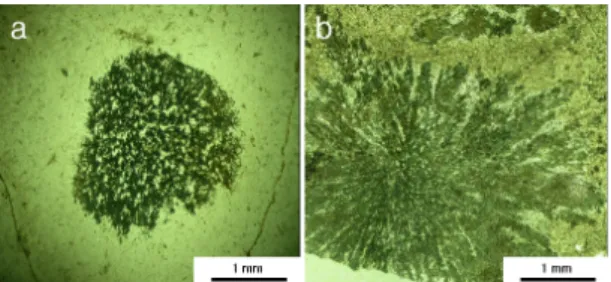
Fig. 3. Open-polarized microscopic views. (a) rounded tourmaline nodule; (b) radiating tourmaline nodule.
Both nodule shows white-haloes around them. There is the difference between (a) and (b); the rounded tourmaline nodule well keeps its white-halo luminescent as shown in the picture, while the radiating tourmaline nodule shows poorly apparent white-halo around its interface between the melt. Nodules show the simultaneous extinction of the different tourmaline segments (darkest areas in the figure).
Fig. 4. Back-scattered electron(BSE) images. (a) rounded tourmaline nodule; (b) radiating tourmaline nodule. In the BSE images above, the presence of lacunae filled by many microcrystals is well shown in the nodule framework.
시료 형태별 5개씩 총 10개를 선별하여 표준박편 으로 제작하였다. 편광 현미경을 이용하여 전기석 의 결정 광학적 특성을 관찰하였으며, 경북대학교 공동실험실습관의 EPMA (Shimadzu 1,600)를 이 용하여 BSE 사진촬영 및 광물정량분석을 실시하 였다. 분석은 빔 직경 1 µm, 가속전압은 15 kV 하 에서 수행되었다. ZAF correction으로 화학량을 계 산하였으며, Fe는 ferrous로 가정하였고, cation number는 29 산소에 맞추었다. B 성분의 측정이 제한되어 각 화학식 단위당 B 원자 3개를 가정하 여 B2O3의 weight %를 계산하였다. 또한, EPMA 에 탑재 된 WDS를 이용하여 광물의 정성 및 정량 을 분석 할 때에 다음에 나열 된 자연계 내지 실험 실 내에서 만들어진 표준시료들을 지정하여 사용 하였다.
결 과
전기석의 조직
대구 대덕산 규장암은 석영, 장석질로 유백색에 서 회백색이며 부수 광물로 붕소 규산염 광물인 전 기석을 취하고 있다. 이 규장암 내의 전기석은 구 형과 방사형의 두 가지 양상을 보인다. 박편 제작 을 위한 암석의 절단면 상에서 볼 때 구형의 전기 석 결정의 최장축 지름은 8 mm이나, 대부분은 2 mm - 4 mm 내외이다. 방사형의 전기석 결정 역
Sample no. 1 2 3 4 5 6 7 8 9 10 11 12 13 14 15 SiO
2 36.6 36.41 36.67 37.14 37.08 37.96 38.57 37.71 37.7 37.25 36.61 36.93 37.78 36.25 36.78TiO
2 0.42 0.68 0.45 0.21 0.58 0.2 0.66 0.3 0.19 0.33 0.5 0.4 0.41 0.35 0.24Al
2O
3 34.13 33.2 35.41 35.79 34.05 36.3 33.59 35.75 36.52 35.17 35.49 34.92 35.01 36.62 35.76FeO
12.88 11.88 11.02 9.28 10.86 9.73 10.33 9.53 9.56 10.14 10.13 10.3 9.47 10.09 10.96MgO
0.84 2.09 1.65 2.58 2.65 2.17 2.66 2.48 2.21 2.47 2.5 2.66 3.01 2.02 1.47CaO
0.18 0.42 0.28 0.2 0.26 0.25 0.23 0.25 0.33 0.25 0.53 0.36 0.2 0.54 0.36MnO
0.24 0.14 0.22 0.14 0.15 0.16 0.16 0.15 0.17 0.12 0.07 0.12 0.09 0.11 0.15Na
2O
1.41 1.58 1.43 1.58 1.55 1.6 1.64 1.62 1.5 1.64 1.62 1.52 1.6 1.59 1.33K
2O
0.02 0.02 0.02 0.02 0.02 0.03 0.03 0.02 0.02 0.03 0.03 0.02 0.02 0.02 0.01B
2O
3 9.38 10.5 10.4 10.3 10.11 9.95 10.25 10.21 10.3 10.06 10.49 10.59 10.76 10.68 10.41H
2O
2.85 3.3 3.01 3.01 2.82 2.83 2.95 2.88 2.92 2.87 2.86 2.96 2.98 2.94 2.9Total
98.96 100.21 100.55 100.24 100.14 101.18 101.06 100.9 101.4 100.33 100.82 100.77 101.33 101.21 100.38Cations calculated on the basis of 29 oxygen
B
2.56 2.8 2.76 2.72 2.7 2.61 2.7 2.69 2.69 2.67 2.77 2.8 2.81 2.81 2.77Si
5.8 5.63 5.64 5.68 5.74 5.78 5.88 5.74 5.71 5.73 5.6 5.65 5.72 5.52 5.67Al(T)
0.2 0.37 0.36 0.32 0.26 0.22 0.12 0.26 0.29 0.27 0.4 0.35 0.28 0.48 0.33Al(Z)
6 6 6 6 6 6 6 6 6 6 6 6 6 6 6Al(Y)
0.37 0.05 0.42 0.45 0.21 0.51 0.04 0.42 0.52 0.38 0.4 0.3 0.24 0.57 0.49Ti
0.05 0.08 0.05 0.02 0.07 0.02 0.08 0.03 0.02 0.04 0.06 0.05 0.05 0.04 0.03Fe
1.71 1.54 1.42 1.19 1.41 1.24 1.32 1.21 1.21 1.3 1.3 1.32 1.2 1.29 1.41Mg
0.2 0.48 0.38 0.59 0.61 0.49 0.6 0.56 0.5 0.57 0.57 0.61 0.68 0.46 0.34Mn
0.03 0.02 0.03 0.02 0.02 0.02 0.02 0.02 0.02 0.02 0.01 0.02 0.01 0.01 0.02Y(total)
2.36 2.17 2.3 2.27 2.32 2.29 2.06 2.25 2.28 2.3 2.34 2.28 2.18 2.37 2.29Ca
0.03 0.07 0.05 0.03 0.04 0.04 0.04 0.04 0.05 0.04 0.09 0.06 0.03 0.09 0.06Na
0.43 0.47 0.43 0.47 0.47 0.47 0.49 0.48 0.44 0.49 0.48 0.45 0.47 0.47 0.4K
0 0 0 0 0 0.01 0.01 0 0 0.01 0 0 0 0 0X(total)
0.47 0.55 0.47 0.51 0.51 0.52 0.53 0.52 0.5 0.54 0.57 0.51 0.5 0.56 0.46OH
- 3.01 3.41 3.09 3.07 2.91 2.87 3 2.93 2.95 2.95 2.92 3.02 3.01 2.99 2.98O
2- 25.99 25.59 25.91 25.93 26.09 26.13 26 26.07 26.05 26.05 26.08 25.98 25.99 26.01 26.02W(total)
29 29 29 29 29 29 29 29 29 29 29 29 29 29 29Fe/(Fe+Mg)
0.9 0.76 0.79 0.67 0.7 0.72 0.69 0.68 0.71 0.7 0.69 0.68 0.64 0.74 0.81Na/(Na+Ca)
0.93 0.87 0.9 0.93 0.91 0.92 0.93 0.92 0.89 0.92 0.85 0.88 0.94 0.84 0.87Table 1. Representative electron microprobe analysis of the rounded tourmaline nodules
Sample no. 16 17 18 19 20 21 22 23 24 25 26 27 28 29 30 SiO
2 37.49 37.5 36.65 36.15 36.9 37.42 37.61 37.85 65.53 35.64 38.83 36.85 35.93 37.56 36.26TiO
2 0.46 0.18 0.21 0.33 0.41 0.2 0.22 0.12 0.2 0.59 0.22 0.41 0.1 0.21 0.59Al
2O
3 34.72 35.13 36.53 35.83 35.63 36.83 35.17 35.24 20.79 36.01 33.99 35.62 37.07 34.27 35.6FeO
12.25 12.1 9.35 9.98 9.96 9.14 10.48 10.75 7.12 10.7 13.76 10.27 9.14 10.34 10.46MgO
1.29 0.76 2.12 2.29 2.4 2.41 2.29 1.88 1.28 1.82 1.93 2.16 1.83 2.72 1.77CaO
0.2 0.24 0.1 0.06 0.12 0.07 0.08 0.12 0.09 0.13 0.09 0.11 0.09 0.05 0.09MnO
0.19 0.18 0.31 0.47 0.42 0.33 0.22 0.09 0.15 0.45 0.18 0.3 0.39 0.16 0.48Na
2O
1.38 1.23 1.41 1.48 1.54 1.41 1.48 1.64 0.92 1.48 1.37 1.4 1.48 1.48 1.39K
2O
0.01 0.03 0.02 0.01 0.02 0.02 0.01 0.02 0 0.02 0.02 0.02 0.02 0.02 0.02B
2O
3 10.76 10.49 10.27 10.68 10.52 10.22 10.1 10.39 10.12 10.14 10.28 10.4 10.25 10.48 10.27H
2O
3.25 3.17 2.92 3.16 3.18 2.87 2.86 3.07 2.78 2.89 2.25 2.99 2.93 2.99 2.95Total
102 101 99.89 100.44 101.09 100.92 100.51 101.18 108.99 99.86 102.92 100.54 99.23 100.29 99.86Cations calculated on the basis of 29 oxygen
B
2.82 2.78 2.72 2.82 2.76 2.68 2.68 2.73 2.37 2.72 2.71 2.75 2.75 2.78 2.74Si
5.69 5.75 5.63 5.53 5.61 5.69 5.78 5.76 8.9 5.53 5.94 5.65 5.55 5.76 5.61Al(T)
0.31 0.25 0.37 0.47 0.39 0.31 0.22 0.24 -2.9 0.47 0.06 0.35 0.45 0.24 0.39Al(Z)
6 6 6 6 6 6 6 6 6 6 6 6 6 6 6Al(Y)
0.21 0.35 0.62 0.46 0.39 0.6 0.37 0.32 -2.67 0.59 0.13 0.44 0.75 0.2 0.49Ti
0.05 0.02 0.02 0.04 0.05 0.02 0.03 0.01 0.02 0.07 0.03 0.05 0.01 0.02 0.07Fe
1.56 1.55 1.2 1.28 1.27 1.16 1.35 1.37 0.81 1.39 1.76 1.32 1.18 1.33 1.35Mg
0.29 0.17 0.49 0.52 0.54 0.55 0.52 0.43 0.26 0.42 0.44 0.49 0.42 0.62 0.41Mn
0.03 0.03 0.01 0.01 0.02 0.01 0.01 0.02 0.01 0.02 0.01 0.01 0.01 0.01 0.01Y(total)
2.14 2.12 2.34 2.31 2.26 2.34 2.27 2.15 -1.57 2.48 2.37 2.31 2.38 2.18 2.33Ca
0.03 0.03 0.05 0.08 0.07 0.05 0.04 0.01 0.02 0.07 0.03 0.05 0.06 0.03 0.08Na
0.41 0.37 0.42 0.44 0.45 0.42 0.44 0.48 0.24 0.45 0.41 0.42 0.44 0.44 0.42K
0 0.01 0 0 0 0 0 0 0 0 0 0 0 0 0X(total)
0.44 0.4 0.48 0.52 0.53 0.47 0.48 0.5 0.27 0.52 0.44 0.47 0.51 0.47 0.5OH
- 3.29 3.24 2.99 3.23 3.23 2.91 2.93 3.12 2.52 2.99 2.3 3.06 3.06 3.06 3.05O
2- 25.71 25.76 26.01 25.77 25.77 26.09 26.07 25.88 26.48 26.01 26.7 25.94 25.94 25.94 25.95W(total)
29 29 29 29 29 29 29 29 29 29 29 29 29 29 29Fe/(Fe+Mg)
0.84 0.9 0.71 0.71 0.7 0.68 0.72 0.76 0.76 0.77 0.8 0.73 0.74 0.68 0.77Na/(Na+Ca)
0.93 0.93 0.89 0.85 0.87 0.89 0.92 0.97 0.92 0.86 0.93 0.89 0.87 0.94 0.84Table 1. (continued)
Sample no. 1 2 3 4 5 6 7 8 9 10 11 12 13 14 15 SiO
2 36.39 37.14 37.84 37.06 37.67 37.43 37.66 35.82 37.75 38.01 38.15 36.5 36.02 35.69 37.61TiO
2 0.32 0.08 0.18 0.48 0.37 0.16 0.08 0.85 0.11 0.08 0.26 0.16 0.13 0.15 0.78Al
2O
3 32.36 32.74 32.33 32.46 33.68 32.44 32.17 31.56 34.15 33 31.3 30.69 33.8 34 32.11FeO
12.39 12.92 12.65 12.47 11.21 12.71 13.04 11.95 11.65 12.48 11.23 13.85 11.61 12.63 12.24MgO
2.8 2.35 1.96 2.14 2.38 1.96 2.06 2.51 2.08 2 4.01 2.96 2.19 2.09 2.47CaO
0.17 0.15 0.25 0.28 0.21 0.24 0.14 0.07 0.15 0.18 0.16 0.08 0.18 0.17 0.22MnO
0 0.14 0.17 0.55 0.38 0.36 0.29 0.31 0.24 0.42 0.53 0.33 0.3 0.38 0.52Na
2O
2.03 2.14 1.93 1.77 1.69 1.88 2 2.38 1.71 1.82 2.15 2.53 1.77 1.8 1.86K
2O
0.06 0.04 0.05 0.04 0.02 0.06 0.05 0.76 0.03 0.04 0.04 0.05 0.04 0.04 0.03B
2O
3 10.29 10.1 10.39 10.12 10.14 10.28 10.4 10.25 10.48 10.48 10.48 10.2 10.35 10.62 10.74H
2O
3.07 2.87 3.07 2.78 2.89 2.96 2.99 2.93 3.14 2.99 3.1 3.08 3.13 3.14 3.23Total
99.89 100.67 100.81 100.15 100.64 100.48 100.87 99.37 101.51 101.49 101.41 100.41 99.5 100.7 101.81Cations calculated on the basis of 29 oxygen
B
2.77 2.71 2.77 2.73 2.7 2.75 2.78 2.78 2.76 2.77 2.76 2.75 2.78 2.84 2.83Si
5.67 5.77 5.84 5.79 5.81 5.81 5.82 5.62 5.75 5.83 5.83 5.7 5.61 5.52 5.74Al(T)
0.33 0.23 0.16 0.21 0.19 0.19 0.18 0.38 0.25 0.17 0.17 0.3 0.39 0.48 0.26Al(Z)
6 6 6 6 6 6 6 6 6 6 6 6 6 6 6Al(Y)
0 0 0 0 0 0 0 0 0.13 0 0 0 0.21 0.2 0Ti
0.04 0.01 0.02 0.06 0.04 0.02 0.01 0.1 0.01 0.01 0.03 0.02 0.02 0.02 0.09Fe
1.62 1.68 1.63 1.63 1.45 1.65 1.69 1.57 1.49 1.6 1.44 1.81 1.51 1.63 1.56Mg
0.65 0.54 0.45 0.5 0.55 0.45 0.47 0.59 0.47 0.46 0.91 0.69 0.51 0.48 0.56Mn
0.02 0.02 0.03 0.04 0.03 0.03 0.02 0.01 0.02 0.02 0.02 0.01 0.02 0.02 0.03Y(total)
2.33 2.25 2.14 2.22 2.06 2.15 2.19 2.27 2.12 2.09 2.4 2.53 2.27 2.35 2.24Ca
0 0.02 0.03 0.09 0.06 0.06 0.05 0.05 0.04 0.07 0.09 0.06 0.05 0.06 0.08Na
0.61 0.64 0.58 0.54 0.5 0.56 0.6 0.72 0.51 0.54 0.64 0.77 0.53 0.54 0.55K
0.01 0.01 0.01 0.01 0 0.01 0.01 0.15 0.01 0.01 0.01 0.01 0.01 0.01 0.01X(total)
0.62 0.67 0.62 0.64 0.57 0.64 0.66 0.93 0.55 0.62 0.73 0.83 0.59 0.61 0.64OH
- 3.19 2.97 3.16 2.9 2.97 3.07 3.08 3.07 3.19 3.06 3.16 3.21 3.25 3.24 3.29O
2- 25.81 26.03 25.84 26.1 26.03 25.93 25.92 25.93 25.81 25.94 25.84 25.79 25.75 25.76 25.71W(total)
29 29 29 29 29 29 29 29 29 29 29 29 29 29 29Fe/(Fe+Mg)
0.71 0.76 0.78 0.77 0.73 0.78 0.78 0.73 0.76 0.78 0.61 0.72 0.75 0.77 0.74Na/(Na+Ca)
1 0.97 0.95 0.85 0.89 0.9 0.93 0.93 0.93 0.89 0.88 0.93 0.91 0.9 0.87Table 2. Representative electron microprobe analysis of the radiating tourmaline nodules
Sample no. 16 17 18 19 20 21 22 23 24 25 26 27 28 29 30 SiO
2 36.67 34.76 35.48 36.15 36.15 35.89 33.95 36.76 34.6 35.31 35.31 35 34.77 35.61 34.89TiO
2 0.35 0.15 0.13 0.33 0.33 0.06 0.05 0.1 0.04 0.06 0.06 0.17 0.16 0.36 0.8Al
2O
3 33.36 34.35 30.84 32 32 31.14 34.09 31.95 34.28 32.99 32.99 29.62 34.99 30.16 33.27FeO
11.01 12.19 14.17 11.47 11.47 12.55 12.56 11.22 12.12 10.55 10.55 14.45 10.98 14.14 11.16MgO
3.41 2.02 2.86 3.69 3.69 3.41 1.68 4.08 1.7 4.07 4.07 3.01 2.12 3.11 2.95CaO
0.07 0.19 0.47 0.11 0.11 0.11 0.19 0.16 0.16 0.09 0.09 0.03 0.16 0.1 0.18MnO
0.45 0.52 0.21 0.49 0.49 0.23 0.39 0.48 0.2 0.49 0.49 0.54 0.33 0.47 0.35Na
2O
1.92 1.7 2.45 1.95 1.95 2.26 1.7 2.16 1.79 2.13 2.13 2.47 1.65 2.41 1.96K
2O
0.03 0.04 0.08 0.03 0.03 0.06 0.02 0.04 0.02 0.03 0.03 0.08 0.04 0.1 0.03B
2O
3 10.73 10.66 10.71 10.29 10.29 10.27 10.2 10.35 10.62 10.73 10.73 10.71 10.29 10.27 10.35H
2O
3.22 3.22 3.12 3.07 3.07 3.1 3.08 3.13 3.14 3.22 3.22 3.12 3.07 3.1 3.13Total
101.22 99.81 100.54 99.57 99.57 99.06 97.92 100.43 98.67 99.66 99.66 99.2 98.56 99.83 99.07Cations calculated on the basis of 29 oxygen
B
2.99 2.87 2.89 2.77 2.77 2.79 2.81 2.76 2.88 2.87 2.86 3.13 2.98 2.99 2.99Si
6 5.42 5.55 5.64 5.64 5.65 5.41 5.68 5.44 5.47 5.48 5.93 5.84 6 5.84Al(T)
0 0.58 0.45 0.36 0.36 0.35 0.59 0.32 0.56 0.53 0.52 0.07 0.16 0 0.16Al(Z)
6 6 6 6 6 6 6 6 6 6 6 6 6 6 6Al(Y)
0 0.31 0 0 0 0 0.41 0 0.36 0.02 0.04 0 0.93 0 0.57Ti
0.05 0.02 0.02 0.04 0.04 0.01 0.01 0.01 0 0.01 0.01 0.02 0.02 0.05 0.1Fe
1.99 1.59 1.85 1.5 1.5 1.65 1.67 1.45 1.59 1.37 1.37 2.05 1.54 1.99 1.56Mg
0.78 0.47 0.67 0.86 0.86 0.8 0.4 0.94 0.4 0.94 0.94 0.76 0.53 0.78 0.74Mn
0.01 0.03 0.06 0.01 0.01 0.01 0.03 0.02 0.02 0.01 0.01 0 0.02 0.01 0.02Y(total)
2.83 2.41 2.6 2.41 2.41 2.47 2.52 2.42 2.37 2.35 2.37 2.84 3.04 2.83 2.99Ca
0.09 0.09 0.04 0.08 0.08 0.04 0.07 0.08 0.03 0.08 0.08 0.1 0.06 0.09 0.06Na
0.79 0.51 0.74 0.59 0.59 0.69 0.53 0.65 0.55 0.64 0.64 0.81 0.54 0.79 0.64K
0.02 0.01 0.02 0.01 0.01 0.01 0 0.01 0 0.01 0.01 0.02 0.01 0.02 0.01X(total)
0.9 0.61 0.8 0.68 0.68 0.74 0.6 0.73 0.59 0.73 0.73 0.93 0.61 0.9 0.71OH
- 3.49 3.35 3.26 3.2 3.2 3.26 3.28 3.23 3.3 3.33 3.26 3.53 3.44 3.49 3.5O
2- 25.51 25.65 25.74 25.8 25.8 25.74 25.72 25.77 25.7 25.67 25.74 25.47 25.56 25.51 25.5W(total)
29 29 29 29 29 29 29 29 29 29 29 29 29 29 29Fe/(Fe+Mg)
0.64 0.77 0.74 0.64 0.64 0.67 0.81 0.61 0.8 0.59 0.59 0.73 0.74 0.72 0.68Na/(Na+Ca)
0.89 0.85 0.95 0.88 0.88 0.95 0.89 0.89 0.94 0.89 0.89 0.89 0.9 0.9 0.91Table 2. (continued)
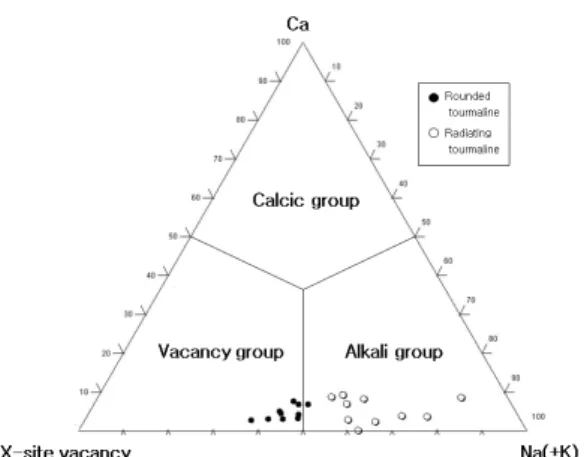
Fig. 5. Classification of the principal tourmaline groups based on the X-site occupancy (after Hawthorne and Henry, 1999). The radiating nodule is more alkalic than the rounded nodule. This suggests the magma evolution to separate the growth zones for rounded and radiating.
Fig. 6. Na
2O-MgO-FeO diagram (after Cavaretta and Puzedda, 1990). The studied tourmaline is perfectly classified into schorl series which has high Fe contents.
시 최장축 지름은 10 mm이고, 대부분 범위는 최 소 1 mm 이상이다. 암석 표품에서 흑녹색을, 편광 현미경 하에서 관찰한 박편 상의 전기석의 색은 흑 녹색에서 흑색이 이르는 색 범위를 지니며 이는 전 기석의 단종 중 철전기석(shorl)의 특징에 해당한 다(Fig. 3).
구형 결정의 경우 큰 결정을 중심으로 작은 결 정들이 주변에 미립으로 산재하여 있는 특징을 보 이며 방사형 결정은 한 점을 중심으로 비교적 치밀 하게 뻗어나가며 자란 형태를 보인다. 두 가지 형 태의 전기석들은 편광 현미경 아래에서 관찰했을 때에 결정 중간에 빈 공간이 있음을 확인할 수 있 으며 이 빈 공간들은 주로 모암에서 기원한 석영이 나 정장석 등으로 채워져 있다. BSE 이미지에서 두 가지 형태의 전기석 모두 누대구조를 보이지 않 았으며 한 결정 내에서는 성분의 변화가 뚜렷하지 않았다(Fig 4).
전기석 광물화학
전기석의 기본 화학식은 XY3Z6(T6O18)(BO3)3V3
W이다. X 사이트에는 Na, Ca, K가, Y 사이트에 는 Fe2+, Mg, Mn2+, Li, Al, Cr3+, V3+, Fe3+, (Ti4+) 가 들어가고(Hawthorne et al., 1993; Taylor et
al., 1995), Z 사이트에는 Mg, Al, Fe
3+, V3+, Cr3+, T 사이트에는 Si, Al, (B)가 채워진다(Hawthorneet al., 1993; Tagg et al., 1999). 또한 B는 채워지
거나 비어 있고, V 사이트에는 OH, O, W 사이트 에는 OH, F, O가 채워진다. 따라서 전기석은 어떠 한 양이온이나 음이온이 어느 자리에 채워지느냐, 혹은 비어있느냐에 따라서 다양하게 분류되는 광 물군이다. 대덕산에서 관찰되는 구형 및 방사형 전 기석을 과학적으로 분류하고 생성환경을 추론하기 위하여 광물 정량분석을 수행하였다(Tables 1, 2).대덕산 규장암체 내의 전기석에서 주로 나타나는 원소는 B, Na, Mg, Si, Al, Fe이고 부수적으로는 Ca, Mn, K, Ti가 분석된다. 본 분석을 통해 X 사 이트에 Ca, Na, K, Y 사이트에 Ti, Fe, Mg, Mn, Z 사이트에 Si, Al이 채워져 있음을 확인할 수 있 다(Hawthorne and Henry, 1999). 광물정량분석값 들 중 각 원소 조성의 최소치와 최대치의 평균을 계산한 결과, 이 전기석은 X 사이트 및 Al 성분도 (Fig. 5)에서는 공극그룹(Vacancy group), 화학 조 성별 단종들 중에서는 철전기석에 해당되며 이는 박편 상에서 관찰한 광물학적 결론과 일치한다
(Fig. 6).
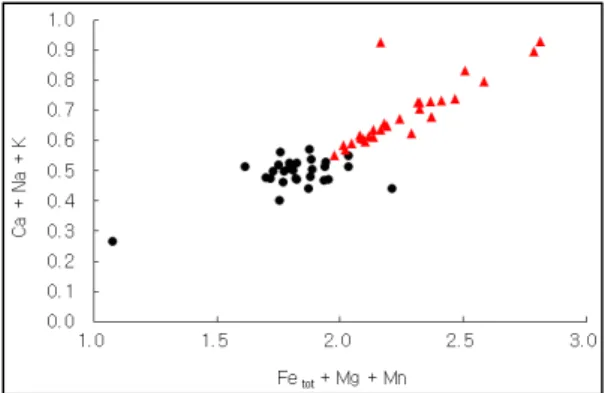
한편 구형 및 방사형 전기석의 대조에서, 구형 전기석은 방사형 전기석에 비해 X 사이트에 채워 지는 Ca, Na, K 등의 알칼리 성분과 주로 Y 사이 트에 채워지는 Fe, Mg, Mn 등의 고철질 성분이 모두 결핍되어있음을 알 수 있다. 즉 구형 전기석 은 방사형 전기석에 비해 Al 함량이 높고 결정구 조상의 빈공간이 매우 우세하였다(Fig. 7).
Fig. 7. Fe
tot+Mg+Mn vs Ca+Na+K plot for the compositional variation between the rounded (circular symbols) and radiating (triangular symbols) tourmaline nodule (after Power, 1968).
토 의
앞서 언급한 바와 같이 대덕산 규장암 관입체 내에서 산출되는 구형 및 방사형 전기석은 동일한 철전기석에 속하지만 성분에서 다소 차이를 보인 다. 유사한 조성을 가지는 동일암체 내에 속한 동 종의 광물의 화학조성이 서로 다른 것은, 두 전기 석의 결정화 시기 혹은 환경이 달랐음을 의미한다.
마그마의 환경과 결정의 성장 간의 관계에 대한 연구는 과거로부터 활발하게 진행되고 있다 (Benard et al., 1985; Cashman, 1993; Aref and El Naschie, 1995; Ferrachat and Ricard, 1998;
Faure et al., 2003). 특히 Witten and Sander (1981; 1983)와 Ferreira (1994)는 광물성장에 필요 한 성분들의 확산 정도가 결정화에 기여한다는 DLA (Diffusion-Limited Aggregation) 성장모델을 제시하였으며 Flinder and Clements (1996), Perugini et al. (2002; 2003)는 광물결정이 성장하 는 유체의 환경을 AMR (Active Mixing Regions) 과 CR (Coherent Regions)의 두 가지 타입으로 분 류하였다. AMR은 유체의 활발한 유동이 일어나서 불규칙한 형태의 결정성장이 우세한 지역을, CR은 유체의 유동이 적고 결정성장에 필요한 성분들의 확산이 미약하여 규칙적인 형태의 결정성장이 우 세한 지역을 의미한다.
따라서 비교적 불규칙도가 낮은 구형 전기석이 불규칙도가 높은 방사형 전기석에 비해 유동이 적 은 안정된 마그마 환경에서 결정화되었음을 짐작 할 수 있다(Vicsek, 1985). 다시 말해, 구형 전기석
은 마그마의 유동이 적은 환경에서 성장하면서 결 정화에 필요한 물질들을 충분히 공급받지 못하여 결핍된 성분을 가지고 구형으로 자라났고, 방사형 전기석은 마그마의 유동이 활발한 환경에서 충분 한 물질들을 공급받으며 불규칙한 형태로 빠르게 자라났을 것이다. 두 가지 형태의 전기석의 화학조 성과 성장형태의 차이점을 고려하여 다음과 같은 과거 마그마 환경을 유추할 수 있다. 최초에 비교 적 온도가 높고 고철질 성분의 함량이 높은 마그마 가 관입을 시작한다. 이 마그마는 온도와 성분에 의해 낮은 점성을 지니며 관입운동과 낮은 점성의 영향으로 활발하게 유동하고 이 과정에서 방사형 전기석이 결정화하였을 것이다. 관입 이후 분화를 통해 점차 규장질 성분이 농집되고 온도가 낮아지 면서 점성이 증가한다. 비교적 높은 점성과 관입이 완료되며 조성된 안정한 환경이 구형의 전기석이 결정화되는 데에 적합하였을 것이다.
하지만 대덕산 규장암체에서 발견되는 두 가지 타입의 전기석은 단일 결정 보다는 작은 결정들의 집합체로 관찰된다(Figs. 2, 3, 4). 비록 전기석 집 합체의 차원에서 구형 및 방사형 형태를 보이고 있 지만 이러한 전체적인 특징이 개개 입자의 성장경 향에서도 동일하게 나타날지는 알 수 없다. 특히 구형 광물결정은 방사형 결정과 유사한 환경 하에 서 수많은 수지상(dendritic) 결정이 모여 만들어질 수도 있다(Oh et al., 2004). 또한 마그마의 성분 자체만으로도 광물 결정화 환경의 안정도에 영향 을 끼친다는 사실은 이미 알려져 있으며(Morgan and London, 1989; London, 1999; Perugini et al., 2004; Perugini and Poli, 2005;) AMR 및 CR 환 경의 조성은 앞서 언급한 온도와 성분 외의 다른 인자들에 의해서도 제어될 가능성이 있다. 따라서 전기석의 결정형태에 대한 미세조직 연구와 더불 어 규장암체와 대덕산 전반에 걸친 다방면의 고찰 이 뒷받침된다면 더 나은 해석이 이루어질 수 있을 것이다.
결 론
대구 대덕산 규장암 관입암체에서 산출되는 전 기석은 은적사 및 서편등산로의 약 4 km 이격된 두 지점에서 각각 구형 및 방사형 결정으로 나타난 다. 또한 광물화학조성에서도 구형의 전기석에 비 해 방사형 전기석이 Al이 결핍되고 Ca, Na, K, Fe, Mg, Mn 성분이 농집된 경향을 뚜렷하게 보인다.
이처럼 지점 간의 거리는 짧으나 동일 암체 내 동 종의 광물이 형태 및 화학조성에서 차이를 보이는 것은 결정화 시기 및 환경이 상이하였음을 의미한 다. 전기석의 형태에 DLA 모델을 적용하고 광물 화학조성을 서로 비교한 결과, AMR 및 CR 환경 은 마그마의 조성 및 관입운동에 의해 규제되었으 며 따라서 대덕산 규장암체의 관입 초기에 방사형 전기석이 결정화한 뒤 관입이 완료되면서 구형의 전기석이 정출되었음을 도출하였다. 차후 대덕산 인근의 과거 지구조 운동 및 규장암체의 관입방향 등의 연구가 뒷받침된다면 전기석의 형태의 기원 즉, 성장환경의 해석에 더 가까이 다가설 수 있을 것이라 생각된다.
사 사
붕소규산염 광물에 대한 고견을 주신 추창오 박사님께 깊은 감사를 표한다. 또한 바쁜 시간을 내어 분석에 도 움을 준 권석범 학형에게 진심어린 감사를 전한다.
참고문헌
Aref, H. and El Naschie, M.S. (1995) Chaos applied to fluid mixing, Pergamon Press. Reprinted from Chaos, Solutions and Fractals, 4(6), 377.
Benard, F., Moutou, P., and Pichavant, M. (1985) Phase relations of tourmaline leucogranites and the significance of tourmaline in silicic magmas. J.
Geol., 93, 271-291.
Boyd, R.J. (2002) The partioning behaviour of boron from tourmaline during ashing of coal. International Journal of Coal Geology, 53, 43-54.
Burianek, D. and Novak, M. (2006) Compositional evolution and substitutions in disseminated and nod- ular tourmaline from leucocratic granites: Example from the Bohemian Massif. Czech Republic, Lithos., 1-17.
Cashman, K.V. (1993) Relationship between crystal- lization and cooling rate: insight from textural stud- ies of dikes. Contrib. Mineral. Petrol., 113, 126-142.
Cavaretta, G. and Puzedda, M. (1990) Schorl-dra- vite-ferridravite tourmalines deposited by hydro- thermal magmatic fluids during early evolution of the Larderello geothermal field. Italy, Econ. Geol., 85, 1236-1251.
Choo, C.O. (2003) Mineralogical studies on complex zoned tourmaline in diaspore nodules from the Milyang clay deposit. Korea. Geosciences Journal,
7-2, 151-156.
Dutrow, B.L. and Henry, D.J. (2000) Complexly zoned fibrous tourmaline, Cruzeiro mine, Minas Gerais Brazil: A record of evolving of magmatic and hy- drothermal fluids. Can. Mineral., 38, 131-143.
Faure F., Trolliard G., Nicollet C., and Montel J.M.
(2003) A developmental model of olivine morphol- ogy as a function of the cooling rate and the degree of undercooling. Contrib. Mineral. Petrol., 145, 251-263.
Ferrachat, S. and Ricard, Y. (1998) Regular vs. chaotic mantle mixing. Earth Planet Sci. Lett., 155, 75-86.
Ferreira S.C. (1994) Effects of the screening break- down in the diffusion-limited aggregation model.
Eur. Phys. J. B., 42, 263-269.
Flinders, J. and Clemens, J.D. (1996) Non-linear dy- namics, chaos, complexity and enclaves in granitoid magmas. Trans. R. Soc. Edinburgh Earth Sci., 87, 225-232.
Hawthorne, F.C. and Henry, D.J. (1999) Classification of the minerals of the tourmaline group. Eur. J.
Mineral., 11, 201-215.
Hawthorne, F.C., MacDonald, D.J., and Burns, P.C.
( 1993) Al/Mg disorder in the crystal structure of dravite. American Mineralogist, 78, 265-270.
Henry, D.J., and Dutrow, B.L. (1996) Metamorphic tourmaline and its petrologicapplications. Rev.
Mineral., 33, 500-555.
Kim, S.J., Kim, J.J., and Choo, C.O. (1992) Mineralogy and genesis of hydrothermal deposits in the south- eastern part of Korean peninsula: (3) Milyang nap- seok deposit. Jour. Mineral. Soc. Korea, 5, 93-101.
London, D. (1999) Stability of tourmaline in per- aluminous granite systems: the boroncycle from ana- texis to hydrothermal aureoles. Eur. Jour. Mineral., 11, 253-262.
Min, K.D., Kim, O.J., Lee, D.S., and Choo, S.H.
(1982) Applicability of plate tectonics to the post Late Cretaceous igneous activitied and mineraliza- tion in Southern part of South Korea(1). Jour. Korea Inst. Mining. Geol., 15, 123-154.
Morgan, G.B. and London, D. (1989) Experimental re- actions of amphibolite with boron-bearing aqueous fluids at 200 MPa: Implications for tourmaline sta- bility and partial melting in mafic rocks. Contrib.
Mineral. Petrol., 102, 281-297.
Oh, C.W., Kim, S.W., Hwang, S.K., Son, C.W., Kim, C.S., and Kim, H.S. (2004) The Study on the Spherulitic Rhyolites in the northern part of Juwang Mt., Cheongsong. Journal of Petrological Society of
Korea, 13, 103-118.
Perugini, D. and Poli, G. (2005) Viscous fingering during replenishment of felsic magma chambers by continuous inputs of mafic magmas: field evidence and fluid-mechanics experiments. Geology, 33, 5-8 Perugini, D., Poli, G., and Gatta, G. (2002) Analysis
and simulation of magma mixing processes in 3D.
Lithos., 65, 313-330.
Perugini, D., Poli, G., and Mazzuoli, R. (2003) Chaotic advection, fractals and diffusion during mixing of magmas: evidence from lava flows. J. Volcanol.
Geoth. Res., 124, 255-279.
Perugini, D., Ventura, G., Petrelli, M., and Poli, G. ( 2004) Kinematic significance of morphological structures generated by mixing of magmas: a case study from Salina Island (Southern Italy). Earth Planet Sci. Lett., 222, 1051-1066.
Power, G.M. (1968) Chemical variation in tourmalines from southwest England. Mineral. Mag., 36, 1078-1089.
Shao-Young, J., Martin, R., Eizo, N., Martin, P., Katsura, K., Hai-Xiang Z., and Kui-Dong, Z. (2008) Chemical and boron isotopic variations of tourma- line in the Hnilec ranite-related hydrothermal sys- tem, Slovakia: Constrainsts on magmatic and meta- morphic fluid evolution. Lithos., 11-21.
Slack, J.F., Palmer, M.R., and Stevens, B.P.J. (1989) Boron isotope evidence for the involvement of non-marine evaporites in the origin of the Broken
Hill ore deposits. Nature, 342, 913-916.
Tagg, S.L., Cho, H., Dyar, M.D., and Grew, E.S.
(1999) Tetrahedral boron in naturally occurring tourmaline. American Mineralogist, 84, 1451-1455.
Taylor, M.C., Cooper, M.A., and Hawthorne, F.C.
(1995) Local charge-compensation in hydrox- yl-deficient uvite. Can. Mineral., 33, 1215-1221.
Torres-Ruiz, J., Pesquera, A., Gil-Crespo, P.P., and Velilla, N. (2003) Origin and petrogenetic im- plications of tourmaline-rich rocks in the Sierra Nevada, Betic Cordillera, southeastern Spain.
Chemical Geology, 197, 55-86.
Vicsek, T. (1985) Formation of solidification patterns in aggregation models, Phys. Rev. A, 32, 3084-3089.
Witten, T.A. and Sander L.M. (1981) Diffusion-limited aggregation, a kinetic critical phenomenon. Phys.
Rev. Lett., 47, 1400-1403.
Witten, T.A. and Sander, L.M. (1983) Diffusion-lim- ited aggregation. Phys. Rev., B27, 5686-5697.
Won, J.K., Koh, J.B., and Hong, S.H. (1971) Geological map of Korea, Kyeongsan sheet (1:50,000). Korea Institute of Geoscience and Mineral Resources.
접수일(2014년 6월 4일), 수정일(1차 : 2014년 6월 19일), 게재확정일(2014년 6월 24일), 책임편집위원 : 서정훈