이중버블시트의 포설 시공조건 변화에 따른 한중 콘크리트의 단열보온 성능 분석
Analysis on the Heat Insulation Performance of Cold Weather Concrete according to Change of Laid Construction Conditions
of Double Bubble Sheets
한 천 구 한 민 철* 백 대 현
Han, Cheon-Goo Han, Min-Cheol* Baek, Dae-Hyun
Department of Architectural Engineering, Cheong-ju University, Naedoekdong, Cheongju-si, 360-170, Korea
Abstract
The present research examined heat insulation performance according to change of various laid construction conditions of double bubble sheet being used as material for heat insulation & curing construction of cold weather concrete, and its results are as follows. First, the change in a laid period of bubble sheet within 4 hours and the change in water content inside bubble sheet overall showed similar temperature history and maturity without a big difference in terms of the temperature history of concrete according to construction factors, but it could be confirmed that when a structure was thin or several bubble sheets are laid, requisites unfavorable for initial curing of concrete can occur if a lagger distance between sheets is generated. In terms of the compressive strength of concrete core specimens, it appeared that the initial compressive strength is declined when conditions unfavorable for concrete curing such as delay of a laid period of bubble sheets, induction of large distance between sheets, increase of water content inside bubble sheets and thinness of a structure of placing concrete, etc. were applied, but it appeared that as its age passes, the difference becomes small.
Keywords : Cold weather Concrete, Double layer Bubble Sheet, Temperature History
1. 서 론
1)최근 도심지에서 건설되는 건축물의 경우는 고층화 및 대형 화로 말미암아 건설공기의 중요성이 강조됨에 따라 연중시공 과 관련한 한중콘크리트의 필요성이 중요하게 부각되고 있 다.[1]
그런데, 우리나라의 한중환경 기온조건은 기상청 통계자 료[2]에 의하면 서울지방을 중심으로 한 중부지방의 경우
Received : August 31, 2010
Revision received : September 29, 2010 Accepted : October 6, 2010
* Corresponding author : Han, Min-Cheol [Tel: 82-43-229-8484, E-mail: [email protected]]
ⓒ2010 The Korea Institute of Building Construction, All rights reserved.
일평균 최저기온이 -5℃ 전후로서 콘크리트의 동결온도가 -1.5℃인 점을 감안할 때 콘크리트가 동결하지 않도록 하 는 최소한의 보온대책만으로도 한중시공이 가능할 수 있 다.[3]
이와 관련하여 본 연구팀에서는 한중콘크리트의 경제적 보 온 양생을 위한 단열보온 양생 공법으로 Figure 1과 같이 폴 리에틸렌 재질의 에어캡 2매를 중간막과 함께 겹쳐서 융착시 킨 2중 공기포를 가진 단열재(이하 이중 버블시트라 칭함)를 개발하여 현재 많은 건설공사 현장에서 한중콘크리트용 단 열보온 양생재로 활용하고 있다.[4,5] 그러나, 일부 현장 관계자들은 이중버블시트를 이용한 한중콘크리트 양생 시 시트의 포설시기, 방법 등 시공조건에 따른 콘크리트의 양 생효과에 대해 더욱 상세한 정보를 제시하여 줄 것을 제시 하고 있다.
Analysis on the Heat Insulation Performance of Cold Weather Concrete according to Change of Laid Construction Conditions of Double Bubble Sheets
Air (Prevention of thermal transfer)
PE film (Prevention of heat convection)
Heat of hydration (Hydration of cement)
Figure 1. A cross section of the structure using bubble sheet
따라서, 본 연구에서는 이중버블시트를 이용한 한중 콘크리 트의 양생공법 중 시트의 포설시기·방법, 시트내 수분함수율 및 구조체 두께 등 실제 현장에서 발생할 수 있는 버블시트의 시공조건에 따라 콘크리트의 온도이력과 강도 특성을 분석함 으로서 이중버블시트를 이용하는 단열보온 양생공법의 활용자 료로 제시하고자 한다.
2. 실험계획 및 방법
2.1 실험계획
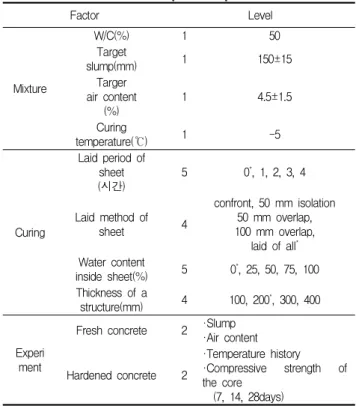
본 연구의 실험계획은 Table 1과 같고, 배합사항은 Table 2와 같다.
Table 1. Experiment plan
Factor Level
Mixture
W/C(%) 1 50
Target
slump(mm) 1 150±15
Targer air content
(%) 1 4.5±1.5
Curing
temperature(℃) 1 -5
Curing
Laid period of sheet
(시간) 5 0*, 1, 2, 3, 4
Laid method of
sheet 4
confront, 50 mm isolation 50 mm overlap, 100 mm overlap,
laid of all* Water content
inside sheet(%) 5 0*, 25, 50, 75, 100 Thickness of a
structure(mm) 4 100, 200*, 300, 400
Experi ment
Fresh concrete 2 ·Slump·Air content
Hardened concrete 2
·Temperature history
·Compressive strength of the core
(7, 14, 28days)
* Applied to an experiment basically.
Table 2. Mixture proportion of concrete W/C(%) W
(kg/m3) S/a
(%) AE
×C(%) SP
×C(%)
Unit weight(kg/m3)
W C S G
50 182 47 0.012 0.65 182 364 797 908
먼저 실험요인으로 W/C는 50 % 1수준에 대하여, 목표 슬 럼프 150±15 mm, 목표 공기량 4.5±1.5 %를 만족하도록 배합설계 하였다.
버블시트의 포설 시공조건 변화에 따른 콘크리트의 단열보 온성능을 확인하기 위하여 시트 포설시기의 경우, 콘크리트 타 설 후 0, 1, 2, 3, 4시간 경과후에 버블시트 양생을 실시하는 것으로 계획하였고, 포설방법의 경우 두장의 버블시트를 50 mm 격리, 맞댐, 50 mm 및 100 mm 겹침하는 방법으로 계 획하였다. 또한 버블시트내의 공간으로 블리딩수, 우수 등 수 분이 침투하는 경우를 가정하여 시트내 수분 함수율을 0, 25, 50, 100 %로 계획하였으며, 구조체 두께에 따른 버블시트의 단열보온 성능을 검토하고자 구조체 두께를 100, 200, 300, 400 mm로 계획하여 실험을 실시하였다.
이때, 콘크리트의 양생온도는 서울지방 기상청 자료를 토대 로 겨울철 일평균 최저기온인 -5℃를 산정하였다.
실험사항으로는 굳지않은 콘크리트에서는 슬럼프, 공기량을 측정하고 경화 콘크리트에서는 온도이력과 계획된 재령에서 코어 공시체를 채취하여 압축강도를 측정하는 것으로 하였다.
2.2 실험방법
본 연구의 실험방법으로 굳지않은 콘크리트와 경화 콘크리 트의 실험은 모두 KS에 의거하여 실시하였고, 콘크리트 내부 온도이력의 경우는 Figure 2와 같이 연속된 슬래브로 가정한 시험체(300×300×200 mm)를 제작하고, 측면은 슬래브의 연속성을 고려하여 T=100 mm인 스티로품으로 밀봉하였다.
Thermocouple Unit(mm) Styrofoam
Thermocouple
(a) Floor plan (b) Elevation
Figure 2. Composition of specimen
(a) Manufacture of specimen (b) Placing of concrete
(c) Curing (d) Thermometry
Figure 3. Manufacture and curing of specimen
콘크리트의 내부 온도는 수화온도 측정용 열전대를 미리 매 립한 후 온도 이력계를 이용하여 계획된 기간동안 온도를 측 정하였다.
양생은 타설 후 7일간은 -5℃에서, 그 이후는 20℃ 기중에 서 양생하였고, 코아측정은 7, 14, 28일 재령에서 코어를 채 취한 다음 KS F 2405에 의거 압축강도를 구하였다.
2.3 사용재료
본 실험에 사용한 시멘트는 국내산 보통 포틀랜드 시멘트 (밀도 : 3.15 g/cm3, 분말도 : 3 303 cm2/g)를 사용하였고, 잔골재 및 굵은골재는 충북 청원군 옥산산 강모래(밀도 : 2.60 g/cm3)와 20 mm 부순 굵은골재(밀도 : 2.66 g/cm3)를 사용하였다. 혼화제로 감수제는 나프탈렌계, AE제는 음이온계 를 사용하였다.
또한, 콘크리트의 단열보온양생을 위한 양생재로는 시판중 인 이중버블시트를 이용하였다.
3. 실험결과 및 분석
3.1 굳지않은 콘크리트 특성
콘크리트의 특성으로 굳지않은 콘크리트의 온도, 슬럼프, 공기량 및 경화 콘크리트의 압축강도는 Table 3과 같은데, 모 두 목표치를 만족하는 것으로 나타났다.
Table 3. Properties of concrete Temperature
(℃) Slump
(mm)
contentAir (%)
Compressive strength(MPa) 7days 14days 28days
20 155 4.8 26.2 29.8 38.0
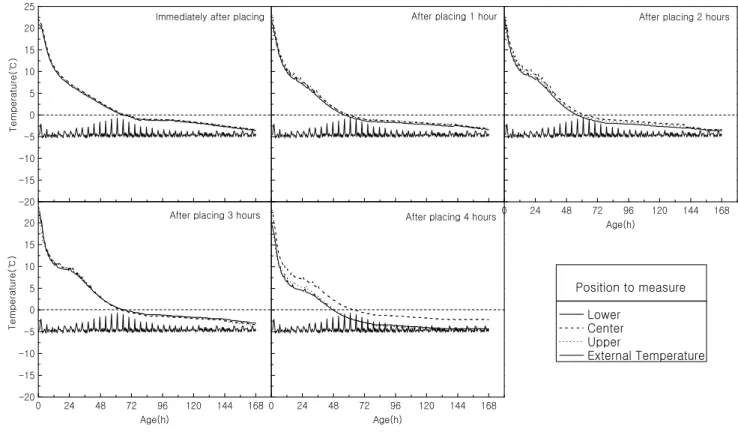
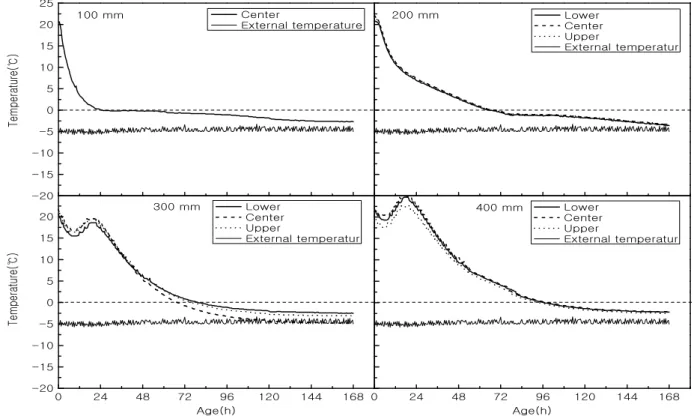
Figure 4-7은 버블시트 포설시기, 방법과 시트내 수분 함 수율 및 구조체 두께에 따른 콘크리트의 온도이력을 나타낸 것이다.
온도이력 측정결과, 시험체의 상부, 중심부 및 하부간의 온 도차는 매우 미미한 것을 확인할 수 있었는데, 이는 부재가 얇 은 슬래브 두께로 가정하였기 때문이라고 분석된다.
먼저 버블시트 포설시기에 따른 콘크리트 온도이력의 경우 는 모두 약 60시간을 전후하여 0℃에 도달하였고, 콘크리트 온도이력은 버블시트 포설시기가 늦어질수록 초기 콘크리트 온도는 급격하게 저하하는 것으로 나타났는데, 이는 포설시기 가 늦어질수록 콘크리트가 외기에 노출되는 시간이 길어짐에 따라 열량 손실이 증가함에 기인한 것으로 판단된다.
버블시트 포설방법에 따른 콘크리트 온도이력의 경우는 포 설방법에 관계없이 모두 유사한 시기에 콘크리트의 온도가 0℃로 저하되는 것을 확인할 수 있었으나, 버블시트를 50 mm 격리시켜 양생한 경우 초기의 콘크리트 온도가 급하게 하 강하는 것을 확인할 수 있는데, 이는 버블시트를 격리시킨 부 분이 외기와 직접 접하면서 콘크리트의 열손실을 일으킨 결과 로 판단된다.
버블시트내 함수율 변화에 따른 콘크리트의 온도이력 측정 결과는 모든 수준에서 전반적으로 0℃에 도달하는 시간이 유 사한 것으로 나타났고, 함수율 변화에 따라서는 함수율이 높아 질수록 온도저하가 빨리 일어났지만 그 차이가 매우 근소한 것을 알 수 있었다. 이는 독립기포층과 공기층으로 구성되어 있는 버블시트의 경우 수분이 침투할 수 있는 공기층은 버블 시트 전체 면적의 10 % 내외이기 때문에 수분이 침투하여도 단열보온성능에 큰 영향을 미치지 않는 것으로 판단된다.
구조체 두께에 따른 콘크리트 온도이력의 경우는 두께가 두 꺼워 질수록 콘크리트의 온도가 0℃에 도달하는 시간이 지연 되는 것으로 나타났는데, 이는 콘크리트 내부에서 발생하는 수 화열이 구조체의 두께가 증가함에 따라 외부로 방출되지 않기 때문인데, 두께 300 mm 이상에서는 내부 수화열에 의해 일 차 상승한 후 하강하는 양상이 나타났다.
Figure 8-11은 시공조건에 따른 콘크리트의 평균 양생온 도 및 적산온도를 나타낸 것이다.
먼저, 버블시트 포설시기의 경우 전체적으로 큰 차이는 아 닐지라도 버블시트 포설시기가 늦어질수록 적산온도는 다소 감소하는 경향을 나타내었는데, 이는 온도이력과 마찬가지로 버블시트 포설시기 지연에 따른 콘크리트의 열량 손실이 원인 인 것으로 판단된다.
Analysis on the Heat Insulation Performance of Cold Weather Concrete according to Change of Laid Construction Conditions of Double Bubble Sheets
-20 -15 -10 -5 0 5 10 15 20 25
0 24 48 72 96 120 144 168
0 24 48 72 96 120 144 168
-20 -15 -10 -5 0 5 10 15 20
0 24 48 72 96 120 144 168
Temperature(℃)
After placing 4 hours After placing 3 hours
After placing 2 hours After placing 1 hour
Temperature(℃)
Immediately after placing
Age(h)
Age(h) Age(h)
Position to measure Lower
Center Upper
External Temperature
Figure 4. Temperature history of concrete according to change of laid period of sheet
-20 -15 -10 -5 0 5 10 15 20 25
0 24 48 72 96 120 144 168
0 24 48 72 96 120 144 168
-20 -15 -10 -5 0 5 10 15 20
0 24 48 72 96 120 144 168
Temperature(℃)Temperature(℃)
Water content 100 % Water content 75 %
Water content 50 %
Water content 0 % Water content 25 %
Age(h)
Age(h) Age(h)
Position to measure Lower
Center Upper
External temperature
Figure 5. Temperature history of concrete according to change of water content inside sheet
0 24 48 72 96 120 144 168 -20
-15 -10 -5 0 5 10 15 20
0 24 48 72 96 120 144 168
-20 -15 -10 -5 0 5 10 15
0 24 48 72 96 120 144 168
Age(h)
Age(h)
Temperature(℃)
Laid of all*
Overlap of 100 mm
Temperature(℃)
Age(h)
Position to measure Lower
Center Upper
External temperature
Figure 6. Temperature history of concrete according to change of laid method of sheet
-20 -15 -10 -5 0 5 10 15 20 25
0 24 48 72 96 120 144 168
-20 -15 -10 -5 0 5 10 15 20
0 24 48 72 96 120 144 168
Temperature(℃)
400 mm 300 mm
200 mm
Temperature(℃)
Center
External temperature
100 mm Lower
Center Upper
External temperatur
Age(h) Lower Center Upper
External temperatur
Age(h) Lower Center Upper
External temperatur
Figure 7. Temperature history of concrete according to change of thickness of a specimen
Analysis on the Heat Insulation Performance of Cold Weather Concrete according to Change of Laid Construction Conditions of Double Bubble Sheets
0 1 2 3 4
-20 -15 -10 -5 0 5 10 15 20 25
Mean curing temperature(℃)
Laid period of bubble sheet(h)
Mean curing temperature
0 1 2 3 4 0
20 40 60 80 100
Maturity(°D·D)
Maturity
Figure 8. Mean curing temperature and maturity according to a laid period of bubble sheet
Isolation 50 mm Attachment Overlap of 50 mm Overlap of 100 mm -20
-15 -10 -5 0 5 10 15 20 25
Mean curing temperature(℃)
Laid method of bubble sheet
Mean curing temperature
Isolation 50 mm Attachment Overlap of 50 mmOverlap of 100 mm 0 20 40 60 80 100
Maturity (°D·D)
Maturity
Figure 9. Mean curing temperature and maturity according to a laid method of bubble sheet
-20 -15 -10 -5 0 5 10 15 20 25
Mean curing temperature(℃)
Mean curing temperature
0 25 50 75 100 0
20 40 60 80 100
Maturity(°D·D)
Water content(%) Maturity
Figure 10. Mean curing temperature and maturity according to a water content inside bubble sheet
100 200 300 400
-20 -15 -10 -5 0 5 10 15 20 25
Mean curing temperature(℃)
thickness of specimen(mm) Mean curing temperature
0 20 40 60 80 100
Maturity (°D·D)
Maturity
Figure 11. Mean curing temperature and maturity according to a thickness of specimen
버블시트 포설방법에 따라서는 시트를 격리시킨 경우에 서 적산온도가 약간 저하하는 경향을 나타내었고, 그 외의 조건에서는 큰 차이가 없는 것으로 나타났다.
버블시트내 함수율에 따른 평균 양생온도 및 적산온도의 경 우도 함수율 변화에 따라 미미한 차이는 있지만 유사한 경향 을 나타내어 실무조건에서 버블시트내 함수율이 어느정도 존 재하더라도 단열보온성능에는 별다른 영향을 미치지 않는 것 을 알 수 있었다.
구조체 두께변화의 경우는 구조체의 두께가 두꺼워질수록 적산온도도 증가하는 것을 알 수 있었다. 이는 두꺼운 구조체 일수록 내부에서 발생하는 수화열 축척이 많아짐에 기인한 것 으로 판단된다.
3.3 경화 콘크리트의 특성
Figure 12-15는 시공조건에 따른 코어공시체의 압축강 도를 나타낸 것이다.
전체적으로 코어압축강도는 경미한 차이가 있었으나 재령이 경과할수록 대부분 유사한 강도값을 발휘하는 것으로 나타났다.
콘크리트 부재를 일정 시간동안 외기온에 노출시킨 버블시 트 포설시간 변화에 따른 코어압축강도의 경우는 버블시트 포 설시기가 늦어질수록 압축강도가 다소 저하하는 것으로 나타 났는데, 이는 외기온에 노출시키는 시간이 길어질수록 외기온 에 의한 콘크리트의 적산온도 저하로 강도증진이 지연된 것으 로 판단된다.
버블시트의 포설방법에 따른 코어압축강도의 경우는 두장의 시트를 격리 및 맞댐시켜 양생하였을 경우 7일 재령에서 저하 하는 것으로 나타났는데, 이는 격리된 부분에 의해 노출된 콘 크리트에서 발생한 열손실로 인한 적산온도 저하가 강도를 저 하시킨 것으로 판단된다.
0 1 2 3 4 0
10 20 30 40
Laid period of bubble sheet(h) 7 14 28
Compressive strength(MPa) Stansard specimen Stansard core specimen
Figure 12. Compressive strength according to a laid period of bubble sheet
Isolation of 50 mm Attachment Overlap of 50 mm Overlap of 100 mm
0 10 20 30 40 50
Overlap of 100 mm Overlap
of 50 mm Confront
Laid method of sheet
Age(day) 7 14 28
Isolation of 50 mm Compressive strength(MPa) Standard specimen Standard core specimen
Figure 13. Compressive strength according to a laid method of bubble sheet
0 25 50 75 100
0 10 20 30 40 50
Water content(%)
Age(day) 7 14 28
Stansard specimen Stansard core specimen
Compressive strength(MPa)
Figure 14. Compressive strength according to a water content inside sheet
100 200 300 400
0 10 20 30 40
Thickness of specimen(mm) 7 14 28
Compressive strength(MPa) Stansard core specimen
Stansard specimen
Figure 15. Compressive strength according to a thickness of specimen
버블시트내 함수율 변화에 따른 코어압축강도의 경우는 함 수율에 관계없이 유사한 강도를 발휘하는 것을 확인할 수 있 었다.
구조체의 두께변화에 따른 코어압축강도의 경우는 두께가 두꺼워질수록 압축강도도 함께 증가하는 것으로 나타났다. 특 히, 두께 100 mm의 경우는 초기 7일 재령에서 저조했던 압 축강도는 표준온도인 20℃로 양생하여도 14일까지는 강도값 이 회복되지 않는 것으로 나타나 버블시트를 이용한 단열보온 양생의 경우 얇은 두께의 슬래브는 가열보온 양생 등 추가적 인양생을 고려해야 하는 것을 확인할 수 있었다.
4. 결 론
본 연구에서는 이중 버블시트의 포설 시공조건 변화에 따 른 한중 콘크리트의 단열보온성능을 분석하였는데, 그 결과를 요약하면 다음과 같다.
1) 버블시트에 의한 한중 콘크리트의 단열보온성능 분석에 서는 시트 포설시기가 늦어질수록, 시트의 간격이 벌어 질수록, 시트내 함수율이 증가할수록, 구조체의 두께가 얇을수록 버블시트의 단열보온 성능이 미미하게 저하하 는 것으로 나타났으나 큰 차이는 아닌 것으로 분석된다.
하지만 구조체의 두께가 너무 얇거나 버블시트 포설 시 시트간 간격이 발생할 경우에는 효과적인 단열보온성능 을 기대하기 어려우므로 주의가 요망되었다.
2) 코어압축강도의 경우는 격리포설, 함수율 증가, 구조체 두께의 감소는 초기 재령에서의 압축강도를 저하시키는 것으로 나타났으나, 20℃ 기중에서 추가 양생 시 재령 28일에서는 모든 수준에서 80 %이상 큰 압축강도를 발
Analysis on the Heat Insulation Performance of Cold Weather Concrete according to Change of Laid Construction Conditions of Double Bubble Sheets
현하는 것으로 나타났다.
이상을 종합하였을 때 버블시트를 이용한 단열보온양생 시 양생시기는 가능한 빠르게, 포설방법은 시트를 서로 겹치도록, 시트내 수분침투에 의한 함수율이 증가되지 않도록 밀실하게 관리해야 효과적인 단열보온성능을 기대할 수 있을 것으로 판 단되며, 두께가 너무 얇은 부재는 버블시트를 단독으로 사용하 는 것 보다는 추가적인 양생계획을 고려해야 할 것으로 판단 된다.
요 약
본 연구에서는 한중 콘크리트의 단열보온양생 공법재료로 사용되고 있는 이중버블시트의 다양한 포설 시공조건 변화에 따른 단열보온성능을 검토하였는데, 그 결과는 다음과 같다.
먼저, 시공요인에 따른 콘크리트의 온도이력의 경우 4시간 이 내의 버블시트 포설시기 변화 및 버블시트내 함수율 변화는 전체적으로 큰 차이없이 유사한 온도이력 및 적산온도를 나타 냈으나, 구조체가 얇거나 여러 장의 버블시트를 포설할 경우 시트간 간격이 크게 발생하면 콘크리트 초기양생에 불리한 요 건이 발생할 수 있음을 확인할 수 있었다. 콘크리트의 코어공 시체 압축강도는 버블시트의 포설시기를 지연시키거나, 시트 간 간격을 크게 유발시키거나, 버블시트내 함수율을 증가시키 거나, 타설 콘크리트 구조체 두께가 얇게 되는 등 콘크리트 양 생에 불리한 조건을 적용시킬수록 초기 압축강도는 저하하는 것으로 나타났으나, 재령이 경과할수록 그 차이는 작아지는 것 으로 나타났다.
키워드 : 한중콘크리트, 이중버블시트, 온도이력 References
1. Han CG, Oh SG Shin DH, Jeon CK, Kim J, The Insulating Curing Method of Cold Weather Concreting using Double Bubble Sheet, Journal of Korea Concrete Institute, 2006;18(6):51-59
2. Korea Meteorological Administration, http//: www.kma.go.kr 3. Hong SM, Baek DH, Han MH, Han CH, Temperature History of Concrete Corresponding to Various Bubble Sheet Layer and Curing Temperature, Proceeding of Korea Institute of Building Construction, 2008;8(2):21-25 4. Han CH, Kim SS, Lim CH, Kim JB, Temperature
Profile and Strength Development of Concrete for Deck Plate depending on Surface Insulation Curing Method Subjected to Cold Weather, Journal of Architectural
Institute of Korea, 2007;23(2):81-88
5. Hong SM, Baek SH, Kim J, Jeon CH, Han MH, Han CH, Field Application of Insulation Curing Method with Double Bubble Sheet Subject to Cold Weather, proceeding of the Korea Institute of Building Construction, 2008;8(1):57-60