• 검색 결과가 없습니다.

Satisfaction, Reliability, and Word-of-Mouth Intention for Online Information According to Cosmetic Consumer Information Search Types

N/A
N/A
Protected

Academic year: 2021

Share "Satisfaction, Reliability, and Word-of-Mouth Intention for Online Information According to Cosmetic Consumer Information Search Types"

Copied!
15
0
0

로드 중.... (전체 텍스트 보기)

전체 글

(1)

ISSN 1229-3350(Print) ISSN 2288-1867(Online)

J. fash. bus. Vol. 23, No. 6:49-63, December. 2019 https://doi.org/

10.12940/jfb.2019.23.6.49

Intention for Online Information According to Cosmetic Consumer Information Search Types

Saeyoung Shin

College of Beauty Art, Seokyeong University, Korea

Corresponding author

Saeyoung Shin Tel : +82-2-940-7812 Fax : +82-2-940-7827 E-mail : [email protected]

Keywords Abstract

cosmetic consumer, information search type, online information, satisfaction, reliability, word-of-mouth intention

This research was supported by Seokyeong University in 2019.

The purpose of this study was to determine the satisfaction, trust and

word-of-mouth intention of online information according to the type of

information search by female cosmetics consumers in their 20’s to 40’s. For this

study, online and offline surveys were conducted by 307 people. Factor,

correlation, and multiple regression analysis were used to analyze the data. The

main results are summarized as follows. First, the cosmetic consumer's

information search types were identified as active, playful, and economic

information search types. Second, the results of examinations on the effect of

consumer information search types on satisfaction, reliability, and

word-of-mouth intention of the online information searches showed that the

active information search type had a positive effect on satisfaction, reliability,

and word-of-mouth intention. The economic information search type had a

positive effect on satisfaction. The active information search type was confirmed

to have high satisfaction, reliability, and word-of-mouth intention for the

provided information and thus, the acceptance of the provided information was

high. The playful information search type was divided into continuous, habitual,

and independent information search and a tendency to assign a low value to

consumer information was confirmed. The economic information search type

showed high satisfaction with the information obtained by searching, but also

a passive attitude toward trust or word-of-mouth intention and was categorized

as a passive search type. Online information search is a communication channel

with a great influence that can provide various benefits to cosmetic consumers.

(2)

I. Introduction

Nowadays, with the spread of smart devices, the wireless Internet has become commonplace, which has changed the information search and communication activities of consumers. Consumers can search for information quickly and easily online. Consumers acquire evaluations or suggestions about products through internet bulletin boards or social media before purchasing them. It also reached a level of activity in which it was communicated to others and shared with each other. As a result, the evaluation of products online is increasing and has become an important criterion for purchasing products.

The consumer's decision making process involves five steps: problem recognition, information search, alternative evaluation, purchase, and post purchase. Information search is every effort made to get information about product purchases and is defined as part of the process for making good decisions (Kiel & Layton, 1981). It is necessary to classify consumers according to the type of information retrieval during consumer decision-making and to analyze the attitudes of each of these types of consumers about the information. Consumers' information search activities are important for the proper information acquisition of consumers who are exposed to a lot of information. Other prior studies focused on identifying factors influencing consumer's information search (Bloch, Sherrell, & Ridway, 1986) and researches are conducted to classify consumers according to their information search motivation (Je, 2012; Lee & Koo, 2002; Rha, Koo, Kim, Lee, Lee, & Lee, 2013).

Recently, online information search for cosmetics consumers has emerged as a communication channel with a great influence to provide various benefits to consumers, and consumers collect relevant information on the Internet before purchasing cosmetics. Therefore, research on this content is required. The research on cosmetics information search began to expand into the online area since 2000, and the study on the purchase tendency of cosmetics by information search type on/offline suggests that intensive research on the online is necessary (Kim & Lee, 2007). Also, with the

development of online blogs and cafes, a study was conducted on how word-of-mouth and information characteristics influence the purchase intention of cosmetics consumers (Park & Whang, 2012).

As mentioned above, although many studies on online information channels are increasing in the cosmetics industry, related studies on information search types and attitudes toward information are insufficient. Therefore, this study is to investigate the types of information search among cosmetics consumers, and to find out the satisfaction, trust, and word-of-mouth intention for the information provided by the information search channels.

II. Theoretical Background 1. Information search

Information search is an intentional effort by consumers to learn more about stores, products, and purchases, which means that information search is intended to reduce the uncertainty associated with decisions and make the right decisions (Lim, Kim, Hong, & Lee, 1996). The types of information search can be classified according to the components of the information search.

Kim (2003) classified the consumer groups into four categories: information acceptance type, information provision type, pursuit of information for pursuit of economic efficiency, and information indifference type for information fun rather than acquisition.

In the study of Choi and Rha (2012), information search was conducted to maximize consumer's satisfaction by acting for consumers to select efficient and reasonable products. This means that various channels are available for consumers to obtain information, and that various types of information search activities are affected by consumers' involvement in information search.

Engel, Blackwell and Miniar (1995) stated that

consumers' external information search behavior can be

defined according to three main dimensions: the degree,

direction and order of information search. First, the

degree of information search refers to the total

(3)

performance of information search by consumers. Second, the direction of information search means consumers' information sources and details. Third, the order of information search means the order that consumers consider when utilizing information.

Kim (2002) analyzed the components of information search by classifying information search volume and product attribute search. Satish and Sivakumaran's (2010) study classified intensive search consumers, broad search range consumers, and broad information search ranges, but the amount of search was moderate. Park (2018) studied active information search, passive information search, and daily information search.

In this study, based on the previous researches on information search, this study divided the types of information search by cosmetic consumers into active information search, playful information search, and economic information search.

2. Online information search type of cosmetic consumers

Information acquisition of cosmetics is made through various information channels. Because the nature of the information channel is different, the content and purpose of the information obtained from the information source used by the consumer are different. Therefore, the choice of channel is important in consumers' information search behavior (H. Lee, 2013).

With the development of online and social networking market, consumers' purchasing patterns are gradually changing, and they are trying to get information about various factors before purchasing cosmetics. As the size of the online market has expanded, cosmetic information in online has been able to communicate simultaneously like individuals and individuals, individuals and companies, free from the past structure where information communication structure was unilaterally made. Currently, the communication is changing to a structure that consumes even consumption. In addition, cosmetics are highly dependent on word-of-mouth information because they are particularly dependent on

online reviews that eliminate risk factors before purchasing (Park, 2007).

Online word-of-mouth refers to information, advice, reviews and testimonials posted by consumers through their various channels (ex: SNS, blogs, internet shopping mall, communities ect.) on the Internet in relation to companies, products, and services (Nam, 2016). Online word-of-mouth effect refers to the recipient's acceptance of word-of-mouth messages delivered by word-of-mouth messages in an online environment, to form attitudes or to modify behavior (Lee & Park, 2006). This is very important in online activities along with oral activities. If word-of-mouth recipient is trusted by word-of-mouth. it affects purchase intention or attitude change.

As online media has become a major space for people to produce and interact with information, most Internet users now find and compare relevant information online before purchasing a product or service.

Types of information search can be divided into goal-oriented search and experiential search. The goal-oriented search, which corresponds to the pre-purchase search, refers to searching for information in order to recognize a need for a purchase and to complete a purchase. Experiential search, which seeks experience through continuous exploration, refers to the search for information with a rather ordinary interest regardless of the immediate purchase (Han & Choi, 2015).

Differences in the types of information search occur in terms of motivation and outcomes, while pre-purchase exploration is driven by motivation to improve the quality of purchase and can be expected to be the best purchase, but continuous search is the Impulse buying is highly likely in terms of stockpiling and some sort of pleasure (Lim & Lee, 2007). The purpose of this study is to classify information search into active information search, playful information search, and economic information search.

3. Trust, satisfaction, word of mouth intention of

cosmetics online information

(4)

Today's online media have been evaluated as a communication medium that can substitute for social interaction because of its bi-directional characteristics compared to other media (Lee, Yoon, & Nam, 2010). In the cosmetics sector, more and more people are searching for 'cosmetic reviews' while expressing their thoughts and feelings in short forms such as product reviews. The information opened in the individual's media becomes intimate with the specific media during the search process of review visitors, and shows loyal behavior. Consumers complete their purchases based on referral information and various behavioral outcomes can be expected including word-of-mouth behavior and review writing on relevant media information (Kim &

Chung, 2009; Lee et al., 2010).

As the review through the online media is activated, the understanding of the overall usage behavior of media users becomes important. Furthermore, given the number of online media available to choose from and their participation depends on the motive and type of user browsing, understanding personal characteristics can determine the success of online media operations.

Harrison-Walker (2001) defined word-of-mouth

Figure 1. Research Model

acceptance as "to form a favorable attitude and purchase intentions for word-of-mouth information." The word-of-mouth receiver plays an active role as a word-of-mouth communicator.

Consumers' trust and satisfaction with online information affect purchase intention or attitude change, and trust directly affects word-of-mouth effects such as attitude and purchase intention formation (Jeon & Lee, 2012).

Therefore, this study is to investigate the difference of satisfaction, reliability and word of mouth intention of online information according to the type of information search in online media.

III. Methods 1. Research questions

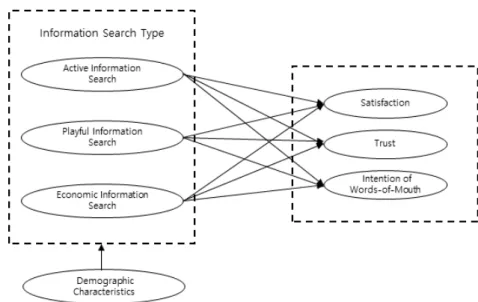
The research questions on the types of information search, satisfaction, reliability, and word-of-mouth intention of cosmetics consumers in their 20s~40s are as follows (Figure 1).

1) There will be differences in the types of information

search by consumers according to demographic characteristics.

(5)

2) The type of information search of consumers will affect satisfaction, reliability and word-of-mouth intention.

2. Instruments

The questionnaire was composed of items verified based on previous studies and items modified and supplemented for this study. And the validity of the surface was verified through five panels consisting of cosmetic experts and beauty experts.

Based on the feedback of the experts, the phrases whose expression was uncertain or did not exactly fit the purpose of the research were corrected, thereby securing the surface validity of the questionnaire.

In this study, cosmetic consumer information search type was modified according to the study used in the study of Kim and Lee (2007) and Park (2018). The cosmetic consumer information search type was measured by 6 items of active information search type, 4 items of playful information search type, and 5 items of economic information search type.

Satisfaction was defined as satisfaction with the use of cosmetic information search channel information. In order to measure this, this study used 3 items that were modified according to the research of Park (2018) according to this study, and each item was measured on a 5-point scale.

Reliability was defined as the degree of trust and confidence in cosmetic search channel information. And In order to measure this, this study used 3 items modified for the study of Park and Whang (2012), and measured on a 5-point scale.

Word-of-mouth intention was defined as the intention to talk to others about the use of cosmetic search information, and the measurement items used in Chun and Lee’s (2012) study were composed of 4 items modified for this study and measured on a five-point scale.

The general characteristics consisted of 8 questions, and a total of 32 questions.

3. Data collection and analyzes

1) Research subjects and data collection

In this study, a survey was conducted on women in their 20s~40s with the highest internet and SNS usage and cosmetic purchasing power. In addition, in order to purchase cosmetics within the past year, it was limited to consumers who have used PC or mobile to search for information. The survey collected data from online and offline surveys from September 16 to October 2, 2019, with a total of 325 respondents. The final 307 copies, excluding inconsistent or unfaithful responses, were used in the results analysis.

2) Data analyses

Data was processed using the SPSS 22.0 statistical package program. The statistical analysis method is as follows.

First, frequency analysis was performed for each demographic characteristic item.

Second, factor analysis was conducted to analyze the types of information search, information satisfaction, trust, and word-of-mouth intention. Principal component analysis and Varimax rotation technique were used, and Cronbach's α reliability verification was performed to verify the reliability of each factor.

Third, ANOVA was conducted to identify the differences in the types of information search of consumers according to demographic characteristics.

Duncan's post-verification was performed for the characteristics that showed statistically significant differences after analysis of variance.

Fourth, correlation analysis was conducted to determine the degree of relationship among factors, and multiple regression analysis was conducted to investigate the effect of information search type on information satisfaction, trust, and word-of-mouth intention.

IV. Results

1. Sample characteristics

(6)

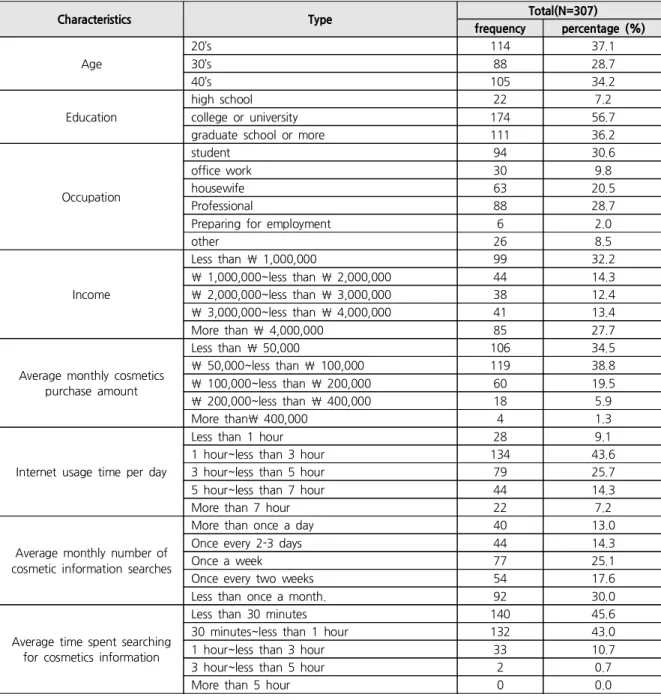
Demographic characteristics of the subjects were shown in Table 1. The 114 (37.1%) of respondents were in their 20s, 88 (28.7%) were in their 30s and 105 (34.2%) were in their 40s. The frequency of final education was 22 (7.2%) for high school, 174 (56.7%) for college and university, and 111 (63.2%) for graduated or attended

Table 1. Sample Characteristics

Characteristics Type Total(N=307)

frequency percentage (%) Age

20’s 114 37.1

30’s 88 28.7

40’s 105 34.2

Education

high school 22 7.2

college or university 174 56.7

graduate school or more 111 36.2

Occupation

student 94 30.6

office work 30 9.8

housewife 63 20.5

Professional 88 28.7

Preparing for employment 6 2.0

other 26 8.5

Income

Less than ₩ 1,000,000 99 32.2

1,000,000~less than 2,000,000

₩ ₩ 44 14.3

2,000,000~less than 3,000,000

₩ ₩ 38 12.4

3,000,000~less than 4,000,000

₩ ₩ 41 13.4

More than ₩ 4,000,000 85 27.7

Average monthly cosmetics purchase amount

Less than ₩ 50,000 106 34.5

50,000~less than 100,000

₩ ₩ 119 38.8

100,000~less than 200,000

₩ ₩ 60 19.5

200,000~less than 400,000

₩ ₩ 18 5.9

More than ₩ 400,000 4 1.3

Internet usage time per day

Less than 1 hour 28 9.1

1 hour~less than 3 hour 134 43.6

3 hour~less than 5 hour 79 25.7

5 hour~less than 7 hour 44 14.3

More than 7 hour 22 7.2

Average monthly number of cosmetic information searches

More than once a day 40 13.0

Once every 2-3 days 44 14.3

Once a week 77 25.1

Once every two weeks 54 17.6

Less than once a month. 92 30.0

Average time spent searching for cosmetics information

Less than 30 minutes 140 45.6

30 minutes~less than 1 hour 132 43.0

1 hour~less than 3 hour 33 10.7

3 hour~less than 5 hour 2 0.7

More than 5 hour 0 0.0

graduate schools. The occupation was 94 (30.6%) for

students, 30 (9.8%) for office workers, 63 (20.5%) for

housewives, 88 (28.7%) for professional, 6 (2.0%) for

preparing for employment, and 26 (8.5%) for other. In

terms of monthly income, 99 (32.2%) earned less than 1

million won, 44 (14.3%) earned over 1 million won to

(7)

less than 2 million won, 39 (12.4%) earned over 2 million won to over 3 million won, 41 (13.4%) earned over 3 million won to over 4 million won, and 85 (27.7%) earned over 4 million won. In addition, the monthly average purchase amount of cosmetics was 106 (34.5%) for less than 50,000 won, 119 (38.8%) for less than 50,000~100,000 won, 60 (19.5%) for 100,000~200,000 won, 18 (5.9%) for 200,000~400,000 won, and 4 (1.3%) for more than 400,000 won. The Internet usage time per day was 28 (9.1%) for less than 1 hour, 134 (43.6%) for 1~3 hours, 79 (25.7%) for 3~5 hours, and 44 (14.3%) for 5~7 hours, and 22 (7.2%) for more than 7 hours. The average monthly number of cosmetic information searches was 40 (13%) for more than once a day, 44 (14.3%) for once every 2~3 days, 77 (25.1%) for once a week, 54 (17.6%) for once every two weeks, 92 (30%) for less than once a month.

The average time spent searching for cosmetics information was 140 (45.6%) for less than 30 minutes, 132 (43.0%) for 30 min.~1 hour, 33 (10.7%) for 1~3 hours, 2 (0.7%) for 3~5 hours, 0 (0%) for more than 5 hours.

2. Validity and reliability tests

In order to verify the validity of the measurement instrument, exploratory factor analysis was performed using principal component analysis and the berry max rotation method. Variables were extracted by the number of factors with Eigen value of 1 or more. The cumulative explanatory power was applied at 50% or more to ensure validity. The items with the factor loading of 0.5 or less were judged as lacking the validity and were eliminated. There is no absolute standard for factor loading, however, factor loadings larger than 0.4 is considered as a significant variable. The Cronbach's α coefficient larger than 0.5 was considered to secure the reliability for each factor (Chae, 2001).

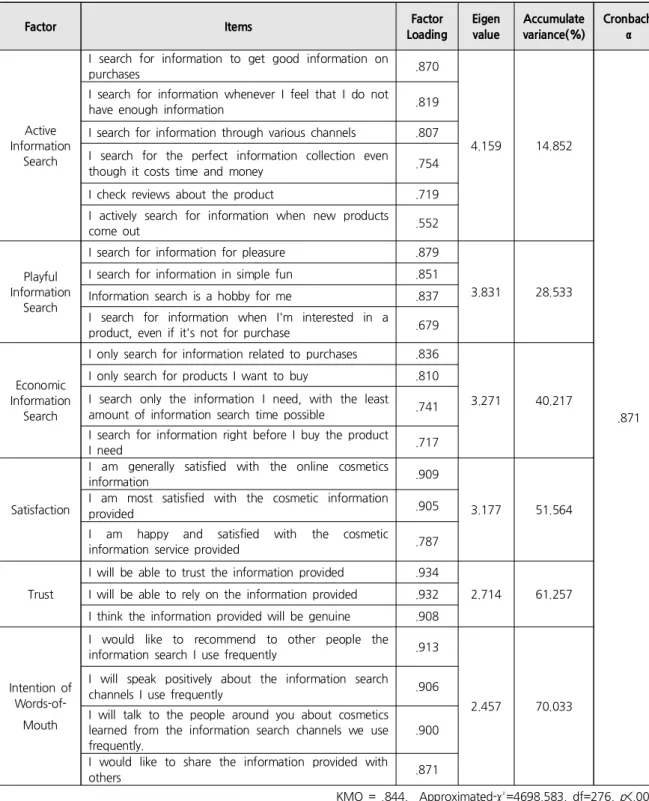
The feasibility and reliability analysis of factors were shown in Table 2.

As a result of KMO and Bartlett's test of active information search type, Kaiser-Meyer-Olkin (KMO)

measure of sample suitability was .844, which satisfies KMO>.5 and Bartlett sphericality test was Chi-Square=4698.583, so factor analysis was performed.

It can be judged as appropriate. In addition, if Bartlett's value is p <.001 and p <.05, it means that it is not a diagonal matrix. So it can be judged as appropriate (Chae, 2001). Of the 24 items, there were no measurement items with factor loadings below 0.5 or overlapping. With 24 questions, one factor accounted for 14.852% of accumulate variance. The Cronbach' α coefficient was .845, as a result of active information search reliability test, a sub-variable of consumer information search types used in this study. The Cronbach' α coefficient was .827, as a result of the playful information search reliability test, a sub-variable of the consumer information search types used in this study. The Cronbach' α coefficient was .780 as a result of the economic information search reliability test, a sub-variable of the consumer information search types used in this study.

Satisfaction factor explained 51.564% of accumulate variance. The Cronbach' α coefficient was .830 as a result of the reliability test of the satisfaction factor of on-line information search utilized in this study. Trust factor accounted for 61.257% of accumulate variance.

The Cronbach' α coefficient was .915 as a result of the reliability test of the truth factor of on-line information search utilized in this study. Word-of-mouth intention factor accounted for 70.033% of accumulate variance.

The Cronbach' α coefficient was .919 as a result of the reliability test of the online search word-of-mouth intention factor utilized in this study. As a result of reliability test of all factors used in this study, Cronbach’

coefficient was .871.

α

3. Differences in consumer information search types according to demographic characteristics

1) Differences in consumers' information search types by age

First of all, one-way ANOVA was conducted to analyze

the differences in the types of information search of

consumers according to the age of the study subjects

(8)

Table 2. Results of Factor Analysis

Factor Items Factor

Loading

Eigen value

Accumulate variance(%)

Cronbach’

α

Active Information

Search

I search for information to get good information on

purchases .870

4.159 14.852

.871 I search for information whenever I feel that I do not

have enough information .819

I search for information through various channels .807 I search for the perfect information collection even

though it costs time and money .754

I check reviews about the product .719 I actively search for information when new products

come out .552

Playful Information

Search

I search for information for pleasure .879

3.831 28.533

I search for information in simple fun .851 Information search is a hobby for me .837 I search for information when I'm interested in a product, even if it's not for purchase .679

Economic Information

Search

I only search for information related to purchases .836

3.271 40.217

I only search for products I want to buy .810 I search only the information I need, with the least amount of information search time possible .741 I search for information right before I buy the product

I need .717

Satisfaction

I am generally satisfied with the online cosmetics

information .909

3.177 51.564

I am most satisfied with the cosmetic information

provided .905

I am happy and satisfied with the cosmetic

information service provided .787

Trust

I will be able to trust the information provided .934

2.714 61.257

I will be able to rely on the information provided .932 I think the information provided will be genuine .908

Intention of Words-of-

Mouth

I would like to recommend to other people the information search I use frequently .913

2.457 70.033

I will speak positively about the information search

channels I use frequently .906

I will talk to the people around you about cosmetics learned from the information search channels we use frequently.

.900

I would like to share the information provided with

others .871

KMO = .844, Approximated- ²=4698.583, df=276, χ p <.001

(9)

(Table 3). In active information search type, the 20s were 3.75, the 30s were 3.70, and the 40s were 3.28 ( F =10.527, p <.001). This data showed a statistically significant difference. In the playful information search type, the 20s were 2.81, the 30s were 2.69, and the 40s were 2.71. There was no statistically significant difference. In economic information search type, there were no statistically significant differences (3.79 for 20s,

Table 3. Differences in Consumer Information Search Types by Age

Items N Mean std. dev. F p

Active Information Search

20’s 114 3.75

a

0.734

10.527 .001***

30’s 88 3.70

a

0.822

40’s 105 3.28

b

0.909

Playful Information Search

20’s 114 2.81 0.966

.502 .606

30’s 88 2.69 0.938

40’s 105 2.71 0.914

Economic Information Search

20’s 114 3.79 0.805

2.454 .088

30’s 88 3.54 0.951

40’s 105 3.73 0.731

p <.001 *** , Duncan test (c < b< a)

Table 4. Differences in Consumer Information Search Types According to Daily Internet Usage Time

Items N Mean std. dev. F p

Active Information

Search

Less than 1 h 28 3.27

a

0.702

3.149 .015*

1 h- less than 3 h 134 3.47

a

0.819

3 h- less than 5 h 79 3.67

ab

0.923

5 h- less than 7 h 44 3.88

b

0.548

More than 7 h 22 3.63

ab

1.176

Playful Information

Search

Less than 1 h 28 2.53

a

0.949

3.000 .019*

1 h- less than 3 h 134 2.74

ab

0.966

3 h- less than 5 h 79 3.12

b

1.049

5 h- less than 7 h 44 3.01

b

1.114

More than 7 h 22 3.03

b

0.836

Economic Information

Search

Less than 1 h 28 3.94

a

0.641

2.892 .023*

1 h- less than 3 h 134 3.79

a

0.733

3 h- less than 5 h 79 3.67

a

0.916

5 h- less than 7 h 44 3.56

ab

1.021

More than 7 h 22 3.26

b

0.696

p <.05 * , Duncan test (c < b< a)

3.54 for 30s, and 3.73 for 40s).

2) Differences in consumers' information search types according to daily Internet usage time

First of all, one-way ANOVA was conducted to analyze

the differences in the types of information research

among consumers according to the average daily time

spent on the Internet (Table 4). In the active information

(10)

search type, 3.27 for less than 1 hour, 3.47 for more than 1 hour and less than 3 hours, 3.67 for more than 3 hours and less than 5 hours, 3.88 for more than 5 hours and less than 7 hours, and 3.63 for more than 7 hours and 3.63. There were statistically significant differences. In the playful information search type, 2.44 for less than 1 hour, 2.61 for more than 1 hour and less than 3 hours, 2.95 for more than 3 hours and less than 5 hours, 2.89 for more than 5 hours and less than 7 hours, and 2.84 for more than 7 hours, 2.84. There were statistically significant differences. In economic information search type, 3.94 for less than 1 hour, 3.79 for more than 1 hour and less than 3 hours, 3.67 for more than 3 hours and less than 5 hours, 3.56 for more than 5 hours and less than 7 hours, 3.26 for more than 7 hours and 3.26 for statistical information. There were no statistically significant differences.

Table 5. Differences in Consumer Information Search Types According to Monthly Average Cosmetic Information Searches

Items N Mean std. dev. F p

Active Information

Search

More than once a day 40 4.09

a

0.753

18.673 .001***

Once every 2-3 days 44 4.03

a

0.608

Once a week 77 3.64

b

0.761

Once every two weeks 54 3.60

b

0.636

Less than once a month 92 3.07

c

0.894

Playful Information

Search

More than once a day 40 3.40

a

0.959

12.679 .001***

Once every 2-3 days 44 3.35

a

1.073

Once a week 77 3.04

a

0.899

Once every two weeks 54 2.68

b

0.916

Less than once a month 92 2.41

b

0.924

Economic Information

Search

More than once a day 40 3.46 1.058

1.138 .339

Once every 2-3 days 44 3.72 0.897

Once a week 77 3.72 0.657

Once every two weeks 54 3.67 0.757

Less than once a month 92 3.79 0.853

p <.001 ***, Duncan test (c < b< a)

3) Differences in consumers' information search types

according to monthly average cosmetic information search

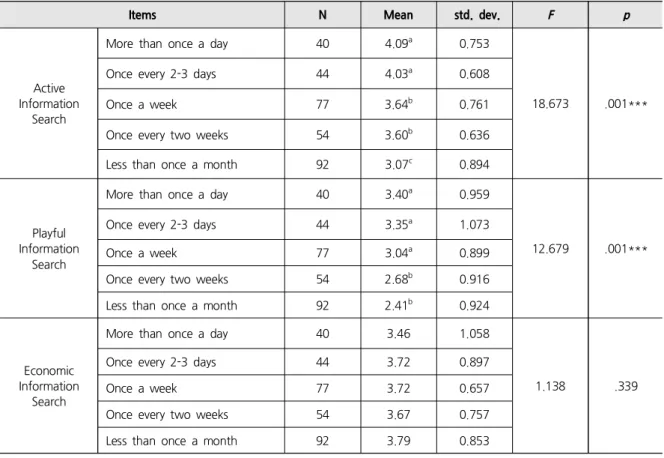
One-way ANOVA was performed to analyze the

differences in the types of information search among

consumers according to the average number of cosmetic

information searches (Table 5). In the active information

search type, 4.07 once or more per day, 4.03 once every

two to three days, 3.64 once a week, 3.60 once every

two weeks, and 3.07 less than once a month. There

were statistically significant differences. In the playful

information search type, there was a statistically

significant difference of 3.18 times more than once a

day, 3.20 once every two to three days, 2.92 once a

week, 2.53 once every two weeks, and 2.31 less than

once a month. In economic information search type,

there was no statistical difference between 3.46 more

than once a day, 3.72 once every 2 to 3 days, 3.72 once

(11)

a week, 3.67 once every 2 weeks, and 3.79 less than once a month.

4. The correlation between consumer information search types, satisfaction, trust, and word-of-mouth intention

Correlation and multiple regression analyzes were conducted to examine the effects of the types of consumer information search on the subjects' satisfaction, trust, and word-of-mouth intention.

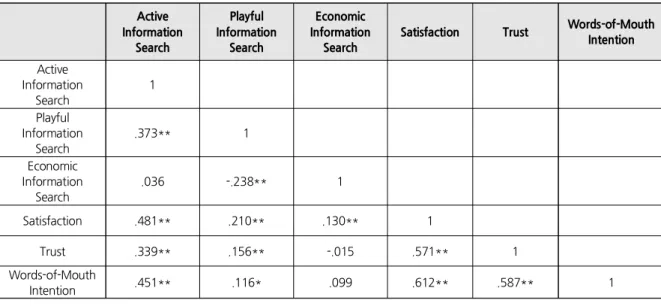
1) Correlation between independent and dependent variables As a result of examining the correlation between subvariables and dependent variables of consumer information search type, the correlation coefficients between variables did not show statistically significant correlations between economic information search type and trust, economic information search type and word-of-mouth intention. The correlations between subvariables and dependent variables of the other types of consumer information retrieval were found to be statistically significant (Table 6).

Specifically, active information search type, a sub-

Table 6. Relationship between Consumer Information Search Types, Satisfaction, Trust, and Word-of-Mouth Intention


Active Information

Search

Playful Information

Search

Economic Information

Search

Satisfaction Trust Words-of-Mouth Intention Active

Information Search

1

Playful Information

Search

.373** 1

Economic Information

Search

.036 -.238** 1

Satisfaction .481** .210** .130** 1

Trust .339** .156** -.015 .571** 1

Words-of-Mouth

Intention .451** .116* .099 .612** .587** 1

p <.01 **, p <.05 *

variable of consumer information search type, was positively correlated with satisfaction (r=.481), trust (r=.339) and word-of-mouth intention (r=.451). Playful information search type, a sub-variable of consumer information search type, has a positive correlation with satisfaction (r=.210), trust (r=.156) and word-of-mouth intention (r=.116). Economic information search type, a sub-variable of consumer information retrieval types, showed a positive correlation with satisfaction (r=.130).

2) The Effect of consumer information search types on satisfaction, trust and word-of-mouth intentions

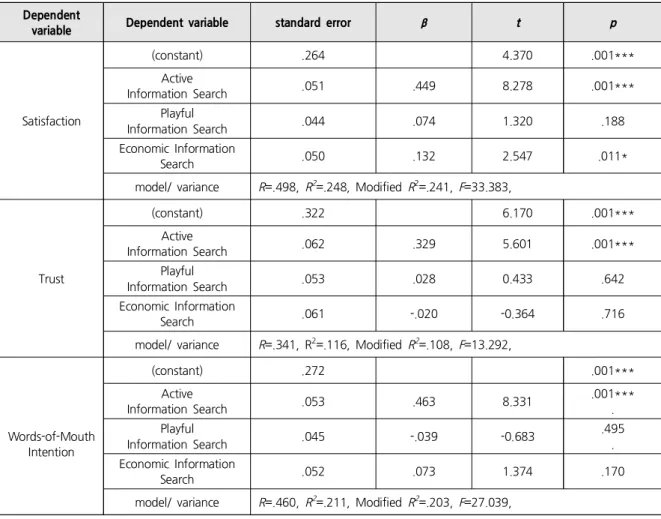
Through multiple regression analysis, the effects of consumer information search types on satisfaction, trust and word-of-mouth intention are as follows (Table 7).

Active information search type and economic

information search type, which are sub-factors of

consumer information search type, have a statistically

significant effect on satisfaction. However, playful

information search type did not have a significant effect

on satisfaction. The regression model was found to be

F =33.393 ( p <.001) and R

2

=.248 for the regression

equation with 24.8% explanatory power. The regression

(12)

Table 7. The Effect of Consumer Information Search Types on Satisfaction, Trust, Word-of-Mouth Intentions

Dependent

variable Dependent variable standard error β t p

Satisfaction

(constant) .264 4.370 .001***

Active

Information Search .051 .449 8.278 .001***

Playful

Information Search .044 .074 1.320 .188

Economic Information

Search .050 .132 2.547 .011*

model/ variance R =.498, R

2

=.248, Modified R

2

=.241, F =33.383,

Trust

(constant) .322 6.170 .001***

Active

Information Search .062 .329 5.601 .001***

Playful

Information Search .053 .028 0.433 .642

Economic Information

Search .061 -.020 -0.364 .716

model/ variance R =.341, R

2

=.116, Modified R

2

=.108, F =13.292,

Words-of-Mouth Intention

(constant) .272 .001***

Active

Information Search .053 .463 8.331 .001***

. Playful

Information Search .045 -.039 -0.683 .495

. Economic Information

Search .052 .073 1.374 .170

model/ variance R =.460, R

2

=.211, Modified R

2

=.203, F =27.039, p <.05 *, p <.001 ***

model is suitable because the tolerance limit value is higher than .01 and there is no problem in multicollinearity. Therefore, the higher the active and economical information search type of consumer information search type, the higher the satisfaction.

Active information search type, a subfactor of consumer information search type, has a statistically significant effect on trust. However, playful information search and economic information search type have no significant effect on trust.

The regression model was found to be F =13.292 ( p <.001) and R

2

=.116 for the regression equation with 11.6% explanatory power. The regression model is suitable because the tolerance limit value is higher than

.01 and there is no problem in multicollinearity.

Therefore, the higher the active information search type of consumer information search type, the higher the reliability.

Active information search type, a subfactor of consumer information search type, was found to have a statistically significant effect on word-of-mouth intention. However, playful information search and economic information search type did not have a significant effect on word-of-mouth intention. The regression model was found to be F =27.039 ( p <.001) and R

2

=.211 for the regression equation with 21.1%

explanatory power. The regression model is suitable

because the tolerance limit value is higher than .01 and

(13)

there is no problem in multicollinearity. Therefore, the higher the active information search type of consumer information search type, the higher the word-of-mouth intention.

As a result of the research, it can be seen that the active information search type has high satisfaction, trust, and word-of-mouth intention. In this type, consumers search for the information itself, and can see that they are acquiring information about the new product and using various sources. In addition, they tend to trust the information provided and passively search and accept it.

Playful information search type can be seen that they do not value satisfaction, trust and word-of-mouth information. Playful information search type is divided into continuous, habitual, and independent information search. This result is consistent with information indifference that searches information for fun rather than acquiring consumer type information in the study of Kim (2003). and it supports the consequences of a tendency to put value low in information.

Also, this result supports J. Lee’s (2013) study of preferring neutral and objective information on clothes and cosmetics, such as friends and reviews of internet purchases, and searching for information relatively habitually and continuously.

The type of economic information search shows a high level of satisfaction with the information obtained by searching, but takes a passive attitude toward trust and word-of-mouth intention. It does not have much dependence, expectation or interest on the information provided online, and can be interpreted as a type that searches only for the information provided by the user and is satisfied with the information. It is classified as a passive information search type, and it is mostly an information activity to facilitate a decision about a specific purchase. This result is consistent with the findings of Kim’s (2003) study and supports the results of Kim and Lee (2007).

Accordingly, it can be seen that there is a difference in satisfaction, trust, and word-of-mouth intention according to the type of information search. and the results of this study support the results of Park and

Whang (2012), which found that the reliability factors differ depending on the type of cosmetic consumption, which is a previous study.

V. conclusion

This study examined the types of information search among cosmetic consumers and the effects on satisfaction, trust, and word-of-mouth intention of information provided by information search channels.

The main results of this study were summarized as follows.

First, cosmetic consumer's information search types were identified as active information search type, playful information search type, and economic information search type.

Second, as a result of analyzing the difference of information search type according to demographic characteristics, only active information search type was distributed in 20s and 30s only by age. According to the internet usage time, active information search type was most widely used for 5~7 hours, playful information search type for 3~5 hours, and economic information search type for less than 1 hour. The average monthly number of information search was used more than once a day by the active and playful information search types.

Third, there was a difference in the effect on satisfaction, trust and word-of-mouth intention of information provided by cosmetic information search types. The type of active information search has a positive influence on satisfaction, reliability, and word-of-mouth intention. The type of economic information search has a positive influence on satisfaction. Playful information search type did not affect satisfaction, reliability and word-of-mouth intention.

In conclusion, it is confirmed that cosmetic consumers

in their 20s and 30s have many types of active

information search, and they use the internet for 5~7

hours a day and search cosmetic information more than

once a day. In addition, the active information search

type was confirmed to have high satisfaction, reliability,

and word-of-mouth intention for the provided

(14)

information, and thus the acceptance of the provided information was high. Playful information search type was divided into continuous, habitual, and independent information search, and it can be confirmed that there is a tendency to put low value on consumer information.

Economic information search type had high satisfaction with the information obtained by searching, but take a passive attitude toward trust or word-of-mouth intention, and can be categorized as a passive search type.

Considering the necessity of a new classification system of consumer types for cosmetic information search by diversifying channels and information sources for information search, the results of this study could be categorized according to the behavior of consumers' prior search for cosmetic decision. In addition, it is meaningful to provide the basic data for consumer research on information search by presenting the difference in satisfaction, trust, and word of mouth intention according to the information search type.

Online information search is a communication channel with a great influence that can provide various benefits to consumers. It can be said that the cosmetic industry has an important influence and activity. Therefore, the cosmetics industry should establish a strategy focused on online marketing.

This study is the first study to classify the types of information search for cosmetic consumers and to measure the satisfaction, trust and word of mouth intention only for women in their 20s and 40s. In the future, it is necessary to study the mediating effect between these variables, and to study the purchasing effect according to search activity and motivation. In addition, as the men's cosmetics market is expanding, it is necessary to expand the research to measure the dimension of cosmetics purchasing behavior including dimensions and lifestyle of men in the future.

References

Bloch, P. H., Sherrell, D. L., & Ridway, N. M. (1986).

Consumer search: An extend framwork. Journal of

Consumer Research, 13 (1) , 119-126. doi:10.1086/

209052

Chae, S. (2001). Marketing research. Gyeonggi:

Hakhyunsa.

Choi, A., & Rha, J. (2012). How do consumers search for information in multi-channel environment?: Consumer typology based on their choice of information channel.

Journal of Consumer Studies, 23 (2), 135-164.

Chun, D., & Lee, H. (2012). A study of effect on trust, acceptance and spread of word-of-mouth and purchase intention by characteristics of electronic word-of-mouth on travel industry. The Academy of Customer Satisfaction Management, 14 (1) , 83-100.

Engel, J. F., Blackwell, R. D., & Miniar, P. W. (1995).

Consumer behavior (8th ed.). NY: Dryden Press.

Han, S., & Choi, A. (2015). A study on online information search of financial consumers: Who searches for financial information? Journal of Consumer Studies, 26 (3), 135-161.

Harrison-Walker, L. J. (2001). The measurement of word-of-mouth communication and an investigation of service quality and customer commitment as potential an antecedents. Journal of Service Research, 4 (1), 60-75. doi:10.1177/109467050141006

Je, E. (2012). The study on satisfaction and intent to reuse by type of advertisement as a result of internet fashion information search. Journal of Fashion Business, 16 (2) , 62-73. doi:10.12940/jfb.2012.16.2.062 Jeon, S., & Lee, H. (2012). Study on the consumption

emotion as mediating role at internet shopping mall between impulse buying and service quality, shopping interest. Journal of Electronic Commerce Studies, 12 (2), 205-230.

Kiel, G., & Layton, R. (1981). Dimensions of consumer information seeking behavior. Journal of Marketing Research, 18 (2) , 233-239. doi:10.2307/3150957 Kim, J. (2003). Study on user behavior and satisfaction

of different consumers in consumer evaluation site (Unpublished master’s thesis) . Seoul National University, Seoul, Korea.

Kim, M., & Lee, K. (2007). Study on the purchasing

orientation of cosmetics by information search types

(15)

of female consumers. Consumer Policy and Education Review, 3 (1) , 1-15.

Kim, S. (2002). Study of consumer information search and satisfaction in e-commerce (Unpublished master’s thesis) . Ewha Womans University, Seoul, Korea.

Kim, Y., & Chung, K. (2009). Hotel brand blog characteristics influencing purchase intention and word-of-mouse communication: Blog attitude as an intervening variable - Focused on blog users in their 20's and 30's. Korean Journal of Hotel Administration, 18 (3), 1-22.

Lee, H. (2013). A study of fund investors' information search behavior and its typology (Unpublished master’s thesis) . Seoul National University, Seoul, Korea.

Lee, J. (2013). A study on fashion leadership of clothing and make-up, information sources, and ongoing information search. Journal of Fashion Business, 17 (1) , 157-169. doi:10.12940/jfb.2013.17.1.157

Lee, S., & Koo, Y. (2002). The perception of online store attributes by online consumer information seeking type. Family and Environment Research, 40 (1) , 99-112.

Lee, S., Yoon, H., & Nam, K. (2010). Blogs in the restaurant industry: Consumer usage motivation and service quality perception. Korean Journal of Hotel Administration, 19 (6), 273-287.

Lee, T., & Park, C. (2006). Effects of direction and type of electronic word of mouth information on purchase decision: Cross-cultural comparison between Korea and U. S. Korean Journal of Marketing, 21 (1) , 29-56.

Lim, J., Kim, J., Hong, S., & Lee, Y. (1996). Consumer behavior. Seoul: Kyungmoonsa.

Lim, J., & Lee, E. (2007). A study of the factors influencing WOM effects in online environments. Asia Marketing Journal, 8 (4), 59-77.

Nam, S. (2016). A study on travel information search and online word-of-mouth (Unpublished doctoral dissertation) . Sookmyung Womans University, Seoul, Korea.

Park, E. (2007). Effects of the direction of online reviews on purchase decision: The role of product type and brand reputation. The Korean Journal of Advertising, 18 (5) , 7-22.

Park, J. (2018). The effect of perceived risk on satisfaction of the hotel reservation site: Focusing on the moderating effect of information researching type (Unpublished master’s thesis) . Kyunghee University, Seoul, Korea.

Park, J., & Whang, S. (2012). A study on the impact of cosmetics blog information characteristics on credibility in the process of word of mouth acceptance and word of mouth effect. Journal of the Korean Society of Costume, 62 (2) , 13-25. doi:10.7233/jksc.2012.

62.2.013

Rha, J., Koo, H., Kim, H., Lee, J., Lee, H., & Lee, W.

(2013). Consumer information search type for financial products . Journal of Consumer Studies, 24 (4) , 99-124.

Satish, S., & Sivakumaran, B. (2010). Information search behaviour among new car buyers: A two-step cluster analysis. IIBM Management Review, 22 (1-2) , 5-15.

doi:10.1016/j.iimb.2010.03.005

Received (November 1, 2019)

Revised (December 2, 2019; (December 8, 2019)

Accepted (December 24, 2019)

수치

Figure  1.  Research  Model
Table  1.  Sample  Characteristics
Table  2.  Results  of  Factor  Analysis
Table  4.  Differences  in  Consumer  Information  Search  Types  According  to  Daily  Internet  Usage  Time
+4

참조

관련 문서

The purpose of this study is to investigate the effect of the “problem solving and programming” area of ​​information subject on perception and

Objectives: This study aimed to investigate the relationship between job stress and turnover intention of employed opticians and to investigate the mediating effect of burnout

The purpose of this study is to analyze the effects of service quality on customer satisfaction and revisit intention perceived by Chinese golf range

In this Thesis, an empirical study on the Influence of Consumer's Preferences and Satisfaction on Purchase Intention of Korean Automobile in Vietnamese Consumers

According to types of apartment houses, walking and resting space had a great influence on residential satisfaction in apartment houses built for sale,

- NEAE News, Publications, Information Resources and Major Statistics - Website Links Related to NEAE, Integrated Search System, NEAE.. Community and

The purpose of this study is to examine the situation of online classes due to the COVID-19 situation, and to find out the actual situation and

The purpose of this study is to investigate the effect of online shopping mall characteristics on direct purchasing satisfaction of foreign consumers and purchase