Kor. J. Pharmacogn.
43(2) : 137∼ 146 (2012)
137
속단(Dipsaci Radix) 중 Asperosaponins 및 Iridoid glycosides의 LC-ESI-MS 에 의한 동시분석
조황의1·손인섭1·김선춘4·손건호3·우미희2·문동철1*
1충북대학교, 2대구가톨릭대학교, 3안동대학교, 4국립과학수사연구원
Simultaneous Determination of Asperosaponins and Iridoid Glycosides from Dipsaci Radix by Using LC-ESI-MS Spectrometry
Hwang Eui Cho1, In-Seop Son1, Suncheun Kim4, Kun Ho Son3 , Mi Hee Woo2 and Dong-Cheul Moon1*
1College of Pharmacy, Chungbuk National University, Cheongju 361-763, Korea
2College of Pharmacy, Catholic University of Daegu, Gyeongsan 712-702, Korea
3College of Life Science, Andong National University, Andong 760-740, Korea
4National Forensic Service, Daejon 305-348, Korea
Abstract − Dipsaci Radix (Dipsacaceae) has been used as a tonic, an analgesic, anti-inflammatory and anti-complement agents in traditional herbal medicine for the therapy of low back pain, knee pain, rheumatic arthritis, traumatic hematoma, and bone fractures. A high-performance liquid chromatography-electrospray ionization-mass spectrometric method (HPLC-ESI-MS) was developed for the simultaneous quantitation method of the five compounds from the herbal drug:asperosaponin VI and aspe- rosaponin XII (terpene glycosides), sweroside, loganin and dipsacus A(iridoid glycosides). HPLC separation of the analytes was achieved on a C18 column (150 × 2.0 mm i.d., 5 µm) using the aqueous methanol containing 5 mM ammonium acetate with gradient flow of the mobile phase. Detection of the analytes was performed by positive ion electrospray ionization, and selected ion monitoring was used for data acquisition using m/z corresponding molecular adduct ion, [M+NH4]+and [M+H]+. Calibration graphs showed good linearity (r2 = 0.9997) over the wide range of the analytes; intra- and inter-day precisions (RSD, %) were within 9.1% and the accuracy between 94.0 - 111.0%. Recoveries of the analytes through the assay procedure were in the range of 93.7 - 110.8%. Analytical results of the herbal drugs of Dipsaci Radix (17 samples) show wide distribution of the five marker compounds and clear difference of the species from Phlomidis Radix (4 samples). The developed method would provide a prac- tical guide for the quality control of the herbal drug.
Key words − Dipsacci radix, HPLC-ESI-MS, Selected ion monitoring, Simultaneous determination, Asperosaponins, Iridoid glycosides, Quality control
속단(Dipsaci Radix; Xuduan in Chinese)은 골절치료에 주 로 사용한 전통중의약(Traditional Chinese Medicine:TCM) 이다.1-3) 근골의 절상을 치유하는 의미로 이름 붙여진 ‘杜夢’
과 유사한 효과를 보이는 생약도 동일한 이름으로 사용한 바, 중국에서는 D. chinensis Bat., 우리나라에서는 산토끼꽃 (Dipsacus japonicus MIQ,)의 뿌리도 ‘일속단’이라 하여 구분 없이 사용하였고, 꿀풀과(Labiatae)의 다년성 초본 ‘속단’
(Phlomis umbrosa Turcz,)의 뿌리는 최근 별개의 생약인 한 속단(Phlomidis Radix)으로 수재되었지만, 식물명이 ‘속단’
인 관계로 혼용된 바 있다. 따라서 최근 「대한약전외생약 규격집」등 공정서에는 한약재 ‘속단’의 기원식물로써 산토 끼꽃과(Dipsacaceae)의 다년성 초본인 천속단(川續斷, Dipsacus asperoides C.Y.Chen et T.M. Ai)의 뿌리를 정품으 로 규정하였다.4,5) 속단속 식물(Dipsacus genus)은 전 세계 적(유럽, 북미, 아프리카 및 아시아)으로 20 여종이 분포하 며, 그 뿌리 및 잎은 약용으로 활용되었다. 이 전에 D. Asper Wall1)로도 알려진 천속단 뿌리는 섬유근종의 치료에 사용 되었을 뿐만 아니라, 최근에는 알츠하이머에 대한 약리 효 과도 보고되었다.6)전 세계의 약용식물 374 종에 대한 in vitro 종양세포 치사효과의 스크리닝 결과6), 천속단은 고용
*교신저자(E-mail):[email protected] (Tel): +82-43-261-2819
량 복용해도 부작용이 없는 Class 1 herb로 분류되었다 (AHPA-BSH:The American Herbal Products Association- Botanical Safety Handbook).7)
천속단의 대표적인 성분으로 oleanane 형의 triterpenoid saponins과 iridoid glycosides이 알려지고 있다.9)속단의 약 효를 대표하는 주성분, asperosaponin VI(또는 akebia saponin D)10)는 이미 중국약전에서 지표성분으로 규정하고 있는데,5)조골세포의 증식과 분화를 촉진할 뿐만 아니라,6) 항암,12) 심근경색에 대한 약리효과13)도 추가로 보고 되고 있 다. 그 외의 saponin 성분으로dipsacus saponins B, C,9) asperosaponin XII,14) asperosaponin X,15) asperosaponin F16) 등도 보고된 바 있다. 한편, iridoid glycosides 성분으로 mono-iridoids인 weroside와 loganin,17) bis-iridoid인 dipsa- noside F,18) 그리고 tetra-iridoid인 dipsanoside A19)등도 보고 되었는데, 이들은 여러 과의 식물에 널리 분포하는 성분으 로써 혈압강하, 진정 해열, 진해 등의 약리효과가 보고되고 있다.20) 특히 sweroside(3)로 부터는 항간염바이러스 및 간 보호작용 외에 신경돌기생성활성, 항종양, 항바이러스, 항균
작용 등도 발표되고 있으며,21,22)몇 가지 bis-iridoids 성분은 Dipsacus 속의 화학분류에서 마커-화합물로 보고된 바 있 다.18)
천속단은 우리나라에서는 생산되지 않고 주로 Hubei, Sichuan, Guizou, Yunnan, and Tibet 등 중국 서남부 산악지 역에서 자생 또는 재배되고 있으므로,1) 그 수요는 전량 수 입에 의존하고 있는 실정이다. 따라서 동속의 유사식물로부 터 유래된 한약재나 위품들이 유통될 가능성이 크다. 한약재
‘속단’의 감별은 형태학적, 현미경 감별,23) DNA 분석법24) 등을 활용하지만, 소수의 전문가에 의한 감별과 DNA 분석 에서 기술적 및 분석경비 문제가 있다. 따라서 속단의 품질 관리에 보편적으로 활용될 수 있는 이화학적 분석법 개발 이 요구되었다.
현재까지 속단 성분의 분석법으로는 asperosaponin VI 의 체내동태 파악하기 위한 동물 plasma (rat, dog)중 asperosaponin VI와 그 대사물의 LC-MS,25-28) loganin 및 sweroside의 약동역학 연구를 위한 LC-MS 분석21)이 있고, 천속단을 그 성분으로 포함하는 한방복합제제의 품질관리
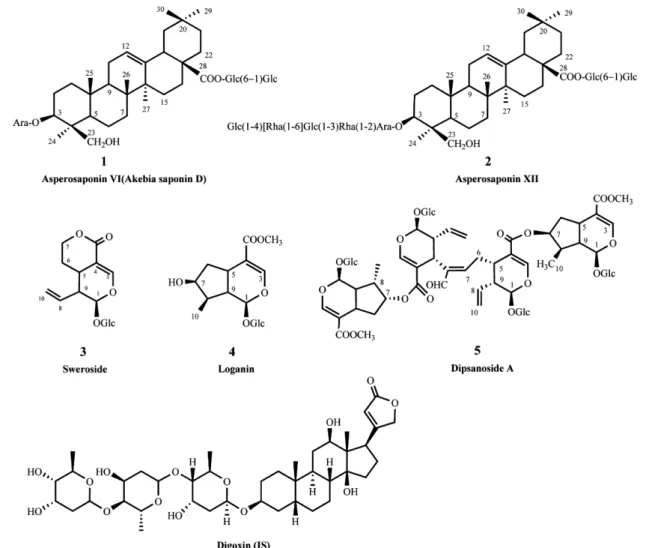
Fig. 1. Structures of the concerned compounds from Dipsaci Radix and digoxin (internal standard).
를 위한 asperosaponin VI의 HPLC 및 HPLC-MS 분석28법 만 보고되어 있을 뿐 속단에 포함되어 있는 서로 다른 계열 성분의 동시분석법에 관한 연구는 찾을 수 없다. 따라서 이 연구에서는 속단의 LC-TIC chromatograms을 검토하여 유 의한 성분 피크로 확인된 asperosaponin VI, XII와 loganin, sweroside, dipsanoside A (Fig. 1)의 HPLC-ESI-MS에 의한 동시분석법을 확립하고 validation하였다. 중국 및 국내 한 약재 시장에서 입수한 한약재 시료 21종의 분석결과로부터 속단과 한속단의 구별 및 품질관리 기준을 제시하고자 하였다.
재료 및 방법
표준품 및 시약 − 본 연구에서 대상으로 한 표준품과 순도 (HPLC, %)는 다음과 같다: asperosaponin VI (1)(or akebia saponin D, >98%), asperosaponin XII (2, Hederagenin 3-O-{α-L-rhamnopyranosyl(1 → 3)-[β-D-glucopyranosyl- (1→ 4)]-D-glucopyranosyl-(1 → 3)-α-L-rhamnopyranosyl- (1→ 2)-α-L-arabinoside]-28-O-[β-D-glucopyranosyl-(1 →6)- β-D-glucopyranosyl]ester, >98%), sweroside (3, ≥96%), loganin (4, ≥97%), dipsanoside A (5, ≥96%). 이 표준품은 모두 천속단으로부터 분리 정제하여 HPLC에 의해 순도를 정한 것으로 모두 손건호교수(안동대학교)로부터 제공받았 다. LC-MS 분석의 내부표준물질(IS)로 사용한 digoxin은 Sigma-Aldrich(MSDS, Germany, ≥98.5%)로부터 구입하여 별도의 정제 없이 사용하였다(Fig. 1). 시료추출 및 분석에 사용한 methanol은 Fisher Scientific Co. (Fairlawn, NJ, USA), ammonium acetate는 Merck KGaA (Darmstadt, Germany)로부터 구입하였다. 그 외 실험에 사용한 모든 용 매는 HPLC급을, 시약은 모두 분석급을 사용하였다. 탈이온 수는 J.T.Baker (Phillipsbug, NJ, USA)로부터 구입하여 사 용하였다.
시험 재료 − 건조 한약재, 속단 13 종(09D1001-11, 19- 21), 기공한 속단 4 종(鹽炙,09D1016-17; 酒炙, 09D1018-19) 은 중국 여러 지역(Sichuan, Guizhou, Anguo, Lanzhou)의 중약재 시장에서, 한속단 4종(09D1012-15)은 국내(영천, 제 천)의 한약재시장에서 한약감정 전문가(이재현 교수, 동국 대)에 의해 제공 받아 시험재료로 사용하였다.
기기 − 본 연구에 사용한 LC-MS system은 Sciex API 3000 triple quadrupole mass spectrometer (Applied Biosystems, MDS Sciex, Concord, Canada)을 사용하였다.
LC-MS에서 HPLC system은 HP1100 series (Agilent Technologies, Palo Alto, CA, USA)로 degasser, binary pump, autosampler, 컬럼온도 controller 및 switching valve system을 장착하여 사용하였다. data 처리는 Analyst software (ver.1.4.2)를 사용하였다.
표준용액 조제 − 지표성분의 보존용액은 표준품을 모두
MeOH에 녹여 조제하고 4oC에서 냉장 보관하였다(100- 110µg/mL). 각 성분의 표준용액은 분석 직전 작업농도 범 위에 들도록 보존용액으로부터 일정 부피씩 정확히 취하여 이동상 용매로 계열희석하여 사용하였으며, 내부표준용액은 MeOH에 녹여 사용하였다(digoxin, 10 µg/mL). 검량용 표준 물 혼합액(standard calibration mixture)은 각 표준품의 보존 용액으로부터 일정 부피씩 정확히 취하여 10.0-mL 용량 플 라스크에 취한 다음 MeOH로 표선까지 채워 조제하였다 (primary standard mixture). 1차 표준물 혼합액으로 일정량 마이크로피펫으로 정확히 취하여 계열희석하고, 내부표준물 (digoxin. 10µg/mL), 20 µL을 최종농도 500 ng/mL 되도록 각 검량용 표준물 혼합액에 첨가하였다.
LC-MS 분석 − HPLC 분리컬럼은 C18 컬럼(Luna C18(2), 150×2.00 mm I.D., 5µ, Phenomenex, Torrance, CA, USA), pre-column은 C18 cartridge (4.0 mmx2.0 mm, I.D.)을 사용 하였다. 컬럼온도는 40oC로 유지하고 이동상 용매는 5 mM 의 ammmonium acetate를 포함한 MeOH 용액을 linear gradient 흐름으로 흘려주었다(18% → 91% MeOH for 0-25 min; hold for 25-30 min; 91%→ 18% MeOH for 30- 32 min; hold to 40 min). 이동상 유속은 0.2 mL/min로 하 였고 autosampler는 10oC로 유지하였고 주입량은 5 µL로 하 였다.
LC-ESI-SIM-MS 분석에서 지표성분은 모두 양이온 검출 법을 채택하였으며 선택적이온 검출방법(selective ion monitoring: SIM)법을 이용하여 분석하였다. LC-SIM-MS의 최적 operation parameter는 Table I과 같다.
검체분석 − 균질한 검체분말(50 mesh sieve 통과) 0.5 g에 해당하는 양을 25-mL 메스플라스크에 정확히 취하고 추출 용매(50% MeOH) 25mL를 가하여 눈금까지 채운 다음 상 온에서 30 분간 초음파 추출하였다. 추출액을 vortex mixing 한 다음 10 분 방치한 다음 여과하여 여액을 25.0-mL 용량 플라스크에 이행시키고, 50% MeOH을 가하여 표선까지 채 웠다(검체 보존용액: sample stock solution). 보존용액 중 일 부분은 HPLC에 의해 용액 안정성 등을 검토하였다. LC- MS 분석은 보존용액 중 일부(1~5 mL)를 정확히 취하여 Table I. MS operation parameter (SIM mode)
Parameters Values
Ion source temperature. (oC) 350 Dwell time per transition (ms) 200 Nebulizer gas flow. (Ion spray flow) (L/min) 0.82 Curtain gas flow. (L/min) 1.25 Auxilliary gas flow. (L/min), nitrogen 6.1 Ion spray voltage (kV) 5.5
Mode of analysis Positive
MeOH을 사용하여 정확하게 10 배 희석하여 작업용액으로 하고, 그중 25-µL aliquots를 1.0-mL 용량플라스크에 정확 하게 취하고, 내부표준용액(10 µg/mL), 20 µL 첨가하고 MeOH을 가하여 표선까지 채웠다(최종검액; final test solution). LC-MS 주입시 최종 검액을 membrane filter (0.2µm)를 통과시키고 이 중 5.0 µL를 주입하였다. 검체로 부터 LC-MS 분석 전까지의 전처리 과정은 Fig. 2와 같다.
분석법 검증 (Method Validation) − 분석법의 직선성, 검 출 및 정량한계를 정하기 위한 검량선은 지표성분과 내부 표준물질의 면적비를 이용하였으며, LOD는 S/N=3, LOQ는 S/N=10을 기준으로 정하였다. 전 분석과정을 통한 분석의 일내 및 일간 정확성과 정밀성은 각 지표성분의 함량이 다 른 세 농도로 첨가한 QC 검체를 만들어 그 분석결과로부 터 구하였다. 정확성은 QC 검체에 spike한 표준물의 양과 표준물첨가법에 따라 측정한 값의 차이로부터 구하였다.
회수율은 임의검체(09D1016)의 작업용액으로부터 25 µL 취한 다음 asperosaponin VI (1)의 농도 각각 100-, 200-, 500 ng/mL, 나머지 성분들은 모두 50-, 100-, 200 ng/mL의 농도로 해당 성분의 최종 검체용액에 내부표준용액(10 µg/
mL) 20µL을 모두 첨가하고, MeOH로 표시선까지 정확히 채운 후 vortex mix하고 membrane 여과한 다음 여액 중 5µL를 취하여 검량선법에 의해 분석결과를 구하였다. 회수 율을 구하는 식은 다음과 같다.
Recovery (%) =
R1= measured concentration of analyte in control sample R2= measured concentration of analyte in spiked sample R3= measured concentration of the amount of spike If R4 is the added amount of spike, R4−R3 = bias
결과 및 고찰
속단성분의 (-)ESI-MS 스펙트라 − 속단 성분의 ESI-MS spectra를 측정하기 위해 infusion 용매로써 MeOH (0.5%
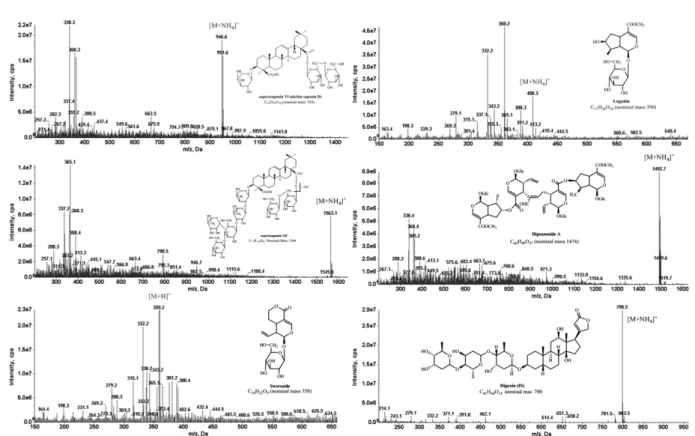
HAc), MeOH (5 mM NH4Ac), AcCN (0.5% HAc), AcCN (5 mM NH4Ac)를 검토한 결과, infusion 용매로써, MeOH (5 mM NH4Ac)을 사용하여 양이온 검출법에서 분자이온 피 크의 감도가 가장 높은 결과를 나타내었다. 검토한 성분은 모두 낮은 이온화 에너지(DP)에서 molecular adduct ion, [M+NH4]+이 검출되고, 높은 이온화 에너지에서는 [M+Na]+ 이온이 검출되었다. 단, sweroside (3)의 경우 [M+H]+이온 의 강도가 높은 것으로 확인되었다(Fig. 3).
MRM mode에 의한 [M+NH4]+등과 같은 q1 이온들을 CID(collisonally induced dissociation)에 의한 분해이온 스 펙트라 (q3 ion spectra)를 검토한 결과 terpenoid- 및 iridoid glycosides 성분들은 여러 개의 당분자(sugar moiety)를 포함
R2–R1
( )
R3 --- 100× Fig. 2. Schematic procedure for sample preparation.
하여 특징적 조각이온 보다 여러 가지 분해이온들이 복잡 하게 나타났으며, dipsanoside A (5)와 asperosaponin XII (2)의 경우 이온화 감도가 매우 낮았다. 속단에는 당이 여러 개 다양하게 결합된 saponins 성분들이 미량으로 많이 포함 되어 있으므로, 분석법의 선택성 면에서 MRM법에 의하기 보다 SIM법이 유리하다고 사료되었다.
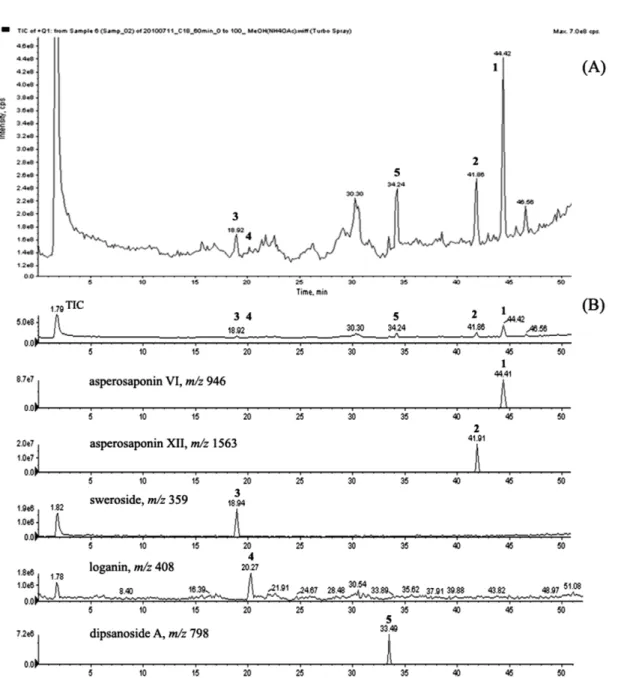
속단의 주성분 확인 − 속단의 주성분 확인을 위한 LC- TIC 및 SIM chromatograms은 Fig. 4와 같다. Fig. 4(A)에서 특징적으로 asperosaponin VI (1), asperosaponin XII (2), sweroside (3), dipsanoside A (5)가 유의한 수준으로, loganin (4)는 적은 양 포함되었음을 확인하였다. dipsanoside F (bis- iridoid glycoside)의 RT는 ~29 min이지만, RT 20~30 min 사이에 여러 가지 iridoids 및 terpene glycosides 로 추정되 는 성분들4)이 분리되지 않고 chromatogram상에 높은 backgrounds를 나타내는 것으로 보인다. RT ~45 min 이후 에 분리되는 성분은 asperosaponin VI (1)에 비해 당분자가 적게 결합한 HN-safonin F 등 terpenoid saponin 성분으로 추정되었다.
HPLC-SIM-MS 분석 − Fig. 4(A)의 TIC에서 확인된 5 성 분에 대한 동시분석의 최적조건을 탐색하기 위하여 이동상 용매 및 조성비, gradient flow 조건을 달리하여 최적 분리 조건을 검토한 결과 MeOH (5mM ammonium acetate)을 이 동상 용매로 사용할 때 분리도 및 검출감도 면에서 가장 양 호한 결과를 보였다. 검토한 성분들의 분자이온 검출의 최
적 SIM parameter는 Table II와 같으며 실험부에 기술한 gradient 조건에서 IS 포함 6 성분은 모두 30분 이내에 완전 분리되었다(Fig. 5). 한편 내부표준물로 사용한 digoxin (IS) 의 검출(m/z 798, [M+NH4]+)에 방해되는 속단성분은 없는 것으로 사료되었다.
분석법 검증 − 검량선과 직선성 범위(linear range), 검출 (LOD) 및 정량한계(LOQ)는 Table III과 같다. 각 성분은 넒 은 농도 범위에서 직선성을 나타냈고 상관계수(R2)는 모두 0.9997 이상을 보였다.
검체에서 서로 다른 3 농도를 spike한 QC sample의 성분 함량으로부터 정확도 및 정밀성을 검토한 결과는 Table IV 와 같다. Intra- 및 inter-day accuracy가 각각 97.7-110.4%, 94.0-111.0%로 나타났고, precision도 0.99-8.2%, 1.04-7.9%
로 나타났다.
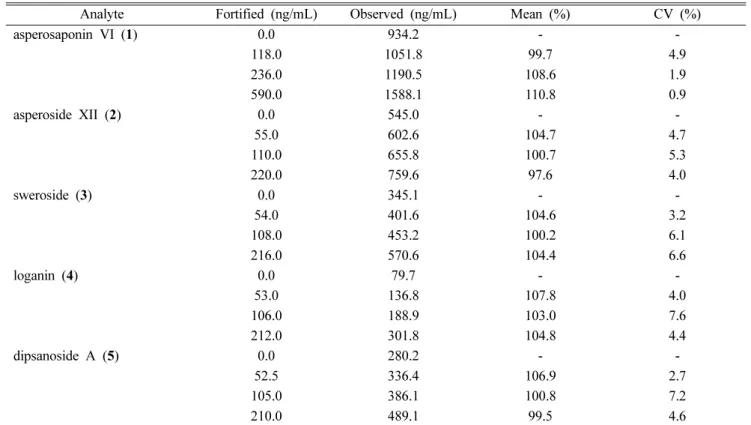
전 분석과정에 있어서의 회수율은 시료 중 포함될 것으로 추정되는 각 성분의 함량을 기준으로 10-100% 범위의 농 도로 표준물을 첨가하여 조제한 QC sample 4 batch (1 control)에 대하여 각 5 회씩 분석하여 구하였다(Table V)과 같다. 각 성분의 회수율은 93.7 - 110.8%의 회수율을 나타 내었다.
검체 분석 결과 − Table VI는 검체 21 종 즉, 속단(13 검 체) 및 수치제품(2종, 4검체)와, 한속단 (검체 4종)의 분석결 과(함량 %, w/w)를 보인다. Fig. 6는 triterpene glycosides 2 종(A)과 iridoid glycosides 3종(B)의 함량결과를 나타내었다.
Fig. 3. (-)ESI-MS spectra of the five compounds from Dipsaci radix and an internal standard, digoxin.
Fig. 4. TIC chromatogram (A) and SIM chromatograms (B) of a D. radix sample mobile phase: MeOH (containing 5 mM NH4Ac);
flow rate: 0.2 mL/min.; column temp.: 40oC; gradient flow: MeOH (aq), 10→90% (0→50min); 90→10% (50→55 min); 10% hold for 55-60 min HPLC column: Luna C18 (150× 2.0 mm, 5µm).
Table II. Optimized SIM parameters
Label Compound Chemical
Formula
Nominal
Mass Q1 ion(m/z) Ions DP FP
1 asperosaponin VI C47H76O18 928 946 [M+NH4]+ 61 310 2 asperosaponin XII C71H116O36 1544 1563 [M+NH4]+ 51 310
3 Sweroside C16H22O9 358 359 [M+H]+ 6 150
4 Loganin C17H26O10 390 408 [M+NH4]+ 1 130
5 Dipsanoside A C66H90O37 1474 1493 [M+NH4]+ 76 320 I.S. Digoxin (I.S.) C41H64O14 780 798 [M+NH4]+ 16 170 DP(V): Orifice voltage; FP(V): Ring voltage
Fig. 5. A typical LC-SIM MS chromatogram of a D. radix sample.
Table III. Calibration curve, linear range, limits of detection (LOD) and quantitation (LOQ) Analytes Linear range
(ng/mL) Slope Intercept Corelation Coefficient (r2)
LOD (ng/mL)
LOQ (ng/mL) asperosaponin VI (1) 12 - 5900 0.0005 -0.0003 1.0000 3.9 13.0 asperosaponin XII (2) 11 - 1100 0.0004 0.0010 0.9999 3.9 12.9
sweroside (3) 11 - 1080 0.0021 0.0088 0.9997 3.6 11.9
loganin (4) 11 - 1060 0.0027 0.0064 0.9998 3.3 10.9
dipsanoside A (5) 11 - 1050 0.0002 0.0001 0.9999 3.5 11.5 Table IV. Precision & Accuracy of analytical results (n=3)
Analyte Nominal conc.
(ng/mL)
Intra-day Inter-day
Observed SD Accuracy Precision Observed SD Accuracy Precision asperosapnin VI (1) 118.0 115.5 8.4 97.9 7.3 116.8 5.2 99.0 4.5
236.0 247.6 14.8 104.9 6.0 256.3 6.7 108.6 2.6 590.0 644.5 14.6 109.2 2.3 654.8 6.8 111.0 1.0 asperoside XII (2) 55.0 59.1 2.2 107.4 3.7 55.9 1.7 101.6 3.0
110.0 113.0 7.5 102.7 6.7 111.4 6.1 101.2 5.5 220.0 218.0 13.2 99.1 6.1 214.7 2.8 97.6 1.3 sweroside (3) 54.0 55.8 2.4 103.4 4.3 56.2 2.0 104.1 3.6
108.0 106.5 4.4 98.7 4.2 110.8 7.7 102.6 6.9 216.0 228.9 12.9 106.0 5.6 225.3 17.4 104.3 7.7
loganin (4) 53.0 58.5 1.3 110.4 2.2 56.2 2.3 105.9 4.0
106.0 111.2 10.1 104.9 9.1 109.8 7.8 103.6 7.1 212.0 231.7 3.7 109.3 1.6 217.0 9.4 102.4 4.3 dipsanoside A (5) 52.5 57.1 0.6 108.9 1.0 55.3 1.4 105.3 2.5 105.0 107.9 7.6 102.8 7.1 105.8 8.4 100.7 7.9 210.0 217.6 13.7 103.6 6.3 207.6 11.3 98.8 5.5
Table V. Recovery of marker compounds through standard addition (n=5)
Analyte Fortified (ng/mL) Observed (ng/mL) Mean (%) CV (%)
asperosaponin VI (1) 0.0 934.2 - -
118.0 1051.8 99.7 4.9
236.0 1190.5 108.6 1.9 590.0 1588.1 110.8 0.9
asperoside XII (2) 0.0 545.0 - -
55.0 602.6 104.7 4.7 110.0 655.8 100.7 5.3 220.0 759.6 97.6 4.0
sweroside (3) 0.0 345.1 - -
54.0 401.6 104.6 3.2 108.0 453.2 100.2 6.1 216.0 570.6 104.4 6.6
loganin (4) 0.0 79.7 - -
53.0 136.8 107.8 4.0 106.0 188.9 103.0 7.6 212.0 301.8 104.8 4.4
dipsanoside A (5) 0.0 280.2 - -
52.5 336.4 106.9 2.7 105.0 386.1 100.8 7.2 210.0 489.1 99.5 4.6 Table VI. Analytical results, w/w% (n=3)
Sample Class
Sample Code
asperosaponinVI asperosaponin XII sweroside dipsanoside A loganin mean ± SD mean ± SD mean ± SD mean ± SD mean ± SD
Dipsaci Radix
09D1001 7.6199 ± 0.2304 1.0607 ± 0.0145 1.3314 ± 0.0035 0.6412 ± 0.0140 0.2285 ± 0.0043 09D1002 2.3490 ± 0.0513 1.1871 ± 0.0327 0.3743 ± 0.0088 0.2787 ± 0.0057 0.0461 ± 0.0013 09D1003 6.7347 ± 0.4092 0.6379 ± 0.0366 1.1356 ± 0.0641 0.5368 ± 0.0052 0.2520 ± 0.0118 09D1004 6.7950 ± 0.2459 0.9806 ± 0.0341 0.9707 ± 0.0203 0.4580 ± 0.0138 0.1742 ± 0.0047 09D1005 2.1460 ± 0.0433 0.2931 ± 0.0013 0.3153 ± 0.0040 0.3753 ± 0.0042 0.0343 ± 0.0003 09D1006 4.4727 ± 0.3512 0.8730 ± 0.0184 0.7780 ± 0.0072 0.4192 ± 0.0091 0.1469 ± 0.0026 09D1007 3.7581 ± 0.3020 0.5273 ± 0.0133 0.5824 ± 0.0070 0.6486 ± 0.0080 0.2012 ± 0.0044 09D1008 5.2297 ± 0.2509 0.8185 ± 0.0265 0.6318 ± 0.0167 0.4959 ± 0.0154 0.1456 ± 0.0037 09D1009 6.4034 ± 0.5150 0.9677 ± 0.0602 0.7839 ± 0.0087 0.6031 ± 0.0281 0.1701 ± 0.0082 09D1010 3.2562 ± 0.0213 0.9036 ± 0.0174 0.7201 ± 0.0363 0.7293 ± 0.0139 0.1775 ± 0.0031 09D1011 3.6075 ± 0.4249 0.3541 ± 0.0097 0.4503 ± 0.0062 0.3601 ± 0.0279 0.2350 ± 0.0070 09D1020 6.3044 ± 0.5568 1.0636 ± 0.0351 0.5255 ± 0.0303 0.5040 ± 0.0168 0.1139 ± 0.0057 09D1021 6.8958 ± 0.3056 1.1019 ± 0.0588 0.5039 ± 0.0107 0.4879 ± 0.0129 0.0940 ± 0.0013 D. Radix
(A)
09D1018 3.1568 ± 0.0933 0.4408 ± 0.0088 0.6539 ± 0.0057 0.2053 ± 0.0040 0.3103 ± 0.0073 09D1019 7.4428 ± 0.3512 0.6861 ± 0.0129 0.8144 ± 0.0136 0.3013 ± 0.0093 0.1642 ± 0.0047 D. Radix
(B)
09D1016 1.7985 ± 0.0953 1.1267 ± 0.0610 0.8717 ± 0.0092 0.6571 ± 0.0238 0.1803 ± 0.0090 09D1017 1.3128 ± 0.0718 0.2045 ± 0.0004 0.8384 ± 0.0075 0.0647 ± 0.0007 0.2665 ± 0.0039 Phlomidis
Radix
09D1012 0.0473 ± 0.0021 N.D. N.D. N.D. N.D.
09D1013 N.D. N.D. N.D. N.D. N.D.
09D1014 0.0348 ± 0.0007 N.D. N.D. N.D. N.D.
09D1015 0.0302 ± 0.0001 N.D. N.D. N.D. N.D.
D. radix (A): processed drugs with liquors (酒炙); D. radix (B): processed drugs with salts (鹽炙)
속단시료 15 종에서 asperosaponin VI (1)의 함량은 2.1- 7.6%로 나타났으나 가공속단(염자)검체 2종에서는 2% 이 하로 나타났다. 한속단은 0.03-0.04%로 함량이 1/100 수준 이거나 검출되지 않으므로 천속단과의 구별이 가능하다.
asperosaponin XII (2)의 함량은 0.3-1.2%로, asperosaponin VI (1)에 비해 1/10 수준이지만 각 시료에 있어서 두 saponin 성분 간에는 어느 정도 비례적인 관계를 보이고 있다. 따라 서 체내에서 asperosaponin VI (1)의 최종 metabolites가 hederagenin으로 보고된 바,26) aperosaponin XII (2)의 체내 대사 및 metabolite에 대한 검토가 필요하리라 사료되었다.
iridoids 성분 중 sweroside (3)은 0.3-1.3%, loganin (4) 0.03-0.27%, dipsanoside A (5) 0.06-0.73%로 나타났다.
dipsanoside F는 시험재료 21 종에서 검출되지 않거나 정량 한계 아래(<0.04%)값을 나타내었다. Fig. 6(B)에서 iridoids 계 3 성분은 서로 상관관계가 없는 것으로 보인다. 따라서 천속단의 경우 asperosaponin VI 외에 asperosaponin XII와 sweroside, dipsanoside A도 속단의 약효, 분류 및 품질과 관 련하여 monitoring 해야 할 것으로 사료되었다. 위 분석결 과로부터 속단(천속단)과 한속단의 이화학적 감별은 간단히 이루어지지만, 속단 생산 각 지역을 구분하여 확보한 다수 의 검체분석 결과로부터 원산지 확인 및 보다 엄격한 품질
관리도 가능할 것으로 사료되었다.
결 론
HPLC-ESI-MS 분석법을 이용하여 한약재 '속단'으로부터 asperosaponin VI, asperosaponin XII, sweroside, loganin, 및 dipsanoside A의 동시분석법을 확립하고 validation하였 다. 본 분석결과로부터 속단(천속단)과 한속단의 이화학적 감별이 용이하였다. 이 분석법은 위 성분들을 지표로 한 속 단의 품질관리와 향후 시험기준법 개정에 활용될 것으로 사 료된다.
사 사
이 연구는 2009년 식품의약품안전청에서 지원한 국가 한 약재 품질과학화 연구사업과 2010년도 충북대학교 학술연 구지원사업의 연구비 지원에 의해 수행되었다.
인용문헌
1. Namba, T. (1980) The encyclopedia of Waken-Yaku (Tra- Fig. 6. Analytical results of the marker compounds: triterpene glycosides (A), iridoid glycosides (B).
ditional Sino-Japanese Medicines) with Color Pictures, 185- 186, Hoiku Publishing Co., LTD., Osaka.
2. Wang, B. X. (1999) Contemporary pharmacology of Chinese herbal medicine, 1263-1264, Tianjin Science and Technology Press, Tianjin.
3. Zhou, F. W., Shi, M. S. and Zhou, J. L. (1981) Chinese her- bology, 596-597, Shandong Science and Technology Press, Weifang, Shandong.
4. KFDA (2007) The Korean herbal pharmacopoeia, 222, KFDA, Seoul.
5. The state commission of Chinese pharmacopeia (2005) Phar- macopoeia of people's republic of China, Part I., 231, Chem- ical Industry Press, Beijing.
6. Zhang, Z. J., Qian, Y. H., Hu, H. T., Yang, J. and Yang, G. D.
(2003) The herbal medicine Dipsacus asper Wall extract reduces the cognitive deficits and overexpression of beta- amyloid protein induced by aluminum exposure. Life Sci. 73:
2443-2454.
7. Mazzio, E. A. and Soliman, K. F. (2009) In vitro screening for the tumoricidal properties of international medicinal herbs. Phytother. Res. 23: 385-398.
8. McGuffin, M. (1997) American herbal products associations botanical safety handbook, CRC Press, Boca Raton, Florida.
9. Zhao, Y. M. and Shi, Y. P. (2011) phytochemicals and bio- logical activities of Dipsacus species. Chem. Biodivers. 8:
414-430.
10. Jung, K. Y., Son, K. H. and Do, J. C. (1993) Triterpenoids from the roots of Dipsacus asper. Arch. Pharm. Res. 16: 32-35.
11. Niu, Y., Li, Y., Huang, H., Kong, X., Zhang, R., Liu, L., Sun, Y., Wang, T. and Mei, Q. (2011) Asperosaponin VI, a saponin component from Dipsacus asper Wall, induces osteoblast dif- ferentiation through bone morphogenetic protein2/p38 and extracellular signalregulated kinase 1/2 pathway. Phytother.
Res. 25: 1700-1706.
12. Zhou, Y. Q., Yang, Z. L., Xu, L., Li, P. and Hu, Y. Z. (2009) Akebia saponin D, a saponin component from Dipsacus asper Wall, protects PC 12 cells against amyloid-beta induced cytotoxicity. Cell Biol. Int. 33: 1102-1110.
13. Li, C., Liu, Z., Tian, J., Li, G., Jiang, W., Zhang, G., Chen, F., Lin, P. and Ye, Z. (2010) Protective roles of asperosaponin VI, a triterpene saponin isolated from Dipsacus asper Wall on acute myocardial infarction in rats. Eur. J. Pharmacol. 627:
235-241.
14. Zhang, Y. W. and Xue, Z. (1993) Structure determination of saponin XI, XII and XIII from Dipsacus asper Wall. Acta pharmaceutica Sinica 28: 358-363.
15. Zhang, Y. W. and Xue, Z. (1992) Structure determination of saponin IX and X from Dipsacus asper Wall. Acta phar- maceutica Sinica 27: 912-917.
16. Wei, F., Lou, Z. C., Liu, Y. M. and Miao, Z. C. (1994) Appli- cation of new techniques of NMR in the structure elucidation of two new saponins, asperosaponin F and H1, and spectral rules involved. Acta Pharmaceutica Sinica 29: 511-518.
17. Tomita, H. and Mouri, Y. (1996) An iridoid glucoside from Dipsacus asperoides. Phytochemistry 42: 239-240.
18. Tian, X. Y., Wang, Y. H., Liu, H. Y., Yu, S. S. and Fang, W.
S. (2007) On the Chemical constiruents of Dipsacus asper.
Chem. Pharm. Bull. 55: 1677-1681.
19. Tian, X. Y., Wang, Y. H., Liu, H. Y., Yu, S. S. and Fang, W.
S. (2006) Two novel tetrairidoid glucosides from Dipsacus asper. Org. Lett. 8: 2179-2182.
20. Son, J., Lee, J., Han, C. K., Kwak, W. J., Yang, R. and Kim, D. H. (2005) Simultaneous quantitation of loganin and sweroside in plasma using column-switching high-perfor- mance liquid chromatography. Anal. Chim. Acta., 503: 257- 261.
21. Chiba, K., Yamazaki, M., Kikuchi, M., Kakuda, R. and Kiku- chi, M., (2011) New physiological function of secoiridoids:
neuritogenic activity in PC12h cells. J. Nat. Med. 65: 186- 190.
22. Luo, Y. D., Chen, J., Cao, J., Wen, X. D. and Li, P. (2009) Determination of sweroside in rat plasma and bile for oral bioavailability and hepatobiliary excretion. Chem. Pharm.
Bull. 57: 79-83.
23. Park, J. H., Bae, J. Y. and Ahn, M. J. (2009) Pharmacog- nostical studies on the 'SokDan' from Korea. Kor. J. Phar- macogn. 40: 286-288.
24. Lee, M. Y., Ryuk, J. A., Kim, H. J., Kim, Y. H., Chae, B. C.
and Ko, B. S. (2007) Discrimination of Phlomidis Radix and Dispsaci Radix using random amplified polymorphic DNA analysis. Korea Journal of Oriental Medicine 13: 147-152.
25. Zhu, H., Ding, L., Shakya, S., Qi, X., Hu, L., Yang, X. and Yang, Z. (2011) Simultaneous determination of asperosa- ponin VI and its active metabolite hederagenin in rat plasma by liquid chromatography-tandem mass spectrometry with positive/negative ion-switching electrospray ionization and its application in pharmacokinetic study. J. Chromatogr. B. 879:
3407-3414.
26. Shakya, S., Zhu, H., Ding, L., Du, X. L., Qi, X. M., Yang, X.
L. and Yang, Z. L. (2012) Determination of asperosaponin VI in dog plasma by high-performance liquid chromatography- tandem mass spectrometry and its application to a pilot phar- macokinetic study. Biomed. Chromatogr. 26: 109-114.
27. Li, K., Ding, L., Yang, Z. L., Liu, E. H., Qi, L. W., Li, P. and Hu, Y. Z. (2010) Determination of asperosaponin VI in rat plasma by HPLC-ESI-MS and its application to preliminary pharmacokinetic studies. Biomed. Chromatogr. 24: 550-555.
28. Li, K., Yang, X. L., Zhang, C. F. and Yang, Z. L. (2009) Metabolites of asperosaponin VI in rats' feces by HPLC-MS.
Chin. J. Nat. Med. 7: 440-443.
29. Guan, X. Y., Li, H. F., Yang, W. Z., Lin, C. H., Sun, C., Wang, B. R., Guo, D. A. and Ye, M. (2011) HPLC-DAD-MSn anal- ysis and HPLC quantitation of chemical constituents in Xian- ling-gu-bao capsules. J. Pharm. Biomed. Anal. 55: 923-933.
(2012. 2. 4 접수; 2012. 4. 3 심사; 2012. 4. 18 게재확정)