버섯재배 배지재료용 수입 농업부산물에서의 세균 조사 연구
김준영 ・ 김수산 ・ 김성환*
단국대학교 자연과학대학 미생물학과 및 생물다양성연구소
Investigation of bacteria in the agricultural by-products imported for the use as media materials in mushroom cultivation
Jun Young Kim , Susan Kim, and Seong Hwan Kim*
Department of Microbiology and Institute of Biodiversity, College of Natural Science, Dankook University, Cheonan 31116, Republic of Korea
(Received November 19, 2018; Revised November 29, 2018; Accepted November 29, 2018)
*For correspondence. E-mail: [email protected];
Tel.: +82-41-550-3454; Fax: +82-41-523-3454
It is urgently required to construct safety data on agricultural by-products imported for use as medium materials for domestic mushroom production. However, research on microorganisms is insufficient. This study was conducted to investigate the presence of bacteria that have the possibility of harmful effects on human, plants and mushroom in wheat straw, peatmoss, cottonseed hull, cottonseed meal, and beet pulp imported from Australia, Canada, China, Egypt, Germany. Bacteria were found in the range of 1.35 × 10
2to 8.34 × 10
6CFU/g. As a result of 16S rDNA sequence analysis, total of 19 genera and 45 species of bacteria were identified. Bacillus genus was dominant, followed by Paenibacillus genus. At the species level, diverse species was in the order of Firmicute, Proteobacteria and Actinobacteria.
Regarding the agricultural by-products, straw and peat moss had more diverse bacteria than other agricultural by-products.
Among the indentified bacteria, 6 species of 5 genera (Enterobacter asburiae, Enterobacter ludwigii, Stenotrophomonas maltophilia, Pseudomonas monteilii, Bacillus anthracis, and Cellulosimicrobium funkei) were present as potent harmful bacteria to human.
Surprisingly, both the human and plant pathogenic Klebsiella pneumoniae subsp. pneumonia was present. Bacillus altitudinis was present as a plant pathogen. Lysinibacillus sphaericus, an insect pathogen, and Ochrobactrum pseudogrignonense, a mushroom pathogen, were also present. The results of this
study confirmed that several kinds of pathogenic bacteria were present in the agricultural by-products for the mushroom cultivation medium imported into Korea. Our work suggests that hygiene inspection and management is urgently needed for imported agricultural by-products to be safely used for mushroom production.
Keywords: bacterial concentration and diversity, harmful bacteria, imported agricultural by-products, mushroom cultivation media materials
농산물우수관리(Good Agricultural Practices, GAP) 제도
는 생산에서부터 수확 후 포장단계에 이르기까지 농산물에 잔
류 가능성이 있는 유해생물, 농약, 중금속 등 위해 요소들을 사
전에 철저하게 관리하여 안정성을 확보하는 제도로 소비자에
게 안전하고 건강한 농산물을 공급하는데 목적이 있다. 이 제
도는 EU(유럽연합), 미국 등 선진국에서는 보편적으로 운영
되고 있다. 국내에는 2006년부터 도입이 되었고, 2009년에
GAP 표준재배지침서를 농촌진흥청에서 발간하여 농산물우
수관리인증을 위한 전반적인 관리기준을 설정하였다. 2014년
9월에 농업인은 보다 쉽게 인증신청을 할 수 있고 안전관리는
더욱 강화하도록 개정되었다. 하지만 국내 GAP 인증을 위한
버섯 분야에 대한 연구는 대부분이 버섯 육종이나 버섯의 자
실체 영양성분 그리고 유용성분 분석을 중심으로 주로 진행되
어 왔고 버섯을 배양하는 버섯배지 원료의 특성, 영양성분, 오 염도, 추적관리 등에 관한 연구는 미비하였다. 이에 따라 유해 생물로서 미생물에 대한 연구 또한 미미한 실정이다.
국내에서 생산 및 재배되는 버섯의 종류는 많지만 그 중 식 용으로 많이 소비되는 버섯은 표고버섯(Lentinula edodes), 양 송이버섯(Agaricus bisporus), 느타리버섯(Pleurotus ostreatus), 팽이버섯(Flammulina velutipes) 등이 있다. 느타리와 양송이 버섯은 주로 농업부산물인 피트모스, 면실박, 면실피, 비트펄 프 등을 적절히 배합하여 버섯배지로 사용하여 재배하고 있다 (Kim et al., 2012; Jang et al., 2014). 점차 버섯의 수요가 늘어 감에 따라 버섯재배용 배지재료는 국내 공급이 충분하지 않아 해외에서 수입하여 버섯배지 원료로 사용하여 버섯을 생산하 고 있는 추세이다. 수입하여 사용하는 농업부산물의 공급 또 한 수출국의 사정에 따라 적기에 수입이 용이치 않아 수입국 을 다변화하고 있는 실정이다. 또한 이러한 실정에 더하여 수 입물량이 충분치 않은 경우도 있고 수입 농업부산물의 가격 상승으로 인해 버섯 재배 생산 단가가 오름으로 인해 경영적 어려움이 가중되면서 사용하는 농업부산물의 다양화도 추진 되고 있는 실정이다. 이런 가운데 농산물우수관리 제도 도입 으로 인해 버섯 재배에 사용되는 배지 재료의 안전성에 대한 자료가 요구되고 있다. 그러나 아직 이러한 자료가 매우 부족 한 실정이다. 특히 수입하는 농업부산물의 안전성에 대한 기 초 정보는 더욱 더 미미한 실정이다. 수입된 농업부산물은 버 섯균의 생장에 필요한 유기물이 풍부하여 각종 미생물들이 존 재 할 가능성이 있으며 농업에 사용되고 남은 부산물이라 농 약이나 중금속에 오염이 되어있을 가능성이 존재한다.
수입된 농업부산물은 대규모 단위로 수입되며 버섯재배 농 가 또는 버섯 배지 생산 공장으로 수송된다. 수입용도가 버섯 배지 또는 축산사료의 조사료로 들여오기 때문에 유해병원균 의 검출을 수행하는 검역적 단계를 거치지 않고 수입되고 있 는 실정을 감안 할 때 유해한 미생물들이 국내에 유입될 가능 성이 다분히 존재하다. 이에 따라 유해미생물 존재 가능성에 대해 본 연구진은 선행연구로서 2015년에 수입된 5가지 농업 부산물을 분석하여 Bacillus anthracis, B. oleronius, Eurotium amstelodami, Aspergillus flavus 등 인체에 유해성이 알려진 미생물이 존재함을 보고하였다(Kwon et al., 2015; Lee et al., 2016). 선행 연구 결과는 수입되는 국가와 재료들이 다양하고 연도별 수입되는 농업부산물에 대한 미생물 상이 다를 수 있 는 바 유해미생물의 범위가 어디까지 인지 보다 확대된 조사 연구가 필요함을 제시하였다. 따라서 본 연구는 지속적인 모 니터링을 수행하여 2016년, 2017년 2년 동안 7개국으로부터 수입된 농업부산물에서 세균의 존재를 농도 수준에서 확인하
고 순수분리 후 종 동정을 수행하여 농업부산물에 대한 세균 의 다양성과 그 특성을 조사하고자 수행하였다. 그 결과 인체, 식물, 버섯에 대한 유해세균의 종으로 추정되는 존재를 확인 하여 보고하고자 한다.
재료 및 방법
수입 버섯배지 재료용 농업부산물
국내 버섯 중 GAP 인증을 위한 연구 대상이 되어온 품목인 느타리와 양송이 버섯 재배에 필요한 밀짚(Wheat straw), 피트 모스(Peat moss), 면실박(Cottonseed meal), 면실피(Cottonseed hull), 비트펄프(Beet pulp) 등 5가지 농업부산물을 대상으로 분석하였다. 2016년에는 호주에서 수입한 밀짚, 캐나다에서 수입한 피트모스, 중국에서 수입한 면실박, 이집트에서 수입 한 비트펄프, 인도에서 수입한 비트펄프와 면실피를 분석하 였고 2017년에는 이집트에서 수입한 비트펄프, 독일에서 수 입한 피트모스, 인도에서 수입한 면실피와 면실박, 우크라이 나에서 수입한 비트펄프를 분석하였다. 총 7개 국가에서 수입 한 11가지 농업부산물 시료를 세균 분석용 시료로 수행하였 다. 농업부산물 시료는 수입농가에서 직수입후 농가와 유통 업체에 배달된 신선 시료만을 대상으로 하였고 밀봉된 포장 을 개봉하자 마자 바로 시료를 클린 지퍼백에 일정 양을 주변 에서 오염되지 않도록 담은 후 실험실로 가져와 분석에 사용 하였다.
세균의 분리 및 동정
분리 검출 하기 위하여서는 생물안전실험대에서 각 농업부
산물 시료 2 g을 멸균 수 각각의 시료들은 생체중량으로 실험
을 진행하였으며 각 시료의 수분함량은 Table 1에 명시하였
다. 세균을 수저로 퍼서 정량 후, 50 ml 멸균 플라스틱 튜브에
담긴 멸균 증류수 20 ml에 넣고 시험관 혼합기를 사용하여 농
업부산물에서 세균이 멸균 증류수에 용출 될 수 있게 3분 동안
부유시켰다. 부유시킨 플라스틱 튜브는 10분간 상온에 방치
하여 농업부산물을 침전시키고 상등액을 취하였다. 세균이 용
출된 상등액은 계단희석법으로 10
-3까지 희석하였고 곰팡이
생장 억제를 위해 항진균제인 베노밀(100 µg/ml)을 첨가한 세
균 배양배지인 Tryptone Soya Agar (TSA, OXOID)에 100 µl
씩 도말 하였다. 배지는 25°C 배양기에서 암조건으로 3일간
배양하였고 자라나온 콜로니를 계수하여 세균 농도를 계산하
였다. 모든 실험은 3회 반복으로 수행하여 실험의 오차를 줄이
며 정확도를 높이고 다양한 세균을 배양하려 하였다. 결과는
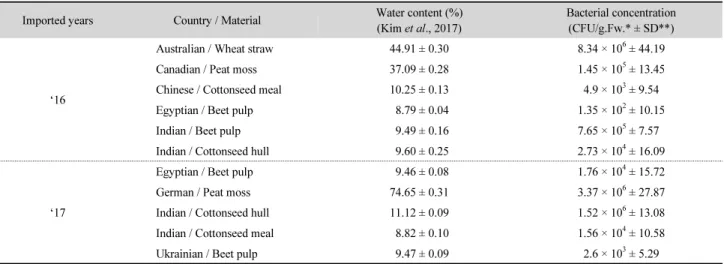
Table 1. Bacterial concentration in the agricultural by-products imported for the use as media materials in mushroom cultivation
Imported years Country / Material Water content (%)
(Kim et al., 2017)
Bacterial concentration (CFU/g.Fw.* ± SD**)
‘16
Australian / Wheat straw 44.91 ± 0.30 8.34 × 10⁶ ± 44.19
Canadian / Peat moss 37.09 ± 0.28 1.45 × 10⁵ ± 13.45
Chinese / Cottonseed meal 10.25 ± 0.13 4.9 × 10³ ± 9.54
Egyptian / Beet pulp 8.79 ± 0.04 1.35 × 10² ± 10.15
Indian / Beet pulp 9.49 ± 0.16 7.65 × 10⁵ ± 7.57
Indian / Cottonseed hull 9.60 ± 0.25 2.73 × 10⁴ ± 16.09
‘17
Egyptian / Beet pulp 9.46 ± 0.08 1.76 × 10⁴ ± 15.72
German / Peat moss 74.65 ± 0.31 3.37 × 10⁶ ± 27.87
Indian / Cottonseed hull 11.12 ± 0.09 1.52 × 10⁶ ± 13.08
Indian / Cottonseed meal 8.82 ± 0.10 1.56 × 10⁴ ± 10.58
Ukrainian / Beet pulp 9.47 ± 0.09 2.6 × 10³ ± 5.29
* g.Fw., gram fresh weight; ** SD, standard deviation
평균치를 제시하였다. 자라난 세균 콜로니는 모양, 색, 크기 등 을 관찰하여 형태적으로 다르게 보이는 콜로니를 선택하여 새 로운 TSA 배지에 3차 획선도말법으로 접종하여 자라나온 콜 로니를 순수분리 하였다.
순수분리된 세균은 16S rDNA를 분석하여 동정하였다. 3차 획 선도말법으로 순수분리된 세균 콜로니 하나를 멸균 증류수 100 µl에 풀어 100°C로 5분간 처리하고 13,000 rpm으로 1분간 원 심분리 한 다음 상층액 1 µl를 취하여 PCR 반응에 주형 DNA로 사용하였다. 16S rDNA 분석을 위해서 27F와 1492R 프라이머 를 사용하였고(Cohen et al., 1972), PCR 조건은 95°C에서 5분 반응하여 DNA 변성시키고, 95°C에서 30초(변성, denaturation), 52°C에서 30초(결합, annealing), 72°C에서 1분 30초(신장, extension) 순서로 30회 반복 수행하고 마지막으로 72°C에서 10 분 반응하여 증폭하였다. 증폭된 PCR 산물은 1% 아가로즈 겔에서 전기영동하여 약 1.4 kb 크기의 밴드를 확인한 다음 NAVIGen
TMPCR Purification Kit (NAVIBIOTECH)를 사용하 여 정제하고 Macrogen사에 의뢰하여 염기서열을 분석하였다.
분석된 염기서열은 EZBioCloud (https://www.ezbiocloud.net) 에서 상동성을 분석하여 세균의 종을 동정하였다. 세균의 계 통분류학적 분석은 MEGA ver. 7.0 프로그램을 이용하여 분석 된 16S rDNA 염기서열을 Neighbor-joining 방법으로 1,000번 의 부스트랩 재형성하여 수행하였다(Saitou and Nei, 1987;
Kumar et al., 2016). 분석된 종에 대한 알려진 특성 조사는 인 터넷 웹 서치 조사와 문헌조사, 미생물 저널 사이트 등을 대상 으로 조사하였다.
결과 및 고찰
수입된 농업부산물 내 세균 농도
선행연구로써 측정된 수입된 농업부산물의 수분함량은 약 8~74% 로 세균의 생존이 충분히 가능한 범위이며 그 밖에 세 균의 생장에 사용될 수 있는 조회분, 조단백, 조지방, 조섬유 등 영양분도 충분히 함유하였다(Kim et al., 2017). 2016년 호주 밀짚에서는 8.34 × 10
6CFU/g, 캐나다 피트모스는 1.45 × 10
5CFU/g, 중국 면실박은 4.9 × 10
3CFU/g, 이집트 비트펄프는 1.35 × 10
2CFU/g, 인도 비트펄프와 면실피에서 각각 7.65 × 10
5CFU/g, 2.73 × 10
4CFU/g농도로 세균이 존재하였다(Table 1). 2017년 이집트 비트펄프는 1.76 × 10
4CFU/g, 독일 피트모 스는 3.37 × 10
6CFU/g, 인도 면실박과 면실피에서 각각 1.52
× 10
6CFU/g, 1.56 × 10
4CFU/g, 우크라이나 비트펄프에서는
2.6 × 10
3CFU/g 농도로 세균이 존재하였다. 세균의 전체적 농
도 수준은 이전 선행 조사에서 보여진 농도 수준과 대체로 유
사하였다(Kwon et al., 2015). 같은 농업부산물 품목이라도 생
산된 나라가 다르면 세균의 농도가 다르게 존재하는 것으로
나타났다. 또한 이집트 비트펄프의 경우 2016년 샘플보다 2017
년 샘플에서 세균의 농도가 더 높게 나타났고 인도의 면실박
에서도 2017년 샘플에서 세균의 농도가 더 높았다. 이 같은 결
과는 같은 나라에서 수입된 같은 농업부산물 품목이라도 연도
에 따라 세균 농도에 차이가 있음을 보여준다. 이러한 결과는
수입되는 모든 농업부산물에 세균이 어느 정도 존재하는지 보
여주는 확실한 증거를 제시한다. 수입 연도와 수입국가에 따
라 세균 농도에 변동이 있음을 볼 때 세균의 종도 변화될 가능
성이 존재한다. 이에 따라 분리 동정을 실시하였다.
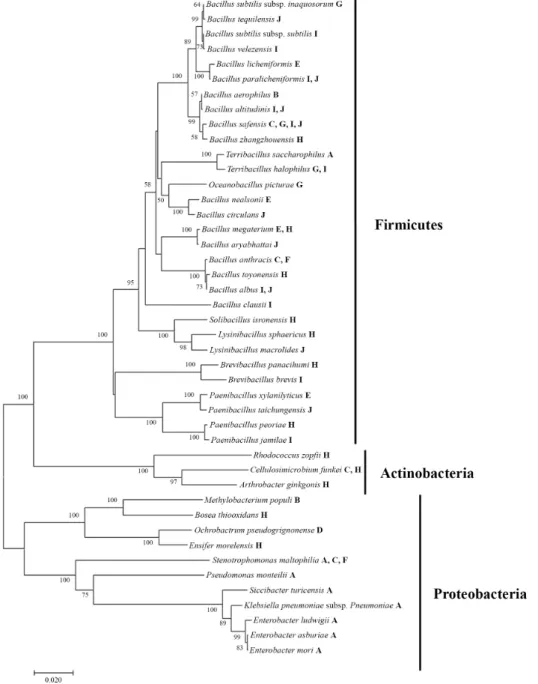
Fig. 1. Phylogenetic analysis of the isolated bacteria in this study based on the 16S rDNA sequences. The evolutionary history was inferred using the neighbor-joining method (Saitou and Nei, 1987). The percentage of replicate trees in which the associated taxa clustered together in the bootstrap test (1,000 replicates) are shown next to the branches (Felsenstein, 1985). The evolutionary distances were computed using the Kimura 2-parameter method (Kimura, 1980) and are in the units of the number of base substitutions per site. The analysis involved 44 nucleotide sequences. Evolutionary analyses were conducted in MEGA7 (Kumar et al., 2016).
A, 2016 Australian wheat straw; B, 2016 Canadian peat moss; C, 2016 Chinese cottonseed meal; D, 2016 Egyptian beet pulp; E, 2016 Indian beet pulp; F, 2016 Indian cottonseed hull; G, 2017 Egyptian beet pulp; H, 2017 German peat moss; I, 2017 Indian cottonseed hull; J, 2017 Indian cottonseed meal; K, 2017 Ukrainian beet pulp.
세균 동정 및 보고된 특성
수입된 농업부산물 시료에서 순수 분리된 세균을 TSA 배지 에서 획선 접종하고 배양하여 자라난 콜로니는 다양한 모양이 존재하였고 노랑색, 분홍색 등 다양한 색소를 지니고 있었다. 이 러한 다양한 세균을 16S rDNA sequence를 분석하여 동정한 결
과 2016년, 2017년 수입된 11가지 농업부산물 시료에서 총 19
속 45종으로 다양하게 나타났다. 분류학적으로 3가지 그룹으로
나뉘어 졌으며 Firmicutes에 속하는 종이 30종으로 가장 다양하
게 분리되었고 Proteobacteria가 11종, Actinobacteria는 3종이
분리되었다(Fig. 1). Firmicutes에 속하는 분류군으로서는 Bacillus
Table 2. Known properties of the identified bacteria isolated from the agricultural by-products imported in 2016 for the use as media materials in mushroom cultivation
Country / Material Species name Known properties References
Australian / Wheat straw
Enterobacter asburiae Human pathogen Koth et al. (2012)
Enterobacter ludwigii Human pathogen Flores-Carrero et al. (2016)
Enterobacter mori -
Klebsiella pneumoniae subsp. pneumoniae Plant pathogen Human pathogen
Nicolau Korres et al. (2013), Liu et al. (2012)
Stenotrophomonas maltophilia Human pathogen Kaito et al. (2018),
Latzer et al. (2018)
Pseudomonas monteilii Human pathogen Shariff and Beri (2017)
Siccibacter turicensis -
Terribacillus saccharophilus -
Canadian / Peat moss
Bacillus aerophilus Probiotic Ramesh et al. (2017)
Methylobacterium populi -
Chinese / Cotton seed meal
Bacillus anthracis Human pathogen Carlson et al. (2018)
Bacillus safensis Biocontrol of virulence factor Mayer and Kronstad (2017)
Cellulosimicrobium funkei Human pathogen Petkar et al. (2011)
Stenotrophomonas maltophilia Human pathogen Kaito et al. (2018), Latzer et al. (2018) Egyptian / Beet pulp
Ochrobactrum pseudogrignonense Mushroom tumor Wu et al. (2016)
Indian / Beet pulp
Bacillus licheniformis Probiotic Gao et al. (2108)
Bacillus megaterium Plant growth promotion,
Biocontrol of aflatoxin, Biological control
Mannaa et al. (2017), Ortíz-Castro et al. (2008), Padgham and Sikora (2007)
Bacillus nealsonii -
Paenibacillus xylanilyticus Biocontrol of hairy root disease Bosmans et al. (2017) Indian / Cottonseed hull
Bacillus anthracis Human pathogen Carlson et al. (2018)
Stenotrophomonas maltophilia Human pathogen Kaito et al. (2018), Latzer et al. (2018)
속 세균이 18종으로서 가장 다양하였다. 이 결과는 이전 연구 에서 Firmicutes, Proteobacteria, Actinobacteria 세균이 주로 존 재하였다는 결과와 그리고 이 3가지 속 중에 Firmicutes가 가장 다양하였다는 결과와도 일치한다 (Kwon et al., 2015). 그러나 이 전 연구에서는 Bacteriodetes 존재하였지만 본 연구에서는 존 재하지 않는 차이를 보였다. 그리고 이전 연구에서는 Actino- bacteria 세균이 Proteobacteria 세균 보다 좀 더 다양하게 분리 되었는데 본 연구에서는 그 반대로 Proteobacteria 세균이 Actinobacteria 세균보다 더 다양하게 분리되는 차이를 보였다.
조사된 각 시료에서 동정된 세균을 살펴보면 2016년 호주 밀짚에서는 6속 8종으로 동정되었다(Table 2). 인체 위해성이
보고된 종으로는 연조직에 감염되어 괴사성 염증을 일으키는 Enterobacter asburiae와 혈류감염을 일으키는 E. ludwigii, 기회 감염균으로 장염을 일으키고 균혈증, 호흡기 감염, 요로감염, 심 내막염, 수막염 등을 일으키는 것으로 보고된 Stenotrophomonas maltophilia 그리고 기관지 감염 및 폐질환을 일으키는 것으로 알려진 Pseudomonas monteilii 등 3속 4종이 동정되었다(Koth et al., 2012; Flores-Carrero et al., 2016; Shariff and Beri, 2017;
Kaito et al., 2018; Latzer et al., 2018). 그리고 흥미롭게도 인체
에 페렴을 일으키는 것으로 잘 알려졌지만(Liu et al., 2012) 동
시에 식물병원균으로서 파인애플에 병을 일으키는 것으로 보
고된 Klebsiella pneumoniae subsp. pneumoniae가 존재하였
다(Nicolau Korres et al., 2013). 캐나다 피트모스에서는 2속 2 종이 분리되었다. 그러나 인체, 식물, 버섯 등에 유해한 종은 없 었다. 중국 면실박에서는 3속 4종이 분리되었다. 이중 인체 위 해성이 보고된 세균으로 심내막염, 척추염, 폐질환을 일으키 는 것으로 알려진 Cellulosimicrobium funkei, S. maltophilia 그 리고 탄저병을 일으키는 것으로 알려진 Bacillus anthracis가 존재하였다(Petkar et al., 2011; Carlson et al., 2018; Kaito et al., 2018; Latzer et al., 2018). 본 연구에서 분리된 세균들이 병 원균으로 보고된 종과 염기서열이 매우 유사하지만 병원성을 지니고 있는지는 확실하지 않으므로 추후에 독소 유전자나 해 당 병원균의 specific marker로 확인을 해서 좀더 병원성 균임 을 명확히 할 필요가 있다. 특히 Bacillus 그룹은 16S rDNA로 는 종 구분이 어렵지만 본 실험에서 16S rDNA 염기서열 상동 성이 가장 높은 종으로 선택하였다. 이집트 비트펄프는 다른 농업부산물과는 다르게 세균 농도도 낮았을 뿐만 아니라 동정 된 세균도 Ochrobactrum pseudogrignonense 1종만 나타났다.
그러나 이 세균은 팽이버섯에 종양을 일으킨다고 아주 최근에 신종병해로 보고되었다(Wu et al., 2016). 국내에 수입된 농업 부산물은 느타리, 양송이 버섯 이외에도 표고, 팽이 등의 병재 배 방식의 배지재료로 사용되는 바 이 균은 수입 농업부산물 을 버섯배지 재료로 사용하는 국내 팽이 버섯 농가에 피해를 줄 소지가 있으므로 주의해야 할 세균이다. 따라서 본 연구에 서 이 균의 검출은 수입 농업부산물 관리를 위해 매우 중요한 정보로서 의미가 깊다.
인도 비트펄프는 2속 4종이 존재하였고 면실피에는 2속 2 종이 동정되었고 2종 모두 인체 위해성이 보고된 B. anthracis, S. maltophilia 였다(Carlson et al., 2018; Kaito et al., 2018;
Latzer et al., 2018). 2017년 이집트 비트펄프에서는 3속 4종이 동정되었으며 독일 피트모스에서는 10속 12종으로 가장 다양 한 세균이 존재하였다(Table 3). 이 중에는 인체 위해성 세균으 로 보고된 C. funkei이 존재하였다(Petkar et al., 2011). 인도 면 실박과 면실피에서는 각각 4속 10종, 2속 7종이 동정되었고 식 물병원균으로 사과와 배에 병을 일으키는 Bacillus altitudinis 이 공통으로 존재하였다(Elbanna et al., 2014). 우크라이나 비 트펄프에서는 2속 2종으로 분리되었으나 유해균은 존재하지 않았다. 이상의 결과는 본 연구에서 동정된 세균에 인체, 식물, 버섯 그리고 곤충에 병원성 있는 유해 세균이 존재하고 있음 을 보여주는 근거 자료를 제시한다.
수입 농업부산물에 존재하는 것으로 확인된 동정된 세균의 국내 유입에 대한 출처를 분석하는데 기초자료를 얻고자 본 연구에서 2016년과 2017년에 7개국에서 수입된 11가지 농업 부산물에서 동정된 세균들과 2015년에 5개국에서 수입된 5가
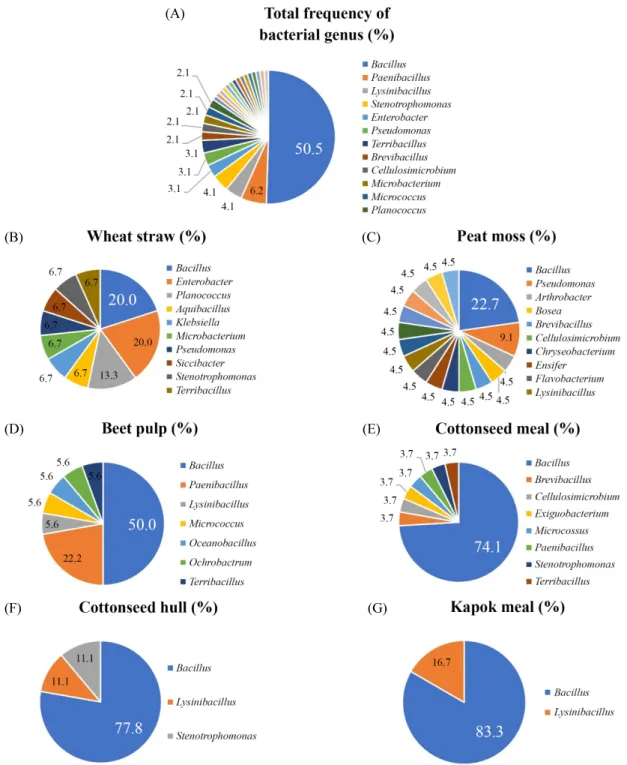
지 농업부산물에 대한 선행연구 결과(Kwon et al., 2015)와 합 하여 농업부산물별 세균을 속 수준에서 그 빈도를 분석하였다 (Fig. 2). 그 결과 전체 농업부산물에서 나타난 세균은 Bacillus 속이 50.5%로 가장 많이 나타났으며 그 뒤를 이어 Paenibacillus 6.2%, Lysinibacillus 4.1% 로 나타났다. 분석된 각각의 모든 농업 부산물에서 Bacillus 속이 가장 높은 비율을 차지하였다. Bacillus 속은 어디에나 존재하는 아주 흔한 세균이며 내생포자를 생성 하고 높은 pH, 높은 염농도, 저온과 고온 등 극한 환경에서도 생존이 가능하기에 가장 높은 비율을 차지한다고 사료된다. 밀 짚에서는 Bacillus 속과 Enterobacter 속이 각각 약 20%로 총 40%를 차지하였다. 피트모스에서는 Bacillus 속이 약 22.7%
로 높은 비율을 차지하였고 Pseudomonas 속이 9.1%를 차지 하였는데 다른 농업부산물에 비하여 가장 다양한 세균의 속이 존재하였다. 피트모스의 수분함량은 대체적으로 약 37~74%
로 높은 수분함량을 보였으며 세균 농도 또한 1.45 × 10
5~3.37
× 10
6CFU/g 수준으로 높게 나타났기에 이러한 결과가 도출되 었다고 사료된다. 비트펄프에서는 Bacillus 속이 약 50%를 차 지하였고 Paenibacillus 속이 약 22.2%를 차지하였다. 면실박 과 면실피에서도 Bacillus 속이 각각 74.1%와 77.8%로 많이 차지하였다. 케이폭박은 시료 개수가 1개로 부족하지만, 세균 종류는 2종류 나왔고 역시 Bacillus 속이 83.3%를 차지하였다.
이상으로 Fig. 2에 나타난 결과를 볼 때 모든 수입 농업부산물 에서 Bacillus 속이 가장 높은 빈도로 분리될 세균임을 알 수 있 었다. 그리고 종 다양성이 늘어 날수록 Bacillus 속이 차지하는 비율이 낮아짐을 볼 수 있었다. Bacillus 속에 속하는 종 중에는 분류학적으로 B. subtilus를 위시하여 species complex 그룹에 속하는 종들이 여러 종 존재하는데 이들의 세밀한 분류에는 16S rDNA sequence 분석만으로는 한계가 존재한다. 따라서 본 연구에서 동정한 Bacillus 속에 속하는 종 중 일부는 차후 rpoB 유전자와 유전체 서열(Fan et al., 2017) 등을 분석하여 좀 더 자세하게 구분하는 것이 필요하다고 사료된다.
최근 수입되는 버섯배지 재료로 사용중인 수입 농업부산물
에서 농약과 중금속을 측정한 결과 납(Pb), 구리(Cu), 니켈(Ni),
카드뮴(Cd), 수은(Hg) 등이 버섯을 키우기 위한 토양의 중금속
허가 기준치(비료공정규격, 농촌진흥청고시 제 2007-3)를 초과
하지는 않았지만 존재하였고, 3종류의 잔류농약(Imidacloprid,
Thiamethoxam, Carbendazim)이 검출된 사례가 있다(Kim et
al., 2017). 이렇듯 버섯배지로 사용이 되는 수입된 농업부산물
에는 인체 유해 중금속, 잔류농약이 존재하지만 유해 가능성 있
는 미생물에 대한 정보가 부재한 실정에서 본 연구 결과에서 도
출된 유해 가능 세균에 대한 정보는 시의적절한 것으로 매우 가
치가 있다고 사료된다. 왜냐하면 농업부산물의 인체 유해균의
Table 3. Known properties of the identified bacteria isolated from the agricultural by-products imported in 2017 for the use as media materials in mushroom cultivation
Country / Material Species name Known properties References
Eqyptian / Beet pulp
Bacillus subtilis subsp. inaquosorum Production of a lipopeptide biosurfactant, Production of a cellulose
Gautam and Sharma (2012), Regmi et al. (2017)
Bacillus safensis Production of inulinase Singh et al. (2013)
Oceanobacillus picturae -
Terribacillus halophilus -
German / Peat moss
Arthrobacter ginkgonis -
Bacillus toyonensis Production of a glycoprotein bioflocculant, a feed additive
Okaiyeto et al. (2015)
Bacillus megaterium Plant growth promotion,
Biocontrol of aflatoxin, Biological control
Mannaa et al. (2017), Ortíz-Castro et al. (2008), Padgham and Sikora (2007)
Bacillus zhangzhouensis -
Bosea thiooxidans -
Brevibacillus panacihumi Production of β-glucosidase Kim et al. (2009)
Cellulosimicrobium funkei Human pathogen Petkar et al. (2011)
Ensifer morelensis -
Lysinibacillus sphaericus Insect pathogen Berry (2012)
Paenibacillus peoriae Antimicrobial activity Weid et al. (2003)
Rhodococcus zopfii Toxicant degrading Stoecker et al. (1994)
Solibacillus isronensis -
Indian / Cottonseed meal
Bacillus albus -
Bacillus altitudinis Plant pathogen Elbanna et al. (2014)
Bacillus clausii -
Bacillus paralicheniformis -
Bacillus safensis Production of inulinase Singh et al. (2013)
Bacillus subtilis subsp. subtilis -
Bacillus velezensis Biological control Nam et al. (2009)
Brevibacillus brevis Biological control Chandel et al. (2009)
Paenibacillus jamilae Producion of exopolysaccharide Pérez et al. (2008)
Terribacillus halophilus -
Indian / Cottonseed hull
Bacillus albus -
Bacillus altitudinis Plant pathogen Elbanna et al. (2014)
Bacillus circulans Chitin degradation Watanabe et al. (1990)
Bacillus tequilensis Trichlorfon degradation Tian et al. (2016)
Bacillus paralicheniformis -
Bacillus safensis Production of inulinase Singh et al. (2013)
Lysinibacillus macrolides -
Ukrainian / Beet pulp
Bacillus aryabhattai Plant growth promotion Lee et al. (2012)
Paenibacillus taichungensis
(A)
(B) (C)
(D) (E)
(F) (G)
Fig. 2. Pie graph for the frequency of bacterial genus isolated from the imported agricultural by-products in 2015 to 2017. (A) Total agricultural by-products, (B) Wheat straw, (C) Peat moss, (D) Beet pulp, (E) Cottonseed meal, (F) Cottonseed hull, (G) Kapok meal.
존재는 버섯배지 제조시 공기중에 부유하기 쉬워 작업자에 대한 감염우려가 존재하고 동시에 제조 장소에서의 배지표면 오염은 농가에서 버섯 재배시 재배되는 버섯에 오염될 수 있어서 버섯 을 식품으로 구매하는 소비자에게도 영향을 줄 가능성이 존재한 다. 또한 버섯 유해균의 존재는 재배하는 버섯에 피해를 일으켜
생산에 피해를 줄 수 있다. 따라서 본 연구에서 얻어진 수입 농업
부산물에 대한 세균 정보는 정부에서 실시하고 있는 GAP 생산
정책의 확대에 있어서 버섯의 식품안전생산에 필요한 미생물기
초를 세우도록 하는데 매우 중요한 근거를 제시한다.
적 요
국내 버섯 생산용 배지재료 용도로 수입되는 밀짚, 피트모 스, 비트펄프, 면실피, 면실박 등 농업부산물에 대한 안전성 자 료 구축이 시급히 요구되고 있다. 그러나 미생물에 대한 조사 연구는 미흡한 실정이다. 이에 따라 본 연구는 2년 동안 호주, 캐나다, 중국, 이집트, 독일, 인도, 우크라이나에서 수입한 농업 부산물인 밀짚, 피트모스, 면실박, 면실피, 비트펄프를 대상으 로 인체, 식물, 버섯에 유해가능성 있는 세균의 존재 여부를 확 인하기 위해 수행하였다. 조사된 수입된 농업부산물에는 1.35 × 10
2에서 8.34 × 10
6CFU/g 농도 범위로 세균이 존재하였다. 세 균을 분리하여 16S rDNA를 분석한 결과 총 19속 45종의 세균 이 동정되었다. Basillus 속 세균이 우점으로 존재 하였고 그 다 음으로 Paenibacillus 속 세균이 많이 존재하였다. 종 수준에 서는 Firmicutes, Proteobacteria, Actinobacteria 그룹에 속하는 순으로 다양성이 존재하였다. 농업부산물 별로 볼 때는 밀짚 과 피트모스에서 더 다양한 속의 세균들이 존재하였다. 이 중 인체 유해성이 보고된 세균은 5속 6종으로서 Enterobacter asburiae, Enterobacter ludwigii, Stenotrophomonas maltophilia, Pseudomonas monteilii, Bacillus anthracis, Cellulosimicrobium funkei 가 존재하였다. 놀랍게도 인체병원균이면서 동시에 식물 병원균으로 보고된 Klebsiella pneumoniae subsp. pneumonia 그리고 식물병원균 Bacillus altitudinis가 존재하였다. 또한 곤충 병원성의 Lysinibacillus sphaericus와 버섯 병원성의 Ochrobactrum pseudogrignonense 가 존재하였다. 본 연구 결과는 국내에 수 입되고 있는 버섯재배 배지용 농업부산물에 여러 종류의 잠재 성 있는 병원성 세균이 존재함을 확인하였다. 이는 수입되고 있는 농업부산물이 버섯생산에 안전하게 사용되기 위해서는 위생 검사와 관리가 시급히 필요함을 시사한다.
감사의 말
This work was supported by National Institute of Horticultural and Herbal Science (PJ01328102), Rural Development Administ- ration, Republic of Korea.
References
Berry C. 2012. The bacterium, Lysinibacillus sphaericus, as an insect pathogen. J. Invertebr. Pathol. 109, 1–10.
Bosmans L, De Bruijn I, Gerards S, Moerkens R, Van Looveren L, Wittemans L, Van Calenberge B, Paeleman A, Van Kerckhove
S, De Mot R, et al. 2017. Potential for biocontrol of hairy root disease by a Paenibacillus clade. Front. Microbiol. 8, 447.
Carlson CJ, Getz WM, Kausrud KL, Cizauskas CA, Blackburn JK, Bustos Carrillo FA, Colwell R, Easterday WR, Ganz HH, Kamath PL, et al. 2018. Spores and soil from six sides: interdisciplinarity and the environmental biology of anthrax (Bacillus anthracis).
Biol. Rev. Camb. Philos. Soc. 93, 1813–1831.
Chandel S, Allan EJ, and Woodward S. 2009. Biological control of Fusarium oxysporum f.sp. lycopersici on tomato by Brevibacillus brevis. J. Phytopathol. 158, 470–478.
Cohen SN, Chang AC, and Hsu L. 1972. Nonchromosomal antibiotic resistance in bacteria: genetic transformation of Escherichia coli by R-factor DNA. Proc. Natl. Acad. Sci. USA 69, 2110–2114.
Elbanna K, Elnaggar S, and Bakeer A. 2014. Characterization of Bacillus altitudinis as a new causative agent of bacterial soft rot.
J. Phytopathol. 162, 712–722.
Fan B, Blom J, Klenk HP, and Borriss R. 2017. Bacillus amyloliquefaciens, Bacillus velezensis, and Bacillus siamensis form an “Operational Group B. amyloliquefaciens” within the B. subtilis species complex.
Front. Microbiol. 8, 22.
Felsenstein J. 1985. Confidence limits on phylogenies: An approach using the bootstrap. Evolution 39, 783–791.
Flores-Carrero A, Labrador I, Paniz-Mondolfi A, Peaper DR, Towle D, and Araque M. 2016. Nosocomial outbreak of extended-spectrum β-lactamase-producing Enterobacter ludwigii co-harbouring CTX-M-8, SHV-12 and TEM-15 in a neonatal intensive care unit in Venezuela. J. Glob. Antimicrob. Resist. 7, 114–118.
Gao X, Zhang M, Li X, Han Y, Wu F, and Liu Y. 2018. Effects of a probiotic (Bacillus licheniformis) on the growth, immunity, and disease resistance of Haliotis discus hannai Ino. Fish Shellfish Immunol. 76, 143–152.
Gautam R and Sharma J. 2012. Optimization, purification of cellulase produced from Bacillus subtilis subsp. inaquosorum under solid state fermentation and its potential applications in denim industry.
Int. J. Sci. Res. (Raipur) 3, 1759–1763.
Jang MJ, Lee YH, Kang YZ, and Ju YC. 2014. Effect of albasia sawdust in Pleurotus ostreatus by bottle cultivation. J. Mushroom 12, 8–11.
Kaito S, Sekiya N, Najima Y, Sano N, Horiguchi S, Kakihana K, Hishima T, and Ohashi K. 2018. Fatal neutropenic enterocolitis caused by Stenotrophomonas maltophilia: A rare and underrecognized entity. Intern. Med. DOI: 10.2169/internalmedicine.1227-18.
Kim JJ, Lee SW, Park KW, Seo KI, and Yee ST. 2012. Effect of Flammulina velutipes extracts cultivated with oriental herbal plants on the activation of immune cells. J. Life Sci. 22, 828–836.
Kim JY, Lee GS, Lee CJ, and Kim SH. 2017. Investigation of heavy metals, residual pesticides and nutrient component from agricultural by-products imported as medium substrates for mushroom cultivation. Korean J. Environ. Agric. 36, 217–221.
Kim MK, Sathiyaraj S, Pulla RK, and Yang DC. 2009. Brevibacillus panacihumi sp. nov., a ß-glucosidase-producing bacterium. Int.
J. Syst. Evol. Microbiol. 59, 1227–1231.
Kimura M. 1980. A simple method for estimating evolutionary rate of base substitutions through comparative studies of nucleotide sequences. J. Mol. Evol. 16, 111–120.
Koth K, Boniface J, Chance EA, and Hanes MC. 2012. Enterobacter asburiae and Aeromonas hydrophila: Soft tissue infection requiring debridement. Orthopedics 35, e996–e999.
Kumar S, Stecher G, and Tamura K. 2016. MEGA7: Molecular evolutionary genetics analysis version 7.0 for bigger datasets.
Mol. Biol. Evol. 33, 1870–1874.
Kwon HW, Min SW, Lee GS, Kim BY, Lee CJ, and Kim SH. 2015.
Investigation of bacteria in imported supplemental substrates for mushroom cultivation media. J. Odor Indoor Environ. 14, 225– 233.
Latzer IT, Paret G, Rubinstein M, Keller N, Barkai G, and Pessach IM.
2018. Management of Stenotrophomonas maltophilia infections in critically III children. Pediatr. Infect. Dis. J. 37, 981–986.
Lee GS, Kim JY, Kim BY, Hyun MW, Lee CJ, Kong WS, and Kim SH.
2016. Detection of fungi in imported supplemental substrates for mushroom cultivation media. J. Odor Indoor Environ. 15, 337– 344.
Lee S, Ka JO, and Song HG. 2012. Growth promotion of Xanthium italicum by application of rhizobacterial isolates of Bacillus aryabhattai in microcosm soil. J. Microbiol. 50, 45–49.
Liu PP, Jiang X, Bi D, Xie Y, Tai C, Deng Z, Rajakumar K, and Ou HY.
2012. Complete genome sequence of Klebsiella pneumoniae subsp. pneumoniae HS11286, a multidrug-resistant strain isolated from human sputum. J. Bacteriol. 194, 1841–1842.
Mannaa M, Oh JY, and Kim KD. 2017. Biocontrol activity of volatile- producing Bacillus megaterium and Pseudomonas protegens against Aspergillus flavus and aflatoxin production on stored rice grains. Mycobiology 45, 213–219.
Mayer FL and Kronstad JW. 2017. Disarming fungal pathogens:
Bacillus safensis inhibits virulence factor production and biofilm formation by Cryptococcus neoformans and Candida albicans.
MBio 8, e01537–17.
Nam MH, Park MS, Kim HG, and Yoo SJ. 2009. Biological control of strawberry Fusarium wilt caused by Fusarium oxysporum f. sp.
fragariae using Bacillus velezensis BS87 and RK1 formulation.
J. Microbiol. Biotechnol. 19, 520–524.
Nicolau Korres AM, Aquije GMDFV, Buss DS, Ventura JA, Fernandes PMB, and Fernandes AAR. 2013. Comparison of biofilm and attachment mechanisms of a phytopathological and clinical isolate of Klebsiella pneumoniae subsp. pneumoniae. Sci. World J. 2013, 925375.
Okaiyeto K, Nwodo UU, Mabinya LV, and Okoh AL. 2015. Bacillus toyonensis strain AEMREG6, a bacterium isolated from south African marine environment sediment samples produces a glycoprotein bioflocculant. Molecules 20, 5239–5259.
Ortíz‑Castro R, Valencia‑Cantero E, and López‑Bucio J. 2008. Plant
growth promotion by Bacillus megaterium involves cytokinin signaling. Plant Signal. Behav. 3, 263–265.
Padgham JL and Sikora RA. 2007. Biological control potential and modes of action of Bacillus megaterium against Meloidogyne graminicola on rice. Crop Prot. 26, 971–977.
Pérez JAM, García-Ribera R, Quesada T, Aguilera M, Ramos-Cormenzana A, and Monteoliva-Sánchez M. 2008. Biosorption of heavy metals by the exopolysaccharide produced by Paenibacillus jamilae. World J. Microbiol. Biotechnol. 24, 2699–2704.
Petkar H, Li A, Bunce N, Duffy K, Malnick H, and Shah JJ. 2011.
Cellulosimicrobium funkei: first report of infection in a non- immunocompromised patient and useful phenotypic tests in differentiation from Cellulosimicrobium cellulans and Cellulo- simicrobium terreum. J. Clin. Microbiol. 49, 1175–1178.
Ramesh D, Souissi S, and Ahamed TS. 2017. Effects of the potential probiotics Bacillus aerophilus KADR3 in inducing immunity and disease resistance in Labeo rohita. Fish Shellfish Immunol.
70, 408–415.
Regmi S, Yoo HY, Choi YH, Choi YS, and Yoo JC. 2017. Prospects for bio-industrial application of an extremely alkaline mannanase from Bacillus subtilis subsp. inaquosorum CSB31. Biotechonol.
J. 12, 1700113.
Saitou N and Nei M. 1987. The neighbor-joining method: a new method for reconstructing phylogenetic trees. Mol. Biol. Evol. 4, 406–425.
Shariff M and Beri K. 2017. Exacerbation of bronchiectasis by Pseudomonas monteilii: a case report. BMC Infect. Dis. 17, 511.
Singh RS, Singh RP, and Yadav M. 2013. Molecular and biochemical characterization of a new endoinulinase producing bacterial strain of Bacillus safensis AS-08. Biologia 68, 1028–1033.
Stoecker MA, Herwig RP, and Staley JS. 1994. Rhodococcus zopfii sp.
nov., a toxicant-degrading bacterium. Int. J. Syst. Bacteriol. 44, 106–110.
Tian J, Yu C, Xue Y, Zhao R, Wang J, and Chen L. 2016. Performance of trichlorfon degradation by a novel Bacillus tequilensis strain PA F-3 and its proposed biodegradation pathway. Biodegradation 27, 265–276.
Watanabe T, Oyanagi W, Suzuki K, and Tanaka H. 1990. Chitinase system of Bacillus circulans WL-12 and importance of chitinase Al in chitin degradation. J. Bacteriol. 172, 4017–4022.
Weid IVD, Alviano DS, Santos ALS, Soares RMA, Alviano CS, and Seldin L. 2003. Antimicrobial activity of Paenibacillus peoriae strain NRRL BD-62 against a broad spectrum of phytopathogenic bacteria and fungi. J. Appl. Microbiol. 95, 1143–1151.
Wu Z, Peng W, He X, Wang B, Gan B, and Zhang X. 2016. Mushroom tumor: a new disease on Flammulina velutipes caused by Ochrobactrum pseudogrignonense. FEMS Microbiol. Lett. 363, fnv226.