Clinical Article
http://dx.doi.org/10.5763/kjsm.2015.33.2.88 pISSN 1226-3729 eISSN 2288-6028
여자 발레무용수와 여자 축구선수의 드롭수직점프 시 전방십자인대 부상위험요인 평가를 위한 착지오류점수 분석
신경대학교 사회체육학과
1, 단국대학교 대학원 운동의과학과
2, 인천대학교 운동역학과
3, 중앙대학교 체육교육학과
4조지훈
1
ㆍ안근옥2
ㆍ조은옥3
ㆍ임비오4
Analysis of Landing Error Scoring System during Drop Vertical Jump on Anterior Cruciate Ligament Injury Risk Factors
in Female Ballet Dancers and Female Soccer Players
Ji Hoon Cho 1 , Keun Ok An 2 , Eun Ok Cho 3 , Bee Oh Lim 4
1
Department of Social Physical Education, Shingyeong University, Hwaseong,
2Department of Sport Biomechanics, Incheon National University, Incheon,
3Department of Kinesiologic Medical Science, Dankook University, Cheonan,
4
Department of Physical Education, Chung-Ang University, Seoul, Korea
The incidence of anterior cruciate ligament (ACL) injuries among female ballet dancers is much lower than among female soccer players, there is currently little research examining the landing error scoring system (LESS) of female ballet dancers and female soccer players. The purpose of this study was to investigate the LESS during drop vertical jump on ACL injury risk factors in female ballet dancers and female soccer players. Thirteen professional female ballet dancers and elite female soccer players participated in the study. Independent sample t-test was used to compare the LESS score between the groups with Bonferroni collection. The elite female soccer player group showed significantly higher stance width—wide, foot position—toe out, symmetric initial foot contact, overall impression and total LESS score than those of the professional ballet dancers.
Keywords: Anterior cruciate ligament, Female soccer players, Injury risk factors, Landing error scoring system
Received: April 7, 2015 Revised: May 22, 2015 Accepted: June 2, 2015
Correspondence: Bee Oh Lim
Department of Physical Education, Chung-Ang University, 84 Heukseok-ro, Dongjak-gu, Seoul 06974, Korea
Tel: +82-2-820-5121, Fax: +82-2-812-2729 E-mail: [email protected]
Copyright ©2015 The Korean Society of Sports Medicine
CC
This is an Open Access article distributed under the terms of the Creative Commons Attribution Non-Commercial License (http://creativecommons.org/
licenses/by-nc/4.0) which permits unrestricted non-commercial use, distribution, and reproduction in any medium, provided the original work is properly cited.
서 론
하지의 근골격계 손상은 다른 신체 부위에 비해 높고 1) ,
점프 후 착지 동작 시 많이 발생된다 2,3) . 착지 시 발생된 부하는
발, 무릎, 엉덩이를 거쳐 척주로 전달되는데, 주로 발목관절,
무릎관절 및 엉덩관절을 통해 이러한 부하가 전달된다 4) . 특히,
무릎관절은 착지 시 부하를 많이 받는 부위로서 충격 흡수를
위해 중요한 역할을 한다 5,6) . 스포츠상황에서 수행되는 착지
동작이 반복되면 무릎관절 손상을 유발할 가능성이 증가된다 .
무릎관절의 손상은 일반적으로 전후방 십자인대와 반월상
연골판 , 측부인대, 슬개골 등에서 발생하지만, 그중에서도 가
Table 1. Physical characteristics of subjects
Group No. Experience (yr) Age (yr) Height (cm) Weight (kg) Body fat (%)
Ballet 13 12.88±1.76 23.44±1.13 164.87±5.62 49.05±3.66 21.38±3.44
Soccer 13 11.33±1.21 23.33±1.03 163.16±7.36 50.48±3.49 22.61±3.72
Values are presented as mean±standard deviation.
장 빈번한 손상 부위는 전방십자인대이다 4,7) .
전방십자인대 손상은 여자 선수들이 남자 선수들보다 부상 발생 비율이 2–10배 정도 더 높다고 보고되고 있으며 8-10) , 여자 선수들이 남자 선수들보다 전방십자인대 손상이 많은 이유는 점프 후 착지할 때 무릎 신전모멘트와 외반모멘트가 더 크고 9,11) , 무릎과 엉덩관절을 덜 굽히고, 대퇴는 더 내반(adduction)되고 내회전(internal rotation)되며, 하퇴는 더 외반(abduction)되고 외회전(external rotation)되기 때문이다 12) . 설문지와 비디오 분 석을 통한 전방십자인대 손상 원인을 분석한 결과 비접촉성 손상이 72%로 감속, 점프 후 착지, 과신전, 후방 착지 등의 순으로 높게 나타났으며, 접촉성 손상은 28%로 무릎관절의 외반력 붕괴, 내반력 붕괴, 과신전, 방향전환, 후방 착지등 순으로 발생하여 비접촉성 손상이 접촉성 손상에 비해 월등히 높게 나타났다 13) . 손상 원인으로는 방향전환하기 전의 급격한 감속 , 방향 조절 실패, 점프 후 잘못 된 착지 등이라고 보고하고
있다 14,15) . 이와 같은 원인으로 인해 여자 선수들의 전방십자인
대 부상의 상당부분은 점프 후 착지할 때 발생한다 16) . 축구의 경우 세계적으로 가장 대중화된 스포츠 중 하나로 많은 사람들이 즐기고 있으며, 누구나 쉽게 참여할 수 있을 뿐만 아니라 , 충분한 운동량과 흥미를 제공하지만 17) , 축구선수 들에게는 과도한 경쟁적 활동과 승부로 인하여 육체적인 손상 들이 자주 발생한다고 하였으며 18) , 게다가 축구는 접촉 스포츠 로서 특히 하체와 관련된 무릎의 손상이 대부분을 차지한다고 보고하고 있다 19) . 발레의 경우 점프는 다양한 표현을 위해 많이 수행되는 동작이며 강한 힘의 이미지와 위로 치솟는 박력을 표출한다 20) . 이러한 이유로 여자 발레무용수들은 매일 훈련과 공연을 하는 동안 약 200회 이상의 점프 후 착지 동작을 수행한다 17) . 여자 발레무용수들의 80% 이상이 스포츠 손상을 경험하고 있으며, 발레로 인한 손상의 64%–80%는 하지 손상 이라고 보고되고 있다 13) .
점프 후 착지 동작의 전방십자인대 손상위험요인을 산출하 기 위한 장비로는 3차원 동작분석 시스템이 표준(gold standard) 으로 받아들여지고 있지만, 스포츠현장에서 모든 선수에게 이를 적용하는 것은 시간적 비용적 제약이 크기 때문에 착지오 류점수(landing error scoring system, LESS)가 그 대안이라 할
수 있다 16) . 착지오류점수는 드롭수직점프 검사와 관련된 착지 동작의 역학적 평가를 통해 비접촉성 전방십자인대 손상의 위험성을 식별하기 위해 개발된 신뢰할 수 있는 임상적인 검사 도구이다 16) . LESS 점수는 관상면과 시상면에서 비디오 분석을 통하여, 드롭수직점프의 착지 시 지면과의 초기 접촉할 때 몸통의 위치, 최대 굴곡, 관절의 유동성과 관절운동범위를 평가하는 것으로 19점 척도에 기반을 두고 있으며, 높은 LESS 점수는 잘못된 착지 기술을 나타내고 , 반면에 낮은 LESS 점수 는 좋은 착지 기술을 나타낸다 21) .
여자발레무용수들은 여자축구선수들만큼 고강도의 신체 활동을 하며, 매일 훈련과 시합을 하는 동안 약 200회 이상의 점프 후 착지 동작을 수행한다. 이러한 점프와 착지 동작은 무릎에 큰 충격이 가해지고, 반복되는 고강도의 착지 동작은 무릎의 전방십자인대 부상 발생률을 증가시킬 것으로 여겨진 다 22) . 그러나, 여자발레무용수들의 무릎 전방십자인대 부상 발생률(1,000명당 0.009)은 여자축구선수들의 부상 발생률 (1,000명당 0.07–0.31)에 비해서 현저하게 낮은데 23) , LESS를 통한 착지오류를 분석한 연구는 전무한 실정이다. 본 연구의 목적은 여자 발레무용수와 여자 축구 선수들을 대상으로 드롭 수직점프 시 착지오류점수를 집단 간에 비교 분석하여 그 차이를 규명하는 것이다.
연구 방법
1. 연구 대상
본 연구는 여자 발레무용수 13명, 여자 축구선수 13명, 총
26명으로 경력 10년 이상된 엘리트 대학학생 선수들을 연구대
상자로 하였다. 모든 대상자는 실험 전 6개월 이내에 수술
및 부상이력이 없는 대상자를 선정하였다 . 실험 전 모든 대상
자에게 본 연구의 목적, 방법, 및 실험에 따르는 위험성에
대하여 충분히 설명하고, 실험참가에 대한 동의를 얻었으며,
연구 대상자의 신체적 특성은 Table 1과 같다. 각 실험집단의
동질성 검증을 위한 독립 t검증 결과, 집단 간에 경력, 나이,
신장, 체중, 체지방률은 유의한 차이가 나타나지 않았다(p>
Injury Risk Factors in Female Ballet Dancers and Female Soccer Players
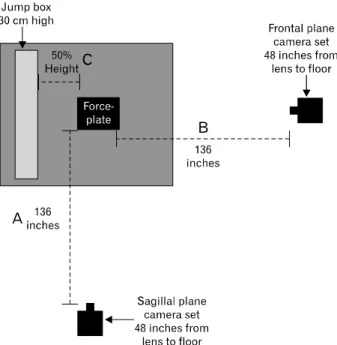
Fig. 1. Composion of landing erorr scoring system.
0.05).
2. 연구 절차
실험실에 도착한 연구대상자들은 연구윤리위원회(Institu- tional Review Board) 실험참가 동의서(CAUIRB 01-001)를 작성 한 후 신체적 특성 평가를 위한 신체구성을 측정하였으며, 이후 착지오류점수 측정을 위한 준비운동을 수행하였다 . 실험 실에는 카메라 2대를 설치하였으며, 발레(13명), 축구(12명)의 대상자들은 착지오류점수 평가하기 위하여 30 cm 높이의 박스 위에서 자신의 신장의 50% 거리가 떨어진 지점에 양 발 착지 후 수직 점프 동작을 3번씩 무작위로 수행하도록 하였다(Fig.
1). 양 발 착지 후 수직 점프 과제는 30 cm 높이의 박스 위에서 뛰어 내린 후 , 곧 바로 자신이 뛸 수 있는 최고 높이로 수직점프 를 수행하는 것 16) 으로 착지 후 3초간 균형을 유지하는 성공적 인 동작만을 기록하였다.
3. 착지오류점수 측정
착지오류점수는 착지하여 즉각적으로 도약하는 순간에 발 생하는 자세의 오류를 항목별로 점수화하는 방법이며 , 본 연구 에는 Padua 등 16) 에 의해 시행된 방법을 사용하였다 . 실험 도구 는 정면과 측면을 기록하는 두 대의 카메라(VM-HMX20C, 인도네시아 )와 30 cm 높이의 도약대로 이루어져 있으며, 착지 위치에서 3.5 m의 거리를 두고 대상자의 오른쪽 무릎관절 방향의 측면과 정면 1.2 m의 높이에 비디오카메라를 각각
설치하였다. 대상자를 30 cm의 도약대에 서게 한 후, 본인 신장의 50% 지점을 향해 뛰어 내려 바닥에 닿는 즉시 가능한 한 높이 다시 뛰어 오르도록 하였다. 3회의 연습 후, 실제 측정을 하고 비디오카메라에 그 영상을 기록하였다. 이후 두 대의 카메라에 기록된 영상 중, 발이 바닥에 닿기 시작하는 착지초기와 다시 공중으로 뛰어오르기 전 무릎관절의 최대 굴곡기에서 잘못된 착지동작(오류)을 찾아내어 점수를 기록 하였다. 측면 영상에서는 총 8가지 항목에서 최고 9점의 오류 점수가 확인되었으며 정면의 영상에서는 총 8가지 항목에서 최고 8점의 오류점수가 확인되었다. 마지막으로 정면과 측면 의 영상을 종합적으로 판단하여 0–2점을 부가하였으며 최고 점수는 19점이었다.
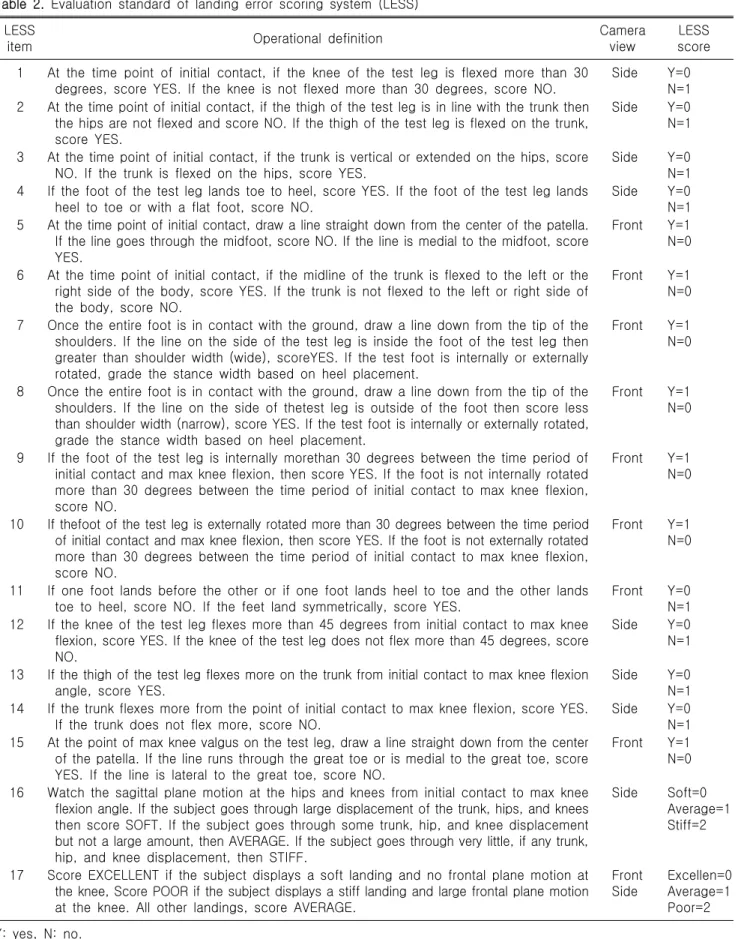
측정된 착지오류점수는 우수한(excellent) 착지(4점 이하), 좋은(good) 착지(4점 이상 5점 이하), 보통(moderate) 착지(5점 이상 6점 이하), 잘못된(poor)착지(6점 이상)로 정의되고 있으 며 16) , 착지오류점수의 평가기준은 Table 2와 같으며, 구체적인 장비의 구성 및 실제 측정 후 분석 장면은 Figs. 1과 2와 같다.
Table 3에 정의된 각도의 계산은 동영상 분석 프로그램인 키노베아(Kinovea ver. 0.8.15, free and open source software, www.kinovea.org)를 사용하였다(Fig. 2). 무릎굴곡 각도는 시상 면에서 촬영된 영상에서 엉덩관절중심에서 무릎관절 중심으 로 연결한 선과 무릎관절 중심에서 발목관절 중심으로 연결한 선의 절대각으로 산출하였다. 엉덩굴곡 각도는 시상면에서 촬영된 영상에서 엉덩관절중심에서 어깨관절 중심으로 연결 한 선과 엉덩관절 중심에서 무릎관절 중심으로 연결한 선의 절대각으로 산출하였다. 몸통굴곡 각도는 시상면에서 촬영된 영상에서 엉덩관절중심에서 어깨관절 중심으로 연결한 선과 수직선 및 엉덩관절 중심에서 무릎관절 중심으로 연결한 선의 절대각으로 산출하였다. 외반각도는 관상면에서 촬영된 영상 에서 무릎뼈 중심에서 아래로 선을 그어 발의 중족과의 위치로 점수를 산출하였다 . 외측몸통 굴곡 각도는 관상면에서 몸통의 중심선과 수직선과의 절대각으로 산출하였다.
4. 통계처리
본 연구에서 측정된 모든 자료는 SPSS ver. 20.0 (IBM Co.,
Armonk, NY, USA) 통계 프로그램을 이용하였다. (1) 모든
변인에 대한 평균(mean)과 표준편차(SD)를 산출하였다. (2)
여자 발레무용수와 여자축구선수의 집단 간 착지오류점수의
차이를 알아보기 위하여 독립표본 t-검정을 실시하였으며,
다중 비교에서 생길 수 있는 오류를 보정하기 위해서 본페로니
교정(Bonferroni collection)을 통해 보정하였다. (3) 그룹 간의
Table 2. Evaluation standard of landing error scoring system (LESS) LESS
item Operational definition Camera
view
LESS score 1 At the time point of initial contact, if the knee of the test leg is flexed more than 30
degrees, score YES. If the knee is not flexed more than 30 degrees, score NO.
Side Y=0 N=1 2 At the time point of initial contact, if the thigh of the test leg is in line with the trunk then
the hips are not flexed and score NO. If the thigh of the test leg is flexed on the trunk, score YES.
Side Y=0 N=1
3 At the time point of initial contact, if the trunk is vertical or extended on the hips, score NO. If the trunk is flexed on the hips, score YES.
Side Y=0 N=1 4 If the foot of the test leg lands toe to heel, score YES. If the foot of the test leg lands
heel to toe or with a flat foot, score NO.
Side Y=0 N=1 5 At the time point of initial contact, draw a line straight down from the center of the patella.
If the line goes through the midfoot, score NO. If the line is medial to the midfoot, score YES.
Front Y=1 N=0
6 At the time point of initial contact, if the midline of the trunk is flexed to the left or the right side of the body, score YES. If the trunk is not flexed to the left or right side of the body, score NO.
Front Y=1 N=0
7 Once the entire foot is in contact with the ground, draw a line down from the tip of the shoulders. If the line on the side of the test leg is inside the foot of the test leg then greater than shoulder width (wide), scoreYES. If the test foot is internally or externally rotated, grade the stance width based on heel placement.
Front Y=1 N=0
8 Once the entire foot is in contact with the ground, draw a line down from the tip of the shoulders. If the line on the side of thetest leg is outside of the foot then score less than shoulder width (narrow), score YES. If the test foot is internally or externally rotated, grade the stance width based on heel placement.
Front Y=1 N=0
9 If the foot of the test leg is internally morethan 30 degrees between the time period of initial contact and max knee flexion, then score YES. If the foot is not internally rotated more than 30 degrees between the time period of initial contact to max knee flexion, score NO.
Front Y=1 N=0
10 If thefoot of the test leg is externally rotated more than 30 degrees between the time period of initial contact and max knee flexion, then score YES. If the foot is not externally rotated more than 30 degrees between the time period of initial contact to max knee flexion, score NO.
Front Y=1 N=0
11 If one foot lands before the other or if one foot lands heel to toe and the other lands toe to heel, score NO. If the feet land symmetrically, score YES.
Front Y=0 N=1 12 If the knee of the test leg flexes more than 45 degrees from initial contact to max knee
flexion, score YES. If the knee of the test leg does not flex more than 45 degrees, score NO.
Side Y=0 N=1
13 If the thigh of the test leg flexes more on the trunk from initial contact to max knee flexion angle, score YES.
Side Y=0 N=1 14 If the trunk flexes more from the point of initial contact to max knee flexion, score YES.
If the trunk does not flex more, score NO.
Side Y=0 N=1 15 At the point of max knee valgus on the test leg, draw a line straight down from the center
of the patella. If the line runs through the great toe or is medial to the great toe, score YES. If the line is lateral to the great toe, score NO.
Front Y=1 N=0
16 Watch the sagittal plane motion at the hips and knees from initial contact to max knee flexion angle. If the subject goes through large displacement of the trunk, hips, and knees then score SOFT. If the subject goes through some trunk, hip, and knee displacement but not a large amount, then AVERAGE. If the subject goes through very little, if any trunk, hip, and knee displacement, then STIFF.
Side Soft=0 Average=1 Stiff=2
17 Score EXCELLENT if the subject displays a soft landing and no frontal plane motion at the knee, Score POOR if the subject displays a stiff landing and large frontal plane motion at the knee. All other landings, score AVERAGE.
Front Side
Excellen=0
Average=1
Poor=2
Y: yes, N: no.
Injury Risk Factors in Female Ballet Dancers and Female Soccer Players
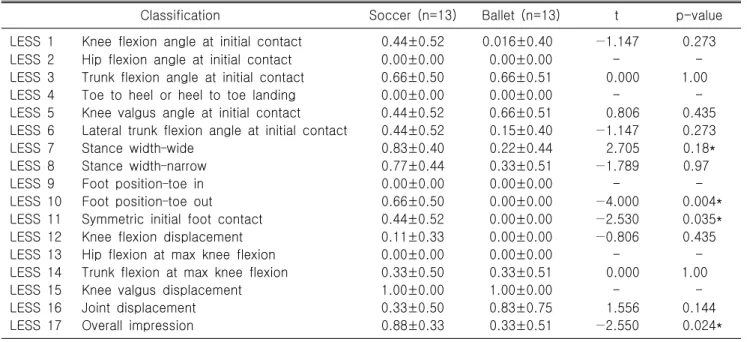
Table 3. Landing error scoring system variable
Classification Soccer (n=13) Ballet (n=13) t p-value
LESS 1 Knee flexion angle at initial contact 0.44±0.52 0.016±0.40 −1.147 0.273
LESS 2 Hip flexion angle at initial contact 0.00±0.00 0.00±0.00 - -
LESS 3 Trunk flexion angle at initial contact 0.66±0.50 0.66±0.51 0.000 1.00
LESS 4 Toe to heel or heel to toe landing 0.00±0.00 0.00±0.00 - -
LESS 5 Knee valgus angle at initial contact 0.44±0.52 0.66±0.51 0.806 0.435 LESS 6 Lateral trunk flexion angle at initial contact 0.44±0.52 0.15±0.40 −1.147 0.273
LESS 7 Stance width–wide 0.83±0.40 0.22±0.44 2.705 0.18*
LESS 8 Stance width–narrow 0.77±0.44 0.33±0.51 −1.789 0.97
LESS 9 Foot position–toe in 0.00±0.00 0.00±0.00 - -
LESS 10 Foot position–toe out 0.66±0.50 0.00±0.00 −4.000 0.004*
LESS 11 Symmetric initial foot contact 0.44±0.52 0.00±0.00 −2.530 0.035*
LESS 12 Knee flexion displacement 0.11±0.33 0.00±0.00 −0.806 0.435
LESS 13 Hip flexion at max knee flexion 0.00±0.00 0.00±0.00 - -
LESS 14 Trunk flexion at max knee flexion 0.33±0.50 0.33±0.51 0.000 1.00
LESS 15 Knee valgus displacement 1.00±0.00 1.00±0.00 - -
LESS 16 Joint displacement 0.33±0.50 0.83±0.75 1.556 0.144
LESS 17 Overall impression 0.88±0.33 0.33±0.51 −2.550 0.024*
LESS: landing error scoring system.
*p<0.05.
Fig. 2. (A) Analysis of landing erorr scoring system (front). (B) Analysis of landing erorr scoring system (side).
유의한 차이는 Cohen's 24) 효과 차이를 사용하여 평가하였다.
(4) 모든 결과의 통계적 유의수준은 α=0.05로 설정하였다.
결 과
1. 착지오류점수 변인
여자 발레무용수와 여자 축구선수 집단 간의 착지오류점수
를 비교한 결과는 Table 3과 같다. 스탠스 폭-넓음(stance width-
wide, p=0.18), 발의위치-외전(foot position-toe out, p=0.004),
초기 접촉시의 발의 대칭(symmetric initial foot contact,
p=0.035), 및 전체적인 진단(overall impression, p=0.024)에서
유의한 차이가 나타났다(p<0.05). LESS 2, 4, 9, 13 항목은
여자 축구선수들과 여자 발레무용수들 모두 0점으로 나타났
고, LESS 15 항목은 모두 1점으로 나타나서, 통계치가 계산되
지 않았다. 그 외 나머지 변인들에서는 통계적인 유의한 차이
가 나타나지 않았다.
2. 착지오류점수 종합점수
여자 발레무용수와 여자 축구선수 집단 간의 착지오류점수 종합점수를 비교한 결과는 Table 3과 같다. 착지오류점수 종합 점수를 비교하여 보면 여자축구선수들이 여자 발레무용수보 다 통계적으로 유의하게 더 높게 나타났다(p=0.014).
고 찰