Solitary Extrahepatic Intraabdominal Metastasis from Hepatocellular Carcinoma after Liver Transplantation
Sae Byeol Choi,
1Hyungi Kim,
2Sung Hoon Kim,
3Young Nyun Park,
2and Kyung Sik Kim
31Department of Surgery, Korea University College of Medicine, Seoul;
Departments of 2Pathology and 3Surgery, Yonsei University College of Medicine, Seoul, Korea.
Received: December 3, 2008 Revised: April 20, 2009 Accepted: April 20, 2009
Corresponding author: Dr. Kyung Sik Kim, Department of Surgery, Yonsei University College of Medicine, 250 Seongsan-ro, Seodaemun-gu, Seoul 120-752, Korea.
Tel: 82-2-2228-2125, Fax: 82-2-313-8289 E-mail: [email protected]
∙ The authors have no financial conflicts of interest.
© Copyright:
Yonsei University College of Medicine 2011 This is an Open Access article distributed under the terms of the Creative Commons Attribution Non- Commercial License (http://creativecommons.org/
licenses/by-nc/3.0) which permits unrestricted non- commercial use, distribution, and reproduction in any medium, provided the original work is properly cited.
A liver transplantation is a treatment option in selected patients with hepatocellu- lar carcinoma (HCC). Despite the adequate selection of candidates, recurrences of HCC may still develop. Solitary extrahepatic metastasis from HCC after a liv- er transplantation is rare. Here we report two cases of HCC demonstrated extra- hepatic recurrence to the adrenal gland and spleen, respectively, within one year after a liver transplantation. Since the treatment of solitary extrahepatic metastasis from HCC after a liver transplantation is not standardized, surgical resection was performed. In the case of HCC adrenal metastasis, innumerable intrahepatic me- tastases were found two months after the adrenalectomy. And 16 months after ad- renalectomy, the patient expired due to tumor progression and hepatic failure. In the case of HCC splenic metastasis, postoperative radiation therapy was per- formed. However, two recurrent HCC nodules were found 15 months after the splenectomy and received transarterial chemoembolization (TACE). And 29 month after the splenectomy, the patient also expired as same causes of former patient.
Key Words: Hepatocellular carcinoma, adrenal metastasis, splenic metastasis, liv- er transplantation
INTRODUCTION
There are several treatments for hepatocellular carcinoma (HCC), and a liver transplantation can be performed in a selected group of patients as such a treat- ment. After the introduction of the Milan and University of California at San Fran- cisco (UCSF) criteria, the candidates for a liver transplantation have been expand- ed. The use of a specific selection criteria has been shown to improve tumor-free survival in patients undergoing a liver transplantation for HCC.1-3 However, de- spite the adequate selection of candidates, recurrences of HCC may still develop and result in death.4,5 The adrenal gland is a common target organ of hematoge- nous metastasis from HCC6 however, the spleen has been rarely reported as a met- astatic site of HCC. We report two cases of solitary extrahepatic metastasis from HCC after a liver transplantation treated with surgical resection.
crolimus after the liver transplantation.
Eleven months post-transplantation, a CT scan revealed a solitary left adrenal mass, 3.5 × 2.3 cm in size, without any other recurrent lesions (Fig. 1A). The laboratory values showed hemoglobin of 10.2 g/dL, WBC of 3,270/μL, plate- let count of 119,000/μL, albumin of 4.5 g/dL, AST/ ALT of 32/15 IU/L, total bilirubin of 0.5 mg/dL, prothrombin time of 10.7 sec, and AFP of 6.02 IU/mL. The patient was in a good performance status and underwent a left adrenalecto- my with retroperitoneal approach in April 2007. A multi- nodular grayish-brown, soft-to-friable solid mass was gross- ly noted. It was well demarcated, measuring 5 × 3.5 cm in size. Tumor emboli were present in the blood vessels con- necting to the mass (Fig. 1B). The pathological examination demonstrated metastatic HCC without metastatic lymph nodes retrieved from around the aorta and the left renal ves- sels (Fig. 1C). There were no immediate complications dur- ing recovery. Immunosuppressive therapy (Tacrolimus) continued following the adrenalectomy.
However, a follow-up CT scan taken two months after the adrenalectomy revealed innumerable intrahepatic arteri- al enhancing nodules consistent with HCC. There were no recurrent lesions at the site of the adrenalectomy. The pa- tient received systemic adriamycin chemotherapy with sub- sequent transarterial chemoembolization. The intrahepatic recurrent tumors were not controlled, although chemothera- py was performed. The patient expired 16 months after the adrenalectomy due to liver failure.
Case 2
A 63-year-old man who was a carrier of HBV for 30 years was admitted for a ruptured HCC located in segments VIII of the liver in August 2004. He belonged to Child-Pugh class A. He was treated three consecutive times with TACE.
The patient then underwent a central bisectionectomy in February 2005 due to a remaining viable tumor (Fig. 2A).
The tumor was 5.7-cm in diameter and the resection margin was tumor-free with a distance of 3.5 cm (Fig. 2B). It was compatible with HCC and was composed of 60% necrosis due to TACE. Vascular invasion was not found. Sixteen months after the operation, another 1.5 cm-sized recurrent HCC on segment VII was found, and the AFP level in- creased to 54.53 IU/mL. He was treated with TACE how- ever; the remaining viable tumor was still detected with an increase in size. Then the patient underwent a cadaver do- nor liver transplantation in November 2006 in China. He thereafter took Tacrolimus for immunosuppression. Four
CASE REPORT
Case 1
A 71-year-old man with HCV hepatitis was diagnosed with HCC in 2002. He was treated with radiofrequency ablation and transarterial chemoembolization (TACE) for the HCC at another hospital. When he was referred to our hospital in December 2005, a CT scan demonstrated innumerable tiny intrahepatic HCC nodules. He belonged to Child-Pugh class A, and the alpha-fetoprotein (AFP) level was mea- sured at 87.96 IU/mL. After a treatment with two cycles of intrahepatic arterial cisplatin and systemic 5-FU chemo- therapy, he underwent a cadaver donor liver transplantation in March 2006 in China, although he met neither Milan nor UCSF criteria. He took Pegylated interferon alpha and Ta-
Fig. 1. A CT scan reveals a newly-developed solitary left adrenal mass, which was 3.5 × 2.3 cm in size, homogenous, and well-demarcated, sug- gesting HCC metastasis (A). Pathologic specimen following adrenalectomy (B) and microscopic exam, Hematoxylin & Eosin stain, ×100 (C).
A
B
C
metastatic HCC (Fig. 3C and D). Because the lesion invad- ed the perisplenic space, the patient received radiation ther- apy on the splenectomy site following an uneventful post- operative recovery. The radiation dosage was 50.4 Gy. The patient demonstrated no evidence of recurrence for 15 months. The patient received only adjuvant radiation thera- py without any other treatment modality. However, a fol- low-up CT scan taken 15 months after the splenectomy demonstrated two nodular lesions in segment VI of the liv- er compatible with HCCs. He then received TACE for 4 times. However, he was in the progressive disease status and was expired 29 months after the splenectomy.
months after the liver transplantation, a newly-developed 3 cm-sized heterogeneous mass was found in the hilum of the spleen (Fig. 3A and B). The laboratory values showed he- moglobin of 10.7 g/dL, WBC of 3400/μL, platelet count of 146,000/μL, albumin of 4.4 g/dL, AST/ ALT of 18/9 IU/L, total bilirubin of 0.4 mg/dL, prothrombin time of 11.0 sec, and AFP of 2.15 IU/mL. The patient was closely observed for three months, and a splenectomy was performed in July 2007 due to a mass growth without evidence of intrahepatic recurrence or distant metastasis. A well-defined, white, sol- id mass measuring 6 × 5 × 4.5 cm was found. It was partial- ly encapsulated and was pathologically compatible with
A B
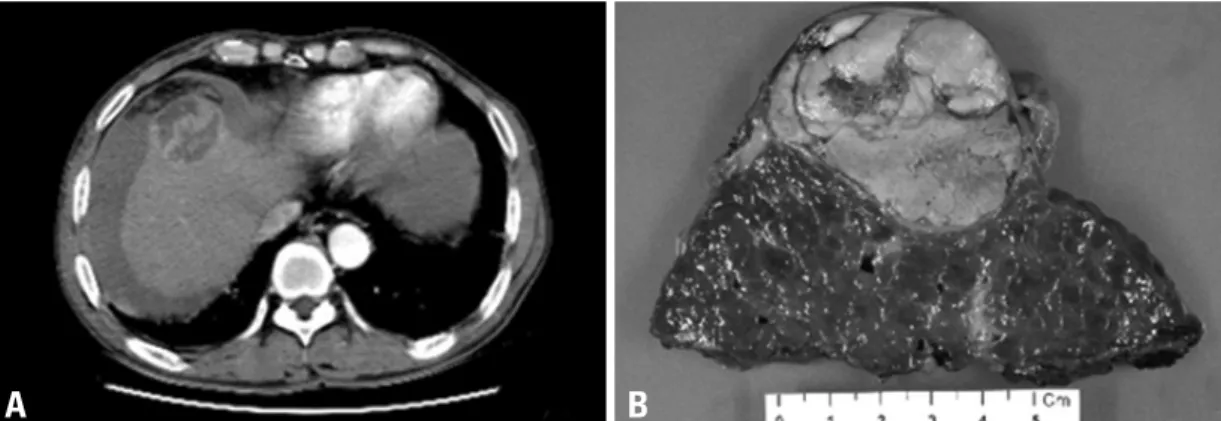
Fig. 2. A CT scan demonstrates a ruptured HCC located in segment VIII of the liver (A). Central bisectionectomy was performed following TACE, and the mass was a 5.7 cm HCC with 60% necrosis (B). HCC, hepatocellular carcinoma.
C A
D B
Fig. 3. A newly-developed, 3 cm-sized heterogeneous mass was found in the hilum of the spleen after liver transplantation (A and B).
Pathologic specimen following splenectomy (C) and microscopic exam, Hematoxylin & Eosin stain, ×40 (D).
In the cases of solitary splenic metastasis of HCC, it is also difficult to predict the prognosis. Because metastatic splenic tumors are usually detected as a part of disseminat- ed hematogenous metastasis with multi-organ involvement, isolated splenic metastasis is exceedingly rare.14 The surviv- al benefit of a splenectomy for a solitary metastatic splenic tumor is unknown and the disease control effect will be evaluated. However, with more aggressive management of metastatic tumors, the increase to perform splenectomy as a treatment of solitary splenic metastasis during the past de- cade might be expected to continue.15
In conclusion, the survival benefit of surgical resection in the management of isolated extrahepatic metastases of HCC is questionable due to its rarity. Surgical resection is a treatment option with low morbidity that may offer a chance for long-term survival in selected patients without poor prognostic factors and whose intrahepatic tumors are con- trolled. Surgical treatment can be an option to treat extrahe- patic solitary metastasis from HCC.
ACKNOWLEDGEMENTS
This study was supported by a grant of the Korea Health- care technology R&D Project, Ministry for Health, Welfare
& Family Affairs, Republic of Korea (A084120).
REFERENCES
1. Mazzaferro V, Regalia E, Doci R, Andreola S, Pulvirenti A, Boz- zetti F, et al. Liver transplantation for the treatment of small hepa- tocellular carcinomas in patients with cirrhosis. N Engl J Med 1996;334:693-9.
2. Yao FY, Ferrell L, Bass NM, Watson JJ, Bacchetti P, Venook A, et al. Liver transplantation for hepatocellular carcinoma: expansion of the tumor size limits does not adversely impact survival. Hepa- tology 2001;33:1394-403.
3. Schwartz M. Liver transplantation for hepatocellular carcinoma.
Gastroenterology 2004;127(5 Suppl 1):S268-76.
4. Katyal S, Oliver JH 3rd, Peterson MS, Ferris JV, Carr BS, Baron RL. Extrahepatic metastases of hepatocellular carcinoma. Radiol- ogy 2000;216:698-703.
5. Castroagudín JF, González-Quintela A, Martínez J, Tomé S, Forteza J, Varo E. Bilateral adrenal metastases from hepatocellular carcinoma after liver transplantation. Hepatogastroenterology 2002;49:249-51.
6. Nakashima T, Okuda K, Kojiro M, Jimi A, Yamaguchi R, Saka- moto K, et al. Pathology of hepatocellular carcinoma in Japan.
232 Consecutive cases autopsied in ten years. Cancer 1983;51:
863-77.
7. Hu RH, Ho MC, Wu YM, Yu SC, Lee PH. Feasibility of salvage
DISCUSSION
A liver transplantation is a treatment option for selected HCC patients with cirrhosis. For those patients with recur- rent HCC and poor liver function, a liver transplantation may be a choice to prolong their lives.7 The recurrence of HCC after a liver transplantation has been reported to be about 10%.8 Some authors reported that the recurrences oc- curring within one year of the liver transplantation are mainly extrahepatic.9 The two cases in this report demonstrated ex- trahepatic HCC recurrence within one year after a liver transplantation. Although early tumor recurrence is depen- dent upon many factors, namely vascular invasion and the number and size of the tumor, the influence of the post- transplant immunosuppression in a dysfunctional immune system cannot be excluded as contributing to the accelera- tion of the recurrence. Although it is known that the phar- macologic immunosuppression required after a transplanta- tion can accelerate tumor growth, the possible influence of different immunosuppressive schedules on HCC recurrence after a liver transplantation has been poorly investigated un- til recently.10
There is no consensus on the treatment of recurrent HCC following a liver transplantation, and treatment of the recur- rent tumor is not always effective. Moreover, early recur- rence shows a short survival period; however, in recent years, treatment has been more aggressive in an effort to improve survival.11 Several therapeutic modalities have been pro- posed such as surgical resection, TACE, percutaneous etha- nol injection therapy, and radiation therapy. Aggressive management of extrahepatic metastatic lesions have achiev- ed improved outcome.12,13
The adrenal gland is the second most common site of metastasis from HCC.6 In those cases, an adrenalectomy is considered to be the treatment of choice. However, the sur- vival benefit and disease control effect of an adrenalectomy in the case 1 patient is questionable. It may be better to closely observe the patient and provide systemic chemo- therapy or TACE rather than to perform a surgical resec- tion. In a clinical situation, a surgical resection should be carefully considered for a patient with good performance and no intrahepatic recurrence. Surgery for adrenal metas- tasis from HCC may be indicated not only for patients without evidence of an intrahepatic or extrahepatic lesion, but also for patients with a well-controlled intrahepatic or extrahepatic lesion to increase survival.14
tells L, et al. Recurrence of hepatocellular carcinoma after liver transplantation. Transplant Proc 2007;39:2308-10.
12. Poon RT, Fan ST, O’Suilleabhain CB, Wong J. Aggressive man- agement of patients with extrahepatic and intrahepatic recurrences of hepatocellular carcinoma by combined resection and locore- gional therapy. J Am Coll Surg 2002;195:311-8.
13. Seong J. Challenge and hope in radiotherapy of hepatocellular carcinoma. Yonsei Med J 2009;50:601-12.
14. Park JS, Yoon DS, Kim KS, Choi JS, Lee WJ, Chi HS, et al. What is the best treatment modality for adrenal metastasis from hepato- cellular carcinoma? J Surg Oncol 2007;96:32-6.
15. Lee SS, Morgenstern L, Phillips EH, Hiatt JR, Margulies DR.
Splenectomy for splenic metastases: a changing clinical spectrum.
Am Surg 2000;66:837-40.
liver transplantation for patients with recurrent hepatocellular car- cinoma. Clin Transplant 2005;19:175-80.
8. Llovet J, Schwartz M, Mazzaferro V. Resection and liver trans- plantation for hepatocellular carcinoma. Semin Liver Dis 2005;
25:181-200.
9. Pérez-Saborido B, de los Galanes SJ, Menéu-Díaz JC, Romero CJ, Elola-Olaso AM, Suárez YF, et al. Tumor recurrence after liv- er transplantation for hepatocellular carcinoma: recurrence path- way and prognostic factors. Transplant Proc 2007;39:2304-7.
10. Vivarelli M, Cucchetti A, Piscaglia F, La Barba G, Bolondi L, Ca- vallari A, et al. Analysis of risk factors for tumor recurrence after liver transplantation for hepatocellular carcinoma: key role of im- munosuppression. Liver Transpl 2005;11:497-503.
11. Escartin A, Sapisochin G, Bilbao I, Vilallonga R, Bueno J, Cas-