* Corresponding author: (E-mail) [email protected]
The Carbon Sequestration Potential of Forestry Sector:
Bangladesh Context
Md. Shawkat Islam Sohel1, Md. Parvez Rana1*, Mahbubul Alam2, Sayma Akhter1, and Mohammed Alamgir3
1Department of Forestry and Environmental Science, School of Agriculture and Mineral Sciences, Shahjalal University of Science and Technology, Sylhet- 3114, Bangladesh.
2United Graduate School of Agricultural Sciences, Ehime University, Matsuyama, Japan
3Institute of Forestry and Environmental Sciences, University of Chittagong, Chittagong, Bangladesh
ABSTRACT : Forests potentially contribute to global climate change through their influence on the global carbon (C) cycle. The Kyoto Protocol provides for the involvement of developing countries in an atmospheric greenhouse gas reduction regime under its Clean Development Mechanism (CDM). Carbon credits are gained from reforestation and afforestation activities in developing countries. Bangladesh, a densely populated tropical country in South Asia, has a huge degraded forestland, which can be reforested by CDM projects. To realize the potential of the forestry sector in developing countries like Bangladesh for full-scale emission mitigation, the carbon sequestration potential should be integrated with the carbon trading system under the CDM of the Kyoto Protocol. This paper discusses the prospects of carbon trading in Bangladesh, in relation to the CDM, in the context of global warming.
Keywords : Carbon sequestration, Carbon trading, CDM, Global warming, Climate change.
INTRODUCTION
There is a wide scientific consensus that global climate is changing in part as a result of human activities (IPCC, 2001; Ravindranath et al., 1997; Negi et al., 2002) and that the social and economic costs of slowing it down and of responding to its impacts will be large (OECD, 2000).
Global changes are occurring in many ways: atmosphere, land-use and now also in climate (Mooney et al., 1999;
Huang et al., 2000; IPCC, 1996, 2001, 2002; CPCB, 2002).
In recent years, the few global issues that have received more attention of scientists, resource mangers, policy makers and public undoubtedly are climate change (Tiwari and Singh, 1987; Al-Amin, 2002; Alamgir, 2005). Climate change is one of the most pressing environmental concerns of the 21st century. It is now generally accepted that this climate change is the result of increasing concentrations of carbon dioxide, methane, nitrous oxide and other green- house gases (GHGs) in the atmosphere (IPCC, 2001;
Schimel et al., 1995). Increasing carbon emission is one
of today’s major concerns, which was well addressed in Kyoto Protocol (Ravindranath et al., 1997) because it is the main causal factor for global warming (Lal, 2001). The per capita GHG emission by industrialized countries is about 6 times the world average emissions, while GHG emission from USA alone accounts for 20% of the total global emissions (Ahmed, 2006). Countries like Bangladesh are not big GHG emitters (Bankoff, 1999). Forests also play an important role in the climate system. Meanwhile, deforestation worldwide contributes 18% of all CO2
emissions (Stern, 2006). Developing countries like Bangla- desh are mostly affected by the consequences of “Global Warming” (Anon, 2000). If the increase of air temperature continues at the present rate, by the end of the year 2030, sea level will rise by 20 cm, and at the end of this century it will rise by one meter. As a result, low-lying countries of the world may go under water partly or wholly and consequently Bangladesh will be greatly affected (Bankoff, 1999; Miah, 2002).
Forests have the potential to be managed to reduce
atmospheric concentrations of carbon and thus mitigate climate change (Houghton et al., 1992; Brown et al., 1996;
Ravindranath et al., 1997; Williams, 2002; Matthews et al., 2000). So forests play multiple and significant roles in regulating atmospheric concentrations of carbon dioxide (Rotter et al., 2002). Active absorption of CO2 from the atmosphere through photosynthesis, and its subsequent storage in the biomass of growing trees or plants is the carbon storage (Baes et al., 1977; Williams, 2002; Heath and Smith, 2004). It was reported that a hectare of actively growing forest can sequesters 2–5 tonne of carbon per year (Brown, 1996). This way forests play an important role in sequestration of carbon globally (Rawat et al., 2003).
Importance of forested areas in carbon sequestration is already accepted, and well documented (Tiwari and Singh, 1987; Alamgir et al., 2009). Forest carbon sequestration is characterized as an increase in carbon stocks on the land base through such activities as afforestation, reforestation, agroforestry, forest restoration (WWF, 2002). Considering the carbon sequestration potential of forest, the forestry community needs to promote all forestry practices that can provide climate change mitigation benefits (UNFCCC, 2007a). Taking this view ahead, the United Nations Framework Convention on Climate Change (UNFCCC) and the Kyoto Protocol have introduced a mechanism named CDM (Clean Development Mechanism) allowing for the development of carbon forestry activities in the developing world as means to mitigate climate change and promote sustainable development (UNFCCC, 2002). Therefore, the proper management of forest as a sink of carbon can provide two fold benefits, one it will help to mitigate the impact of climate change (Nabuurs et al, 2007) and two it will be a mean of potential profitable business (i. e. carbon trading) through the CDM (Sampson, 2004; Richards et al., 2006; Ruddell et al., 2006; Helms, 2007).
To protect world from climate change and the low lying country like Bangladesh management of forest with a vision of carbon sequestration is essential. Bangladesh was once densely forested but this has been cleared for timber, converted to agriculture or cut for firewood (Gain, 2002).
Bangladesh has a total forest land of 2.53 million ha of
which 1.11 million ha is under tree cover (Roy, 2004). So, there is a large scope to initiate new plantation in the degraded and denuded forest areas also in the area outside the forests (Unclassified State forest, road sides and canal banks). Furthermore the presence of trees and forests benefits communities in many ways such as: Adapting to climate change impacts, maintaining natural resources and promoting sustainable development (Nabuurs et al., 2007).
Now it is high time to incorporate the existing forest management strategies with the climate change through the sequestration of carbon. Taking this view ahead, the present study explore the carbon sequestration potential of forestry sector in Bangladesh, in relation to the CDM and in the context of climate change, which ultimately help future forest management strategies for Bangladesh.
The Human Contribution to Climate Change
The increase in greenhouse gas in the atmosphere is now recognized to contribute to climate change (IPCC, 2000).
It is now generally accepted that this change in global temperature is caused primarily by rising atmospheric concentrations of greenhouse gases, principally carbon dioxide (CO2), methane (CH4) and nitrous oxide (N2O). The most important of these greenhouse gases, CO2, accounts for some 65 percent of the “greenhouse effect” (IPCC, 2000) followed by methane (CH4) (20%), nitrous oxide (N2O) (6%) (Andrasko, 1990). The concentration of CO2
in the atmosphere increased from 285 ppm at the end of the nineteenth centenary to about 366 ppm in 1998 as consequences of anthropogenic emissions of about 405 gigatonnes of carbon into the atmosphere (IPCC, 2001).
The rise of atmospheric CO2 concentrations has also been caused by the combustion of fossil fuels, cement manufac- ture and deforestation (IPCC, 2000). Deforestation is a significant source of carbon emissions; evidence suggests that deforestation in the 1980s may have accounted for one- fourth of all anthropogenic carbon emissions (Houghton, 1999). Between 1850 and 1980, more than 100 Gt of carbon were released into the atmosphere as a result of deforesta- tion, representing about one-third of the total anthropogenic car-
Total Carbon emission 6.46 billion tones (In 1995)
4 11 3 3 6
22 7
27 17
0 5 10 15 20 25 30
Latin america China africa Mid east Other asia USA Asia E. Europe W. Europe
Developing world (27%) Developed world (73%)
Percentage
Fig. 1. (a). Total Carbon emissions in 1995 by different countries Source: (Mintzer and Trexler, 2000).
Total Carbon emission 11.71 billion tones (In 2035)
6
17 8 5
14 15 4
19 12
0 5 10 15 20
Latin america China africa Mid east Other asia USA Asia E. Europe W. Europe
Developing world (50%) Developed world (50%)
Percentage
(b). Total Carbon emissions in 2035 by different countries Source: (Mintzer and Trexler, 2000).
bon emissions over this period (Houghton, 1996). Figure 1 (a, b) shows contribution of GHGs emissions by the de- veloping and developed world.
Carbon sequestration potential of forestry sector: Global context
Forest can play a significant role in global carbon budget both by conserving and sequestering carbon from the atmosphere. Carbon sequestration is the strategy for the management of forest carbon to increase the amount or rate of carbon accumulation by creating or enhancing carbon sinks (carbon sequestration) (Bass et al., 2000). This strategy involves afforestation, reforestation and restoration of degraded lands, improved silvicultural techniques to increase growth rates and implementation of agroforestry practices on agricultural lands. Carbon sequestration has tended to be equated to tree planting both in natural forest
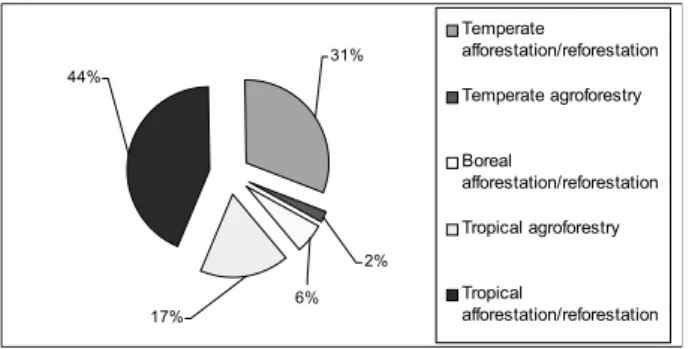
and plantation contexts. Although there are many more options than simply afforestation and reforestation, estimates of the global potential of carbon sequestration have taken as their starting point the area of land available for afforestation (Bass et al., 2000). The world forest contains an estimated 340 Pg C in live and dead above and below ground vegetation and 618 Pg C in mineral soils and O horizon (Brown, 1996). Globally 700 million ha of land might be available for carbon conservation and sequestration programme, 345 million ha currently non forested or under stocked land for plantation and agroforestry, 138 million ha through slowed tropical deforestation and 217 million ha through natural and assisted regeneration of tropical forest (Trexler and Haugan, 1994; Nilson and Schopfhauser, 1995). This amount of land could conserve 60 to 87 Pg C by 2050 (Table 1). Table 1 shows global estimates of the potential amount of C that could be sequestered and conserved by forest management practices between 1995 to 2050. The tropics have the potential to conserve and sequester largest quantity of carbon (80%) followed by the temperate zone (17%) and the boreal Zone (3%), annual rate of carbon sequestration from all practices would increase overtime and reach about 202 Pg/yr by 2045 (Brown, 1996). Brown et al. (1996) estimate that approximately 38 Gt of carbon could be sequestered over the next 50 years – i.e. 30.6 Gt by afforestation/reforestation and 7 Gt through the increased adoption of agroforestry practices. Figure 2 shows potential contribution of afforestation/reforestation and agroforestry activities to global carbon sequestration from 1995-2050, where total carbon sequestration potential 38 Gt.
Anthropogenic changes in the earth’s climate have been the focus of climate change policy since the signing of the United Nations Framework Convention on Climate Change (UNFCCC) at the 1992 Earth Summit. To date, this Convention has been ratified by 191 countries, including the United States (UNFCCC, 2007b). The objective of the UNFCCC was to stabilize GHG emissions, “at a level that would prevent dangerous anthropogenic interference with the climate system.” A global carbon market has emerged as a result of the Kyoto Protocol (of the UNFCCC), which
Table 1. Global estimates of the potential amount of C that could be sequestered and conserved by forest management practices between 1995 to 2050 Latitudinal
belt Practice Area (M ha)Csequestered &
conserved (Pg3)
High Forestation 95.21 2.4
Mid Forestation 113 11.8
Agroforestry 6.5 0.7
Low
Forestation 66.9 16.4
Agroforestry 63.2 6.3
Regeneration2 217 11.5-28.7 Slow eforestation1 138 10.8-20.8
Total 700 60-87
1 Includes not satisfactorily restocked forest lands in Canada.
2 Includes an additional 25% of aboveground C to account for C belowground in roots, litter, and soil (based on data in Nilsson and Schopfhauser, 1995 and Brown et al., 1993b); the range in values is based on the use of low and high estimates of biomass C density resulting from the uncertainty in these estimates
31 Pg = 1015 g or billion metric tons Source: Brown et al., 1996
44%
31%
17%
6%
2%
Temperate
afforestation/reforestation Temperate agroforestry
Boreal
afforestation/reforestation Tropical agroforestry
Tropical
afforestation/reforestation
Fig. 2. Potential contribution of afforestation/reforestation and agroforestry activities to global carbon sequestration, 1995-2050 (Total carbon sequestration potential 38 gigatonnes (Gt).
Source: Brown et al., 1996.
set GHG emission limitations for ratifying nations and established mechanisms for reducing overall GHG by at least 5% below 1990 levels by the end of 2012 (UNFCCC, 2002). As a result of this a concept arise named ‘carbon trading’. The concept of carbon trading is an opportunity for the developing countries. The Kyoto Protocol has developed a strategy by which the developed country will sponsor for the establishment of a new forest to the developing countries. On the basis of this several funds were established according to which project implementers
will receive the forest credits (Schoene, 2002). To achieve this goal a mechanism name CDM develops. The purpose of the CDM is to assist developing countries in achieving sustainable development and at the same time to assist developed countries in fulfilling their commitments under the Kyoto Protocol (KP). However, in the first commitment period of the KP, there is an important restriction for inclusion of Carbon Sequestration (CS) in the CDM (FAO, 2003a; FAO, 2004). CDM was established to supervise the project of the establishment of the new forest (Schoene, 2002). By applying this CDM of carbon trading climate change can be mitigate. The mitigation cost through forestry can be quite modest, US$ 0.1- US$ 20/t C in some tropical developing countries and somewhat higher US$ 20- US$ 100/t C in developed countries (Hoogeveen, 2007).
State of Bangladesh forest
According to Forest Department (FD) and some other sources (Hossain, 2005; Khan et al., 2007; Mukul et al., 2008) the area of forest land is about 2.53 million ha representing approximately 17.5% of the country’s total surface area (Table 2.) but according to FRA 2005 this figure is only about 0.871 million ha (FAO, 2006; 2007).
Officially, Bangladesh FD manages 1.53 million hectares of forest land of the country. Bangladesh has a total land area of 14.39 million hectares, of which 9.12 million ha is cultivated, 2.14 million ha public forests, 0.27 million ha village groves, and 1.64 million ha constantly under water. The remaining land area (1.22 million hectares) is occupied by tea gardens, uncultivable areas, rural and urban houses and ponds (Kibria et al., 2000). The area covered by government and village forests is about 16% of the total land area; however only 0.93 million ha (6.5%) is under tree cover, which is about 40% of the forests controlled by the government. The remaining 60% includes denuded lands (grassland, scrubland and encroached areas) (FAO, 2003b). About 24 000 ha of forest is lost annually as a result of homestead development, urbanization and deforestation (FAO, 2003a). But there is a controversy and another report shows that agricultural land makes up 64%
Table 2. Forest types (ecosystem diversity) and areas in Bangladesh
Forest type Location Area
(million ha) Remarks
Hill forest
Managed reserved forest (evergreen to
semi-evergreen)
Eastern part of the country (Chittagong, Chittagong Hill Tracts and Sylhet)
0.67 Highly degraded and managed by the Forest Department.
Unclassed state
forest (USF) Chittagong Hill Tracts 0.73
Under the control of district administration and denuded mainly due to faulty management and shifting cultivation. Mainly scrub forest.
Plain land forest
Tropical moist deciduous Forest
Central and north-western region (Dhaka, Mymensingh, Tangail etc.)
0.12
Mainly Sal forest but now converting to exotic short rotation plantations. Managed by the Forest Department.
Mangrove
Sundarbans Southwest (Khulna, Satkhira) 0.57 World’s largest continuous mangrove forest and including 0.17 million ha of water.
Coastal forest Along the shoreline of twelve
districts 0.10 Mangrove plantations along the shoreline of 12 districts. Managed by Forest Department.
Village forest Homestead Forests all over
the Country 0.27
Diversified productive system. Fulfill majority of country’s domestic timber, fuelwood and bamboo requirements.
Plantation in tea and rubber gardens
Chittagong Hill Tracts and
Sylhet 0.07 Plantations of various short rotation species (mainly exotics).
Total forest 2.53 17.49 % of country’s total landmass
Source: Hossain, 2005; Mukul et al., 2008
Table 3. Classified and unclassified forest land by physical cover
Type of Land Cover Area Area (Hectares) Percentage
Natural Forest
Medium-Good Density 460,700.0 20.5
Poor Density 82,200.0 3.7
Bamboo 71,200.0 3.2
Scattered Trees/Barren 95,900.0 4.3
Total 710,000.0 31.7
Plantations 303,000.0 13.5
Jhummed/Encroached 111,000.0 4.9
Total Productive 1,124,000.0 50.1
Unproductive 12,900.0 0.6
Parks/Sanctuaries 116,700.0 5.2
Water 9.0 -
Other* 786,600.0 44.1
Total Unproductive 1,118,200.0 44.9
Total 2,242,300 100.0
* Predominantly Unclassified State Forest (USF) (Source: APFSOS, 1998; Alamgir, 2005)
of Bangladesh’s land area, forest lands account for almost 18%, and urban areas account for a further 8% (APFSOS, 1998). Water and other land uses account for the remaining 10%. Total forest land area totals 2.53 million ha, including officially classified and unclassified state lands and forest lands accounted for by village forests and tea/rubber gardens. This data shows that the natural forest accounts for almost 31% and forest plantations 13% of total forest
areas (Table 3).Shifting agriculture plus illegal occupation cover 5% of forest lands while water (9%) and unproduc- tive area (0.6%) and other areas (35%) account for almost 45% of forest land. Presently protected areas represent just over 5% of forest land. Bangladesh FD is responsible for administering 65% of state forest land (about 1.46 million ha). The balance comes under local District Commissioners (DC). Excluding parks and sanctuaries, but including the
0 50 100 150 200 250
Closed large crown
Closed small crown
Disturbed Closed
Disturbed open Forest types
Biomass densities (tonne/dm/ha)
Underground biomass (Calculated- 15% of the above ground) tonne/dm/ha Above ground biomass tonne/dm/ha
Carbon sequestration (Calculated) tonne/dm/ha
Fig. 3. Biomass densities in forest of Bangladesh (Adapted and modified from Alamgir et al., 2009).
0 0.2 0.4 0.6 0.8 1 1.2 1.4 1.6
Hill Forest Mangrove Forest
Sal Forest Village Forest Forest types
Area (m. ha) Total area (m. ha)
Area under tree cover (m. ha)
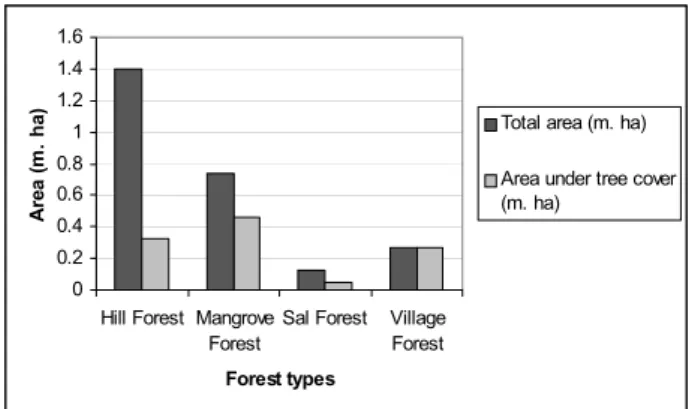
Fig. 4. Potential land available in different forest types for plantation (Adapted and modified from Roy, 2004).
better quality natural forest (medium to good density) plus bamboo areas and plantations gives a figure of 835,000 ha of reasonable quality forest vegetation on state forest land.
This equals 5.8% of Bangladesh’s total area. The area included in the present protected area network is 116,700 ha, equal to 5.2% of state forest land or less than 1% of Bangladesh’s total area (APFSOS, 1998).
Potentials of Bangladesh forest for carbon sequestration
Carbon trading is an opportunity for the developing countries. The Kyoto Protocol has developed a strategy by which the developed country will sponsor for the establishment of a new forest to the developing countries.
On the basis of this several funds were established according to which project implementers will receive the forest credits (Schoene, 2002). Bangladesh forests still absorb more carbon than the total carbon produced in the country. As a signatory party of ‘Kyoto Protocol’ the country can ask for compensation from the developed countries for this extra carbon absorbed by country’s forest (Mukul, 2007). A study conducted by Jha et al. (2003) showed that national average of soil organic carbon content /ha was 182.94 tonne/ha. It has been estimated that that 367 tones of carbon per hectare is stored by the tree tissues in the forest of Bangladesh (Figure 3). According to Jha (2001) the soil organic carbon contents under different land use in India were found as 120 tonne/ha, 40 tonne/ha and 40 tonne/ha in forest, agriculture and pasture respectively. Khajuria and Chauhan (2003) reported that a project to restore 10,000 ha of degraded community land in Handia forest range of Madya pradesh, India has been estimated to earn US$ 300, 000. They also reported that the forest area of Panjab, India can sequester 1.5 million tones per year of organic carbon worth US$ 20-25 million.
The forest area of Chittagong (South) forest division can sequester 1.9 million tones per year of organic carbon worth US$ 34.23 million at the rate of 18 US$ per tonne of organic carbon (Alamgir, 2005). As Bangladesh has 1.43 million ha of forest land without forest cover (Figure
4) can be use for plantation through CDM under Kyoto Protocol.
CONCLUSION AND FUTURE ISSUES
Forests are an important component of the global carbon cycle. They both influence and are influenced by climate change and their management or destruction will have a significant impact on the course of global warming in the twenty-first century. Forest management can contribute towards emissions reductions and to carbon sequestration.
By proper management of forest we can mitigate climate change impact. Climate change mitigation through carbon sequestration by forest is the low cost method and it will open a door for development activities because it’s very easy and simple of getting fund for carbon sequestration.
To increase forest capacity regarding carbon sequestration
following steps should be considered: providing incentives for the maintenance of future and existing forest resource values in ways that discourage conversion of forests to other land uses, enhancing regeneration to increase species composition and stocks, increase people participation in forest management, decelerating hot spot for carbon sequestration and protected area, training program for government officials to develop skills to combat atmo- spheric carbon, formulate a separate institutional body for the management of carbon trading.
LITERATURE CITED
Ahmed, A. U. 2006. Bangladesh Climate Change Impacts and Vulnerability: A Synthesis. Climate Change Cell, Department of Environment, Dhaka, Bangladesh.
Alamgir, M. 2005. Estimation and Modeling of organic Carbon Stock Using Spatial Database at Chittagong (South) forest division. M. Sc. thesis, Institute of forestry and Environmental Science, University of Chittagong, Bangladesh, pp. 6-17.
Alamgir, M., Moin, T. M. and N. Shah. 2009. Climate Change Mitigation and Role of Forest: Bangladesh Perspective. Environ Monitor 9(1&2): 4-16.
Al-Amin, M. 2002. The application of spatial data in Forest Ecology & Management; Windthrow, Carbon Sequestration and Climate change, Ph D. Thesis, School of Agricultural and Forest Sciences, University of Wales, Bangor, United Kingdom.
Andrasko, k. 1990. Global warming and forests: An overview of current Knowledge. Unasylva 41: 3-11.
Anon. 2000. Environmental Matters. World Bank, 65 pp.
APFSOS (Asia Pacific Forestry Sector Outlook Study). 1998.
Country Report Bangladesh. Working Paper No: APFSOS/WP/
48. Regional Office for Asia and the Pacific, Bangkok, 150 pp.
Baes, C. F., Goeller, H. E., Olson J. S. and R. M. Rotty. 1977.
Carbon dioxide and climate: The uncontrolled experiment. Am Sci 65: 310-320.
Bankoff, G. 1999. A history of poverty: the politics of natural disasters in the Philippines, 1985 – 1995, The Pacific Review, 12: 3. In: Poverty and Climate Change: Assessing Impacts in Developing Countries and Initiatives of the International Community, Mcguigan, M., Renolds, R. and Weidmer, D. (eds.).
Consultancy Project for the Overseas Development Institute, London School of Economics, London, pp. 1-30.
Bass, S., Dubois, O., Moura, C.P., Pinard, M., Tipper, R. and C.
Wilson. 2000. Rural livelihood and carbon management. IIED Natural Resources Issues Paper No.1. London, IIED. 120 pp.
Brown, S. 1996. Present and potential roles of forests in global change debate. Unasylva 47 (2): 3-10.
Brown, S., Sathaye, J., Cannel, M. and P. Kauppi. 1996. Manage- ment of forests for mitigation of greenhouse gas emissions. In:
Climate change 1995, impacts, adaptations and mitigation of climate change: scientific-technical analyses, Watson, R.T., Zinyowera, M.C., and Moss R.H. (eds.). Report of Working Group II, Assessment Report, IPCC, Cambridge, UK, Cambridge University Press, pp. 773-797.
CPCB. 2002. Climate change. In: Evidences of climate change and its impact on structure and function of forest ecosystems in and around doon vally, Negi j.D.S., Chauhan P.S., and Negi M.
(eds.), Indian forester 129 (6): 757-769.
FAO. 2003a. Carbon Sequestration in dry land soil. FAO Corporate Document Repository. Rome, Italy. pp. 75-80.
FAO. 2003b. State of Forest genetic resources conservation and management in Bangladesh. Working Paper No. FGR/68E. Rome, Italy, 25 pp.
FAO. 2004. Assessing carbon stocks and modeling win-win scenarios of carbon sequestration. FAO corporate Document repository, Rome, Italy, 55 pp.
FAO. 2006. Global Forest Resource Assessment 2005: Progress towards sustainable forest management. FAO Forestry Paper 147, FAO, Rome, Italy, 170 pp.
FAO. 2007. State of the world’s forest 2007. FAO, Rome, Italy, 144 pp.
Gain, P. 2002. Bangladesh Environment. Facing the 21st Century (2nd ed.) Society for Environment and Human Development (SHED), Dhaka, Bangladesh, pp. 70-105.
Health, L.S. and J.E. Smith. 2004. Contribution of forest products to the global carbon budget, including absorption and release of carbon (standing biomass, coarse woody debris, peat and soil carbon). In: A supplement to the national report on sustainable forests, Darr D.R. (ed.). US Forest Service, Washington, DC, pp.
1-7.
Helms, J.A. 2007. Testimony before the House of Representatives Select Committee on Energy Independence and Global Warming, Washington DC. Available online at www.safnet. org/policyandpress /documents/testimony_dr _john_helms.pdf; last accessed Jan. 3, 2009.
Hoogeveen, H. 2007. Forest and Climate Change. Complex Problem to Integrated solution. UN Chronicle Home page.
Hossain, M.K. 2005. Conversion of dipterocarps-dominant natural forests to short rotation plantations- an unrecoverable threat to the native dipterocarps in Bangladesh. Available online at http://www.
apafri.org/8thdip/Session%204/S4_Hossain.doc; last accessed Jan.
3, 2009.
Houghton, J. T., Callander, B. A. and S. K. Varney. 1992. Climate Change 1992. The supplementary report to the IPCC scientific assessment, Cambridge University Press, Cambridge. 150 pp.
Houghton, R.A. 1996. Converting terrestrial ecosystems from sources to sinks of carbon. Ambio 25(4): 267-272.
Houghton, R.A. 1999. The annual net flux of carbon to the atmosphere from changes in land use, 1850-1990. Chemical and physical meteorology 51(2): 298-313.
Huang, S., Pollack, H. N. and P. Y. Shen. 2000. Temperature trend over the past five centenaries reconstructed from borehole Temperature. Nature 403: 756-758.
IPCC. 1996. Climate Change 1995: The Science of Climate Change.
Contribution of Working Group I to the Second Assessment Report of the Intergovernmental Panel on Climate Chang. Cambridge University Press, Cambridge, United Kingdom and New York, NY, USA. 572 pp.
IPCC. 2000. Land use, land-use change, and forestry. In: A Special Report of the IPCC, Watson R. T., Noble I. R., Bolin B., Ravindranath N. H., Verardo D. J. and Dokken D. J. (eds.).
Published for IPCC by the World Meteorological Society and UNEP. Cambridge, UK, Cambridge University Press.
IPCC. 2001. Climate Change 2001: Impacts, Adaptation and Vulnerability, contribution of Working Group II to the third assessment report of the IPCC, Cambridge University Press, New York. 188 pp.
IPCC. 2002. IPCC technical paper on climate change and Biodiversity. Intergovernmental panel for climate change, Geneva, Switzerland. 180 pp.
Jha, M.N., Gupta, M.K. and A.K. Raina. 2001. Carbon Sequestration:
Forest Soil and Land Use Management. Annals of Forestry 9 (2):
249-256.
Jha, M.N., Gupta, M.K., Sexena, A. and K. Rajesh. 2003. Soil organic carbon store in different forest of India. Indian Forester 129 (6): 714-721.
Khajuria, H.N. and S.K. Chauhan 2003. Global warming and climate change-effect and strategies for mitigation. Indian Forester 129 (6): 741-748.
Khan, M.A.S.A., Uddin, M.B., Uddin, M.S., Chowdhury, M.S.H.
and S.A. Mukul. 2007. Distribution and Status of Forests in the Tropic: Bangladesh Perspective. Proc. Pakistan Acad. Sci. 44(2):
145-153.
Kibria, M.G., Sarker, D.C., Hossain, M.A.T, Manna, M.A., Motaleb, M.A. and S.S. Islam. 2000. Forest Statistics of Bangladesh, Bulletin 4, Forest Economics Division, Bangladesh Forest Research Institute, Chittagong, Bangladesh. In: FAO, 2003. State of Forest genetic resources conservation and management in Bangladesh. Working Paper No. FGR/68E. Rome, Italy, pp. 1-5.
Lal, M. 2001. Global warming and climate change-effect and strategies for mitigation. Indian Forester 129 (6): 741-748.
Matthews, E., Payne, R., Rohweder, M. and S. Murray. 2000.
Forest ecosystems: Carbon storage and sequestration. Global Climate Change Digest 12 (2): 19-99.
Miah, M. D. 2002. Forest Conservation, Afforestation and carbon trading in Bangladesh due to the Global Warming. The Daily Ittafaq. Year-4 No. 302.
Mintzer, I. and M. Trexler. 2000. Best Practices Guide: Global Climate Change & Development. USAID/Office of Energy, Environment and Technology. 34 pp.
Mooney, H.A., Chandell, J. and J. Chapin. 1999. Ecosystem physiology responses to global change. In: The terrestrial Biosphere and global change: Implications for natural and managed ecosystems, walker, B. H., Steffen, W., canadell J., Ingram J. (eds.).
Cambridge, Cambridge university press, pp. 141-189.
Mukul, S.A., Uddin, M.B., Uddin, M.S. and M.A.S.A. Khan. 2008.
Protected areas of Bangladesh: current status and efficacy for
biodiversity conservation. Proc. Pakistan Acad. Sci. 45(2): 133-140.
Mukul, S.A. 2007. Biodiversity Conservation and Sustainable Development in Bangladesh: An overview of the present status, management problems and future prospects. 28p. Available online at http://www.mtnforum.org/rs/ol/browse.cfm?tp=vd&docid=1159.
Last accessed, 18 march 2009.
Nabuurs, G. J., Masera, O., Andrasko, K., Benitez-Ponce, P., Boer, R., Dutschke, M., Elsiddig, E., Ford-Robertson, J., Frumhoff, P., Karjalainen, T., Krankina, O., Kurz, W.A., Matsumoto M., Oyhantcabal W., Ravindranath N. H., Sanz Sanchez M. J. and X. Zhang. 2007. Forestry. In: Climate Change 2007: Mitigation.
Contribution of Working Group III to the Fourth Assessment Report of the Intergovernmental Panel on Climate Change, Metz, B., Davidson, O.R., Bosch, P.R., Dave, R., Meyer, L.A. (eds.).
Cambridge, United Kingdom and New York, USA, Cambridge University Press.
Negi, J.D.S., Manhas, R.K. and P.S. Chuhan. 2002. Carbon se- questration through community based forest management-A case study from Sambalpur Forest Division, Orissa. Indian Forester 129 (6): 735-738.
Nilson, S. and W. Schopfhauser. 1995. The carbon sequestration potential of a global afforestation program. Climate Change 30:
267-293.
OECD. 2000. Long-term Strategies for Cooperation with Developing Countries, Working Paper No. 37, OECD, Paris.
Ravindranath, N. H., Somashekhar, B. S. and M. Gadgil. 1997.
Carbon flow in Indian forests, Ministry of Environment and Forest, Bangladesh.
Rawat, V., Singh, D. and P. Kumar. 2003. Climate change and its impact on forest biodiversity. Indian Forester 129 (6): 787-798.
Richards, K.R., Sampson, R.N. and S. Brown. 2006. Agricultural and forestlands: U.S. carbon policy strategies. The Pew Center on Global Climate Change, Arlington VA. 72 pp.
Rotter, J. and K. Danish. 2002. Forest, carbon and the Kyoto protocol’s Clean development mechanism. Journal of forestry 98 (5): 38-47.
Roy, M.K. 2004. Designing a Comanagement Model for Protected Areas in Bangladesh. International seminar on Protected Area Management, University of Montana, USA.
Ruddell, S., Walsh, M. J. and M. Kanakasabai. 2006. Forest carbon trading and marketing in the United States. A Report to the North Carolina Division of the Society of American Foresters. 55 pp.
Sampson, R.N. 2004. Integrating land use, land use change, and forestry into a mandatory national greenhouse gas reduction program. In: A climate policy framework: Balancing policy and politics, Riggs J. A. (ed.). The Aspen Institute, Queenstown. PP.
63-72.
Schimel, D., Enting, I.G., Heimann, M., Wigley, T.M.L., Rayneud, D., Alves, D. and U. Seigenthaler. 1995. CO2 and the carbon cycle.
In: Climate change 1994 radiative forcing of climate change and an evaluation of the IPCC IS92 emission scenarios, Houghton, J. T., Filho, M. L. G., Bruce, J., Lee, H., Callander, B. A., Haites, E., Harris, N. and K. Maskell. (eds.). Published for the IPCC, Cambridge University Press, Cambridge, pp. 35-71.
Schoene, D. 2002. Assessing and reporting forest carbon stock changes: a concerted effort. Unasylva 210 (53): 76-81.
Stern, N. 2006. Report of the Stern Review: The Economics of Climate Change. HM Treasury: London.
Tiwari, A.K. and J.S. Singh. 1987. Analysis of Forest Land use and Vegetation in a part of Central Himalaya, Using Aerial photographs.
Enviro Conser. 14: 233-244.
Trexler, M. C. and C. Haugen. 1994. Keeping it green: evaluating tropical strategies to mitigate global warming. Washington, DC.
World Resource Institute. 77 pp.
UNFCCC. 2002. Report of the Conference of Parties on its Seventh Session held at Marrakesh from 29th October to 10th November 2001: Part II – Action Taken by the Conference of Parties. 54 pp.
UNFCCC. 2007a. Status of ratification of the Kyoto protocol.
Available online at www.unfccc.int/kyoto_protocol/background/
status_of_ratification/items/2613.phplast accessed Jan. 3, 2009.
UNFCCC. 2007b. Status of ratification of the UNFCCC. Available online at http://unfccc.int/essential_background/ convention/items/
2627.php; last accessed Jan. 3, 2009.
Williams, M. 2002. Climate Change Information Kit. The United Nations Environment Programme and the Climate Change Secre- tariat (UNFCCC) and sponsored by UNEP, the UN Devel- opment Programme, the UN Department of Economic and Social Affairs, the UN Institute for Training and Research, the World Meteorological Organization, the World Health Organization, and the UNFCCC: Geneva, Switzerland. 125 pp.
WWF. 2002. Climate change and forest carbon sequestration. Position Paper. One of a series of position papers produced as WWF’s response to the WWF/IUCN Forests for Life strategy and WWF’s current five-year target-driven programme on forests. 1 pp.
(Received June 8, 2009; Accepted November 27, 2009)