155
Introduction
A liquid mouthwash (or gargle) is used for gargling, to wash away or kill bacteria. It usually requires that the head be tilted
back, allowing a mouthful of liquid to sit in the upper throat.
Commercialized Hexamedine solution is an antiseptic and disinfectant, and consists of chlorhexidine gluconate solution.
It is in the World Health Organization’s list of essential and important medicines needed in a basic health system [1].
Chlorhexidine solution is active against gram-positive and gram-negative organisms, facultative anaerobes, aerobes, and yeasts [2-5]. Chlorhexidine is neutralized by common toothpaste additives such as sodium lauryl sulfate. Although data is limited, to maximize its effectiveness, it may be best to keep more than a 30-minute interval between brushing and using the mouthwash, ‘cautiously close to 2 hours after brushing’ [6]. It is recommended that Hexamedine solution can be applied upto two times for a minute per day, and may not be applied continuously for more than two weeks. Thus, there is a need to develop a new therapy to enable continuous application of mouthwash. This study was undertaken to analyze whether Cololo SP solution (developed in Japan) can be an alternative or ORAL BIOLOGY RESEARCH 2015; 39(2): 155-158
Evaluation of gargling Cololo solution for bacterial growth inhibition
A-Young Park
1, A-Young Kang
1, Chan-Young Park
1, Seung-Hye Hong
1, Seung-Hee Hong
1, Dae-Yoon Lee
1, Yun-Jae Lee
1, Suk-Yul Jung
1,*, Ho-Joon Shin
2,*
1
Department of Biomedical Laboratory Science, Molecular Diagnostics Research Institute, School of Health and Medicine, Namseoul University, Cheonan,
2Department of Microbiology, Ajou University School of Medicine, Suwon, Korea
ABSTRACT
Purpose: The aims of this study were to analyze whether or not Cololo SP solution developed in Japan could be an alternative or superior to Hexamedine solution.
Materials and Methods: Analysis was done by evaluating the bactericidal effects of mouthwash. Several methodologies tested, e.g., mixing bacteria directly into the mouthwash and long-term treatment of bacteria with solution.
Results: Bacterial suspension treated twice with 80-fold diluted Cololo SP solution (1 hour of incubation at room temperature [RT] and 4 hours of incubation at RT) was more effective than single-directed inoculation of bacteria mixed with Cololo SP solution.
Conclusion: The recommended dosage for Hexamedine solution application is two times for 1 min/d, and application should not be continued for more than 2 weeks. Thus, a new therapy needs to be developed to facilitate its continuous application as a mouthwash. Hexamedine solution is generally harmful if used for even 10 days. Therefore, our data suggest that Cololo SP solution would be a better alternative to Hexamedine solution.
Key Words: Bacterial inhibition, Cololo SP solution, Hexamedine Original Article
Received Aug 24, 2015; Revised version received Aug 24, 2015 Accepted Aug 25, 2015
Corresponding author: Suk-Yul Jung
Department of Biomedical Laboratory Science, Molecular Diagnostics Research Institute, School of Health and Medicine, Namseoul University, 91 Daehak-ro, Seonghwan-eup, Seobuk-gu, Cheonan 31020, Korea
Tel: 82-41-580-2723, Fax: 82-41-580-2932 E-mail: [email protected]
Corresponding author: Ho-Joon Shin
Department of Microbiology, Ajou University School of Medicine, 164 WorldCup-ro, Yeongtong-gu, Suwon 16499, Korea
Tel: 82-31-219-5076, Fax: 82-31-219-5079 E-mail: [email protected]
*These authors contributed equally to this work as co-corresponding authors.
This is an open-access article distributed under the terms of the Creative Commons Attribution Non-Commercial License (http://creativecommons.org/licenses/by-nc/4.0) which permits unrestricted non-commercial use, distribution, and reproduction in any medium, provided the original work is properly cited.
156
Evaluation of gargling Cololo solution for bacterial growth inhibition
superior in its bactericidal effects, as compared to Hexamedine.
The bactericidal effects of the mouthwash were analyzed by various methodologies.
Materials and Methods
Preparation of gargles and bacteria
The Cololo
®SP solution (100 mL containing 0.1 g of chlorhexidine gluconate as an active ingredient; SARAYA Co. Ltd., Osaka, Japan) and Hexamedine solution (Bukwang Pharma. Co., Seoul, Korea) were purchased from Medicom Co. (Yongin, Korea). Each solution was filtered using a 0.22 µm syringe filter, and they were diluted upto 320-times in distilled water. Pathogenic strains of bacteria, known to cause oral infections, were selected. These include: Streptococcus pyogenes, Staphylococcus aureus, Escherichia coli O157,
Salmonella typhi, Enterococcus faecalis, Pseudomonas aeruginosa, Lactobacillus rhamnosus, and Porphyromonas gingivalis. The bacteria were cultured on tryptic soy agar (TSA), and then subcultured overnight in tryptic soy broth.
Treatment of gargles to bacteria
To standardize the microbial testing, McFarland standards were used as a reference to adjust the turbidity of bacterial suspensions, such that the number of bacteria would be within a given range. In this experiment, 0.5 McFarland standard was applied, which was then diluted upto 1,000-times; this resulted in 1.5×10
5colony forming unit/mL. Three different protocols were applied, to evaluate the effect of the mouth wash on bacteria. After each method, the bacterial colonies were counted. First, bacterial suspension was mixed with 1 mL of gargles (Cololo SP solution), cultured onto TSA and incubated
Streptococcus pyogenes Salmonella typhi
Staphylococcus aureus Enterococcus faecalis
Escherichia coli O157 Pseudomonas aeruginosa
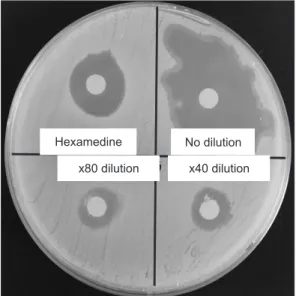
Fig. 1. Treatment of the undiluted
gargles (each left discs), and 40- or
80-times dilutions (middle and right
discs). Bacteria were treated to only 1
mL of the gargles for 24 hours.
A-Young Park et al.
157 overnight at 37
oC. Second, bacterial suspension was mixed with
1 mL of the gargles and incubated at room temperature (RT) for an hour. This step was repeated; suspension was then cultured overnight at 37
oC. The third protocol was a modification of the antibiotic resistance test by disc diffusion assay. The gargles were loaded onto the discs, cultured overnight onto TSA at 37
oC, after which the bacterial colonies were counted.
Results
Effect of serially diluted gargles to bacteria
Only 40- and 80-times dilutions of Cololo SP solution (gargle) were analyzed in this 1st protocol. Hexamedine solution and undiluted Cololo SP solution inhibited the growth of all six bacteria, but diluted gargles when they were single treatment did not show complete inhibition (Fig. 1). Nevertheless, diluted 40-times gargle was inhibited more than diluted 80-times onto bacteria.
Fig. 2. Treatment of the gargles twice, with 1 hour incubation and 4 hours incubation at room temperature.
Staphylococcus aureus Porphyromonas gingivalis
Escherichia coli O157 Streptococcus pyogenes
Lactobacillus rhamnosus Salmonella typhi
Hexamedine No dilution x80 dilution
x160 dilution x320 dilution
Hexamedine No dilution x80 dilution
x160 dilution x320 dilution
Hexamedine No dilution x80 dilution
x160 dilution x320 dilution
Hexamedine No dilution x80 dilution
x160 dilution x320 dilution
Hexamedine No dilution x80 dilution
x160 dilution x320 dilution x160 dilution x320 dilution
Hexamedine No dilution x80 dilution
158
Evaluation of gargling Cololo solution for bacterial growth inhibition
Effect of repeated treatment of gargles to bacteria When compared to Hexamedine solution, 1 mL of Cololo SP solution when it was single treatment did not show complete bacterial inhibition. In the 2nd protocol, the bacteria were treated twice with the gargle at RT for 1 hour, before overnight incubation. All other bacteria were completely inhibited by the undiluted and 80-times diluted gargles. Furthermore, the 160- and 320-times diluted gargles showed the bacterial inhibition, except for two strains, S. aureus and P. gingivalis (Fig. 2).
Disc diffusion assay using gargles
Using disc diffusion assay, the Cololo SP solution was loaded onto discs and then incubated at 37
oC overnight. As the result of disc diffusion assay for S. typhi resistance, the undiluted gargles showed the strong bacterial inhibition as compared to Hexamedine solution. In addition, the 40- and 80-times dilutions of gargle showed also bacterial inhibition (Fig. 3).
Discussion
The major compound of Hexamedine solution is 0.005 mL/mL of chlorhexidine gluconate. It is safe for humans, but a little harmful to animals [7]. Chlorhexidine gluconate is widely used to treat gingivitis (swelling, redness and
bleeding gums). However, a treatment of more than 10 days is not recommended. Recurrent serious dental infections or incomplete killing of bacteria would render the dental treatment to be unsuccessful. Therefore, new therapeutics is strongly required. Cololo SP solution, developed in Japan, has been considered as an alternative.
Bacterial killing by twice-treatment of Cololo SP solution when it was diluted 1:80 (0.00006 mL/mL of chlorhexidine gluconate) was effective as much as Hexamedine solution.
However, if considered for longer treatment, we suggest that Cololo SP solution will be a superior alternative as compared to Hexamedine solution. Moreover, side effects by long-term usage will be studied in near future.
Acknowledgments
We sincerely thank for the president of MDcom Co., Jang- Gyu Lee who provided Coloro SP solution and Hexamedine.
References
1. World Health Organization (WHO): WHO model list of essential medicines. Jeneva: WHO, 2013.
2. Hagi A, Iwata K, Nii T, Nakata H, Tsubotani Y, Inoue Y:
Bactericidal effects and mechanism of action of olanexidine gluconate, a new antiseptic. Antimicrob Agents Chemother 59:
4551-4559, 2015.
3. Leikin JB, Paloucek FP: Poisoning and toxicology handbook.
4th ed. New York (NY): Informa Healthcare USA, Inc., 2008.
p.183-184.
4. Sadat Sajadi F, Moradi M, Pardakhty A, Yazdizadeh R, Madani F: Effect of fluoride, chlorhexidine and fluoride-chlorhexidine mouthwashes on salivary streptococcus mutans count and the prevalence of oral side effects. J Dent Res Dent Clin Dent Prospects 9:49-52, 2015.
5. Vale GC, Cury AA, Arthur RA, Cury JA, Tabchoury CP:
Recolonization of mutans Streptococci after application of chlorhexidine gel. Braz Dent J 25:485-488, 2014.
6. Kolahi J, Soolari A: Rinsing with chlorhexidine gluconate solution after brushing and flossing teeth: a systematic review of effectiveness. Quintessence Int 37:605-612, 2006.
7. Hasegawa H, Tomiyama K, Kumada H, Kawata A, Higashi K, Takahashi O, Hamada N, Mukai Y: Antimicrobial effects of carbamide peroxide against a polymicrobial biofilm model.
Am J Dent 28:57-60, 2015.
Hexamedine No dilution
x40 dilution x80 dilution