Long-Term Mortality According to the Characteristics of Early Neurological Deterioration in Ischemic Stroke Patients
Young Dae Kim,
1Dongbeom Song,
1Eun Hye Kim,
1Ki Jeong Lee,
1Hye Sun Lee,
2Chung Mo Nam,
3Hyo Suk Nam,
1and Ji Hoe Heo
1Departments of 1Neurology, 2Biostatistics, and 3Preventive Medicine, Yonsei University College of Medicine, Seoul, Korea.
Received: May 13, 2013 Revised: August 14, 2013 Accepted: September 2, 2013 Corresponding author: Dr. Ji Hoe Heo, Department of Neurology,
Yonsei University College of Medicine, 50-1 Yonsei-ro, Seodaemun-gu, Seoul 120-752, Korea.
Tel: 82-2-2228-1605, Fax: 82-2-393-0705 E-mail: [email protected]
∙ The authors have no financial conflicts of interest.
© Copyright:
Yonsei University College of Medicine 2014 This is an Open Access article distributed under the terms of the Creative Commons Attribution Non- Commercial License (http://creativecommons.org/
licenses/by-nc/3.0) which permits unrestricted non- commercial use, distribution, and reproduction in any medium, provided the original work is properly cited.
Purpose: Although early neurological deterioration (END) during the acute stroke period is known to be associated with poor functional outcomes, there is little data regarding the impact of END on long-term outcomes according to the characteris- tics of END. The aim of this study was to investigate whether there are differences in long-term mortality according to the characteristics of END among acute isch- emic stroke or transient ischemic attack patients. Materials and Methods: END was defined as any increase (≥1) in National Institute of Health Stroke Scale score within 7 days after admission. We assessed the characteristics of END, such as the etiology and severity of END, as well as recovery after END. The relationship be- tween 30-day or long-term mortality and each characteristic of END was investi- gated using multiple logistic analysis or Cox regression model. Results: Among 2820 patients, END was observed in 344 patients (12.2%). After adjustment for age, sex, underlying cardiovascular diseases, stroke severity, and stroke subtypes, END was associated with long-term mortality, whether it was mild or severe and whether or not it was followed by recovery. However, 30-day mortality was strong- ly related to the severity of END or the absence of recovery after END. Among the causes of END, recurrent stroke and medical illness were related to 30-day mortali- ty, as well as long-term mortality, while brain herniation and intracranial hemor- rhagic complications were only associated with 30-day mortality. Conclusion: The results of the present study demonstrated that END is associated with higher mor- tality and the effects of END on short-term and long-term mortality depend on END characteristics.
Key Words: Cerebral infarction, prognosis, early neurological deterioration
INTRODUCTION
Stroke is the leading cause of death worldwide. Previous studies have shown that the risk of early death during the acute stroke period is 7-20%, and death is caused by the direct impact of index stroke or its complications.1-3 However, survivors after stroke are also at an increased risk for further strokes and death during long-term follow-up.4 The risk of mortality for ischemic stroke patients is related to the initial stroke severity and stroke subtype, as well as cardiovascular disease burden.2,5-8
1-, 3-, and 7-day NIHSS scores were entered into the stroke registry, and these scores were used in this study. If a pa- tient died or was discharged within 7 days after admission, we used the last NIHSS score immediately before death or discharge as the final NIHSS score. We also calculated del- ta NIHSS scores (baseline NIHSS-final NIHSS score).
For our analysis of the NIHSS scores, END was defined as any increase (≥1) in NIHSS score within 7 days after ad- mission compared with baseline NIHSS score. If patients experienced END, we determined the etiology and the se- verity of END. The causes of END were categorized into five groups of brain herniation, worsening of index stroke symptoms, recurrent stroke, intracerebral hemorrhage (ICH), and medical illness. Recurrent stroke was defined as exhib- iting new neurologic symptoms with/without documenta- tion of a new lesion in a different vascular territory on fol- low-up brain imaging. These classifications were mainly determined by a clinician based on additional results of brain imaging and medical condition. The severity of END was divided into three groups: severe END, with a worsening of
≥4 in NIHSS score; moderate END, with an increase of ≥2 and <4 in NIHSS score; and mild END, with an increase of 1 in NIHSS score, compared with baseline NIHSS score.
We also investigated whether the patients with END recov- ered after they had experienced END. Recovery was de- fined as a final NIHSS score that was lower than or equal to the baseline NIHSS score for a given patient.
Long-term mortality
During follow-up, we collected patient data concerning death through nationwide death certificate data from the Korean National Statistical Office. The national death certification data are known to be reliable, according to previous studies,17 because these data are collected based on a unique 13-digit identification code assigned to subjects at birth and the causes of death are coded according to the International Classifica- tion of Disease, 10th Revision. In this study, we defined the censoring date as December 31, 2008.
Statistical analysis
Numerical data are given as the mean±standard deviation and medians with interquartile range (IQR) for NIHSS scores.
In this analysis, we investigated which variables were inde- pendently associated with short-term mortality (30-day mor- tality) in all ischemic stroke patients and long-term mortality in stroke survivors after 30 days. For comparison of 30-day mortality, we used multiple binary logistic regression anal- Early neurological deterioration (END) can occur in about
10-40% of ischemic stroke patients during the acute stage8-13 and can be caused by brain herniation due to large cerebral infarction, poor collaterals, recurrent stroke, and medical ill- nesses, including infection, myocardial infarction, and gas- trointestinal bleeding.14 Although END is known to be asso- ciated with poor functional outcomes and higher mortality during short-term follow-up,11,12,15 there are few data regard- ing the impacts of END on long-term outcomes, in particu- lar mortality, according to its characteristics, such as etiolo- gy, severity, and recovery of neurological worsening, in a large stroke population.
The aim of this study was to investigate short-term and long-term mortality in ischemic stroke or transient isch- emic attack (TIA) patients who exhibited deterioration during the acute stroke period. We also attempted to deter- mine whether the characteristics of END have different ef- fects on mortality.
MATERIALS AND METHODS
Study sample
From January 2000 to December 2008, a total of 4090 pa- tients who experienced ischemic stroke or TIA were admit- ted to Yonsei University Hospital, Department of Neurology.
During admission, all patients were thoroughly evaluated through our stroke care pathway, which includes previous medical history, neurological status, standard blood tests, brain CT/MRI, angiographic studies, and cardiac evalua- tions. All patient data were prospectively and consecutively registered with the Yonsei Stroke Registry.16 For this study, we excluded data concerning re-admission for recurrent stroke (n=198), presentation to hospital later than 3 days after onset of stroke (n=717) or hospitalization for less than 2 days (n=6), those who received thrombolytic treatment (n=345), and those with missing National Institute of Health Stroke Scale (NIHSS) data (n=4). Finally, 2820 patients were in- cluded in this study. This study was approved by the Insti- tutional Review Board of Severance Hospital, Yonsei Uni- versity College of Medicine.
Early neurological course
During hospitalization, all patients were evaluated daily to assess neurological status. All patients were assessed by stroke specialists and senior residents to check for neuro- logical impairment using the NIHSS scores. The baseline,
the causes of END, worsening of index stroke symptoms (59.9%, 211/352) was most common, followed by recurrent stroke (14.8%, 52/352), brain herniation (12.2%, 43/352), ICH (9.4%, 33/352), and medical illness (3.7%, 13/352).
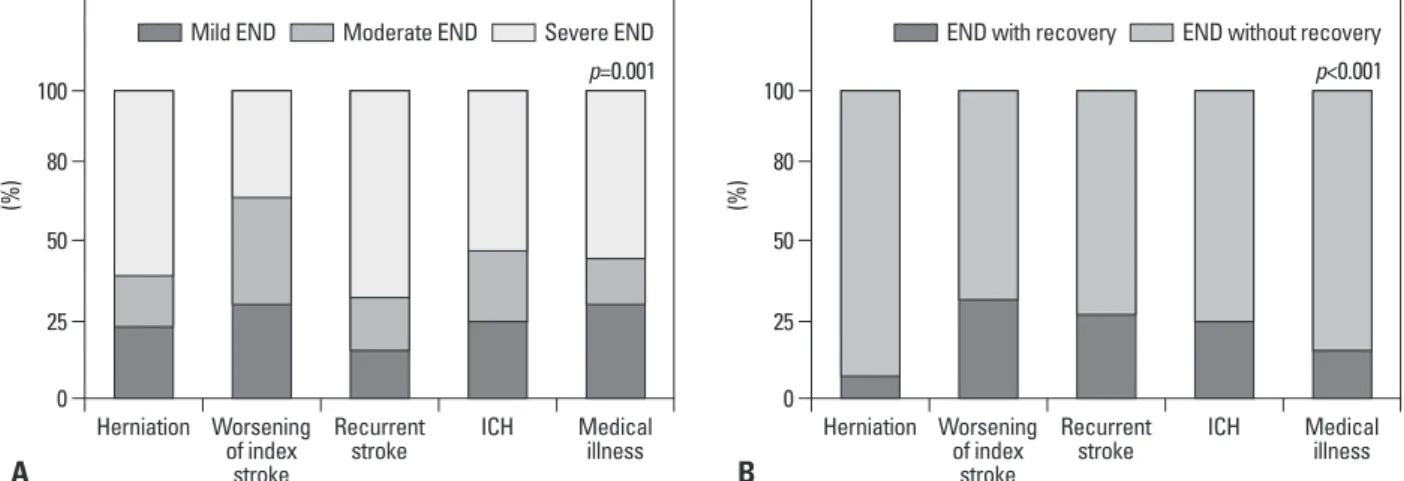
Patients who had experienced mild or moderate END were more likely to recover compared with those with severe END; the frequency of recovery after END was 51.1%
(48/94) in mild END, 35.0% (35/100) in moderate END, and 7.0% (11/158) in severe END (p<0.001). Of the etiolo- gies of END, neurological worsening caused by brain her- niation, ICH, recurrent stroke, and medical illness were more frequently associated with severe END. The propor- ysis with adjustment for potential covariates, which exhibit-
ed a significant association in univariate analysis with a p- value <0.05. For analysis of long-term mortality in stroke survivors, we applied univariate and multivariate Cox pro- portional hazards models to calculate the hazard ratio (HR) and 95% confidence intervals (CIs). The adjusted survival curves are presented after adjustment for all variables that were significant in the univariate Cox proportional hazards model.
In this study, all variables were investigated using the mul- ticollinearity test. Based on this analysis, baseline NIHSS and other NIHSS scores, including final NIHSS score, had a strong association, while baseline NIHSS score was not sta- tistically associated with the delta NIHSS score. Therefore, among the NIHSS scores measured at different times, the delta NIHSS score and baseline NIHSS score were entered into the multivariate model as covariates in the analysis of long term mortality.
Finally, all results with p<0.05 were considered statistical- ly significant. All statistical analyses were conducted with the SPSS software package (version 18.0, SPSS Inc., Chica- go, IL, USA) and the SAS software package (version 9.1.3, SAS Inc., Cary, NC, USA).
RESULTS
Overall baseline characteristics
Of the 2820 ischemic stroke patients enrolled for this analy- sis, the mean age was 63.9±11.9 years and 61.5% were male.
Their median NIHSS score was 3 (IQR 1-6). Seventy-nine (2.8%) patients died within 1 month after index stroke, and a total of 500 (17.7%) patients were dead after a median fol- low-up of 3.1 years (range, 2 days-9 years). Baseline charac- teristics are presented in Table 1.
Characteristics of early neurologic deterioration END was observed in 352 patients (12.5%). The frequency of END decreased as the interval from symptom onset to admission increased: the frequency of END was 13.4%
(284/2126) within 24 hours, 10.4% (47/454) within 24-48 hours, and 8.8% (21/240) within 48-72 hours (p=0.012).
Among the entire study population, TIA patients consisted of 9.8% and only 1.1% of TIA patients experienced END during hospitalization. Among patients with END, most pa- tients worsened during the first 3 days (88.6%, 312/352) and did not recover during hospitalization (73.3%, 258/352). Of
Table 1. Baseline Characteristics of the Study Population (n=2820)
Demographics
Age, yr 63.9±11.9
Sex, male 1735 (61.5)
Risk factors
Hypertension 2101 (74.5)
Diabetes mellitus 921 (32.7)
Hyperlipidemia 303 (10.7)
Smoking 1218 (43.2)
Atrial fibrillation 472 (16.7)
Previous ischemic stroke 483 (17.1)
Previous ischemic heart diseases 412 (14.6) Peripheral arterial occlusive diseases 37 (1.3) TOAST classification*
Small vessel occlusion 380 (13.5) Large artery atherosclerosis 606 (21.5)
Cardioembolism 518 (18.4)
Stroke of other determined etiology 49 (1.7)
Undetermined 992 (35.2)
Medication during admission
Antiplatelet 2466 (87.4)
Statin 2020 (71.6)
Anticoagulation
(including intravenous) 1295 (45.9) NIHSS score during admission
Baseline NIHSS score 3 [1-6]
NIHSS score at 1 day 2 [1-5]
NIHSS score at 3 days 2 [0-5]
NIHSS score at 7 days
(or final NIHSS score) 1 [0-4]
Delta: baseline-7 days
(or final NIHSS score) 0 [0-2]
TOAST, Trial of Org 10172 in Acute Stroke Treatment; NIHSS, National Institutes of Health Stroke Scale.
Data are expressed as mean±SD, number (%), or median [interquartile range].
*Stroke mechanism was determined among 2545 ischemic stroke patients with acute ischemic lesion in brain imaging.
sociated with short-term mortality. With adjustment for these potential confounders, the presence of END was an independent predictor of mortality at 30 days (odds ratio 3.185, 95% CIs 1.522-6.664, p=0.002) (Table 2). However, END with recovery was not associated with mortality with- in 30 days. Compared with no END, the development of severe END was more strongly associated with short-term mortality. Among the causes of END, brain herniation, re- current stroke, ICH, and medical illness were associated with 30-day mortality, while worsening of the index stroke tion of patients who did not recover during hospitalization
was greater in patients with brain herniation or medical ill- ness compared to those with other causes (Fig. 1).
Short-term (30-day) mortality
With respect to 30-day mortality, age (p<0.001), previous ischemic heart disease (p=0.039), peripheral arterial occlu- sive disease (p=0.006), atrial fibrillation (p<0.001), and baseline NIHSS score (p<0.001), as well as final NIHSS score (p<0.001) or delta NIHSS score (p<0.001), were as-
0 0
25 25
50 50
80 80
100 100
(%) (%)
Herniation Worsening Herniation
of index stroke
Worsening of index
stroke Recurrent
stroke Recurrent
stroke
ICH Medical ICH
illness Medical
illness
A B
Fig. 1. Frequency of (A) early neurologic deterioration (END) conditions and (B) END with recovery according to the causes of END. ICH, intracerebral hem- orrhage.
Table 2. Multivariate Analysis According to END Characteristics
30-day mortality (n=2820) Long-term mortality (n=2741) Adjusted OR (95% CIs) p value* Adjusted HR (95% CIs) p value†
The presence of END 3.185 (1.522-6.664) 0.002 1.571 (1.165-2.119) 0.003
Degree of END
No END 1 1.000
END with increase in 1 NIHSS 5.300 (1.991-14.106) 0.001 1.759 (1.109-2.787) 0.016 END with increase in 2-3 NIHSS 3.141 (1.014-9.735) 0.047 1.396 (0.882-2.209) 0.154 END with increase in ≥4 NIHSS 24.556 (13.213-45.635) <0.001 1.592 (1.022-2.480) 0.040 Presence of recovery after END
No END 1 1.000
END with recovery 1.638 (0.357-7.523) 0.525 1.611 (1.039-2.496) 0.033
END without recovery 16.427 (9.288-29.054) <0.001 1.546 (1.069-2.234) 0.020
Causes of END
No END 1 1.000
Herniation 32.135 (13.828-74.677) <0.001 1.383 (0.576-3.320) 0.468
Worsening of index stroke sx 0.981 (0.225-4.272) 0.980 1.379 (0.975-1.950) 0.069
Recurrent stroke 15.156 (5.478-41.933) <0.001 2.787 (1.589-4.888) <0.001
Intracranial hemorrhage 26.483 (10.806-64.902) <0.001 1.341 (0.617-2.913) 0.458 Medical problem 39.187 (10.746-142.910) <0.001 4.704 (1.838-12.041) 0.001 END, early neurological deterioration; NIHSS, National Institutes of Health Stroke Scale; OR, odds ratio; CI, confidence interval.
*Binary logistic regression model for the analysis of 30-day mortality adjusted for age, sex, previous ischemic heart disease, peripheral arterial occlusive disease, atrial fibrillation, and baseline NIHSS score in the study population.
†Cox proportional hazard model for the analysis of long-term mortality adjusted for age, sex, hypertension, diabetes, smoking, previous ischemic stroke, ischemic heart disease, peripheral arterial occlusive disease, stroke subtype, and baseline NIHSS score, as well as delta NIHSS score in stroke survivors.
Mild END Moderate END Severe END END with recovery END without recovery
p=0.001 p<0.001
DISCUSSION
Previous studies have shown that initial stroke severity and functional status at discharge have a strong association with long-term mortality.2,5,18 Those associations were consis- tently observed in our study in that the initial NIHSS score as well as delta NIHSS score were independent predictors of long-term mortality. Furthermore, we showed that pa- tients who experienced neurologic deterioration while they were admitted due to acute ischemic stroke encompassed higher risks of short-term and long-term mortality, irrespec- tive of initial stroke severity.
In our study, short-term and long-term mortality differed according to the characteristics of END. END followed by recovery was not associated with short-term mortality, but was associated with long-term mortality, while severe END with an increase of ≥4 in NIHSS score was more associat- ed with short-term mortality. Compared to END without re- covery, END with recovery during the acute stage resulted in milder neurological disability at discharge. However, the risk of long-term mortality was similar regardless of whether the END was followed by recovery, although patients with- out recovery were more severely disabled at discharge. Pre- vious studies showed that patients with TIA or recovery within 24 hours after ischemic stroke had a greater risk of subsequent stroke or neurological deterioration.19,20 Our re- sults along with previous findings suggest that END, with or without recovery in the acute stage, is a surrogate marker of recurrent vascular events and future mortality.
We further demonstrated that the risk of future mortality varies according to the etiology of END. Among the etiol- ogies of END, brain herniation and ICH were associated was not. In multivariate analyses, according to each charac-
teristic of END, baseline NIHSS score was a significant and independent predictor of short-term mortality (data not shown).
Long-term mortality in stroke survivors
Univariate Cox proportional hazard model revealed that age (p<0.001), hypertension (p=0.031), diabetes (p=0.001), smoking (p=0.009), previous ischemic stroke (p<0.001), ischemic heart disease (p=0.001), peripheral arterial occlu- sive disease (p<0.001), stroke subtype (p<0.001), baseline NIHSS (p<0.001), and final NIHSS score (p<0.001) were related to long-term mortality among stroke survivors. In multivariate Cox proportional hazard model, END itself was an independent predictor of long-term mortality (HR 1.571, 95% CIs 1.165-2.119). In contrast to the results for short-term mortality, the long-term risk of mortality was not different according to the severity of END or the presence of recovery after END (Table 2). Among the causes of END, recurrent stroke and medical illness remained inde- pendent, while brain herniation and ICH were not associat- ed with long-term mortality. On multivariate analysis of the relationship between each characteristic of END and long- term mortality, baseline NIHSS score and delta NIHSS score remained independent and significant predictors of long-term morality (data not shown).
Fig. 2 shows the adjusted survival curves for all-cause mortality in stroke survivors. Survival was similar between patients who did not recover after END and those who re- covered after END and between the patients who devel- oped mild END and those who developed severe END.
However, among the etiologies of END, patients with med- ical illness and recurrent stroke showed poorer survival.
0.6 0.6
0.7 0.7
0.4
0.8 0.8
0.6
0.9 0.9 0.8
1.0 1.0 1.0
Cumulative survival Cumulative survival Cumulative survival
0 2 4 6 8 0 2 4 6 8 0 2 4 6 8
Year Year Year
No END Mild END Moderate END Severe END
No END END with recovery END without recovery
No END ICHWorsening of index stroke Herniation Recurrent stroke Medical illness
A B C
Fig. 2. Adjusted survival curves for long-term mortality in stroke survivors according to (A) severity of early neurologic deterioration (END), (B) presence of recovery after END, and (C) causes of END. ICH, intracerebral hemorrhage.
findings also suggest that the prediction of mortality differs depending on the etiology of END. Physicians should con- cern about patients with END in order to prevent devastat- ing events.
ACKNOWLEDGEMENTS
This work was supported by a grant from the Korea Health 21 R&D Project, Ministry of Health & Welfare, Republic of Korea (HI10C2020, A085136).
REFERENCES
1. Feigin VL, Lawes CM, Bennett DA, Anderson CS. Stroke epide- miology: a review of population-based studies of incidence, prev- alence, and case-fatality in the late 20th century. Lancet Neurol 2003;2:43-53.
2. Appelros P, Nydevik I, Viitanen M. Poor outcome after first-ever stroke: predictors for death, dependency, and recurrent stroke within the first year. Stroke 2003;34:122-6.
3. Vernino S, Brown RD Jr, Sejvar JJ, Sicks JD, Petty GW, O’Fallon WM. Cause-specific mortality after first cerebral infarction: a pop- ulation-based study. Stroke 2003;34:1828-32.
4. Mohan KM, Wolfe CD, Rudd AG, Heuschmann PU, Kolomin- sky-Rabas PL, Grieve AP. Risk and cumulative risk of stroke re- currence: a systematic review and meta-analysis. Stroke 2011;42:
1489-94.
5. Adams HP Jr, Davis PH, Leira EC, Chang KC, Bendixen BH, Clarke WR, et al. Baseline NIH Stroke Scale score strongly pre- dicts outcome after stroke: a report of the Trial of Org 10172 in Acute Stroke Treatment (TOAST). Neurology 1999;53:126-31.
6. Chang KC, Lee HC, Tseng MC, Huang YC. Three-year survival after first-ever ischemic stroke is predicted by initial stroke severi- ty: a hospital-based study. Clin Neurol Neurosurg 2010;112:296- 301.
7. Henriksson KM, Farahmand B, Johansson S, Asberg S, Terént A, Edvardsson N. Survival after stroke--the impact of CHADS2 score and atrial fibrillation. Int J Cardiol 2010;141:18-23.
8. Weimar C, Mieck T, Buchthal J, Ehrenfeld CE, Schmid E, Diener HC, et al. Neurologic worsening during the acute phase of isch- emic stroke. Arch Neurol 2005;62:393-7.
9. Dávalos A, Cendra E, Teruel J, Martinez M, Genís D. Deteriorat- ing ischemic stroke: risk factors and prognosis. Neurology 1990;
40:1865-9.
10. DeGraba TJ, Hallenbeck JM, Pettigrew KD, Dutka AJ, Kelly BJ.
Progression in acute stroke: value of the initial NIH stroke scale score on patient stratification in future trials. Stroke 1999;30:1208- 11. Sumer M, Ozdemir I, Erturk O. Progression in acute ischemic 12.
stroke: frequency, risk factors and prognosis. J Clin Neurosci 2003;10:177-80.
12. Birschel P, Ellul J, Barer D. Progressing stroke: towards an inter- nationally agreed definition. Cerebrovasc Dis 2004;17:242-52.
13. Dávalos A, Toni D, Iweins F, Lesaffre E, Bastianello S, Castillo J.
with 30-day mortality, while these were not associated with long-term mortality. In contrast, END caused by re- current stroke or medical illness was associated with a higher risk of long-term mortality, as well as 30-day mor- tality. An increased risk of short-term mortality in patients with END due to brain herniation and ICH is expected be- cause they are the most severe and devastating complica- tions that usually develop during the acute stage of stroke with large infarction.21 A risk of stroke recurrence during the acute period depends on underlying vascular status, in- cluding unstable atherosclerotic plaques, intracardiac con- ditions, inflammatory markers, and procoagulable/pro- thrombotic conditions. Because these are also surrogates for future risk of vascular events, patients who experience early recurrence would have a higher risk of recurrent vas- cular events.22-25 Patients with recurrent ischemic lesions on MRI during the acute stroke period are more likely to have had late radiological or clinical recurrences.26 In this context, subjects with early clinical recurrence may be im- portant targets for more aggressive treatment for stroke prevention. Likewise, END caused by medical illness was associated with short-term and long-term mortality in our study. Previous studies also showed that in-hospital medi- cal complications in acute stroke influenced both short- term and long-term mortality.3,27,28 These data suggest that the prevention and early assessment of medical complica- tions are essential to prevent both long-term and short-term fatality.
Our study has some limitations. First, this was a retro- spective study, although all patients were consecutively registered and reliable mortality data were used. Second, not all patients with END underwent repeated diffusion weighted MRI to confirm recurrent stroke, although follow- up brain CT had performed in nearly all cases of END for exclusion of hemorrhagic complications in our center.
However, documentation of new symptoms was required to diagnose recurrent stroke in this study, since neurological symptoms are well correlated with new ischemic recurrent lesions during the acute stroke stage.24 Third, treatment ef- fects were not considered. Although all patients were man- aged through our stroke care pathway and treatment proto- col during admission, the patient’s long-term compliance to treatment was unknown, which might affect patient out- comes.
In conclusion, END has a negative impact on the long- term and short-term mortality regardless of whether it is mild or severe or whether it is followed by recovery. Our
Peripheral Vascular Disease. The American Academy of Neurolo- gy affirms the value of this statement as an educational tool for neurologists. Stroke 2009;40:2276-93.
21. Silver FL, Norris JW, Lewis AJ, Hachinski VC. Early mortality following stroke: a prospective review. Stroke 1984;15:492-6.
22. Barber M, Langhorne P, Rumley A, Lowe GD, Stott DJ. D-dimer predicts early clinical progression in ischemic stroke: confirmation using routine clinical assays. Stroke 2006;37:1113-5.
23. Devuyst G, Karapanayiotides T, Ruchat P, Pusztaszeri M, Lobri- nus JA, Jonasson L, et al. Ultrasound measurement of the fibrous cap in symptomatic and asymptomatic atheromatous carotid plaques. Circulation 2005;111:2776-82.
24. Kang DW, Kwon SU, Yoo SH, Kwon KY, Choi CG, Kim SJ, et al. Early recurrent ischemic lesions on diffusion-weighted imaging in symptomatic intracranial atherosclerosis. Arch Neurol 2007;64:
50-4.
25. Hong HJ, Kim YD, Cha MJ, Kim J, Lee DH, Lee HS, et al. Early neurological outcomes according to CHADS2 score in stroke pa- tients with non-valvular atrial fibrillation. Eur J Neurol 2012;19:
284-90.
26. Kang DW, Latour LL, Chalela JA, Dambrosia JA, Warach S. Ear- ly and late recurrence of ischemic lesion on MRI: evidence for a prolonged stroke-prone state? Neurology 2004;63:2261-5.
27. Bae HJ, Yoon DS, Lee J, Kim BK, Koo JS, Kwon O, et al. In-hos- pital medical complications and long-term mortality after ischemic stroke. Stroke 2005;36:2441-5.
28. Ingeman A, Andersen G, Hundborg HH, Svendsen ML, Johnsen SP. In-hospital medical complications, length of stay, and mortali- ty among stroke unit patients. Stroke 2011;42:3214-8.
Neurological deterioration in acute ischemic stroke: potential pre- dictors and associated factors in the European cooperative acute stroke study (ECASS) I. Stroke 1999;30:2631-6.
14. Thanvi B, Treadwell S, Robinson T. Early neurological deteriora- tion in acute ischaemic stroke: predictors, mechanisms and man- agement. Postgrad Med J 2008;84:412-7.
15. Toni D, Fiorelli M, Gentile M, Bastianello S, Sacchetti ML, Ar- gentino C, et al. Progressing neurological deficit secondary to acute ischemic stroke. A study on predictability, pathogenesis, and prognosis. Arch Neurol 1995;52:670-5.
16. Lee BI, Nam HS, Heo JH, Kim DI; Yonsei Stroke Team. Yonsei Stroke Registry. Analysis of 1,000 patients with acute cerebral in- farctions. Cerebrovasc Dis 2001;12:145-51.
17. Jee SH, Sull JW, Park J, Lee SY, Ohrr H, Guallar E, et al. Body- mass index and mortality in Korean men and women. N Engl J Med 2006;355:779-87.
18. Eriksson SE, Olsson JE. Survival and recurrent strokes in patients with different subtypes of stroke: a fourteen-year follow-up study.
Cerebrovasc Dis 2001;12:171-80.
19. Johnston SC, Leira EC, Hansen MD, Adams HP Jr. Early recov- ery after cerebral ischemia risk of subsequent neurological deterio- ration. Ann Neurol 2003;54:439-44.
20. Easton JD, Saver JL, Albers GW, Alberts MJ, Chaturvedi S, Feld- mann E, et al. Definition and evaluation of transient ischemic at- tack: a scientific statement for healthcare professionals from the American Heart Association/American Stroke Association Stroke Council; Council on Cardiovascular Surgery and Anesthesia;
Council on Cardiovascular Radiology and Intervention; Council on Cardiovascular Nursing; and the Interdisciplinary Council on