Interleukin-6 Receptor Polymorphisms Contribute to the Neurological Status of Korean Patients with Ischemic Stroke
To investigate the contribution of the interleukin-6 receptor (IL-6R) gene single nucleotide polymorphisms (SNPs) to the neurological status of Korean patients with ischemic stroke (IS), two SNPs of the IL-6R gene (rs4845617, 5 UTR; rs2228144, Ala31Ala) were selected.
IS patients were classified into clinical phenotypes according to two well-defined scores:
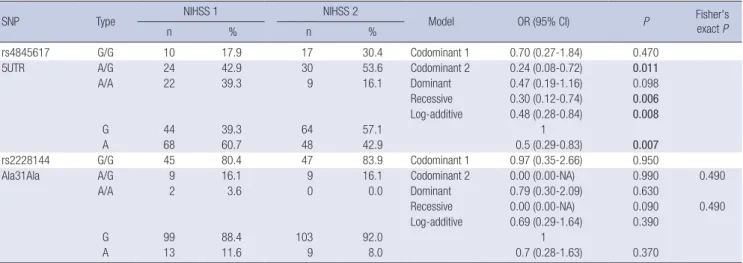
the National Institutes of Health Stroke Survey (NIHSS) and the Modified Barthel Index scores. There were 121 IS patients and 291 control subjects. The SNP rs4845617 significantly contributed to the neurological status of patients with IS (P = 0.011 in codominant model 2, P = 0.006 in recessive model, and P = 0.008 in log-additive model).
Allele frequencies of rs4845617 and rs2228144 demonstrated no significant difference in IS patients and controls. The AG and GG haplotypes differed between the NIHSS 1 (NIHSS scores < 6) group and the NIHSS 2 (NIHSS scores ≥ 6) group in patients with IS (P = 0.014, P = 0.0024). These results suggest that rs4845617 of the IL-6R gene is associated with the neurologic status of Korean patients with IS.
Keywords: Interleukin 6-Interleukin 6 Receptor Fusion Protein, Recombinant; Brain Ischemia; Stroke; Neurological Manifestations; Polymorphism
Dong Hwan Kim,1 Seung Don Yoo,1 Jinmann Chon,1 Dong Hwan Yun,1 Hee-Sang Kim,1 Hae Jeong Park,2 Su Kang Kim,2 Joo-Ho Chung,2 Jin Kyu Kang,1 and Seung Ah Lee1
1Department of Physical Medicine & Rehabilitation, College of Medicine, Kyung Hee University, Seoul, Korea; 2Kohwang Medical Research Institute, Kyung Hee University, Seoul, Korea
Received: 25 March 2015 Accepted: 23 September 2015 Address for Correspondence:
Seung Ah Lee, MD
Department of Physical Medicine & Rehabilitation, College of Medicine, Kyung Hee University, 26 Kyungheedae-ro, Dongdaemun-gu, Seoul 02447, Korea
E-mail: [email protected]
Funding: This work was supported by a grant from Kyung Hee University in 2015 (KHU-20150830).
http://dx.doi.org/10.3346/jkms.2016.31.3.430 • J Korean Med Sci 2016; 31: 430-434
INTRODUCTION
Despite the recent advancements in prevention and treatment of stroke, stroke remains the leading cause of disability and the fifth leading cause of death in the US. Especially in those older than 65 years, stroke is a leading cause of death and disability.
In the future, due to rapid aging, stroke will have a larger socio- economic influence (1). Therefore, to aid in prevention, the iden- tification of markers of stroke risk is important. Although stroke has been believed to be a multifactorial disorder with minimal classical patterns of inheritance, accumulating evidence has shown the importance of genetic factors in stroke. Especially, it has been reported that a number of inflammatory mechanisms play a fundamental part in stroke (2); thus, various inflamma- tory genes showing an association with stroke have received at- tention as candidate genes (3-11). Also, genetic factors could have an effect on stroke onset, infarct size, and prognosis (12,13).
Although several candidate genes have been studied as risk fac- tors for stroke, there are few useful markers for the prevention, diagnosis, and treatment of stroke (14,15).
Interleukin-6 (IL-6) is a potent pleiotropic cytokine that regu- lates survival and differentiation of neuronal cells. This cytokine plays a substantial role in the immune system. The counterpart, interleukin-6 receptor (IL-6R) complex consists of IL-6R and the interleukin 6 signal transducer (IL6ST/GP130/IL-6 beta),
which is associated with many other cytokines. If IL-6 binds to IL-6R, this complex binds to GP130, leading to intracellular sig- naling cascades (16). IL-6 performs as the main stimulator of C- reactive protein (CRP) production, the levels of which are known to be associated with metabolic syndromes such as obesity and diabetes, as well as with vascular events (17). As an extension of the study of IL-6R, IL-6, and CRP in stroke, the role of IL-6R needs to be elucidated. To our knowledge, there is no study about the associations between IL-6R polymorphisms and ischemic stroke (IS).
Disability after stroke is assessed through formal observation.
The National Institutes of Health Stroke Scale (NIHSS) is a neu- rologic impairment assessment tool that provides an objective quantified measurement in stroke patients (18,19). Higher scores on NIHSS indicate greater stroke severity. In a previous IL-6 poly- morphism study, patients with severe disability (NIHSS ≥ 6) were associated with a specific genotype (20). Stroke rehabilita- tion outcomes are usually assessed using the Modified Barthel Index (MBI), which is a validated tool scoring independent dai- ly living (21).
The aim of this study was to assess whether single nucleotide polymorphisms (SNPs) of the IL-6R gene were associated with the development, neurologic status, and clinical features of isch- emic stroke in the Korean population.
MATERIALS AND METHODS
All participants with stroke were patients who visited the De- partments of Rehabilitation Medicine at Kyung Hee Medical Center and Kyung Hee University Hospital at Gangdong. Healthy control subjects were recruited from a general health check-up.
IS patients were diagnosed based on magnetic resonance (MR) imaging, computed tomography (CT), or angiography. Exclu- sion criteria were ischemic heart disease or other causes of cere- brovascular events such as traumatic brain injury, transient isch- emic attack, and vascular malformation, etc. The NIHSS and MBI scored were measured in the IS patients.
Peripheral blood samples were collected from the subjects, and genomic DNA extraction was performed using a QIAamp® DNA mini kit (QIAGEN, Valencia, CA, USA). The genotypes of the two selected SNPs ware determined by direct sequencing (MACROGEN, Seoul, Korea). The following primers were used in the polymerase chain reaction (PCR) amplification: rs4845617 (forward 5´-CTGTTCTCCCCGCTCAGGTGCG-3´, reverse 5´- AGAGGCGGACAGGCTAATG-3´) and rs2228144 (forward 5´- GTAGCCTGGGCCACTTCATCA T-3´, reverse 5´-GACCTCTGA- GGCACAACTCAC-3´).
PCR consisted of 40 cycles at 94°C for 30 seconds, 58°C for 30 seconds, 72°C for 30 seconds, and 1 cycle at 72°C for 5 minutes.
An ABI PRISM 3730XL analyzer (PE Applied Biosystems, Foster City, CA, USA) sequenced the PCR products, and SeqManII soft- ware (DNASTAR, Madison, WI, USA) was used to analyze the sequencing data (22).
To obtain odds ratios (ORs), 95% confidence intervals (CIs), and P values adjusted for age and sex as covariates, SNPAnalyz- er Pro (ISTECH, Goyang, Korea), Helixtree (Golden Helix, Boz- eman, MT, USA), and SNPStats (http://bioinfo.iconcologia.net/
index.php? module = Snpstats) were used. The χ2 test was used to determine Hardy-Weinberg equilibrium (HWE). A multiple logistic regression analysis was adjusted for age and sex. In terms of increasing risk of disease, an increased specific allele frequen- cy was noted in IS patients compared with the allele frequency of controls. To analyze the association between a polymorphism and disease, a contingency table and χ2 test were applied using a prespecified genetic model. The codominant model was the most general model “where the disease risk associated with AB individuals lies between that of AA and BB individuals. In dom- inant model, with the hypothesis that carrying allele B increased risk of disease (dominant model), the AB and BB genotypes are pooled giving a 2 * 2 table. Alternatively, under a recessive mod- el for allele B, cells AA and AB would be pooled. Additive model is assumed that increased disease risk of γ for AB genotypes and 2 γ for BB genotypes” (23). In this study, codominant model 1 compared major allele homozygotes with heterozygotes, and codominant model 2 compared major allele homozygotes with minor allele homozygotes.
To determine the haplotypes between the two SNPs and the clinical features in patients with IS, Haploview version 4.2 (Daly Lab, Cambridge, MA, USA) was used.
The statistical significance level was set at P < 0.05.
Ethics statement
The study was approved by the institutional review board of Medical Research Institute, School of Medicine, Kyung Hee Uni- versity and Center, and Kyung Hee University Hospital at Gang- dong (IRB No. KMC-IRB-761-09, KHNMC-IRB-2007-020). In- formed consent was obtained from all patients before inclusion in the study.
RESULTS
There were 121 IS patients (mean ± SD, 65.7 ± 12.1 years) and 291 controls (mean ± SD, 63.0 ± 9.3 years). The total IS group consisted of 68 males and 53 females. The control group con- sisted of 152 males and 140 females. There was a difference in mean age between IS patients and control subjects, but it was not significant (P = 0.30). Therefore, we adjusted the statistical results for age and gender. IS patients were classified into two subgroups according to NIHSS score (NIHSS 1, NIHSS score
< 6; and NIHSS 2, NIHSS score ≥ 6) and MBI score (MBI 1, MBI
≤ 60; and MBI 2, MBI score > 60). The numbers of IS patients with NIHSS score < 6 and ≥ 6 were 56 and 57, respectively. The characteristics of the IS and control groups are shown in Table 1. The numbers of IS patients with MBI score ≤ 60 and > 60 were 71 and 25, respectively (data not shown).
The genotype and allele frequencies of the two examined SNPs are shown in Tables 2 and 3, respectively. Two SNPs (rs4845617, 5TUR; rs2228144, Ala31Ala) of the IL-6R gene were in HWE in the IS and control groups, respectively (P > 0.05, data not shown).
The genotype and allele frequencies of the two SNPs demon- strated no significant difference in IS cases and controls (Table 2). As shown in Table 3, the SNP rs4845617 was associated with the NIHSS score of IS patients (P = 0.011, OR = 0.24, 95% CI = 0.08-0.72 in codominant model 2, P = 0.006, OR = 0.30, 95%
CI = 0.12-0.74 in recessive model, and P = 0.008, OR = 0.48, 95%
CI = 0.28-0.84 in log-additive model). In SNP rs4845617, the frequencies of genotype according to NIHSS score was signifi- cantly different in the codominant model 2, recessive model, Table 1. Demographic characteristics of ischemic stroke patients (NIHSS 1,2) and control subjects
Name NIHSS 1 (n = 55) NIHSS 2 (n = 57) Control (n = 291) Gender (number) M = 32, F = 24 M = 32, F = 25 M = 152, F = 139 Average age (year,
mean ± SD) 64.6 ± 12.5 66.2 ± 11.8 63.0 ± 9.3 Average NIHSS (score,
mean ± SD)
3.4 ± 1.7 11.9 ± 4.6 -
NIHSS 1, NIHSS score < 6; NIHSS 2, NIHSS score ≥ 6.
Table 2. Genotype and allele frequencies of the two SNPs (rs4845617, rs2228144) in ischemic stroke patients and control subjects
SNP Type Ischemic stroke Control
Model OR (95% CI) P Fisher’s exact
n % n % P
rs4845617 G/G 29 24.2 91 31.5 Codominant 1 1.32 (0.78-2.23) 0.300
5UTR A/G 59 49.2 133 46.0 Codominant 2 1.57 (0.86-2.86) 0.140
A/A 32 26.7 65 22.5 Dominant 1.40 (0.86-2.29) 0.170
Recessive 1.32 (0.80-2.16) 0.280
Log-additive 1.25 (0.93-1.69) 0.140
G 117 48.8 315 54.5
A 123 51.3 263 45.5 1.3 (0.94-1.71) 0.130
rs2228144 G/G 98 81.7 225 77.3 Codominant 1 0.75 (0.43-1.32) 0.320
Ala31Ala A/G 20 16.7 60 20.6 Codominant 2 0.70 (0.14-3.56) 0.670 1.000
A/A 2 1.7 6 2.1 Dominant 0.75 (0.43-1.29) 0.280
Recessive 0.74 (0.15-3.74) 0.710 1.000
Log-additive 0.78 (0.48-1.26) 0.290
G 216 90.0 510 87.6 1
A 24 10.0 72 12.4 0.8 (0.49-1.29) 0.340
Table 3. Genotype and allele frequencies of the two SNPs (rs4845617, rs2228144) in ischemic stroke patients (NIHSS 1, 2) according to NIHSS score
SNP Type NIHSS 1 NIHSS 2
Model OR (95% CI) P Fisher's
exact P
n % n %
rs4845617 G/G 10 17.9 17 30.4 Codominant 1 0.70 (0.27-1.84) 0.470
5UTR A/G 24 42.9 30 53.6 Codominant 2 0.24 (0.08-0.72) 0.011
A/A 22 39.3 9 16.1 Dominant 0.47 (0.19-1.16) 0.098
Recessive 0.30 (0.12-0.74) 0.006
Log-additive 0.48 (0.28-0.84) 0.008
G 44 39.3 64 57.1 1
A 68 60.7 48 42.9 0.5 (0.29-0.83) 0.007
rs2228144 G/G 45 80.4 47 83.9 Codominant 1 0.97 (0.35-2.66) 0.950
Ala31Ala A/G 9 16.1 9 16.1 Codominant 2 0.00 (0.00-NA) 0.990 0.490
A/A 2 3.6 0 0.0 Dominant 0.79 (0.30-2.09) 0.630
Recessive 0.00 (0.00-NA) 0.090 0.490
Log-additive 0.69 (0.29-1.64) 0.390
G 99 88.4 103 92.0 1
A 13 11.6 9 8.0 0.7 (0.28-1.63) 0.370
NIHSS 1, NIHSS score < 6; NIHSS 2, NIHSS score ≥ 6.
Table 4. IL-6R Haplotype frequencies in ischemic stroke patients and control subjects Haplotype Frequency Ischemic stroke Control
χ2 P
+ - + -
GG 0.459 102.3 137.7 275.3 306.7 1.493 0.220
AG 0.424 113.7 126.3 234.7 347.3 3.451 0.060
GA 0.069 14.7 225.3 41.8 540.2 0.299 0.580
AA 0.048 9.3 230.7 30.2 551.8 0.638 0.420
Table 5. Haplotype frequencies in ischemic stroke patients according to NIHSS scores Haplotype Frequency NIHSS 1 NIHSS 2
χ2 P
+ - + -
AG 0.485 63.5 48.5 45.1 66.9 6.044 0.014
GG 0.417 35.5 76.5 57.9 54.1 9.203 0.002
GA 0.065 8.5 103.5 6.1 105.9 0.419 0.520
AA 0.033 4.5 107.5 2.9 109.1 0.361 0.550
NIHSS 1, NIHSS score < 6; NIHSS 2, NIHSS score ≥ 6.
and log-additive model, and the A allele frequency was signifi- cantly higher in the NIHSS 1 group of IS patients. However, in SNP rs2228144, the genotype and allele frequencies did not cor- relate with the NIHSS score of the IS group (Table 3). Further- more, rs4845617 and rs2228144 had no correlation with MBI score in the IS group (data not shown).
We investigated the associations between haplotypes of con- trol subjects and IS patients and NIHSS score. The haplotype frequencies of the two SNPs were not significantly different be- tween control subjects and IS patients (Table 4). However, as shown in Table 5, the AG and GG haplotypes differed between
Table 6. Haplotype frequencies in ischemic stroke patients according to MBI scores
Haplotype Frequency MBI 1 MBI 2
χ2 P
+ - + -
AG 0.489 65.8 74.2 27.1 22.9 0.76 0.380
GG 0.417 61.2 78.8 17.9 32.1 0.945 0.330
GA 0.062 8.8 131.2 3.1 46.9 0.001 0.980
AA 0.032 4.2 135.8 1.9 48.1 0.079 0.780
MBI 1, MBI ≤ 60; MBI 2, MBI score > 60.
the NIHSS 1 and NIHSS 2 groups in IS patients. The frequency of the AG haplotype was higher in the NIHSS 1 group, and that
of the GG haplotype was higher in the NIHSS 2 group of IS pa- tients (P = 0.014, P = 0.0024, respectively). However, the haplo- type frequencies found no significant difference by MBI scores (Table 6).
DISCUSSION
Ischemic stroke is known to be a heterogeneous multifactorial disease (24). Although conventional risk factors such as hyper- tension, diabetes, dyslipidemia and smoking account for a sig- nificant proportion of these stroke events, a considerable por- tion remains insufficiently explained by these factors (25,26).
As risk factors for stroke, several genetic factors have been stud- ied; however, there are few useful markers for prevention, diag- nosis, and treatment of stroke (26). Therefore, increasing our understanding of risk factors including genetic components would allow us to predict the risk better, identification of novel stroke mechanisms, and new therapeutic approaches using ge- netic factors (27).
Several studies have reported the relationship between SNPs and stroke risk in Korea. Some of these SNPs include apolipo- protein E (3), 5-methyltetrahydrofolate-homocysteine methyl- transferase (6), interleukin 4 (11), interleukin-1 receptor antag- onist, tumor necrosis factor, interleukin 1 beta (8), neuropep- tide Y (5), peroxisome proliferator-activated receptor gamma (9), phosphodiesterase 4D cAMP-specific chemokine (C-C mo- tif) ligand 5 (4), thromboxaneA2 receptor, and thromboxane A synthase 1 (platelet) (10).
Several SNPs have been identified in the IL-6R gene, associ- ated with carotid plaque (28), CRP (17,29) and obesity or diabe- tes (30-33). However, there has been no study of polymorphisms of the IL-6R gene in relation to stroke. Carotid plaque is assumed to be associated with increased stroke risk. In a genetic study in a Dominican population, IL-6R was suggested to be a related gene associated with carotid plaque (28).
Elevated CRP level predicts risk of stroke (17). IL-6 has been shown to have a positive correlation with CRP and to predict the risk of vascular events. The polymorphism of IL-6R gene is linked with CRP expression and plasma IL-6 level (34). Lu Qi et al. (35) demonstrated that the IL-6R variants (rs6684439, rs4845622, rs8192284, rs4329505) are significantly associated with plasma CRP level, independent of IL-6 level. In addition, the IL-6R vari- ant interacts with CRP in relation to diabetes risk. In another study, the IL-6R gene (rs4845617) was suggested to play an im- portant role in the pathogenesis of dyslipidemia and atheroscle- rosis (36). We identified SNPs of IL-6R, in coding regions near the promoter region, that had greater than 0.1 heterozygosity and greater than 0.1 minor allele frequency. For rs4845617, het- erozygosity is 0.471, and minor allele frequency is 0.3804; for rs2228144, heterozygosity is 0.208, and minor allele frequency is 0.1178.
This is the first report to identify an association between SNPs of the IL-6R gene associated with risk of stroke and the clinical features of stroke. The two SNPs (rs4845617 and rs2228144) were not associated with development or daily activities of IS. How- ever, our results revealed that SNP rs4845617 contributes to the neurologic status of IS patients. The mechanisms remain of the effects of IL-6R gene polymorphisms on stroke severity remain unclear. Compared with previous SNPs studies, the sample size in this study was relatively small. Therefore, other stroke risk fac- tors analyses could be included while sample size became small- er after dividing groups with regard to hypertension, diabetes, dyslipidemia, and smoking history in this study. Further studies with larger sample size are necessary to elucidate this result.
In summary, two SNPs of the IL-6R gene (rs4845617, rs2228144) were analyzed in Korean ischemic stroke patients. The frequen- cies of genotype and alleles of the two SNPs demonstrated no significant difference in IS cases and controls. Therefore, the two SNPs are not associated with development of IS. However, in SNP rs4845617, the frequencies of genotypes according to NIHSS score are statistically different, and the A allele frequen- cy in the mild stroke patients is significantly higher than an al- lele frequency in the severe stroke patients. This indicates that SNP rs4845617 is associated with the neurologic status evaluat- ed by NIHSS in patients with IS. In addition, the A allele of SNP rs4845617 might have a protective effect against neurologic def- icit in IS patients.
DISCLOSURE
The authors have no potential conflicts of interest to disclose.
AUTHOR CONTRIBUTION
Study design and literature review: Kim DH, Yoo SD, Lee SA, Chung JH. Data managment and analyses: Kim DH, Chon J, Yun DH, Kim HS, Park HJ, Kim SK. Interpretation of the find- ings and preparation of the manuscript: Kim DH, Kim HS, Kim SK, Chung JH, Kang JK, Lee SA. Manuscript preparation: Kim DH, Yoo SD, Chon J, Yun DH, Kim HS, Park HJ, Kim SK, Kang JK, Lee SA. Agreement with final manuscript and submission:
all authors.
ORCID
Dong Hwan Kim http://orcid.org/0000-0002-3812-5509 Seung Ah Lee http://orcid.org/0000-0002-3426-6259
REFERENCES
1. Andrawes WF, Bussy C, Belmin J. Prevention of cardiovascular events in elderly people. Drugs Aging 2005; 22: 859-76.
2. Tuttolomondo A, Di Raimondo D, di Sciacca R, Pinto A, Licata G. Inflam- matory cytokines in acute ischemic stroke. Curr Pharm Des 2008; 14: 3574- 89.
3. Kang SY, Lee WI. Apolipoprotein e polymorphism in ischemic stroke pa- tients with different pathogenetic origins. Korean J Lab Med 2006; 26:
210-6.
4. Kim MK, Kim JT, Choi SM, Lee SH, Park MS, Cho KH. Phosphodiesterase 4D gene and risk of noncardiogenic ischemic stroke in a Korean popula- tion. J Korean Med Sci 2009; 24: 307-10.
5. Kim NS, Ko MM, Cha MH, Oh SM, Bang OS. Age and sex dependent ge- netic effects of neuropeptide Y promoter polymorphism on susceptibility to ischemic stroke in Koreans. Clin Chim Acta 2010; 411: 1243-7.
6. Kim OJ, Hong SP, Ahn JY, Hong SH, Hwang TS, Kim SO, Yoo W, Oh D, Kim NK. Influence of combined methionine synthase (MTR 2756A > G) and methylenetetrahydrofolate reductase (MTHFR 677C > T) polymorphisms to plasma homocysteine levels in Korean patients with ischemic stroke.
Yonsei Med J 2007; 48: 201-9.
7. Kim Y, Kim JH, Nam YJ, Kong M, Kim YJ, Yu KH, Lee BC, Lee C. Klotho is a genetic risk factor for ischemic stroke caused by cardioembolism in Ko- rean females. Neurosci Lett 2006; 407: 189-94.
8. Lee BC, Ahn SY, Doo HK, Yim SV, Lee HJ, Jin SY, Hong SJ, Lee SH, Kim SD, Seo JC, et al. Susceptibility for ischemic stroke in Korean population is associated with polymorphisms of the interleukin-1 receptor antago- nist and tumor necrosis factor-alpha genes, but not the interleukin-1beta gene. Neurosci Lett 2004; 357: 33-6.
9. Lee BC, Doo HK, Ahn SY, Byun SH, Kim SI, Park HK, Hong M, Ha E, Yim SV, Yin C, et al. Peroxisome proliferator-activated receptor-gamma Pro- 12Ala polymorphism is associated with the susceptibility to ischemic stroke in Taeeumin classified by Sasang medicine. Neurol Res 2007; 29 Suppl 1:
S32-7.
10. Park SA, Park BL, Park JH, Lee TK, Sung KB, Lee YK, Chang HS, Park CS, Shin HD. Association of polymorphisms in thromboxane A2 receptor and thromboxane A synthase 1 with cerebral infarction in a Korean popula- tion. BMB Rep 2009; 42: 200-5.
11. Um JY, Kim HM. Polymorphisms of RANTES and IL-4 genes in cerebral infarction. J Mol Neurosci 2009; 37: 1-5.
12. Meschia JF. Clinically translated ischemic stroke genomics. Stroke 2004;
35: 2735-9.
13. Mallolas J, Hurtado O, Castellanos M, Blanco M, Sobrino T, Serena J, Viv- ancos J, Castillo J, Lizasoain I, Moro MA, et al. A polymorphism in the EAAT2 promoter is associated with higher glutamate concentrations and higher frequency of progressing stroke. J Exp Med 2006; 203: 711-7.
14. Dichgans M. Genetics of ischaemic stroke. Lancet Neurol 2007; 6: 149-61.
15. Yamada Y, Metoki N, Yoshida H, Satoh K, Kato K, Hibino T, Yokoi K, Wata- nabe S, Ichihara S, Aoyagi Y, et al. Genetic factors for ischemic and hem- orrhagic stroke in Japanese individuals. Stroke 2008; 39: 2211-8.
16. Wang M, Song H, Jia J. Interleukin-6 receptor gene polymorphisms were associated with sporadic Alzheimer’s disease in Chinese Han. Brain Res 2010; 1327: 1-5.
17. Ridker PM, Rifai N, Rose L, Buring JE, Cook NR. Comparison of C-reac- tive protein and low-density lipoprotein cholesterol levels in the predic- tion of first cardiovascular events. N Engl J Med 2002; 347: 1557-65.
18. Goldstein LB, Bertels C, Davis JN. Interrater reliability of the NIH stroke scale. Arch Neurol 1989; 46: 660-2.
19. Muir KW, Weir CJ, Murray GD, Povey C, Lees KR. Comparison of neuro-
logical scales and scoring systems for acute stroke prognosis. Stroke 1996;
27: 1817-20.
20. Greisenegger S, Endler G, Haering D, Schillinger M, Lang W, Lalouschek W, Mannhalter C. The (-174) G/C polymorphism in the interleukin-6 gene is associated with the severity of acute cerebrovascular events. Thromb Res 2003; 110: 181-6.
21. Wade DT. Measurement in neurological rehabilitation. Curr Opin Neurol Neurosurg 1992; 5: 682-6.
22. Park HK, Jo DJ. Polymorphisms of integrin, alpha 6 contribute to the de- velopment and neurologic symptoms of intracerebral hemorrhage in Ko- rean population. J Korean Neurosurg Soc 2011; 50: 293-8.
23. Lewis CM. Genetic association studies: design, analysis and interpreta- tion. Brief Bioinform 2002; 3: 146-53.
24. Matarin M, Singleton A, Hardy J, Meschia J. The genetics of ischaemic stroke. J Intern Med 2010; 267: 139-55.
25. Bevan S, Markus HS. Genetics of common polygenic ischaemic stroke:
current understanding and future challenges. Stroke Res Treat 2011; 2011:
179061.
26. Hassan A, Markus HS. Genetics and ischaemic stroke. Brain 2000; 123:
1784-812.
27. Markus HS. Stroke genetics. Hum Mol Genet 2011; 20: R124-31.
28. Gardener H, Beecham A, Cabral D, Yanuck D, Slifer S, Wang L, Blanton SH, Sacco RL, Juo SH, Rundek T. Carotid plaque and candidate genes re- lated to inflammation and endothelial function in Hispanics from north- ern Manhattan. Stroke 2011; 42: 889-96.
29. Laaksonen DE, Niskanen L, Nyyssönen K, Punnonen K, Tuomainen TP, Valkonen VP, Salonen R, Salonen JT. C-reactive protein and the develop- ment of the metabolic syndrome and diabetes in middle-aged men. Dia- betologia 2004; 47: 1403-10.
30. Wolford JK, Colligan PB, Gruber JD, Bogardus C. Variants in the interleu- kin 6 receptor gene are associated with obesity in Pima Indians. Mol Gen- et Metab 2003; 80: 338-43.
31. Hamid YH, Urhammer SA, Jensen DP, Glümer C, Borch-Johnsen K, Jør- gensen T, Hansen T, Pedersen O. Variation in the interleukin-6 receptor gene associates with type 2 diabetes in Danish whites. Diabetes 2004; 53:
3342-5.
32. Wang H, Zhang Z, Chu W, Hale T, Cooper JJ, Elbein SC. Molecular screen- ing and association analyses of the interleukin 6 receptor gene variants with type 2 diabetes, diabetic nephropathy, and insulin sensitivity. J Clin Endocrinol Metab 2005; 90: 1123-9.
33. Esteve E, Villuendas G, Mallolas J, Vendrell J, López-Bermejo A, Rodrí- guez M, Recasens M, Ricart W, San Millán JL, Escobar-Morreale H, et al.
Polymorphisms in the interleukin-6 receptor gene are associated with body mass index and with characteristics of the metabolic syndrome.
Clin Endocrinol (Oxf) 2006; 65: 88-91.
34. Ridker PM, Pare G, Parker A, Zee RY, Danik JS, Buring JE, Kwiatkowski D, Cook NR, Miletich JP, Chasman DI. Loci related to metabolic-syndrome pathways including LEPR,HNF1A, IL6R, and GCKR associate with plas- ma C-reactive protein: the Women’s Genome Health Study. Am J Hum Genet 2008; 82: 1185-92.
35. Qi L, Rifai N, Hu FB. Interleukin-6 receptor gene, plasma C-reactive pro- tein, and diabetes risk in women. Diabetes 2009; 58: 275-8.
36. Chu NF, Lin FH, Chin HC, Hong YJ. Association between interleukin-6 receptor gene variations and atherosclerotic lipid profiles among young adolescents in Taiwan. Lipids Health Dis 2011; 10: 136.