Association of the Single-Nucleotide Polymorphism and Haplotype of the Complement Receptor 1 Gene with Malaria
Yan Lan,
1* Chuan-Dong Wei,
2* Wen-Cheng Chen,
2* Jun-Li Wang,
2Chun-Fang Wang,
2Guo-Gang Pan,
2Ye-Sheng Wei,
2and Le-Gen Nong
3Departments of 1Dermatology and 2Laboratory Medicine, Affiliated Hospital of Youjiang Medical University for Nationalities, Baise, Guangxi;
3Institute of Medical Laboratory, Youjiang Medical University for Nationalities, Baise, Guangxi, P. R. China.
Received: December 3, 2013 Revised: March 27, 2014 Accepted: April 23, 2014
Co-corresponding authors: Dr. Le-Gen Nong, Institute of Medical Laboratory,
Youjiang Medical University for Nationalities, No. 98 Chengxiang Road, Baise,
Guangxi 533000, P. R. China.
Tel: 86-776-2829008, Fax: 86-776-2829008 E-mail: [email protected] and Dr. Ye-Sheng Wei,
Department of Laboratory Medicine, Affiliated Hospital of Youjiang Medical University for Nationalities, No. 18 Zhongshan Road, Baise, Guangxi 533000, P. R. China.
Tel: 86-776-2853093, Fax: 86-776-2853093 E-mail: [email protected]
*Yan Lan, Chuan-Dong Wei, and Wen-Cheng Chen equally contributed to this work.
∙ The authors have no financial conflicts of interest.
© Copyright:
Yonsei University College of Medicine 2015 This is an Open Access article distributed under the terms of the Creative Commons Attribution Non- Commercial License (http://creativecommons.org/
licenses/by-nc/3.0) which permits unrestricted non- commercial use, distribution, and reproduction in any medium, provided the original work is properly cited.
Purpose: Although the polymorphisms of erythrocyte complement receptor type 1 (CR1) in patients with malaria have been extensively studied, a question of whether the polymorphisms of CR1 are associated with severe malaria remains controver- sial. Furthermore, no study has examined the association of CR1 polymorphisms with malaria in Chinese population. Therefore, we investigated the relationship of CR1 gene polymorphism and malaria in Chinese population. Materials and Meth- ods: We analyzed polymorphisms of CR1 gene rs2274567 G/A, rs4844600 G/A, and rs2296160 C/T in 509 patients with malaria and 503 controls, using the Taq- man genotyping assay and PCR-direct sequencing. Results: There were no signifi- cant differences in the genotype, allele and haplotype frequencies of CR1 gene rs2274567 G/A, rs4844600 G/A, and rs2296160 C/T polymorphisms between pa- tients with malaria and controls. Furthermore, there was no association of polymor- phisms in the CR1 gene with the severity of malaria in Chinese population. Con- clusion: These findings suggest that CR1 gene rs2274567 G/A, rs4844600 G/A, and rs2296160 C/T polymorphisms may not be involved in susceptibility to malar- ia in Chinese population.
Key Words: Erythrocyte complement receptor type 1, gene, polymorphism, hap- lotype, malaria
INTRODUCTION
The global malaria is still very serious in currently. From the World Health Organi- zation (WHO) report in 2008 indicated that an estimated 247 million malaria cases and about 3.3 billion people at risk.1 The manifestations of malaria range from as- ymptomatic parasitaemia in semi-immune individuals to severe disease in suscep- tible populations, including the children under the age of five years, pregnant women, and non-immune adults. Among the infected patients, the symptoms of severe malaria have shown on different forms, including severe anaemia, cerebral malaria, placental malaria, metabolic acidosis, and hypoglycaemia, and so on.2,3 Although there were variety of causes to cause those disease patterns, but recent researches have shown that lack of erythrocyte complement regulatory proteins
Kingdom has recently been shown to be not associated with polymorphisms in the 3’ untranslated regions of the CR1 gene.22 Although, little is known about the role of single nu- cleotide polymorphisms (SNPs) of CR1 gene in the develop- ment of malaria, National Center for Biotechnology Informa- tion SNP database showed that CR1 gene rs2274567 G/A, rs4844600 G/A, and rs2296160 C/T sites (all are located on coding region) have frequencies of polymorphism distribu- tion in different ethnicity, including Chinese. Lastly, re- search for Thailand population indicated that the CR1 gene rs2274567 G/A and rs2296160 C/T sites polymorphisms are not associated with CR1 level and malaria.23 However, there have been no studies to examine the association be- tween SNPs of CR1 gene rs2274567 G/A, rs4844600 G/A, and rs2296160 C/T with malaria in a Chinese population.
In this study, we evaluated whether CR1 gene rs2274567 G/A, rs4844600 G/A, rs2296160 C/T sites polymorphisms and haplotype are associated with malaria in a Chinese population.
MATERIALS AND METHODS
Study population
The case-control population contained 1012 adult unrelated Chinese selected from the same populations living in China between February and August 2012, and the demographics of the cases and controls are shown in Table 1. There were no significant differences between the cases and controls for the mean age or gender distribution, smoking and alcohol consumption status, suggesting that the matching based on these two variables was adequate. For all patients with ma- was the main in pathogenesis of severe malaria anaemia,
those complement regulatory proteins including complement receptor 1 and CD55 (CR1/CD35).4,5 Those complement regulatory proteins can inhibit formation of C3 convertases, and prevent terminal polymerization of membrane attack complex, thus protecting the destruction of red blood cells.6
CR1 is an immune-regulatory protein found on the surface of erythrocytes and most leukocytes, and its functions in- clude key complement regulation of complement activation and clearance of immune complexes.7,8 Furthermore, increas- ing evidences from several studies suggest that CR1 plays a critical role in the pathogenesis of Plasmodium falciparum (P. falciparum) malaria.9,10 Early study found that the surface of erythrocytes of CR1 can bind the infected red cells to un- infected red cells to form rosettes, which is thought to con- tribute to malaria pathology by causing microvascular ob- struction and impaired tissue perfusion.11 Recently, studies indicated also that CR1 is a receptor for the invasion of eryth- rocytes by P. falciparum,12 and some studies suggest that CR1 not only regulate the complement system but also clear the immune complexes during malaria infection.13,14 Thus, the correlation of CR1 receptor and malaria remains to be studied.11
The gene encoding CR1 is located at long arm of chromo- some 1 in humans. Recent data showed that CR1 gene poly- morphisms influence CR1 production or protein expression and are associated with malaria in several populations.15-17 Furthermore, clinical studies showed a correlation between the levels of serum CR1 and disease severity in patients with malaria.18,19 On the other hand, some results were inconsis- tent.20,21 Moreover, the CR1 expression level in the popula- tions from Papua New Guinea (PNG), Mali, and the United
Table 1. Clinical Characteristics of the Study Participants
Variable Malaria patients,
n=509 (%) Controls,
n=503 (%) p value
Age (mean±SD) 42.6±14.1 43.1±13.5 0.624
Sex 0.234
Male 269 (52.8) 247 (72.0)
Female 240 (47.2) 256 (28.0)
Cigarette smoking 0.330
Non-smokers 278 (54.6) 290 (57.7)
Smokers 231 (45.4) 213 (42.3)
Alcohol consumption 0.293
Non-drinkers 205 (40.3) 219 (43.5)
Drinkers 304 (59.7) 284 (56.5)
Malaria severity
Mild malaria 327 (64.2)
Cerebral malaria & severe malaria 182 (35.8)
CGC AGA AGG TAA AAT GAG AGT ATG T-3’ were used to amplify a fragment, which included CR1 gene rs2296160 site, by polymerase chain reaction (PCR). Simi- larly, using PCR, forward primer 5’-GCT CCC TGA CAG TCC CTC CT-3’ and revere primer 5’-CAG CAT AGA CAT AGA GCA CGA GG-3’ were used for a fragment which included CR1 gene rs2274567 site, and forward primer 5’-AGC AAA ACT TTC ATA AAA CTT ACC AAC-3’ and revere primer 5’-CGC AGA AGG TAA AAT GAG AGT ATG T-3’ were used for a fragment which in- cluded CR1 gene rs4844600. All three sites of CR1 gene production by PCR were used for DNA sequencing. The genotyping was performed on an ABI 7900 real-time PCR by Taqman allele discrimination method (Taqman assay;
Applied Biosystems, Shanghai, China) using the manufac- turers specifications. The Taqman genotyping assay was supplied by Applied Biosystems. The genotypings were confirmed by PCR-direct sequencing using sequenator of ABI 3500 (DNA sequencing; Applied Biosystems, Shang- hai, China).
Statistical analysis
Genotype and allele frequencies of CR1 were compared be- tween malaria cases and controls using the χ2 test and Fish- er’s exact test when appropriate, and odds ratios and 95%
confidence intervals were calculated to assess the relative risk conferred by a particular allele and genotype. Demo- graphic and clinical data between groups were compared by χ2 test and by Student’s t-test. Hardy-Weinberg equilibrium was tested for with a goodness of fit χ2-test with one degree of freedom to compare the observed genotype frequencies among the subjects with the expected genotype frequencies.
The linkage disequilibrium (LD) between the polymor- phisms was quantified using the Shi’s standardized coeffi- cient D’ (|D’|).25 The haplotypes and their frequencies were estimated based on a Bayesian algorithm using the Phase program.26 Statistical significance was assumed at the p<0.05 level. The SPSS statistical software package version 11.5 (SPSS Inc., Chicago, IL, USA) was used for all of the statis- tical analysis.
RESULTS
Genotype distribution of CR1 polymorphisms
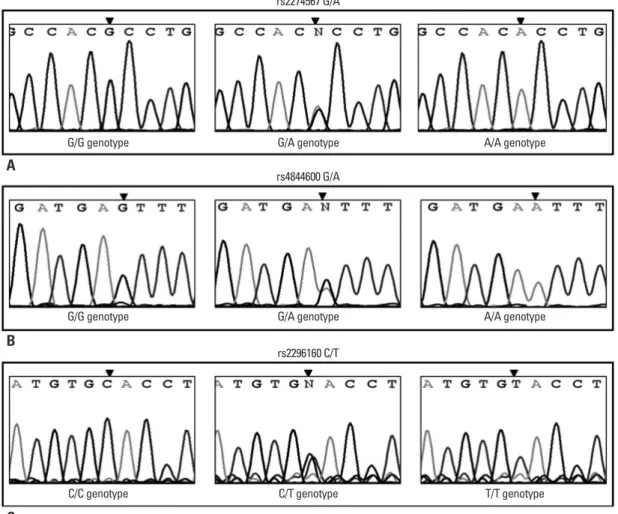
The results of sequencing, including the CR1 gene rs2274567 G/A, rs4844600 G/A, and rs2296160 C/T sites, are shown in laria, malarial infection with P. falciparum was confirmed by
a positive blood smear result for the asexual form of P. falci- parum. Clinical manifestations of malaria were classified ac- cording to the definitions and associated criteria set forth by the WHO. The patients were selected from groups with 3 dif- ferent types of malaria (i.e., mild malaria, noncerebral severe malaria, and cerebral malaria). The mild malaria group con- sisted of 327 patients with mild symptoms who were charac- terized by fever without other causes of infection but by none of the manifestations of severe malaria described below. The noncerebral severe malaria group (hereafter referred to the
“severe malaria group”) comprised 102 patients with severe malaria, which was defined as malaria with evidence of vital organ dysfunction or with one of the following signs of se- verity: a high level of parasitemia (>100000 parasites/mL), hypoglycemia (plasma glucose level <22 nmol/L), severe anemia (a hematocrit of <20% or a hemoglobin level <7 g/
dL), or a serum creatinine level >3 mg/dL. The cerebral ma- laria group consisted of 80 patients who experienced a coma from which they could not be roused and for whom noncere- bral causes of coma could be excluded. All of the patients in this group were ≥9 years of age, and mean ages of patients with mild malaria, severe malaria, and cerebral malaria were 43.1±12.3, 40.2±9.8, and 43.7±14.2 years, respectively. The control group comprised 503 healthy volunteers selected on the basis of no evidence of any personal or family history of malaria or other serious illness. The mean age of the control group (247 males and 256 females) was 43.1±13.5 years.
Written informed consent was obtained from all the subjects, and the study was performed with the approval of the ethics committee of Chinese Human Genome.
DNA extraction
Genomic DNA was extracted from ethylenediaminetet- raacetic acid-anticoagulated peripheral blood leukocytes by the salting-out method.24 Briefly, 3 mL of blood was mixed with Triton lysis buffer (0.32 M sucrose, 1% Triton X 100, 5 mM MgCl2, H2O, 10 mM Tris-HCl, pH 7.5). Leucocytes were spun down and washed with H2O. The pellet was in- cubated with proteinase K at 56°C and subsequently salted out at 4°C using a saturated NaCl solution. Precipitated proteins were removed by centrifugation. The DNA in the supernatant fluid was dissolved in 300 μL of H2O.
Determination of CR1 genotype
The oligonucleotide forward primer 5’-AGC AAA ACT TTC ATA AAA CTT ACC AAC-3’ and reverse primer 5’-
Haplotype analysis of the CR1 gene
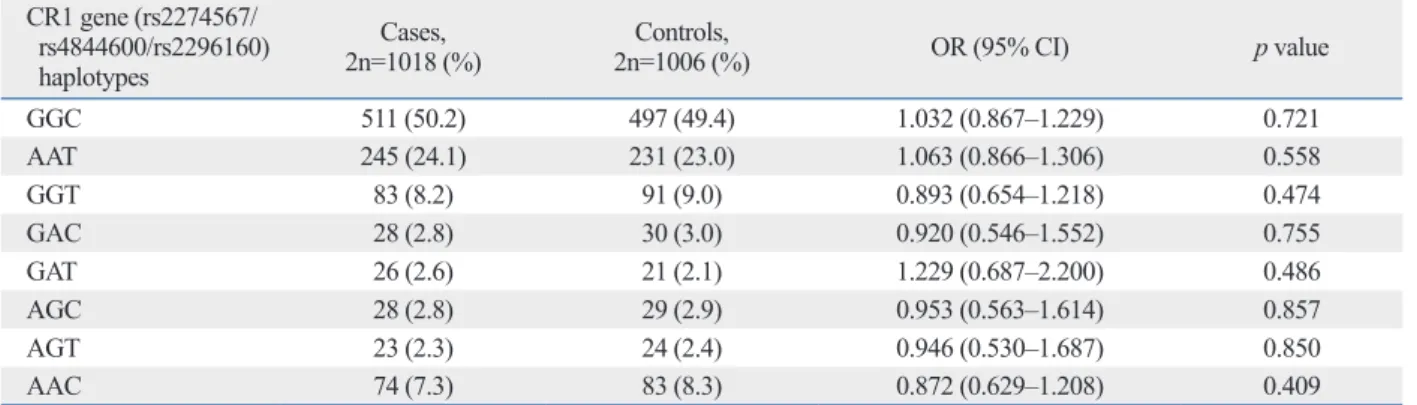
Haplotype analyses were performed, and the possible eight haplotype frequencies are shown in Table 4. The rs2274567 G/A polymorphism was in strong LD with the rs4844600 G/A (|D’|=0.865) and rs2296160 C/T (|D’|=0.854), respec- tively. The rs4844600 G/A and rs2296160 C/T were in strong LD (|D’|=0.871). Major GGC haplotype accounted for 50.2% and 49.4% of these eight haplotypes in both pa- tients and controls, respectively. However, haplotype fre- quencies of the CR1 gene in malaria patients were not sig- nificantly different than that in healthy controls (p>0.05).
DISCUSSION
To our best knowledge, this is the first attempts to evaluate the association between the single-nucleotide polymorphism and haplotype of CR1 gene rs2274567 G/A, rs4844600 G/
A, and rs2296160 C/T sites and malaria in a Chinese popu- lation, and we failed to observe an association of CR1 gen- Fig. 1. The genotype and allele frequencies of the CR1 gene
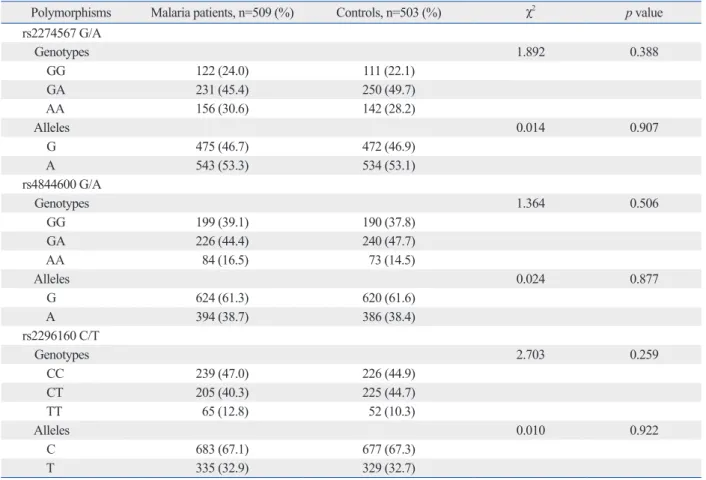
rs2274567 G/A, rs4844600 G/A, and rs2296160 C/T poly- morphisms in the group of patients with malaria and in the control group are shown in Table 2. The genotype distribu- tions of three polymorphisms among the controls and the cases were in Hardy-Weinberg equilibrium. There were no significant differences in the genotype and allele frequen- cies of the CR1 gene rs2274567 G/A, rs4844600 G/A, and rs2296160 C/T polymorphisms between the two study groups (p>0.05).
Genotype distribution of CR1 polymorphisms in relation to severity indices of malaria
No association was found between CR1 gene rs2274567 G/
A, rs4844600 G/A, and rs2296160 C/T polymorphisms and different types of malaria, shown in Table 3. Genotype and al- lele frequencies of the CR1 gene rs2274567 G/A, rs4844600 G/A, and rs2296160 C/T polymorphisms in mild malaria were not significantly different between cerebral malaria &
severe malaria of malaria patients, respectively (p>0.05).
Fig. 1. PCR-direct sequencing. CR1 gene rs2274567 site genotype GG, GA, and AA (A). CR1 gene rs4844600 site genotype GG, GA, and AA (B). CR1 gene rs2296160 site genotype CC, CT, and TT (C). PCR, polymerase chain reaction; CR1, complement receptor type 1.
rs2274567 G/A
rs4844600 G/A
rs2296160 C/T G/G genotype
G/G genotype
C/C genotype
G/A genotype
G/A genotype
C/T genotype
A/A genotype
A/A genotype
T/T genotype
A
B
C
complement receptor type 1 (E-CR1) expression, leading to the accumulation of immune complexes. A lower E-CR1 ex- pression causes tissue damage or cell aggregation and this would lead to severe clinical features, including cerebral ma- laria. On the other hand, it’s higher expression of would pro- tect the development of severe symptoms through improving the clearance rate of immune complexes. Nevertheless, sev- eral studies showed contradictory results; higher number of copies of E-CR1 increased the rosette formation,30-33 and in- creased rosette formation was associated with severe clinical syndrome of malaria infection.34-37 Research indicated that the genetic polymorphisms in exon 19 (3093G>T), exon 22 (3650A>G), exon 33 (5507C>G), and intron 27 (Hind III A>T) of the CR1 gene were associated with the level of CR1 expression in different populations of malaria patients.38 And study also shown that contains A Hind III, G3093, A3650, and C5507 of haplotype allele (high expression haplotype) could increase the level expression of CR1, and contains T Hind III, T3093, G3650, and G5507 of haplotype allele (low expression haplotype) would decrease the level ex- pression of CR1.38 Population survey of malaria-endemic area indicated that have some conflicting findings on the as- otypes, alleles and haplotypes with malaria or any subtype
of malaria in Chinese population. These data suggest that CR1 gene rs2274567 G/A, rs4844600 G/A, and rs2296160 C/T sites polymorphisms may not be an important contrib- utor to malaria in Chinese population.
As a Complete membrane protein, CR1 mainly found on red blood cells, lymphocytes, macrophages, follicular den- dritic cells, macrophages, and kidney podocytes, and so on.
Some of functions were found on CR1, including to bind to and remove the immune complexes of C4b- and C3b-, and as a complement regulatory protein 1. Recent research indi- cated that the CR1 could connect the uninfected red blood cells to resetting of P. falciparum-infected red blood cells through banding to P. falciparum erythrocyte membrane protein 1.27 Several studies have shown that in vitro rosette formation was closely related to the severity of malaria, and CR1 gene polymorphism may be to play an important role on susceptibility to severe malaria pathogenesis.28,29 Fur- thermore, some data have demonstrated that erythrocytes can play a dual role in immune regulation, removing im- mune complexes. Single nucleotide polymorphisms in the promoter of CR1 gene would reduce the level of erythrocyte
Table 2. The Genotype and Allele Frequencies of CR1 Polymorphisms in Malaria Patients and Controls
Polymorphisms Malaria patients, n=509 (%) Controls, n=503 (%) χ2 p value
rs2274567 G/A
Genotypes 1.892 0.388
GG 122 (24.0) 111 (22.1)
GA 231 (45.4) 250 (49.7)
AA 156 (30.6) 142 (28.2)
Alleles 0.014 0.907
G 475 (46.7) 472 (46.9)
A 543 (53.3) 534 (53.1)
rs4844600 G/A
Genotypes 1.364 0.506
GG 199 (39.1) 190 (37.8)
GA 226 (44.4) 240 (47.7)
AA 84 (16.5) 73 (14.5)
Alleles 0.024 0.877
G 624 (61.3) 620 (61.6)
A 394 (38.7) 386 (38.4)
rs2296160 C/T
Genotypes 2.703 0.259
CC 239 (47.0) 226 (44.9)
CT 205 (40.3) 225 (44.7)
TT 65 (12.8) 52 (10.3)
Alleles 0.010 0.922
C 683 (67.1) 677 (67.3)
T 335 (32.9) 329 (32.7)
CR1, complement receptor type 1.
expression of erythrocyte-CR1 and contributes to protect against cerebral malaria in Thailand.23 However, the intron 27 and exon 33 variants of CR1 gene did not influence the level of erythrocyte-CR1 expression in African popula- tion.21 In the present study, we found no apparent relation- ship of the CR1 gene CR1 gene rs2274567 G/A, rs4844600 G/A, and rs2296160 C/T sites polymorphisms with the risk of malaria. No strict group for server malaria, thus result in sociation of CR1 polymorphism with malaria, on the one
hand, with the intermediate CR1 level of heterozygotes (HL) individuals for the CR1 exon 22 polymorphism sig- nificantly protected against severe malaria in PNG,15 on the other hand, with the low CR1 level of homozygous (LL) individuals for the CR1 intron 27 were significantly higher in severe malaria.16 Furthermore, study also shown that the CR1 of rs9429942-T was associated with a high level of
Table 4. Haplotype Frequencies of CR1 Gene in the Patients with Malaria and in Controls CR1 gene (rs2274567/
rs4844600/rs2296160) haplotypes
Cases,
2n=1018 (%) Controls,
2n=1006 (%) OR (95% CI) p value
GGC 511 (50.2) 497 (49.4) 1.032 (0.867‒1.229) 0.721
AAT 245 (24.1) 231 (23.0) 1.063 (0.866‒1.306) 0.558
GGT 83 (8.2) 91 (9.0) 0.893 (0.654‒1.218) 0.474
GAC 28 (2.8) 30 (3.0) 0.920 (0.546‒1.552) 0.755
GAT 26 (2.6) 21 (2.1) 1.229 (0.687‒2.200) 0.486
AGC 28 (2.8) 29 (2.9) 0.953 (0.563‒1.614) 0.857
AGT 23 (2.3) 24 (2.4) 0.946 (0.530‒1.687) 0.850
AAC 74 (7.3) 83 (8.3) 0.872 (0.629‒1.208) 0.409
CR1, complement receptor type 1; OR, odds ratio; CI, confidence interval.
Table 3. The Genotype and Allele Frequencies of CR1 Polymorphisms in Relation to Malaria Severity
Item Malaria patients
χ2 p value
Mild malaria, n=327 (%) Cerebral malaria and severe malaria, n=182 (%) rs2274567 G/A
Genotypes 1.089 0.580
GG 83 (25.4) 39 (21.4)
GA 147 (45.0) 84 (46.2)
AA 97 (29.7) 59 (32.4)
Alleles 1.057 0.304
G 313 (47.9) 162 (44.5)
A 341 (52.1) 202 (55.5)
rs4844600 G/A
Genotypes 0.813 0.666
GG 124 (37.9) 75 (41.2)
GA 146 (44.6) 80 (44.0)
AA 57 (17.4) 27 (14.8)
Alleles 0.853 0.356
G 394 (60.2) 230 (63.2)
A 260 (39.8) 134 (36.8)
rs2296160 C/T
Genotypes 1.436 0.488
CC 160 (48.9) 79 (43.4)
CT 127 (38.8) 78 (42.9)
TT 40 (12.2) 25 (13.7)
Alleles 1.307 0.253
C 447 (68.3) 236 (64.8)
T 207 (31.7) 128 (35.2)
CR1, complement receptor type 1.
agnosis of viral and bacterial infections. Hum Immunol 2013;74:
522-30.
9. Awandare GA, Spadafora C, Moch JK, Dutta S, Haynes JD, Stoute JA. Plasmodium falciparum field isolates use complement receptor 1 (CR1) as a receptor for invasion of erythrocytes. Mol Biochem Parasitol 2011;177:57-60.
10. Stoute JA. Complement receptor 1 and malaria. Cell Microbiol 2011;13:1441-50.
11. Newbold C, Craig A, Kyes S, Rowe A, Fernandez-Reyes D, Fa- gan T. Cytoadherence, pathogenesis and the infected red cell sur- face in Plasmodium falciparum. Int J Parasitol 1999;29:927-37.
12. Spadafora C, Awandare GA, Kopydlowski KM, Czege J, Moch JK, Finberg RW, et al. Complement receptor 1 is a sialic acid-in- dependent erythrocyte receptor of Plasmodium falciparum. PLoS Pathog 2010;6:e1000968.
13. Fernandez-Arias C, Lopez JP, Hernandez-Perez JN, Bautista-Oje- da MD, Branch O, Rodriguez A. Malaria inhibits surface expres- sion of complement receptor 1 in monocytes/macrophages, caus- ing decreased immune complex internalization. J Immunol 2013;
190:3363-72.
14. Thomas BN, Diallo DA, Noumsi GT, Moulds JM. Circulating Immune Complex Levels are Associated with Disease Severity and Seasonality in Children with Malaria from Mali. Biomark In- sights 2012;7:81-6.
15. Cockburn IA, Mackinnon MJ, O’Donnell A, Allen SJ, Moulds JM, Baisor M, et al. A human complement receptor 1 polymor- phism that reduces Plasmodium falciparum rosetting confers pro- tection against severe malaria. Proc Natl Acad Sci U S A 2004;
101:272-7.
16. Nagayasu E, Ito M, Akaki M, Nakano Y, Kimura M, Looareesu- wan S, et al. CR1 density polymorphism on erythrocytes of falci- parum malaria patients in Thailand. Am J Trop Med Hyg 2001;64:
17. Rout R, Dhangadamajhi G, Mohapatra BN, Kar SK, Ranjit M. 1-5.
High CR1 level and related polymorphic variants are associated with cerebral malaria in eastern-India. Infect Genet Evol 2011;11:
139-44.
18. Mahajan RC, Narain K, Mahanta J. Anaemia & expression levels of CD35, CD55 & CD59 on red blood cells in Plasmodium falci- parum malaria patients from India. Indian J Med Res 2011;133:
662-4.
19. Tham WH, Schmidt CQ, Hauhart RE, Guariento M, Tetteh-Quar- coo PB, Lopaticki S, et al. Plasmodium falciparum uses a key functional site in complement receptor type-1 for invasion of hu- man erythrocytes. Blood 2011;118:1923-33.
20. Soares SC, Abé-Sandes K, Nascimento Filho VB, Nunes FM, Sil- va WA Jr. Genetic polymorphisms in TLR4, CR1 and Duffy genes are not associated with malaria resistance in patients from Baixo Amazonas region, Brazil. Genet Mol Res 2008;7:1011-9.
21. Rowe JA, Raza A, Diallo DA, Baby M, Poudiougo B, Coulibaly D, et al. Erythrocyte CR1 expression level does not correlate with a HindIII restriction fragment length polymorphism in Africans;
implications for studies on malaria susceptibility. Genes Immun 2002;3:497-500.
22. Cockburn IA, Rowe JA. Erythrocyte complement receptor 1 (CR1) expression level is not associated with polymorphisms in the promoter or 3’ untranslated regions of the CR1 gene. Int J Im- munogenet 2006;33:17-20.
23. Teeranaipong P, Ohashi J, Patarapotikul J, Kimura R, Nuchnoi P, Hananantachai H, et al. A functional single-nucleotide polymor-
underestimate or overestimate the actual level of CR1 might be the reason of the difference of clinical symptoms and CR1 genotype in different studies. Researches indicated that age-related and/or regional differences of malaria endemic area would change CR1 level on RBC.39,40 In addition, non- random sampling, a limited sample size, and the possible se- lection bias might be influencing the outcome of different re- searches. In this study, we also cannot exclude the possibility that observed association depends on a gene in LD with the CR1 gene or effect of CR1 expression on other factors.
In summary, we did not find an association between CR1 gene rs2274567 G/A, rs4844600 G/A, and rs2296160 C/T sites polymorphisms and malaria or any subtype severity of malaria in a Chinese population. Nevertheless, further studies are needed to explore the complex interaction between envi- ronmental factors and CR1 gene polymorphisms in the risk of malaria, especially in ethnically disparate populations.
ACKNOWLEDGEMENTS
This study was supported by National Natural Science Foun- dation (No. 81160212), the Key Project of Guangxi bureau of health, Guangxi, China (No. 200986), and the Open Fund in Medical Laboratory Science Center of Guangxi (kfjj 2011-03).
REFERENCES
1. Mayor S. WHO report shows progress in efforts to reduce malaria incidence. BMJ 2008;337:a1678.
2. Schofield L, Grau GE. Immunological processes in malaria patho- genesis. Nat Rev Immunol 2005;5:722-35.
3. Mackintosh CL, Beeson JG, Marsh K. Clinical features and pathogenesis of severe malaria. Trends Parasitol 2004;20:597-603.
4. Stoute JA, Odindo AO, Owuor BO, Mibei EK, Opollo MO, Wait- umbi JN. Loss of red blood cell-complement regulatory proteins and increased levels of circulating immune complexes are associ- ated with severe malarial anemia. J Infect Dis 2003;187:522-5.
5. Waitumbi JN, Opollo MO, Muga RO, Misore AO, Stoute JA. Red cell surface changes and erythrophagocytosis in children with se- vere plasmodium falciparum anemia. Blood 2000;95:1481-6.
6. Vorup-Jensen T, Boesen T. Protein ultrastructure and the nanosci- ence of complement activation. Adv Drug Deliv Rev 2011;63:
1008-19.
7. Lapin ZJ, Höppener C, Gelbard HA, Novotny L. Near-field quanti- fication of complement receptor 1 (CR1/CD35) protein clustering in human erythrocytes. J Neuroimmune Pharmacol 2012;7:539-43.
8. Nuutila J, Jalava-Karvinen P, Hohenthal U, Kotilainen P, Pellinie- mi TT, Nikoskelainen J, et al. Use of complement regulators, CD35, CD46, CD55, and CD59, on leukocytes as markers for di-
setting mediated by a parasite-variant erythrocyte membrane pro- tein and complement-receptor 1. Nature 1997;388:292-5.
33. Stoute JA. Complement-regulatory proteins in severe malaria: too little or too much of a good thing? Trends Parasitol 2005;21:218- 34. Carlson J, Helmby H, Hill AV, Brewster D, Greenwood BM, 23.
Wahlgren M. Human cerebral malaria: association with erythro- cyte rosetting and lack of anti-rosetting antibodies. Lancet 1990;
336:1457-60.
35. Treutiger CJ, Hedlund I, Helmby H, Carlson J, Jepson A, Twuma- si P, et al. Rosette formation in Plasmodium falciparum isolates and anti-rosette activity of sera from Gambians with cerebral or uncomplicated malaria. Am J Trop Med Hyg 1992;46:503-10.
36. Heddini A, Pettersson F, Kai O, Shafi J, Obiero J, Chen Q, et al.
Fresh isolates from children with severe Plasmodium falciparum malaria bind to multiple receptors. Infect Immun 2001;69:5849- 37. Rowe A, Obeiro J, Newbold CI, Marsh K. Plasmodium falci-56.
parum rosetting is associated with malaria severity in Kenya. In- fect Immun 1995;63:2323-6.
38. Xiang L, Rundles JR, Hamilton DR, Wilson JG. Quantitative al- leles of CR1: coding sequence analysis and comparison of haplo- types in two ethnic groups. J Immunol 1999;163:4939-45.
39. Waitumbi JN, Donvito B, Kisserli A, Cohen JH, Stoute JA. Age- related changes in red blood cell complement regulatory proteins and susceptibility to severe malaria. J Infect Dis 2004;190:1183- 40. Sinha S, Jha GN, Anand P, Qidwai T, Pati SS, Mohanty S, et al. 91.
CR1 levels and gene polymorphisms exhibit differential associa- tion with falciparum malaria in regions of varying disease ende- micity. Hum Immunol 2009;70:244-50.
phism in the CR1 promoter region contributes to protection against cerebral malaria. J Infect Dis 2008;198:1880-91.
24. John SW, Weitzner G, Rozen R, Scriver CR. A rapid procedure for extracting genomic DNA from leukocytes. Nucleic Acids Res 1991;19:408.
25. Shi YY, He L. SHEsis, a powerful software platform for analyses of linkage disequilibrium, haplotype construction, and genetic as- sociation at polymorphism loci. Cell Res 2005;15:97-8.
26. Stephens M, Smith NJ, Donnelly P. A new statistical method for haplotype reconstruction from population data. Am J Hum Genet 2001;68:978-89.
27. Kirchgatter K, Portillo Hdel A. Association of severe noncerebral Plasmodium falciparum malaria in Brazil with expressed PfEMP1 DBL1 alpha sequences lacking cysteine residues. Mol Med 2002;8:16-23.
28. Valle-Delgado JJ, Urbán P, Fernàndez-Busquets X. Demonstration of specific binding of heparin to Plasmodium falciparum-infected vs. non-infected red blood cells by single-molecule force spectros- copy. Nanoscale 2013;5:3673-80.
29. Doumbo OK, Thera MA, Koné AK, Raza A, Tempest LJ, Lyke KE, et al. High levels of Plasmodium falciparum rosetting in all clinical forms of severe malaria in African children. Am J Trop Med Hyg 2009;81:987-93.
30. Krych-Goldberg M, Moulds JM, Atkinson JP. Human comple- ment receptor type 1 (CR1) binds to a major malarial adhesin.
Trends Mol Med 2002;8:531-7.
31. Rowe JA, Rogerson SJ, Raza A, Moulds JM, Kazatchkine MD, Marsh K, et al. Mapping of the region of complement receptor (CR) 1 required for Plasmodium falciparum rosetting and demon- stration of the importance of CR1 in rosetting in field isolates. J Immunol 2000;165:6341-6.
32. Rowe JA, Moulds JM, Newbold CI, Miller LH. P. falciparum ro-