480
©The Korean Society of Food Science and Technology
Complement component 9 (C9) 유전자의 단일염기다형성과
버크셔 돼지 육질 형질과의 연관성 분석
하정임
1†·황정혜
1†·유고은
1·박다혜
1·강덕경
1·김태완
1·박화춘
2·안상미
1·김철욱
1,*
1경남과학기술대학교 양돈과학기술센터, 2다산육종
Association between a non-synonymous single nucleotide polymorphism in
the Complement component 9 (C9) gene and meat-quality traits in
Berkshire pigs
Jeongim Ha1†, Jung Hye Hwang1†, Go Eun Yu1, Da Hye Park1, Deok Gyeong Kang1, Tae Wan Kim1, Hwa Chun Park2, Sang Mi An1, and Chul Wook Kim1,*
1Swine Science and Technology Center, Gyeongnam National University of Science & Technology 2Dasan Pig Breeding Co.
Abstract In this study, to identify single nucleotide polymorphisms (SNPs) associated with meat quality in Berkshire pigs, we performed RNA sequencing. A non-synonymous SNP (nsSNP) in the Complement component 9 (C9) gene was identified, and the association between meat quality traits and the C9 genotype was analyzed. The nsSNP in the C9 gene was located at c.942 G>T. In the dominant model, significant associations were observed between the SNP and meat
quality traits such as CIE L, collagen content, moisture level, and pH24 h, whereas in the co-dominant model, significant
associations were observed between the SNP and CIE L, collagen content, and protein content. In the recessive model, a significant association between the C9 genotype and the collagen content was observed. In addition, we identified the significant relationship between the C9 genotype and meat quality according to sex. These results indicate that the C9 SNP can be used as a genetic marker for improving pork quality.
Keywords: berkshire, pH24 h, meat quality, C9, nsSNP
서
론
현재 우리나라에서는 국민 소득 증가로 인해 축산물의 소비 가 증가하고 있는 추세이다(Kim 등, 2016). 돼지고기의 소비는 전체 축산물 중 67.2%의 비중을 차지하고 있으며 2000년대 초 반에 비해 1인당 돼지고기 소비량이 30% 이상 증가하였다(Hwang 등, 2014; Kang 2004). 흑색종의 돼지 품종이 백색종의 돼지에 비해 근내 지방도가 풍부한 장점을 가지고 있다(Crawford 등, 2010; Jin 등, 2006; Suzuki 등, 2003). 버크셔(Berkshire)종의 경 우 고기의 마블링이 좋고 사후 pH가 높아 육즙이 풍부하며 육 질의 연도와 향미가 좋은 장점을 가지고 있어 우리나라의 소비 자들에게 선호도가 높은 것으로 알려져 있다(Jin 등, 2006; Crawford 등, 2010). 고기의 육질은 소비자들이 돈육을 구매하는데 있어 중요한 판 단 기준의 하나로 최근 소비자들은 육색과 같이 보여지는 부분 외에도 육즙의 보유력과 육질의 부드러움, 향미와 같은 관능적인 특성에 따라 고기를 선택하고 있는 것으로 보고되고 있다(Bonneau 와 Lebret 2010; Lee 등, 2015). 육질은 유전 및 환경 조건에 따 라 결정이 되며, 특히나 육질 형질은 돼지의 형질 중 유전적인 특성이 높은 것으로 알려져 있기 때문에(Mortimer 등, 2014; Newcom 등, 2002), 최근 연구들은 기존의 전통적인 육종방법에 서 벗어나 유전자 마커를 활용한 분자육종법으로 육질을 개량하 는데 많은 노력을 기울이고 있다(Ellies-Oury 등, 2016; Te Pas 등, 2017). 육질과 관련된 유전자 마커를 확보하기 위한 선행 연구로 RPS3와 AGPAT5 유전자의 단일염기다형성(SNP)이 사후 pH24 h, 가 열감량에 영향을 주는 것으로 보고 되었다(Hwang 등, 2017b; Park 등, 2017). 고품질 돈육을 생산하기 위해 분자유전 육종법의 중 요성이 강조됨에 따라 본 연구에서는 육질과 관련된 유전자 마 커를 탐색하고 확보하기 위해 버크셔 돼지의 간 조직에서 RNA-Sequencing을 수행하였다. Complement component 9 (보체 구성요소 9, C9) 유전자는 혈 액 및 림프속에 존재하는 보체계의 한 구성원이다(Hadding과 Müller-Eberhard, 1969; Kolb 등, 1972). 주로 외부로부터 유입된 균을 파괴시키는 면역반응에 역할을 하며(Khoa와 Wimmers, 2015; Uddin 등, 2010), 세포 사멸에 의해 활성화 되어 손상된 세포를 재생시키는데 영향을 주고, 세포의 성장 및 재생에 관여하는 것†These authors contributed equally to this work.
*Corresponding author: Chul Wook Kim, Swine Science and nology Center, Gyeongnam National University of Science & Tech-nology, Jinju, Gyeongnam 52725, Korea
Tel: +82-55-751-3289 Fax : +82-55-759-1893 E-mail: [email protected]
Received August 8, 2018; revised September 23, 2018; accepted September 26, 2018
으로 알려져 있다(Müller-Eberhard, 1988; Rutkowski 등, 2010). C9 단백질은 선천성 면역체계의 일부인 보체계에 관여하는 단백 질이며(Lint 등, 1980) 세포 공격단위(membrane attack complex, MAC)의 구성원으로 세포막을 손상시켜 용해를 일으킨다(Janeway 등, 2001). 보체계에 관련된 유전자 중 Complement factor D (보 체구성요소 D)가 랜드레이스× 중국-유럽 교잡종에서 육색의 밝 기와 근육내의 지방함량에 연관되어 있다는 보고가 있지만(Èepica 등, 2012), 돼지에서 C9에 대한 육질형질과의 연관성에 대한 연 구는 전무하다. 이에 본 연구에서는 C9 유전자의 단일염기다형 성을 동정하고 육질 형질과의 연관성 분석을 진행하였다.
재료 및 방법
공시동물 본 연구에서는 버크셔 돼지(n=3)의 간 조직을 이용하여 단일염 기다형성를 검색하였고 유전자형 분석과 육질 형질 분석을 위해 동일한 환경에서 사육된 110 kg 버크셔 돼지 405두(다산육종, 남 원)의 혈액으로 유전자형 분석과 등심 조직 이용하여 육질형질간 의 연관성을 분석하였다. RNA 염기서열 분석 및 SNP확인 Berkshire 돼지의 간 조직을 채취한 후 액체 질소로 급속 냉동한 뒤 TRI-Reagent (TR118, Molecular Research Center, Inc., Cinci-nati, OH, USA)를 이용해 total RNA를 분리하였다. 분리된 total RNA는 NanoDrop ND-1000 분광광도계를 이용하여 A260/280의 흡 광도에서 정량하였다. TruSeqTM RNA sample preparation kit(RS-200-0012, Illumina, Inc., San Diego, CA, USA)를 이용하여 Total RNA에서 mRNA를 정제한 뒤 cDNA를 합성하였으며 Genome Analyzer II (GAII, Illumina, Inc.)을 이용하여 분석하였다. 단일 염기다형성은 RNA sequencing을 통해 확인하였고, 엑손(exon) 영 역에 해당하는 유전자를 mapping하기 위해 BEDtool (Quinlan와 Hall, 2010)를 이용하였다. 돼지의 간에서 발현되는 유전자 개수 확 보를 위해 RPKM (reads per kilobase per million mapped reads) 값을 이용하여 정량화 하였으며, mapping을 통해 엑손 지역에 존 재하는 단일염기다형성을 확보한 뒤 NCBI (http://www.ncbi.nlm.nih. gov)를 통해 최종적으로 확인하였다(Mortazavi 등, 2008). 버크셔 유전자형 분석 RNA-Sequencing 분석을 통해 확인된 C9 유전자의 단일염기다 형성의 유전자형을 분석하기 위해 동일한 환경에서 사육된 체중 이 110 kg에 도달한 버크셔 405두의 혈액에서 WizardGenomic DNA Purification kit (A1120, Promega, Fitchburg, WI, USA)를 이용하여 genomic DNA를 분리하였다. Genomic DNA 분리 후 단일염기다형성의 위치에 각각의 대립유전자형에 특이적으로 결 합하는 대립유전자 특이 올리고뉴클레오타이드와 단일염기 다형 성 위치의 염기쌍 하부에 결합되는 지역 특이적인 프라이머를 사 용하여 Veracode Golden Gate assay kit (VC-201-0048, Illumina, Inc.)를 가지고 유전자형을 분석하였다. C9 유전자의 단일염기다 형성 분석에 사용된 Golden Gate assay kit Primer는 다음과 같다. 대립유전자 특이 올리고뉴클레오타이드 1: 5'-ACTTCGTCAG-TAACGGACATATCCCCACTGGGGACGCAT-3', 대립유전자 특이 올리고뉴클레오타이드 2: 5'-GAGTCGAGGTCATATCGTATATC-CCCACTG GGGACGCAC-3', 대립유전자 특이 올리고뉴클레오타 이드 3'-TGATGCTGTGCATATTGATATACAGCCGGTGCT-GTCGCCAATTACGTCTGCCTATAGTGAGTC-3'. 육질분석 전라북도 남원에 있는 다산 종돈의 동일한 조건에서 사육된 도 체중 110 kg의 버크셔 405두의 등심 조직으로 육질분석을 진행 하였다. 육질분석 방법은 Hwang 등(2017b)의 방법에 따라 측정 하였으며, 육질분석 형질로는 등지방 두께(backfat thisckness), 도 체중(carcass weight), 육색(CIE L, a, b), 가열감량(cooking loss), 육즙 손실(drip loss), 전단력(shear force), 도축 후 24시간 pH (pH24 h)을 측정하였고, 보수력(water-holding capacity)은 Park 등 (2001)의 방법, 육질의 수분, 단백질, 지방 및 콜라겐 조성은 Anderson(2007)의 방법에 따라 분석하였다.
통계분석
단일염기다형성에 대한 유전자형과 육질 형질과의 연관성을 확 인하고자, SAS Version 9.1.3 (SAS Institute INC., Cary, NC, USA)로 분석하였다. 통계분석을 위한 단일염기다형성 선택은 단 일염기다형성 선택 비율(call rate) 0.90, 대립유전자 빈도 (MAFs)>0.01, 하디-와인버그 법칙(HWE) p>0.05 기준으로 하였다. 선형모델은 yijklm=µ+Gi+Sj+Pl+eijklm이며, yij: 표현형의 특징의 값, µ: 일반 평균, Gi:Genotype i의 고정 효과, Sj: SEX j 의 고정 효과, Pl: Period 1의 고정 효과, eij: 오류 값을 뜻하며, 유의한 차이가 나타날 경우 평균값의 차이에 따라 분리하였다. 우성, 열성, 공우 성 모델에서 Mann-Whitney와 Student’s test 및 ANOVA와 t-test 를 사용하여 분석하였다(p<0.01, p<0.05).
결과 및 고찰
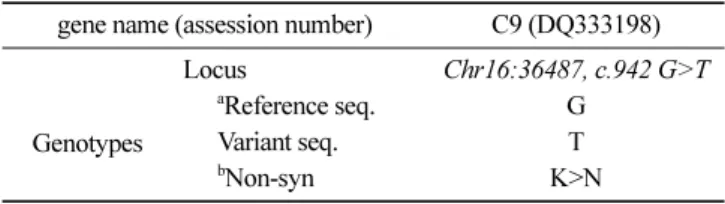
단일염기다형성의 검색 및 유전자형 분석 Berkshire 3두의 간조직을 이용하여 RNA-Sequencing를 수행하 고 Jung 등(2012) 방법으로 C9 유전자의 단일염기다형성을 확인 하였다. 원래 돼지의 유전체 지도에서 16번 염색체 g36487에는 G 서열이 와야 하지만 본 연구를 통해 발굴한 염기는 T로 확인 되어 해당 위치에서 G 서열이 T로 바뀌는 단일염기다형성이 발 생함을 알 수 있었다. cDNA 위치상 서열이 942이고 G에서 T로 변이가 일어나면 라이신 아미노산을 번역해야 하는 위치에 아스 파라긴 아미노산이 오게 되어 아미노산의 변이가 유발된다. 즉, C9 유전자의 단일염기다형성은 아미노산의 변이를 일으키는 nonsynonymous SNP에 해당된다(Table 1). 405두의 버크셔 돼지 에서 해당 단일염기다형성의 유전자 형의 분석 결과 major allele 은 G, minor allele은 T이며, 대립유전자 빈도는(MAF) 0.0951이고, 하디-와인버그 법칙(HWE)은 0.5563, 단일염기다형성 선택 비율 (call rate)은 92.68%로 대립유전자 빈도 >0.01, 하디-와인버그 법 칙 p>0.05, 단일염기다형성 선택 비율 0.09 기준을 만족하여 유 전자형 분석에 적합한 것을 확인 하였다.Table 1. Information of identified SNP in C9 gene
gene name (assession number) C9 (DQ333198) Locus Chr16:36487, c.942 G>T Genotypes
aReference seq. G
Variant seq. T
bNon-syn K>N
aThe cDNA sequence of complement C9 are based on the report of
GenBank accession No. DQ333198.
bNon-syn indicates a non-synonymous point mutation, leading to the
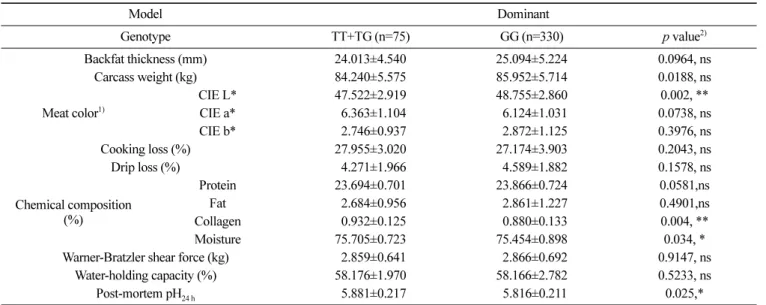
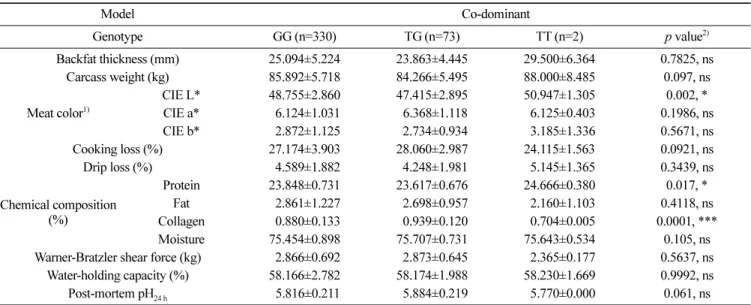
육질 형질과의 연관성 분석 다음으로, Berkshire 돼지 405 두를 이용하여 육질 형질을 분 석하였다. 분석된 육질 형질 값과 각 돼지 개체의 C9 유전자 형 을 분석하고 C9 유전자의 유전자형에 따른 육질 형질과의 연관 성 분석을 수행하였다. 통계분석은 우성, 열성, 공우성 모델을 이 용하였다. 우성 모델에서 육 색의 명도(CIE L, p<0.05), 콜라겐 (p<0.05) 및 수분 함량(p<0.01), pH24 h (p<0.01)에서 유의성을 확인 할 수 있었다(Table 2). 고품질의 육질을 결정하는 중요한 형질은 pH24 h, 보수력, 육즙 손실, 가열 감량이며(Bonneau와 Lebret, 2010; Yu 등, 2017), 그중에서도 pH24 h는 가장 중요한 형질이라고 여겨 지는데 TT+TG 그룹에서 GG 그룹과 비교했을 때 pH24 h가 더 높 은 값을 가지는 것으로 확인되어 T allele을 가지는 돼지가 육질 이 좋을 것으로 판단된다. 또한 TT+TG 그룹에서 유의성은 없었 지만 보수력이 높고 육즙 손실이 적었다(Table 2). 열성 모델의 분석 결과 콜라겐 함량에서만 유의성이 나타났다(p<0.05, Table 3). 공우성 모델에서는 육색 의 밝기(CIE L, p<0.05), 단백질 (p<0.05), 콜라겐 함량(p<0.001)에서 유의성을 확인할 수 있었다 (Table 4). 육색은 소비자가 육류 구매 시 일차적으로 판단할 수 있는 지표이며 일반적으로 밝은 육색을 선호하게 되는데 공우성 모델에서 TT 유전자 형이 가장 밝은 육색을 띠어 좋은 육질을 가지는 것으로 판단된다(p<0.05). 단백질 함량은 TT (p<0.05) 유 전자형에서 콜라겐 함량은 TG (p<0.001) 유전자형 그룹에서 높 은 값을 가지는 것으로 확인이 되었다. T allele을 가지는 돼지에 서 육질이 우수한 것으로 판단되고 육질 개선을 위한 분자 육종 에 C9 유전자의 단일염기다형성을 이용할 경우, T allele을 가지 는 돼지를 선발하도록 제안할 수 있겠다. 공우성 모델에서 유의 Table 2. Analysis of the association between meat-quality traits and complement 9 non-synonymous SNP c.942G>T
Model Dominant Genotype TT+TG (n=75) GG (n=330) p value2) Backfat thickness (mm) 24.013±4.540 25.094±5.224 0.0964, ns Carcass weight (kg) 84.240±5.575 85.952±5.714 0.0188, ns Meat color1) CIE L* 47.522±2.919 48.755±2.860 0.002, ** CIE a* 06.363±1.104 06.124±1.031 0.0738, ns CIE b* 02.746±0.937 02.872±1.125 0.3976, ns Cooking loss (%) 27.955±3.020 27.174±3.903 0.2043, ns Drip loss (%) 04.271±1.966 04.589±1.882 0.1578, ns Chemical composition (%) Protein 23.694±0.701 23.866±0.724 0.0581,ns Fat 02.684±0.956 02.861±1.227 0.4901,ns Collagen 00.932±0.125 00.880±0.133 0.004, ** Moisture 75.705±0.723 75.454±0.898 0.034, *
Warner-Bratzler shear force (kg) 02.859±0.641 02.866±0.692 0.9147, ns Water-holding capacity (%) 58.176±1.970 58.166±2.782 0.5233, ns Post-mortem pH24 h 05.881±0.217 05.816±0.211 0.025,* 1)CIE L*, a*, and b* indicate meat color lightness, redness, and yellowness, respectively.
2)Significant differences between the genotype classes are indicated by *p<0.05, **p<0.01.
ns, not significant difference
Table 3. Analysis of the association between meat-quality traits and complement 9 non-synonymous SNP c.942G>T
Model Recessive Genotype TT (n=2) GG+TG (n=403) p value2) Backfat thickness (mm) 29.500±6.364 24.871±5.109 0.2295, ns Carcass weight (kg) 88.000±8.485 85.623±5.717 0.6061,ns Meat color1) CIE L* 50.945±1.308 48.567±2.895 0.2468, ns CIE a* 06.125±0.403 06.168±1.050 0.9496, ns CIE b* 03.185±1.336 02.847±1.093 0.6497, ns Cooking loss (%) 24.115±1.563 27.335±3.766 0.1065, ns Drip loss (%) 05.145±1.365 04.527±1.902 0.4730, ns Chemical composition (%) Protein 24.670±0.382 23.830±0.721 0.0706,ns Fat 02.160±1.103 02.832±1.183 0.3965,ns Collagen 00.704±0.005 00.890±0.133 0.048, * Moisture 75.645±0.530 75.513±0.870 0.9300,ns
Warner-Bratzler shear force (kg) 02.365±0.177 02.881±0.683 0.2155, ns Water-holding capacity (%) 58.230±1.669 58.168±2.653 0.8487, ns Post-mortem pH24 h 05.770±0.000 05.829±0.211 0.8820, ns 1)CIE L*, a*, and b* indicate meat color lightness, redness, and yellowness, respectively.
2)Significant differences between the genotype classes are indicated by *p<0.05.
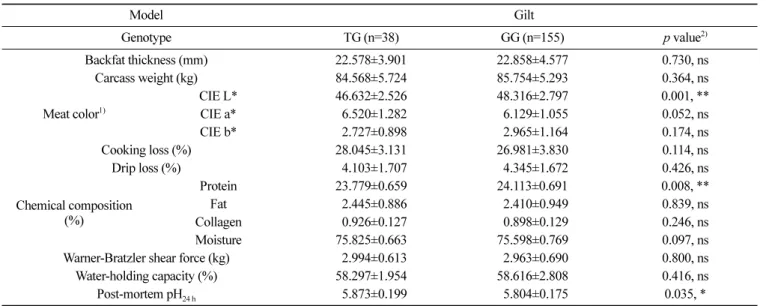
성을 확인할 수 없었지만, TG 유전자형이 다른 유전자형에 비해 pH24 h이 높고 육즙 손실이 감소되는 것을 확인하였다. 또한 거세 돈(barrow)과 암퇘지(gilt)로 나누어 돼지의 성별에 따른 육질 형 질과 유전자형 간의 연관성을 분석하였다(Table 5 and 6). 그중 TT 유전자형의 경우 거세돈과 암퇘지의 수가 각 1두로 통계분석 에 적합하지 않아 나머지 두 가지 유전자형으로 연관성 분석을 수행하였다. 거세돈에서는 도체중(p<0.05)과 콜라겐 함량(p<0.01) 에서 유의성을 나타내었고(Table 5), 암퇘지는 CIE L(p<0.01), 단 백질 함량(p<0.01), pH24 h (p<0.05)에서 유의성을 나타내어 암퇘지 에서 더 많은 육질 형질에서 C9의 단일염기다형성 유전자형과 연관성이 있는 것으로 확인하였다(Table 6). 암퇘지의 TG 유전자 형이 GG 유전자형에 비해 pH24 h와 보수력이 높고, 육즙 손실이 낮아 육질이 더 우수한 것으로 확인하였다. 이전의 연구에 따르 면 pH는 육질의 보수성, 연도, 조직감/텍스쳐, 육색에 영향을 미 치며(Joo 등, 1999; Kang 등, 2011), pH가 높을수록 보수력이 높 고 육색이 좋았으며, 육즙 손실이 적다고 알려져 있다(Kim 등, 2016; Hwang 등, 2017a). 본 연구에서도 C9 유전자의 TG 유전자 형이 pH24 h가 증가되고 유의성이 없지만 육즙 손실이 감소되는 경향의 결과로 선행 연구결과와 동일한 양상으로 나타났다. 이러한 결과를 바탕으로 높은 pH24 h를 가진 C9의 TG 유전자 형을 가진 돼지에서 고품질 돈육 생산이 가능할 것이다. 따라서 본 연구를 통해 C9 유전자의 단일염기다형성을 고품질 돼지를 조기 선발하는 중요한 분자 마커로 사용 가능할 것으로 사료된다. Table 4. Analysis of the association between meat-quality traits and complement 9 non-synonymous SNP c.942G>T
Model Co-dominant Genotype GG (n=330) TG (n=73) TT (n=2) p value2) Backfat thickness (mm) 25.094±5.224 23.863±4.445 29.500±6.364 0.7825, ns Carcass weight (kg) 85.892±5.718 84.266±5.495 88.000±8.485 0.097, ns Meat color1) CIE L* 48.755±2.860 47.415±2.895 50.947±1.305 0.002, * CIE a* 06.124±1.031 06.368±1.118 06.125±0.403 0.1986, ns CIE b* 02.872±1.125 02.734±0.934 03.185±1.336 0.5671, ns Cooking loss (%) 27.174±3.903 28.060±2.987 24.115±1.563 0.0921, ns Drip loss (%) 04.589±1.882 04.248±1.981 05.145±1.365 0.3439, ns Chemical composition (%) Protein 23.848±0.731 23.617±0.676 24.666±0.380 0.017, * Fat 02.861±1.227 02.698±0.957 02.160±1.103 0.4118, ns Collagen 00.880±0.133 00.939±0.120 00.704±0.005 0.0001, *** Moisture 75.454±0.898 75.707±0.731 75.643±0.534 0.105, ns Warner-Bratzler shear force (kg) 02.866±0.692 02.873±0.645 02.365±0.177 0.5637, ns Water-holding capacity (%) 58.166±2.782 58.174±1.988 58.230±1.669 0.9992, ns Post-mortem pH24 h 05.816±0.211 05.884±0.219 05.770±0.000 0.061, ns 1)CIE L*, a*, and b* indicate meat color lightness, redness, and yellowness, respectively.
2)Significant differences between the genotype classes are indicated by *p<0.05, **p<0.01, and ***p<0.001.
ns, not significant difference
Table 5. Analysis of the association between meat-quality traits in barrows and complement 9 non-synonymous SNP c.942G>T
Model Barrow Genotype TG (n=26) GG (n=159) p value2) Backfat thickness (mm) 25.807±4.354 27.459±4.791 0.101, ns Carcass weight (kg) 83.384±5.123 86.025±6.117 0.039, * Meat color1) CIE L* 48.557±3.062 49.181±2.864 0.309, ns CIE a* 06.125±0.856 06.140±1.011 0.943, ns CIE b* 02.884±1.008 02.763±1.076 0.591, ns Cooking loss (%) 27.794±3.013 27.261±4.035 0.521, ns Drip loss (%) 04.249±2.477 04.749±2.002 0.256, ns Chemical composition (%) Protein 23.383±0.642 23.593±0.678 0.143, ns Fat 03.254±0.815 03.334±1.317 0.764, ns Collagen 00.959±0.107 00.864±0.135 0.001, ** Moisture 75.538±0.803 75.316±0.989 0.280, ns
Warner-Bratzler shear force (kg) 02.626±0.467 02.798±0.960 0.224, ns Water-holding capacity (%) 58.254±1.897 57.680±2.586 0.280, ns
Post-mortem pH24 h 5.898±0.247 5.827±0.240 0.165, ns
1)CIE L*, a*, and b* indicate meat color lightness, redness, and yellowness, respectively. 2)Significant differences between the genotype classes are indicated by *p<0.05, **p<0.01.
요
약
본 연구는 Berkshire 간 조직을 이용하여 RNA-sequencing 분석 을 통해 돼지 육질 연관 단일염기다형성을 발굴하기 위해 수행 되었다. 그 결과, C9 유전자의 cDNA 942번 G 서열이 T 서열로 변환되어 라이신(lysin)이 아스파라진(asparagin)으로 변하는 non-synonymous SNP를 확인하였다. Berkshire 돼지 405두에서 C9 단 일염기다형성의 유전자형을 분석한 결과 major allele는 G, minor allele은 T였다. Berkshire 돼지 405두의 육질 형질을 분석하여 C9 단일염기다형성의 유전자형과 육질 형질과의 연관성 분석한 결 과 우성 모델의 경우 육색의 명도, 콜라겐, 수분, 도축 후 24시 간 뒤 pH (pH24 h)육질 형질에서 유의성이 확인되었고, 열성 모 델의 콜라겐 함량, 공우성 모델의 육색의 명도(CIE L), 단백질, 콜라겐 함량에서 유의성을 가졌다. 성별에 따른 C9 유전자형과 육질 형질 간의 연관성을 분석한 결과 거세돈에서 도체중, 콜라 겐에서 유의성이 있었으며, 암퇘지의 경우 육색의 명도, 단백질, pH24 h 육질 형질에서 유의성이 있었다. 육질 형질 중 pH24 h 형질 은 육질을 결정하는 중요한 형질로 C9 유전자의 유전자형이 다 른 유전자형들에 비해 pH24 h가 증가되고 육즙 손실이 감소되는 것으로 확인되어 C9 유전자의 TG 유전자를 가진 돼지가 더 좋 은 육질을 가지는 것으로 판단된다. 본 결과를 바탕으로 C9 유 전자의 단일염기다형성을 육질을 판단하는 생물마커(biomarker)로 의 활용이 기대된다.
감사의 글
이 논문은 2018-2020년도 경남과학기술대학교 대학회계 연구 비 지원에 의하여 연구되었음.References
Anderson S. Determination of fat, moisture, and protein in meat and meat products by using the FOSS FoodScan Near-Infrared Spec-trophotometer with FOSS Artificial Neural Network Calibration Model and Associated Database: collaborative study. J. AOAC
Int. 90: 1073-1083 (2007)
Bonneau M, Lebret B. Production systems and influence on eating quality of pork. Meat Sci. 84: 293-300 (2010)
Èepica S, Ovilo C, Masopust M, Knoll A, Fernandez A, Lopez A, Rohrer G, Nonneman D. Four genes located on a SSC2 meat quality QTL region are associated with different meat quality traits in Landrace× Chinese-European crossbred population. Anim. Genet. 43: 333-6 (2012)
Crawford S, Moeller S, Zerby H, Irvin K, Kuber P, Velleman S. Leeds T. Effects of cooked temperature on pork tenderness and relationships among muscle physiology and pork quality traits in loins from Landrace and Berkshire swine. Meat Sci. 84: 607-12 (2010)
Ellies-Oury M.-P, Gagaoua M, Saracco J, Chavent M. Picard B. Biomarker abundance in two beef muscles depending on animal breeding practices and carcass characteristics. J Bioinform, Genomics, Proteomics. 2: 1013-1023 (2016)
Hadding U, Müller-Eberhard H. The ninth component of human complement: isolation, description and mode of action. Immunol-ogy. 16: 719-35 (1969)
Hwang JH, An SM, Kwon SG, Park DH, Kim TW, Kang DG, Yu GE, Kim IS, Park HC, Ha J. Associations of the Polymorphisms in DHRS4, SERPING1, and APOR Genes with Postmortem pH in Berkshire Pigs. Anim. Biotechnol. 28: 288-293 (2017a)
Hwang JH, Ha J, Kwon S, An SM, Yu GE, Park DH, Kang DG, Kim TW, Park HC, Kim CW. Non-synonymous SNP in the ribo-somal protein S3(RPS3) gene and its association with meat qual-ity traits in berkshire pigs. Korean J. Agr. Life Sci. 51: 151-61 (2017b)
Hwang EG, Oh DY, Kim BK, Kim SJ. Effects of storage and supple-mentation with ginger and ginseng powder on volatile basic nitro-gen, aerobic plate and sensory evaluation of pork jerky. Korean J. Food Nutr. 27: 240-248 (2014)
Janeway Jr C.A, Travers P, Walport M, Shlomchik M.J. Immunobiol-ogy: The Immune System in Health and Disease. 5thed. Garland Science, NY, USA (2001)
Jin SK, Kim IS, Hur SJ, Kim SJ, Jeong KJ. The influence of pig breeds on qualities of loin. Korean J.Food Sci An. 48: 747-758 (2006)
Joo S, Kauffman R, Laack R, Lee S. Kim B. Variations in rate of water loss as related to different types of post-rigor porcine mus-culature during storage. J. Food Sci. 64: 865-8 (1999)
Jung WY, Kwon SG, Son M, Cho ES, Lee Y, Kim JH, Kim BW, Park DH, Hwang JH, Kim T.W. RNA-Seq approach for genetic
Table 6. Analysis of the association between meat-quality traits in gilts and complement 9 non-synonymous SNP c.942G>T
Model Gilt Genotype TG (n=38) GG (n=155) p value2) Backfat thickness (mm) 22.578±3.901 22.858±4.577 0.730, ns Carcass weight (kg) 84.568±5.724 85.754±5.293 0.364, ns Meat color1) CIE L* 46.632±2.526 48.316±2.797 0.001, ** CIE a* 06.520±1.282 06.129±1.055 0.052, ns CIE b* 02.727±0.898 02.965±1.164 0.174, ns Cooking loss (%) 28.045±3.131 26.981±3.830 0.114, ns Drip loss (%) 04.103±1.707 04.345±1.672 0.426, ns Chemical composition (%) Protein 23.779±0.659 24.113±0.691 0.008, ** Fat 02.445±0.886 02.410±0.949 0.839, ns Collagen 00.926±0.127 00.898±0.129 0.246, ns Moisture 75.825±0.663 75.598±0.769 0.097, ns
Warner-Bratzler shear force (kg) 02.994±0.613 02.963±0.690 0.800, ns Water-holding capacity (%) 58.297±1.954 58.616±2.808 0.416, ns Post-mortem pH24 h 05.873±0.199 05.804±0.175 0.035, * 1)CIE L*, a*, and b* indicate meat color lightness, redness, and yellowness, respectively.
2)Significant differences between the genotype classes are indicated by *p<0.05, **p<0.01.
improvement of meat quality in pig and evolutionary insight into the substrate specificity of animal carbonyl reductases. PloS one. 7: e42198 (2012)
Kang M. Effects of various marinates and marinating conditions on the palatability of pork hind legs. MS. Thesis, Joongbu Universty, Geumsan, Korea. (2004)
Kang HS, Seo KS, Kim KT, Nam KC. Comparison of pork quality characteristics of different parts from domesticated pig species. Korean J. Food Sci An. 31: 921-927 (2011)
Khoa D, Wimmers K. Genetic association of the porcine c9 comple-ment component with hemolytic complecomple-ment activity. Asian-Aus-tralas. J. Anim. Sci. 28: 1354-1361 (2015)
Kim TW, Kim CW, Yang MR, No GR, Kim SW, Kim IS. Pork qual-ity traits according to postmortem pH and temperature in Berk-shire. Korean J. Food Sci. An. 36: 29-36 (2016)
Kolb WP, Haxby JA, Arroyave CM, Müller-Eberhard HJ. Molecular analysis of the membrane attack mechanism of complement. J Exp Med Sci. 135: 549-566 (1972)
Lee JH, Song KD, Lee HK, Cho KH, Park HC, Park KD. Genetic parameters of reproductive and meat quality traits in Korean berkshire pigs. Asian-Australas. J. Anim. Sci. 28: 1388-93 (2015) Lint TF, Zeitz HJ, Gewurz H. Inherited deficiency of the ninth
com-ponent of complement in man. J Immunol. 125: 2252-2257 (1980)
Müller-Eberhard HJ. Molecular organization and function of the com-plement system. Annu. Rev. Biochem. 57: 321-347 (1988)
Mortazavi A, Williams BA, McCue K, Schaeffer L, Wold B. Map-ping and quantifying mammalian transcriptomes by RNA-Seq. Nat. Methods. 5: 621-628 (2008)
Mortimer S, Van der Werf J, Jacob RH, Hopkins D, Pannier L, Pearce K, Gardner G, Warner RD, Geesink G, Edwards JH.
Genetic parameters for meat quality traits of Australian lamb meat. Meat Sci. 96: 1016-1024 (2014)
Newcom DW, Baas T, Mabry J, Goodwin R. Genetic parameters for pork carcass components 1. J. Anim Sci. 80: 3099-3106 (2002) Park B, Cho S, Yoo Y, Ko J, Kim J, Chae H, Ahn J, Lee J, Kim Y,
Yoon S. Animal products and processing: Effect of carcass tem-perature at 3hr post-mortem on pork quality. Korean J. Anim. Sci. Technol. 43: 949-54 (2001)
Park WB, An SM, Yu GE, Kwon S, Hwang JH, Kang DG, Kim TW, Park HC, Ha J, Kim CW. The rs196952262 Polymorphism of the AGPAT5 gene is associated with meat quality in berkshire pigs. Korean J. Food Sci Anim Resour. 37: 926-930 (2017)
Rutkowski MJ, Sughrue ME, Kane AJ, Ahn BJ, Fang S, Parsa AT. The complement cascade as a mediator of tissue growth and regeneration. Inflamm. Res. 59: 897-905 (2010)
Suzuki K, Shibata T, Kadowaki H, Abe H, Toyoshima T. Meat qual-ity comparison of berkshire, duroc and crossbred pigs sired by berkshire and duroc. Meat Sci. 64: 35-42 (2003)
Te Pas MF, Lebret B, Oksbjerg N. Invited Review: Measurable biomarkers linked to meat quality from different pig production systems. Arch. Tierz. 60: 271 (2017)
Uddin MJ, Grosse-Brinkhaus C, Cinar MU, Jonas E, Tesfaye D, Tholen E, Juengst H, Looft C, Ponsuksili S, Wimmers K. Map-ping of quantitative trait loci for mycoplasma and tetanus anti-bodies and interferon-gamma in a porcine F 2 Duroc× Pietrain resource population. Mamm. Genome. 21: 409-418 (2010) Yu G, Kwon S, Hwang J, An S, Park D, Kang D, Kim T, Kim I,
Park H, Ha J. Effects of cell death-inducing DFF45-like effector B on meat quality traits in berkshire pigs. Genet. Mol. Res. 16: 1-11 (2017)