INTRODUCTION
Asthma is a chronic and complex disorder of the respiratory system characterized by airway obstruction and inflammation,
1and its prevalence is increasing in both developed and develop- ing countries.
2,3This increased prevalence may reflect increased exposure to environmental risk factors. Although environmen- tal factors are important determinants of asthma, numerous studies have revealed that asthma has a strong genetic compo- nent. Susceptibility genes have been identified by candidate gene association studies, genome-wide linkage studies, and ge- nome-wide association studies.
4Many genes have been shown to make small contributions to the overall phenotype.
Toll-like receptors are an essential family of innate immune pattern recognition receptors that play a pivotal role in host de- fense against microbes.
5TLRs can modulate the immune sys-
tem through cellular activation, modulation of cytokine secre- tion
6and production of soluble factors to local dendritic net- works.
7Human epidemiological studies have supported the common clinical perception that TLRs are associated with asth- ma. These studies have varied in design, population composi- tion, asthma definition and size. Macrophages, one of the main immune cell types involved in asthma, express various TLRs, including TLR2, 4, 5, 6, 7, 8, and 9.
8Each TLR recognizes differ- ent classes of molecules expressed by pathogens and recogniz-
Association of Single Nucleotide Polymorphisms in Toll-like Receptor Genes With Asthma Risk: A Systematic Review and Meta-analysis
Kalthoum Tizaoui,
1* Wajih Kaabachi,
1Kamel Hamzaoui,
1Agnès Hamzaoui
1,21 Division of Histology and Immunology, Department of Basic Sciences, Faculty of medicine Tunis, Tunis El Manar University, Tunis, Tunisia
2Division of Pulmonology, Unit research: 12SP15”Homeostasis and Cell Immune Dysfunction”, A. Mami Hospital, Ariana, Tunisia
This is an Open Access article distributed under the terms of the Creative Commons Attribution Non-Commercial License (http://creativecommons.org/licenses/by-nc/3.0/) which permits unrestricted non-commercial use, distribution, and reproduction in any medium, provided the original work is properly cited.
Purpose: Asthma is a complex disease, with contributions from multiple genes, various genetic backgrounds, and environmental factors. Many hu- man epidemiological studies have demonstrated that single nucleotide polymorphisms (SNPs) in Toll-like receptor (TLR) genes are inconsistently as- sociated with asthma risk. Some have demonstrated differences concerning the study design and effect size, and conflicting results have been re- ported. A meta-analysis is necessary to determine the magnitude of this association. Methods: Following the Preferred Reporting Items for Sys- tematic Reviews and Meta-analyses guidelines, a systematic search and meta-analysis of the literature was conducted to estimate the association of SNPs in TLR genes with asthma risk. We screened the medical literature based on the following keyword searches in MEDLINE and EMBASE da- tabases: ‘TLR’, ‘polymorphism’, ‘asthma’, and their combinations. Results: Meta-analysis of eight studies on TLR4 Asp299Gly showed a marginal association of TLR4 with asthma risk (odds ratio [OR]=0.814 [95% confidence interval [CI], 0.652-1.016; P=0.069]) in the recessive model. TLR4 Thr399Ile was not associated with asthma risk under any genetic model. Meta-analysis of four studies on TLR2 Arg753Gln indicated that TLR2 might be significantly associated with asthma in the dominant and codominant models (P=0.029, P=0.030, and P=0.009, respectively). TLR9 -1237 was marginally associated with asthma risk (OR=0.408 [95% CI, 0.163-1.021; P=0.065]) in the codominant model. Analysis using the allele con- trast model showed that the major TLR9 -1237 T allele tended to be a significant protective factor with OR=0.689 (95% CI, 0.471-1.007; P=0.055).
Conclusions: The results showed that TLR4 Asp299Gly, TLR2 Arg753Gln, and TLR9-1237 might contribute significantly to asthma susceptibility. Fu- ture genetic association studies would consolidate these findings.
Key Words: Asthma; TLR genes; SNPs; association; meta-analysis
Correspondence to: Kalthoum Tizaoui, PhD student, Division of Histology and Immunology, Department of Basic Sciences, Faculty of medicine Tunis, Tunis El Manar University, 15 Rue Djebel Lakdhar, 1007 Tunis, Tunisia.
Tel: +216-24-616-454; Fax: +216-71-660-444; E-mail: [email protected] Received: January 9, 2014; Revised: April 13, 2014; Accepted: May 2, 2014
•There are no financial or other issues that might lead to conflict of interest.
Allergy Asthma Immunol Res. 2015 March;7(2):130-140.
http://dx.doi.org/10.4168/aair.2015.7.2.130 pISSN 2092-7355 • eISSN 2092-7363
es structurally conserved motifs.
9TLR1 and 6 recognize multiple diacyl peptides, and TLR1/2 dimers can recognize lipopeptides.
10TLR2, which has been found to be expressed by various cell types,
11is related to pro- tection against allergies and allergic asthma by sensing patho- gen-associated patterns in lipoproteins and lipopeptides. The TLR2/6 dimer is involved in the recognition of diacylated lipo- peptides.
12Long-term stimulation of TLR3 upregulates the pro- duction of inflammatory cytokines and cellular recruitment to the airways.
13TLR4 encodes a macrophage cell-surface recep- tor, which is principally activated by bacterial endotoxin, also known as lipopolysaccharide (LPS). Few studies of the role of TLR5 in asthma have been reported. However, a significant de- crease in the expression of TLR5 was observed in asthma pa- tients,
14and TLR5 recognizes bacterial flagellin when com- plexed with TLR4.
15Similar to TLR5, few data exist on the role of TLR6 in allergic asthma.
12TLR6 is expressed on mast cells, which play important roles in allergy.
16TLR7 and TLR8, which are localized on the sex chromosome Xp22,
17recognize single- stranded RNA, and induce interferons (IFNs) to protect the host from viral infection.
18TLR9 detects bacterial or viral DNA with unmethylated cytosine and guanine.
8TLR10 is the most recently identified gene in the TLR family whose product rec- ognizes pathogen-associated molecular patterns (PAMPs).
19TLRs are also involved in various signaling pathways of the im- mune system that protect from asthma or develop asthma phe- notypes.
20-25Most studies published since 2004 have comprised genetic as- sociation investigations in various clinical settings, and have found positive associations of SNPs in TLR2,
26-28TLR4,
29TLR6,
30TLR7/8,
31TLR9,
32and TLR10
19with asthma. Recent insights into the complex mechanisms of human innate immunity have suggested that genetic variability in genes may play a role in the development of asthma and related diseases.
34-38Due to the important contribution of TLR genes to asthma, an updated meta-analysis was conducted to estimate the effect of SNPs in TLR genes on asthma susceptibility.
MATERIALS AND METHODS
Identification of eligible studiesThe review process followed the Preferred Reporting Items for Systematic Reviews and Meta-Analyses guidelines.
39We per- formed a literature search using the MEDLINE and EMBASE databases to identify articles that examined associations be- tween TLR polymorphisms and asthma. Combinations of key- words, such as ‘TLR’, ‘polymorphism’, and ‘asthma’ were en- tered as medical subject heading (MeSH) and text words. Ref- erences in the identified studies were used to identify addition- al studies not indexed by MEDLINE or EMBASE databases. No language or date restrictions were applied.
Inclusion and exclusion criteria
Studies identified from the searches were screened and ex- cluded from further analysis if one of the following reasons was satisfied: a review article, lack of information, animal research, not case-control or nested case-control study design, or unre- ported genotype frequencies.
For inclusion, the studies must have met the following crite- ria: (1) they evaluated TLR gene polymorphisms and asthma;
(2) were case-control studies; (3) supplied the number of indi- vidual genotypes in asthmatic cases and in controls, respective- ly; or (4) they had an asthma outcome definition that followed accepted diagnostic guidelines.
Data extraction
Information was extracted carefully from all of the eligible publications independently by 2 authors, based on the inclu- sion criteria above. The following information was extracted from each study: author, year of study publication, ethnicity of the study population, demographics (age), asthma status, and number of cases and controls for each TLR polymorphism.
Statistical analysis
Data from the studies were combined to provide a summary odds ratio (OR). Summary ORs were represented as a point es- timate with 95% confidence intervals (CIs) on a forest plot.
40The heterogeneity of the data was evaluated using the Q statis- tic.
41The stability of the summary risk estimate was evaluated using a sensitivity analysis in which each study was removed individually, and the OR was recalculated. Egger’s regression test was used to identify publication bias.
42RESULTS
Study inclusion and characteristics
The initial search using the headings ‘TLR’, ‘polymorphism’
‘asthma’, and their combinations resulted in approximately 6,395 journal articles. Based on the titles, 110 were potentially relevant. Nineteen studies investigating general atopic and al- lergic phenotypes were excluded. An additional 25 studies on TLR polymorphism involvement in signaling pathways were excluded. Review articles (n=28) were also excluded. Seven- teen studies were excluded because they did not meet the in- clusion criteria: eight did not report genotypic frequencies in cases and/or in controls
24,25,38,43-47; two were cross-sectional studies
48,49; four were family-based studies,
50-53and 3 were ab- stracts.
54-56Twenty case-control studies were eligible for meta- analysis,
19,26-33,57-67one study was in Portuguese,
62and another was in Chinese.
64Among the eligible studies, 11 were excluded because the number of studies of the same polymorphism was less than 3.
The controls for the studies by Lachheb et al.
32and Zhang et
al.
29deviated from Hardy-Weinberg equilibrium (HWE) in the
controls (P<0.01). The study by Caravalho et al.
61was small, and the definition of asthma was restricted to severe asthma with fungal sensitization. In the study by Palikhe et al.,
65the def- inition of asthma was limited to aspirin-tolerant asthma. In the study by Yang et al.,
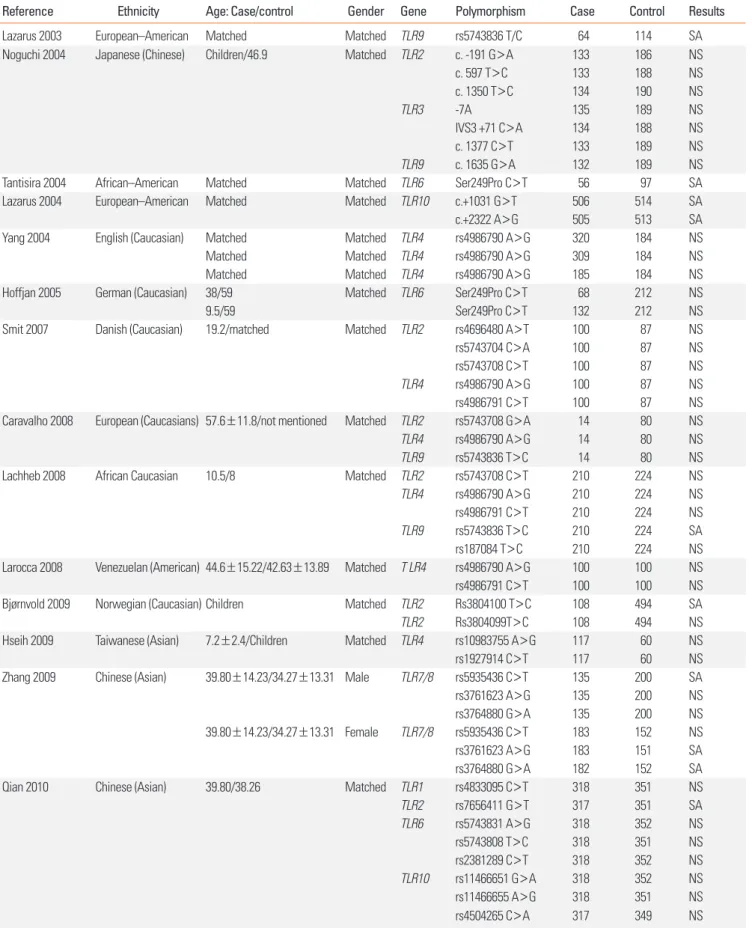
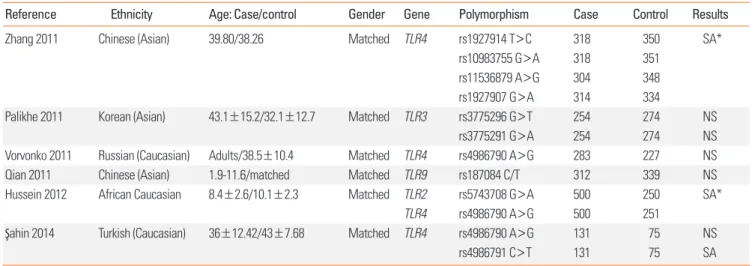
58three sets of patients (first-affected sibling, second-affected sibling and asthmatic parents) were compared with hyper-normal controls. A meta-analysis was conducted when at least 3 studies on the same polymorphism were avail- able. Fig. 1 provides a summary of the search results. Table 1 summarizes the characteristics of the case-control studies.
Data analysis
Association of TLR4 Asp299Gly with asthma risk
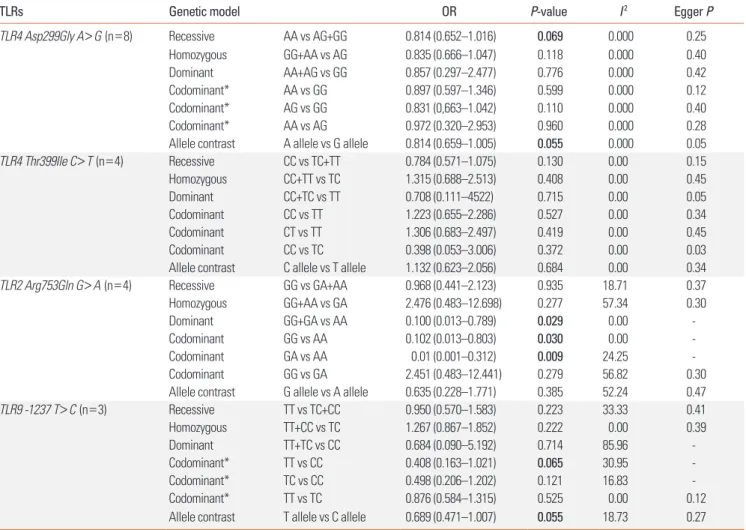
Analyses in the random effects model showed that the TLR4 Asp299Gly polymorphism was marginally associated with asth- ma under the recessive (0.069) (Fig. 2) and allele contrast (0.055) models. In the allele contrast model, sensitivity analysis by ex- clusion of any one particular study
60in the influence analysis significantly changed the results. The recalculated OR was 0.803 (95% CI, 0.647-0.997; P=0.047), indicating that the major A al- lele might protect against asthma (Table 2).
The estimated OR1 (AA vs GG), OR2 (AG vs GG) and OR3 (AA vs AG) were 0.897, 0.831, and 0.972, respectively. These esti- mates were likely to suggest a codominant genetic model. The pooled OR1 was 0.897 (95% CI, 0.597-1.346; P=0.599). Hetero- geneity was absent (0.00%). No evidence of publication bias was detected by Egger’s test (P=0.12). Sensitivity analysis by the re- moval of one study did not significantly change the results (Ta- ble 2).
Association of TLR4 Thr399Ile C>T with asthma risk
Analyses in the random-effects model showed that the TLR4 Thr399Ile polymorphism was not associated with asthma un- der any of the genetic models.
The estimated OR1 (CC vs TT), OR2 (CT vs TT) and OR3 (CC vs TC) were 1.223, 1.306, and 0.398, respectively. These estimates did not fit any genetic model. Analysis in the allele contrast mod- el showed no significant association of the TLR4 Thr399Ile C al- lele with asthma risk (OR=1.223 [95% CI, 0.655-2.286; P=0.528]) (Fig. 3). Heterogeneity was absent in all of the models (0.00%).
Sensitivity analysis by the removal of one study did not signifi- cantly change the results. Publication bias was detected by Egg-
Potentially relevant studies identified and screened for retrieval based on title (n=6,395)
-General atopic and allergic phenotypes (n=19) - TLR polymorphisms involved in signaling
pathways (n=25)
-Review articles (n=28) -Meta-analysis (n=1)
Studies targeted for retrieval for detailed evaluation (n=110)
Case-control studies eligible for meta-analysis (n=20)
Studies excluded because abstracts showed they were not relevant
Studies excluded because they did not meet the inclusion criteria (n=17)
Number of studies on the same polymorphism less than three (n=11) -Unreported genotype frequencies (n=8) -Cross sectional studies (n=2) -Family based studies (n=4) -Abstracts (n=3)
Studies included in the meta-analyses (n=9):
-Studies on TLR4 Asp299Gly (n=8) -Studies on Thr 399Ile (n=4) -Studies on TLR2 Arg753Gln (n=4) -Studies on TLR9 -1237 (n=3)
Fig. 1. Flow diagram of the systematic review and meta-analysis literature search results.
Table 1. Characteristics of the reviewed studies on SNPs in TLR genes and asthma risk
Reference Ethnicity Age: Case/control Gender Gene Polymorphism Case Control Results
Lazarus 2003 European–American Matched Matched TLR9 rs5743836 T/C 64 114 SA
Noguchi 2004 Japanese (Chinese) Children/46.9 Matched TLR2 c. -191 G>A 133 186 NS
c. 597 T>C 133 188 NS
c. 1350 T>C 134 190 NS
TLR3 -7A 135 189 NS
IVS3 +71 C>A 134 188 NS
c. 1377 C>T 133 189 NS
TLR9 c. 1635 G>A 132 189 NS
Tantisira 2004 African–American Matched Matched TLR6 Ser249Pro C>T 56 97 SA
Lazarus 2004 European–American Matched Matched TLR10 c.+1031 G>T 506 514 SA
c.+2322 A>G 505 513 SA
Yang 2004 English (Caucasian) Matched Matched TLR4 rs4986790 A>G 320 184 NS
Matched Matched TLR4 rs4986790 A>G 309 184 NS
Matched Matched TLR4 rs4986790 A>G 185 184 NS
Hoffjan 2005 German (Caucasian) 38/59 Matched TLR6 Ser249Pro C>T 68 212 NS
9.5/59 Ser249Pro C>T 132 212 NS
Smit 2007 Danish (Caucasian) 19.2/matched Matched TLR2 rs4696480 A>T 100 87 NS
rs5743704 C>A 100 87 NS
rs5743708 C>T 100 87 NS
TLR4 rs4986790 A>G 100 87 NS
rs4986791 C>T 100 87 NS
Caravalho 2008 European (Caucasians) 57.6±11.8/not mentioned Matched TLR2 rs5743708 G>A 14 80 NS
TLR4 rs4986790 A>G 14 80 NS
TLR9 rs5743836 T>C 14 80 NS
Lachheb 2008 African Caucasian 10.5/8 Matched TLR2 rs5743708 C>T 210 224 NS
TLR4 rs4986790 A>G 210 224 NS
rs4986791 C>T 210 224 NS
TLR9 rs5743836 T>C 210 224 SA
rs187084 T>C 210 224 NS
Larocca 2008 Venezuelan (American) 44.6±15.22/42.63±13.89 Matched T LR4 rs4986790 A>G 100 100 NS
rs4986791 C>T 100 100 NS
Bjørnvold 2009 Norwegian (Caucasian) Children Matched TLR2 Rs3804100 T>C 108 494 SA
TLR2 Rs3804099T>C 108 494 NS
Hseih 2009 Taiwanese (Asian) 7.2±2.4/Children Matched TLR4 rs10983755 A>G 117 60 NS
rs1927914 C>T 117 60 NS
Zhang 2009 Chinese (Asian) 39.80±14.23/34.27±13.31 Male TLR7/8 rs5935436 C>T 135 200 SA
rs3761623 A>G 135 200 NS
rs3764880 G>A 135 200 NS
39.80±14.23/34.27±13.31 Female TLR7/8 rs5935436 C>T 183 152 NS
rs3761623 A>G 183 151 SA
rs3764880 G>A 182 152 SA
Qian 2010 Chinese (Asian) 39.80/38.26 Matched TLR1 rs4833095 C>T 318 351 NS
TLR2 rs7656411 G>T 317 351 SA
TLR6 rs5743831 A>G 318 352 NS
rs5743808 T>C 318 351 NS
rs2381289 C>T 318 352 NS
TLR10 rs11466651 G>A 318 352 NS
rs11466655 A>G 318 351 NS
rs4504265 C>A 317 349 NS
(Continued to the next page)
er’s test in the dominant and CC vs TC codominant models (P=
0.05 and P=0.03, respectively) (Table 2).
Association of TLR2 Arg753Gln G/A with asthma risk
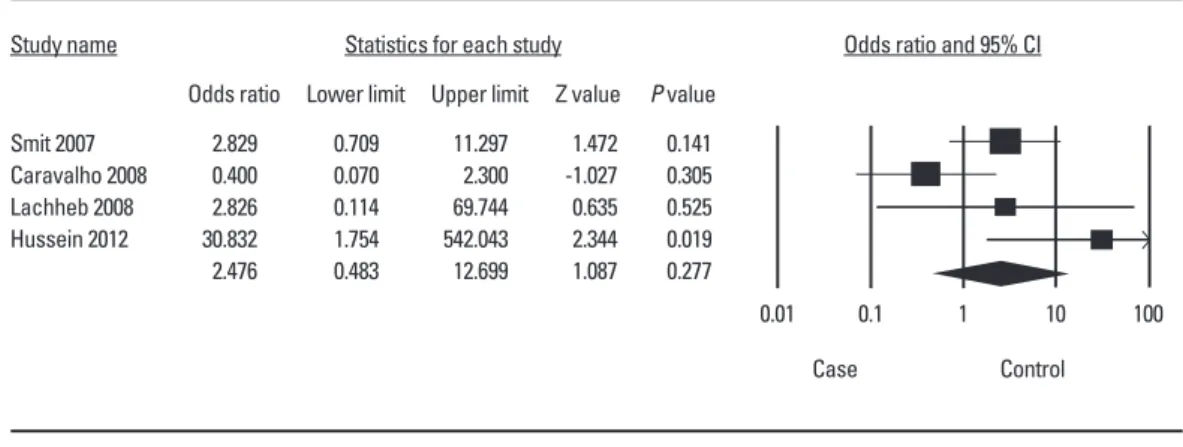
Analyses showed that the TLR2 Arg753Gln polymorphism was not associated with asthma under the recessive, homozy- gous (Fig. 4) and allele contrast models. In the homozygous model, sensitivity analysis by the removal of one study
61signifi- cantly changed the results. The recalculated OR was 4.460 (95%
CI, 1.213-16.396), indicating that the homozygous genotypes might be a significant risk factor (P=0.024). In the GG vs GA model, when one study was removed,
61the recalculated OR
was 4.365 (95% CI, 1.227-15.536), suggesting that the homozy- gous genotype might be a significant risk factor (P=0.023). Sen- sitivity analysis by the removal of one study
60in the allele con- trast model significantly changed the results. The recalculated OR was 0.402 (95% CI, 0.199-0.811), indicating that the major G allele might protect significantly against asthma (P=0.011).
The estimated OR1 (GG vs AA), OR2 (GA vs AA) and OR3 (GG vs GA) were 0.102, 0.01, and 2.451, respectively. These estimates did not fit any genetic model. Only three studies were available;
therefore, estimates were not sufficiently powerful. However, these estimates provided a first indication that genotypes with at least one copy of the major G allele might be protective. No
Table 1. ContinuedReference Ethnicity Age: Case/control Gender Gene Polymorphism Case Control Results
Zhang 2011 Chinese (Asian) 39.80/38.26 Matched TLR4 rs1927914 T>C 318 350 SA*
rs10983755 G>A 318 351
rs11536879 A>G 304 348
rs1927907 G>A 314 334
Palikhe 2011 Korean (Asian) 43.1±15.2/32.1±12.7 Matched TLR3 rs3775296 G>T 254 274 NS
rs3775291 G>A 254 274 NS
Vorvonko 2011 Russian (Caucasian) Adults/38.5±10.4 Matched TLR4 rs4986790 A>G 283 227 NS
Qian 2011 Chinese (Asian) 1.9-11.6/matched Matched TLR9 rs187084 C/T 312 339 NS
Hussein 2012 African Caucasian 8.4±2.6/10.1±2.3 Matched TLR2 rs5743708 G>A 500 250 SA*
TLR4 rs4986790 A>G 500 251
Şahin 2014 Turkish (Caucasian) 36±12.42/43±7.68 Matched TLR4 rs4986790 A>G 131 75 NS
rs4986791 C>T 131 75 SA
NS, non significant association; SA, significant association; SA*, significant association with asthma severity.
Yang a 2004 Yang b 2004 Yang c 2004 Smit 2007 Caravalho 2008 Lachheb 2008 Larroca 2008 Vorvonko 2011 Hussein 2012 Sahin 2014
Study name Statistics for each study Odds ratio and 95% CI
Meta analysis
Meta analysis
Odds ratio 0.881 0.719 0.650 1.167 0.857 0.937 0.879 0.870 0.826 0.764 0.814
Lower limit 0.497 0.411 0.354 0.441 0.167 0.058 0.325 0.514 0.516 0.227 0.652
Upper limit 1.558 1.260 1.193 3.084 4.406 15.080 2.379 1.475 1.322 2.570 1.016
Z value -0.437 -1.152 -1.390 0.311 -0.185 -0.046 -0.253 -0.516 -0.798 -0.435 -1.820
P value 0.662 0.249 0.164 0.756 0.854 0.964 0.800 0.606 0.425 0.663 0.069
Case Control
0.01 0.1 1 10 100
Fig. 2. Forest plot of the association between TLR4 Asp299Gly and asthma risk: AA vs AG+GG. The forest plot shows the odds ratios (ORs) and respective 95% con- fidence intervals (CIs) for the studies included in the meta-analysis. For each study in the forest plot, the area of the black square is proportional to the study weight, and the horizontal bar represents the 95% CI. Z score: the standardized expression of a value in terms of its relative position in the full distribution of values.
Smit 2007 Larroca2008 Lachheb 2008 Sahin 2014
Study name Statistics with study removed Odds ratio (95% CI) with study removed Meta analysis
Meta analysis
Odds ratio 0.989 1.229 1.142 1.599 1.223
Lower limit 0.447 0.554 0.596 0.765 0.655
Upper limit 2.191 2.726 2.188 3.341 2.286
Z value -0.027 0.507 0.399 1.248 0.632
P value 0.979 0.612 0.690
0.22 0.528
Case Control
0.1 0.2 0.5 1 2 5 10
Fig. 3. Forest plot of the association between TLR4 Thr399Ile and asthma risk: C allele vs T allele. The forest plot shows the ORs and respective 95% CIs for the studies included in the meta-analysis. For each study in the forest plot, the area of the black square is proportional to the study weight, and the horizontal bar repre- sents the 95% CI. Z score: the standardized expression of a value in terms of its relative position in the full distribution of values.
Table 2. Association of TLR4 Asp299Gly A/G, TLR4 Thr399Ile C>T, TLR2 Arg753Gln G/A and TLR9 -1237 T/C with asthma risk
TLRs Genetic model OR P-value I2 Egger P
TLR4 Asp299Gly A>G (n=8) Recessive AA vs AG+GG 0.814 (0.652–1.016) 0.069 0.000 0.25
Homozygous GG+AA vs AG 0.835 (0.666–1.047) 0.118 0.000 0.40
Dominant AA+AG vs GG 0.857 (0.297–2.477) 0.776 0.000 0.42
Codominant* AA vs GG 0.897 (0.597–1.346) 0.599 0.000 0.12
Codominant* AG vs GG 0.831 (0,663–1.042) 0.110 0.000 0.40
Codominant* AA vs AG 0.972 (0.320–2.953) 0.960 0.000 0.28
Allele contrast A allele vs G allele 0.814 (0.659–1.005) 0.055 0.000 0.05
TLR4 Thr399Ile C>T (n=4) Recessive CC vs TC+TT 0.784 (0.571–1.075) 0.130 0.00 0.15
Homozygous CC+TT vs TC 1.315 (0.688–2.513) 0.408 0.00 0.45
Dominant CC+TC vs TT 0.708 (0.111–4522) 0.715 0.00 0.05
Codominant CC vs TT 1.223 (0.655–2.286) 0.527 0.00 0.34
Codominant CT vs TT 1.306 (0.683–2.497) 0.419 0.00 0.45
Codominant CC vs TC 0.398 (0.053–3.006) 0.372 0.00 0.03
Allele contrast C allele vs T allele 1.132 (0.623–2.056) 0.684 0.00 0.34
TLR2 Arg753Gln G>A (n=4) Recessive GG vs GA+AA 0.968 (0.441–2.123) 0.935 18.71 0.37
Homozygous GG+AA vs GA 2.476 (0.483–12.698) 0.277 57.34 0.30
Dominant GG+GA vs AA 0.100 (0.013–0.789) 0.029 0.00 -
Codominant GG vs AA 0.102 (0.013–0.803) 0.030 0.00 -
Codominant GA vs AA 0.01 (0.001–0.312) 0.009 24.25 -
Codominant GG vs GA 2.451 (0.483–12.441) 0.279 56.82 0.30
Allele contrast G allele vs A allele 0.635 (0.228–1.771) 0.385 52.24 0.47
TLR9 -1237 T>C (n=3) Recessive TT vs TC+CC 0.950 (0.570–1.583) 0.223 33.33 0.41
Homozygous TT+CC vs TC 1.267 (0.867–1.852) 0.222 0.00 0.39
Dominant TT+TC vs CC 0.684 (0.090–5.192) 0.714 85.96 -
Codominant* TT vs CC 0.408 (0.163–1.021) 0.065 30.95 -
Codominant* TC vs CC 0.498 (0.206–1.202) 0.121 16.83 -
Codominant* TT vs TC 0.876 (0.584–1.315) 0.525 0.00 0.12
Allele contrast T allele vs C allele 0.689 (0.471–1.007) 0.055 18.73 0.27 TLR4 Asp299Gly (rs 4986790); TLR4 Thr399Ile (rs4986791); TLR2 Arg753Gln (rs5743708); TLR9 -1237 (rs187084); Bold: significant P value (<0.05). TLR4 Asp299Gly polymorphism: one study removed,60 OR=0.803 (0.647-0.997); P=0.047 in the allele contrast model. TLR2 Arg753Gln polymorphism: one study removed,61 OR=4.460 (1.213-16.396); P=0.024 in the homozygous model; one study removed,61 OR=4.365 (1.2265-15.536); P=0.023 in the GG vs GA codominant model; one study re- moved,60 OR=0.402 (0.199-0.811); P=0.011 in the allele contrast model.
n, number of studies; OR, odds ratio; I2, heterogeneity test.
*best-fitted genetic model.
evidence of publication bias was detected by Egger’s test in all of the genetic models (Table 2).
Association of TLR9 -1237 T/C with asthma risk
Analyses showed that the TLR9 -1237 T/C polymorphism was not associated with asthma under the recessive, homozygous and codominant models. In the allele contrast model, the major T allele was marginally associated with asthma with OR=0.689 (95% CI, 0.471-1.007; P=0.055), suggesting that the major T al- lele might be a significant protective factor (Table 2 and Fig. 5).
The estimated OR1 (TT vs CC), OR2 (TC vs CC) and OR3 (TT vs TC) were 0.408, 0.01, and 0.498, respectively. These estimates likely suggested a codominant genetic model. Only three stud- ies on TLR9 -1237 T/C were available; therefore, estimates were not sufficiently powerful. However, these estimates indicated that the TT genotype tended to be a significant protective factor (P=0.065). No evidence of publication bias was detected by Eg-
ger’s test in all of the genetic models (Table 2).
DISCUSSION
During the last decade, the function of TLRs in asthma patho- genesis has been investigated largely by comparing the inci- dence of disease among persons with different polymorphisms.
The magnitude of the association of polymorphisms with asth- ma varies depending on genetics, demographics, environmen- tal factors, and study methodologies. Many association studies have reported that TLR polymorphisms predispose to asth- ma.
26,47,49,52,56,59,61,68However, some polymorphisms might not be associated with asthma susceptibility, but rather with asthma severity, such as TLR4 polymorphisms.
48,51,58Conflicting results were also reported, demonstrating a protective effect of some polymorphisms.
12,45,46However, other studies reported no asso- ciation between TLR polymorphisms and asthma risk.
44,50,53,60,61,Smit 2007 Caravalho 2008 Lachheb 2008 Hussein 2012
Study name Statistics for each study Odds ratio and 95% CI
Meta analysis
Meta analysis
Odds ratio 2.829 0.400 2.826 30.832 2.476
Lower limit 0.709 0.070 0.114 1.754 0.483
Upper limit 11.297
2.300 69.744 542.043 12.699
Z value 1.472 -1.027 0.635 2.344 1.087
P value 0.141 0.305 0.525 0.019 0.277
Case Control
0.01 0.1 1 10 100
Fig. 4. Forest plot of the association between TLR2 Arg753Gln and asthma: GG+AA vs GA. The forest plot shows the ORs and respective 95% CIs for the studies in- cluded in the meta-analysis. For each study in the forest plot, the area of the black square is proportional to the study weight, and the horizontal bar represents the 95% CI. Z score: the standardized expression of a value in terms of its relative position in the full distribution of values.
Lazarus et al. 2003 Lachheb et al. 2008 Caravalho et al. 2008
Study name Statistics for each study Odds ratio and 95% CI
Meta analysis
Meta analysis
Odds ratio 0.553 0.729 2.793 0.689
Lower limit 0.319 0.499 0.354 0.471
Upper limit 0.959 1.064 22.036 1.008
Z value -2.109 -1.638 0.975 -1.919
P value 0.035 0.102 0.330 0.055
Case Control
0.01 0.1 1 10 100
Fig. 5. Forest plot of the association between TLR9 -1237 and asthma: T allele vs C allele. The forest plot shows the (ORs and respective 95% CIs for the studies in- cluded in the meta-analysis. For each study in the forest plot, the area of the black square is proportional to the study weight, and the horizontal bar represents the 95% CI. Z score: the standardized expression of a value in terms of its relative position in the full distribution of values.
64,69,70
Given the conflicting results yielded by genetic association studies, a systematic review and meta-analysis is of great value.
The current meta-analysis provides a comprehensive examina- tion of the available evidence concerning the association of SNPs in TLR genes with asthma and refines their risk profiles.
This analysis represents the first meta-analysis concerning the impact of some TLR polymorphisms on asthma and assesses their role as modifiers of asthma risk.
Estimates of combined effect sizes revealed that the major TLR9 -1237 T allele was significantly associated with a decreased asthma risk. Additionally, for TLR2 Arg753Gln G>A, sensitivity analysis in the allele contrast model revealed that the major G allele was significantly associated with a decreased asthma risk.
For TLR4 Asp299Gly A>G, the AA homozygote genotype and A allele tended to be associated with a decreased asthma risk.
These results implicate that the major allele in TLR polymor- phisms might be generally associated with a protective effect.
However, TLR4 Thr399Ile showed no significant association with asthma risk. In a previous meta-analysis, Chen
71reported no di- rect association between TLR4 Asp299Gly and asthma. This re- sult is consistent with our findings in the dominant, homozy- gous and codominant models. In a recent systematic review, Klassen et al.
72reported that TLR 2, TLR6, TLR9, and TLR10 ap- pear to have some association with childhood asthma in Cauca- sians. However, no convincing evidence for a role of TLRs in re- lation to childhood asthma exists. Polymorphisms in TLR3 seemed not to be associated with asthma.
57,65Results for TLR6 are conflicting. One study with a small sample size showed that TLR6 Ser249Pro C>T contributed to asthma susceptibility,
30but a larger study on the same polymorphism reported no associa- tion in both children and adults.
59However, other studies report- ed that polymorphisms in TLR6 were significantly associated with asthma phenotypes.
44,45,56,73Similarly, some polymorphisms in TLR7/8 have been shown to be associated with asthma dis- ease,
29,33whereas other polymorphisms showed no associa- tion.
29For TLR10, some polymorphisms showed significant as- sociation with asthma
23,33,45; however, other polymorphisms showed no significant association.
27,45Genetic association stud- ies on TLR1 and TLR5 remain scarce or are lacking. Further in- vestigations on TLR polymorphisms, including haplotype analy- sis along with gene-environment interaction, are needed.
SNPs, which occur at every 1.9 kb in the genome on average,
73could result in reduced or increased gene expression when they occur in promoter.
74This meta-analysis did not control for mul- tiple known risk factors for asthma, such as age, gender, and ethnicity. These potential confounding factors may interact with TLR polymorphisms to moderate asthma susceptibility.
Genetic associations were shown to be significantly influenced by age
75-78likely because some genes are expressed in adults and not expressed in children and vice versa. Observational studies showed that the prevalence of asthma has increased during the last decade due to environmental factors.
3There-
fore, it is important to investigate other polymorphisms in TLRs, as well as gene-gene and gene-environment interactions. A possible gene-environment interaction has been reported,
79in which the SNPs act as modifiers of asthma risk in individuals with various degrees of environmental endotoxin exposure. Fu- ture studies should include haplotype analysis and stratifica- tion of the study population according to related environmen- tal risk factors.
Asthma is a complex disease involving several genes that might be more relevant than TLR genes. Although statistically significant, the effect of the TLRs on asthma was modest. This result may reflect the important role of other confirmed candi- date genes in asthma disease. It has been reported that many genes are involved and make small contributions to the overall asthma phenotype.
The findings of our meta-analyses are consistent with experi- mental studies demonstrating that TLR polymorphisms are im- portant factors in asthma disease, and support the need for fur- ther research into the mechanisms underlying asthma suscep- tibility. The significant association between TLR polymor- phisms and asthma risk may be of clinical and public health importance. Further meta-analyses and studies on the expres- sion of related genes, environmental factors, and gene-gene and gene-environment interactions would provide useful infor- mation for the prevention and treatment of asthma.
The recent discovery of TLRs, with their role as initiators of the innate immune response and inflammation, suggests that modulating these receptors may be beneficial in the treatment of allergic disorders.
7TLRs are currently being exploited as pos- sible targets for drug development.
80Recently, several patents aimed to modulate the innate immune reaction occurring in asthma through the use of novel synthetic TLR2 ligands
8,11; these open new therapeutic perspectives for the prevention of these pathologies. Greater knowledge of risk factors will trans- late into improved diagnosis, prevention and therapeutic strat- egies for this chronic disease.
ACKNOWLEDGMENTS
This work was supported by a grant from the Ministry of High- er Education, Tunisia.
REFERENCES
1. Corrigan CJ, Hartnell A, Kay AB. T lymphocyte activation in acute severe asthma. Lancet 1988;1:1129-32.
2. Devenny A, Wassall H, Ninan T, Omran M, Khan SD, Russell G. Re- spiratory symptoms and atopy in children in Aberdeen: question- naire studies of a defined school population repeated over 35 years.
BMJ 2004;329:489-90.
3. Ho SM. Environmental epigenetics of asthma: an update. J Allergy Clin Immunol 2010;126:453-65.
4. Ober C, Yao TC. The genetics of asthma and allergic disease: a 21st
century perspective. Immunol Rev 2011;242:10-30.
5. Lee SH, Park JS, Park CS. The search for genetic variants and epi- genetics related to asthma. Allergy Asthma Immunol Res 2011;
3:236-44.
6. Sioud M. Induction of inflammatory cytokines and interferon re- sponses by double-stranded and single-stranded siRNAs is se- quence-dependent and requires endosomal localization. J Mol Biol 2005;348:1079-90.
7. Phipps S, Lam CE, Foster PS, Matthaei KI. The contribution of toll- like receptors to the pathogenesis of asthma. Immunol Cell Biol 2007;85:463-70.
8. Kanagaratham C, Camateros P, Flaczyk A, Radzioch D. Polymor- phisms in toll-like receptor genes and their roles in allergic asthma and atopy. Recent Pat Inflamm Allergy Drug Discov 2011;5:45-56.
9. Takeda K, Akira S. Toll-like receptors in innate immunity. Int Im- munol 2005;17:1-14.
10. Liang S, Hosur KB, Lu S, Nawar HF, Weber BR, Tapping RI, et al.
Mapping of a microbial protein domain involved in binding and activation of the TLR2/TLR1 heterodimer. J Immunol 2009;182:
2978-85.
11. Fuchs B, Braun A. Modulation of asthma and allergy by addressing toll-like receptor 2. J Occup Med Toxicol 2008;3 Suppl 1:S5.
12. Roponen M, Yerkovich ST, Hollams E, Sly PD, Holt PG, Upham JW.
Toll-like receptor 7 function is reduced in adolescents with asthma.
Eur Respir J 2010;35:64-71.
13. Stowell NC, Seideman J, Raymond HA, Smalley KA, Lamb RJ, Egenolf DD, et al. Long-term activation of TLR3 by poly(I:C) induc- es inflammation and impairs lung function in mice. Respir Res 2009;10:43.
14. Lun SW, Wong CK, Ko FW, Hui DS, Lam CW. Expression and func- tional analysis of toll-like receptors of peripheral blood cells in asthmatic patients: implication for immunopathological mecha- nism in asthma. J Clin Immunol 2009;29:330-42.
15. Mizel SB, Honko AN, Moors MA, Smith PS, West AP. Induction of macrophage nitric oxide production by Gram-negative flagellin in- volves signaling via heteromeric Toll-like receptor 5/Toll-like re- ceptor 4 complexes. J Immunol 2003;170:6217-23.
16. Chun E, Lee SH, Lee SY, Shim EJ, Cho SH, Min KU, et al. Toll-like receptor expression on peripheral blood mononuclear cells in asthmatics; implications for asthma management. J Clin Immunol 2010;30:459-64.
17. Chuang TH, Ulevitch RJ. Cloning and characterization of a sub- family of human toll-like receptors: hTLR7, hTLR8 and hTLR9. Eur Cytokine Netw 2000;11:372-8.
18. Diebold SS, Kaisho T, Hemmi H, Akira S, Reis e Sousa C. Innate an- tiviral responses by means of TLR7-mediated recognition of single- stranded RNA. Science 2004;303:1529-31.
19. Lazarus R, Raby BA, Lange C, Silverman EK, Kwiatkowski DJ, Ver- celli D, et al. Toll-like receptor 10 genetic variation is associated with asthma in two independent samples. Am J Respir Crit Care Med 2004;170:594-600.
20. Nakashima K, Hirota T, Suzuki Y, Akahoshi M, Shimizu M, Jodo A, et al. Association of the RIP2 gene with childhood atopic asthma.
Allergol Int 2006;55:77-83.
21. Nakashima K, Hirota T, Obara K, Shimizu M, Jodo A, Kameda M, et al. An association study of asthma and related phenotypes with polymorphisms in negative regulator molecules of the TLR signal- ing pathway. J Hum Genet 2006;51:284-91.
22. Lee SW, Wang JY, Hsieh YC, Wu YJ, Ting HW, Wu LS. Association of
single nucleotide polymorphisms of MD-1 gene with pediatric and adult asthma in the Taiwanese population. J Microbiol Immunol Infect 2008;41:445-9.
23. Heinzmann A, Brugger M, Bierbaum S, Mailaparambil B, Kopp MV, Strauch K. Joint influences of Acidic-Mammalian-Chitinase with Interleukin-4 and Toll-like receptor-10 with Interleukin-13 in the genetics of asthma. Pediatr Allergy Immunol 2010;21:e679-86.
24. Sordillo JE, Sharma S, Poon A, Lasky-Su J, Belanger K, Milton DK, et al. Effects of endotoxin exposure on childhood asthma risk are modified by a genetic polymorphism in ACAA1. BMC Med Genet 2011;12:158.
25. Smit LA, Bouzigon E, Bousquet J, Le Moual N, Nadif R, Pin I, et al.
Mold allergen sensitization in adult asthma according to integrin β3 polymorphisms and Toll-like receptor 2/+596 genotype. J Aller- gy Clin Immunol 2011;128:185-91.e7.
26. Bjørnvold M, Munthe-Kaas MC, Egeland T, Joner G, Dahl-Jør- gensen K, Njølstad PR, et al. A TLR2 polymorphism is associated with type 1 diabetes and allergic asthma. Genes Immun 2009;10:
181-7.
27. Qian FH, Zhang Q, Zhou LF, Jin GF, Bai JL, Yin KS. Polymorphisms in the toll-like receptor 2 subfamily and risk of asthma: a case-con- trol analysis in a Chinese population. J Investig Allergol Clin Im- munol 2010;20:340-6.
28. Hussein YM, Awad HA, Shalaby SM, Ali AS, Alzahrani SS. Toll-like receptor 2 and Toll-like receptor 4 polymorphisms and susceptibil- ity to asthma and allergic rhinitis: a case-control analysis. Cell Im- munol 2012;274:34-8.
29. Zhang Q, Qian FH, Zhou LF, Wei GZ, Jin GF, Bai JL, et al. Polymor- phisms in toll-like receptor 4 gene are associated with asthma se- verity but not susceptibility in a Chinese Han population. J Investig Allergol Clin Immunol 2011;21:370-7.
30. Tantisira K, Klimecki WT, Lazarus R, Palmer LJ, Raby BA, Kwiat- kowski DJ, et al. Toll-like receptor 6 gene (TLR6): single-nucleotide polymorphism frequencies and preliminary association with the diagnosis of asthma. Genes Immun 2004;5:343-6.
31. Zhang Q, Qian F, Zhou L, Wei G, Wang Y, Hu Z, et al. Polymor- phisms of TLR7 and TLR8 associated with risk of asthma and asth- ma-related phenotypes in a southeastern Chinese Han popula- tion. J Nanjing Med Univ 2009;23:25-32.
32. Lachheb J, Dhifallah IB, Chelbi H, Hamzaoui K, Hamzaoui A. Toll- like receptors and CD14 genes polymorphisms and susceptibility to asthma in Tunisian children. Tissue Antigens 2008;71:417-25.
33. Lazarus R, Klimecki WT, Raby BA, Vercelli D, Palmer LJ, Kwiat- kowski DJ, et al. Single-nucleotide polymorphisms in the Toll-like receptor 9 gene (TLR9): frequencies, pairwise linkage disequilibri- um, and haplotypes in three U.S. ethnic groups and exploratory case-control disease association studies. Genomics 2003;81:85-91.
34. Lazarus R, Vercelli D, Palmer LJ, Klimecki WJ, Silverman EK, Rich- ter B, et al. Single nucleotide polymorphisms in innate immunity genes: abundant variation and potential role in complex human disease. Immunol Rev 2002;190:9-25.
35. Leung TF, Tang NL, Wong GW, Fok TF. CD14 and toll-like recep- tors: potential contribution of genetic factors and mechanisms to inflammation and allergy. Curr Drug Targets Inflamm Allergy 2005;
4:169-75.
36. Yang IA, Fong KM, Holgate ST, Holloway JW. The role of Toll-like receptors and related receptors of the innate immune system in asthma. Curr Opin Allergy Clin Immunol 2006;6:23-8.
37. Daley D, Park JE, He JQ, Yan J, Akhabir L, Stefanowicz D, et al. As-
sociations and interactions of genetic polymorphisms in innate immunity genes with early viral infections and susceptibility to asthma and asthma-related phenotypes. J Allergy Clin Immunol 2012;130:1284-93.
38. Miedema KG, Tissing WJ, Te Poele EM, Kamps WA, Alizadeh BZ, Kerkhof M, et al. Polymorphisms in the TLR6 gene associated with the inverse association between childhood acute lymphoblastic leukemia and atopic disease. Leukemia 2012;26:1203-10.
39. Moher D, Liberati A, Tetzlaff J, Altman DG; PRISMA Group. Pre- ferred reporting items for systematic reviews and meta-analyses:
the PRISMA statement. Int J Surg 2010;8:336-41.
40. Light RJ, Singer JD, Willett JB. The visual presentation and interpre- tation of meta-analyses. In: Cooper H, Hedges LV, editors. The handbook of research synthesis. New York (NY): Russell Sage Foundation; 1994. 439-54.
41. Cochran WG. The combination of estimates from different experi- ments. Biometrics 1954;10:101-29.
42. Egger M, Davey Smith G, Schneider M, Minder C. Bias in meta- analysis detected by a simple, graphical test. BMJ 1997;315:629-34.
43. Saçkesen C, Karaaslan C, Keskin O, Tokol N, Tahan F, Civelek E, et al. The effect of polymorphisms at the CD14 promoter and the TLR4 gene on asthma phenotypes in Turkish children with asth- ma. Allergy 2005;60:1485-92.
44. Puthothu B, Heinzmann A. Is toll-like receptor 6 or toll-like recep- tor 10 involved in asthma genetics--or both? Allergy 2006;61:649- 50.
45. Kormann MS, Depner M, Hartl D, Klopp N, Illig T, Adamski J, et al.
Toll-like receptor heterodimer variants protect from childhood asthma. J Allergy Clin Immunol 2008;122:86-92, 92.e1-92.e8.
46. Smit LA, Siroux V, Bouzigon E, Oryszczyn MP, Lathrop M, Deme- nais F, et al. CD14 and toll-like receptor gene polymorphisms, country living, and asthma in adults. Am J Respir Crit Care Med 2009;179:363-8.
47. Kerkhof M, Postma DS, Brunekreef B, Reijmerink NE, Wijga AH, de Jongste JC, et al. Toll-like receptor 2 and 4 genes influence suscep- tibility to adverse effects of traffic-related air pollution on child- hood asthma. Thorax 2010;65:690-7.
48. Fagerås Böttcher M, Hmani-Aifa M, Lindström A, Jenmalm MC, Mai XM, Nilsson L, et al. A TLR4 polymorphism is associated with asthma and reduced lipopolysaccharide-induced interleukin- 12(p70) responses in Swedish children. J Allergy Clin Immunol 2004;114:561-7.
49. Eder W, Klimecki W, Yu L, von Mutius E, Riedler J, Braun-Fahrlän- der C, et al. Toll-like receptor 2 as a major gene for asthma in chil- dren of European farmers. J Allergy Clin Immunol 2004;113:482-8.
50. Raby BA, Klimecki WT, Laprise C, Renaud Y, Faith J, Lemire M, et al. Polymorphisms in toll-like receptor 4 are not associated with asthma or atopy-related phenotypes. Am J Respir Crit Care Med 2002;166:1449-56.
51. Werner M, Topp R, Wimmer K, Richter K, Bischof W, Wjst M, et al.
TLR4 gene variants modify endotoxin effects on asthma. J Allergy Clin Immunol 2003;112:323-30.
52. Møller-Larsen S, Nyegaard M, Haagerup A, Vestbo J, Kruse TA, Børglum AD. Association analysis identifies TLR7 and TLR8 as novel risk genes in asthma and related disorders. Thorax 2008;
63:1064-9.
53. Lange NE, Zhou X, Lasky-Su J, Himes BE, Lazarus R, Soto-Quirós M, et al. Comprehensive genetic assessment of a functional TLR9 pro- moter polymorphism: no replicable association with asthma or
asthma-related phenotypes. BMC Med Genet 2011;12:26.
54. Adjers K, Karjalainen J, Pessi T, Eklund C, Hurme M. Epistatic effect of TLR4 and IL4 genes on the risk of asthma in females. Int Arch Al- lergy Immunol 2005;138:251-6.
55. He J, Bosse Y, Laprise C, Paré P, Sandford A, Kozyrskyj A, et al. Nov- el associations of genetic polymorphisms in the interleukin-1 re- ceptor/Toll-like receptor signaling pathways with atopy and atopic asthma. J Allergy Clin Immunol 2009;123:S167.
56. Koponen P, Vuononvirta J, Nuolivirta K, Helminen M, He Q, Korp- pi M. The association of genetic variants in toll-like receptor 2 sub- family with allergy and asthma after hospitalization for bronchiol- itis in infancy. Pediatr Infect Dis J 2014;33:463-6.
57. Noguchi E, Nishimura F, Fukai H, Kim J, Ichikawa K, Shibasaki M, et al. An association study of asthma and total serum immunoglo- bin E levels for Toll-like receptor polymorphisms in a Japanese population. Clin Exp Allergy 2004;34:177-83.
58. Yang IA, Barton SJ, Rorke S, Cakebread JA, Keith TP, Clough JB, et al. Toll-like receptor 4 polymorphism and severity of atopy in asth- matics. Genes Immun 2004;5:41-5.
59. Hoffjan S, Stemmler S, Parwez Q, Petrasch-Parwez E, Arinir U, Ro- hde G, et al. Evaluation of the toll-like receptor 6 Ser249Pro poly- morphism in patients with asthma, atopic dermatitis and chronic obstructive pulmonary disease. BMC Med Genet 2005;6:34.
60. Smit LA, Bongers SI, Ruven HJ, Rijkers GT, Wouters IM, Heederik D, et al. Atopy and new-onset asthma in young Danish farmers and CD14, TLR2, and TLR4 genetic polymorphisms: a nested case-con- trol study. Clin Exp Allergy 2007;37:1602-8.
61. Carvalho A, Pasqualotto AC, Pitzurra L, Romani L, Denning DW, Rodrigues F. Polymorphisms in toll-like receptor genes and sus- ceptibility to pulmonary aspergillosis. J Infect Dis 2008;197:618-21.
62. Larocca N, DeSanctis J, Toro F, Moreno D. F.23. Polymorphisms of Toll-like receptor 2 and 4 genes in asthma and COPD. Clin Immu- nol 2006;119 Suppl:S58-9.
63. Hsieh YY, Wan L, Chang CC, Tsai CH, Tsai FJ. STAT2*C related gen- otypes and allele but not TLR4 and CD40 gene polymorphisms are associated with higher susceptibility for asthma. Int J Biol Sci 2009;
5:74-81.
64. Qian XB, Wu Y, Cao SY, Cai XH, Yu CY, Xuan MY, et al. Association of single nucleotide polymorphisms in the promoter region of the TLR9 gene with childhood atopic asthma. Zhonghua Yi Xue Yi Ch- uan Xue Za Zhi 2011;28:185-9.
65. Palikhe NS, Kim SH, Kim JH, Losol P, Ye YM, Park HS. Role of toll- like receptor 3 variants in aspirin-exacerbated respiratory disease.
Allergy Asthma Immunol Res 2011;3:123-7.
66. Voron’ko OE, Dmitrieva-Zdorova EV, Latysheva EA, Aksenova MG, Storozhakov GI, Bodoev NV, et al. CARD15 and TLR4 genes poly- morphisms in atopic bronchial asthma. Mol Biol (Mosk) 2011;45:
831-9.
67. Sahin F, Yıldız P, Kuskucu A, Kuskucu MA, Karaca N, Midilli K. The effect of CD14 and TLR4 gene polimorphisms on asthma pheno- types in adult Turkish asthma patients: a genetic study. BMC Pulm Med 2014;14:20.
68. Pacheco-Martínez MM, Saucedo-Ramírez O, Del Rio Navarro B, Del Rio-Chivardi J, Cruz M, Pérez-Figueroa GE, et al. Toll-like re- ceptor 4 expression in obese asthmatic children with allergic in- flammation. Bol Med Hosp Infant Mex 2011;68:257-61.
69. Liang XH, Cheung W, Heng CK, Wang DY. Absence of the toll-like receptor 4 gene polymorphisms Asp299Gly and Thr399Ile in Sin- gaporean Chinese. Ther Clin Risk Manag 2005;1:243-6.
70. Douville RN, Lissitsyn Y, Hirschfeld AF, Becker AB, Kozyrskyj AL, Liem J, et al. TLR4 Asp299Gly and Thr399Ile polymorphisms: no impact on human immune responsiveness to LPS or respiratory syncytial virus. PLoS One 2010;5:e12087.
71. Chen S. Association between the TLR4 +896A>G (Asp299Gly) polymorphism and asthma: a systematic review and meta-analy- sis. J Asthma 2012;49:999-1003.
72. Klaassen EM, Thönissen BE, van Eys G, Dompeling E, Jöbsis Q. A systematic review of CD14 and toll-like receptors in relation to asthma in Caucasian children. Allergy Asthma Clin Immunol 2013;
9:10.
73. Marth G, Yeh R, Minton M, Donaldson R, Li Q, Duan S, et al. Sin- gle-nucleotide polymorphisms in the public domain: how useful are they? Nat Genet 2001;27:371-2.
74. Trajkov D, Mirkovska-Stojkovikj J, Arsov T, Petlichkovski A, Strezo- va A, Efinska-Mladenovska O, et al. Association of cytokine gene polymorphisms with bronchial asthma in Macedonians. Iran J Al- lergy Asthma Immunol 2008;7:143-56.
75. Saadat M, Ansari-Lari M. Genetic polymorphism of glutathione S-
transferase T1, M1 and asthma, a meta-analysis of the literature.
Pak J Biol Sci 2007;10:4183-9.
76. Cui L, Jia J, Ma CF, Li SY, Wang YP, Guo XM, et al. IL-13 polymor- phisms contribute to the risk of asthma: a meta-analysis. Clin Bio- chem 2012;45:285-8.
77. Piacentini S, Polimanti R, Simonelli I, Donno S, Pasqualetti P, Man- fellotto D, et al. Glutathione S-transferase polymorphisms, asthma susceptibility and confounding variables: a meta-analysis. Mol Biol Rep 2013;40:3299-313.
78. Lee YH, Choi SJ, Ji JD, Song GG. The CTLA-4 +49 A/G and -318 C/T polymorphisms and susceptibility to asthma: a meta-analysis. Mol Biol Rep 2012;39:8525-32.
79. von Mutius E. Gene-environment interactions in asthma. J Allergy Clin Immunol 2009;123:3-11.
80. Bezemer GF, Sagar S, van Bergenhenegouwen J, Georgiou NA, Garssen J, Kraneveld AD, et al. Dual role of toll-like receptors in asthma and chronic obstructive pulmonary disease. Pharmacol Rev 2012;64:337-58.