Natural Product Sciences 21(4) : 251-254 (2015)
http://dx.doi.org/10.20307/nps.2015.21.4.251
251
Anti-Inflammatory Effect of Violapyrones B and C from a Marine-derived Streptomyces sp.
Hwa-Sun Lee
1, Bong-Jeun An
2, Hyeon Jeong Kim
2,3, Yong Hun Cho
2, Dong In Kim
2, Jae Yoon Jang
2, Jae Hoon Kwak
2, Hyi-Seung Lee
1, Yeon-Ju Lee
1, Jong Seok Lee
1, and Hee Jae Shin
1,4,*
1
Marine Natural Products Chemistry Laboratory, Korea Institute of Ocean Science and Technology, 787 Haeanro, Ansan 426-744, Korea
2
Department of Cosmeceutical Science, Dague Haany University, 285-10 Eobongji-gil, Gyeoungsan 712-220, Korea
3
Institute of technology, Herbnoori.Co.,Ltd. Daegu, 702-852, Korea
4
Department of Marine Biotechnology, University of Science and Technology, 217 Gajungro, Daejeon 305-350, Korea
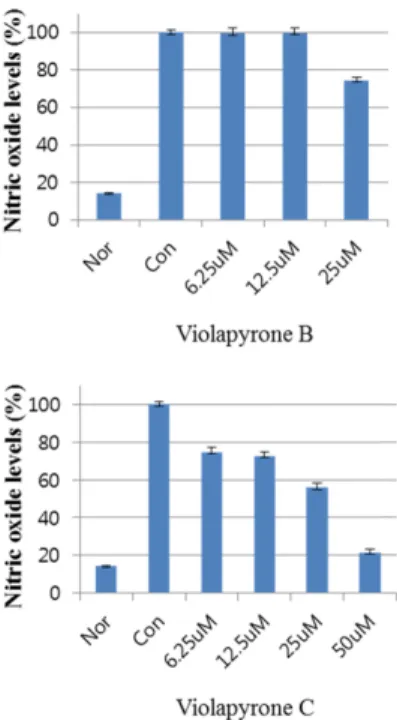
Abstract − Recently, we reported violapyrones B, C, H and I, unusual 3, 4, 6-trisubstituted α-pyrone derivatives, from the culture broth of the marine Streptomyces sp. 112CH148. In previous studies, violapyrones have been shown to have antibacterial and antitumor activities. However, the anti-inflammatory effect of violapyrones has not been reported yet. As part of our ongoing study for the discovery of bioactive metabolites from marine microorganisms, we found that violapyrones also have anti-inflammatory activity. In this study, we investigated the effect of violapyrones on LPS-induced inflammatory responses in vitro. Violapyrones B and C did not affect the viability of RAW 264.7 cells at concentrations up to 25 μM. However, violapyrones B and C inhibited the production of NO compared to the LPS-induced control. In addition, violapyrones B and C down-regulated the expression of iNOS protein in LPS-stimulated RAW 264.7 cells. To the best of our knowledge, this is the first report on the anti-inflammatory activity of violapyrones B and C.
Keywords − Violapyrones, α-Pyrones, Streptomyces sp., Anti-inflammatory
Introduction
Inflammation is part of non-specific immune response that caused by pathogens, physical injury or chemical irritants.
1This complex biological response is a protective process to remove the injurious stimuli from the body tissues.
2However, chronic inflammation is associated with the development of various diseases such as Alzhei- mer, atherosclerosis, rheumatoid arthritis and cancer.
3-6During the inflammatory process, proinflammatory cytokines, nitric oxide (NO) and prostaglandin E
2(PGE
2), are produced by inducible nitric synthase (iNOS) and cyclooxygenase-2 (COX-2).
7In addition, iNOS is activated by interferon- γ and lipopolysaccharide (LPS).
2The high level of NO affects formation of peroxynitrite and cell toxicity.
8In our recent study, we isolated violapyrones B, C, H and I from the culture broth of marine Streptomyces sp. 112CH148.
9,10Violapyrones A-G have been also reported to show anti-
bacterial activities.
11In this study, we report the anti- inflammatory effect of violapyrones B and C (Fig. 1) on the NO production and expression of iNOS and COX-2 proteins in LPS-induced RAW 264.7 cells.
Experimental
General experimental procedures − The general experi- mental procedures are described in detail in our previous paper.
10Reagents and antibodies − Reagents for anti-inflam- matory activity such as dulbeco’s modified eagle medium (DMEM), fetal bovine serum (FBS), streptomycin and penicillin were supplied by Invitrogen (Carlsbad, California, USA); sodium dodesyl sulfate (SDS), acrylamide and bis- acrylamide were purchased from Bio-Rad Laboratories (Hercules, California, USA); NP-40, protease inhibitor, RIPA buffer and Griess reagent were obtained from Sigma-Aldrich (Saint Louis, Missouri, USA). Anti-iNOS (BD bioscience, San jose, California, USA), anti-COX-2 (Cayman Chemical, Ann Arbor, Michigan, USA), anti- β- actin, anti-rabbit Ig-G horseradish peroxidase (HRP)-
*Author for correspondence
Hee Jae Shin, Marine Natural Products Chemistry Laboratory, Korea Institute of Ocean Science and Technology, 787 Haeanro, Ansan 426-744, Korea
Tel: +82-31-400-6172; E-mail: [email protected]
252 Natural Product Sciences
conjugated antibody (Santa Cruz, California, USA) and ELISA kit (R&D systems Inc., Minneapolis, Minnesota, USA) were purchased as indicated. All solvents used in our study were guaranteed reagent grade.
Microorganism − The producing strain 112CH148 was isolated from a crown-of-thorns starfish, Acanthaster planci, collected from Chuuk, Federated States of Micronesia in 2011. The strain was identified as Streptomyces sp. on the basis of 16S rRNA sequence analysis. The sequence was deposited in the GenBank under the accession number KJ419328. This strain is currently preserved in the Microbial Culture Collection, KIOST, with the name of Streptomyces sp. 112CH148 under the curatorship of Hee Jae Shin.
Preparation of compounds − Violapyrones B and C were isolated from the EtOAc extract of culture broth and purified by chromatographic methods. In previous our paper, we reported the detailed experimental procedure including isolation of the strain 112CH148, seed and mass cultivation, extraction of the fermentation broth, purification of violapyrones B and C and their structural elucidation.
10Violapyrone B − Yellowish amorphous solid; UV (MeOH) λ
max(log ε) 286.5 (1.34) nm; IR (MeOH) ν
max3347 (br), 2943, 1674 cm
−1;
1H NMR (CD
3OD, 500 MHz) δ 5.97 (1H, s, H-5), 2.45 (2H, t, J = 7.5 Hz, H-7), 1.85 (3H, s, Me-3), 1.62 (2H, m, H-8), 1.54 (1H, m, H- 11), 1.35 (2H, m, H-9), 1.23 (2H, m, H-10), 0.88 (6H, d, J = 7.0 Hz, H-12);
13C NMR (CD
3OD, 125 MHz) δ 169.4 (C-2), 168.8 (C-4), 164.9 (C-6), 101.5 (C-5), 98.9 (C-3), 39.9 (C-10), 34.4 (C-7), 29.2 (C-11), 28.3 (C-8), 27.9 (C- 9), 23.1 (C-12), 8.4 (Me-3); HR-ESI-MS m/z 225.1485 [M+H]
+; (calcd for C
13H
21O
3, 225.1491).
Violapyrone C − Yellowish amorphous solid; : +50 ( c 0.1, MeOH); UV (MeOH) λ
max(log ε) 288.0 (0.91) nm; IR (MeOH) ν
max3343 (br), 2925, 1674 cm
−1;
1