25(1) : 64-71 (2019)
https://doi.org/10.20307/nps.2019.25.1.64
64
Anti-nociceptive and Anti-inflammatory Properties of Ilex latifolia and its Active Component, 3,5-Di-caffeoyl Quinic Acid Methyl Ester
Joo Youn Kim
†, Hong Kyu Lee
†, and Yeon Hee Seong*
College of Veterinary Medicine, Chungbuk National University, Cheongju, Chungbuk 28644, Republic of Korea
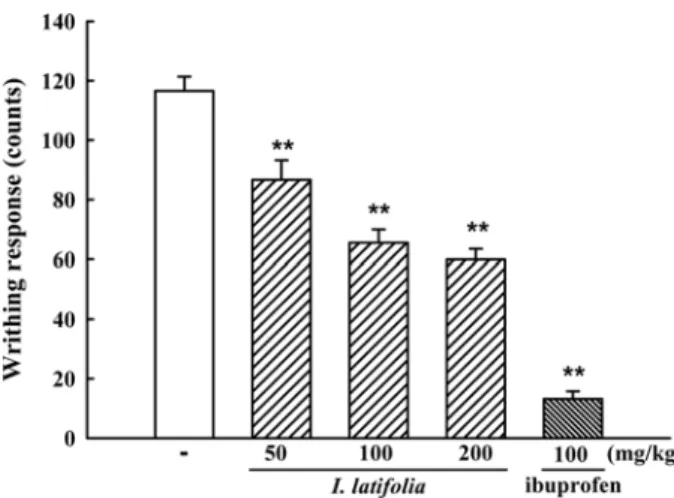
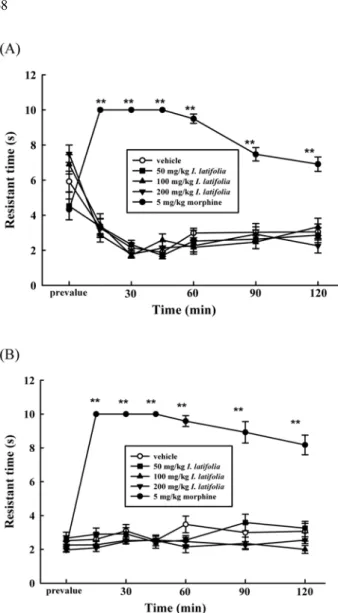
Abstract − The present study was conducted to investigate anti-nociceptive and anti-inflammatory effects of the leaves of Ilex latifolia Thunb (I. latifolia) in in vivo and in vitro. Writhing responses induced by acetic acid and formalin- and thermal stimuli (tail flick and hot plate tests)-induced pain responses for nociception were evaluated in mice. I. latifolia (50 – 200 mg/kg, p.o.) and ibuprofen (100 mg/kg, p.o.), a positive non-steroidal anti- inflammatory drug (NSAID), inhibited the acetic acid-induced writhing response and the second phase response (peripheral inflammatory response) in the formalin test, but did not protect against thermal nociception and the first phase response (central response) in the formalin test. These results show that I. latifolia has a significant anti-nociceptive effect that appears to be peripheral, but not central. Additionally, I. latifolia (50 and 100 μg/mL) and 3,5-di-caffeoyl quinic acid methyl ester (5 μM) isolated from I. latifolia as an active compound significantly inhibited LPS-induced NO production and mRNA expression of the pro-inflammatory mediators, iNOS and COX-2, and the pro-inflammatory cytokines, IL-6 and IL-1β, in RAW 264.7 macrophages. These results suggest that I. latifolia can produce antinociceptive effects peripherally, but not centrally, via anti-inflammatory activity and supports a possible use of I. latifolia to treat pain and inflammation.
Keywords − Ilex latifolia, 3,5-di-caffeoyl quinic acid methyl ester, anti-nociception, anti-inflammation, cyclooxy- genase-2, nitric oxide, pro-inflammatory cytokines
Introduction
Although inflammation is a host defense mechanism caused by infection or injury, the inflammation process causes increased vascular permeability, active migration of blood cells, and the passage of plasma constituents into injurious tissue, resulting in pain, swelling, and erythema.
1Various inflammatory mediators such as prostaglandins (PGs), leukotrienes, histamine, bradykinin, and platelet- activating factor are involved in initiating and sustaining pain and inflammatory cascades. Arachidonic acid, which is released from phospholipids of cellular membranes by phospholipase A
2, is catalyzed to produce PGs by cyclooxygenase (COX) during inflammatory responses.
2Prostaglandins themselves does not produce pain, but strongly enhance the pain-producing effect of 5- hydroxytryptamine or bradykinin.
3Therefore, inflammatory process are controlled by the aspirin-like non-steroidal anti-inflammatory drugs (NSAIDs), which mainly inhibit
COX and reduce synthesis of PGs, as well as by corticosteroids, which inhibit phospholipase A
2and further prevent PGs formation. Cyclooxygenase exists in two isoforms, COX-1 and COX-2.
4COX-1 is responsible for maintaining normal physiological functions, whereas COX-2 is induced by pro-inflammatory cytokines under inflammatory conditions and synthesized in macrophages in response to injury or bacterial infection.
5Nitric oxide (NO), which is also known as an inflammatory mediator,
6is synthesized by inducible nitric oxide synthase (iNOS) in tissue to regulate immunity and defend hosts against infectious pathogens.
7However, excessive synthesis of NO results in destruction of tissue homeostasis and mediation of inflammation.
8Macrophages play key roles in inflammation by inducing inflammatory mediators, including NO, PGE
2and pro- inflammatory cytokines such as tumor necrosis factor alpha (TNF- α), interleukin (IL)-6, and IL-1β.
9Cytokines released from activated macrophages increase the expres- sion of inflammatory mediators including iNOS and COX-2.
10The inhibition of pro-inflammatory cytokines and mediators is regarded as a primary target of anti- inflammatory agents.
11*Author for correspondence
Prof. Dr. Yeon Hee Seong, College of Veterinary Medicine, Chung- buk National University, Cheongju, Chungbuk 28644, Korea.
Tel: +82-43-261-2968; E-mail: [email protected]
†