• 검색 결과가 없습니다.

Flame Retardant Performance of Wood Treated with Flame Retardant Chemicals

N/A
N/A
Protected

Academic year: 2021

Share "Flame Retardant Performance of Wood Treated with Flame Retardant Chemicals"

Copied!
8
0
0

로드 중.... (전체 텍스트 보기)

전체 글

(1)

*1 Received on August 7, 2012; accepted on September 18, 2012

*2 Department of Housing Environmental Design and Research Institute of Human Ecology, College of Human Ecology, Chonbuk National University, Jeonju 561-756, Korea

*3 R&D Center, Samhwa Paints Inc. Co., Ltd., 677 Seonggok-dong, Danwon-gu, Ansan 425-835, Korea

*4 Department of Wood Science & Technology, College of Agriculture Life Science, Chonbuk National University, Jeonju 561-756, Korea

Corresponding author : Mingyu-Wen (e-mail: [email protected])

Flame Retardant Performance of Wood Treated with Flame Retardant Chemicals* 1

Hee-Jun Park *

2

, Mingyu-Wen *

2†

, Sang-Hun Cheon *

3

, Jung-woo Hwang *

4

, and Seung-Won Oh *

4

ABSTRACT

This study investigated the flame retardant performance of developed four types of flame retardant chemicals (FRC), FRC-A, B, C and D. Four kinds of soft wood species, Sugi (Cryptomeria), Spruce (Picea abies), Hinoki (Chamaecyparis obtusa) and Korean pine (Pinus koraiensis), were used. The wood specimens were treated by spreading the FRC on the surface with different quantities, 30, 50, 70, 90, 110 g/m

2

, respectively. The charred area, charred length, after flame time and after glow time were tested. And their suitabilities as incombustible ma- terials were evaluated. The specimen treated by FRC-D showed better incombustible properties than others, even though with lower quantity. Therefore it is supposed that the FRC-D could be able to be applied on the cultural heritage, such as Korean wooden house for preventing fire.

Keywords : flame retardant chemical (FRC), flame retardant performance, charred area, charred length

1. INTRODUCTION

Wood materials with its natural qualities and beauty of grain always is favored in the field of residential, commercial and industry building construction, as well as for indoor furnishing.

The need for consumer protection, coupled with the new regulations and environmental con- cerns, fire retardant treatment of wood materials to improve the fire performance is increasingly demanded. Chemical treatment can significantly improve the fire performance of wood materials, by so doing, widens their utilization options

(Chuang et al., 2008).

Currently, many types of flame retardants are used for wood materials. There are three major ways to enhance the fire performance of wood, including (1) impregnating a fire retardant agent into the wood; (2) an agent mixed with in- organic composite and (3) fire retardant spread- ing applied as paint (Wang et al., 2004). App- ling paint treatment is found to be the fast and convenient way, especially for existing ancient architectural buildings, such as wooden houses.

Under the heat at the earlier stage of fire, the

paint on the achieve flame retardancy by form

(2)

Table 1. Moisture content of species

Species Spruce Sugi Hinoki Korea pine

MC (%) 10.34 9.68 12.12 9.93

ing physical barrier to deter heat and mass transfer between the gas and the condensed phases. Thus rescue time could be saved in the emergency situation.

It is well known that wood treated with com- pounds containing nitrogen, phosphorus, halo- gens, and boron such as ammonium phosphate, ammonium halide, boric acid and borax to im- prove fire retardance and accelerate the for- mation of a carbonized layer on the materials.

It is proposed that such chemicals can lead to a lowering of the decomposition temperature and a higher char yield (Zhang and Chen, 2011 Kunze et al., 2004). In addition, the in- tumescent fire retardant (IFR) system has re- cently aroused a great attention in the fire re- tardation of polymers for many advantages such as low smoke, low toxicity and halogen free.

Typically, the IFR system is composed of three components, i.e. an acid source, a carbonization compound and a blowing agent (Gao et al., 2005; Lv et al., 2009). For example, ammonium polyphosphate (APP), pentaerythritol and mela- mine are a well-known intumescent flame re- tardant formulation. In polymeric intumescent spreadings endothermic chemical reactions are exploited to absorb heat and to produce bubbles causing the material to swell. A carbonaceous or silicate layer of a multi-cellular structure is formed with simultaneous release of non-flam- mable gases (Choi, 2011; Marney and Russell, 2008).

In this study four types of water soluble flame retardant chemicals (FRC-A, B, C and D) were developed and the flame retardant per- formance of four kinds of wood species treated by the FRCs were evaluated. The better for- mulation was selected for further wood flame

retardant study for the application for culture buildings.

2. MATERIALS and METHODS

2.1. Materials

Four kinds of softwood wood species were used: Sugi ( Cryptomeria), Spruce (Picea abies), Hiniki ( Chamaecyparis obtusa) and Korean pine ( Pinus koraiensis). The moisture contents of all wood species are shown in Table 1. The speci- mens were cut into 300 × 200mm blocks, with thickness of 10 mm.

The developed four types of FRC were spread on the surface of specimens using a brush, and then the specimens were air dried.

The quantity was 30, 50, 70, 90, 110 g/m

2

, respectively. Prior to flammability testing, the air dried specimens were conditioned for over 48 hr. at 50 ± 2°C. For comparison, control specimens without spreading were also prepared.

Three replications for each spreading were tested.

The FRC-A, B, C and D are synthesized in lab.

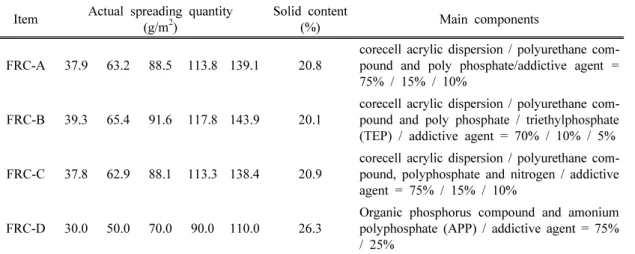
Their main components and spreading quantities are shown in Table 2.

2.2. 45° Flammability Test

The 45° flammability test was conducted ac- cording to Notification of Korean National Emergency Management Agency standard, No.

2009-31 (2009). The specimens were clamped

with a steel holder and kept steady at the heat-

ing flame at an angle of 45 degrees. The heat-

ing flame, adjust to a length of 65 mm from the

bottom. The duration of heating by the flame

was set at 2 min. The after flame time (duration

(3)

Table 2. Properties of flame retardant chemicals Item Actual spreading quantity

(g/m

2

)

Solid content

(%) Main components

FRC-A 37.9 63.2 88.5 113.8 139.1 20.8

corecell acrylic dispersion / polyurethane com- pound and poly phosphate/addictive agent = 75% / 15% / 10%

FRC-B 39.3 65.4 91.6 117.8 143.9 20.1

corecell acrylic dispersion / polyurethane com- pound and poly phosphate / triethylphosphate (TEP) / addictive agent = 70% / 10% / 5%

FRC-C 37.8 62.9 88.1 113.3 138.4 20.9

corecell acrylic dispersion / polyurethane com- pound, polyphosphate and nitrogen / addictive agent = 75% / 15% / 10%

FRC-D 30.0 50.0 70.0 90.0 110.0 26.3

Organic phosphorus compound and amonium polyphosphate (APP) / addictive agent = 75%

/ 25%

Note. Each value is average of three replications.

of continuous flaming after removing the heat- ing source) was observed. The after glow time (state of non-flame combustion after cessation of the flame) was also recorded. The charred area and length of tested specimens were meas- ured after brushing and removing the charred surface.

2.3. The Analysis of Morphology of the Residual Charred Outer Layers

The digital morphology of the residual char- red outer layers of Hinoki was observed by Digital Megascope system IMSD-12A-088 (Alpha- systec. Co. kr) with lens set of × 300 lens.

3. RESULTS and DISCUSSION

3.1. Flame Retardant Performance of Wood Specimen Treated by FRC- A, B, C and D

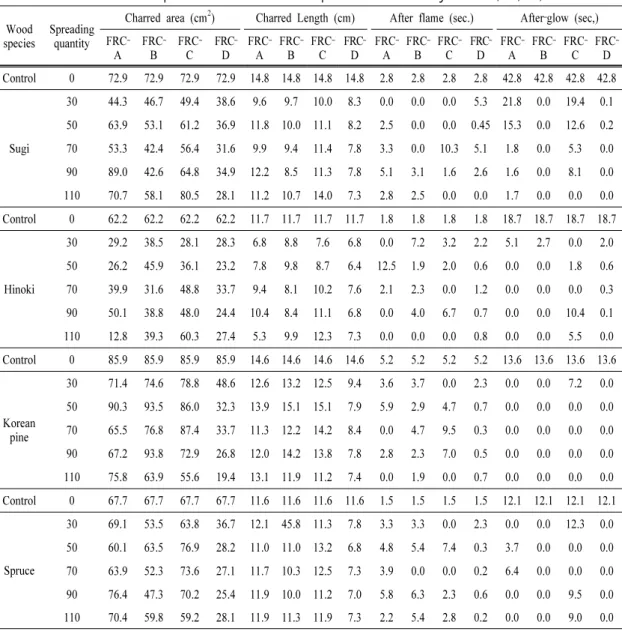
The flame retardant performance of different wood species treated by developed FRCs were shown in Table 3. According to Notification of

Korean National Emergency Management Age-

ncy standard, No. 2009-31 (2009) the charred

area was required 50 cm

2

, 20 cm for charred

length, 10 sec. for after flame and 30 sec. for

after glow. It is obviously that the controlled

specimens of four species were all not able to

meet the requirement, especially in case of

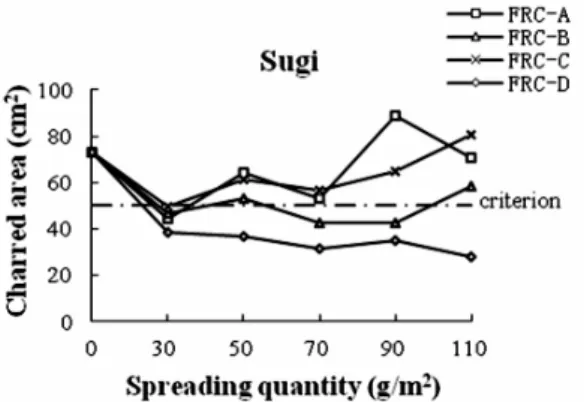
charred area and after glow. The charred area as

a function of spreading quantity was shown in

Figs.1 ∼4. However, it is generally observed

that no specific trend of variation in charred

area as increasing spreading quantity was record

for all species. The improvement of flame re-

tardant performance of specimens treated by

FRC-A, B and C were slightly compared with

control specimen. Additionally, in view of FRC-A,

B, and C, among them it is hard to discern the

better flame retardant performance due to the

absence of consistence trend. One the on hand,

wood as uneven-textured material, it is hard to

get the same part on the same wood. When the

part where resin exits is heated, the leaked out

resin is one of the reasons responsible for the

inferior flame retardant performance. Furthermore,

due to the spreading treatment only the surface

of wood, rather than impregnation, the deviation

(4)

Table 3. Flame retardant performances of wood specimen treated by FRC-A, B, C, D

Wood species

Spreading quantity

Charred area (cm

2

) Charred Length (cm) After flame (sec.) After‐glow (sec,) FRC‐

A FRC‐

B FRC‐

C FRC‐

D FRC‐

A FRC‐

B FRC‐

C FRC‐

D FRC‐

A FRC‐

B FRC‐

C FRC ‐

D FRC‐

A FRC‐

B FRC‐

C FRC‐

D Control 0 72.9 72.9 72.9 72.9 14.8 14.8 14.8 14.8 2.8 2.8 2.8 2.8 42.8 42.8 42.8 42.8

Sugi

30 44.3 46.7 49.4 38.6 9.6 9.7 10.0 8.3 0.0 0.0 0.0 5.3 21.8 0.0 19.4 0.1 50 63.9 53.1 61.2 36.9 11.8 10.0 11.1 8.2 2.5 0.0 0.0 0.45 15.3 0.0 12.6 0.2

70 53.3 42.4 56.4 31.6 9.9 9.4 11.4 7.8 3.3 0.0 10.3 5.1 1.8 0.0 5.3 0.0

90 89.0 42.6 64.8 34.9 12.2 8.5 11.3 7.8 5.1 3.1 1.6 2.6 1.6 0.0 8.1 0.0

110 70.7 58.1 80.5 28.1 11.2 10.7 14.0 7.3 2.8 2.5 0.0 0.0 1.7 0.0 0.0 0.0 Control 0 62.2 62.2 62.2 62.2 11.7 11.7 11.7 11.7 1.8 1.8 1.8 1.8 18.7 18.7 18.7 18.7

Hinoki

30 29.2 38.5 28.1 28.3 6.8 8.8 7.6 6.8 0.0 7.2 3.2 2.2 5.1 2.7 0.0 2.0

50 26.2 45.9 36.1 23.2 7.8 9.8 8.7 6.4 12.5 1.9 2.0 0.6 0.0 0.0 1.8 0.6

70 39.9 31.6 48.8 33.7 9.4 8.1 10.2 7.6 2.1 2.3 0.0 1.2 0.0 0.0 0.0 0.3

90 50.1 38.8 48.0 24.4 10.4 8.4 11.1 6.8 0.0 4.0 6.7 0.7 0.0 0.0 10.4 0.1

110 12.8 39.3 60.3 27.4 5.3 9.9 12.3 7.3 0.0 0.0 0.0 0.8 0.0 0.0 5.5 0.0

Control 0 85.9 85.9 85.9 85.9 14.6 14.6 14.6 14.6 5.2 5.2 5.2 5.2 13.6 13.6 13.6 13.6

Korean pine

30 71.4 74.6 78.8 48.6 12.6 13.2 12.5 9.4 3.6 3.7 0.0 2.3 0.0 0.0 7.2 0.0 50 90.3 93.5 86.0 32.3 13.9 15.1 15.1 7.9 5.9 2.9 4.7 0.7 0.0 0.0 0.0 0.0 70 65.5 76.8 87.4 33.7 11.3 12.2 14.2 8.4 0.0 4.7 9.5 0.3 0.0 0.0 0.0 0.0 90 67.2 93.8 72.9 26.8 12.0 14.2 13.8 7.8 2.8 2.3 7.0 0.5 0.0 0.0 0.0 0.0 110 75.8 63.9 55.6 19.4 13.1 11.9 11.2 7.4 0.0 1.9 0.0 0.7 0.0 0.0 0.0 0.0 Control 0 67.7 67.7 67.7 67.7 11.6 11.6 11.6 11.6 1.5 1.5 1.5 1.5 12.1 12.1 12.1 12.1

Spruce

30 69.1 53.5 63.8 36.7 12.1 45.8 11.3 7.8 3.3 3.3 0.0 2.3 0.0 0.0 12.3 0.0 50 60.1 63.5 76.9 28.2 11.0 11.0 13.2 6.8 4.8 5.4 7.4 0.3 3.7 0.0 0.0 0.0 70 63.9 52.3 73.6 27.1 11.7 10.3 12.5 7.3 3.9 0.0 0.0 0.2 6.4 0.0 0.0 0.0 90 76.4 47.3 70.2 25.4 11.9 10.0 11.2 7.0 5.8 6.3 2.3 0.6 0.0 0.0 9.5 0.0 110 70.4 59.8 59.2 28.1 11.9 11.3 11.9 7.3 2.2 5.4 2.8 0.2 0.0 0.0 9.0 0.0 Note : Each value is average of three replications.

between wood species is not obvious. On the other hand, the FRC-A, B and C which with the main component of corecell acrylic dispersion, polyurethane and polyphosphate are not so ef- fect enough to resist those disadvantages. Therefore, as increased spreading quantity, they did not ex- hibit consistence decline trend. In the cases of

Korean pine, there is no apparently effect re- gardless of spreading FRC-A, B or C, all of which were fail to meet the criterion. This may be attributed to the characteristic of Korean pine, with abundance knots and resin inferior to fire prevention.

In contrast to FRC-A, B, and C, as for

(5)

Fig. 1. Charred area of treated Sugi specimen as a function of spreading quantity.

Fig. 2. Charred area of treated Hinoki specimen as a function of spreading quantity.

FRC-D, initially there is a drastic reduction in the charred area, even though with lower quan- tity of 30 g/m

2

, at which charred area are rela- tive lower to be in accordance with the criterion for all specimens, and trend tends to flat finally.

Consequently, this confirmed the good flame re- tardant performance of FRC-D, APP based in- tumescent formulation. Generally, the function of flammable retardant in cellulose material is to increase the char at the cost of flammable volatile products. Thus good flame retardant can make wood decompose at lower temperature (< 300°C, where cellulose, the critical compo- nent of wood, decomposes though the first type of reaction and products more char and corre-

Fig. 3. Charred area of treated Korean pine specimen as a function of spreading quantity.

Fig. 4. Charred area of treated Spruce specimen as a function of spreading quantity.

spondingly less flammable volatiles (Wladyka- Przbylak and Kozlowski, 1999). It is observed that upon heating intumescent fire-retardant for- mulation, a layer of foamy carbonaceous char is produced, which protects the polymer surface from the flames. This is confirmed by following observation of residual char morphology. When ignited, wood undergo thermal degradation, forming combustible volatile compounds which become involved in the propagation of fire.

Theoretically, this layer acts as a physical bar- rier that hinders the transfer of heat from the flame to the material.

Furthermore, the difference of formulation is

the one of the main factors responsible for the

(6)

FRC-A

FRC-B

FRC-C

FRC-D

Control

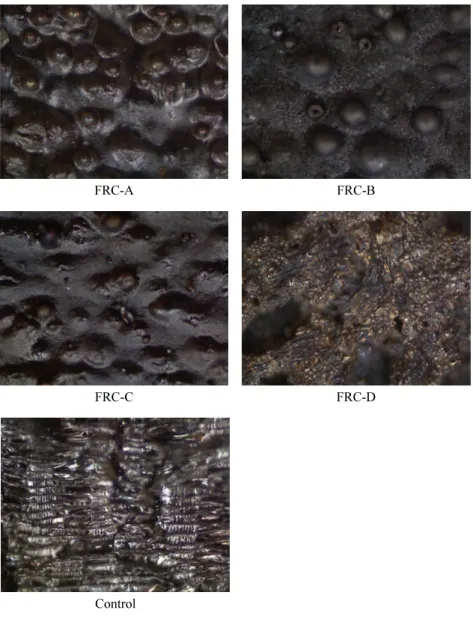
Fig. 5. The morphology of the residual charred outer layers (× 300 lens).

(FRC-A, FRC-B, FRC-C, FRC-D, Control)

deviation in the flame retardant performance of FRC- A, B, C and D. In concern with the eco- nomic, for the application of FRC-D, at least 30 g/m

2

is recommended. Compared with other study (Ho and Seong, 2012) using three kinds of commercial flame retardants, with main com- ponent of guanidine and polyphosphate re-

spectively, even though spread two times with

the quantity of 500 ㎖/m

2

and 200 ㎖/m

2

, they

failed to meet the flame retardant criterion. The

satisfied flame retardant performance of FRC-D

enable it should be potential flame retardant

chemical applying for wood and heritage culture

fire prevention.

(7)

3.3. The Morphology of Combusted Residual Charred out Layer

Fig.5 shows the photos of out charred layer of wood specimen treated by FRC-A, B, C and D. From the char residue it can be observed that compared with control specimen (Control), FRC-A, B, and D all formed a condensed phase charred area during combustion. However, a lot of small bubbles existed on the surface of the charred layer of FRC-D, different from FRC-A, B, C and Control. As the main component of FRC-D, APP is reported would be transformed into ultra-phosphate substance with elimination of ammonium and water (Drevelle et al., 2004;

Zhong et al., 2007). The existed bubble form, on the one hand was caused by the released large quantities of gases impacted flame re- tardant system in the process of burning and decomposition. On the other hand, such a struc- ture can attribute to prevent the exchange of the fuels and the oxygen outside between the con- densed phase and the gas phase, and hold amount of the decomposition gas. The in- combustible ammonia released from the thermal decomposition of APP can dilute air and simul- taneously remove part of the generated heat (Gao et al., 2004).

The morphology of compact outer surface further evidence of the fire retardant is the in- tumescent flame retardants which provide a bar- rier to resist the transfer of heat and mass dur- ing a fire and subsequently effectively prevent the exposure of heat and combustible gas to flame retardant system. As a result, FRC-D showed the better flame retardant performance, confirmed by combustion test result above. In addition, in view of FRC-A, B and C, there is presence of some honey shape layers formed on the surface, however they were fail to prevent combustion effectively as the result stated above.

4. CONCLUSION

In this paper, the flame retardant performance of developed four types of flame retardant chemicals (FRC), FRC-A, B, C and D was in- vestigated on four kinds of wood species treated with the FRCs, in attempt to selected the better formulation for further study. The conclusions are as follows:

(1) The results of The flammability test show that the FRC-D, APP based intumscent for- mulation, was detected to be superior to others and present desirable flame retardant perfor- mance. In concern with economic, at least 30 g/m

2

is recommended for its application.

(2) The morphology of combusted residual charred out layers was observed by microscope.

The result further confirmed the conclusion above. The morphology of char formed by FRC-D indicates that the char layer could swell well to form a barrier to resist the transfer of heat and mass during a fire.

(3) For the consideration of good flame re- tardant performance of FRC-D, it is supposed that the FRC-D could be potential to able to be applied on the cultural heritage, such as Korean wooden house for preventing fire, compared with other commercial flame retardants.

ACKNOWLEDGMENT

The present work is supported by the re- search fund of the Rural Development Admini- stration, Korea, under project No. PJ0079674.

REFERRNCE

1. Chuang, C.-S., C.-H. Ko, K.-C. Tsai, M.-K. Wang,

C.-C. Ou, and I.-L. Shiau. 2008. Effects of in-

tumescent formulation for acrylic-based spre- ad-

ing on flame-retardancy of painted red lauan

(Parashorea spp.) thin plywood. Wood Sci. Technol.

(8)

42: 593 ∼607.

2. Wang, Q., J. J. Li, and E. Winandy. 2004. Chemi- cal mechanism of fire retardance of boric acid on wood. Wood Sci. Technol. 38: 375 ∼389.

3. Zhang, Q., and Y. Chen. 2011. Synergistic effects of ammonium polyphosphate/melamine intumescent system with macromolecular char former in flame- retarding polyoxymethylene. J. Polym. Res. 18:

293 ∼303.

4. Kunze, R., Schartel, B., Bartholmai, M., Neubert, D., and Schriever, R. 2002. TG-MS and TG-FTIR applied for an unambiguous thermal analysis of intumescent spreading. J. Therm. Anal. Calorim.

70: 897909.

5. Gao, M., B. Ling, S. Yang, and M. Zhao. 2005.

Flame retardance of wood treated with guanidine compounds characterized by thermal degradation behavior. J. Anal. Appl. Pyrolysis 73: 151 ∼156.

6. Lv, P., Z. Wang, Y. Hu, and M. Yu. 2009. Study on effect of polydimethylsiloxane in intumescent flame retardant polypropylene. J. Polym Res. 16:

81 ∼89.

7. Choi, J.-M. 2011. A study on combustion charac- teristics of fire retardant treated Pinus Densiflora and Pinus Koraiensis. Mokchae Konghak 39(3):

244 ∼251.

8. Marney, D. C. O., and L. J. Russell. 2008. Com-

bined fire retardant and wood preservative treat- ments for outdoor wood applications a review of the literature. Fire Technology 44: 114.

9. Notification No. 2009-31. Korean National Emer- gency Management Agency standard. 2009.

10. Wladyka-Przbylak, M., and R. Kozlowski. 1999.

The thermal characteristics of different intumescent spreadings. Fire Mater. 23: 33 ∼43.

11. Drevelle, C., S. Duquesne, M. Le. Bras, J. Lefe- bvre, R. Delobel, A. Castrovinci, C. Magniez, M.

Vouters. 2004. Influence of ammonium poly- phosphate on the mechanism of thermal degrada- tion of an acrylic binder resin. J. Appl. Polym.

Sci.94: 717 ∼729.

12. Zhong, H., D. Wu, P. Wei, P. Jiang, and Q. Li.

2007. Synthesis, haracteristic of a novel addi- tive-type flame retardant containing silicon and its application in PC/ABS alloy. J. Mater. Sci.

42: 1010610112.

13. Ho, C. S. and H. G. Seong. 2012. Performance of some commercial flame retardants. 2012 pro- ceedings of the Korean society of wood science and technology annual meeting. 174-175.

14. Gao, M., C. Sun, and K. Zhu. 2004. Thermal degradation of wood treated with guanidine com- pounds in air flammability study. J. Therm. Anal.

Calorim. 75: 221 ∼232.

수치

Table 1. Moisture content of species
Table 2. Properties of flame retardant chemicals Item Actual spreading quantity
Table 3. Flame retardant performances of wood specimen treated by FRC-A, B, C, D
Fig. 1. Charred area of treated Sugi specimen as a  function of spreading quantity.
+2

참조

관련 문서

Four circular bone defects with a diameter of 8mm were formed on each of the calvaria of rabbits. Each defect in the calvarium was allocated to 1) control group,.. 2)

In 1396, a wall with four main gates and four smaller gates was constructed to keep the city safe from invaders.. Although two of the gates are now gone, many sections of

Diagrammatic representation of the mechanisms of local deformation of wood cells under a longitudinal compression force; (a) wood before the application of the force, (b)

A cross section of wood from a white-pocket area of decayed wood showing delignified wood cells. These cells have no middle lamella (this is the area between

It considers the energy use of the different components that are involved in the distribution and viewing of video content: data centres and content delivery networks

After first field tests, we expect electric passenger drones or eVTOL aircraft (short for electric vertical take-off and landing) to start providing commercial mobility

1 John Owen, Justification by Faith Alone, in The Works of John Owen, ed. John Bolt, trans. Scott Clark, &#34;Do This and Live: Christ's Active Obedience as the

The Joint Resarch Centre's European Chemicals Bureau has developed a hazard estimation software called Toxtree, capable of making structure-based predictions for a