Impacts of Soil Texture on Microbial Community of Orchard Soils in Gyeongnam Province
Min Keun Kim, Yeon-Kyu Sonn1, Hang-Yeon Weon1, Jae-Young Heo, Jeong-Seok Jeong, Yong-Jo Choi, Sang-Dae Lee, Hyun-Yul Shin2, Yong Sik Ok3**, and Young Han Lee*
Gyeongsangnam-do Agricultural Research and Extension Services, Jinju 660-370, Republic of Korea.
1National Academy of Agricultural Science, Rural Development Administration, Wanju 565-851, Republic of Korea
2Gyeongsangnam-do Office of Planning and Coordination, Changwon 641-702, Republic of Korae
3Biochar Research Center, Department of Biological Environment, Kangwon National University, Chuncheon 200-701, Republic of Korea
(Received: February 24 2015, Revised: April 17 2015, Accepted: April 22 2015)
Soil management for orchard depends on the effects of soil microbial activities. The present study evaluated the soil microbial community of 25 orchard (5 sites for sandy loam, 7 sites for silt loam, and 13 sites for loam) in Gyeongnam Province by fatty acid methyl ester (FAME) method. The average values for 25 orchard soil samples were 270 nmol g-1 of total FAMEs, 72 nmol g-1 of total bacteria, 34 nmol g-1 of Gram-negative bacteria, 34 nmol g-1 of Gram-positive bacteria, 6 nmol g-1 of actinomycetes, 49 nmol g-1 of fungi, and 7 nmol g-1 of arbuscular mycorrhizal fungi. In addition, silt loam soils had significantly low ratio of cy17:0 to 16:1ω7c and cy19:0 to 18:1ω7c compared with those of loam soils (p < 0.05), indicating that microbial activity increased. The average soil microbial communities in the orchard soils were 26.7% of bacteria, 17.9% of fungi, 12.6% of Gram-negative bacteria, 12.5% of Gram-positive bacteria, 2.5% of arbuscular mycorrhizal fungi, and 2.2% of actinomycetes. The soil microbial community of Gram-negative bacteria in silt loam soils was significantly higher than those of sandy loam and loam soils (p < 0.05).
Key words: Orchard, Microbial community, Soil texture, Fatty acid methyl ester (FAME)
Ratio of cy17:0 to 16:1ω7c and cy19:0 to 18:1ω7c of different orchard soils in Gyeongnam Province. Means by the same letter within a column are not significantly different at 0.05 probability level according to Tukey's studentized range test.
Bars represent one standard deviation of the mean.
1)
†The first two authors equally contributed to this work.
*Corresponding author : Phone: +82552541313, E-mail: [email protected]
**Co-corresponding author : Phone: +82332506443, E-mail: [email protected]
§Acknowledgement: This study was conducted with the support of the Research Cooperating Program for Agricultural Science &
Technology Development (Project No. PJ009198252015), RDA, Republic of Korea.
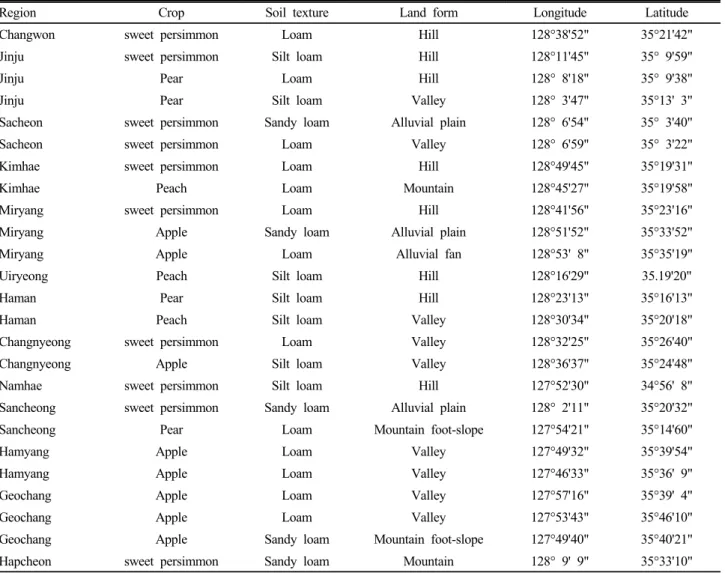
Table 1. Orchard soil sampling sites from different locations in Gyeongnam Province (n=25).
Region Crop Soil texture Land form Longitude Latitude
Changwon sweet persimmon Loam Hill 128°38'52" 35°21'42"
Jinju sweet persimmon Silt loam Hill 128°11'45" 35° 9'59"
Jinju Pear Loam Hill 128° 8'18" 35° 9'38"
Jinju Pear Silt loam Valley 128° 3'47" 35°13' 3"
Sacheon sweet persimmon Sandy loam Alluvial plain 128° 6'54" 35° 3'40"
Sacheon sweet persimmon Loam Valley 128° 6'59" 35° 3'22"
Kimhae sweet persimmon Loam Hill 128°49'45" 35°19'31"
Kimhae Peach Loam Mountain 128°45'27" 35°19'58"
Miryang sweet persimmon Loam Hill 128°41'56" 35°23'16"
Miryang Apple Sandy loam Alluvial plain 128°51'52" 35°33'52"
Miryang Apple Loam Alluvial fan 128°53' 8" 35°35'19"
Uiryeong Peach Silt loam Hill 128°16'29" 35.19'20"
Haman Pear Silt loam Hill 128°23'13" 35°16'13"
Haman Peach Silt loam Valley 128°30'34" 35°20'18"
Changnyeong sweet persimmon Loam Valley 128°32'25" 35°26'40"
Changnyeong Apple Silt loam Valley 128°36'37" 35°24'48"
Namhae sweet persimmon Silt loam Hill 127°52'30" 34°56' 8"
Sancheong sweet persimmon Sandy loam Alluvial plain 128° 2'11" 35°20'32"
Sancheong Pear Loam Mountain foot-slope 127°54'21" 35°14'60"
Hamyang Apple Loam Valley 127°49'32" 35°39'54"
Hamyang Apple Loam Valley 127°46'33" 35°36' 9"
Geochang Apple Loam Valley 127°57'16" 35°39' 4"
Geochang Apple Loam Valley 127°53'43" 35°46'10"
Geochang Apple Sandy loam Mountain foot-slope 127°49'40" 35°40'21"
Hapcheon sweet persimmon Sandy loam Mountain 128° 9' 9" 35°33'10"
Introduction
경남지역의 주요 과수 재배면적은 단감 7,358 ha, 사과 3,148 ha, 배 996 ha, 복숭아 359 ha로서 전국 재배면적 대 비 단감은 57%, 사과 10%, 배 7%, 복숭아 2%를 차지하고 있 다. 다양한 과수의 지속적인 토양관리와 현재 추진되고 있 는 친환경농업 육성을 위해서는 농업의 경작형태에 따른 농 경지내 환경조건별 미생물상에 대한 지속적인 자료축적이 요구된다. 토양 미생물의 다양성을 분석하는 방법으로는 유 전체 분석을 통한 파이로시컨싱 기술 (Davinic et al., 2012;
Jones et al., 2009)이 있으나 고비용적인 측면 때문에 일반 적으로 미생물의 세포벽 지방산 조성을 분석하는 지방산 메 틸에스테르 (fatty acid methyl ester, FAME) 방법을 많이 사용하고 있다 (Kim and Lee, 2011; Lee and Kim, 2011;
Lee and Yun, 2011; Macalady et al., 1998). 전북지역 과수 원 토양은 미사함량이 많아질수록 호기성세균, 곰팡이, 미 생물 biomass C 함량은 증가하였고 (Ahn et al., 2011), Lee and Zhang (2011)은 경남지역 과수원 토양은 미사질양토에 서 곰팡이와 형광성 슈도모나스균 개체수가 사양토 보다 유
의적으로 높았다고 하였다. 유기 사과과원의 토양미생물 군 집은 자연초생구에 비해 호밀과 레드클로버를 녹비작물로 처리한 곳에서 세균 군집밀도가 높았으며 방선균 군집밀도 는 자연초생구와 비교해서 청보리가 높았다 (Oh et al., 2012). 과수원 토양의 미생물 군집에 대한 농민들의 관심은 높아지고 있으며 과수원 토양 환경을 건강하게 관리하기 위 해서는 토양 양분 뿐만 아니라 미생물 다양성을 함께 검토 해야 한다.
본 연구는 경남지역 과수원 토양 25개소를 대상으로 2014 년에 토양의 화학성분과 미생물 군집을 검토하였으며 주성 분 분석에 의한 토성별 주요 변동요인을 구명하여 친환경 토양관리를 위한 기초 자료를 제공코자 수행하였다.
Materials and Methods
토양 시료채취 방법 경남지역 과수원 토양의 화학성 분과 미생물 군집을 분석하기 위하여 재배면적과 토양환경 을 고려하여 2014년에 사양토 5개소, 양토 13개소, 미사질 양토 7개소 등 25개소를 선정하였다 (Table 1). 토양은 비료
Table 2. Chemical properties of upland soils in Gyeongnam Province as affected by different soil texture.
Soil texture pH EC OM Avail. P2O5
Exch. cation
K Ca Mg Na LR
(1:5) dS m-1 g kg-1 mg kg-1 --- cmolc kg-1 --- kg 10a-1
Sandy loam 6.4a† 0.44a 33ab 675ab 0.72b 8.7a 1.4b 0.28a 113a
Loam 5.8a 0.98a 43a 908a 1.44a 8.5a 1.9ab 0.31a 161a
Silt loam 6.3a 0.35a 29b 533b 0.64b 9.1a 2.9a 0.30a 100a
†Means by the same letter within a column are not significantly different at 0.05 probability level according to Tukey's studentized range test.
를 시용하기 전인 3월부터 4월 사이에 표토를 1 cm정도 걷 어내고 0-15 cm 깊이에서 500 g 정도를 3번 반복으로 채취 하였다.
토양 화학성분 분석방법 토성별로 채취한 토양시료 는 그늘에서 깨끗한 플라스틱 평판위에 얇게 펴서 7일간 건 조하여 고무망치로 입자를 분쇄한 후 2 mm 체를 통과된 것 을 화학성분 분석에 사용하였다. 토양의 화학성분은 토양화 학 분석법 (NIAST, 2010)을 적용하여 pH와 EC는 토양 10 g 에 50 mL 증류수를 가하여 1:5 비율로 희석하고 비이커를 가끔씩 저어주면서 1시간 정치한 후 pH meter (Orion 520A pH meter, Orion Research Inc., Boston, USA)와, EC meter (Orion 3STAR EC meter, Orion Research Inc., Boston, USA) 로 분석하였다. 유기물은 Tyurin법, 유효인산은 Lancaster 법으로 비색계 (UV-1650PC, Shimadzu Co., Kyoto, Japan) 를 사용하여 분석하였다 (NIAST, 2010). 치환성 칼륨, 칼 슘, 마그네슘, 나트륨 등의 양이온은 1M NH4OAc로 추출하 여 ICP (AAnalyst 300, Perkin-Elmer, Norwalk, USA)로 분 석하였고 석회소요량은 ORD (Office of Rural Development) 법으로 분석하였다 (NIAST, 2010).
토양 미생물 군집 분석 밭토양 미생물 군집은 습토를 사용하여 Schutter and Dick (2000)의 방법에 준하여 fatty acid methyl ester (FAME) 방법을 이용하였다 (Kim et al., 2014; Park et al., 2014). 미생물의 함량과 군집 분석은 GC Agilent 6890N (Agilent Technologies, USA)과 HP-ULTRA 2 capillary column (25 m × 0.2 mm × 0.33 µm film thickness, Agilent Technologies, USA)을 사용하였다. Internal standard 19:0을 이용하여 상대적인 함량과 비율을 계산하 였다 (Hamel et al., 2006; Kim et al., 2014). 총 세균은 지 방산 조성 i15:0, a15:0, 15:0, i16:0, 16:1ω9, 16:1ω7, i17:0, a17:0, 17:0, cy17:0, 18:1ω7c와 cy19:0 (i, iso-branched FAMEs;
a, anteiso-branched FAMEs; cy, cyclopropane groups; ω, aliphatic; c, cis-conformation)을 합산하여 분석하였다 (Macalady et al., 1998; Schutter and Dick, 2000). 그람음성 세균은 지방산 16:1ω7c, 18:1ω7c, cy17:0 및 cy19:0을 합산하였고
그람양성 세균은 지방산 i15:0, a15:0, i16:0, i17:0 및 a17:0을 합산하여 구하였다 (Zelles, 1997). 방선균은 지방산 10Me18:0 (Me, methyl group)을 사용하였고 (Schutter and Dick, 2000) 곰팡이는 지방산 18:1ω9c와 18:2ω6c를 사용하였다 (Bradleya et al., 2006). 지방산 16:1ω5c는 내생균근균의 biomarker 로 이용하였다 (Balser et al., 2005; Frosteg rd et al., 1993;
Olsson et al., 1998). 그리고 cy17:0과 16:1ω7c와 cy19:0과 18:1ω7c의 비율은 토양환경에 대한 활성 지표로 사용하였다 (Guckert et al., 1986; Grogan and Cronan, 1997).
통계분석 분석된 토양 화학성과 미생물 군집은 SAS 프 로그램 9.1.3 버젼 (2006)을 사용하여 통계분석 하였다. 토 성별 토양 미생물 특성과 화학성은 5% 수준에서 Tukey's studentized range test를 하였다. 그리고 토양 pH와 미생물 군집은 주성분 분석을 통하여 토성별 차이를 검토하였다.
Results and Discussion
토성별 토양 화학성 경남지역 과수원 토양의 화학성 분을 분석한 결과는 Table 2와 같다. 양토는 pH가 5.8로 사 양토 6.4와 미사질양토 6.3 보다 낮은 반면 염류농도는 0.98 dS m-1로 사양토 0.44 dS m-1와 미사질양토 0.35 dS m-1 보다 높았으나 유의적인 차이는 없었다. 유기물 함량은 양토에서 43 g kg-1으로 미사질양토 29 g kg-1 보다 유의적 으로 많았다 (p < 0.05). 유효인산 함량도 양토에서 908 mg kg-1으로 미사질양토 533 mg kg-1 보다 유의적으로 높았다 (p < 0.05). 이러한 경향은 농가에서 가축분 퇴비를 유기물 의 공급원으로 많이 시용한 결과로 판단되었다 (Choi et al., 2010; Choi et al., 2014). 치환성 칼륨 함량은 양토에서 1.44 cmolc kg-1으로 사양토 0.72 cmolc kg-1 및 미사질양토 0.64 cmolc kg-1 보다 유의적으로 높았으나 치환성 마그네 슘 함량은 미사질양토에서 2.9 cmolc kg-1으로 양토 1.9 cmolc kg-1 및 사양토 1.4 cmolc kg-1 보다 유의적으로 낮았 다. 치환성 칼슘, 치환성 나트륨 및 석회소요량은 토성별로 유의적인 차이가 없었다.
Table 3. Microbial biomass of orchard soils in Gyeongnam Province as affected by soil texture.
Soil texture TF† B G(-) G(+) A F AMF G(-)/G(+) F/B
--- nmol g-1 ---
Sandy loam 259a‡ 66a 31a 31a 5.8a 44a 6.6a 1.03b 0.64a
Loam 277a 75a 34a 36a 6.2a 49a 5.9a 0.93b 0.66a
Silt loam 264a 70a 36a 30a 6.2a 53a 7.7a 1.21a 0.75a
†TF, total FAMEs; B, total bacteria; G(-), gram-negative bacteria; G(+), gram-positive bacteria; A, actinomycetes; F, fungi; AMF, arbuscular mycorrhizal fungi.
‡Means by the same letter within a column are not significantly different at 0.05 probability level according to Tukey's studentized range test.
Fig. 1. Ratio of cy17:0 to 16:1w7c of different orchard soils in Gyeongnam Province. Means by the same letter within a column are not significantly different at 0.05 probability level according to Tukey's studentized range test. Bars represent one standard deviation of the mean.
Fig. 2. Ratio of cy19:0 to 18:1w7c of different orchard soils in Gyeongnam Province. Means by the same letter within a column are not significantly different at 0.05 probability level according to Tukey's studentized range test. Bars represent one standard deviation of the mean.
토성별 토양 미생물 함량 경남지역 과수원 토양의 미 생물 함량을 토성별로 분석한 결과는 Table 3과 같다. 경남 지역 과수원 토양 25개소의 평균값은 총 FAME 함량이 270 nmol g-1이었으며 총 세균 함량은 72 nmol g-1, 그람음성 세 균 함량은 34 nmol g-1, 그람양성 세균은 34 nmol g-1, 방선 균 함량은 6.0 nmol g-1, 곰팡이 함량은 49 nmol g-1, 내생 균근균 함량은 7.0 nmol g-1이었다. 이러한 결과는 시설 재 배지 그람양성 세균 49.4~63.7 nmol g-1과 내생균근균 함 량 12.5~14.7 nmol g-1 보다 낮았으나 (Lee et al., 2011) 벼 생육초기 논토양 곰팡이 함량 36 nmol g-1 및 내생균근균 함량 3.4 nmol g-1에 비해 높았다 (Kim and Lee, 2011). 경 남지역 과수원 토양의 토성별 총 FAME 함량은 양토가 277 nmol g-1으로 가장 높았으며 미사질양토가 264 nmol g-1, 사양토 259 nmol g-1을 나타냈으나 유의적인 차이는 없었 다. 양토의 총 FAME 함량은 총 세균 함량이 70 nmol g-1, 곰팡이 49 nmol g-1, 그람양성 세균 36 nmol g-1, 그람음성 세균 34 nmol g-1, 방선균 6.2 nmol g-1, 내생균근균 5.9 nmol g-1의 순으로 영향을 준 것으로 나타났다. 양토의 총 세균 함량, 그람양성 세균 함량은 사양토와 미사질양토에 비해 높았으나 유의적인 차이는 없었다. 내생균근균 함량은 미사질양토에서 7.7 nmol g-1으로 사양토 6.6 nmol g-1 및 양토 5.9 nmol g-1에 비해 많았으나 유의성은 없었다. 그람
음성 세균과 그람양성 세균 비율은 미사질양토가 1.21 nmol g-1로서 사양토 1.03 nmol g-1 및 양토 0.93 nmol g-1에 비 해 유의적으로 높았으며 이러한 결과는 Lee and Lee (2011) 의 결과와 일치하였다. 곰팡이 함량은 미사질양토가 53 nmol g-1로서 양토 49 nmol g-1 및 사양토 44 nmol g-1 보다 많았으나 유의적인 차이는 없었으며 Lee and Zhang (2011) 의 결과와 일치하였다.
미생물 활성 지표 토양 환경에 대한 미생물의 활성 지 표로 사용되는 cy17:0과 16:1ω7c 및 cy19:0과 18:1ω7c 비율 은 Fig. 1 및 Fig. 2와 같다. 미사질양토의 cy17:0과 16:1ω7c 비율은 0.24였고 cy19:0과 18:1ω7c 비율은 0.66으로 양토의 0.42 및 1.13 보다 유의적으로 낮았다 (p < 0.05). 일반적으 로 cy17:0과 16:1ω7c 비율과 cy19:0과 18:1ω7c 비율이 낮을 수록 미생물의 활성은 증가된다 (Mechri et al., 2010). 이러 한 원인은 영양원 불균형, 산성 토양, 토양의 수분 부족 등 의 다양한 요인에 따라 cyclopropyl 지방산이 집적되어 미 생물의 활성이 감소되는 것으로 알려져 있다 (Guckert et al., 1986; Grogan and Cronan, 1997). 양토가 미사질양토 에 비해 미생물의 활성 지수가 낮은 것은 Lee and Lee (2011)가 보고한 바와 같이 토양의 pH에 기인된 것으로 판 단되었다.
Table 4. Microbial communities of upland soils in Gyeongnam Province as affected by soil texture.
Soil texture B† G(-) G(+) A F AMF
--- % ---
Sandy loam 25.6a‡ 12.1b 11.9a 2.2a 16.5a 2.7a
Loam 27.1a 12.1b 13.2a 2.2a 17.4a 2.1a
Silt loam 26.7a 13.8a 11.6a 2.2a 20.0a 3.3a
†B, total bacteria; G(-), gram-negative bacteria; G(+), gram-positive bacteria; A, actinomycetes; F, fungi; AMF, arbuscular mycorrhizal fungi.
‡Means by the same letter within a column are not significantly different at 0.05 probability level according to Tukey's studentized range test.
Fig. 3. Principal component analyses between microbial com- munities and chemical properties of different upland soils in Gyeongnam Province. The variance explained by each principal component (PC) axis is shown in parentheses. PC analysis shows loading values for the individual microbial biomarkers.
The bars represent one standard deviation of the mean. Means by the same letter within a column are not significantly different at 0.05 probability level according to Tukey's studentized range test. A, actinomycetes; AMF, arbuscular mycorrhizal fungi;
B, total bacteria; EC, electrical conductivity; F, fungi; G(-), gram-negative bacteria; G(+), gram-positive bacteria.
토성별 토양 미생물 군집 토양 미생물의 함량을 총 FAME 함량으로 나누어 미생물 군집을 분석한 결과는 Table 4 와 같다 (Bossio and Scow, 1998; Schutter and Dick, 2000).
과수원 토양의 미생물 군집은 총 세균 26.7%, 곰팡이 17.9%, 그람음성 세균 12.6%, 그람양성 세균 12.5%, 내생균근균 2.5%, 방선균 2.2%로 나타났다. 미사질양토는 그람음성 세균이 13.8%로 사양토와 양토의 12.1%에 비해 유의적으로 많았다 (p < 0.05). 그람음성 세균은 미생물의 활성이 감소할수록 매우 민감하게 반응하여 개체수가 감소한다 (Kieft et al., 1997; Lee and Lee, 2011). 미사질양토의 그람음성 세균 군 집이 많은 결과는 cy17:0과 16:1ω7c 및 cy19:0과 18:1ω7c 비
율이 낮은 결과와 일치하였다. 양토는 총 세균 27.1%, 그람 양성 세균 13.2%, 미사질양토는 곰팡이 20.0%, 내생균근균 3.3%로 가장 많았으나 유의적인 차이는 없었다. 과수원 토 양의 미생물 군집과 pH를 토성에 따라 주성분 분석을 하였 다 (Fig. 3). 주성분 분석결과 제1주성분이 36.1%, 제2주성 분이 27.0%로서 전체 63.1%의 자료를 설명할 수 있는 것으 로 나타났다. 제1주성분은 내생균근균 군집이 가장 크게 기 여하였고 그람음성 세균 군집, 토양 pH, 그람양성 세균 군 집 순으로 기여를 하였다. 반면 제2주성분은 곰팡이 군집 및 방선균 군집의 순으로 기여를 하였다. 토양 pH는 그람음 성 세균의 군집 및 내생균근균과 정의 상관을 보인 반면 곰 팡이와 방선균은 부의 상관을 나타냈다. 주성분 분석결과로 미사질양토와 양토는 미생물 군집 및 토양 pH에 따라 차이 가 있는 것으로 나타났다. 특히 그람음성 세균의 군집은 과 수원 토양의 토성에 따른 유의적인 차이를 나타내는 것으로 판단되며 향후 토양 미생물의 다양성을 관리하기 위해서는 지속적인 모니터링이 필요할 것으로 생각된다.
Conclusions
경남지역 과수원 사양토 5개소, 양토 13개소, 미사질양토 7개소 등 25개 토양을 대상으로 2014년에 토양 화학성과 미 생물 군집을 분석하였다. 과수원 토양의 미생물 함량은 총 FAME 함량이 270 nmol g-1이었으며 총 세균 함량은 72 nmol g-1, 그람음성 세균 함량은 34 nmol g-1, 그람양성 세 균은 34 nmol g-1, 방선균 함량은 6.0 nmol g-1, 곰팡이 함 량은 49 nmol g-1, 내생균근균 함량은 7.0 nmol g-1이었다.
미사질양토의 cy17:0과 16:1ω7c 비율은 0.24였고 cy19:0과 18:1ω7c 비율은 0.66으로 양토의 0.42 및 1.13 보다 유의적 으로 낮았다. 과수원 토양의 미생물 군집은 총 세균 26.7%, 곰팡이 17.9%, 그람음성 세균 12.6%, 그람양성 세균 12.5%, 내생균근균 2.5%, 방선균 2.2%로 나타났다. 미사질양토는 그람음성 세균이 13.8%로 사양토와 양토의 12.1%에 비해 유 의적으로 많았다. 이러한 결과는 지속가능한 과수원 토양관 리를 위한 기초자료로 활용할 수 있을 것으로 기대된다.
References
Ahn, B.K., H.J. Kim, S.S Han, Y.H. Lee, and J.H. Lee. 2011.
Response of microbial distribution to soil properties of orchard field in Jeonbuk Area. Korean J. Soil Sci. Fert. 44:696-701.
Bossio, D.A. and K.M. Scow. 1998. Impacts of carbon and flooding on soil microbial communities: phospholipid fatty acid profiles and substrate utilization patterns. Microb. Ecol.
35:265-278.
Bradleya, K., A. Rhae, R.A. Drijberb, and J. Knopsc. 2006.
Increased N availability in grassland soils modifies their microbial communities and decreases the abundance of arbu- scular mycorrhizal fungi. Soil Biol. Biochem. 38:1583-1595.
Choi, M.T., J.I. Lee, Y.U. Yun, J.E. Lee, B.C. Lee, E.S. Yang, and Y.H. Lee. 2010. Relationship between fertilizer application level and soil chemical properties for strawberry cultivation under greenhouse in Chungnam Province. Korean J. Soil Sci.
Fert. 43:153-159.
Choi, M.T., Y.U. Yun, J.I. Lee, J.E. Lee, S.K. Jung, Y.G. Nam, and Y.H. Lee. 2014. Characteristics of fertility of cucumber cultivated soils at controlled horticulture in Chungnam Province. Korean J. Soil Sci. Fert. 47:262-268.
Davinic, M., Fultz, L.J., Acosta-Martinez, V., Calderόn, F.J., Cox, S.B., Dowd, S.E., Allen, V.G., Zak, J.C., Moore-Kucera, J., 2012. Pyrosequencing and mid-infrared spectroscopy reveal distinct aggregate stratification of soil bacterial communities and organic matter composition. Soil Biology and Biochemistry 46, 63-72.
Frostegård, Å., A. Tunlid, and E. Bååth. 1993. Phospholipid fatty acid composition, biomass and activity of microbial communities from two soil types experimentally exposed to different heavy metals. Appl. Environ. Microbiol. 59:3605-3617.
Grogan, D.W. and J.E. Cronan. 1997. Cyclopropane ring formation in membrane lipids of bacteria. Microbiol. Mol. Biol. Rev.
61:429-441.
Guckert, J.B., M.A. Hood, and D.C. White. 1986. Phospholipid ester-linked fatty acid profile changes during nutrient deprivation of Vibrio cholerae: increases in cis/trans ratio and proportions of cyclopropyl fatty acid. Appl. Environ. Microbial. 52:
794-801.
Hamel, C., K. Hanson, F. Selles, A.F. Cruz, R. Lemke, B.
McConkey, and R. Zentner. 2006. Seasonal and long-term resource-related variations in soil microbial communities in wheat-based rotations of the Canadian prairie. Soil Biol.
Biochem. 38:2104-2116.
Jones, R.T., M.S. Robeson, C.L. Lauber, M. Hamady, R. Knight, and N. Fierer. 2009. A comprehensive survey of soil aci- dobacterial diversity using pyrosequencing and clone library analyses. ISME J. 3, 442-453.
Kieft, T.L., E. Wilch, K. O’connor, D.B. Ringelberg, and D.C.
White. 1997. Survival and phospholipid fatty acid profiles of surface and subsurface bacteria in natural sediment microcosms.
Appl. Environ. Microbiol. 63:1531-1542.
Kim, M.K., Y.S. Ok, J.Y. Heo, S.L. Choi, S.D. Lee, H.Y. Shin, J.H. Kim, H.R. Kim, and Y.H. Lee. 2014. Analysis of soil microbial communities formed by different upland fields in Gyeongnam Province. Korean J. Soil Sci. Fert. 47:100-106.
Kim E.S. and Y.H. Lee. 2011. Response of soil microbial communities to applications of green manures in paddy at an early rice growing stage. Korean J. Soil Sci. Fert. 44:221-227.
Lee, Y.H. and H. Kim. 2011. Response of soil microbial communities to different farming systems for upland soybean cultivation. J. Korean Soc. Appl. Biol. Chem. 54(3):423-433.
Lee, Y.H. and H.D. Yun. 2011. Changes in microbial community of agricultural soils subjected to organic farming system in Korean paddy fields with no-till management. J. Korean Soc.
Appl. Biol. Chem. 54(3):434-441.
Lee, Y.H. and S.T. Lee. 2011. Comparison of microbial community of orchard soils in Gyeongnam Province. Korean J. Soil Sci.
Fert. 44:492-497.
Lee, Y.H. and Y.S. Zhang. 2011. Response of microbe to chemical properties from orchard soil in Gyeongnam Province.
Korean J. Soil Sci. Fert. 44:236-241.
Lee, Y.H., B.K. Ahn, and Y.K. Sonn. 2011. Effects of electrical conductivity on the soil microbial community in a controled horticultural land for strawberry cultivation. Korean J. Soil Sci. Fert. 44(5):830-835.
Macalady, J.L., M.E. Fuller, and K.M. Scow. 1998. Effects of metam sodium fumigation on soil microbial activity and community structure. J. Environ. Qual. 27:54-63.
Mechri, B., H. Chehab, F. Attia, F.B. Mariem, M. Braham, and M. Hammami. 2010. Olive mill wastewater effects on the microbial communities as studied in the field of olive trees by analysis of fatty acid signatures. Eur. J. Soil Biol. 46:312-318.
NIAST (National Institute of Agricultural Science and Technology).
2010a. Methods of soil chemical analysis. Suwon, Korea.
Oh, Y.J., S.B. Kang, Y.I. Song, J.H. Choi, and W.K. Paik. 2012.
Effects of cover plants on soil microbial community in organic apple orchards. Korean J. Soil Sci. Fert. 45:822-828.
Olsson, P.A., R. Francis, D.J. Read, and B. Söderström. 1998.
Growth of arbuscular mycorrhizal mycelium in calcareous dune sand and its interaction with other soil micro-organisms as estimated by measurement of specific fatty acids. Plant Soil 201:9-16.
Park, J.H., M.K. Kim, B.J. Lee, H.R. Kim, Y.H. Lee, and Y.S.
Cho. 2014. Diversity of soil microbial communities formed by different light penetrations in forests. Korean J. Soil Sci. Fert.
47:496-499.
SAS Institute. 2006. SAS Version 9.1.3. SAS Inst., Cary, NC.
Schutter, M.E. and R.P. Dick. 2000. Comparison of fatty acid methyl ester (FAME) methods for characterizing microbial communities. Soil Sci. Soc. Am. J. 64:1659-1668.
Zelles, L. 1997. Phospholipid fatty acid profiles in selected members of soil microbial communities. Chemosphere 35:275-294.