Su-Min Kang and Joon-Baek Lee
252Korean J. Environ. Biol. 36(3) : 252~259(2018) https://doi.org/10.11626/KJEB.2018.36.3.252
INTRODUCTION
Marine benthic dinoflagellates have been paid attention in terms of microalgal monitoring due to potentially harmful benthic species which lead to the economic loss by killing fish/shellfish through toxic blooms and subsequently human health especially in subtropical to tropical coastal areas(Hal- legraeff 1993; Gilbert et al. 2005). Benthic dinoflagellates are known to be present in tropical and subtropical regions of the Pacific Ocean, Indian Ocean, and the Caribbean where they are found to be associated with seagrasses, mac- roalgae and sediments(Fukuyo 1981; Morton and Faust 1997; Aligizaki et al. 2008; Almazán-Becerril et al. 2015).
Recently some species are also found in temperate regions (Pistocchi et al. 2011; Selina and Levchenko 2011; Shah et al. 2013). Several benthic dinoflagellates species of the gen- era Ostreopsis, Coolia, Prorocentrum, and Amphidinium are
known to be potentially toxic(Fukuyo 1981; Besada et al.
1982; Faust 1995; Mohammad-Noor et al. 2007).
Previously, the toxic dinoflagellates recorded from Kore- an temperate waters were planktonic, but potentially toxic benthic sand dwelling and epiphytic dinoflagellates have not been well documented. To date, no toxic event caused by a marine benthic dinoflagellate has been reported from Jeju Island. Since Kim et al.(2011), Jeong et al.(2012a, b), Kang et al.(2013) and Lim et al.(2013) described 6 benthic epiphytic dinoflagellates in the coast of Jeju Island, Shah et al.(2013) added 37 benthic dinoflagellates from the Jeju coastal beach through two years of intensive survey. A re- search searching for unrecorded indigenous species, which has not been described taxonomically in Korea, has been done as part of projects by NIBR from 2006. This study clarify additionally 5 species belonging to 4 genera with the respects of classification and easy taxonomical key based on Light Microscope(LM) criteria.
* Corresponding author: Joon-Baek Lee, Tel. 064-754-3435, Fax. 064-725-2461, E-mail. [email protected]
ⓒ2018. Korean Society of Environmental Biology.
New Records of Benthic Dinof lagellates of Four Genera (Bispidodinium, Cabra, Prorocentrum, Sinophysis) from
the Coastal Beach of Korea
Su-Min Kang and Joon-Baek Lee*
Department of Earth and Marine Sciences, College of Ocean Sciences, Jeju National University, Jeju 63243, Republic of Korea
Abstract - A research probing for the unrecorded and taxonomically undescribed indigenous species has been initiated since 2006. Samples were collected from an intertidal zone along the coasts of Korea as well as around the Jeju Island. We have found five unrecorded species of four genera belonging to the order Dinophysiales, Gymnodiniales, Peridiniales, and Prorocentrales.
The species are as follows, Sinophysis canaliculata(2017) Bispidodinium angelaceum(2015), Cabra armorica (2016), Prorocentrum bimaculatum(2017), and P. tsawwassenense(2017) (note;
The numbers in parenthesis refer to the year in which the species was reported as unrecorded indigenous species by National Institute of Biological Resources, NIBR hereafter).
Keywords: Bispidodinium, Cabra, Prorocentrum, Sinophysis, benthic dinoflagellates
<Original article>
MATERIALS AND METHODS
Samplings were done at intertidal zone of sandy beach in Korea as well as Jeju Island from January 2015 to April 2017. Samples of sand sediment were collected on sandy beaches using a spatula. The samples were transferred to plastic bottles with seawater. The samples were incubated and then isolated by picking method and fixed with formal- dehyde(final concentration of 1%) or glutaraldehyde(final concentration of about 1%). Benthic dinoflagellates were identified by using LM(Axioplan, Carl Zeiss, Oberkochen, Germany). To make slide specimens for one species, the dinoflagellate samples were washed with distilled water and then the method described in Kim et al.(2013) was followed.
For identification, a monograph of Hoppenrath et al.(2014) reported from different areas were mainly used. Classifica- tion for the new combinations of the family Dinophysiales familia incertae sedis, Gymnodiniaceae, Peridiniales incertae sedis and Prorocentraceae was cited from AlgaeBase(http://
www.algaebase.org)(Guiry and Guiry 2018).
RESULTS AND DISCUSSION
A total of 36 species of 4 genera(Sinophysis, Bispinodini- um, Cabra and Prorocentrum) belonging to the family Dino- physiales familia incertae sedis, Gymnodiniaceae, Peridini- ales incertae sedis and Prorocentraceae from Korean coastal beach were identified and classified in the checklist based on valid name as below. Five species were described as newly recorded species in Korean waters. The newly recorded are marked with asterisks(*), ‘C’ indicates a currently accepted name, ‘S’ a synonym based on the species database of Al- gaeBase(Guiry and Guiry 2018), respectively.
Checklist of the genus Sinophysis, Bispinodinium, Cabra and Prorocentrum occurred in Korea Waters Class Dinophyceae West et Fritsch
Order Dinophysiales Kofoid
Family Dinophysiales familia incertae sedis Genus Sinophysis Nie et Wang
* Sinophysis canaliculata Quod, Ten-Hage, Turquet, Mascarell et Couté C
Order Gymnodiniales Apstein Family Gymnodiniaceae Lankester
Genus Bispinodinium Yamada et Horiguchi
*Bispinodinium angelaceum Yamada et Horiguchi C Order Peridiniales Haeckel
Family Peridiniales incertae sedis Genus Cabra Murray et Patterson
*Cabra armorica Chomérat, Couté et Nézan C Cabra matta Murray et Patterson C
Order Prorocentrales Lemmermann Family Prorocentraceae Stein
Genus Prorocentrum Ehrenberg
Prorocentrum aporum(Schiller) Dodge C Prorocentrum arcuatum Issel C
Prorocentrum balticum(Lohmann) Loeblich Ⅲ C
*Prorocentrum bimaculatum Chomérat et Saburova C Prorocentrum clipeus Hoppenrath C
Prorocentrum compressum(Bailey) Abé ex Dodge S =Tryblionella compressa(Bailey) Poulin C Prorocentrum concavum Fukuyo C
Prorocentrum cordatum(Ostenfeld) Dodge C =Prorocentrum minimum(Pavillard) Schiller S Prorocentrum cornutum Schiller C
Prorocentrum dactylus (Stein) Dodge C Prorocentrum dentatum Stein C Prorocentrum emarginatum Fukuyo C Prorocentrum fukuyoi Murray et Nagahama C Prorocenturm gracile Schütt C
=Prorocentrum sigmoides Böhm S Prorocentrum hoffmannianum Faust C =Prorocentrum belizeanum Fasut S
Prorocentrum koreanum Han, Cho et Wang C Prorocentrum leve Faust, Kibler, Vandersea, Tester
et Litaker C
Prorocentrum lima(Ehrenberg) Stein C Prorocentrum maculosum Faust C Prorocentrum mexicanum Osorio-Tafall C Prorocentrum micans Ehrenberg C Prorocentrum nanum Schiller C
Prorocentrum oblongum(Schiller) Taylor C
Prorocentrum rhathymum Loeblich III, Sherley et Schmidt C
Prorocentrum rostratum Stein C
Prorocentrum ruetzleranum Faust C Prorocentrum scutellum Schröder C
Prorocentrum sipadanensis Mohammad-Noor, Daugbjerg et Moestrup C
Prorocentrum triestinum Schiller C Prorocentrum tropicale Faust C
* Prorocentrum tsawwassenense Hoppenrath et Lean- der C
Taxonomic description of unrecorded dinoflagellates
Genus Sinophysis Nie et Wang 1944
Holotype species: Sinophysis microcephala Nie et Wang.
Description: Medium-sized(35-45μm) laterally compressed dinoflagellate, circular to subcircular in lateral view. Thecal plates are covered by many areolae. It has a very small epi- cone, separated by a well-developed cingulum from the large hypocone with a well-developed sulcus which does not reach the antapex. It has 2 pairs of channeled and paralled projec- tions, possesses a large apical pore. No chloroplasts(Guiry and Guiry 2018).
Numbers of names and species: There are 9 species names in the database at present, of which 9 have been flagged as accepted taxonomically(Guiry and Guiry 2018).
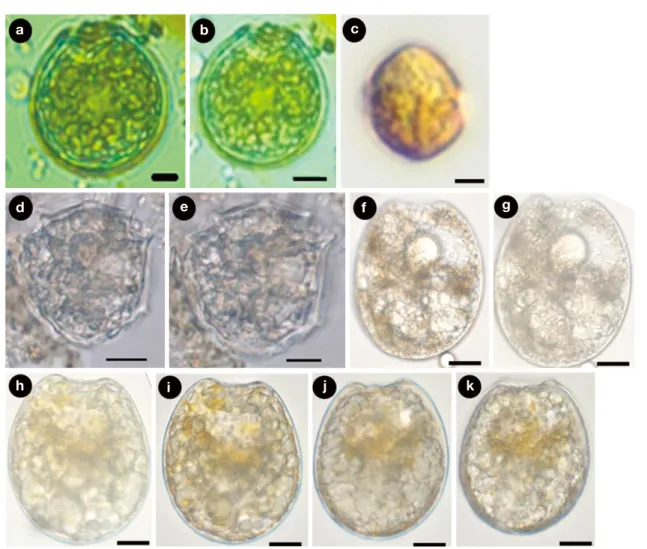
Sinophysis canaliculata Quod, Ten-Hage, Turquet, Mascarell et Couté 1999(Fig. 1a and b)
Synonym: No synonym.
References: Hoppenrath et al. 2014. p. 165. figs. 77A, 78A-C, 79A and B.
Specimen examined: Serial No. LJB2017001.
Description: Cells are almost spherical and compressed.
The relatively large, dome shape epitheca has two parallel anterior projection. The hypotheca is slightly elongated and posteriorly rounded. Cingulum is relatively deep and wide.
Sulcus is present on the right side and covers about two- thirds of the cell length.
Size: 45-57μm long, 37-51μm wide in the apical view.
Sampling: Jan. 2015. Sa-gye beach in Jeju Island(33°13ʹ 53.12ʺ N, 126°18ʹ38.22ʺ E).
Habitat: Marine species.
Distribution: Atlantic Islands: Canary Islands(García- Portela et al. 2017); North America: Mexico(Caribbean) (Almazán-Becerril et al. 2015); South America: Brazil(Di-
niz et al. 2017); Asia: Japan(García-Portela et al. 2017).
Note: This species was reported as an unrecorded indige- nous species by NIBR in 2017 and reported as a newly re- corded species in the coastal waters of Korea in the present study.
Genus Bispinodinium Yamada et Horiguchi 2013 Holotype species: Bispinodium angelaceum Yamada et Horiguchi.
Description: Amphidinium-like athecate photosynthetic dinonflagellate. Cells composed of a short epicone and a large hypocone. The cingulum completely encircling the cell.
(Hoppenrath 2014).
Numbers of names and species: There is only one species or infraspecific name in the database at present, which has been flagged as accepted taxonomically(Guiry and Guiry 2018).
Bispinodinium angelaceum Yamada et Horiguchi 2013 (Fig. 1c)
Synonym: No synonym.
References: Hoppenrath et al. 2014. p. 62, fig. 23.
Specimen examined: Serial No. LJB2015003.
Description: Cells are almost oval and athecate dinofla- gellates. The epicone is triangle and the hypocone is oval.
The ventral and dorsal side is flattened. The cingulum is located at about one-third of the total cell length. The sul- cus is straight, narrow and extends antapex. The nucleus is spherical and is located in the middle of the hypocone.
Chloroplasts exist.
Size: 30-42μm long, 25-33μm wide in the lateral view.
Sampling: Jul. 2015. Hamduk beach in Jeju Island(33°
32ʹ36.11ʺ N, 126°40ʹ4.98ʺ E).
Habitat: Marine species.
Distribution: Japan(Yamada et al. 2013).
Note: This species was reported as an unrecorded indige- nous species by NIBR in 2017 and reported as a newly re- corded species in the coastal waters of Korea in the present study.
Genus Cabra Murray et Patterson 2004 Holotype species: Cabra matta Murray et Patterson.
Description: Medium sized(30-55μm) sand-dwelling dinoflagellates. Cells are strongly compressed and asym-
metric, appearing different from the left as compared to the right side. Heterotrophic thecal plates are more or less pentagonal and irregular in lateral view. The cingulum is markedly ascending(Hoppenrath et al. 2014).
Numbers of names and species: There are 4 species names in the database at present, of which 4 have been flagged as accepted taxonomically(Guiry and Guiry 2018).
Cabra armorica Chomérat, Couté et Nézan 2010(Fig.
1d and e)
Synonym: No synonym.
References: Hoppenrath et al. 2014. p. 74, figs. 29A-C, 30A-F.
Specimen examined: Serial No. LJB2016011.
Description: Cells are polygonal. Thecal plates are areolate
shallowly depressions. The hypotheca is larger than the epi- theca. The plate of hypotheca 2’’’ and 4’’’ makes up 4 multi- discipline shaped cells, separated by ridges. The apical pore is hook shape but extends to the dorsal left side of cells.
Size: 37-40μm long, 31-38μm wide in the lateral view.
Sampling: Jul. 2016. Sinyang beach in Jeju Island(33°
26ʹ6.63ʺ N, 126°55ʹ30.07ʺ E).
Habitat: Marine species.
Distribution: France(Chomérat et al. 2010).
Note: This species was reported as an unrecorded indige- nous species by NIBR in 2017 and reported as a newly re- corded species in the coastal waters of Korea in the present study.
Genus Prorocentrum Ehrenberg 1834
Fig. 1. Light micrographs of the genus Sinophysis, Bispinodinium, Cabra and Prorocentrum. (a), (b) S. canaliculata, lateral view, (c) B. an- gelaceum, ventral view, (d), (e) C. armorica, lateral view, (f), (g) P. bimaculatum, right lateral view, (h), (i) P. tsawwassenense, right lateral view, and (j), (k) P. tsawwassenense, left lateral view(Scale bars: 10μm).
a
d
h i j k
e f g
b c
Table 1. Checklist of genus Sinophysis, Bispinodinium, Cabra and Prorocentrum described from Korean coastal area. The newly recorded species are marked with asterisks(*) and ‘n’ indicates a newly recorded species in Korean waters by Shin(2016), ‘f’ indicates a species recorded only in floristic lists(Lee and Kim 2015). The terms ‘val’ and ‘syn’ refer to a valid name and a synonym, respectively. Species nameShim et al. (1981)Han and Yoo (1983)Yoo and Lee (1986)Shim (1994)Mun et al. (1995)Shin et al. (2005)Shah et al. (2013)Lee and Kim (2015)Han et al. (2016)Shin (2016)Lee and Kim (2017)Present study *Sinophysis canaliculata● *Bispinodinium angelaceum● *Cabra armorica● Prorocentrum aporumf● Prorocentrum arcuatumf● Prorocentrum balticum●●●●●● *Prorocentrum bimaculatum● Prorocentrum clipeus●● Prorocentrum compressum =val. Tryblionella compressa
●●●●● Prorocentrum concavum●●●● Prorocentrum cordatum =syn. Prorocentrum minimum
●●●●●●● Prorocentrum cornutumf● Prorocentrum dactylusf● Prorocentrum dentatum●●●● Prorocentrum emarginatum●● Prorocentrum fukuyoi●● Prorocenturm gracile =syn. Prorocentrum sigmoides
●●●● Prorocentrum hoffmannianumn =syn. Prorocentrum belizeanumn● Prorocentrum koreanum● Prorocentrum leven● Prorocentrum lima●●●●●● Prorocentrum maculosum● Prorocentrum mexicanumf● Prorocentrum micans●●●●●●●●● Prorocentrum nanumf●● Prorocentrum oblongum●● Prorocentrum rhathymum●●● Prorocentrum rostratumf●● Prorocentrum ruetzleranumn● Prorocentrum scutellumf●● Prorocentrum sipadanensis● Prorocentrum triestinum●●●●●●● Prorocentrum tropicale● *Prorocentrum tsawwassenense● No. of species43567862221535
Holotype species: Prorocentrum micans Ehrenberg.
Description: Small to medium sized(15-100μm) bilateral thecate dinoflagellates with 2 apical heterodynamic flagella.
The shape is globular, lanceolate or oval. Thecal plates are composed of two smooth valve-shaped plates with pores or spines. Both flagella emerge from one pore. In the flagellar region are an additional 7-14 small plates(Guiry and Guiry 2018).
Numbers of names and species: There are 119 species names in the database at present, as well as 4 infraspecific names. Of the species names, 75 have been flagged as ac- cepted taxonomically(Guiry and Guiry 2018).
Prorocentrum bimaculatum Chomérat et Saburova 2012(Fig. 1f and g)
Synonym: No synonym.
References: Hoppenrath et al. 2014. p. 135, figs. 62, 64A.
Specimen examined: Serial No. LJB2017010.
Description: Cells are long oval. The surface of the plate is exceptionally smooth with tiny pores. The two cingular ar- eas are located above and below the center without a pore.
The periflagellar area is wide V-shaped with a short collar.
Size: 50-55μm long, 38-43μm wide in lateral view.
Sampling: Apr. 2017. Wangsan beach in Incheon(37°
27ʹ20.97ʺ N, 126°22ʹ17.67ʺ E).
Habitat: Marine species.
Distribution: South-west Asia: Kuwait(Chomérat et al.
2012).
Note: This species was reported as an unrecorded indige- nous species by NIBR in 2017 and reported as a newly re- corded species in the coastal waters of Korea in the present study.
Prorocentrum tsawwassenense Hoppenrath et Leander 2008(Fig. 1h-k)
Synonym: No synonym.
References: Hoppenrath et al. 2014. p. 152, fig. 63.
Specimen examined: Serial No. LJB2017011.
Description: Cells are oval. The surface of thecal plate has large pores as radial row, and the center of the plate is smooth and pores don’t exist. The periflagellar area is wide U-shaped, with collar.
Size: 40-55μm long, 30-48μm wide in lateral view.
Sampling: Apr. 2017. Wangsan beach in Incheon(37°
27ʹ20.97ʺ N, 126°22ʹ17.67ʺ E).
Habitat: Marine species.
Distribution: North America: British Columbia(Hop- penenrath and Leander 2008; Chomérat et al. 2011).
Note: This species was reported as an unrecorded indige- nous species by NIBR in 2017 and reported as a newly re- corded species in the coastal waters of Korea in the present study.
ACKNOWLEDGEMENTS
This study was supported by a grant from the National Institute of Biological Resources(NIBR), funded by the Ministry of Environment(MOE) of the Republic of Korea (NIBR201801205), and by Jeju Sea Grant Center, funded by the Ministry of Ocean and Fisheries(MOF) of the Re- public of Korea.
REFERENCES
Aligizaki K, G Nikolaidis and S Fraga. 2008. Is Gambierdiscus expanding to new areas? Harmful Algae News 36:6-7.
Almazán-Becerril A, S Escobar-Morales, G Rosiles-González and F Valadez. 2015. Benthic-epiphytic dinoflagellates from the northern portion of the Mesoamerican Reef Sys- tem. Bot. Mar. 58:115-128.
Besada EG, LA Loeblich and AR Loeblich III. 1982. Observa- tions on tropical, benthic dinoflagellates from ciguatera-en- demic areas: Coolia, Gambierdiscus, and Ostreopsis. Bull.
Mar. Sci. 32:723-735.
Chomérat N, A Couté and E Nézan. 2010. Further investiga- tions on the sand-dwelling genus Cabra(Dinophyceae, Peridiniales) in South Brittany(northwestern France), including the description of C. armorica sp. nov. Mar. Bio- divers. 40:131-142.
Chomérat N, F Zentz, S Boulben, G Bilien, A van Wormhoudt and E Nézan. 2011. Prorocentrum glenanicum sp. nov. and Prorocentrum pseudopanamense sp. nov.(Prorocemtrales, Dinophyceae), two new benthic dinoflagellate species from south Brittany(northwestern France). Phycologia 50:202- 214.
Chomérat N, M Saburova, G Bilien and F Al-Yamani. 2012.
Prorocentrum bimaculatum sp. nov.(Dinophyceae, Pro- rocentrales), an new benthic dinoflagellate species from Kuwait(Arabian Gulf). J. Phycol. 48:211-221.
Diniz BS, M menezes and SM Nascimento. 2017. Morphology of Sinophysis microcephala and Sinophysis canaliculata (Dinophyceae) from the South Atlantic. Bot. Mar. 60:79- 83.
Faust MA. 1995. Observation of sand-dwelling toxic dinofla- gellates(Dinophyceae) from widely differing sites, includ- ing two new species. J. Phycol. 31:996-1003.
Fukuyo Y. 1981. Taxonomical study on benthic dinoflagellates collected in coral reefs. Bull. Jap. Soc. Sci. Fish. 47:967- 978.
García-Portela M, P Riobó and F Rodríguez. 2017. Morpholog- ical and molecular study of the Cyanobiont-bearing dino- flagellate Sinophysis canaliculata from the Canary Islands (eastern central Atlatic)(Note) J. Phycol. 53:446-450.
Glibert PM, S Seitzinger, CA Heil, JM Burkholder, MW Par- row, LA Codispoti and V Kelly. 2005. The role of eutrophi- cation in the global proliferation of harmful algal blooms.
Oceanography 18:198-209.
Guiry MD and GM Guiry. 2018. AlgaeBase. World-wide elec- tronic publication, National University of Ireland, Galway.
http://www.algaebase.org; assessed on 05 August 2018.
Hallegraeff GM. 1993. A review of harmful algal blooms and their apparent global increase. Phycologia 32:79-99.
Han MS and KI Yoo. 1983a. A taxonomical study on the dino- flagellates in Chinhae Bay Ⅰ: armored and unarmored dino- flagellates. Bull. KORDI 5:37-47(in Korean).
Han MS, PB Wang, JH Kim, SY Cho, BS Park, JH Kim, T Katano and BH Kim. 2016. Morphological and molecu- lar phylogenetic position of Prorocentrum micans sensu stricto and description of Prorocentrum koreanum sp. nov.
from Southern Coastal Waters in Korea and Japan. Protist 167:32-50.
Hoppenrath M, AM Shauna, N Chomérat and T Horiguchi.
2014. Marine Benthic Dinoflagellates-Unveiling Their Worldwide Biodiversity. Vol. 54. Kleine Senckenberg Rei- he, Germany.
Hoppenrath M and BS Leander. 2008. Morphology and molec- ular phylogeny of a new marine sand-dwelling Prorocen- trum species, P. tsawwassenense(Dinophyceae, Prorocen- trales), from British Columbia, Canada. J. Phycol. 44:451- Jeong HJ, AS Lim, SH Jang, WH Yih, NS Kang, SY Lee, YD 466.
Yoo and HS Kim. 2012a. First report of the epiphytic dino- flagellate Gambierdiscus caribaeus in the temperate waters off Jeju Island, Korea: morphology and molecular charac- terization. J. Eukaryot. Microbiol. 59:637-650.
Jeong HJ, W Yih, NS Kang, SY Lee, EY Yoon, YD Yoo, HS Kim and JH Kim. 2012b. First report of the epiphytic ben- thic dinoflagellates Coolia canariensis and Coolia malay-
ensis in the waters off Jeju Island, Korea: Morphology and rDNA Sequences. J. Eukaryot. Microbiol. 59:114-133.
Kang NS, HJ Jeong, SY Lee, AS Lim, MJ Lee, HS Kim and WH Yih. 2013. Morphology and molecular characteriza- tion of the epiphytic benthic dinoflagellate Ostreopsis cf.
ovata in the temperate waters off Jeju Island, Korea. Harm- ful Algae 27:98-112.
Kim HS, WH Yih, JH Kim, G Myung and HJ Jeong. 2011.
Abundance of epiphytic dinoflagellates from coastal waters off Jeju Island, Korea during autumn 2009. Ocean Sci. J.
46:205-209.
Kim HS, SH Kim, MM Jung and JB Lee. 2013. New record of dinoflagellates around Jeju Island. J. Ecol. Environ.
36:273-291.
Lee JB and HS Kim. 2015. National List of Species of Korea -Flagellates. National Institute of Biological Resources, Ministry of Environment, Korea(in Korean).
Lee JB and KB Kim. 2017. New records of two genera Meso- poros and Prorocentrum(Prorocentraceae, Prorocentrales, Dinophyceae) in Korean Waters. Korean J. Environ. Biol.
35:265-272.
Lim AS, HJ Jeong, TY Jang, NS Kang, SY Lee, YD Yoo and HS Kim. 2013. Morphology and molecular characteriza- tion of the epiphytic dinoflagellate Prorocentrum cf. rha- thymum in temperate waters off Jeju Island, Korea. Ocean Sci. J. 48:1-17.
Mohammad-Noor N, N Daugbjerg, O Moestrup and A Anton.
2007. Marine epibenthic dinoflagellates from Malaysia: A study of live cultures and preserved samples based on light and scanning electron microscopy. Nordic J. Bot. 24:629- 690.
Morton SL and MA Faust. 1997. Survey of toxic epiphytic dinoflagellates from the Belizean Barrier Reef Ecosystem.
Bull. Mar. Sci. 61:899-906.
Mun SG, SG Lee and CG Hong. 1995. A study of the genus Prorocentrum. J. Environ. Sci. Int. 4:105-116(in Korean).
Pistocchi R, L Pezzolesi, F Guerrini, S Vanucci, C Dell’Aver- sano and E Fattorusso. 2011. A review on the effects of environmental conditions on growth and toxin production of Ostreopsis ovata. Toxicon 57:421-428.
Selina MS and EV Levchenko. 2011. Species composition and morphology of dinoflagellates(Dinophyta) of epiphytic assemblages of Peter the Great Bay in the Sea of Japan.
Russ. J. Mar. Biol. 37:23-32.
Shah MMR, SJ An and JB Lee. 2013. Presence of benthic di- noflagellates around coastal waters of Jeju Island including newly recorded species. J. Ecol. Environ. 36:347-370.
Shim JH. 1994. Illustrated Encyclopedia of Fauna and Flora of Korea Vol. 34 Marine Phytoplankton. Ministry of Educa-
tion, Korea(in Korean).
Shim JH, EY Shin and JK Choi. 1981. A taxonomical study on the dinoflagellates of the coastal waters in the vicinity of Yeosu, Korea. J. Oceanol. Soc. Korea 16:57-98(in Kore- Shin EY. 2016. Dinoflagellates. In: Protists of Korea Vol. 1an).
(Choi JK ed.), The Korean Society of Protistologist, Gun- san. pp. 71-518(in Korean).
Shin EY, HG Yeo and JG Park. 2005. Morphological re-ex- am-ination of Prorocentrum spp. in Korean coastal waters.
Korean. J. Environ. Biol. 23:184-190.
Yamada N, R Terada, A Tanaka and T Horiguchi. 2013.
Bispinodinium angelaceum gen. et sp. nov.(Dinophyceae), a new sand-dwelling dinoflagellate from the seafloor off Mageshima Island, Japan. J. Phycol. 49:555-569.
Received: 22 August 2018 Revised: 7 September 2018 Revision accepted: 7 September 2018