Su-Min Kang and Joon-Baek Lee
260Korean J. Environ. Biol. 36(3) : 260~270(2018) https://doi.org/10.11626/KJEB.2018.36.3.260
INTRODUCTION
Jeju Island has experienced a peculiar change of marine ecosystem due to climate changes by global warming over last two decades, which include increasing seawater tem- perature and expansion of the high salinity and high tem- perature Kuroshio Current (Yeh and Kim 2010; Kang et al.
2012). Dinoflagellates are a major group of phytoplankton community and are composed of various species in terms of habitat and nutrition type. They also contribute to primary production in oceans and distribute from tropical to artic sea in many waters world-wide (Dodge 1982). A total of 153 planktonic dinoflagellates from Korean waters have been described by Shim et al. (1981), Han and Yoo (1983a, b), Yoo and Lee (1986), Lee et al. (1993), and Shim (1994).
During the last decade, more than 170 planktonic and ben- thic dinoflagellates have been added to a checklist of dino-
flagellates by several researchers in Korea (Kim et al. 2013;
Shah et al. 2013; Lee et al. 2014). Since 394 dinoflagellates were listed as recorded species in Korean waters (Lee and Kim 2015), Lee et al. (2015) reported newly 19 species be- longing to genera Dinophysis, Histoneis, and Parahistioneis in Korean waters. Lee and Kim (2017a) added 4 unrecorded Prorocentroid dinoflagellates, and Lee and Kim (2017b) 16 unrecorded species including of five unarmored genera.
Lee and Kang (2017) reported 5 unrecorded species and re-described 8 species belonging to family Diplopsaliaceae, Heterocapsaceae, Kolkwitziellaceae, Protoperidiniaceae and Thoracosphaeraceae. However, there were few recent taxonomic studies on planktonic dinoflagellates except Shin (2016). The objectives of this study were to check the list and to describe some newly recorded species, focusing on the genera of family Dinophysaceae, Gonyaulacaceae, Gymnodiniaceae and Heterocapsaceae.
* Corresponding author: Joon-Baek Lee, Tel. 064-754-3435, Fax. 064-725-2461, E-mail. [email protected]
ⓒ2018. Korean Society of Environmental Biology.
New Records of Genus Dinophysis, Gonyaulax, Amphidinium, Heterocapsa (Dinophyceae) from Korean Waters
Su-Min Kang and Joon-Baek Lee*
Department of Earth and Marine Sciences, College of Ocean Sciences, Jeju National University, Jeju 63243, Republic of Korea
Abstract - A study describing unrecorded and taxonomically undescribed indigenous species is in progress since 2006. Samples were collected from many sites in coastal waters and offshore of Korea as well as from Jeju Island. Since 2008, we have found ten unrecorded species of four genera belonging to family Dinophysaceae, Gonyaulacaceae, Gymnodiniaceae, and Heterocapsaceae.
The species are as follows, Dinophysis elongata (2016 winter), D. nasuta (2016 winter), Gonyaulax alaskensis (2016 winter), G. diegensis (2017), G. monospina (2008), Amphidinium flagellans (2017), Heterocapsa circularisquama (2017), H. horiguchii (2017), H. lanceolata (2017), and H. pygmaea (2017) (note; The numbers in the parenthesis refer to the year in which the species was reported as unrecorded indigenous species by National Institute of Biological Resources, NIBR hereafter).
Among them, seven species were described as newly recorded species in Korean waters, and three have been re-described in this study.
Keywords : Amphidinium, Dinophysis, Gonyaulax, Heterocapsa, new record species
<Original article>
MATERIALS AND METHODS
Samplings were done at coastal waters and offshore in Korea as well as around Jeju Island from September 2008 to August 2017. Plankton samples were obtained by using a 20 μm mesh size plankton net and fixed with formaldehyde (final concentration of 1%). Planktonic dinoflagellates were identified by using LM (Axioplan, Carl Zeiss, Oberkochen, Germany). To make slide specimens for one species, the dinoflagellate samples were washed with distilled water and then the method described in Kim et al. (2013) was followed. To allow for more detailed observations, dinofla- gellate cells were isolated with a micropipette, placed on a cover slip, air-dried and gold-coated, and finally observed with a field emission scanning electron microscope (JSM- 6700F, JEOL, Tokyo, Japan).
For the species identification, several monographs that were reported from different oceans such as the British and Atlantic Ocean (Dodge 1982), Korean waters (Shim 1994) and Western Pacific (Omura 2012) were used. A dinoflagel- late classification for the new combinations of the family Dinophysaceae, Gonyaulacaceae, Gymnodiniaceae, and Heterocapsaceae was cited from AlgaeBase (http://www.
algaebase.org) (Guiry and Guiry 2018).
RESULTS AND DISCUSSION
A total of 77 species of four genera (Dinophysis, Gon- yaulax, Amphidinium and Heterocapsa) belonging to the family Dinophysaceae, Gonyaulacaceae, Gymnodiniaceae and Heterocapsaceae were identified from Korean waters and classified in the checklist based on valid name as be- low. Among them seven species were described as newly recorded species in Korean waters and three were re-de- scribed. The newly recorded and the re-described species are marked with asterisks (*) and sharps (#), respectively.
‘C’ indicates a currently accepted name, ‘S’ a synonym, ‘U’
uncertain taxonomic name, ‘P’ preliminary based on the species database of AlgaeBase (Guiry and Guiry 2018), re- spectively.
Checklist of the genus Dinophysis, Gonyaulax, Amphi- dinium and Heterocapsa occurred in Korea Waters
Class Dinophyceae West et Fritsch Order Dinophysiales Kofoid
Family Dinophysaceae Bütschli Genus Dinophysis Ehrenberg
Dinophysis acuminata Claparéde et Lachmann C Dinophysis acuta Ehrenberg C
= Dinophysis dens Pavillard S Dinophysis argus (Stein) Abé C Dinophysis caudata Kent C
Dinophysis contracta (Kofoid et Skogsberg) Balech C
*Dinophysis elongata (Jörgensen) Abé C Dinophysis exigua Kofoid et Skogsberg C Dinophysis fortii Pavillard C
= Dinophysis lapidistrigiliformis Abé S Dinophysis hastata Stein C
Dinophysis infundibulum Schiller C Dinophysis irregularis (Lebour) Balech C Dinophysis joergensenii Kofoid et Skogsberg C Dinophysis laevis Claparéde et Lachmann C Dinophysis micropterygia Dangeard C Dinophysis miles Cleve C
*Dinophysis nasuta (Stein) Parke et Dixon C Dinophysis norvegica Claparéde et Lachmann C Dinophysis ovum Schütt C
Dinophysis parvula (Schütt) Balech C Dinophysis punctata Jörgensen C
Dinophysis recurva Kofoid et Skogsberg C Dinophysis rudgei Murray et Whitting C Dinophysis schroederi Pavillard C Dinophysis schuettii Murray et Whitting C Dinophysis similis Kofoid et Skogsberg C Dinophysis tripos Gourret C
Order Gonyaulacales F.J.R.Taylor Family Gonyaulacaceae Lindemann
Genus Gonyaulax Diesing
#
Gonyaulax alaskensis Kofoid C Gonyaulax brevisulcatum Dangeard C Gonyaulax bruunii Taylor C
#
Gonyaulax diegensis Kofoid C
Gonyaulax digitale (Pouchet) Kofoid C
Gonyaulax fragilis (Schütt) Kofoid C
Gonyaulax hyalina Ostenfeld et Schmidt C
Gonyaulax lebouriae Balech C
Gonyaulax macroporus Mangin C Gonyaulax monacantha Pavillard C
#
Gonyaulax monospina Rampi C Gonyaulax orientalis Lindemann C
Gonyaulax pavillardii Kofoid et Michener C Gonyaulax polygramma Stein C
Gonyaulax scrippsae Kofoid C
Gonyaulax spinifera (Claparéde et Lachmann) Diesing C
= Gonyaulax apiculata Entz S
= Gonyaulax buxus Balech S
= Gonyaulax levanderi (Lemmermann) Paulsen S Gonyaulax striata Mangin C
Gonyaulax turbynei Murray et Whitting C Gonyaulax verior Sournia C
Order Gymnodiniales Apstein Family Gymnodiniaceae Lankester
Genus Amphidinium Claparéde et Lachmann Amphidinium acutissimum Schiller C Amphidinium carterae Hulburt C
Amphidinium corpulentum Kofoid et Swezy C Amphidinium crassum Lohmann C
*Amphidinium flagellans Schiller C Amphidinium flexum Herdman C Amphidinium fusiforme Martin P
Amphidinium gibbosum (Maranda et Shimizu) Jør- gensen et Murray C
Amphidinium globosum Schröder C Amphidinium herdmanii Kofoid et Swezy C Amphidinium incoloratum Campbell C Amphidinium inflatum Kofoid C Amphidinium kesslitzii Schiller C Amphidinium longum Lohmann C Amphidinium massartii Biecheler C
Amphidinium mootonorum Murray et Patterson C Amphidinium operculatum Claparéde et Lachmann C Amphidinium ovum Herdman C
Amphidinium scissum Kofoid et Swezy C Amphidinium steinii (Lemmermann) Kofoid et Swezy C
Amphidinium stigmatum Schiller C
Amphidinium thermaeum Dolapsakies et Econo- mou-Amilli U
Amphidinium trulla Murray, Rhodes et Jørgensen C Order Peridiniales Haeckel
Family Heterocapsaceae Fensome, Taylor, Norris, Sar- jeant, Wharton et Williams
Genus Heterocapsa Stein
*Hetrocapsa circularisquama Horiguchi C
* Hetrocapsa horiguchii Iwataki, Takayama et Mat- suoka C
*Hetrocapsa lanceolata Iwataki et Fukuyo C Heterocapsa ovata Iwataki et Fukuyo C
Heterocapsa psammophila Tamura, Iwataki et Hori- guchi C
Heterocapsa pseudotriquetra Iwataki, Hansen et Fukuyo C
* Heterocpasa pygmaea Lobelich Ⅲ, Schmidt et Sher- ley C
Heterocapsa rotundata (Lohmann) Hansen C Heterocapsa triquetra (Ehrenberg) Stein C
Taxonomic description of unrecorded dinoflagellates Genus Dinophysis Ehrenberg 1839
Holotype species: Dinophysis acuta Ehrenberg.
Description: Small to medium sized (25-100 μm) laterally more or less compressed dinoflagellate. The cells is cellu- losic thecal plates. Two large prominent hypothecal and ep- ithecal plates joined by a serrated sagittal dorsal suture. The cingulum is located very much anteriorly. The right sulcal list is part of the right hypothecal plate and has one or two rids. Nucleus is spherical or ovoid (Guiry and Guiry 2018).
Numbers of names and species: There are 230 species names in the database at present, as well as 58 infraspecific names. Of the species names, 122 have been flagged as cur- rently accepted taxonomically (Guiry and Guiry 2018).
Dinophysis elongata (Jörgensen) Abé 1967
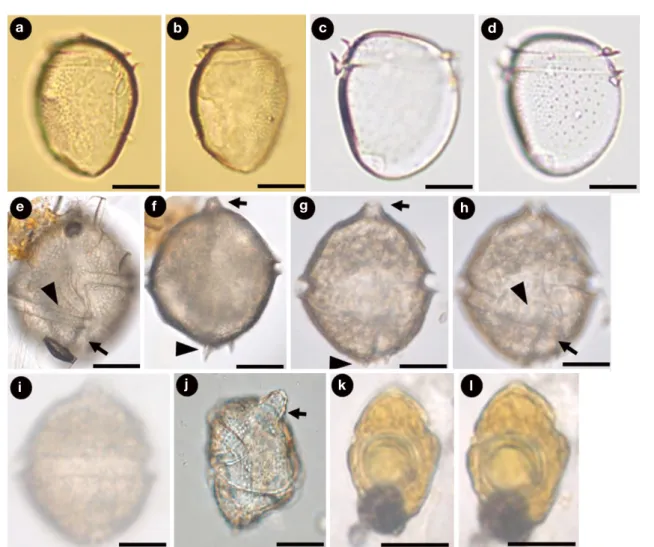
(Fig. 1a and b)
Basionym: Phalacroma elongatum Jörgensen
Homotypic synonym: Phalacroma elongatum Jörgensen References: Omura et al. 2012, p. 61.
Specimen examined: Serial No. LJB2016001 (winter) / NIBR No. NIBRDN0000000415.
Description: Cells are almost oval. Epitheca is smaller
than the hypotheca and is hemispherical, and the cingulum groove protrudes upward. The hypotheca is large and cone shape, and has no spines. The sulcus list takes up about two-thirds of the hypotheca and has three ribs.
Size: 50-55 μm long, 35-37.5 μm wide in the ventral view.
Sampling: Dec. 2016. Geoje coast (Yeocha Mongdol) in Korea (34°42ʹ47.03ʺN, 128°37ʹ38.81ʺE).
Habitat: Marine species.
Distribution: Europe: Britain (Parke and Dixon 1976).
Note: This species was reported as an unrecorded indige- nous species by NIBR in 2016 and reported as a newly re- corded species in the coastal waters of Korea in the present study.
Dinophysis nasuta (Stein) Parke et Dixon 1968 (Fig. 1c and d)
Basionym: Phalacroma nasutum Stein.
Homotypic synonym: Phalacroma nasutum Stein 1883;
Pseudophalacroma nasutum (Stein) Jørgensen 1923.
Heterotypic Synonym: Prodinophysis nasutum Loeblich 1965.
References: Dodge 1982, pp. 51-52, fig. 4G.
Specimen examined: Serial No. LJB2016002 (winter) / NIBR No. NIBRDN0000000416.
Description: Cells are hemispherical. The epitheca is not obscured by the cingular lists. Characteristically, the sulcus extends to about two-thirds of the distance from cingulum
a b c d
e f g h
i j k l
Fig. 1. Light micrographs of the genus Dinophysis, Gonyaulax, and Amphidinium. (a),(b) D. elongata, lateral view,(c),(d) D. nasuta, lateral view,(e) G. alaskensis, ventral view, arrowhead; cingulum, arrow; sulcus,(f) G. alaskensis, ventral view, arrowhead; spines, arrow;
apical horn,(g) G. diegensis, ventral view, arrowhead; spines, arrow; apical horn,(h) G. diegensis, ventral view, arrowhead; cingulum, arrow; sulcus,(i) G. diegensis, dorsal view,(j) G. monospina, lateral view, arrow; apical horn, and(k),(l) A. flagellans, ventral view (Scale bars, a-i: 20μm; j-l: 10μm).
to apex. The hypotheca is large and has not any spines. The sulcus list is narrow, unobtrusive and has not a clear ribs.
Size: 43-49 μm long, 38-43 μm wide in the ventral view.
Sampling: Dec. 2016. Geoje coast (Yeocha Mongdol) in Korea (34°42ʹ47.03ʺN, 128°37ʹ38.81ʺE).
Habitat: Marine species.
Distribution: Europe: Mediterranean (Gómez 2003); Brit- ain (Parke and Dixon 1976; Dodge 1982).
Note: This species was reported as an unrecorded indige- nous species by NIBR in 2016 and reported as a newly re- corded species in the coastal waters of Korea in the present study.
Genus Gonyaulax Diesing 1866
Holotype species: Gonyaulax spinifera (Claparéde et Lach- mann) Diesing.
Description: Small to large sized (25-175 μm) dinoflagel- late of circular shape. The cells show asymmetry due to torsion. Hypotheca plates have few to several spines. The cingulum starts median ventrally, turning to the left in a descending spiral, making more than one loop. The sulcus starts cingulum mid-ventrally. Chloroplast exists. Nucleus is U-shaped (Guiry and Guiry 2018).
Numbers of names and species: There are 122 species names in the database at present, as well as 7 infraspecific names. Of the species names, 75 have been flagged as cur- rently accepted taxonomically (Guiry and Guiry 2018).
Gonyaulax alaskensis Kofoid 1911 (Fig. 1e and f) Synonym: No synonym.
References: Dodge 1982, pp. 207-208, fig. 25K; Omura et al. 2012, p. 104.
Specimen examined: Serial No. LJB2016003 (winter) / NIBR No. NIBRDN0000000417.
Description: Cells are almost spherical. Epitheca has short apical horn. Hypotheca has two sulcal list spine and is an- tapex flattened. Thecal plates are randomly reticulate except along either side of cingulum. Cingulum is much higher on one side and is obliquely present. Cells has chloroplast.
Size: 65-75 μm long and wide in the ventral view.
Sampling: July 2015. Chagwi-do coast in Jeju Island (33°19.02ʹN, 126°08.03ʹE).
Habitat: Marine species.
Distribution: Europe: Portugal (Moita and Vilarinho 1999);
New Zealand (Taylor 1974).
Note: This species was reported as an unrecorded indig- enous species by Shin (2016) and reported as a newly re- corded species in the coastal waters of Korea in the present study.
Gonyaulax diegensis Kofoid 1911 (Fig. 1g-i) Synonym: No synonym.
References: Dodge 1982, p. 208, fig. 26G; Omura et al.
2012, p. 105.
Specimen examined: Serial No. LJB2017002.
Description: Cells are almost spherical. Epitheca has short apical horn and is convex along it. Thecal plates are thick and have reticulations. Hypotheca is round and has two to four very short spines. Cingulum is located in the middle and no list exists. Sulcus is sinuous.
Size: 56-100 μm long, 50-82 μm wide in the ventral view.
Sampling: May 2016. Geomundo coast in Korea (34°1ʹ 25.46ʺ N, 127°18ʹ30.37ʺ E).
Habitat: Marine species.
Distribution: Europe: Black Sea (Goméz and Boicenco 2004), Britain (Dodge 1982), Helgoland (Hoppenrath 2004), Mediterranean (Gómez 2003); Asia: China (Liu 2008).
Note: This species was reported as an unrecorded indig- enous species by Shin (2016) and reported as a newly re- corded species in the coastal waters of Korea in the present study.
Gonyaulax monospina Rampi 1952 (Fig. 1j) Synonym: No synonym.
References: Naik 2010, p. 33, fig. 2.10 (a).
Specimen examined: Serial No. LJB2008010.
Description: The upper part of epitheca has a cone. Hy- potheca is round as a whole and has a small cone at the bot- tom. The cingulum and sulcus meet and cross each other in Z-shape.
Size: 33 μm long, 27 μm wide in the ventral view.
Sampling: Sep. 2008. Yellow Sea (35°00ʹN, 125°40ʹE).
Habitat: Marine species.
Distribution: Europe: Black Sea (Goméz and Boicenco 2004), Mediterranean (Gómez 2003), Portugal (Moita and Vilarinho 1999).
Note: This species was reported as an unrecorded indig-
enous species by Shin (2016) and reported as a newly re-
corded species in the coastal waters of Korea in the present study.
Genus Amphidinium Claparéde et Lachmann 1859 Holotype species: Amphidinium operculatum Claparéde et Lachmann.
Description: Small to large (10-100 μm) unarmored di- noflagellates. Cells were globular to fusiform, laterally or dorsoventrally compressed. Cingulum circular or little dis- placed. Sulcus extends from cingulum to antapex. Epicone is small and hypcone is large, as the cingulum is located in the anterior part of the cell. Chloroplasts were present or absent (Guiry and Guiry 2018).
Numbers of names and species: There are 192 species names in the database at present, as well as 12 infraspecific names. Of the species names, 113 have been flagged as ac- cepted taxonomically (Guiry and Guiry 2018).
Amphidinium flagellans Schiller 1928 (Fig. 1k and l) Synonym: No synonym.
References: Omura et al. 2012, p. 71.
Specimen examined: Serial No. LJB2017003.
Description: Cell is thick in the middle, narrow fusiform and not flat. The epicone almost conical and has a sharp end. The hypocone is round, but it also has a sharp end. The cingulum is deep and board. The sulcus is narrow at epi- cone, wide at hypocone and sharply end.
Size: 20-25 μm long, 8-9 μm wide in the ventral view.
Sampling: May 2017. Seongsan (Tongbatal) in Jeju Island (33°27ʹ10.95ʺ N, 126°55ʹ5.09ʺ E).
Habitat: Marine species.
Distribution: Europe: Black Sea (Goméz and Boicenco 2004), Mediterranean (Goméz 2003); North America: Mex- ico (Escobar-Morales and Hernández-Becerril 2015).
Note: This species was reported as an unrecorded indige- nous species by NIBR in 2017 and reported as a newly re- corded species in the coastal waters of Korea in the present study.
Genus Heterocapsa Stein 1883
Holotype species: Heterocapsa triquetra (Ehrenberg) Stein Description: Medium-sized (20-40 μm) biflagellated the- cate dinoflagellates, irregularly spindle shaped or ovoid with a medium and circular cingulum, sulcus restricted to
a d
e f g h
b c
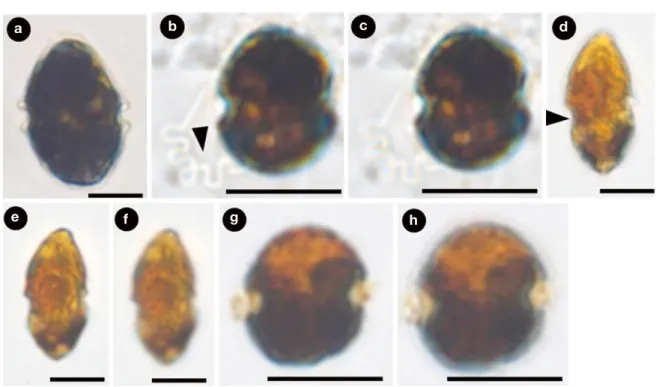
Fig. 2. Light micrographs of the genus Heterocapsa.(a) H. circularisquama, lateral view,(b),(c) H. horiguchii, lateral view, arrowhead; fla- gellum,(d) H. lanceolata, lateral view, arrowhead; cingulum,(e),(f) H. lanceolata, lateral view, and(g),(h) H. pygmaea, ventral view (Scale bars, a-h: 10 μm).
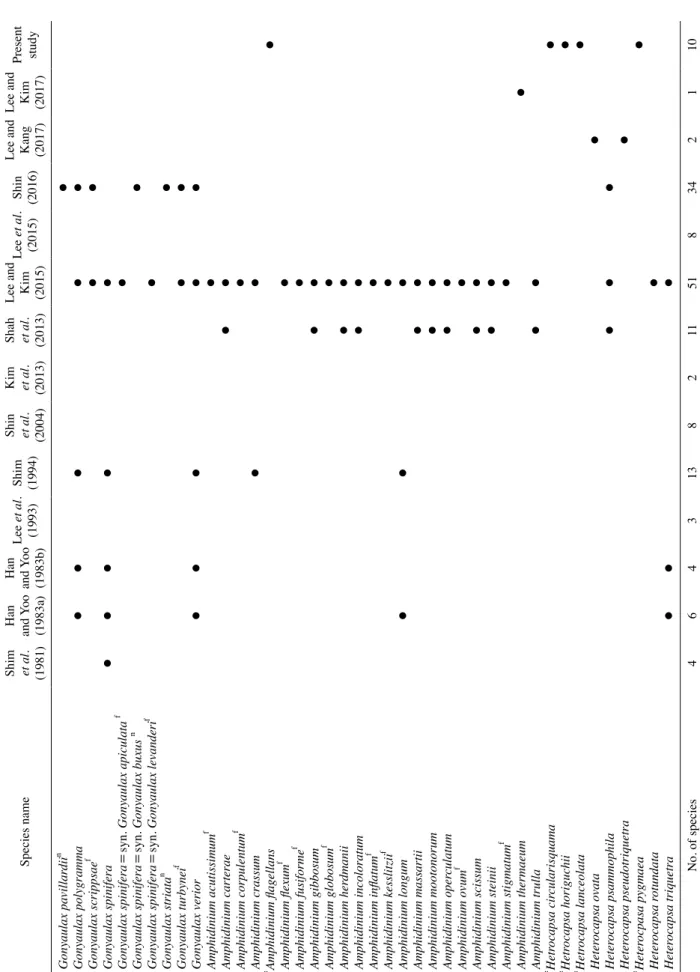
Table 1. Checklist of genus Dinophysis, Gonyaulax, Amphidinium, and Heterocapsa described from Korean waters(The newly recorded and the re-described species are marked with asterisks(*) and sharps(#), respectively, and ‘n’ indicates a newly recorded species in Korean waters by Shin(2016), ‘f’ indicates a species recorded only in floristic list(Lee and Kim 2015) and ‘syn’ refers to the synonym, respectively). Species name
Shim et al. (1981)
Han and Yoo (1983a)
Han and Yoo (1983b)Lee et al. (1993)
Shim (1994)
Shin et al. (2004)
Kim et al. (2013)
Shah et al. (2013)
Lee and Kim (2015) Lee et al. (2015) Shin (2016) Lee and Kang (2017) Lee and Kim (2017) Present study
Dinophysis acuminata ●●●●●● Dinophysis acutaf ●● Dinophysis acuta=syn. Dinophysis dens●●● Dinophysis argusn ● Dinophysis caudata●●●●● Dinophysis contractan ●
* Dinophysis elongata
● Dinophysis exiguan ● Dinophysis fortii●●●●● Dinophysis fortii=syn. Dinophysis lapidistrigiliformis●● Dinophysis hastata●● Dinophysis infundibulum●●●● Dinophysis irregularis●●● Dinophysis joergenseniif ● Dinophysis laevis●● Dinophysis micropterygia● Dinophysis miles●
* Dinophysis nasuta
● Dinophysis norvegica● Dinophysis ovum●●●● Dinophysis parvula●●●● Dinophysis punctata● Dinophysis recurva●●● Dinophysis rudgei●● Dinophysis schroederin ● Dinophysis schuettii●●● Dinophysis similis n ● Dinophysis tripos●●● #Gonyaulax alaskensisn ●● Gonyaulax brevisulcataumn ● Gonyaulax bruuniin ● #Gonyaulax diegensisn ●● Gonyaulax digitale●●● Gonyaulax fragilisn ● Gonyaulax hyalinen ● Gonyaulax lebouriaef ● Gonyaulax macroporusn ● Gonyaulax monacantha●●● #Gonyaulax monospinan ●● Gonyaulax orientalisf ●
Table 1. Checklist of genus Dinophysis, Gonyaulax, Amphidinium, and Heterocapsa described from Korean waters(The newly recorded and the re-described species are marked with asterisks(*) and sharps(#), respectively, and ‘n’ indicates a newly recorded species in Korean waters by Shin(2016), ‘f’ indicates a species recorded only in floristic list(Lee and Kim 2015) and ‘syn’ refers to the synonym, respectively). Species name
Shim et al. (1981)
Han and Yoo (1983a)
Han and Yoo (1983b)Lee et al. (1993)
Shim (1994)
Shin et al. (2004)
Kim et al. (2013)
Shah et al. (2013)
Lee and Kim (2015) Lee et al. (2015) Shin (2016) Lee and Kang (2017) Lee and Kim (2017) Present study
Gonyaulax pavillardiin ● Gonyaulax polygramma●●●●● Gonyaulax scrippsaef ●● Gonyaulax spinifera●●●●● Gonyaulax spinifera=syn. Gonyaulax apiculata f ● Gonyaulax spinifera=syn. Gonyaulax buxus n ● Gonyaulax spinifera=syn. Gonyaulax levanderif ● Gonyaulax striatan ● Gonyaulax turbyneif ●● Gonyaulax verior●●●●● Amphidinium acutissimumf ● Amphidinium carterae ●● Amphidinium corpulentumf ● Amphidinium crassum ●●
* Amphidinium flagellans
● Amphidinium flexumf ● Amphidinium fusiformef ● Amphidinium gibbosum●● Amphidinium globosumf ● Amphidinium herdmanii●● Amphidinium incoloratum●● Amphidinium inflatumf ● Amphidinium kesslitziif ● Amphidinium longum●●● Amphidinium massartii●● Amphidinium mootonorum●● Amphidinium operculatum●● Amphidinium ovumf ● Amphidinium scissum ●● Amphidinium steinii●● Amphidinium stigmatumf ● Amphidinium thermaeum● Amphidinium trulla●●
* Hetr
ocapsa circularisquama●
* Hetr
ocapsa horiguchii●
* Hetr ocapsa lanceolata● Heterocapsa ovata● Heterocapsa psammophila●●● Heterocapsa pseudotriquetra●
* Heter
ocpasa pygmaea● Heterocapsa rotundata● Heterocapsa triquetra●●● No. of species4643138211518342110
Table 1. Continued.
the hypocone. The plate pattern is difficult to establish and has been disputed. Numerous chloroplasts and an ovoid nucleus. Marine plankton, worldwide distribution mainly in coastal waters (Guiry and Guiry 2018).
Numbers of names and species: There are 22 species names in the database at present, as well as 3 infraspecific names. Of the species names, 19 have been flagged as cur- rently accepted taxonomically (Guiry and Guiry 2018).
Heterocapsa circularisquama Horiguchi 1995 (Fig. 2a) Synonym: No synonym.
References: Horiguchi 1995, p. 130, figs. 1-11; Iwataki 2008, p. 139, figs. 3-4; Omura et al. 2012, p. 130.
Specimen examined: Serial No. LJB2017006.
Description: Cells are entirely elliptical. The epitheca is al- most equal to the hypotheca. The epitheca is in cone shape and the hypotheca is in round form. Cingulum is relatively wide, and sulcus is narrow and almost to the antapex. Chlo- roplasts present.
Size: 20-25 μm long, 13-20 μm wide in lateral view.
Sampling: Jun. 2017. Jeju coast (Geonip-dong) in Jeju Is- land (33°12ʹ39.026ʺ N, 126°35ʹ1.750ʺ E).
Habitat: Marine species.
Distribution: Japan (Iwataki et al. 2004).
Note: This species was reported as an unrecorded indige- nous species by NIBR in 2017 and reported as a newly re- corded species in the coastal waters of Korea in the present study.
Heterocapsa horiguchii Iwataki, Takayama et Matsuo- ka 2002 (Fig. 2b and c)
Synonym: No synonym.
References: Iwataki 2008, p. 139, figs. 3-4; Omura et al.
2012, p. 130.
Specimen examined: Serial No. LJB2017007.
Description: Cells are oval. The epitheca and hypotheca are about the same size and are in the hemisphere. Cingu- lum is central and relatively wide. Sulcus is wide and al- most reached antapex.
Size: 13-21 μm long, 10-15 μm wide in lateral view.
Sampling: Aug. 2017. Seogwipo coast in Jeju Island (33°19ʹ23.387ʺ N, 126°51ʹ59.928ʺ E).
Habitat: Marine species.
Distribution: Japan (Iwataki et al. 2004).
Note: This species was reported as an unrecorded indige- nous species by NIBR in 2017 and reported as a newly re- corded species in the coastal waters of Korea in the present study.
Heterocapsa lanceolata Iwataki et Fukuyo 2002
(Fig. 2d-f)
Synonym: No synonym.
References: Iwataki 2008, p. 139, figs. 3-4; Omura et al.
2012, p. 130.
Specimen examined: Serial No. LJB2017008.
Description: Cells have the shape of spear. The epitheca is greater than the hypotheca, and both cone. Cingulum is rel- atively wide. In the case of thecal plates, it is relatively thin.
Size: 22-25 μm long, 10-15 μm wide in lateral view.
Sampling: Aug. 2017. Seogwipo coast in Jeju Island (33°19ʹ423.387ʺ N, 126°51ʹ59.929ʺ E)
Habitat: Marine species.
Distribution: Europe: Mediterranean (Gómez 2003); Asia:
Japan (Iwataki et al. 2004).
Note: This species was reported as an unrecorded indige- nous species by NIBR in 2017 and reported as a newly re- corded species in the coastal waters of Korea in the present study.
Heterocapsa pygmaea Lobelich Ⅲ, Schmidt et Sherley 1981 (Fig. 2g and h)
Synonym: No synonym.
References: Iwataki 2008, p. 139, figs. 3-4; Omura et al.
2012, p. 130.
Specimen examined: Serial No. LJB2017009.
Description: Cells are oval. The epitheca is almost equal to the hypotheca and hypotheca is round. Cingulum is rel- atively wide and slightly up on the left. Sulcus is relative wide
Size: 22-25 μm long, 10-15 μm wide in lateral view.
Sampling: Aug. 2017. Tongbatal in Jeju Island (33°37ʹ 10.95ʺ N, 126°55ʹ5.09ʺ E).
Habitat: Marine species.
Distribution: Japan (Iwataki et al. 2004).
Note: This species was reported as an unrecorded indige-
nous species by NIBR in 2017 and reported as a newly re-
corded species in the coastal waters of Korea in the present
study.
ACKNOWLEDGEMENTS
This study was supported by a grant from the National Institute of Biological Resources (NIBR), funded by the Ministry of Environment (MOE) of the Republic of Korea (NIBR201801205), and by Jeju Sea Grant Center, funded by the Ministry of Ocean and Fisheries (MOF) of the Re- public of Korea.
REFERENCES
Dodge JD. 1982. Marine Dinoflagellates of the British Isles.
Her Majesty’s Stationary Office, London.
Escobar-Morales S and DU Hernández-Becerril. 2015.
Free-living marine planktonic unarmoured dinoflagellates from the Gulf of Mexico and the Mexican Pacific. Bot.
Mar. 58:9-22.
Goméz F. 2003. Checklist of Mediterranean free-living dinofla- gellates. Bot. Mar. 46:215-242.
Goméz F and L Boicenco. 2004. An annotated checklist of di- noflagellates in the Black Sea. Hydrobiologia 517:43-59.
Guiry MD and GM Guiry. 2018. AlgaeBase. World-wide elec- tronic publication, National University of Ireland, Galway.
http://www.algaebase.org; assessed on 05 August 2018.
Han MS and KI Yoo. 1983a. A taxonomical study on the dino- flagellates in Chinhae Bay Ⅰ: armored and unarmored dino- flagellates. Bull. KORDI 5:37-47(in Korean).
Han MS and KI Yoo. 1983b. A taxonomical study on the dino- flagellates in Chinhae Bay Ⅱ: Peridiniales. Bull. KORDI 5:49-67(in Korean).
Hoppenrath M. 2004. A revised checklist of planktonic diatoms and dinoflagellates from Helgoland(North Sea, German Bight). Helgoland Mar. Res. 58:243-251.
Horiguchi T. 1995. Heterocapsa circularisquama sp. nov.
(Peridiniales, Dinophyceae): A new marine dinoflagellate causing mass mortality of bivalves in Japan. Phycol. Res.
43:129-136.
Iwataki M. 2008. Taxonomy and identification of the armored dinoflagellate genus Heterocapsa(Peridiniales, Dinophyce- ae). Plankton Benthos Res. 3:135-142.
Iwataki M, G Hansen, T Sawaguchi, S Hiroishi and Y Fukuyo.
2004. Investigations of body scales in twelve Heterocapsa species(Peridiniales, Dinophyceae), including a new spe- cies H. pseudotroquetra sp. nov. Phycologia 43:394-403.
Kang SK, S Jung, Y Zuenko, I Choi and N Dolganova. 2012.
Regional differences in the response of mesozooplankton to oceanographic regime shifts in the northeast Asian mar-
ginal seas. Prog. Oceanogr. 97:120-134.
Kim HS, SH Kim, MM Jung and JB Lee. 2013. New record of dinoflagellates around Jeju Island. J. Ecol. Environ.
36:273-291.
Kofoid CA. 1911. Dinoflagellata of the San Diego Region, IV.
The genus Gonyaulax with notes on the skeletal morpholo- gy. Univ. Calif. Publ. Zool. 8:187-287.
Lee JB, SJ An, HS Chung and MMF Shah. 2014. New records of genus Tripos(Dinophyceae) around Jeju Island, Korea. J.
Ecol. Environ. 37:271-284.
Lee JB and HS Kim. 2015. National List of Species of Korea - Flagellates. National Institute of Biological Resources, Ministry of Environment, Korea.
Lee JB, HS Kim and HS Chung. 2015. New records of three dinophycean genera Dinophysis, Histoneis, and Parahis- tioneis(Dinophysiales, Dinophyceae) from coastal waters of Jeju Island, Korea. J. Ecol. Environ. 38:599-609.
Lee JB and SM Kang. 2017. New records of dinoflagellates in five genera of Peridiniales(Dinophyceae) from Korean wa- ters. Korean J. Environ. Biol. 35:251-264.
Lee JB and GB Kim. 2017a. New records of two genera Meso- poros and Prorocentrum(Prorocentraceae, Prorocentrales, Dinophyceae) in Korean waters. Korean J. Environ. Biol.
35:265-272.
Lee JB and GB Kim. 2017b. New records of five unarmored genera of the family Gymnodiniaceae(Dinophyceae) in Korean waters. Korean J. Environ. Biol. 35:273-288.
Lee SG, JS Park and HG Kim. 1993. Taxonomy of marine toxic flagellates occurring in the southern coastal waters of Korea. Bull. NFRDI 48:1-23(in Korean).
Liu R. 2008. Checklist of Biota of Chinese Seas. Science Press, Beijing.
Moita MT and MG Vilarinho. 1999. Checklist of phytoplank- ton species off Portugal: 70 years of studies. Portugaliae Acta Biologica. Serie B. Sistemataca 18:5-50.
Naik RK. 2010. Studies on Phytoplankton with Reference to Dinoflagellates. Goa University, India.
Omura T, M Iwataki, VM Borja, H Takayama and Y Fukuyo.
2012. Marine Phytoplankton of the Western Pacific. Kou- seisha Kouseikaku, Tokyo.
Parke M and PS Dixon. 1976. Check-list of British marine al- gae - third revision. J. Mar. Biol. Assoc. U.K. 56:527-594.
Shah MMR, SJ An and JB Lee. 2013. Presence of benthic di- noflagellates around coastal waters of Jeju Island including newly recorded species. J. Ecol. Environ. 36:347-370.
Shim JH. 1994. Illustrated Encyclopedia of Fauna and Flora of Korea Vol. 34 Marine Phytoplankton. Ministry of Educa- tion, Korea(in Korean).
Shim JH, EY Shin and JK Choi. 1981. A taxonomical study on
the dinoflagellates of the coastal waters in the vicinity of Yeosu, Korea. J. Oceanol. Soc. Kor. 16:57-98(in Korean).
Shin EY. 2016. Dinoflagellates. In: Protists of Korea Vol. 1 (Choi JK ed.), The Korean Society of Protistologist, Gun- san. pp. 71-518(in Korean).
Shin EY, JG Park and HG Yeo. 2004. A taxonomic study of family Dinophysiaceae Stein(Dinophysiales, Dinophyta) in Korean coastal waters. Ocean Polar Res. 26:655-668.
Taylor FJR. 1974. A preliminary annotated check list of dino- flagellates from New Zealand coastal waters. J. Roy. Soc.
New Zeal. 4:193-201.
Yeh SW and CH Kim. 2010. Recent warming in the Yellow/
East China Sea during winter and the associated atmo- spheric circulation. Cont. Shelf Res. 30:1428-1434.
Yoo KI and JB Lee. 1986. Taxonomical studies on dinoflagel- lates in Masan Bay. 1. Genus Prorocentrum Ehrenberg. J.
Ocean. Soc. Korea 21:46-55.
Received: 22 August 2018 Revised: 7 September 2018 Revision accepted: 7 September 2018