• 검색 결과가 없습니다.

Factors Affecting Delayed Hospital Arrival Times in Acute Ischemic Stroke Patients

N/A
N/A
Protected

Academic year: 2021

Share "Factors Affecting Delayed Hospital Arrival Times in Acute Ischemic Stroke Patients"

Copied!
7
0
0

로드 중.... (전체 텍스트 보기)

전체 글

(1)

Factors Affecting Delayed Hospital Arrival Times in Acute Ischemic Stroke Patients

1)

Yong-Deok Lim*, Sung-Soo Choi**

Abstract

The purpose of this study was to investigate the factors of hospital arrival delays of acute ischemic stroke patients. The study subjects were 126 cerebral infarction patients G Metropolitan City university hospital emergency center. General characteristics, disease-related characteristics and stroke-related were collected by self-reported questionnaires. Hospital arrival times by subjects' characteristics were tested by χ2 test and logistic regression analysis. Of 126 cerebral infarction patients, Their average hours taken to move to a hospital was 12.7 hours with the fastest case being 0.5 hour and the most delayed case being 127.8 hours. 61.1%(77 persons) of the stroke patients under this experiment said to have taken 3 hours or less. In logistic regression analyses, Coming to the hospital directly without passing through other hospitals was found to have higher probability of arriving less than 3 hours(β=2.960, p=.009), And if LAPSS was tested positive, such cases are more likely to arrive within 3 hours(β=2.219, p=.049). For acute ischemic stroke and caregivers need training to be conducted promptly admitted to hospitals for education and treatment hospital stroke screening will help to improve the treatment of stroke patients

▸Keyword : Acute ischemic stroke, Cerebral infarction, Delay factor, Hospital arrival times

I. Introduction

급성 허혈성 뇌졸중은 증상이 발현 후 시간이 지체될수록 치료효 과는 감소하며, 일정 시간이 지날수록 뇌의 경색 부위에 뇌혈류를 회복시킬 가능성이 떨어진다[1]. 미국 FDA(The US Food and Drug Adminitstation)는 1996년 급성 허혈성 뇌졸중의 치료에 효과가 있다고 입증 된 ricombinant tissue Plasminogen Activator(r-tPA)을 승인하였으며[2], r-tPA는 증상 발생 후 3시 간 이내에 혈전용해제 치료를 받아야 환자에게 긍정적인 효과를 얻을 수 있으며[3, 4], 뇌조직의 비가역적인 변성이 이루어진 후에 는 회복이 극히 제한적이기 때문에 증상 발생 후 3시간 이내 치료를 받아야 하며, 사망률과 장애율을 줄이는데 결정적인 역할을 한다 [5].

하지만 뇌졸중 증상 발현 후 3시간 이전에 병원에 도착한 환자는 미국의 경우 20-25%[6,7], 일본의 경우 35.4%[8], 폴란드의 경우 23.1%로 보고되었다[9]. 국내의 경우 19-44% 보고하고 있고

[10], 반면 3시간 이후 응급실에 도착하는 경우는 24-50% 보고하 였다[11].

뇌졸중 환자에서 응급실 도착시간과 관련요인에 관한 선행연구 에서는 공통적으로 도착시간을 지연시켰던 요인으로 환자의 의식 상태, 치료 가능한 병원이 아니 다른 병원을 경유한 것으로 나타났다 [10]. 국외의 경우 증상 발생 당시 환자의 의식저하, 치료 가능한 병원이 아니 다른 병원 경유, 동거인이 없었거나 야간에 발생한 경우와 응급이송체계(Emergency Medical Service System, EMSS)를 이용한 경우, NIHSS(National Institution of Health Stroke Scale)점수가 내원 지연시간과 관계가 있다고 하였다[12].

이에 일반인을 대상으로 한 뇌졸중의 특성 및 응급치료의 필요성 에 대한 교육과 홍보가 필요하나[13], 지역별 지리적인 차이, 거주 지역 인구의 특성, 의료기관에 내원 환자 등의 특성이 다를 수 있으므로 내원 시간의 차이를 평가하기가 쉽지 않다고 하였다[14].

따라서 본 연구에서는 허혈성 뇌졸중 환자의 도착 지연시간 및 지연요인을 파악함으로써, 증상 발생 후 지체하지 않고 치료

∙First Author: Yong-Deok Kim, Corresponding Author: Sung-Soo Choi

*Yong-Deok Lim ([email protected]), Graduate School of Kongju University, EMT-Paramedic, Dept. of Emergency Medicine, Chonnam National Unuversity Hospital.

**Sung-Soo Choi ([email protected]), Dept. of Emergency Medical Service, Howon University

∙Received: 2016. 04. 18, Revised: 2016. 05. 24, Accepted: 2016. 06. 30.

(2)

가능한 뇌졸중 센터에 도착하여 적절한 치료를 받을 수 있도록 교육하기 위한 자료를 제공하고자 시도되었다.

II. Methodology

1. Subject of Study & Collect Date

본 연구의 대상은 2012년 12월 1일부터 2013년 7월 31일 까지 8개월 동안 G광역시에 소재하고 있는 일개 3차 대학병원 응급의료센터로 내원하여 뇌경색(I63-상병코드)으로 최종 진단 받은 환자들 중, 본 연구자가 연구의 목적과 취지를 설명하고 동의를 받은 자를 선정하였다. 총 160명을 대상으로 설문지를 배포하여 회수하였고, 자격요건이 미흡하거나 응답지가 미흡하 게 기록된 34부을 제외한 126부의 설문지를 연구의 분석에 이 용하였다.

2. Research Tool

본 연구의 도구는 뇌졸중 환자에 대한 의무기록을 이용한 선 행연구[4,5,7,10]에서 환자지연에 미치는 요인들을 본 연구에 맞게 재구성 하였으며, 뇌졸중 환자 및 최초반응자인 환자 보호 자에게 직접 설문을 작성하도록 하였다. 설문의 내용은 일반적 특성 10문항, 질환관련 특성 6문항이며, 질환관련 특성에는 신 시내티 병원 전 뇌졸중 척도(Cincinati Prehospital Stroke Scale, CPSS), 로스앤젤레스 병원 전 뇌졸중 척도(LosAngeles Prehospital Stroke Screen, LAPSS) 문항이 포함되었다.

2.1 General characteristics of subjects

대상자의 일반적인 특성은 성별, 연령, 거주지, 병원과의 거 리, 가족구성원, 증상 발생시간, 발생장소, 이송수단, 응급처치, 타 병원경유 여부 등 10문항을 조사하였다.

2.2 Disease-related characteristics

질환관련 특성으로 증상 발생시 의식유무, 신경학적 증상, 과거력, 가족력, 신시내티 병원 전 뇌졸중 척도, 로스앤젤레스 병원 전 뇌졸중 척도 등 6문항을 조사하였다.

2.2.1 Cincinati Prehospital Stroke Scacle(CPSS)

CPSS 척도는 비대칭적 안면마비, 비정상적인 상지운동 약 화, 구음장애, 3가지 항목으로 구분하였고[15], 안면마비는 얼 굴 양측이 대칭적으로 움직이는 경우를 정상, 얼굴 한쪽이 움직 이지 않는 경우를 비정상으로 구분하였다. 상지운동은 양측 팔 을 똑같이 들고 있거나, 양측 모두 움직이지 못하는 경우를 정 상, 한쪽 팔만을 들지 못하거나, 한쪽 팔이 다른 쪽 팔에 비하여 아래로 내려가는 경우를 비정상으로 하였다. 구음장애는 말의 어눌함이 없이 또렷하게 따라하는 경우는 정상, 비정상은 단어 를 말할 때 어눌하거나, 다른 언어를 말하는 경우, 환자가 말을 할 수 없는 경우로 하였으며, 3가지 항목 중 하나라도 이상이 있을 경우 양성으로 평가하였다.

2.2.2 LosAngeles Prehospital Stroke Screen(LAPSS)

LAPSS 척도는 환자 병력으로 45세 이상의 나이, 간질이나 경련의 과거력, 증상 발현이 24시간 이내, 증상 발현 전 일상생

Talbe 1. General characteristics of cerebral infarction patients

Characteristics Category N %

Gender Male 78 61.9

Female 48 38.1

Age(year) ≤49 5 4.0

50-59 14 11.1

60-69 35 27.8

70-79 47 37.3

≥80 25 19.8

Residence Big city 32 25.4

Other 94 74.6

Distance 0km-59km 113 89.7

≥60km 13 10.3

family Alone. 12 9.5

Couple 69 54.8

≥Of three members 45 35.7 Symptoms

onset (hour)

0->6 25 19.8

6≤->12 62 49.2

12≤->18 31 24.6

18≤->24 8 6.3

Location of accident

home 101 80.2

Public place 11 8.7

Other 14 11.1

Transfer method

Ambulance 76 60.3

Other 50 39.7

First aid No 88 69.8

Drug 18 14.3

Folk remedy 20 15.9

Othe hospitals through

Yes 82 65.1

No 44 34.9

활, 혈당, 비대칭적 운동으로 안면실조, 악력 약화, 상완의 실 조로 구성되었다. LAPSS에 대한 평가는 ‘확인되지 않음 (unknown)’, ‘아니오(No)’, ‘예(Yes)’로 표기하도록 하여 6가지 항목이 모두 만족되어야 양성으로 정의하지만, 본 연구에서는 선행연구[16]를 참고하여 ‘확인하지 않음(unknown)’의 경우도 양성으로 하였으며, 이외의 경우 모두 음성으로 평가하였다.

3. Data Analysis

자료분석은 SPSS version 18.0 통계 프로그램을 이용하였 다. 일반적인 특성과 질환관련 특성은 빈도와 백분율로 나타냈 으며, 병원 도착시간은 평균과 표준편차를 제시하였다. 일반적 인 특성과 질환관련 특성과 병원 도착시간의 차이는 χ

2

-test로 분석하였으며, 병원도착 지연시간에 영향을 미치는 요인은 로 지스틱 회귀분석(logistic regression analysis)을 실시하였다.

III. Results of the Study

1. General characteristics of subjects

대상자 중 남자는 61.9%(78명), 여자는 38.1%(48명)로 나

타났으며, 49세 이하 4.0%(5명), 50-59세 11.1%(14명), 80세

이상 19.8%(25명), 60-69세 27.8%(35명), 70-79세 37.%(47

명) 순이었으며, 거주지는 시나 군에 거주하는 경우가

(3)

Table 2. Disease-related characteristics of cerebral infarction patients

Characteristics Category N %

Consciousness Alert 93 73.8

Stupor 25 19.8

Coma 8 6.3

Neurological symptom

Consciousness disorder 17 13.5 Language disorder 40 31.7 Movement disorder 58 46.0

Other 11 8.7

History Yse 97 77.0

No 29 23.0

Family history Yse 21 16.7

No 105 83.3

CPSS Positive 105 83.3

Negative 21 16.7

LAPSS Positive 71 56.3

Negative 55 43.7

Table 3. Hospital arrival times of cerebral infarction patients

N(%) M(SD) Min Max

Admission time(hour)

<3 77

(61.1) 12.7

( ± 23.2) 0.50 127.8

≥3 49

(38.9)

74.6%(94명), 광역시에 사는 경우 25.4%(32명) 이었다. 가족 구성원의 경우 부부만 사는 경우 54.8%(69명), 여러 구성원이 사는 경우가 35.7%(45명), 혼자 사는 경우는 9.5%(12명)였다.

증상은 6시-12시 미만의 경우가 49.2%(62명), 12시-18시 미 만 24.6%(31명), 0시-6시 미만 19.8%(25명), 18시-24시 미 만 6.3%(8명) 이었다. 환자가 발생한 장소는 가정에서 80.2%(101명), 길거리 등 11.1%(14명), 공공장소 8.7%(11명) 이었다. 이송수단은 구급대, 헬리콥터, 이송단 등을 이용한 경 우는 60.3%(76명), 기타 37.8%(54명) 이였다. 응급처치는 시 행하지 않은 경우 69.8%(88명), 민간요법 15.9%(20명), 약물 복용 14.3%(18명) 이었으며, 타 병원 경유는 65.1%(82명), 34.9%(44명)은 바로 내원한 경우로 나타났다[Table 1].

2. Disease-related characteristics

대상자의 질환관련 특성으로는 의식이 있는 경우 73.8%(93 명), 혼미 19.8%(25명), 없는 경우 6.3%(8명)이었다. 신경학적 증상은 운동불능 46.0%(58명), 언어장애 31.7%(40명), 의식장 애 13.5%(17명), 기타장애 8.7%(11명)로 나타났다. 과거력은 있는 경우 77.0%(97명), 없는 경우 23.0%(29명) 이었다. 가족 력은 없는 경우 83.3%(105명), 있는 경우 16.7%(21명) 이었 다. CPSS 평가에서 83.3%(105명)는 양성, 16.7%(21명)가 음 성이었으며, LAPSS 평가에서 56.3%(71명)는 양성, 43.7%(55 명)에서 음성이었다[Table 2].

3. Hospital arrival times of patients

환자가 증상을 인지한 시간 또는 보호자들에 의해 발견 된 시간부터 병원 도착까지의 평균 시간은 12.7시간이었고, 가장 빠르게 내원한 경우는 0.5 시간, 가장 늦게 도착한 경우는

127.8시간이었다.

혈전용해제 정맥 투여의 권장시간 3시간 이내에 병원에 도 착한 대상자는 61.1%(77명) 이었고, 38.9%(49명)는 3시간 이 후에 도착한 것으로 나타났다[Table 3].

4. Hospital arrival times by general characteristics 혈전용해제를 정맥 투여의 권장시간인 3시간을 기준으로 일 반적인 특성과 병원도착 시간과의 차이를 살펴보면, 타 병원 경 유의 경우 경유한 경우 3시간 이내 30.5%(25명), 3시간 초과 69.5%(57명), 타 병원을 경우하지 않은 경우 3시간 이내 54.5%(24명), 3시간 초과 45.5%(20명)으로 유의한 차이가 있 었다(p=0.008). 그 이외 성별, 연령, 거주지, 병원까지의 거리, 가족구성원, 증상 발생시간, 발생장소, 이송수단, 응급처치 문 항에서는 유의한 차이가 없었다[Table 4].

5. Hospital arrival times by disease-related characteristics

혈전용해제를 정맥 투여의 권장시간인 3시간을 기준으로 질 환관련 특성과 병원도착 시간과의 차이를 살펴보면, LAPSS의 양성인 경우 3시간이내 47.9%(34명), 3시간 초과 52.1%(37 명), 음성인 경우 3시간 이내 27.3%(15명), 3시간 초과 72.7%(40명)으로 유의한 차이가 있었다(p=0.019). 그 이외 의 식유무, 신경학적 증상, 과거력, 가족력, CPSS 문항에서는 유 의한 차이가 없었다[Table 5].

6. Factors influencing Hospital arrival times by logistic regression analysis

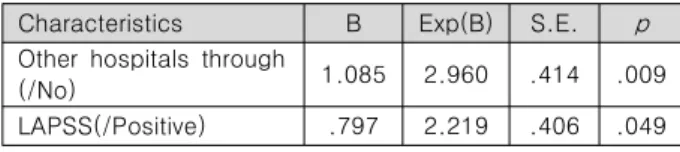
병원도착시간에 영향을 미치는 요인을 알아보기 위해 일반 적인 특성과 질환관련 특성에 따른 병원도착 시간의 차이에서 유의한 문항을 대상으로 로지스틱 회귀분석을 실시하였다.

타 병원을 경유를 하지 않은 경우가 타 병원을 경유한 경우 보다 3시간 이내에 도착 할 가능성이 유의하게 높았으며(β

=2.96, p=0.009), LAPSS 양성인 경우가 음성인 경우보다 3시 간 이내에 도착 할 가능성 유의하게 높았다(β=2.21, p=0.049)[Table 6].

IV. Discussion

본 연구에서는 허혈성 뇌졸중 환자의 병원 도착 지연시간 및 지연요인을 파악하기 위해 시행하였으며, 허혈성 뇌졸중 환자 에서 병원 도착 지연요인으로는 타병원경유와 LAPSS 이었다.

타 병원을 경유하여 내원한 환자는 65.1%(82명), 타 병원을 경유하지 않고 바로 내원한 환자는 34.9%(44명)로, 타 병원 경 유 여부가 도착지연 시간에 유의한 차이(p=.008)를 보여주었 다. 이는 65.7%가 타병원을 경유하여 내원하였던 안경애[17]

의 연구와 유사한 결과를 나타내었지만, 66.1%에서 응급의료 센터로 직접내원 하였던 류지영 등[10]의 연구결과와는 차이 를 보였다. 이는 변영순[18]의 연구에서 의료기관 선택 이유로

‘거리가 가까워서’라고 응답하는 비중이 높았던 경우를 참고할

(4)

Table 4. Hospital arrival times by general characteristics

Characteristics Category

Admission time(hour)

χ

2

p 

<3 ≥3

N(%) N(%)

Gender Male 26(33.3) 52(66.7)

2.659 .103

Female 23(47.9) 25(52.1)

Age(year) ≤49 3(60.0) 2(40.0)

6.671 .154

50-59 2(14.3) 12(85.7)

60-69 12(34.3) 23(65.7)

70-79 19(40.4) 28(59.6)

≥80 13(52.0) 12(48.0)

Residence Big city 15(46.9) 17(53.1)

1.151 .283

Other 34(36.2) 60(63.8)

Distance (km)

0-59 43(38.1) 70(61.9)

.322 .570

≥60 6(46.2) 7(53.8)

family Alone. 5(41.7) 7(58.3)

1.796 .407

Couple 30(43.5) 39(56.5)

≥Of three members 14(31.1) 31(68.9) Symptoms onset

(hour)

0->6 5(20.0) 20(80.0)

5.399 .145

6≤->12 25(40.3) 37(59.7)

12≤->18 15(48.4) 16(51.6)

18≤->24 4(50.0) 4(50.0)

Location of accident home 39(38.6) 62(61.4)

1.765 .414

Public place 6(54.5) 5(45.5)

Other 4(28.6) 10(71.4)

Transfer method Ambulance 32(42.1) 44(57.9)

.834 .361

Other 17(34.0) 33(66.0)

First aid No 36(40.9) 52(59.1)

1.097 .578

Drug 5(27.8) 13(72.2)

Folk remedy 8(40.0) 12(60.0)

Other hospitals through Yes 25(30.5) 57(69.5)

6.974 .008 

No 24(54.5) 20(45.5)

Table 5. Hospital arrival times by disease-related characteristics

Characteristics Category

Admission time(hour)

χ

2

p 

<3 ≥3

N(%) N(%)

Consciousness Alert 36(38.7) 57(61.3)

.925 .630

Stupor 11(44.0) 14(56.0)

Coma 2(25.0) 6(75.0)

Neurologica symptom Consciousness disorder 8(47.1) 9(52.9)

3.267 .352

Language disorder 19(47.5) 21(52.5) Movement disorder 19(32.8) 39(67.2)

Other 3(27.3) 8(72.7)

History Yse 34(35.1) 63(64.9)

2.611 .106

No 15(51.7) 14(48.3)

Family history Yse 8(38.1) 13(61.9)

.007 .935

No 41(39.0) 64(61.0)

CPSS Positive 43(41.0) 62(59.0)

1.129 .288

Negative 6(28.6) 15(71.4)

LAPSS Positive 34(47.9) 37(52.1)

5.542  .019 

Negative 15(27.3) 40(72.7)

때 본 연구 대상자들의 거주지가 소 도시와 군 단위의 농어촌 지역이 대부분을 차지하고 있어, 거주지에서 가까운 병원을 경 유하여 3차 병원으로 도착하기 때문에 지연되었던 것으로 생각 된다. 하지만 타 병원 경유여부가 도착시간에 영향을 미친다는 허지회 등[19]의 연구와 유사한 결과를 나타낸 것으로 볼 때, 급성기의 뇌졸중 환자에 대한 보호자의 빠른 증상 인지 및 119 구급대원의 적절한 병원 선정에 대한 교육이 필요할 것으로 생

각된다.

LAPSS는 뇌졸중의 신속한 인지를 위해 응급구조사들이 현 장에서 시행 할 것을 권장하고 있다[15,16]. LAPSS는 간질, 저혈당 또는 고혈당과 같은 의식저하 원인을 배제하기 위한 몇 가지의 항목을 포함하여 비대칭적인 얼굴의 처짐, 손의 움켜쥠 과 상지근력의 약화 등으로 이루어져 있다[16].

LAPSS의 선행연구의 경우 의료진이나 응급구조사 등을 통

(5)

Table 6. Factors influencing Hospital arrival times by logistic regression analysis

Characteristics B Exp(B) S.E. p

Other hospitals through

(/No) 1.085 2.960 .414 .009

LAPSS(/Positive) .797 2.219 .406 .049

한 타당도 평가가 대부분이었다[20]. 본 연구에서는 보호자 를 대상으로 실시하여, LAPSS 평가기준에 56.3%(71명)에서 양성으로 나타났다. 이는 이신호 등[21]의 LAPSS 평가에서 45.2%(77명)의 양성으로 나타나는 것과 비교하면 높은 결과이 다. 환자발견 당시 보호자들이 뇌졸중이라고 생각하였는지에 대한 조사는 실시하지 않았지만, 일반인들에게 뇌졸중에 대한 빠른 인식을 가능하게 할 수 있도록 LAPSS 등의 교육을 충분 히 시행한다면, 환자의 초기 증상 발견으로 뇌졸중을 인지할 수 있을 것이라 사료된다.

병원도착 시간에 영향을 미치는 요인으로 로지스틱 회귀분 석을 실시하였다.

LAPSS의 결과 양성을 보였던 경우가 음성을 보였던 경우보 다 병원도착 시간이 2.219배 빠르게 도착한 것으로 나타났다 (p=.049). 2010년 미국심장협회의 가이드라인에서는 응급구조 사를 포함한 모든 병원 전 단계에서 병원 전 뇌졸중 선별평가 를 수행할 것을 Class Ia로 권장하고 있다[22]. 하지만 우리나 라의 경우는 병원 전 단계에서 보호자에 의해서는 거의 시행되 지 않으며, 119 구급대원들의 의해 뇌졸중 선별평가를 수행하 고 있다. 하지만 119 구급대원들의 선별평가 타당도가 높다는 경우[23]와 낮다[24]는 상반되는 연구결과를 보고하고 있다.

이에 병원 전 단계의 LAPSS 척도와 같은 표준화된 뇌졸중 척 도를 이용하여 신속한 뇌졸중을 인지하고, 3시간 이내 혈전용 해제를 투여할 수 있는 병원으로 신속한 이송이 필요하므로 [25], 119 구급대원 뿐만 아니라 뇌졸중 환자 보호자 즉 최초 반응자에 대한 교육이 이루어져야 할 것으로 생각된다.

본 연구의 제한점으로는 G광역시에 위치하고 있는 3차 대학 병원 응급의료센터에 내원한 뇌졸중 환자 및 보호자를 대상으 로 본 연구결과를 전체 뇌경색 환자의 결과로 일반화하기에는 무리가 있다. 그럼에도 불구하고 본 연구는 급성 허혈성 뇌졸중 환자의 일반적인 특성과 질환관련 특성이 병원 지연에 영향을 미치는 요인을 파악하여, 증상 발현 후 지체하지 않고 병원에 도착하여 적절한 치료를 받을 수 있도록 교육하기 위한 자료를 제공하고데 의의가 있다고 하겠다.

Ⅴ. Conclusion

급성 허혈성 뇌졸중 환자의 병원 도착 지연요인으로는 타병 원의 경우와 뇌졸중 선별검사인 LAPSS 척도에 영향을 받았다.

향후 급성 허혈성 뇌졸중 환자가 증상발현 후 3시간이내 병원 도착을 위해 최초반응자인 환자보호자와 병원 전 단계의 의료 서비스를 제공하는 119 구급대원에게 뇌졸중 환자의 치료 가 능한 병원과 병원 전 뇌졸중 선별검사 방법에 대한 교육이 충 분이 이루어져야 할 것으로 판단된다.

REFERENCES

[1] T. H. Park, M. H. Bae, J. B. Lee, S. Y. Ha, S. W.

Ha, H. G. Oh, et al. “Socioeconomic Status and Prehospital Delay in Acute Ischemic Stroke Patients,” Korean J Stroke, Vol. 12, No. 1. pp.

26-32, January 2010.

[2] W. Hacke, G. Donnan, C. Fieschi, M. Kaste, R. von Kimmer, JP. Broderick, et al. “Association of outcome with early stroke treatment: Pooled analysis of ATLANTIS, ECASS, and NINDS rt-PA stroke trial,” Lancet, Vol. 363, No. 9411, pp.

768-774, March 2004.

[3] JR. Marler, BC. Tilley, M. Lu, TG. Brott, PC. Lyden, JC. Grotta, et al. “Early stroke treatment associated with better outcome: the NINDS rt-PA stroke study,” Neurology, Vol. 55, No. 11, pp. 1649-1655, December 2000.

[4] C. D. Lim, H. W. Ryoo, Y. H. Hwang, M. J. Lee, S.

J. Shin, J. Y. Ahn. et al. “Urban-Rural Gap in the Prehospital Delay of Acute Stroke Patients,” JKSEM, Vol. 24, No. 6, pp. 664-673, December 2013.

[5] D. H. Lee, K. O. Kim, S. D. Shin, H. A. Park, Y. S.

Roa, W. C. Cha. et al. “Impacts of Urbanization on Delay in Transferred Ischemic Stroke Patients,”

JKSEM, Vol. 25, No. 4, pp. 392-400, August 2014.

[6] MJ. Reeves, S. Arora, JP. Broderick, M. Frankel, JP.

Heinrich, S. Hickenbottom, et al. “Acute stroke care in the US: results from 4 pilot prototypes of the Paul Coverdell National Acute Stroke Registry,”

Stroke, Vol. 36, No. 6, pp. 1232-1240, August 2005.

[7] AI. Qureshi, JF. Kirmani, MA. Sayed, A. Safdar, S.

Ahmed, R. Ferguson, et al. “Time to hospital arrival, use of thrombolytics, and in-hospital outcomes in ischemic stroke,” Neurology, Vol. 64, No.12, pp.

2115-2120, June 2005.

[8] K. Kimura, K. Minematsu, T., Yamaguchi, “Atrial

fibrillation as a predictive factor for severe stroke

and early death in 15,831 patients with acute

(6)

ischemic stroke,” J Neurol Neurosurg Psychiatry, Vol. 76, No, 5, pp. 679-683, May 2005.

[9] P. Nowachki, M. Nowik, A. Bajer-Czajkowska, A.

Porebska, A. Zywica, D. Nocon, et al. “Patient's and bystander's awaerness of stroke and pre-hospital delay after stroke onset's Perspectives for thrombolysis in west pomerania province, Poland,”

European Neurology, Vol. 58, No. 3, pp. 159-165, June 2007.

[10] J. Y. Ryu, E. K. Eo, Y. J. Kim, K. Y. Jung, “Factors Associated with Delayed Arrival at the Hospital in Cases of Acute Stroke,” JKSEM, Vol. 11, No. 3, pp.

296-304, October 2000.

[11] S. C. Lee, W. Kim, K. S. Lim, “Factors Associated with Early Presentation and Rapid Imaging Evaluation of Acute Stroke,” JKSEM, Vol. 16, No. 3 pp. 363-370, June 2005.

[12] O. Agyeman, K. Nedeltchev, M. Arnold, U. Fische,r L. Remonda, J. Isenegger, et al. “Time to admission in acute ischemic stroke and transient ischemic attack,” Stroke, Vol. 37,. No. 4, pp. 963-966, March 2006.

[13] S. S. Yung, S. Y. Lee, “Factors Delaying Hospital Arrival Time After Stroke,” JPPKM, Vol. 16, No. 5, pp. 1075-1078, October 2002.

[14] S. J. Kim, J. S. Koo, J. S. Lee, J. Y. Park, J. M.

Park, B. K. Kim. et al. “Factors Associated with Reduced Prehospital Delay Over 4 Years in Patients with Acute Ischemic Stroke or Transient Ischemic Attack Within 48 Hours of Symptom Onse,” J Korean Neurol Assoc, Vol. 29, No. 2, pp. 81-88, May 2011.

[15] RU. Kothari, K. Hall, T. Brott, J. Broderick, “Early stroke recognition: developing an out-of-hospital stroke scale,” Acad Emerg Med, Vol. 4, No. 10, pp.

986-990, October 1997.

[13-16] CS. Kidwell, S. Starkman, M. Eckstein, K.

Weems, JL. Saver, “Identifying stroke in the field.

Prospective validation of the Los Angeles Prehospital stroke screen(LAPSS),” Stroke Vol. 31, No. 1, pp. 71-76, January 2000.

[17] K. G. An, “Pre-hospital Delay and Factors Associated with Delayed Admission to Hospital in Acute Stroke Patients,” Nursing Science, Vol. 14, No. 1, pp. 36-47, June 2002.

[18] Y. S. Byun, “Pathway of stroke patients seeking medical care,” Journal of the Korean Academy of

fundamentals of Nursing, Vol. 7, No. 2, pp.

149-163, August 2000.

[19] J. H. Heo, H. Y. Cheon, C. M. Nam, D. C. Kim, G.

W. Kim, B. I. Lee, “Presentation Time to Hospital and Recognition of Stroke in Patients with Ischemic Stroke,” J Korean Neurol Assoc, Vol. 18, No. 2, pp.

125-131, May 2000.

[20] D. B. Shc, S. D. Shin, Y. J. Kim, K. O. Ahn, K. J.

Song, J. O. Park, et al. “External Validation of Prehospital Stroke Screen Scales for EMT: One Center Study,” JKSEM, Vol. 19, No. 1, pp. 7-14, February 2008.

[21] S. H. Lee, Y. S. Park, S. P. Chung, I. C. Park, H.

S. Chung, S. H. Choi, et al. “Factors in Delayed Arrival at the Emergency Department in Patients with Suspected Acute Stroke,” JKSEM, Vol. 17, No.

5, pp. 431-437, October 2006.

[22] EC. Jauch, B. Cucchiara, O. Adeoye, W. Meurer, J.

Brice, et al. “2010 American Heart Association Guidelines for Cardiopulmonary Resuscitation and Emergency Cardiovascular Care: Part 11:Adult Stroke,” Circulation, Vol. 122, No. 18, pp.

S818-S828, November 2010.

[23] K. O. Ahn, S. D. Shin, C. B. Park, K. J. Song, K. J.

Hong, S. C. Lee, et al. “Validation of Pre-Hospital Stroke Screens By Ambulance Service Personnel:

AProspective Observation Study,” JKSEM, Vol. 24, No. 3, pp. 272-278, June 2013.

[24] H. J. Kim, D. H. Kim, H. I. Park, I. Y. Lee, J. K.

Cha, “Prehospital Delay Factors After Stroke and Paramedic Identification of Stroke Patients in AMetropolitan City Emergency Medical Service System,” J Korean Neurol Assoc, Vol. 29, No. 2, pp.

89-94, May 2011.

[25] H. M. Song, S. G. Roh, “A Research of Prehospital

119 Emergency Medical Service for Stroke

Patients,” J. Kor. Inst. Fire Sci. Eng., Vol. 26, No. 3,

pp. 14-20, June 2012.

(7)

Authors

Yong-Deok Lim. EMT-Paramedic.

2012. 02. Emergency Medical Service Science B.S

2014. 02. Emergency Medical Service Science M.S

2010. 01. Currently a EMT-Paramedec in the Chonnam National University Hospital.

2016. 03. Currently in the Graduate school Gongju National University of attendance.

Choi Sung Soo, EMT. Ph.D.

2009. 2. Health Science B.S 2012. 2. Health Science M.S 2015. 2. Health Science Ph.D

2007. 02-2015. 02 EMT-Paramedic, Chonnam National University Hospital.

2015. 03. Currently a Professor in the Dept. of

Emergency Medical Service, Howon University.

수치

Table  2.  Disease-related  characteristics  of  cerebral  infarction  patients Characteristics Category N % Consciousness Alert 93 73.8 Stupor 25 19.8 Coma 8 6.3 Neurological symptom Consciousness  disorder 17 13.5 Language  disorder 40 31.7 Movement  dis
Table  4.  Hospital  arrival  times  by  general  characteristics Characteristics Category Admission  time(hour) χ 2 p &lt;3≥3 N(%)   N(%) Gender Male 26(33.3) 52(66.7) 2.659 .103 Female 23(47.9) 25(52.1) Age(year) ≤49 3(60.0) 2(40.0) 6.671 .15450-592(14.3
Table  6.  Factors  influencing  Hospital  arrival  times  by  logistic  regression  analysis

참조

관련 문서

Of the common risk factors associated with stroke (age, gender, hypertension, diabetes mellitus, IHD, renal impairment, carotid disease), older age was more strongly

Conclusions—Acute stroke in atrial fibrillation patients is associated with high rates of ischemic recurrence and major bleeding at 90 days. This study has observed that high CHA

Keywords Elderly; Ischemic stroke; Thrombolytic therapy; Outcome assessment.. nine, and hemoglobin); (3) vascular risk factors (hypertension, diabetes

EMS, emergency medical services; Direct, arrived final hospital directly; Indirect, arrived final hospital via other hospital; NHI, national health insurance; Sx., symptom, FMC,

■Results We analyzed indicators of Korean Standard Pattern Identification for Stroke-Ⅲ by Common Carotid Intima Media Thickness difference.. As a result, pale complexion,

CHA 2 DS 2 -VASc score is well validated risk model to esti- mate the risk of systemic thromboembolism or stroke in pat- ents with AF, which composed of only clinical variables

Methods zzThis study retrospectively investigated the real transfer and imaging processing times for cases of suspected acute stroke (AS) with EMS notification of a requirement

In old-onset patients, factors related to low QOL included motor impairment and severe modified Rankin scale (both at discharge and at the time of follow up), poor economic