Comparison of Epidemiology, Emergency Care, and Outcomes of Acute Ischemic Stroke between Young Adults and Elderly in Korean Population: A Multicenter Observational Study
Stroke in young adults has been known to show a lower incidence and a better prognosis.
Only a few studies have examined the epidemiology and outcomes of ischemic stroke in young adults and compared them with the elderly in Korean population. All consecutive patients with ischemic stroke visiting 29 participating emergency departments were enrolled from November 2007 to October 2009. Patients with less than 15 yr of age and unknown information on age and confirmed diagnosis were excluded. We categorized the patients into young adults (15 to 45 yr) and elderly (46 yr and older) groups. Of 39,156 enrolled all stroke patients, 25,818 with ischemic stroke were included and analyzed (young adult; n = 1,431, 5.5%). Young adult patients showed lower prevalence of most chronic diseases but significantly higher prevalence in exercise, current smoking, and alcohol consumption. Hospital mortality was significantly lower in young adults than elderly (1.1% vs. 3.1%, P < 0.001). Higher number of patients in elderly group (68.1%) showed worsening change of modified Rankin Scale than young adults (65.2%). Young adults ischemic stroke showed favorable hospital outcomes than the elderly in Korean population.
Keywords: Stroke; Age Distribution; Epidemiology; Outcome Assessment Won-Bin Park,1 Jin-Seong Cho,1
Sang-Do Shin,2 So-Yeon Kong,3 Jin-Joo Kim,1 Yong-Su Lim,1 Hyuk-Jun Yang,1 and Gun Lee1
1Department of Emergency Medicine, Gachon University Gil Medical Center, Incheon; 2Department of Emergency Medicine, Seoul National University Hospital, Seoul, Korea; 3World Health Organization, International Agency for Research on Cancer, Lyon, France
Received: 10 December 2013 Accepted: 29 April 2014 Address for Correspondence:
Jin-Seong Cho, MD
Department of Emergency Medicine, Gachon University Gil Medical Center, 21 Namdong-daero 774 beon-gil, Namdong-gu, Incheon 405-760, Korea Tel: +82.32-460-3015, Fax: +82.32-460-3019 E-mail: [email protected]
Funding: The current study was financially supported by the Korea Centers for Disease Control and Prevention (2008-2011).
http://dx.doi.org/10.3346/jkms.2014.29.7.985 • J Korean Med Sci 2014; 29: 985-991
INTRODUCTION
Cerebrovascular disease is the second leading cause of death and the major cause of disability in Korea (1). Each year, about 105,000 Koreans experience a new or recurrent stroke and this number is estimated to rise up to 350,000 by 2030 (2). It has been considered that stroke frequently affects the elderly aged 55 yr or older, and rarely affects young adults aged between 15 and 45 yr (3-6). Recent studies provide evidence that ischemic stroke in young adults is increasing worldwide (1). Although both prognosis and outcome of young adults stroke patients are better than those observed in older patients, stroke in younger adults has greater socioeconomic burden and quality of life consequences due to its longer duration than stroke in older adults (4, 7). Moreover, there are differences in etiologic and prognostic factors between young and old age stroke (6, 8).
Until now, numerous studies have been conducted to identi- fy etiology, risk factors, and prognostic factors of stroke in young adults, but most of these studies have been conducted in a sin- gle-institutional setting with small sample sizes (4, 5, 9, 10). Fur- thermore, most of these studies have examined both hemor- rhagic stroke and ischemic stroke, and only few studies have
compared the epidemiologic features, emergency care, and outcomes between young adults and the elderly.
The objective of the present study was to examine demogra- phics, epidemiologic features, emergency care, and outcomes of ischemic stroke in two age groups, young adults and the el- derly in Korea.
MATERIALS AND METHODS Study setting and data sources
We used the data from the Cardiovascular Disease Surveillance (CAVAS) Project, which was a hospital-based registry from 29 tertiary teaching hospital emergency departments (ED) in Ko- rea during November 2007 to October 2010. The CAVAS project, supported by Korea Centers for Disease Control and Preven- tion (CDC), collected information on patients with acute myo- cardial infarction (AMI) (ST elevation MI and non-ST elevation MI) and all stroke (ischemic stroke, hemorrhagic stroke, and subarachnoid hemorrhage) within 1 week of disease onset. Par- ticipating hospitals were tertiary and teaching hospitals located in metropolitan or urban areas. All hospitals provided 24 hr/7 days emergency cardiac and stroke care by emergency physi- Neuroscience
cians and cardiovascular/ neurovascular specialty doctors (11).
Study subjects
Ischemic stroke patients who were diagnosed at study hospitals were included in the present study. The definition of ischemic stroke was defined based on the international classification of disease 10th version (ICD-10) codes. Ischemic stroke patients were included if they had one of following ICD-10 diagnosis codes; I60.0-I60.9, I61.0-I61.9, I63.0-I63.9, and I64. We excluded patients with less than 15 yr of age or without information on age and confirmed diagnosis code.
Data variables and data collection
Data variables included demographics (age and gender), socio- economic factors (type of insurance, education level, and occu- pation), time variables related with event and process of care (time of event, prehospital care, ED care, and hospitalization), clinical parameters, laboratory and radiologic examinations, and emergency care procedures (prehospital care, interhospital transport, and hospital care). Primary endpoint was hospital mortality at discharge. Secondary endpoint was disability at discharge measured by modified Rankin Scale (ranged from 0 (no disability) to 6 [fatal]). For each patient, both pre-event and discharge modified Rankin Scale were measured.
Information was collected by study hospital staffs, such as nurse, emergency medical technicians, interns, residents, and attending physicians according to hospital specific human re- sources. Hospital care and outcomes were recorded by trained study coordinators, who were employed by each ED and re- viewed medical records for hospital outcomes. The collected information was then imported to a database via a web-based data entry operated by Korea CDC. Regular quality manage- ment process was performed by the central data quality control committee, composed of emergency physicians, cardiologists, and neurologists, epidemiologists, and biostatisticians. Regular education and training were provided to maintain the data qual- ity collected by study coordinators. All education and training were performed using a designed data collection instruction with various case examples.
Statistical analysis
We categorized the patients into two age groups; young adults (15-45 yr) and elderly (46 yr and older). We compared the de- mographics, epidemiologic features of risk factors, emergency care, and hospital outcomes. Continuous variables were de- scribed with mean (standard deviation) and median (inter- quartile range). Categorical variables were described with fre- quency and percent. Categorical variables were analyzed using chi-square-test and continuous variables were analyzed using Mann-Whitney U test and Student’s t-test. Statistical analysis was done using PASW for Windows 21.0 (SPSS Inc., Chicago, IL,
USA). A P value of < 0.05 was considered statistically significant.
Ethics statement
This study protocol was approved by the institutional review board of Seoul National University Hospital (IRB No. 1012-134- 346). Informed consent was waived by the IRB.
RESULTS
Patient characteristics
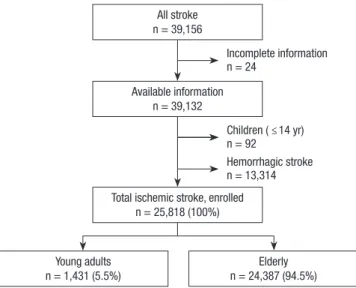
During the study period, a total of 39,156 patients visited the participating EDs due to acute stroke. Of these, patients with incomplete information (n = 24), hemorrhagic stroke (n = 13,314), and children age less than 14 yr old (n = 92) were excluded. To- tal 25,818 patients were analyzed (young adult 5.5% and elderly 94.5%) (Fig. 1).
Comparison of demographic findings
Compared to elderly, young adults ischemic stroke showed sig- nificantly higher proportions of being male, having high body mass index, better socioeconomic status such as higher educa- tion level, professional and business job category, and national health insurance program (P < 0.001 for all). The number of pa- tients with traditional risk factors of developing stroke, such as diabetes mellitus, hypertension, and hyperlipidemia, was sig- nificantly higher in elderly compared to young adults; 25.5% vs.
7.8% for diabetes mellitus, 55.1% vs. 18.5% for hypertension, and 5.3% vs. 2.6% for hyperlipidemia. In addition, the number of patients with past history of cardiovascular and cerebrovas- cular diseases was significantly higher in elderly than young adults (P < 0.001). On the other hand, compared to elderly, sig- nificantly higher proportion of young adults were exercising, smoking, and consuming alcohol. Primary symptoms, includ-
Fig. 1. Patient enrollment for analysis. Young adults (15-45 yr old), Elderly (46 yr and older).
All stroke n = 39,156
Available information n = 39,132
Total ischemic stroke, enrolled n = 25,818 (100%)
Young adults
n = 1,431 (5.5%) Elderly
n = 24,387 (94.5%) Incomplete information n = 24
Children ( ≤ 14 yr) n = 92
Hemorrhagic stroke n = 13,314
ing mental change, sensory abnormality, unable to walk, and dizziness were significantly different between two age groups (Table 1).
Emergency care and process
Young adults ischemic stroke showed less utilization of emer- gency medical services (EMS) while the time to call for ambu- lance was significantly shorter in young adults than the elderly (56 min vs. 87 min, P = 0.039). Time from symptom onset to hospital arrival was similar between two groups (P = 0.103).
Young adults were more likely to be transported from another hospital than the elderly. Time interval between ED arrival and brain CT scan was shorter in the elderly than young adults (30
vs. 33 min, P < 0.015). The number of patients receiving reper- fusion therapy was not different between two groups while op- eration rate was higher in young adults (Table 2).
Hospital outcomes and disability
Overall hospital mortality was higher in the elderly than young adults (3.1% vs. 1.1%, P < 0.001). However, hospital length of stay was not different between two groups (Table 3). The modi- fied Rankin Scale (mRS) before the event was higher in the el- derly compared to young adults with 9.4% and 3.3% of the el- derly and young adults were in the moderate to severe disability category, respectively (P < 0.001). Moreover, more elderly pa- tients showed worsen change of mRS before and after the oc- Table 1. Comparison of demographic findings between young adults and elderly ischemic stroke
Parameters Young adults (15-45 yr old) Elderly (46 and older) P value
Total, No. (%) 1,431 (100.0) 24,387 (100.0)
Male, No. (%) 1,017 (71.1) 13,998 (57.4) < 0.001
Age (mean ± SD) 38.5 ± 6.3 68.9 ± 10.6 < 0.001
Body mass index (kg/m2), median (IQR) 24.1 (22.0-26.4) 23.4 (21.5-25.4) < 0.001
Education, No. (%) Primary-High school College-Graduate school Uneducated
Unknown
738 (51.6) 576 (40.3) 11 (0.8) 106 (7.4)
15,720 (64.5) 2,993 (12.3) 3,956 (16.2) 1,718 (7.0)
< 0.001
Occupation, No. (%) Professionals & CEOs Businessmen Engineers Laborers Students Housewives Unemployed Not applicable Unknown
101 (7.1) 353 (24.7) 126 (8.8) 320 (22.4)
50 (3.5) 156 (10.9) 175 (12.2) 85 (5.9) 65 (4.5)
596 (2.4) 973 (4.0) 2,371 (9.7) 2,589 (10.6)
7 (0.0) 3,004 (12.3) 13,252 (54.3) 733 (3.0) 862 (3.5)
< 0.001
Risk factors, No. (%) Exercise Diabetes mellitus Hypertension Hyperlipidemia Renal failure Cardiovascular disease Cerebrovascular disease
291 (20.3) 112 (7.8) 258 (18.0)
37 (2.6) 29 (2.0) 59 (4.1) 103 (7.2)
2,888 (11.8) 6,209 (25.5) 13,437 (55.1) 1,293 (5.3)
485 (2.0) 3,640 (14.9) 4,306 (17.7)
< 0.001
< 0.001
< 0.001
< 0.001 0.161
< 0.001
< 0.001 Ever smoking
Current smoker Former smoker
816 (57.0) 684 (47.8) 132 (9.2)
6,038 (40.1) 9,774 (24.8) 3,736 (15.3)
< 0.001
Alcohol drinking 760 (53.1 ) 7,251 (29.7) < 0.001
Insurance, No. (%) National health insurance Others
Unknown
1,348 (94.2) 77 (5.4)
6 (0.4)
22,661 (92.9) 1,610 (6.6)
116 (0.5)
< 0.001
Primary symptoms, No. (%) Mental change Motor weakness Sensory abnormality Unable to walk Dizziness Cardiac arrest
127 (8.9) 853 (59.6) 434 (30.3) 154 (10.8) 254 (17.7) 5 (0.3)
3,574 (14.7) 14,804 (60.7) 6,279 (25.7) 3,284 (13.5) 3,449 (14.1) 48 (0.2)
< 0.001 0.715 0.002 0.013 0.001 0.372 Recognition of stroke at onset, No. (%)
Yes 1,280 (89.4) 20,783 (85.2) < 0.001
SD, standard deviation; IQR, interquartile range.
Table 2. Emergency care between young adults and elderly stroke
Parameters Young adults (15-45 yr old) Elderly (46 and older) P value
Total, No. (%) 1,431 (100.0) 24,387 (100.0)
Prehospital care
Utilization of 119 ambulance, No. (%) Time to 119 call* (min), median (IQR) Time to hospital arrival† (min), median (IQR)
< 3 hr, No. (%) 3-6 hr 6-12 hr 12-24 hr
> 24 hr
276 (19.3) 56 (10-435) 480 (127-1641) 426 (29.8) 172 (12.0) 201 (14.0) 197 (13.8) 378 (26.4)
6,356 (26.1) 87 (18-571) 540 (155-1,600) 6,573 (27.0) 3,288 (13.5) 3,192 (13.1) 3,821 (15.7) 6,512 (26.7)
< 0.001 0.039 0.103 0.003
Interhospital transport Via another hospital, No. (%) Treatment by another hospital, No. (%)
Antiplatelet agents Anticoagulants Thrombolytic therapy Operation
546 (38.2) 23 (4.2) 69 (12.6) 34 (6.2)
2 (0.4)
7,783 (31.9) 352 (4.5) 758 (9.7) 384 (4.9) 8 (0.1)
< 0.001 0.061 0.011 0.085 0.028 Emergency department image
Brain CT‡ imaging, No. (%) Time to Brain CT‡ (min), median (IQR) Within 10 minutes, No. (%) Brain MRI imaging, No. (%)
931 (65.1) 33 (17-84) 116 (12.5) 930 (65.0)
15,978 (65.5) 30 (15-80) 2,582 (16.2) 16,036 (65.8)
0.723 0.015 0.016 0.553 Hospital care, No. (%)
Intravenous thrombolysis Intraarterial thrombolysis Antiplatelet agents Anticoagulants Operation
101 (7.7) 40 (3.0) 999 (75.7) 337 (25.5) 49 (3.7)
1,774 (7.8) 830 (3.7) 17,336 (76.6)
6,291 (27.8) 498 (2.2)
0.879 0.435 0.663 0.177 0.002
*Time to 119 call means that the median elapsed time between the onset of stroke symptoms and the 119 call; †Time to hospital arrival means that the median elapsed time between the onset of stroke symptoms and arrival at the study center; ‡Time to Brain CT (min), means that the median elapsed time between the study center arrival and the Brain CT scanning. IQR, interquartile range.
Table 3. Hospital outcomes between young adults and elderly ischemic stroke
Outcomes Young adults
(15-45 yr old) Elderly
(46 and older) P value Total, No. (%) 1,431 (100.0) 24,387 (100.0)
ER* results, No. (%) Discharge Transfer Death at ER*
Admission, total Discharge
Transfer to other facility Other
Death on ward
66 (4.6) 44 (3.1) 1 (0.1) 1,319 (92.2) 1,052 (79.8) 207 (15.7) 21 (1.6) 15 (1.1)
778 (3.2) 904 (3.7) 47 (0.2) 22,633 (92.8) 16,057 (70.9) 4,723 (20.9) 553 (2.4) 709 (3.1)
0.072
< 0.001
Hospital mortality, No. (%)
Death at ER* and on ward 16 (1.1) 756 (3.1) < 0.001 Hospital length of stay
Days, median (IQR) 9 (6-15) 9 (6-15) 0.138
ER, emergency room; IQR, interquartile range.
Table 4. Comparison of disability before event and at discharge between young adults and elderly stroke
Disability category Young adult
(15-45 yr old)
Elderly
(46 and older) P value
Total 1,431 (100.0) 24,387 (100.0)
mRS before events, total, No. (%) No symptoms
No significant disability Slight disability
Moderate disability: able to walk Moderate disability: unable to walk Severe disability
Moderate to severe disability
1,422 (100.0) 1,151 (80.4)
145 (10.1) 79 (5.5) 20 (1.4) 19 (1.3) 8 (0.6) 47 (3.3)
24,204 (100.0) 16,533 (67.8)
3,360 (13.8) 2,007 (8.2) 1,056 (4.3) 865 (3.5) 383 (1.6) 2,304 (9.4)
< 0.001
< 0.001 mRS at discharge, total, No. (%)
No symptoms No significant disability Slight disability
Moderate disability: able to walk Moderate disability: unable to walk Severe disability
Moderate to severe disability
1,301 (100.0) 305 (23.1) 402 (30.5) 297 (22.5) 132 (10.0) 122 (9.2)
43 (3.3) 297 (22.5)
22,202 (100.0) 3,340 (14.8) 6,038 (26.7) 5,022 (22.2) 2,639 (11.7) 3,219 (14.2) 1,944 (8.6) 7,802 (34.5)
< 0.001
< 0.001 Change* on mRS, No. (%)
Improved Not changed Worsened
1,301 (100.0) 93 (7.1) 348 (26.4) 860 (65.2)
22,202 (100.0) 1,851 (8.2) 4,944 (21.8) 15,407 (68.1)
< 0.001
*Change on mRS based on change of mRS score from pre-hospital to in-hospital.
mRS, modified Rankin Scale.
currence of stroke compared to young adults (68.1% vs. 65.2%, P < 0.001) (Table 4).
DISCUSSION
The present study from a large nationwide multi-center hospi- tal-based cardiovascular registration compares demographic, epidemiological, emergency care, and hospital outcomes be-
tween young adults and elderly ischemic stroke.
Our results showed that young age ischemic stroke account-
ed for 5.5% of total ischemic stroke patients, which is greater than 3.7% on the National Survey of Stroke in North America (3), but lower than 8.5% reported by Bevan et al. (4). Previous studies on stroke in young adults in Korean population have re- ported the proportion of stroke in young adults as about 14%, which was much higher than the incidence observed in our study (9, 10). This might be because the current study was a multi-center study while previous studies were single institu- tion reports. Also, the patients with ischemic stroke in young age group accounted for 38.5% of all kinds of stroke in the cur- rent study. Although this value was close to 41% reported by Bevan et al., it was greater than 31.9% and 30.5% reported by two previous studies in Korean population (9, 10). It is well known that intracerebral hemorrhage and subarachnoid hemorrhage occur more frequently than cerebral infarction in young adults unlike in the elderly (12, 13). However, a recent study by George et al. reported that there is an increasing tendency in the rate of hospitalization in young adults with acute ischemic stroke (14).
One study which examined trends in the incidence of stroke during a period from 1993 to 2005, reported that while there was a decrease in the overall incidence of stroke, the proportion of stroke in young adults (age range: 20-54 yr) increased from 12.9% to 18.6% (15). According to this report, this increase in trend was associated with the increase in the prevalence of dia- betes mellitus, hyperlipidemia, and obesity among young adults, which are major risk factors for stroke. A numerous studies have shown that the prevalence of stroke increases with the increased incidence of hyperlipidemia, obesity and diabetes mellitus in young adults (8, 14). Also in Korea, the prevalence of these dis- eases has been gradually increasing (2, 16, 17). Therefore, the resulting increase in the prevalence of stroke is one of major public health concerns. Although it is known that most risk fac- tors for stroke increase with age, the main objective of our study was to evaluate and compare the distributions of these risk fac- tors in young adults and the elders. In the present study, we demonstrated the difference in the risk factors in two different age groups using a multi-center registry.
In addition, our results demonstrated that the proportions of smokers and alcohol drinkers were significantly higher in young adults than in the elderly. The smoking is one of the major risk factors of developing stroke through vasoconstriction, platelet aggregation, elevation of blood coagulation factors, increased blood viscosity and elevated blood pressure (18, 19). Although there has been a decreasing tendency in the smoking rate since 1998, Korea still shows a high smoking rate. Currently, about 48.3% of Korean adult males aged 19 yr or older are smokers and Korea ranks the 5th in smoking among the Organization for Economic Co-operation and Development (OECD) coun- tries (17, 20). In particular, the age-specific smoking rates in the 20s, 30s and 40s were estimated to be 47.3%, 60.9% and 53.6%, respectively (17). In this study, the significantly higher propor-
tion of ever-smokers in young adults compared to the elderly was even higher when only current smokers were compared.
Numerous studies reported that smoking was the important risk factor for stroke in young adults with dose-response rela- tionship between cigarette smoking and risk of ischemic stroke (18, 21, 22). The alcohol drinking is also involved in the occur- rence of stroke through various mechanisms. Alcohol increases risks of developing cerebral embolism by causing cardiac ar- rhythmia and cardiac wall dysfunction, elevates the blood pres- sure, promotes the platelet aggregation and blood coagulation, induces the contraction of cerebrovascular smooth muscle cells and thereby decreases the cerebral perfusion and alters the brain metabolism (23). According to a Finnish study con- ducted by Hillbom and Kaste, ethanol intoxication was preced- ed in 40% of total patients within 24 hr before the onset of stroke (24). The proportion of alcohol drinkers in young adults was 54.9% in our study, showing that the alcohol drinking was the most prevalent risk factor in young adults.
Several studies had shown that the proportion of patients with stroke receiving definitive treatments such as thrombolytic agents was significantly increased because the pre-hospital and in-hospital period was significantly shortened if they used emer- gency medical system (25, 26). However, in this study, the pro- portion of young adults who visited the first hospital using 119 ambulances was smaller than that of the elderly, and therefore, young adults were more likely to be transported from another hospital than elderly. Moreover, only 29.8% of young adults with ischemic stroke reached hospital within three hours of onset of stroke symptoms during which they were allowed to receive thrombolytic agents, and the median elapsed time between the onset of symptoms and hospital arrival was 480 min. Because proportion of patients with known time of symptom onset was higher in young adults than elders, young adults had shorter median symptom onset to hospital arrival time. However, they used 119 ambulances less frequently than elders, thus more likely to visit the primary or secondary hospital first, where de- finitive treatments cannot be provided, and more likely to be transferred to the tertiary hospital than elders. These are very important factors in the aspects of treatment results and prog- nosis.
Our study showed better hospital outcomes in young adults than the elderly as shown in other previous studies. While over- all mortality was very low in young adults (1.1%), 22.5% of them were remained to have moderate to severe disability and 65.2%
of them were shown to have worsened disability suggesting that young age stroke can make huge economic burden. Hospi- tal length of stay was not different between young adults and elderly group. If young adults can receive better systems of stroke care program, such as higher proportion of ambulance utiliza- tion and shorter time interval to definite care, then the full re- covery discharge will increase.
Although this is one of the largest ED-based studies, there are a number of limitations. First, the participated emergency de- partments were located in either metropolitan or urban areas, where more resources were allocated than other parts of the country. If smaller hospitals in rural areas participated in the study, the results might have been changed. Second, we could not clarify effects of underlying conditions such as congenital cardiac anomaly or cerebral vascular anomaly, which were known to be responsible for the occurrence of stroke in young adults. Third, we did not compare the effect size of the risk fac- tors on outcomes, but just compared the distributions between two age groups. If we adjust for confounders, effect of age group on hospital outcomes and disability might be different than what we observed in this study. Last, we used the cut off age of 15 to 45 for young adults based on the cut-point used in previ- ous studies. However exact age criteria were not decided in most studies (3-5, 9, 10).
From ED-based stroke registry, young adults stroke showed very different epidemiologic features when compared with el- derly patients. In young adults, overall hospital mortality was 1.1% and moderate to severe disability at discharge as measured by mRS was about 22.5%. For developing prevention program for young adults stroke, further studies should be investigated to determine the association between stroke risk factors and outcomes.
DISCLOSURE
The authors have no conflicts of interest to disclose.
ORCID
Won-Bin Park http://orcid.org/0000-0003-3557-6547 Jin-Seong Cho http://orcid.org/0000-0001-6762-4692 Sang-Do Shin http://orcid.org/0000-0003-4953-2916 So-Yeon Kong http://orcid.org/0000-0001-5106-7342 Jin-Joo Kim http://orcid.org/0000-0002-5678-2019 Yong-Su Lim http://orcid.org/0000-0003-4390-4010 Hyuk-Jun Yang http://orcid.org/0000-0001-8324-9749 Gun Lee http://orcid.org/0000-0001-7967-8663
REFERENCES
1. Statistics Korea. 2011 annual report on the cause of death statistics. Avail- able at http://kostat.go.kr/portal/korea/kor_nw/2/6/1/index.board?b mode=read&bSeq=&aSeq=260046&pageNo=1&rowNum=10&navCou nt=10&currPg=&sTarget=title&sTxt= [accessed on 13 September 2012].
2. Hong KS, Bang OY, Kang DW, Yu KH, Bae HJ, Lee JS, Heo JH, Kwon SU, Oh CW, Lee BC, et al. Stroke Statistics in Korea: part I. epidemiology and risk factors: a report from the Korean Stroke Society and Clinical Research Center for Stroke. J Stroke 2013; 15: 2-20.
3. Walker AE, Robins M, Weinfeld FD. The national survey of stroke: clini-
cal findings. Stroke 1981; 12: I13-44.
4. Bevan H, Sharma K, Bradley W. Stroke in young adults. Stroke 1990; 21:
382-6.
5. Marini C, Totaro R, De Santis F, Ciancarelli I, Baldassarre M, Carolei A.
Stroke in young adults in the community-based L’Aquila registry: inci- dence and prognosis. Stroke 2001; 32: 52-6.
6. Griffiths D, Sturm J. Epidemiology and etiology of young stroke. Stroke Res Treat 2011; 2011: 209370.
7. Adams HP Jr, Butler MJ, Biller J, Toffol GJ. Nonhemorrhagic cerebral in- farction in young adults. Arch Neurol 1986; 43: 793-6.
8. Putaala J, Metso AJ, Metso TM, Konkola N, Kraemer Y, Haapaniemi E, Kaste M, Tatlisumak T. Analysis of 1008 consecutive patients aged 15 to 49 with first-ever ischemic stroke: the Helsinki young stroke registry. Stroke 2009; 40: 1195-203.
9. Lee SS, Kim SM, Kim WT, Choi IS. Stroke in young adults. J Korean Neu- rol Assoc 1991; 9: 297-301.
10. Lee GH, Lee WY, Hong SB, Yoon BW, Roh JK, Lee SB, Myung H. Stroke in young adults. J Korean Neurol Assoc 1993; 11: 43-53.
11. Korea Centers for Disease Control & Prevention. Hospital-based regis- tration of cardiovascular disease in South Korea. Available at https://
ccvd.cdc.go.kr/ccvd/index.do [accessed on 9 October 2013].
12. Nencini P, Inzitari D, Baruffi MC, Fratiglioni L, Gagliardi R, Benvenuti L, Buccheri AM, Cecchi L, Passigli A, Rosselli A. Incidence of stroke in young adults in Florence, Italy. Stroke 1988; 19: 977-81.
13. Kleindorfer D, Khoury J, Kissela B, Alwell K, Woo D, Miller R, Schneider A, Moomaw C, Broderick JP. Temporal trends in the incidence and case fatality of stroke in children and adolescents. J Child Neurol 2006; 21:
415-8.
14. George MG, Tong X, Kuklina EV, Labarthe DR. Trends in stroke hospi- talizations and associated risk factors among children and young adults, 1995-2008. Ann Neurol 2011; 70: 713-21.
15. Kissela BM, Khoury JC, Alwell K, Moomaw CJ, Woo D, Adeoye O, Fla- herty ML, Khatri P, Ferioli S, De Los Rios La Rosa F, et al. Age at stroke:
temporal trends in stroke incidence in a large, biracial population. Neu- rology 2012; 79: 1781-7.
16. Khang YH, Yun SC. Trends in general and abdominal obesity among Korean adults: findings from 1998, 2001, 2005, and 2007 Korea National Health and Nutrition Examination Surveys. J Korean Med Sci 2010; 25:
1582-8.
17. Korea Centers for Disease Control & Prevention. Korean Health Statis- tics 2010: Korea National Health and Nutrition Examination Survey (KNHANESV-1). Available at http://knhanes.cdc.go.kr/knhanes/index.
do [accessed on 30 August 2012].
18. Wolf PA, D’Agostino RB, Kannel WB, Bonita R, Belanger AJ. Cigarette smoking as a risk factor for stroke: the Framingham Study. JAMA 1988;
259: 1025-9.
19. Abbott RD, Yin Y, Reed DM, Yano K. Risk of stroke in male cigarette smok- ers. N Engl J Med 1986; 315: 717-20.
20. Organisation for Economic Co-operation and Development. Health at a Glance 2011: OECD indicators. OECD Publishing, 2011. Available at http://www.oecd.org/els/health-systems/49105858.pdf [accessed on 23 November 2011].
21. Love BB, Biller J, Jones MP, Adams HP Jr, Bruno A. Cigarette smoking: a risk factor for cerebral infarction in young adults. Arch Neurol 1990; 47:
693-8.
22. Bhat VM, Cole JW, Sorkin JD, Wozniak MA, Malarcher AM, Giles WH, Stern BJ, Kittner SJ. Dose-response relationship between cigarette smok- ing and risk of ischemic stroke in young women. Stroke 2008; 39: 2439- 43.
23. Gorelick PB. Alcohol and stroke. Stroke 1987; 18: 268-71.
24. Hillbom M, Kaste M. Ethanol intoxication: a risk factor for ischemic brain infarction. Stroke 1983; 14: 694-9.
25. Gladstone DJ, Rodan LH, Sahlas DJ, Lee L, Murray BJ, Ween JE, Perry JR, Chenkin J, Morrison LJ, Beck S, et al. A citywide prehospital protocol increases access to stroke thrombolysis in Toronto. Stroke 2009; 40: 3841-4.
26. Nagaraja N, Bhattacharya P, Norris G, Coplin W, Narayanan S, Xavier A, Rajamani K, Chaturvedi S. Arrival by ambulance is associated with acute stroke intervention in young adults. J Neurol Sci 2012; 316: 168-9.