10.3988/jcn.2010.6.3.138 J Clin Neurol 2010;6:138-142
Prehospital Notification from the Emergency Medical Service Reduces the Transfer and Intra-Hospital Processing Times for Acute Stroke Patients
Hyo-Jin Bae, MDa; Dae-Hyun Kim, MDa; Nam-Tae Yoo, MDb; Jae Hyung Choi, MDa; Jae-Taeck Huh, MDa; Jae-Kwan Cha, MDa; Sung Kwun Kimc; Jeom Sig Choic; Jae Woo Kim, MDa
aBusan-Ulsan Regional Cardio-Cerebral Vascular Center, Dong-A University Hospital, Busan, Korea
bDepartment of Neurology, Samsung Changwon Hospital, Changwon, Korea
cBusan Medical Information Centre, Busan, Korea
Received January 13, 2010 Revised June 1, 2010 Accepted June 1, 2010 Correspondence Jae Woo Kim, MD Busan-Ulsan Regional Cardio-Cerebral Vascular Center, Dong-A University Hospital, 3-1 Dongdaesin-dong, Seo-gu, Busan 607-020, Korea Tel +82-51-240-5266 Fax +82-51-244-8338 E-mail [email protected]
Background and PurposezzThere is little information available about the effects of Emergency Medical Service (EMS) hospital notification on transfer and intrahospital processing times in cases of acute ischemic stroke.
MethodszzThis study retrospectively investigated the real transfer and imaging processing times for cases of suspected acute stroke (AS) with EMS notification of a requirement for intra- venous (IV) tissue-type plasminogen activator (t-PA) and for cases without notification. Also we compared the intra-hospital processing times for receiving t-PA between patients with and with- out EMS prehospital notification.
ResultszzBetween December 2008 and August 2009, the EMS transported 102 patients with suspected AS to our stroke center. During the same period, 33 patients received IV t-PA without prehospital notification from the EMS. The mean real transfer time after the EMS call was 56.0±32.0 min. Patients with a transfer distance of more than 40 km could not be transported to our center within 60 min. Among the 102 patients, 55 were transferred via the EMS to our emer- gency room for IV t-PA. The positive predictive value for stroke (90.9% vs. 68.1%, p=0.005) was much higher and the real transfer time was much faster in patients with an EMS t-PA call (47.7±23.1 min, p=0.004) than in those without one (56.3±32.4 min). The door-to-imaging time (17.8±11.0 min vs. 26.9±11.5 min, p=0.01) and door-to-needle time (29.7±9.6 min vs. 42.1±
18.1 min, p=0.01) were significantly shorter in the 18 patients for whom there was prehospital notification and who ultimately received t-PA than in those for whom there was no prehospital notification.
ConclusionszzOur results indicate that prehospital notification could enable the rapid dispatch of AS patients needing IV t-PA to a stroke centre. In addition, it could reduce intrahospital delays, particularly, imaging processing times. J Clin Neurol 2010;6:138-142 Key Wordszz stroke, thrombolysis, prehospital notification, stroke care system.
Introduction
The administration of intravenous (IV) tissue-type plasmino- gen activator (t-PA) is the only approved therapeutic modali- ty for recanalizing occluded vessels and improving clinical outcomes in acute ischemic stroke (AIS).1 However, its rate of use remains lower than expected, at under 7%,2-5 which may be due to several factors, especially including delay in transpor-
tation and intra-hospital processing for its use. According to the Korean Stroke Registry,6 only 20% of ischemic stroke pa- tients arrive at the emergency room (ER) within 3 h, a rate that is much lower than in many other countries.4,7 Furthermore, the rate of t-PA administration does not exceed 3% in Korea,6 indicating the possibility of considerable delays in transpor- tation and intra-hospital processing for patients with AIS.
According to recent guidelines for AIS,8 stroke centres sh-
ould have a relay system in conjunction with the local Emer- gency Medical Service (EMS) as a necessary intervention for acute stroke (AS) patients. The implementation of a prehospi- tal notification system between the local EMS and the stroke centre has also been emphazised.9
We recently reproted data on the utility of prehospital noti- fications to reduce the door-to- needle time for t-PA therapy in AIS.10 However, there are no detailed published notification data from the EMS.
This study retrospectively investigated transportation de- lays from the referred hospital to our stroke centre and any re- lated difference in intra-hospital processing times for IV t-PA between patients with and without a prehospital notification from the EMS.
Methods
Our hospital is a tertiary teaching hospital located in the Busan metropolitan area (size: 765.64 km2, population: -4 million) in South Korea. For acute care for ischemic stroke patients, two attending stroke neurologists, two neuro-radiologists, and ei- ght residents word at our stroke centre. Since January 2006, to shorten the processing time to within the time window of IV t-PA use, we have applied a central alerting system to re- cruit all available stroke team members to the ER as soon as possible after the arrival of a suspected stroke patient. From October 2007, we also implemented a hotline system11 in conjunction with the Korean Emergency Medical Informa- tion System (1339) for prehospital notification whenever it is felt that a stroke patient requires emergency care at other gen- eral hospitals in our metropolitan area. The primary role of the 1339 system has been to connect a patient needing an emer- gency intervention or operation in community hospitals with appropriate available hospitals.
In cases of stroke patients, the 1339 system gives us de- tailed information regarding their status, including the onset time, severity of neurologic deficit, and location of the hospi- tal wanting to refer the patient. After receiving a prehospital notification from 1339, we recruit the stroke team members at the ER and prepare the imaging machines (MRI) before the arrival of the suspected stroke patient from the referring hospital. Between December 2008 and August 2009, we esti- mated the expected transfer time using the Global Position- ing System (GPS) and the real transfer time, using the actual time to arrive at our ER from the hospital that dispatched the suspected stroke patient. We analyzed the positive predictive value for stroke among the suspected stroke patients dispa- tched to our hospital. To elucidate the efficacy of prehospital notification in reducing intra-hospital processing times, such as the door-to-imaging and door-to-needle times for IV t-PA,
we compared each time point with that of non-notified stroke patients in the same period. Since this was a retrospective study design, no formal ehtical approval was needed accord- ing to local guidelines.
Definition of the time interval
We assessed the expected transfer time (GPS-based ideal transfer time from a hospital dispatching a patient to arrival at our ER), the real transfer time (actual transfer time between the two), the door-to-imaging time (from ER arrival to imag- ing), the door-to-needle time (from ER arrival to IV t-PA use), and the onset-to-needle time (from symptom onset to IV t-PA use).
Statistical analysis
All statistical analyses were performed using SPSS. Stu- dent’s t-tests were used for all continuous variables, and Chi- square or Fisher’s exact tests for all categorical variables. All data are presented as mean±SD values, and the level of sta- tistical significance was set at p<0.05.
Results
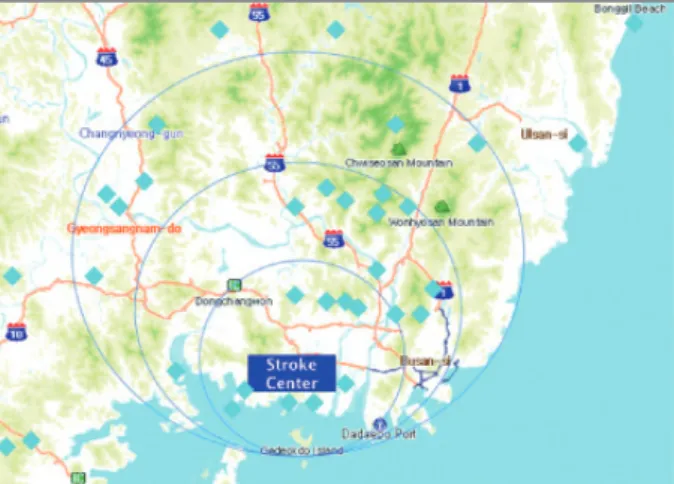
Between December 2008 and August 2009, 102 suspected AS patients were transferred from 38 hospitals around the Busan- Kyungnam area (Fig. 1) to our stroke centre with a prehospi- tal notification from EMS. The distance from the hospital re- questing dispatch to our hospital was 24.0±24.4 km (range, 2.9-153.0 km), the expected transfer time (as calculated by GPS) was 34.4±22.8 min (range, 6-153 min), and the real tr- ansfer time was 56.0±32 min (range, 7-203 min). After adjust- ing the real arrival time according to the transfer distance, the arrival time within 10 km of the transferred distance was 43.1± 20.3min; within 20 km, it was 45.6±22.2 min; and within 40 km, it was 58.0±20.0 min. However, at distances over 40 km,
Fig. 1. Location of our stroke centre and distribution of transfer hos- pitals.
any patients with suspected AS were unable to arrive at our hospital within 60 min. All patients arriving at our hospital with suspected stroke were sent to the MRI room; the door- to-imaging time was 28.9±22.0 min (5-93 min).
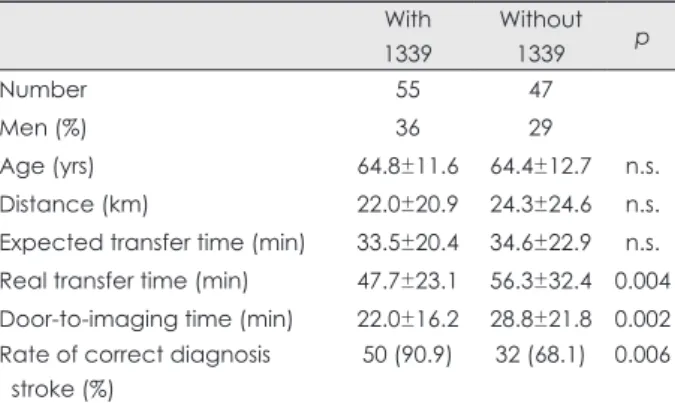
Of the 102 suspected AS patients, 55 (53.9%) were trans- ferred to our hospital to receive IV t-PA. Of these, 63 (61.8%) were transferred during weekends or holidays and 82 (80.4%) were ultimately identified to be true AS patients through neu- rologic examination and brain imaging. Table 1 presents com- parisons of the clinical and time parameters between patients with thrombolysis call and those without it. The positive pre- dictive rate of stroke was significantly higher in patients with thrombolysis prenotification (90.9% vs. 68.1%, p=0.005) than in those without it. The real transfer time (47.7±23.1 min vs.
56.3±32.4 min, p=0.004) and door-to-imaging time (17.8± 11.0 min vs. 28.8±21.8 min, p=0.001) were much shorter in patients with the thrombolysis call than in those without it (Table 1).
Among the 55 patients for whom there had been an IV t-PA call, 50 (47-AIS and 3-brain hemorrhage) had AS (90.9%).
Of the 47 with AIS, 18 (36.7%) received IV t-PA. The rea- sons for not using IV t-PA were as follows; 1) time delays (n=9), 2) large infarctions (n=7), 3) contraindications (n=6), 4) rapidly improved symptoms (n=4), 5) brain haemorrhage
(n=3), and 6) transient ischaemic attack (n=3).
During the observation period, 33 patients received IV t-PA in our hospital without EMS prehospital notification.
Table 2 summarizes the differences in processing time for IV t-PA between patients with and without a prehospital notifi- cation. The door-to-needle time was 29.7±9.6 min (range, 15-52 min) in the 18 patients with a notification who received IV t-PA. The door-to-imaging and door-to-needle times were significantly shorter for 18 patients with EMS prehospital no- tification than for those without it. However, the onset-to-nee- dle time was significantly delayed in the notified group com- pared to the non-notified group.
Discussion
The EMS is key to reducing the time delay to IV t-PA in AIS.
Therefore, therapeutic guidelines strongly recommend the im- plementation of a stroke-care system-related community EMS.
A previous study12 showed that stroke patients using the EMS arrived at the ER 200 min faster than those not using the EMS, suggesting the usefulness of the EMS in optimizing rapid transport and greatly decreasing arrival times to the ER. How- ever, little information is available regarding the time required to transfer a stroke patient via the EMS relative to the distance from the dispatching hospital to the stroke centre; we there- fore addressed this in the present study.
This study identified a time discrepancy of roughly 21 min between the expected transportation time estimated using GPS and the real transportation time for patients with sus- pected AS. Several factors may have contribute to this time difference. The finding of given a difference of only 2 min be- tween dispatch distances of 10 km and 20 km to our stroke centre was attributed to, some intra-ER delay. Also, distances of over 40 km prevented at the ER within 60 min. Given that the onset to call time was 89±21 min (data not shown) for patients with a thrombolysis call in this study, a dispatch dis- tance of more than 40 km may be an unrealistic boundary for a stroke-care system in our community.
Several studies have shown that the EMS enables a rapid dispatch of AS patients to a stroke centre13,14 and consequently enhances the rate of being able to use IV t-PA.10 In the pres- ent study, the transport time was shorter for patients eligible for IV t-PA than for those who were not eligible, indicating that the EMS system may have transferred AS patients eligi- ble for IV t-PA more rapidly to our stroke centre. In particular, the time discerpancy between the expected and real transfer times was significantly shorter for patients with an IV t-PA call (14 min) than for those without one (21 min), suggesting the necessity of close cooperation in the ER for dispatched pa- tients needing IV t-PA and using the EMS.
Table 1. Comparison of transfer and intra-hospital processing times between patients with a prehospital tissue type plasmonogen acti- vator (t-PA) notification call and without such a notification
With 1339
Without
1339 p
Number 55 47
Men (%) 36 29
Age (yrs) 64.8±11.6 64.4±12.7 n.s.
Distance (km) 22.0±20.9 24.3±24.6 n.s.
Expected transfer time (min) 33.5±20.4 34.6±22.9 n.s.
Real transfer time (min) 47.7±23.1 56.3±32.4 0.004 Door-to-imaging time (min) 22.0±16.2 28.8±21.8 0.002 Rate of correct diagnosis
stroke (%)
50 (90.9) 32 (68.1) 0.006 Expected transfer time: transfer time as assessed using the Global Po- sitioning System.
Table 2. Comparisons of clinical and time parameters after intrave- nous t-PA use between patients with and without a prehospital no- tification by the Emergency Medical Service
Without 1339 With 1339 p
Number 33 18
Men (%) 17 (51.5) 14 (77.7) 0.08
Age (yrs) 067.8±11.2 63.6±11.6 0.21
Door-to-imaging time (min) 026.9±11.5 17.8±11.0 0.01 Door-to-needle time (min) 042.1±18.1 29.7±09.6 0.01 Onset-to-needle time (min) 128.6±40.2 150.8±26.4 0.03 Onset-to-door time (min) 086.5±13.8 124.4±16.8 0.02
Prehospital notification might provide the greatest benefit for EMS-related AS care in a stroke centre. The EMS can pro- vide useful information to the stroke centre, enabling the stroke team to cut the time required for intra-hospital processing, such as gathering team members at the ER and preparing the MRI before the arrival of an AS patient needing IV t-PA. In patients with myocardial infarction, prehospital transmission of the ECG and notification of the hospital decreased the time to thrombolysis from 130 min to 81 min.15 However, no previous study has shown similar time savings using this ap- proach in stroke. We recently demonstrated that prehospital notification reduced the door-to-needle time for receiving IV t-PA in AIS. In the current study, the door-to-imaging time based on MRI and the door-to-needle time for IV t-PA were faster for those patients with prehospital notification than for those without it. Our previous report10 presumed that a shorter door-to-imaging time might also have involved a significant- ly shorter door-to-needle time for IV t-PA in the group with prehospital notification. In fact, it has been shown that reduc- ing the imaging time might be the main obstacle to shorten- ing the door-to-needle time for IV t-PA in AIS.16,17 In the present study, prehospital notification shaved 10 min off the door-to-imaging time for using IV t-PA compared to patients without pre-notification. In fact, with the 1339 notification system, we had enough time to prepare the necessary equip- ment before patient arrivals. Our data indicate that patients who underwent MRI with prehospital notification had door- to-needle times of almost 30 min, corresponding to 10 min faster than those without it. This reduction was achieved by a combination of the prehospital notification system and our central alert system for assembling the stroke team. In partic- ular, 10 min reduction in imaging time might have played a pi- votal role in the faster door-to-needle times in the prehospital notified group.
In this study, 61% of patients were transferred on holidays and weekends. Interestingly, almost all patients who transferr- ed to our stroke centre from a hospital had a neurologist or neu- rosurgeon available to administer IV t-PA for AIS. However, on holidays and weekends, these hospitals have a shortfall of facilities and staff to care for patients after receiving IV t-PA.
A previous study showed that lower staffing levels on week- ends were related to a poor outcome in AIS patients.18 We sug- gest that the community hospitals in this study did indeed ex- perience this so-called “weekend effect” in terms of AS, le- ading to the higher transfer rate to our stroke center on week- ends and holidays. Because of this, there is an emphasis on the important role of a comprehensive stroke centre to ame- liorate this “weekend effect” in AS.19
Prehospital notification reduced the intra-hospital process- ing time before AIS patients received t-PA in the current work.
However, the onset-to-needle time was significantly delayed (25 min, p=0.03) in the EMS pre-notified group compared to those patients without pre-notification. This paradoxical re- sult might be related to a drawback of our community stroke rescue system. The 1339 system actually connects an AS pa- tients needing more aggressive treatment from the ER of a community hospital to an available stroke centre, which is res- ponsible for some differences between our results and those from previous studies showing a reduction in the onset-to- needle time with help from the EMS. In the current study, of the 49 AIS patients with EMS pre-notification calls, only 18 (36.7%) received IV t-PA, and the most frequent cause of not using IV t-PA was the delayed time window. Therefore, our community requires an improved mechanism for using the EMS to directly connect an AS patient eligible for thrombolysis to a stroke centre.
In addition, the positive predictive value of stroke was 80.4% in this study. This value is slightly higher than those reported previously.20,21 Considering that most of the initial diagnoses were made by on-duty doctors in the ERs, we con- clude that this difference is probably not meaningful. How- ever, among patients with a thrombolysis call from 1339, the value climbed to more than 92%, which is a relatively good diagnostic rate. A correct diagnosis with prehospital notifica- tion is important in a stroke-care system, as frequent incor- rect prehospital diagnosis of stroke could cause fatigue among the members of a stroke team, who need to be alert state.9 Therefore, in cases of thrombolysis, a relatively high rate of stroke identification from the 1339 system could help main- tain an efficient stroke network for using IV t-PA.
The findings of this study demonstrate the beneficial ef- fects of prehospital notification from the EMS (1339) with re- gard to reducing the transfer time and intrahospital process- ing for AS patients. However, ours was an observational case study based on a stroke centre in a single metropolitan area, and therefore, we cannot assert that this study reveals the wh- ole picture of a stroke-care system using the EMS. Therefore, future well-designed, prospective multicenter trials are needed.
Conflicts of Interest
The authors have no financial conflicts of interest.
Acknowledgements
This study was supported by Dong-A University Research Fund in 2007.
REFERENCES
1. Tissue plasminogen activator for acute ischemic stroke. The National Institute of Neurologic Disorder and Stroke rt-PA Stroke Study Group.
N Engl J Med 1995;333:1581-1587.
2. Hacke W, Kaste M, Fieschi C, Toni D, Lesaffre E, von Kummer R, et al. Intravenous thrombolysis with recombinant tissue plasminogen activator for acute hemispheric stroke. The European Cooperative
Acute Stroke Study (ECASS). JAMA 1995;274:1017-1025.
3. Chiu D, Krieger D, Villar-Cordova C, Kasner SE, Morgenstern LB, Bratina PL, et al. Intravenous tissue plasminogen activator for acute ischemic stroke: feasibility, safety, and efficacy in the first year of clini- cal practice. Stroke 1998;29:18-22.
4. Smith MA, Doliszny KM, Shahar E, McGovern PG, Arnett DK, Lu- epker RV. Delayed hospital arrival for acute stroke: the Minnesota Stroke Survey. Arch Intern Med 1998;129:190-196.
5. Katzan IL, Furlan AJ, Lloyd LE, Frank JI, Harper DL, Hinchey JA, et al. Use of tissue-type plasminogen activator for acute ischemic stroke:
the Cleveland area experience. JAMA 2000;283:1151-1158.
6. Yu KH, Bae HJ, Kwon SU, Kang DW, Hong KS, Lee YS, et al. Anal- ysis of 10,811 cases with acute ischemic stroke from the Korean Stroke Registry: hospital-based multicenter prospective registration study. J Korean Neurol Assoc 2006;24:535-543.
7. Lacy CR, Suh DC, Bueno M, Kostis JB. Delay in presentation and evaluation for acute stroke: Stroke Time Registry for Outcomes Knowl- edge and Epidemiology (S.T.R.O.K.E.). Stroke 2001;32:63-69.
8. Adams HP Jr, del Zoppo G, Alberts MJ, Bhatt DL, Brass L, Furlan A, et al. Guidelines for the early management of adults with ischemic stroke: a guideline from the American Heart Association/American Stroke Association Stroke Council, Clinical Cardiology Council, Cardiovascular Radiology and Intervention Council, and the Athero- sclerotic Peripheral Vascular Disease and Quality of Care Outcomes in Research Interdisciplinary Working Groups: the American Academy of Neurology affirms the value of this guideline as an educational tool for neurologists. Stroke 2007;38:1655-1711.
9. Rajajee V, Saver J. Prehospital care of the acute stroke patient. Tech Vasc Interv Radiol 2005;8:74-80.
10. Kim SK, Lee SY, Bae HJ, Lee YS, Kim SY, Kang MJ, et al. Pre-hos- pital notification reduced the door-to-needle time for iv t-PA in acute ischemic stroke. Eur J Neurol 2009;16:1331-1335.
11. Yun YH, Chung JY, Kang MJ, Huh JT, Park KW, Cha JK. A retro- spective study on intracerebral haemorrhage reduction by MRI versus CT in intravenous thrombolysis for acute ischaemic stroke. Hong Kong J Emer Med 2009 (in press).
12. Barsan WG, Brott TG, Broderick JP, Haley EC, Levy DE, Marler JR.
Time of hospital presentation in patients with acute stroke. Arch In- tern Med 1993;153:2558-2561.
13. Belvís R, Cocho D, Martí-Fàbreagas J, Pagonabarraga J, Aleu A, Gar- cía-Bargo MD, et al. Benefits of a prehospital stroke code system. Fea- sibility and efficacy in the first year of clinical practice in Barcelona, Spain. Cerebrovasc Dis 2005;19:96-101.
14. Schroeder EB, Rosamond WD, Morris DL, Evenson KR, Hinn AR.
Determinants of use of emergency medical services in a population with stroke symptoms: the Second Delay in Accessing Stroke Health- care (DASH II) Study. Stroke 2000;31:2591-2596.
15. Kereiakes DJ, Gibler WB, Martin LH, Pieper KS, Anderson LC. Rel- ative importance of emergency medical system transport and the pre- hospital electrocardiogram on reducing hospital time delay to therapy for acute myocardial infarction: a preliminary report from the Cincin- nati Heart Project. Am Heart J 1992;123:835-840.
16. Wester P, Rådberg J, Lundgren B, Peltonen M. Factors associated with delayed admission to hospital and in-hospital delays in acute stroke and TIA: a prospective, multicenter study. Seek- Medical-Atten- tion-in-Time Study Group. Stroke 1999;30:40-48.
17. Nam HS, Han SW, Ahn SH, Lee JY, Choi HY, Park IC, et al. Improved time intervals by implementation of computerized physician order entry-based stroke team approach. Cerebrovasc Dis 2007;23:289-293.
18. Turin TC, Kita Y, Rumana N, Ichikawa M, Sugihara H, Morita Y, et al. Case fatality of stroke and day of the week: is the weekend effect an artifact? Takashima stroke registry, Japan (1988-2003). Cerebrovas- cular Dis 2008;26:606-611.
19. Albright KC, Raman R, Ernstrom K, Hallevi H, Martin-Schild S, Mey- er BC, et al. Can comprehensive stroke centers erase the ‘weekend ef- fect’? Cerebrovascular Dis 2009;27:107-113.
20. Smith WS, Isaacs M, Corry MD. Accuracy of paramedic identifica- tion of stroke and transient ischemic attack in the field. Prehosp Emerg Care 1998:2:170-175.
21. Zweifler RM, York D, U TT, Mendizabal JE, Rothrock JF. Accuracy of paramedic diagnosis of stroke. J Stroke Cerebrovasc Dis 1998;7:
446-448.