Copyright © 2015 Korean Stroke Society
This is an Open Access article distributed under the terms of the Creative Commons Attribution Non-Commercial License (http://creativecommons.org/licenses/by-nc/3.0/) which permits unrestricted non-commercial use, distribution, and reproduction in any medium, provided the original work is properly cited.
Factors Associated with Early Hospital Arrival in
Patients with Acute Ischemic Stroke
Dongbeom Song,
aEijirou Tanaka,
bKijeong Lee,
aShoichiro Sato,
bMasatoshi Koga,
bYoung Dae Kim,
aKazuyuki Nagatsuka,
cKazunori Toyoda,
bJi Hoe Heo
aaDepartments of Neurology, Severance Stroke Center, Yonsei University College of Medicine, Seoul, Korea bDepartment of Cerebrovascular Medicine, National Cerebral and Cardiovascular Center, Suita, Osaka, Japan cDepartment of Neurology, National Cerebral and Cardiovascular Center, Suita, Osaka, Japan
Correspondence: Ji Hoe Heo Department of Neurology, Yonsei University College of Medicine, 50 Yonsei-ro, Seodaemoon-gu, Seoul 120-752, Korea Tel: +82-2-2228-1605 Fax: +82-2-393-0705 E-mail: [email protected] Received: January 23, 2015 Revised: March 31, 2015 Accepted: April 1, 2015
This work was supported by a grant from the Korea Healthcare Technology Research and Development Project, Ministry for Health and Welfare, Republic of Korea (HI10C2020, HI08C2149). The NCVC Stroke Registry is partially supported by an Intramural Research Fund (H23-4-3) for Cardiovascular Diseases of National Cerebral and Cardiovascular Center. Shoichiro sato holds a fellowship from the vehara Memorial Foundation of Japan. Background and Purpose Factors associated with early arrival may vary according to the
characteristics of the hospital. We investigated the factors associated with early hospital ar-rival in two different stroke centers located in Korea and Japan.
Methods Consecutive patients with ischemic stroke arrived hospital within 48 hours of on-set between January 2011 and December 2012 were identified and the clinical and time variables were retrieved from the prospective stroke registries of Severance Hospital of Yon-sei University Health System (YUHS; Seoul, Korea) and National Cerebral and Cardiovascular Center (NCVC; Osaka, Japan). Subjects were dichotomized into early (time from onset to ar-rival ≤ 4.5 hours) and late (> 4.5 hours) arar-rival groups. Univariate and multivariate analyses were performed to evaluate factors associated with early hospital arrival.
Results A total of 1,966 subjects (992 from YUHS; 974 from NCVC) were included in this study. The median time from onset to arrival was 6.1 hours [interquartile range, 1.7-17.8 hours]. In multivariate analysis, the factors associated with early arrival were atrial fibrilla-tion (Odds ratio [OR], 1.505; 95% confidence interval [CI], [1.168-1.939]), higher initial Na-tional Institute of Health Stroke Scale scores (OR, 1.037; 95% CI [1.023-1.051]), onset dur-ing daytime (OR, 2.799; 95% CI [2.173-3.605]), and transport by an emergency medical ser-vice (OR, 2.127; 95% CI [1.700-2.661]). These factors were consistently associated with early arrival in both hospitals.
Conclusions Despite differences between the hospitals, there were common factors related to early arrival. Efforts to identify and modify these factors may promote early hospital ar-rival and improve stroke outcome.
Keywords Acute stroke therapy; Cerebral infarction; Early hospital arrival; Prehospital delay; Emergency medical service; Countries
Original Article
Introduction
Administration of intravenous (IV) tissue plasminogen activa-tor (tPA) within 4.5 hours,1 and endovascular reperfusion
thera-py within 6 hours2 are the proven treatments for acute ischemic
stroke. However, only a small proportion of patients with
isch-emic stroke receive reperfusion therapy, mainly because of the narrow time window.3,4 Delayed presentation at hospitals is one
of the most important factors hindering reperfusion therapy.3
Even within the therapeutic time window, the benefit is strongly time-dependent.5,6 Therefore, early hospital arrival is important
In an effort to promote early hospital arrival, several studies have been conducted to determine the factors associated with early hospital arrival, and have identified demographic, socio-economic, clinical, and personal characteristics related to early hospital arrival.4,7-10 Early hospital arrival has been associated
with socioeconomic status and the prehospital delivery system, and may involve factors that differ according to the characteris-tics of the country or hospital. Therefore, we investigated the factors associated with early hospital arrival using data of two stroke centers with distinct characteristics, which are located in urban areas of Korea and Japan.
Methods
Study hospital and patients
This is a retrospective cohort study. Data were obtained from the prospective stroke registries of Severance Hospital of the Yon-sei University Health System (YUHS, Seoul, Korea) and the Na-tional Cerebral and Cardiovascular Center (NCVC, Osaka, Japan; ClinicalTrials.gov Identifier: NCT02251665). Consecutive pa-tients with ischemic stroke who had arrived at hospital within 48 hours (24 hours for sensitivity analyses) of symptom onset were included in this study. We excluded patients who had a stroke while they were being hospitalized. The study period was from January 2011 to December 2012. Severance Hospital of the YUHS is a 2000-bed, typical university general hospital located in the cen-tral part of Seoul, the capital city of Korea. The NCVC is a 640-bed hospital specializing in cerebrovascular and cardiovascular dis-eases, and is located in the northern part of Suita city in Osaka pre-fecture, which is the second largest metropolitan area in Japan. The stroke centers of the YUHS and NCVC satisfy the key require-ments for a comprehensive stroke center, as defined by the Brain Attack Coalition.11 The Institutional Review Boards of the YUHS
and NCVC approved this study and granted a waiver of consent because of the retrospective nature of the study.
Variables and groups
The onset time of stroke symptoms, time of arrival at the hos-pital, demographic data, mode of transport, vascular risk factors, and initial National Institute of Health Stroke Scale (NIHSS) score were all retrieved. For patients whose onset of symptoms was unknown, the last known time without symptoms was re-garded as the time of symptom onset. The onset time was cate-gorized into weekday (Monday to Friday) vs. weekend (Satur-day, Sun(Satur-day, and official holidays in each country), and daytime (06:01-22:00) vs. nighttime (22:01-06:00). Mode of transport was classified into emergency medical services (EMS) vs. others (e.g., private car, taxi, walking). Stroke symptoms were retrieved
from NIHSS sub-scales. Each NIHSS sub-scale was categorized as either normal (score=0) or abnormal (score>0). Right and left arm motor scores were combined as “arm weakness,” and right and left leg motor scores were combined as “leg weakness.” Subjects were dichotomized into the early group (time from symptom onset to hospital arrival ≤4.5 hours) and the late group (time from symptom onset to hospital arrival >4.5 hours). The cut-off value of 4.5 hours was chosen considering the current 4.5 hours time limit of IV tPA1 and the possible
en-dovascular reperfusion therapy time window of 6 hours from onset to puncture.2
Statistical analysis
Values were presented as number (%), mean±standard devia-tion (SD), or median with interquartile range [IQR], as appropri-ate. Univariate analyses (independent sample t test or Mann–
Whitney U test for continuous variables, and χ2 test or Fisher’s
ex-act test for categorical variables, as appropriate) were performed to compare demographics, past history, previous medications, stroke symptoms, onset time, and transfer mode between the early and late arrival groups. Variables achieving a P value of <0.1
in the univariate analyses for early hospital arrival were adjusted for multivariate analyses except for each stroke symptom because of potential collinearity with total NIHSS score. Statistical analy-ses were performed using the IBM SPSS Statistics for Windows Version 20.0 (IBM Corp., Armonk, NY, USA). A two-sided P
value of <0.05 was considered statistically significant.
Results
Baseline characteristics
There were 2,047 patients with ischemic stroke (1,228 from YUHS; 1,199 from NCVC) between January 2,011 and Decem-ber 2,012. From these, 2,009 patients (1,016 from YUHS; 993 from NCVC) who arrived at hospital within 48 hours of symp-tom onset were considered for this study. We excluded further 43 patients (24 from YUHS; 19 from NCVC) who had in-hos-pital stroke. Finally, a total of 1,966 subjects (992 from YUHS; 974 from NCVC) were included in the study. Mean age was 70.0 ±13.1 years and 60% were male. Median time from symptom onset to hospital arrival was 6.1 hours [IQR, 1.7-17.8 hours].
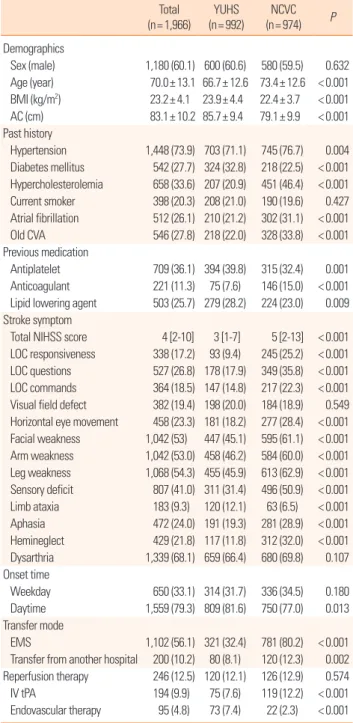
Comparisons of baseline characteristics between the two hos-pitals showed that patients with stroke at the NCVC were older, and had the following characteristics: lower body mass index and abdominal circumference; more frequent history of hyper-tension, atrial fibrillation, hypercholesterolemia, previous stroke, previous use of anticoagulant drugs; less frequent history of dia-betes mellitus and previous use of antiplatelet agent and lipid
lowering drugs; more severe stroke at presentation (higher NI-HSS score); more frequent stroke onset during the nighttime; and more frequent transport by EMS or transfer from another hospital. While overall numbers of patients who received reper-fusion therapy were not different between the two hospitals, IV tPA was more frequently used in NCVC and endovascular re-perfusion therapy was more commonly performed in YUHS
Table 1. Baseline characteristics of patients from the YUHS and NCVC
Total (n= 1,966) YUHS (n= 992) NCVC (n= 974) P Demographics Sex (male) 1,180 (60.1) 600 (60.6) 580 (59.5) 0.632 Age (year) 70.0± 13.1 66.7± 12.6 73.4± 12.6 < 0.001 BMI (kg/m2) 23.2± 4.1 23.9± 4.4 22.4± 3.7 < 0.001 AC (cm) 83.1± 10.2 85.7± 9.4 79.1± 9.9 < 0.001 Past history Hypertension 1,448 (73.9) 703 (71.1) 745 (76.7) 0.004 Diabetes mellitus 542 (27.7) 324 (32.8) 218 (22.5) < 0.001 Hypercholesterolemia 658 (33.6) 207 (20.9) 451 (46.4) < 0.001 Current smoker 398 (20.3) 208 (21.0) 190 (19.6) 0.427 Atrial fibrillation 512 (26.1) 210 (21.2) 302 (31.1) < 0.001 Old CVA 546 (27.8) 218 (22.0) 328 (33.8) < 0.001 Previous medication Antiplatelet 709 (36.1) 394 (39.8) 315 (32.4) 0.001 Anticoagulant 221 (11.3) 75 (7.6) 146 (15.0) < 0.001 Lipid lowering agent 503 (25.7) 279 (28.2) 224 (23.0) 0.009 Stroke symptom
Total NIHSS score 4 [2-10] 3 [1-7] 5 [2-13] < 0.001 LOC responsiveness 338 (17.2) 93 (9.4) 245 (25.2) < 0.001 LOC questions 527 (26.8) 178 (17.9) 349 (35.8) < 0.001 LOC commands 364 (18.5) 147 (14.8) 217 (22.3) < 0.001 Visual field defect 382 (19.4) 198 (20.0) 184 (18.9) 0.549 Horizontal eye movement 458 (23.3) 181 (18.2) 277 (28.4) < 0.001 Facial weakness 1,042 (53) 447 (45.1) 595 (61.1) < 0.001 Arm weakness 1,042 (53.0) 458 (46.2) 584 (60.0) < 0.001 Leg weakness 1,068 (54.3) 455 (45.9) 613 (62.9) < 0.001 Sensory deficit 807 (41.0) 311 (31.4) 496 (50.9) < 0.001 Limb ataxia 183 (9.3) 120 (12.1) 63 (6.5) < 0.001 Aphasia 472 (24.0) 191 (19.3) 281 (28.9) < 0.001 Hemineglect 429 (21.8) 117 (11.8) 312 (32.0) < 0.001 Dysarthria 1,339 (68.1) 659 (66.4) 680 (69.8) 0.107 Onset time Weekday 650 (33.1) 314 (31.7) 336 (34.5) 0.180 Daytime 1,559 (79.3) 809 (81.6) 750 (77.0) 0.013 Transfer mode EMS 1,102 (56.1) 321 (32.4) 781 (80.2) < 0.001 Transfer from another hospital 200 (10.2) 80 (8.1) 120 (12.3) 0.002 Reperfusion therapy 246 (12.5) 120 (12.1) 126 (12.9) 0.574 IV tPA 194 (9.9) 75 (7.6) 119 (12.2) < 0.001 Endovascular therapy 95 (4.8) 73 (7.4) 22 (2.3) < 0.001 Data are presented as number of patients (%), mean± standard deviation, or medi-an [interquartile rmedi-ange].
YUHS, Yonsei University Health System; NCVC, National Cerebral and Cardiovas-cular Center; BMI, body mass index; AC, abdominal circumference; NIHSS, Nation-al Institutes of HeNation-alth Stroke ScNation-ale; LOC, level of consciousness; EMS, emergency medical service.
(Table 1).
Factors associated with early arrival
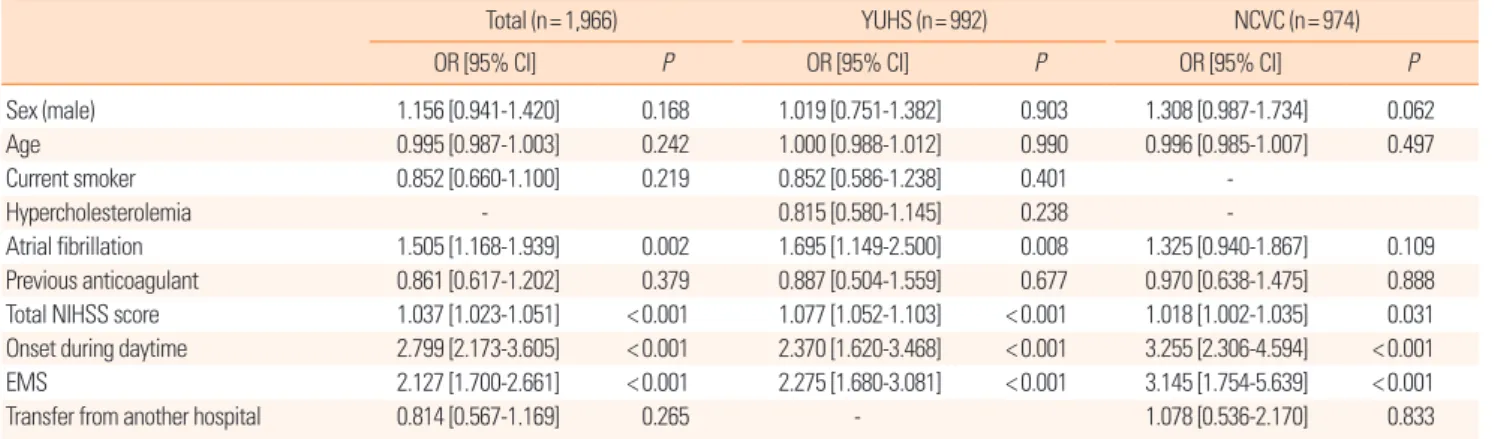
In the univariate analysis of the entire study population, older age, atrial fibrillation, previous use of anticoagulants, higher NI-HSS score, onset during daytime, and transport by EMS were significantly associated with early hospital arrival (Table 2). Transfer from another hospital was significantly associated with late hospital arrival. Presence of most stroke symptoms was relat-ed with early hospital arrival but limb ataxia was not. While atrial fibrillation, higher NIHSS score, onset during daytime, and transport by EMS were commonly associated with early arrival in each hospital, there were still some differences between the hospitals. Older age and non-smoking status were associated with early arrival only in the YUHS group. Transfer from another hospital was associated with late arrival only in the NCVC group. In binary logistic regression analysis of the entire study popu-lation (adjusting for demographics and variables achieving a P
value of < 0.1 in the univariate analyses), atrial fibrillation, high-er initial NIHSS score, onset during daytime, and transport by EMS were independently associated with early arrival. In the binary logistic regression analysis of each hospital group, the factors associated with early arrival for each hospital were com-parable to those of the entire study population, except that atrial fibrillation did not reach statistical significance in the NCVC group (Table 3). In the sensitivity analyses, which includes pa-tients who had arrived at hospital within 24 hours of symptom onset, the results were comparable (Supplementary Tables 1-3).
Discussion
We investigated factors associated with early arrival of pa-tients with stroke at two different stroke centers in Korea and Japan. This study showed that there were consistent factors re-lated to early arrival despite the differences of patients’ charac-teristics in two hospitals.
Although these two stroke centers are located in large metro-politan cities of countries in East Asia, the baseline demograph-ics differed between them, which might be attributable to dif-ferences in hospital, regional, and national characteristics. As the NCVC is a highly specialized referral center for cerebrovas-cular and cardiovascerebrovas-cular diseases even among tertiary centers, patients at the NCVC were older, more severely affected; more frequently transported by EMS or transferred from another hospital; and had more frequent histories of hypertension, atrial fibrillation, previous stroke, and previous use of anticoagulant therapy compared to patients from the YUHS, which is a general tertiary referral center. Meanwhile, higher body mass index and
abdominal circumference, and more frequent history of diabetes mellitus and previous use of antiplatelet agent and lipid lowering drugs in the YUHS patients compared to those from the NCVC may reflect some general features of Korea compared with Japan. During the last few decades, the prevalence of diabetes mellitus and metabolic syndrome has been rapidly increasing in Korea.12
Despite the rate of acute reperfusion therapy were not different between the two hospitals, IV tPA was more frequently used in NCVC, and endovascular treatment was more commonly used in YUHS. This difference might be partly related with the
differ-ent reimbursemdiffer-ent policy of national insurance service for IV tPA as well as the different regulation policy and availability re-garding endovascular devices between the two countries. Time limit of IV tPA for reimbursement was extended from 3 hours to 4.5 hours at August 2012 in Japan,13 but not in Korea during the
study enrollment period.
Despite the different baseline characteristics between the two stroke centers, several major factors associated with early hospi-tal arrival were consistent. Among them, transport by EMS demonstrated important association with early arrival, as in
pre-Table 2. Univariate model of early hospital arrival for the entire study population and for each hospital
Total (n= 1,966) YUHS (n= 992) NCVC (n= 974) Early arrival
group (n= 875) group (n= 1,091)Late arrival P group (n= 423)Early arrival group (n= 569)Late arrival P group (n= 452)Early arrival group (n= 522)Late arrival P Demographics Sex (male) 520 (59.4) 660 (60.6) 0.596 243 (57.4) 357 (63.0) 0.079 277 (61.3) 303 (58.0) 0.305 Age (year) 71.1± 12.7 69.2± 13.3 0.001 68.2± 12.2 65.7± 12.9 0.002 73.9± 12.6 73.0± 12.7 0.255 BMI (kg/m2) 23.1± 3.7 23.2± 4.5 0.501 23.8± 3.5 24.0± 4.9 0.598 22.4± 3.7 22.4± 3.7 0.992 AC (cm) 82.8± 10.3 83.4± 10.1 0.310 85.6± 9.5 85.8± 9.4 0.641 79.0± 10.2 79.2± 9.8 0.731 Past history Hypertension 653 (74.8) 795 (73.1) 0.405 312 (73.8) 391 (69.1) 0.108 341 (75.8) 404 (77.5) 0.516 Diabetes mellitus 227 (26.0) 315 (29.0) 0.143 134 (31.7) 190 (33.6) 0.531 93 (20.7) 125 (24.0) 0.216 Hypercholesterolemia 284 (32.5) 374 (34.4) 0.382 78 (18.4) 129 (22.8) 0.096 206 (45.8) 245 (47.0) 0.698 Current smoker 161 (18.5) 237 (21.8) 0.068 74 (17.5) 134 (23.7) 0.018 87 (19.4) 103 (19.8) 0.878 Atrial fibrillation 294 (33.7) 218 (20.1) < 0.001 130 (30.7) 80 (14.1) < 0.001 164 (36.4) 138 (26.5) 0.001 Old CVA 239 (27.4) 307 (28.2) 0.680 96 (22.7) 122 (21.4) 0.637 143 (31.8) 185 (35.6) 0.204 Previous medication Antiplatelet agent 315 (36.0) 394 (36.2) 0.925 170 (40.2) 224 (39.6) 0.845 145 (32.2) 170 (32.6) 0.874 Anticoagulant 116 (13.3) 105 (9.7) 0.012 39 (9.2) 36 (6.4) 0.093 77 (17.1) 69 (13.2) 0.096 Lipid lowering agent 224 (25.6) 279 (25.7) 0.985 121 (28.6) 158 (27.9) 0.811 103 (22.8) 121 (23.2) 0.887 Stroke symptom
Total NIHSS score 6 [2-15] 3 [1-7] < 0.001 5 [2-14] 3 [1-5] < 0.001 7 [3-17] 4 [2-11] < 0.001 LOC responsiveness 203 (23.2) 135 (12.4) < 0.001 65 (15.4) 28 (4.9) < 0.001 138 (30.5) 107 (20.5) < 0.001 LOC questions 301 (34.4) 226 (20.7) < 0.001 116 (27.4) 62 (10.9) < 0.001 185 (40.9) 164 (31.4) 0.002 LOC commands 220 (25.1) 144 (13.2) < 0.001 98 (23.2) 49 (8.6) < 0.001 122 (27.0) 95 (18.2) 0.001 Visual field defect 229 (26.2) 153 (14.0) < 0.001 124 (29.3) 74 (13.0) < 0.001 105 (23.2) 79 (15.1) 0.001 Horizontal eye movement 304 (34.7) 154 (14.1) < 0.001 132 (31.2) 49 (8.6) < 0.001 172 (38.1) 105 (20.1) < 0.001 Facial weakness 509 (58.2) 533 (48.9) < 0.001 220 (52.0) 227 (39.9) < 0.001 289 (63.9) 306 (58.6) 0.090 Arm weakness 523 (59.8) 519 (47.6) < 0.001 236 (55.8) 222 (39) < 0.001 287 (63.5) 297 (56.9) 0.036 Leg weakness 524 (59.9) 544 (49.9) < 0.001 227 (53.7) 228 (40.1) < 0.001 297 (65.7) 316 (60.5) 0.096 Sensory deficit 427 (48.8) 380 (34.8) < 0.001 172 (40.7) 139 (24.4) < 0.001 255 (56.4) 241 (46.2) 0.001 Limb ataxia 75 (8.6) 108 (9.9) 0.314 44 (10.4) 76 (13.4) 0.158 31 (6.90) 32 (6.1) 0.645 Aphasia 261 (29.8) 211 (19.3) < 0.001 115 (27.2) 76 (13.4) < 0.001 146 (32.3) 135 (25.9) 0.027 Hemineglect 256 (29.3) 173 (15.9) < 0.001 71 (16.8) 46 (8.1) < 0.001 185 (40.9) 127 (24.3) < 0.001 Dysarthria 628 (71.8) 711 (65.2) 0.002 313 (74.0) 346 (60.8) < 0.001 315 (69.7) 365 (69.9) 0.937 Onset time Weekday 596 (68.1) 720 (66.0) 0.321 292 (69.0) 386 (67.8) 0.690 304 (67.3) 334 (64) 0.284 Daytime 764 (87.3) 795 (72.9) < 0.001 369 (87.2) 440 (77.3) < 0.001 395 (87.4) 355 (68) < 0.001 Transfer mode EMS 604 (69.0) 498 (45.6) < 0.001 199 (47) 122 (21.4) < 0.001 405 (89.6) 376 (72) < 0.001 Transfer from another hospital 59 (6.7) 141 (12.9) < 0.001 29 (6.9) 51 (9.0) 0.228 30 (6.6) 90 (17.2) < 0.001 Data are presented with number (%), mean± standard deviation, or median [interquartile range].
YUHS, Yonsei University Health System; NCVC, National Cerebral and Cardiovascular Center; BMI, body mass index; AC, abdominal circumference; CVA, cerebrovascular acci-dent; NIHSS, National Institutes of Health Stroke Scale; LOC, level of consciousness; EMS, emergency medical service.
vious studies.4,7-10 Calling an EMS implies that the patient or
by-stander recognized the symptom of stroke as being urgent, and managed the situation properly. Contact with an EMS enables the appropriate delivery of the patient to the nearest hospital with facilities for acute stroke care.
In our study, the frequency of EMS use was much higher in the NCVC patients (80.2%) compared to those from the YUHS (32.4%). Previous studies using retrospective registry data from tertiary general hospitals in Japan have indicated the frequency of EMS use to be around 50%,14,15 and one study using prospective
survey data from 14 tertiary general hospitals in Korea has indi-cated a frequency of 36%.16,17 Higher rates of EMS use in Japan,
despite EMS being free in both countries, may be associated with better knowledge of act on stroke.16,18 Therefore, public
educa-tion is important for increasing the use of EMS and reducing prehospital delays.17-20 However, the 80% EMS use of the NCVC
in our study was even higher than previous statistics from Japan. It is likely that EMS personnel may prefer to deliver patients with a suspected stroke to a highly specialized hospital like the NCVC. This finding suggests that the awareness of which hospitals have a stroke center by EMS personnel is important for appropriate dispatch, particularly in metropolitan cities with many hospitals.
Greater stroke severity represented by a higher initial NIHSS score is a well-known factor associated with early arrival,4,7-10 and
was confirmed by our analysis. Of note, while most of stroke symptoms were related with early hospital arrival, limb ataxia was not. This may reflect the suboptimal public awareness re-garding limb ataxia as a stroke symptom.21 Onset during daytime
was associated with early hospital arrival. This might be partly attributable to delayed recognition of stroke symptoms by a wit-ness when severe stroke incapacitates people during the night-time. However, waiting until the morning may also cause delays after nighttime onset. This aspect should be addressed in public education.
The association between atrial fibrillation and early hospital ar-rival was also noted in our results, as in most previous reports.9,17
Stroke caused by cardiac embolism is usually more severe and sudden in onset.22 These characteristics may cause patients or
witnesses to seek medical assistance earlier. However, the P values
for atrial fibrillation did not reach the level of statistical signifi-cance after adjusting for confounding factors in the NCVC pa-tients. This might reflect low power of NCVC subgroup rather than true insignificance. While the reason is uncertain, male sex tended to be related with early hospital arrival only in NCVC.
The strength of this study is that we analyzed data for a rela-tively large sample from two distinct hospitals located in differ-ent countries. Our study is also valuable because it is one of only a few reports about this issue in East Asian populations. Howev-er, the study has some limitations that need to be addressed. Firstly, factors known to affect prehospital delays, such as educa-tional, socioeconomic, and personal attributes were not investi-gated in the current study. In addition, some variables were not available from the records, such as the distance from the place where the stroke occurred to the hospital, which might be help-ful in interpreting the results. Secondly, because the two hospi-tals studied were tertiary referral centers located in urban areas of each country, the findings of this study cannot be generalized. These limitations should be considered when interpreting the study results.
In conclusion, transport by EMS, daytime onset, atrial fibril-lation, and higher initial NIHSS scores were consistently associ-ated with early hospital arrival regardless of the country or hos-pital characteristics. Despite transport by EMS is the only di-rectly modifiable factor, education focused on the characteris-tics of late arrival patients might promote early hospital arrival and improve stroke outcome.
Table 3. Multivariate model of early hospital arrival for the entire study population and for each hospital
Total (n= 1,966) YUHS (n= 992) NCVC (n= 974)
OR [95% CI] P OR [95% CI] P OR [95% CI] P
Sex (male) 1.156 [0.941‐1.420] 0.168 1.019 [0.751‐1.382] 0.903 1.308 [0.987‐1.734] 0.062 Age 0.995 [0.987‐1.003] 0.242 1.000 [0.988‐1.012] 0.990 0.996 [0.985‐1.007] 0.497 Current smoker 0.852 [0.660‐1.100] 0.219 0.852 [0.586‐1.238] 0.401 -Hypercholesterolemia - 0.815 [0.580‐1.145] 0.238 -Atrial fibrillation 1.505 [1.168‐1.939] 0.002 1.695 [1.149‐2.500] 0.008 1.325 [0.940‐1.867] 0.109 Previous anticoagulant 0.861 [0.617‐1.202] 0.379 0.887 [0.504‐1.559] 0.677 0.970 [0.638‐1.475] 0.888 Total NIHSS score 1.037 [1.023‐1.051] < 0.001 1.077 [1.052‐1.103] < 0.001 1.018 [1.002‐1.035] 0.031 Onset during daytime 2.799 [2.173‐3.605] < 0.001 2.370 [1.620‐3.468] < 0.001 3.255 [2.306‐4.594] < 0.001 EMS 2.127 [1.700‐2.661] < 0.001 2.275 [1.680‐3.081] < 0.001 3.145 [1.754‐5.639] < 0.001 Transfer from another hospital 0.814 [0.567‐1.169] 0.265 - 1.078 [0.536‐2.170] 0.833 YUHS, Yonsei University Health System; NCVC, National Cerebral and Cardiovascular Center; OR, odds ratio; NIHSS, National Institutes of Health Stroke Scale; EMS, emer-gency medical service.
References
1. Jauch EC, Saver JL, Adams HP Jr, Bruno A, Connors JJ, De-maerschalk BM, et al. Guidelines for the early management of patients with acute ischemic stroke: a guideline for healthcare professionals from the American Heart Association/American Stroke Association. Stroke 2013;44:870-947.
2. Berkhemer OA, Fransen PS, Beumer D, van den Berg LA, Lingsma HF, Yoo AJ, et al. A randomized trial of intraarterial treatment for acute ischemic stroke. N Engl J Med 2015;372:
11-20.
3. de Los Ríos la Rosa F, Khoury J, Kissela BM, Flaherty ML, Alwell K, Moomaw CJ, et al. Eligibility for intravenous recombinant tis-sue-type plasminogen activator within a population: the effect of the European Cooperative Acute Stroke Study (ECASS) III trial.
Stroke 2012;43:1591-1595.
4. Jin H, Zhu S, Wei JW, Wang J, Liu M, Wu Y, et al. Factors associ-ated with prehospital delays in the presentation of acute stroke in urban China. Stroke 2012;43:362-370.
5. Khatri P, Yeatts SD, Mazighi M, Broderick JP, Liebeskind DS, Demchuk AM, et al. Time to angiographic reperfusion and clini-cal outcome after acute ischaemic stroke: an analysis of data from the Interventional Management of Stroke (IMS III) phase 3 trial. Lancet Neurol 2014;13:567-574.
6. Emberson J, Lees KR, Lyden P, Blackwell L, Albers G, Bluhmki E, et al. Effect of treatment delay, age, and stroke severity on the effects of intravenous thrombolysis with alteplase for acute isch-aemic stroke: a meta-analysis of individual patient data from randomised trials. Lancet 2014;384:1929-1935.
7. Morris DL, Rosamond W, Madden K, Schultz C, Hamilton S. Prehospital and emergency department delays after acute stroke: the Genentech Stroke Presentation Survey. Stroke 2000;31:
2585-2590.
8. Derex L, Adeleine P, Nighoghossian N, Honnorat J, Trouillas P. Factors influencing early admission in a French stroke unit.
Stroke 2002;33:153-159.
9. Faiz KW, Sundseth A, Thommessen B, Rønning OM. Prehos-pital delay in acute stroke and TIA. Emerg Med J
2013;30:669-674.
10. Fassbender K, Balucani C, Walter S, Levine SR, Haass A, Grotta J. Streamlining of prehospital stroke management: the golden hour. Lancet Neurol 2013;12:585-596.
11. Gorelick PB. Primary and comprehensive stroke centers: his-tory, value and certification criteria. J Stroke 2013;15:78-89.
12. Lim S, Shin H, Song JH, Kwak SH, Kang SM, Won Yoon J, et al. Increasing prevalence of metabolic syndrome in Korea: the Korean National Health and Nutrition Examination Survey for 1998-2007. Diabetes Care 2011;34:1323-1328.
13. Minematsu K, Toyoda K, Hirano T, Kimura K, Kondo R, Mori E, et al. Guidelines for the intravenous application of recombi-nant tissue-type plasminogen activator (alteplase), the second edition, October 2012: a guideline from the Japan Stroke Soci-ety. J Stroke Cerebrovasc Dis 2013;22:571-600.
14. Inatomi Y, Yonehara T, Hashimoto Y, Hirano T, Uchino M. Pre-hospital delay in the use of intravenous rt-PA for acute ischemic stroke in Japan. J Neurol Sci 2008;270:127-132.
15. Yanagida T, Fujimoto S, Inoue T, Suzuki S. Causes of prehospital delay in stroke patients in an urban aging society. J Clin Gerontol Geriatr 2014;5:77-81.
16. Hong KS, Bang OY, Kim JS, Heo JH, Yu KH, Bae HJ, et al. Stroke statistics in Korea: part II stroke awareness and acute stroke care, a report from the Korean Stroke Society and Clinical Research Center for Stroke. J Stroke 2013;15:67-77.
17. Kim YS, Park SS, Bae HJ, Cho AH, Cho YJ, Han MK, et al. Stroke awareness decreases prehospital delay after acute isch-emic stroke in Korea. BMC Neurol 2011;11:2.
18. Miyamatsu N, Okamura T, Nakayama H, Toyoda K, Suzuki K, Toyota A, et al. Public awareness of early symptoms of stroke and information sources about stroke among the general Japa-nese population: the Acquisition of Stroke Knowledge Study.
Cerebrovasc Dis 2013;35:241-249.
19. Miyashita F, Yokota C, Nishimura K, Amano T, Inoue Y, Shige-hatake Y, et al. The effectiveness of a stroke educational activity performed by a schoolteacher for junior high school students. J Stroke Cerebrovasc Dis 2014;23:1385-1390.
20. Sakamoto Y, Yokota C, Miyashita F, Amano T, Shigehatake Y, Oyama S, et al. Effects of stroke education using an animated cartoon and a manga on elementary school children. J Stroke Cerebrovasc Dis 2014;23:1877-1881.
21. Kim YS, Park SS, Bae HJ, Heo JH, Kwon SU, Lee BC, et al. Pub-lic awareness of stroke in Korea: a population-based national survey. Stroke 2012;43:1146-1149.
22. Ferro JM. Cardioembolic stroke: an update. Lancet Neurol 2003;
Supplementary Table 1. Baseline characteristics of patients who arrived within 24 hours Total (n= 1,629) YUHS (n= 808) NCVC (n= 821) P Demographics Sex (male) 965 (59.2) 483 (59.8) 482 (58.7) 0.661 Age (year) 70.3± 13.1 67.0± 12.6 73.6± 12.8 < 0.001 BMI (kg/m2) 23.1± 3.6 23.8± 3.3 22.4± 3.7 < 0.001 AC (cm) 83.1± 10.2 85.9± 9.4 78.8± 9.9 < 0.001 Past history Hypertension 1,197 (73.6) 580 (71.8) 617 (75.4) 0.095 Diabetes mellitus 426 (26.2) 256 (31.7) 170 (20.8) < 0.001 Hypercholesterolemia 542 (33.3) 170 (21.0) 372 (45.5) < 0.001 Current smoker 317 (19.5) 154 (19.1) 163 (20.0) 0.650 Atrial fibrillation 460 (28.3) 190 (23.5) 270 (33.0) < 0.001 Old CVA 448 (27.6) 178 (22.0) 270 (32.9) < 0.001 Previous medication Antiplatelet 581 (41.9) 316 (39.1) 265 (45.9) 0.011 Anticoagulant 195 (12.0) 66 (8.2) 129 (15.8) < 0.001
Lipid lowering agent 414 (25.4) 233 (28.8) 181 (22.1) 0.002
Stroke symptom
Total NIHSS score 4 [2-12] 4 [1-3] 6 [2-15] < 0.001
LOC responsiveness 302 (18.5) 88 (10.9) 214 (26.1) < 0.001
LOC questions 470 (28.8) 163 (20.1) 307 (37.4) < 0.001
LOC commands 334 (20.5) 137 (16.9) 197 (24.0) < 0.001
Visual field defect 344 (21.1) 179 (22.1) 165 (20.1) 0.322
Horizontal eye movement 429 (26.3) 174 (21.5) 255 (31.1) < 0.001
Facial weakness 892 (54.7) 384 (47.4) 508 (61.9) < 0.001 Arm weakness 904 (55.4) 396 (48.9) 508 (61.9) < 0.001 Leg weakness 916 (56.2) 386 (47.7) 530 (64.6) < 0.001 Sensory deficit 708 (43.4) 274 (33.8) 434 (52.9) < 0.001 Limb ataxia 150 (9.2) 100 (12.3) 50 (6.1) < 0.001 Aphasia 410 (25.1) 169 (20.9) 241 (29.4) < 0.001 Hemineglect 391 (24) 106 (13.1) 285 (34.7) < 0.001 Dysarthria 1,131 (69.3) 550 (67.9) 581 (70.8) 0.209 Onset time Weekday 1,108 (67.9) 564 (69.6) 544 (66.3) 0.145 Daytime 1,286 (78.8) 651 (80.4) 635 (77.3) 0.135 Transfer mode EMS 973 (59.7) 288 (35.6) 685 (83.4) < 0.001
Transfer from another hospital 153 (9.4) 70 (8.6) 83 (10.1) 0.309
Reperfusion therapy 238 (14.6) 117 (14.4) 121 (14.7) 0.867
IV tPA 191 (11.7) 74 (9.2) 117 (14.3) 0.001
Endovascular therapy 90 (5.5) 71 (8.8) 19 (2.3) < 0.001
Data are presented as number of patients (%), mean± standard deviation, or median [interquartile range].
YUHS, Yonsei University Health System; NCVC, National Cerebral and Cardiovascular Center; BMI, body mass index; AC, abdominal circumference; NIHSS, National Institutes of Health Stroke Scale; LOC, level of consciousness; EMS, emergency medical service.
Supplementary Table 2. Univariate model of early hospital arrival for the entire study population and for each hospital in patients arrived within 24 hours
Total (n= 1,631) YUHS (n= 810) NCVC (n= 821) Early arrival
group (n= 875) group (n= 756)Late arrival P group (n= 423)Early arrival group (n= 387)Late arrival P group (n= 452)Early arrival group (n= 369)Late arrival P Demographics Sex (male) 520 (59.4) 445 (59) 0.867 243 (57.4) 240 (62.3) 0.157 277 (61.3) 205 (55.6) 0.097 Age (year) 71.1± 12.7 69.4± 13.5 0.010 68.2± 12.2 65.8± 12.9 0.007 73.9± 12.6 73.2± 13.2 0.471 BMI (kg/m2) 23.1± 3.7 23.1± 3.5 0.996 23.8± 3.5 23.9± 3.1 0.821 22.4± 3.7 22.3± 3.7 0.635 AC (cm) 82.8± 10.3 83.3± 10.1 0.434 85.6± 9.5 86.2± 9.3 0.307 79.0± 10.2 78.6± 9.5 0.678 Past history Hypertension 653 (74.8) 544 (72.2) 0.244 312 (73.8) 268 (69.6) 0.191 341 (75.8) 276 (75.0) 0.797 Diabetes mellitus 227 (26.0) 199 (26.4) 0.846 134 (31.7) 122 (31.7) 0.998 93 (20.7) 77 (20.9) 0.928 Hypercholesterolemia 284 (32.5) 258 (34.3) 0.460 78 (18.4) 92 (23.9) 0.057 206 (45.8) 166 (45.1) 0.848 Current smoker 161 (18.5) 156 (20.7) 0.253 74 (17.5) 80 (20.8) 0.235 87 (19.4) 76 (20.7) 0.650 Atrial fibrillation 294 (33.7) 166 (22.0) < 0.001 130 (30.7) 60 (15.6) < 0.001 164 (36.4) 106 (28.8) 0.021 Old CVA 239 (27.4) 209 (27.8) 0.865 96 (22.7) 82 (21.2) 0.605 143 (31.8) 127 (34.7) 0.378 Previous medication Antiplatelet 315 (42.0) 266 (41.9) 0.967 170 (40.2) 146 (37.9) 0.510 145 (32.2) 120 (48.0) 0.382 Anticoagulant 116 (13.3) 79 (10.5) 0.085 39 (9.2) 27 (7.0) 0.253 77 (17.1) 52 (14.1) 0.250 Lipid lowering agent 224 (25.6) 190 (25.2) 0.855 121 (28.6) 112 (29.1) 0.879 103 (22.8) 78 (21.2) 0.573 Stroke symptom
Total NIHSS score 6 [2-15] 3 [2-8] < 0.001 5 [2-14] 3 [1-6] < 0.001 7 [3-17] 4 [2-13] 0.001 LOC responsiveness 203 (23.2) 99 (13.1) < 0.001 65 (15.4) 23 (5.9) < 0.001 138 (30.5) 76 (20.6) 0.001 LOC questions 301 (34.4) 169 (22.4) < 0.001 116 (27.4) 47 (12.1) < 0.001 185 (40.9) 122 (33.1) 0.020 LOC commands 220 (25.1) 114 (15.1) < 0.001 98 (23.2) 39 (10.1) < 0.001 122 (27.0) 75 (20.3) 0.026 Visual field defect 229 (26.2) 115 (15.2) < 0.001 124 (29.3) 55 (14.2) < 0.001 105 (23.2) 60 (16.3) 0.013 Horizontal eye movement 304 (34.7) 125 (16.5) < 0.001 132 (31.2) 42 (10.9) < 0.001 172 (38.1) 83 (22.5) < 0.001 Facial weakness 509 (58.2) 383 (50.7) 0.002 220 (52.0) 164 (42.4) 0.006 289 (63.9) 219 (59.3) 0.178 Arm weakness 523 (59.8) 381 (50.4) < 0.001 236 (55.8) 160 (41.3) < 0.001 287 (63.5) 221 (59.9) 0.290 Leg weakness 524 (59.9) 392 (51.9) 0.001 227 (53.7) 159 (41.1) < 0.001 297 (65.7) 233 (63.1) 0.445 Sensory deficit 427 (48.8) 281 (37.2) < 0.001 172 (40.7) 102 (26.4) < 0.001 255 (56.4) 179 (48.5) 0.024 Limb ataxia 75 (8.6) 75 (9.9) 0.347 44 (10.4) 56 (14.5) 0.079 31 (6.9) 19 (5.1) 0.308 Aphasia 261 (29.8) 149 (19.7) < 0.001 115 (27.2) 54 (14.0) < 0.001 146 (32.3) 95 (25.7) 0.040 Hemineglect 256 (29.3) 135 (17.9) < 0.001 71 (16.8) 35 (9.0) 0.001 185 (40.9) 100 (27.1) < 0.001 Dysarthria 628 (71.8) 503 (66.5) 0.022 313 (74.0) 237 (61.2) < 0.001 315 (69.7) 266 (72.1) 0.453 Onset time Weekday 596 (68.1) 512 (67.7) 0.867 292 (69.0) 272 (70.3) 0.698 304 (67.3) 240 (65.0) 0.504 Daytime 764 (87.3) 522 (69.0) < 0.001 369 (87.2) 282 (72.9) < 0.001 395 (87.4) 240 (65.0) < 0.001 Transfer mode EMS 604 (69.0) 369 (48.8) < 0.001 199 (47) 89 (23.0) < 0.001 405 (89.6) 280 (75.9) < 0.001 Transfer from another hospital 59 (6.7) 94 (12.4) < 0.001 29 (6.9) 41 (10.6) 0.059 30 (6.6) 53 (14.4) < 0.001 Data are presented with number (%), mean± standard deviation, or median [interquartile range].
YUHS, Yonsei University Health System; NCVC, National Cerebral and Cardiovascular Center; BMI, body mass index; AC, abdominal circumference; CVA, cerebrovascular acci-dent; NIHSS, National Institutes of Health Stroke Scale; LOC, level of consciousness; EMS, emergency medical service.
Supplementary Table 3. Multivariate model of early hospital arrival for the entire study population and for each hospital in patients arrived within 24 hours
Total (n= 1,631) YUHS (n= 810) NCVC (n= 821)
OR [95% CI] P OR [95% CI] P OR [95% CI] P
Sex (male) 1.196 [0.962-1.485] 0.107 1.010 [0.736-1.388] 0.949 1.433 [1.054-1.948] 0.022 Age 0.997 [0.988-1.005] 0.431 1.002 [0.989-1.014] 0.814 0.996 [0.984-1.008] 0.488
Hypercholesterolemia - 0.785 [0.543-1.135] 0.198
-Atrial fibrillation 1.430 [1.089-1.878] 0.010 1.588 [1.082-2.331] 0.018 1.202 [0.858-1.684] 0.286
Previous anticoagulant 0.838 [0.587-1.196] 0.330 -
-Total NIHSS score 1.031 [1.016-1.046] < 0.001 1.072 [1.043-1.101] < 0.001 1.016 [0.998-1.034] 0.084 Onset during daytime 3.235 [2.486-4.210] < 0.001 2.899 [1.950-4.309] < 0.001 3.673 [2.556-5.279] < 0.001 EMS 1.956 [1.532-2.497] < 0.001 2.031 [1.430-2.886] < 0.001 2.845 [1.517-5.336] 0.001 Transfer from another hospital 0.845 [0.571-1.249] 0.398 0.600 [0.332-1.084] 0.091 1.259 [0.590-2.689] 0.551 YUHS, Yonsei University Health System; NCVC, National Cerebral and Cardiovascular Center; OR, odds ratio; NIHSS, National Institutes of Health Stroke Scale; EMS, emer-gency medical service.