1. 서론
1.1 연구의 배경 및 목적
2017년 맥킨지 글로벌 연구소의 글로벌 건설업 혁신 보고 서에 따르면, 건설투자가 많은 41개국의 건설업 생산성은 타 산업에 비해 크게 낮은 수준인 것으로 나타났다(McKinsey Global Institute Report, 2017). 한국의 경우 제조업의 노 동생산성지수는 2008년 100을 기준으로 2010년 120로 20%
증가한 반면, 건설업의 노동생산성 지수는 68.3로 오히려 32.7% 감소하였다(Korea Productivity Center, 2013). 이 는 건설업이 가진 특수한 환경인 사회적, 기후 환경 등과 같 은 외적 요인들의 영향을 많이 받기 때문이다(Kim et al., 2014).
건설업의 생산성 저하를 극복하기 위해 영국, 미국 등을 포함한 세계 각국에서는 기존 건설보다 약 40% 생산성이 높은 공장 제작 및 생산 방식인 오프사이트 건설(Off-Site Construction; OSC)에 대해 주목하기 시작했다. 이 방식은 공장에서 부재를 생산 후, 운반을 통해 건설 현장에서 조립 하는 건설 방식으로, 구조적 안정성, 공기단축, 노동력 감 소, 안전 향상 등에서의 높은 이점을 가진 방식이다(Gibb, 2001). 이러한 건설 방법의 패러다임 변화로 기존 건설 영
* Corresponding author: Kim, TaeWan, College of Urban Architecture Engineering, Incheon National University, Incheon, Korea
E-mail: [email protected] Received May 13, 2019: revised - accepted June 21, 2019
국외 오프사이트 건설 관리 연구 동향 : 작업 단계 수준에서의 문헌 연구
장준영1·Chen Hao1·이찬식2·김태완*
1인천대학교 건축학과·2인천대학교 도시건축학부
Research Trends in Off-Site Construction Management : Review of Literature at the Operation Level
Jang, JunYoung1, Chen Hao1, Lee, Chansik2, Kim, TaeWan*
1Department of Architectural Engineering, Incheon National University
2College of Urban Architecture epartment Engineeringof Architectural Engineering, Incheon National University
Abstract : Off-Site Construction (OSC) is a new construction method based on factory production. OSC (Off-Site Construction) is a new construction method based on factory production. Researches such as OSC-related design and production standardization, transport methods are actively conducted in the U.S., UK and other parts of the world as this new method has an edge over existing methods in terms of productivity, economy and quality. As the emergence of this new area requires reasonable management, an analysis of the scope of construction project management is required accordingly. Therefore, this research analyzed the study trends and relationships at the CM/PM range’s “Operation level” to identify areas of study, relationship between studies and deficiencies in current research. This study carried out a comprehensive literature review of the OSC (CM/PM) research by analyzing 94 papers in Operation level as of September 3, 2018, and the analysis results are as follows. (1) Working stage level researches have been increasing rapidly since 2006. (2) Non-volumetric type is contributing most significantly at work stage level. In the building sector, it has been identified that problems such as residential: living, quality issues, non-residential: economic difficulties, factory: productivity problems have been addressed. (4) The Non-volumetric pre-assembly type dealt with the economic feasibility of residential and non-residential buildings, whereas the modular type was studied in regards to assembly quality. (5) From 2006, project management areas (e.g., quality, human resources, risks) have been expanded. It is expected that this research will help find new areas of research for OSC. If the analysis is carried out to the level of the industrial, corporate and project phases in the future, it is deemed that the overall research flow and area of the OSC industry can be identified.
Keywords : Literature review, Off-site construction, Project management, Modular method, Operation level
역과 달라진 공장 생산, 조립 방식, 운반 방식 등에 대한 세 부 분야별로 활발한 연구가 진행되고 있으며, 다양한 영역의 연구 성과물들이 양산되고 있다. 이에 따라 다음 네 가지 건 설사업관리(Construction Management; CM) 수준에서의 오프사이트 건설 문헌연구가 필요한 실정이다: (1) 산업 수 준: 구조분석, 시장분석, 경쟁분석, 기술예측, 정부정책, 계 약/입찰, 교육, 혁신 등, (2) 기업 수준: 경영전략, 입찰전략, 기술개발 전략 등 (3) 프로젝트 수준: 프로젝트 기획/ 조정, 생산성 향상, 일정관리, 구매관리, 안전관리 등 (4) 작업 단 계 수준: 견적, 전산정보관리, 시공 자동화 등(Construction Engineering & Management, 1997).
관련하여 현재까지 발표된 오프사이트 문헌 연구들은 Li et al. (2014), O’Neill and Organ (2016), Kamali and Hewage (2016), Jin et al. (2018), Hosseini et al. (2018), Zakaria et al. (2018) 등이 있지만, 기존 문헌 연구들은 (1) 국외 연구 동향을 파악하기 위한 정보제공의 보고서에 머물 렀으며, (2) CM/PM 기술 중심의 문헌연구가 부족하며, (3) Scientometric 등의 방법을 이용해 네트워크 중심 분석에 치 중하고 있는 상황이다.
따라서 이 연구는 OSC에서 “작업 단계 수준” 프로젝트 관 리 영역의(일정, 비용, 품질 등) 연구 지형을 명확히 파악하 기 위해, 2018년 9월까지 게재된 94편의 관련 문헌을 대상 으로 동향 분석 및 다 차원 간의 교차분석을 수행하였다. 이 연구는 CM/PM 연구자들로 하여금 OSC 관리 분야의 연구 추세를 이해하고 미래 연구를 계획하고 진행하는데 도움을 줄 것으로 판단된다.
1.2 연구의 범위 및 방법
이 연구는 국외의 OSC (CM/PM) 관련 연구동향 및 주요 영역 간의 관계를 파악하기 위한 연구의 일환으로서 국외 OSC 논문 자료 분석에 중점을 두고 있으며 다음 절차 및 방 법에 따라 수행하였다.
첫째, 국외의 OSC (CM/PM) 분야 연구논문 현황을 조 사한다. 이를 위해 2018년 9월까지 Scopus 및 Web of Science (WoS)에 영어로 게재된 1,042편의 OSC 논문을 수집하였으며, 이때 검색에 사용된 키워드는 다음과 같 다: “Off-site construction” OR “off site construction”
OR “prefabricated construction” OR “industrialized construction” OR “modular construction” OR “offsite construction” OR “precast construction” OR “Modern methods of construction” OR “modular construction and project” OR “prefabrication construction”
둘째, 수집된 1,042편의 논문을 OSC 유형별, 건설 단계 별, 건물 유형별, 관리 영역별로 분류하기 위해 다음과 같 이 용어를 정의하였다: (1) OSC 유형 정의: Gibb (2001)가 제시한 OSC의 4가지 유형으로 Component manufacture and subassembly, Non-volumetric pre-assembly, Volumetric pre-assembly, Modular building로 정의하 였다(Gibb and Isack, 2003). (2) 건설 단계 정의: 기존 건 축 프로세스 6가지 단계로 기획, 설계, 생산, 운반, 조립, 유 지관리 (3) 건물 유형 정의: 주거용 건축물, 비주거용 건축 물, 공업용 건축물 (4) 관리 영역 정의: PMBOK에서 정의 하는 8가지 유형으로 Integrated management, Schedule Management, Cost Management, Quality Management, Human Resource Management, Risk management, Procurement management, Stakeholder Management (PMI, 2013).
셋째, 수집된 1,042편의 논문을 위 5가지 측면으로 분류하 였다. 먼저 수집된 논문 중 OSC 분야가 아닌 논문을 제외하 기 위해 제목 및 키워드를 읽고 검토하여 155편을 제외하였 다. 다음으로 OSC 건축 및 토목 분야가 아닌 논문을 분류하 기 위해 초록을 읽고 169편을 추가 제외하였다. 마지막으로 CM/PM과 관련이 없는 설계, 구조, 설비 등의 477편을 제외 하였다. 이에 따라 OSC (CM/PM)논문은 241편인 것으로 파 악되었으며, 이후 산업 차원, 기업 차원, 프로젝트 차원의 논 문을 제외하여 최종적으로 94편의 작업 단계 수준의 논문을 확보하였다.
넷째, 확보되고 분류된 94편의 논문을 바탕으로 연도별 분석 및 서로 다른 분류 측면 간의 교차분석을 통하여 연도 별 주요 연구 현황, 연구 간의 관계를 파악하였다. 그 결과 도출된 그래프 및 표를 통해 현 OSC 관리 분야의 주요 연구 현황을 파악할 수 있다. 또한, 그 결과를 바탕으로 향후 OSC 연구 활성화를 위한 영역을 제시하였다.
2. 이론적 고찰
2.1 오프사이트 건설의 정의
<Table 1>은 국내의 오프사이트 건설의 정의이다. 2014년 이전까지 Modular building 및 유닛 건축으로 정의되었으 며, 2015년 이후부터 OSC 공법의 정의로 적용되고 있다.
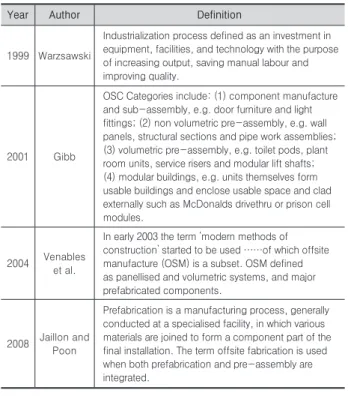
<Table 2>는 국외에서 주로 사용하는 OSC 정의이다. 이 연구에서는 Gibb (2001)가 정의한 내용을 채택하였다. 이는 다른 연구들의 정의 및 범위보다 명확하며 많은 연구에서 사 용되고 있다.
Table 1. Definition of domestic Off-site construction
Year Author Definition
2011 Lee et al.
Modular building construction refers to construction systems and construction methods that assemble and complete factory-produced three-dimensional building modules on site, including frames, facilities, and finishes, in the purpose of shorter construction time, allowance of movement and re-usage of the building, and reduced construction costs.
2011 Lim and Lee
Modular building construction is an architectural system and construction method that assembles factory produced building modules for the purpose of shortening construction time, moving and reusing buildings, and reducing construction costs.
2011 Ha
Unit Modular Building Method is an industrialized construction method based on steel frame that assembles factory-produced building modules on site.
2015 Kim et al.
The OSC method is a construction method where the concept of mass production from general manufacturing industry is applied to the construction industry, that the main components of construction materials are partized, standardized, mass-produced in factories, then moved and assembled on site.
Table 2. Definition of overseas Off-Site construction
Year Author Definition
1999 Warzsawski
Industrialization process defined as an investment in equipment, facilities, and technology with the purpose of increasing output, saving manual labour and improving quality.
2001 Gibb
OSC Categories include: (1) component manufacture and sub-assembly, e.g. door furniture and light fittings; (2) non volumetric pre-assembly, e.g. wall panels, structural sections and pipe work assemblies;
(3) volumetric pre-assembly, e.g. toilet pods, plant room units, service risers and modular lift shafts;
(4) modular buildings, e.g. units themselves form usable buildings and enclose usable space and clad externally such as McDonalds drivethru or prison cell modules.
2004 Venables et al.
In early 2003 the term ‘modern methods of construction’ started to be used ……of which offsite manufacture (OSM) is a subset. OSM defined as panellised and volumetric systems, and major prefabricated components.
2008 Jaillon and Poon
Prefabrication is a manufacturing process, generally conducted at a specialised facility, in which various materials are joined to form a component part of the final installation. The term offsite fabrication is used when both prefabrication and pre-assembly are integrated.
2.2 문헌연구 현황
Li et al. (2014)은 프리패브 건설관리 문헌 100편을 수집 하여 질적분석을 수행하였다. 이를 통해 OSC에서의 다섯 가지 주요 연구주제를 선정하였으나, 이는 산업 수준, 프로 젝트 수준의 문헌 모두를 포함하여, 건축 작업 단계 수준에 서의 상세한 현황을 파악하기 어렵다. O’Neill and Organ
(2016)은 12세기부터 현재까지 영국 저층 건축물에서 프리 패브가 활용된 역사를 정리하여 OSC 발전사를 고찰하였으 나, CM/PM 연구의 방향 및 성과에 관한 내용은 고려되지 않았다. Kamali and Hewage (2016)은 모듈러 건설의 이점 과 어려운 점 및 모듈러 건설의 생애주기 분석에 대한 문헌 연구를 수행하였으나, 이는 유지관리 분야의 연구리뷰로 한 정되어 있다. Jin et al. (2018)은 349개의 OSC 관련 문헌 을 대상으로 VOSViewer를 활용하여 scientometric 분석 을 수행하였으며 이를 통해 주요 연구분야, OSC의 성과측 정, 잠재적 활용기술들, 추후 연구방향 등을 도출하였다. 유 사하게 Hosseini et al. (2018)은 OSC 논문 501개를 수집하 여 VOSViewer를 통해 scientometric 분석을 수행하였으며 이를 통해 추후 연구방향을 제안하였다. 하지만 이들 연구는 CM/PM 논문으로 범위를 국한하지 않았으며 상세 분류 또 한 되어있지 않다. Zakaria et al. (2018)은 OSC 채택에 영 향을 미치는 맥락적(contextual), 구조적(structural), 그리 고 행위적(behavioral) 요인들을 문헌 조사를 통해 정리하였 으나, CM/PM 지식 분류 및 연구 방향을 이해하려는 이 연 구의 목적과 맞지 않다. 따라서 이 연구는 OSC 프로젝트 관 리분야의 연구지형을 명확히 파악하기 위해 CM/PM 논문을 수집 및 분류하였으며 이를 바탕으로 다 차원 간의 교차분석 을 수행하였다.
3. 작업 단계 수준의 OSC CM/PM 연구 동향
3.1 연도별 OSC(CM/PM) 연구의 동향
1986년에서 2018년 사이에 게재 된 CM/PM 논문 증가 추 세를 확인하였다<Fig. 1>. 산업 및 기업 수준, 프로젝트 수 준, 작업 수준의 CM/PM 논문의 수가 2005년 이후 현저하 게 증가하는 것으로 나타났다. 특히 최근 3년(2016~2018)에 게재된 113편의 논문 수는 1986년에서 2015년 사이에 출판 된 132편의 논문 수의 86%에 육박하는 것으로 나타났다. 이 는 2005년 이후부터 작업 단계 수준에서의 효율적인 관리의 필요성으로 인하여 관련 연구가 증가했기 때문으로 파악되
Fig. 1. OSC project management papers trends 1986-2018 (Total 241)
었다. 아래 절부터는 241편의 OSC (CM/PM) 논문 중 본 연 구의 목적인 작업 단계 수준의 논문 94편을 대상으로 다양 한 측면에서의 분석 결과를 설명하고자 한다.
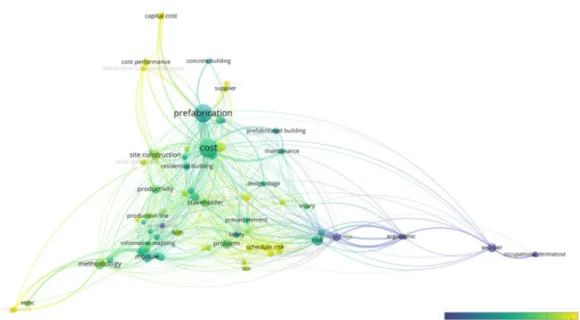
VosViewer는 논문의 주제, 키워드, 초록의 자료를 바탕으 로 분석하여 단어 빈도 및 단어 간의 관계를 보여주는 방법 이다. <Fig. 2>는 VosViewer를 이용하여 분석하였으며, 이 를 통해 시간에 따른 주제의 변화 및 관계를 파악하였다. (1) 2008년~2016년 동안 나타난 주요 단어들로는 조립식 구조 물, 비용, 리스크. 모듈러, 공장 부재 근로자 등인 것으로 파 악하였다. (2) 2017년 이후 주요 단어들로는 일정 리스크, 일 정 지연, 이해관리자 협업, 유지관리 등인 것으로 나타났다.
이는 OSC (CM/PM)의 연구가 포괄적인 연구에서 구체적인 연구로 변화하고 있음을 의미하고 있다.
3.2 건설 단계별 연구 추세
1986년 이후부터 최근까지 생산, 조립단계에 관한 연구가 지속적으로 수행되었으며, 2005년 이후부터 기획, 설계, 운 반 등의 전반적인 범위까지 확장된 것으로 나타났다. 이는 각 단계 단계에 대한 생산성 향상을 위한 것으로 사료된다
<Fig. 3>.
3.3 OSC 유형별 연구 추세
1986년부터 2018년 기간 동안 총 50편의 Non- volumetric pre-assembly 유형의 연구가 수행되었으며, 또 한 Modular building 유형 12편, Component manufacture and subassembly 유형 5편의 연구가 수행된 것으로 나타 났다<Fig. 4>. 특히 Non-volumetric pre-assembly에서는 2006년에서 2018년 동안 40편의 연구가 진행되어 총 80%
가 넘는 연구가 수행된 것을 확인하였다. 이는 해당 유형의 연구영역이 급격하게 확장하며, 깊이 있는 연구가 수행된 것 으로 의미한다.
Non-volumetric pre-assembly 유형은 연도가 지남에 따른 연구들의 주제가 변화하는 것으로 나타났다. 프리캐스 트 생산 계획(Retik and Warszawskit, 1994), 부재 생산 일 정 계획 및 툴 개발(Leu and Hwang, 2002), 부재 및 공법 결정(Baeza Pereyra and Álvarez Romero, 2009; Chen et al., 2010), 운반 및 현장 조립(Wang et al., 2018)의 순으로 주제가 바뀌는 것을 파악하였다. Modular building의 경우 연도가 지남에 따라 생산성 향상을 위한 도구 개발(Han et al., 2012; Moghadam et al., 2012)에서 모듈러 건축물의 품 질 관리(Kim et al., 2016; Yu et al., 2013)로 주제가 변화하 였다. Component manufacture and subassembly의 경우
Fig. 2. OSC Project Management papers Keyword Trend 1986-2018 (Total 241)
Fig. 3. Trends of process-level OSC management papers by phases (Total 94)
Fig. 4. Trends of process-level OSC management papers by OSC types (total 68; missing 26)
현장 내 생산을 통한 조립 방식에 관한 연구가 주로 수행되 었으며(Altobelli et al., 1993; Herkommer and Bley, 1996) 이후 작업자의 안전을 고려한 부재 설계(Kim et al., 2008), 공급망 정보 흐름 및 생산 계획(Wang and Hu, 2018)에 관 한 연구로 관심이 변화하는 것으로 나타났다.
3.4 건물 유형별 연구 추세
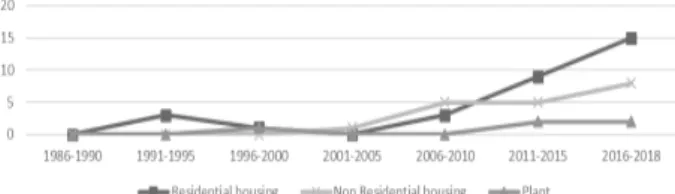
건축물 유형별 분석 결과, 주거용 건축물에 관한 연구가 56%로 큰 부분을 차지하며, 비주거용, 플랜트 유형의 연구 가 그 뒤를 잇고 있다<Fig. 5>. 먼저 주거용 건축물에서는 설계 방안(Jaillon and Poon, 2010), 건축물의 품질(목재 기 반 건축물 품질)(Jonsson and Rudberg, 2017), 건축물 유지 관리(Švajlenka and Kozlovská, 2018), LCA 평가(Samani et al., 2018)와 같은 거주자의 편의성에 관한 연구들이 주 로 수행되었다. 반면 비주거용 건축물에서는 건축 일정 (Moghadam et al., 2012; Salama et al., 2017), 이해관계 자 및 의사결정(Finnie et al., 2018) 등과 같은 사업주의 경 제적 타당성에 관한 연구가 주를 이루고 있다. 한편, 플랜트 의 경우 생산부재의 운반관리(Tam et al., 2007), 재료 조달 프로세스 통합 계획(Jo et al., 2018) 등 공장건설 시 생산성 향상에 초점을 맞추고 있는 것으로 나타났다.
3.5 관리 영역별 연구 추세
관리 영역별 분석 결과 조달관리(22%), 일정관리(18%), 통 합관리(16%) 영역을 중점으로 연구가 수행된 것으로 나타났 으며, 구체적인 세 영역의 연구 주제는 다음과 같다. 첫째, 조달관리의 주요 연구들은 2007년 이전까지 부재 개발, 부재 생산 자동화(Benjaoran and Dawood, 2006), 부재 조달방법 과 같은 연구가 주로 수행되었다. 2007년 이후부터 공급 체 인망 관리(Niu et al., 2017), 프리캐스트 공장 위치 선정(Nor et al., 2012), 사전 부재 관리(제도)(Wu and Low, 2014), 공 급망 리스크 관리(Rebolj and Podbreznik, 2014), 조달 의사 결정(Arashpour et al., 2017), 부재 주문 관리(Yang et al., 2018)와 같이 연구의 주제가 확장되는 것으로 나타났다. 둘 째, 일정관리의 주요 연구들은 1992~2012년 동안 프로젝 트 전체의 일정관리, 일정관리를 위한 툴 개발(Shaked and Warszawski, 1992)에 관한 연구들이 수행되었으며, 2012년
이후 공장 생산 일정 검토 시뮬레이션(Rohani et al., 2014), 현장에서의 부재 조립 일정 수립(Wang and hu, 2017), 현장 조립에서 일정지연을 유발하는 리스크 관리(Li et al., 2017), 현장 조립 Work Break Structure (WBS) 개발(Sutrisna et al., 2018), 현장 조립 일정 시뮬레이션(Li et al., 2018)들 과 같이 세부적인 일정 계획으로 연구의 범위가 넓어진 것 으로 나타났다. 셋째, 통합관리의 주요 연구들은 1991년부 터 2018년까지 연구가 진행되었으며, 주요 주제로는 기술 개 발(Martinez et al., 2015), 공법 선정 검토(Pereyra et al., 2010) 에 대한 연구들을 포함하고 있는 것으로 파악되었다.
1986~2005년까지는 한정된 범위의 연구들이 수행됐으나, 2006~2018년에 들어서는 다양한 연구 및 상세한 연구가 수 행되는 것으로 나타났다<Table 3>.
Table 3. Number of journals in the project management area from 1986 to 2018
Project management
10 areas
Years 1986
-1990 1991 -1995
1996 -2000
2001 -2005
2006 -2010
2011 -2015
2016 -2018 Total Integration
management 0 2 1 1 5 3 3 15
Time
Management 0 1 0 2 0 5 9 17
Cost Management 0 0 0 0 1 2 3 6
Quality
Management 0 0 0 0 0 2 6 8
Human Resources
Management 0 0 0 0 0 3 2 5
Procurement
management 0 0 1 0 4 5 11 21
Risk management 0 0 0 0 0 2 3 5
Stakeholder
Management 0 1 0 0 1 0 4 6
Safety
management 4 0 0 0 1 2 1 8
Maintenance
Management 0 0 1 0 0 0 2 3
Total 4 4 3 3 12 24 44 94
4. CM/PM 영역별 교차분석
OSC 프로젝트의 관리를 향상시키기 위해 어떤 지식이 어 디에서 개발되었는지를 구체적으로 파악하기 위해 앞 장에 서 살펴본 각 분류 측면 간에 교차분석을 수행하였다.
4.1 OSC 유형-건물 유형 교차분석
<Table 4>는 OSC 유형과 건물 유형의 교차분석 결과이 다. 먼저 주거용 건축물 유형에서는 Non-volumetric pre- assembly 유형(69%)과 Modular 유형(19%) 연구의 비율이 높으며, 비주거용 건축물 유형에서는 Non-volumetric pre-
Fig. 5. Trends of process-level OSC management papers by applications (Total 55; missing 39)
assembly 유형(78%)에 관한 연구가 주로 수행된 것으로 나 타났다. 마지막으로 플랜트 유형에서만 Modular 유형(66%) 이 주요 연구인 것으로 확인되었다. 이는 주거용, 비주거용 건축물에서 Non-volumetric pre-assembly 유형(70%)에 관한 연구들이 관심이 높은 것을 알 수 있으며, 프리 캐스트 콘크리트의 연구가 주된 OSC 구성 요소였다고 기술한 내용 과 유사한 것으로 확인되었다(Jin et al., 2018).
Table 4. Cross-tabulation of process-level OSC management papers by OSC types and construction types (Total 43; Unknown 51)
OSC types
Construction 4 type Residential
housing
Non- Residential
housing
Plant Total
Component
manufacture 2 1 0 3
Non-volumetric
pre-assembly 18 11 1 30
Volumetric 1 0 0 1
Modular 5 2 2 9
Total 26 14 3 43
4.2 건설 단계-관리 영역 교차분석
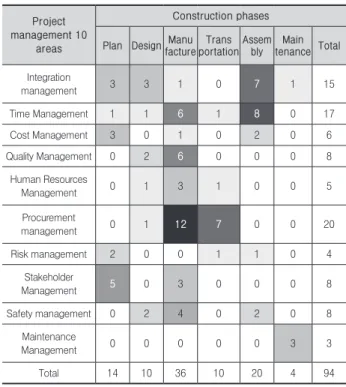
<Table 5>는 프로젝트 관리 영역 측면과 건설 단계 측면 으로 교차 분석한 결과이다. 먼저 가장 많은 비중을 차지하 는 조달관리에서는 주로 생산단계(60%)와 운반단계(35%)에 서 많은 연구가 수행된 것으로 나타났다. 생산단계에서는 생 산 계획 및 제어 관리(Sadiq et al., 2018), 생산 툴 및 자동화 개발(Garg and Kamat, 2014)를 위한 연구가 수행되었으며, 운반단계에서는 공급망 관리(Melo and Alves, 2010), 공급 망 리스크(Zhai et al., 2017)를 위한 연구가 수행된 것을 파 악하였다. 이는 공장에서 현장까지 부재 등의 이동을 합리적 또는 효율적인 관리의 필요성 때문인 것으로 사료된다. 둘째 로 일정관리 분야의 주요 연구는 조립단계(47%)와 생산단계 (35%)에서 많이 나타났다. 조립단계에서는 현장 조립일정을 관리를 위한 일정관리 및 개발 등에 관한 연구가 이루어졌으 며, 생산단계에서는 공장 중심의 부재 생산을 위한 일정 관 리 연구(Arashpour et al., 2016), 생산 일정 자동화(Leu et al., 2002) 연구들이 중점으로 수행된 것을 확인하였다. 이 는 생산 지연으로 인해 이후 공정에서 비용과 일정에 영향 을 미치기 때문인 것으로 사료된다. 마지막으로 통합관리 분 야에서는 조립단계(46%), 기획단계(20%), 설계단계(20%)가 주요 영역인 것으로 나타났다. 이는 기획 초기 단계에서 조 립 공법 선정, 장비의 선정으로 프로젝트의 의사결정(비용, 일정)의 효율성을 높이기 위한 것으로 파악되었다.
각 건설 단계별 연구의 주요 관리 영역 또한, 생산단계, 조 립단계, 기획단계 등 건설 단계에 따라 차이가 있었다.
첫째, 생산단계는 38%로 다른 항목에 비해 높은 비율을 차지하고 있으며, 주요 지식영역으로는 조달관리(부재 생산 성 관련 및 공급망 관련(Heravi and Firoozi, 2017), 현장 로 봇 제작 등 공장 생산성을 높이기 위한 연구(Herkommer and Bley, 1996), 일정관리(부재 일정관리, 부재 운반 일정 에 관한 연구 등 생산 작업의 진행이 계획대로 수행되도록 배려하고 지연의 원인을 제거하기 위한 연구), 품질관리(품 질 검사와 관련된 연구(Kim et al., 2016) 등 재작업 발생을 예방하기 위한 연구(Rausch et al., 2017))인 것으로 나타났 다. 둘째, 조립단계의 연구는 21%로 생산단계 다음으로 연 구의 비율이 높은 것으로 나타났으며 주요 연구로는 크레인 사용 계획(Han et al., 2015), 조립 일정 개발 및 관리(Cheng and Chen, 2002)에 관한 연구 등 일정관리, 통합관리와 관 련된 내용이 주를 이루는 것으로 파악되었다. 셋째, 기획단 계는 14%의 비율을 차지하고 있으며 주로 이해관리자관리, 리스크관리, 일정관리 영역에서 연구가 수행된 것으로 나타 났다. 기획단계는 건축 초기 단계로 이해관계자 협업을 통해 위험요소인 예산 관리 최적화(Xue et al., 2018), 일정 오류 (Li et al., 2017) 등의 관리를 통해 제어할 수 있기 때문에 이 에 관련된 프로젝트의 합리적인 공법선정, 리스크 사전도출, 이해관계자 의사결정과 같은 연구가 주로 수행된 것으로 사 료된다.
Table 5. Cross-tabulation of process-level OSC management papers by project phases and management areas
Project management 10
areas
Construction phases
Plan Design Manu facture
Trans portation
Assem bly
Main tenance Total
Integration
management 3 3 1 0 7 1 15
Time Management 1 1 6 1 8 0 17
Cost Management 3 0 1 0 2 0 6
Quality Management 0 2 6 0 0 0 8
Human Resources
Management 0 1 3 1 0 0 5
Procurement
management 0 1 12 7 0 0 20
Risk management 2 0 0 1 1 0 4
Stakeholder
Management 5 0 3 0 0 0 8
Safety management 0 2 4 0 2 0 8
Maintenance
Management 0 0 0 0 0 3 3
Total 14 10 36 10 20 4 94
반면 유지관리(3%), 리스크관리(4%), 인적자원관리(5%), 비용관리(6%), 품질관리(9%), 안전관리(9%), 비용관리(6%) 는 전체 논문 대비 낮은 비율로 연구가 미흡한 것으로 나타 나고 있다. 또한, 건설단계 측면에서도 생산단계, 조립단계, 기획단계를 제외한 분야는 전체 대비 10%의 낮은 비율로 연 구가 수행된 것으로 나타났다. 이는 OSC 프로젝트의 관리 효율성을 저하 시킬 수 있으므로 향후 해당 연구 분야의 지 속적인 연구와 관심의 증대가 요구된다.
4.3 OSC 유형-건설 단계 교차분석
<Table 6>는 OSC 유형과 건설 단계를 교차 분석한 결과 를 보여주고 있다. Non-volumetric pre-assembly 유형 절 반에 해당하는 생산단계(38%) 및 조립단계(22%)의 연구가 주로 다루어진 것으로 나타났다. 생산단계에서는 공장생산 의 효율적인 관리, 조립단계에서는 조립 일정의 효율적인 관 리를 위한 연구가 수행된 것을 파악하였다. 주요 연구로는 효율적인 자원 활용을 위한 조립 일정 계획(Taghaddos et al., 2014), 조립 일정 프로세스 검토(Rohani et al., 2014) 연구들이 수행된 것으로 나타났다.
Table 6. Cross-tabulation of process-level OSC management papers by OSC types and phases
OSC types
Construction phases
Plan Design Manu facture
Trans portation
Assem bly
Main tenance Total Component
manufacture 0 1 2 1 1 0 5
Non-volumetric
pre-assembly 7 6 19 4 11 3 50
Volumetric 0 1 0 0 0 0 1
Modular 1 1 5 0 5 0 12
Unknown 6 2 10 5 3 1 27
Total 14 10 36 10 20 4 94
4.4 건설 단계-건물 유형 교차분석
<Table 7>은 건물 유형과 건설 단계를 교차 분석한 결과 이다. 전체의 56%를 차지하는 주거용 건축물 유형에서 생산 단계(29%)에서 거주자의 주거환경 및 건축비용에 관한 연구 등 생산과 품질 및 비용을 중점으로 연구가 수행되었으며, 또한 조립단계(29%)에서는 조립 일정, 기술, 안전에 관한 연 구 등 조립 일정의 체계적인 일정 관리를 통해 시공자의 편 의를 위한 연구가 주로 수행된 것으로 파악되었다. 반면 운 반단계, 유지관리단계가 7%의 비율로 관련 연구가 부족한 것으로 나타났다.
Table 7. Cross-tabulation of process-level OSC management papers by Construction types and phases
Construction 4 types
Construction phases Plan Design Manu
facture Trans portation
Assem bly
Main tenance Total Residential
housing 7 4 8 2 8 2 28
Non Residential
housing 4 4 1 3 6 1 22
Plant 0 0 2 1 1 1 5
Unknown 3 3 25 3 5 0 39
Total 14 11 36 9 20 4 94
4.5 관리 영역-OSC 유형 교차분석
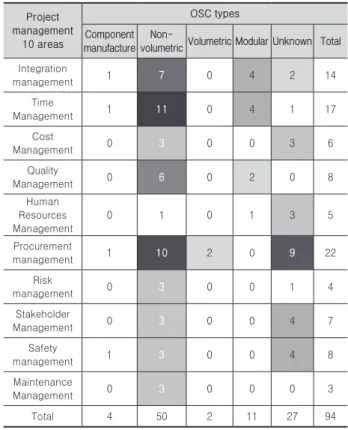
<Table 8>과같이 Non-volumetric pre-assembly 유형의 문헌 비율이 53%를 차지하고 있으며, 주로 일정관리(22%), 조달관리(20%)에 관한 연구를 중점으로 수행한 것으로 나타 났다. 먼저 일정관리에서는 현장에서의 일정관리에 관한 연 구(Li et al., 2018)가 대부분을 차지하고 있으며, 다음으로 조 달관리에서는 공장에서의 부재 생산과 운반에 관련된 연구 (Garg and Kamat, 2012)가 주로 수행되었음을 확인할 수 있 었다. 통합관리, 품질관리 등도 활발히 연구되고 있었으며, 반면 비용관리, 인적자원관리 등을 포함한 6가지 관리유형에 관한 연구가 상대적으로 부족한 것을 확인할 수 있었다.
Table 8. Cross-tabulation of process-level OSC management papers by management areas and OSC Types
Project management
10 areas
OSC types Component
manufacture Non-
volumetricVolumetric Modular Unknown Total Integration
management 1 7 0 4 2 14
Time
Management 1 11 0 4 1 17
Cost
Management 0 3 0 0 3 6
Quality
Management 0 6 0 2 0 8
Human Resources Management
0 1 0 1 3 5
Procurement
management 1 10 2 0 9 22
Risk
management 0 3 0 0 1 4
Stakeholder
Management 0 3 0 0 4 7
Safety
management 1 3 0 0 4 8
Maintenance
Management 0 3 0 0 0 3
Total 4 50 2 11 27 94
4.6 관리 영역-건물 유형 교차분석
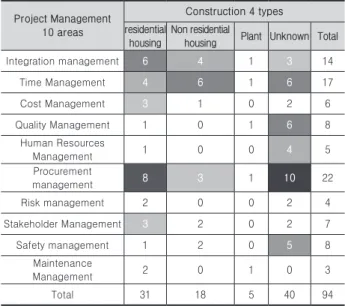
프로젝트 관리 영역과 건물 유형 간 교차분석 결과, 먼저 주거용 건축물 유형(30%)에서는 주로 조달관리, 통합관리, 일정관리, 비용관리 연구가 이루어지고 있는 것으로 파악되 었다<Table 9>. 조달관리에서는 공장에서의 부재 생산을 위 한 생산계획 및 제어시스템 개발(Sadiq et al., 2018), 실시간 생산 데이터 분석을 통한 시스템과 운반을 위한 차량 플랫 폼 개발(Xu et al., 2018) 등에 관한 연구가 이루어지고 있었 다. 통합관리에서는 공장에서의 부재 설계를 위한 도구 개발 (Diez et al., 2007), 생산 자동화(Penin et al., 1998), 장비 관리의 효과를 증대시키는 연구 등 기술 및 공법 개발에 관 한 연구가 수행된 것으로 나타났다. 마지막으로 일정관리에 서는 현장을 중심으로 한 일정관리 연구가 수행되었으며, 조 립식 모듈 일정 개발(Li et al., 2018), 일정 리스크 요인 도출 (Li et al., 2017)에 관한 연구 등을 포함하고 있었다. 반면 품 질관리(3%), 인적자원관리(3%), 리스크관리(6%), 안전관리 (3%), 유지관리(6%)에 관한 연구는 상대적으로 부족한 것으 로 나타났다.
Table 9. Cross-tabulation of process-level OSC management papers by management areas and construction types
Project Management 10 areas
Construction 4 types residential
housing
Non residential
housing Plant Unknown Total
Integration management 6 4 1 3 14
Time Management 4 6 1 6 17
Cost Management 3 1 0 2 6
Quality Management 1 0 1 6 8
Human Resources
Management 1 0 0 4 5
Procurement
management 8 3 1 10 22
Risk management 2 0 0 2 4
Stakeholder Management 3 2 0 2 7
Safety management 1 2 0 5 8
Maintenance
Management 2 0 1 0 3
Total 31 18 5 40 94
5. 결론
OSC 연구는 기존 건설방식보다 높은 생산성을 확보하기 위해 강조되고 있고, 이에 따라 OSC를 효과적으로 수행하기 위하여 작업 단계 수준의 CM/PM 연구들이 급격히 늘어나 고 있다. 따라서 이 연구는 OSC 프로젝트 관리를 지원하기 위해 어떤 지식이 개발되었는지를 이해하기 위해, 국외의 관 련 OSC (CM/PM) 논문을 검토하였다.
이 연구의 주요 결과는 다음과 같다: (1) 2006년 이후부터 작업 단계 수준의 OSC (CM/PM) 연구에 대한 관심이 증가 하는 것으로 나타났다. 즉, 1986년부터 2005년까지 전체 연 구의 3%가 수행되었지만 2006~2018년 동안 97%가 수행 된 것으로 나타났다. 또한, 계획, 설계, 운반, 유지보수 등 의 다양한 영역으로 연구 주제가 확장되는 것으로 나타났다.
(2) 1990년 이전에서는 Component Manufacture, Non- volumetric pre-assembly, Modular의 연구가 비슷한 증 가 추세를 보였지만, 2006년 이후 Non-volumetric pre- assembly 유형을 중심으로 연구가 수행되는 것을 파악하였 다. 이러한 변화는 부위별 생산으로 인한 오차 감소, 단일 크 기의 감소로 인한 운반 이점 등으로 인한 것으로 사료된다.
(3) 주거용 건축물에서는 거주자의 편의성에 관련된 연구가 수행되었으며, 비주거용 건축물에서는 거주자의 경제성에 관련된 연구들이 주로 이루어진 것으로 나타났다. 한편 플랜 트에서는 시공 품질에 관한 연구들이 주로 진행되는 것으로 파악되었다. (4) 관리 영역별 시간에 따른 분석 결과, 1986 년~2005년까지 일정관리, 통합관리 분야가 주요 영역인 것 으로 나타났다. 2006년 이후부터 조달관리, 원가관리, 품질 관리, 인적자원관리, 리스크관리, 안전관리, 유지관리와 같 은 연구들로 범위가 확장되는 것을 파악하였다. 이는 각 관 리 영역 연구들이 한정된 범위의 연구들이 수행되었으나, 최 근 들어서는 연구의 범위가 세분화되며 다양한 참여자들에 게 도움이 될 수 있는 연구들로 확장되는 것으로 사료된다.
(5) 주거용 건축, 비주거 유형에서는 Non-volumetric pre- assembly 유형의 연구가 주로 수행되었으며, 플랜트 유형 에서는 Modular 유형 연구가 주로 수행된 것으로 분석을 통 해 파악되었다. (6) 생산단계(조달, 일정, 품질관리 분야), 조 립단계(일정, 통합 관리 분야), 기획단계(통합, 비용 관리 분 야)에 대한 연구가 주로 수행된 것으로 나타났다. OSC (CM/
PM) 연구가 특정 연구 분야에서는 심도 있는 연구가 수행되 었지만, 반면 다른 영역에서는 연구의 수행 빈도가 낮은 것 으로 나타났다.
이 논문은 CM/PM 연구자에게 OSC 프로젝트 관리 분야 의 연구 추세를 이해하고 미래 연구를 계획하고 수행하는 데 도움을 줄 것으로 예상한다. 추후 산업·기업·프로젝 트 차원의 문헌에 대한 검토, 기존 연구의 결과 및 한계점 등 에 대한 명확한 파악, 연구에 사용된 데이터 및 기술들(BIM, Simulation, VR, AR 등)에 대한 조사가 추가로 진행된다면 다양한 측면의 OSC (CM/PM) 연구 지형을 파악할 수 있을 것으로 기대된다.
References
Altobelli, F., Taylo, H., and Bernold, L. (1993). “The International Institute of Production Engineering Research (CIRP).” Journal of Aerospace Engineering, 6(1), pp. 19–33.
Arashpour, M., Wakefield, R., Abbasi, B., Lee, E.W.M., and Minas, J. (2016). “Off-site construction optimization: Sequencing multiple job classes with time constraints.” Automation in Construction, 71, pp. 262–270.
Arashpour, M., Bai, Y., Aranda-mena, G., Bab- hadiashar, A., Hosseini, R., and Kalutara, P. (2017).
“Optimizing decisions in advanced manufacturing of prefabricated products: Theorizing supply chain configurations in off-site construction.” Automation in Construction, 84, pp. 146–153.
Baeza Pereyra, J., and Álvarez Romero, S. (2009).
“Technical and economical simulation of two roofing construction systems in southeast Mexico.” Revista Ingenieria de Construccion, 24(2), pp. 167–180.
Benjaoran, V., and Dawood, N. (2006). “Intelligence approach to production planning system for bespoke precast concrete products.” Automation in Construction, 15(6), pp. 737–745.
Chen, Y., Okudan, G.E., and Riley, D.R. (2010).
“Decision support for construction method selection in concrete buildings: Prefabrication adoption and optimization.” Automation in Construction, 19(6), pp. 665–675.
Cheng, M.Y., and Chen, J.C. (2002). “Integrating barcode and GIS for monitoring construction progress.” Automation in Construction, 11(1), pp.
23–33.
Diez, R., Padrón, V.M., Abderrahim, M., and Balaguer, C. (2007). “AUTMOD3 : The Integration of Design and Planning Tools for Automatic Modular Construction.” International Journal of Advanced Robotic Systems, 4(4), pp. 457–468.
Finnie, D., Ali, N.A., and Park, K. (2018). “Enhancing off-site manufacturing through early contractor involvement (ECI) in New Zealand.” Management Procurement and Law, 171(4), pp. 176–185.
Garg, A., and Kamat, V.R. (2012). “Virtual Prototyping
for Robotic Fabrication of Rebar Cages in Manufactured Concrete Construction.” Journal of Architectural Engineering, 20(1), pp. 309–318.
Gibb, A. (2001). “A review of recent and current industry and research initiatives on pre-assembly in construction.” Construction Research & Innovation Strategy Panel Rights, pp. 5–8.
Gibb, A., and Isack, F. (2003). “Re-engineering through pre-assembly: Client expectations and drivers.”
Building Research and Information, 31(2), pp. 146–
160.
Ha, T.H. (2011). “Structural Performance of Modular Building System.” Journal of the KGBC, 12(3), pp.
26-33.
Hällmark, R., White, H., and Collin, P. (2012).
“Prefabricated Bridge Construction across Europe and America.” Practice Periodical on Structural Design and Construction, 17(3), pp. 82–92.
Han, S.H., Al-Hussein, M., Al-Jibouri, S., and Yu, H.
(2012). “Automated post-simulation visualization of modular building production assembly line.”
Automation in Construction, 21, pp. 229–236.
Han, S.H., Hasan, S., Bouferguène, A., Al-hussein, M., Asce, M., and Kosa, J. (2015). “Utilization of 3D Visualization of Mobile Crane Operations for Modular Construction On-Site Assembly.” Journal of Management in Engineering, 31(5), pp. 1–9.
Heravi, G., and Firoozi, M. (2017). “Production process improvement of buildings’ prefabricated steel frames using value stream mapping.” The International Journal of Advanced Manufacturing Technology, 89(9), pp. 3307–3321.
Herkommer, F., and Bley, B. (1996). “CAD/CAM for the prefabrication of brickwork.” Automation in Construction, 4(4), pp. 321–329.
Hosseini, M.R., Martek, I., Zavadskas, E.K., Aibinu, A.A., Arashpour, M., and Chileshe, N. (2018).
“Critical evaluation of off-site construction research: A Scientometric analysis.” Automation in Construction, 87, pp. 235–247.
Jaillon, L., and Poon, C.S. (2010). “Design issues of using prefabrication in hong kong building construction.” Construction Management and Economics, 28(10), pp. 1025–1042.
Jin, R., Gao, S., Cheshmehzangi, A., and Aboagye- Nimo, E. (2018). “A Holistic Review of off-site Construction Literature Published between 2008 and 2018.” Journal of Cleaner Production, 202, pp.
1202–1219.
Jo, S., Lee, E., and Pyo, K. (2018). “Integrating a Procurement Management Process into Critical Chain Project Management (CCPM): A Case- Study on Oil and Gas Projects, the Piping Process.”
Sustainability, 10(6), p. 1817.
Jonsson, H., and Rudberg, M. (2017). “KPIs for measuring performance of production systems for residential building: A production strategy perspective.” Construction Innovation, 17(3), pp.
381–403.
Kamali, M., and Hewage, K. (2016). “Life cycle performance of modular buildings: A critical review.”
Renewable and Sustainable Energy Reviews, 62, pp.
1171–1183.
Kim, M.K., Wang, Q., Park, J.W., Cheng, J.C.P., Sohn, H., and Chang, C.C. (2016). “Automated dimensional quality assurance of full-scale precast concrete elements using laser scanning and BIM.”
Automation in Construction, 72, pp. 102–114.
Kim, M.K,. Brilakis, L., and An, Y.K. (2015). “A study on influencing factors and revitalization of the adoption of off-site construction.” Journal of KIBIM, 5(3), pp. 33-40.
Kim, S., Seol, H., Ikuma, L.H., and Nussbaum, M.A.
(2008). “Knowledge and opinions of designers of industrialized wall panels regarding incorporating ergonomics in design.” International Journal of Industrial Ergonomics, 38(2), pp. 150–157.
Korea Institute of Civil Engineering and Building Technology. (1997). Construction Engineering &
Management. 1rd ed, Boseonggak, Korea, pp. 25- 26.
Korea Productivity Center (2013). “Quarterly Labor Productivity Tendency.” <http://www.kpc.or.kr/>
(Nov. 1, 2018)
Lee, C,J., and Lim, S,H. (2015). “An Analysis on Architectural Characteristics of Domestic Modular Housing and Building Material Standardization Effect through MC Design.” Journal of the Korean
Housing Association, 26(6), pp. 103-113.
Leu, S.S., and Hwang, S.T. (2002). “GA-based resource-constrained flow-shop scheduling model for mixed precast production.” Automation in Construction, 11(4), pp. 439–452.
Li, C.Z., Xu, X., Shen, G.Q., Fan, C., Li, X., and Hong, J. (2018). “A model for simulating schedule risks in prefabrication housing production: A case study of six-day cycle assembly activities in Hong Kong.”
Journal of Cleaner Production, 185, pp. 366–381.
Li, C.Z., Zhong, R.Y., Xue, F., Xu, G., Chen, K., Huang, G. G., and Shen, G.Q. (2017). “Integrating RFID and BIM technologies for mitigating risks and improving schedule performance of prefabricated house construction.” Journal of Cleaner Production, 165, pp. 1048–1062.
Li, Z., Shen, G.Q., and Xue, X. (2014). “Critical review of the research on the management of prefabricated construction.” Habitat International, 43, pp. 240–
249.
Lim, S.H., and Lee, G.K. (2011). “A Study on the Standardization of UBR (Unit Bath Room) by Utilizing Reference Plane.” Journal of Architectural Institute of Korea, 27(1), pp. 81-88.
Martinez, S., Jardon, A., Navarro, J.M., Gonzalez, P., Martinez, S., Jardon, A., and Gonzalez, P. (2015).
“Building industrialization : robotized assembly of modular products.” Assembly Automation, 28(2), pp.
134–142.
Kim, D.M., Lee, J.S., Kim, J.H., and Kim, J.J.
(2014). “Marketing Strategy and Influential Factors based on the Attributes of Unit Modular System.”
Korean Journal of Construction Engineering and Management, KICEM, 15(1), pp. 78-86.
McKinsey & Company (2017). Reinventing construction through a productivity revolution, McKinsey Global Institute Report, 2017-11.
Melo, R.S.S. De, and Alves, T.C.L. (2010). “Investigation of the supply chain of prefabricated wooden doors.”
Lean Construction Journal, pp. 30–42.
Moghadam, M., Al-Hussein, M., Al-Jibouri, S., and Telyas, A. (2012). “Post simulation visualization model for effective scheduling of modular building construction.” Canadian Journal of Civil
Engineering, 39(9), pp. 1053–1061.
Niu, Y., Lu, W., Liu, D., Chen, K., Anumba, C., and Huang, G.G. (2017). “An SCO-Enabled Logistics and Supply Chain–Management System in Construction.” Journal of Construction Engineering and Management, 143(3).
Nor, M., Azman, A., Ahamad, M.S.S., Hamid, Z.A., and Gomez, C.P. (2012). “The selection of IBS precast manufacturing plant in Malaysia using GIS.”
Malaysian Construction Research Journal, 10(1), pp.
77–90.
O’Neill, D., and Organ, S. (2016). “A literature review of the evolution of British prefabricated low-rise housing.” Structural Survey, 34(2), pp. 191–214.
Penin, L., Balaguer, C.P., J.M, R., F.J, B., and A, Aracil, R. (1998). “Robotized Spraying of Prefabricated Panels.” IEEE Robotics & Automation Magazine, 5(3) (September), pp. 18–29.
Pereyra, J.R.B., Romero, S.O.Á., Yucatán, U.A.
De, Chen, Y., Okudan, G.E., and Riley, D.R.
(2010). “Automation in Construction Sustainable performance criteria for construction method selection in concrete buildings.” Automation in Construction, Elsevier B.V., 24(2), pp. 235–244.
PMI. (2013). A Guide to the Project Management Body of Knowledge. In (5a ed.). Pennsylvania: Project Management Institute, Inc.
Rausch, C., Asce, S.M., Nahangi, M., Perreault, M., Haas, C. T., Asce, F., and West, J. (2017). “Optimum Assembly Planning for Modular Construction Components.” 31(1), pp. 1–14.
Rebolj, D., and Podbreznik, P. (2014). “Computers in Industry Supply-chain transparency within industrialized construction projects ˇ us.” 65, pp.
345–353.
Retik, A., and Warszawskit, A. (1994). “Automated Design of Prefabricated Building.” Building and Environment, 29(4), pp. 421–436.
Rohani, M., Fan, M., and Yu, C. (2014). “I ndoor and Built Advanced visualization and simulation techniques for modern construction management.”
23(5), pp. 665–674.
Sadiq, M., Bouferguene, A., Liu, H., Al-hussein, M., and Yu, H. (2018). “Automation in Construction
Integrated production planning and control system for a panelized home prefabrication facility using simulation and RFID.” Automation in Construction, Elsevier, 85(August 2017), pp. 369–383.
Salama, T., Salah, A., Moselhi, O., and Al-Hussein, M. (2017). “Near optimum selection of module configuration for efficient modular construction.”
Automation in Construction, 83, pp. 316–329.
Samani, P., Jeremy, G., Leal, V., Mendes, A., and Correia, N. (2018). “Lifecycle Cost Analysis of Prefabricated Composite and Masonry Buildings : Comparative Study.” 24(1), pp. 1–11.
Shaked, O., and Warszawski, A. (1992). “CONSCHED:
Expert System for Scheduling of Modular Construction Projects.” Journal of Construction Engineering and Management, 118(3), pp. 488–506.
Sutrisna, M., Ramanayaka, C.D.D., Goulding, J.S., Sutrisna, M., Ramanayaka, C.D.D., and Goulding, J.S. (2018). “Developing work breakdown structure matrix for managing offsite construction projects.”
2007 (May).
Švajlenka, J., and Kozlovská, M. (2018). “Houses based on wood as an ecological and sustainable housing alternative-Case study.” Sustainability, 10(5), p.
1502.
Taghaddos, H., Asce, A.M., Hermann, U., Asce, M., Abourizk, S., Asce, M., Mohamed, Y., and Asce, M.
(2014). “Simulation-Based Multiagent Approach for Scheduling Modular Construction.” 28(April), pp.
263–274.
Tam, V.W.Y., Tam, C.M., and Ng, W.C.Y. (2007). “On prefabrication implementation for different project types and procurement methods in Hong Kong.”
Journal of Engineering Design and Technology, 5(1), pp. 68–80.
Wang, Y., Yuan, Z., and Sun, C. (2018). “Research on Assembly Sequence Planning and Optimization of Precast Concrete Buildings.” Journal of Civil Engineering and Management, 24(2), pp. 106–115.
Wang, Z., and Hu, H. (2018). “Dynamic response to demand variability for precast production rescheduling with multiple lines.” International Journal of Production Research, 56(16), pp. 5386–
5401.
Wu, P., and Low, S.P. (2014). “Barriers to achieving green precast concrete stock management – a survey of current stock management practices in Singapore.” International Journal of Construction Management, 14(2), pp. 78–89.
Xu, G., Li, M., Luo, L., Chen, C., and Huang, G.Q. (2018).
“Cloud-based fleet management for prefabrication transportation.” Enterprise Information Systems, Taylor & Francis, 13(1), pp. 87–106.
Xue, H., Zhang, S., Su, Y., and Wu, Z. (2018). “Capital cost optimization for prefabrication: A factor analysis evaluation model.” Sustainability, 10(1), pp. 1–22.
Yang, H., Chung, J.K.H., Chen, Y., Pan, Y., Mei, Z., and Sun, X. (2018). “Ordering Strategy Analysis of Prefabricated Component Manufacturer in Construction Supply Chain.” Mathematical Problems in Engineering, 2018.
Yu, H., Al-Hussein, M., Al-Jibouri, S., and Telyas, A.
(2013). “Lean Transformation in a Modular Building Company: A Case for Implementation.” Journal of Management in Engineering, 29(1), pp. 103–111.
Zakaria, S.A.S., Gajendran, T., Rose, T., and Brewer, G.
(2018). “Contextual, structural and behavioural factors influencing the adoption of industrialised building systems: a review.” Architectural Engineering and Design Management, 14(1–2), pp. 3–26.
Zhai, Y., Zhong, R.Y., Li, Z., and Huang, G. (2017).
“Production lead-time hedging and coordination in prefabricated construction supply chain management.”
International Journal of Production Research, 55(14), pp. 3984–4002.
요약 : OSC (Off-Site Construction)는 공장 생산 기반의 새로운 건설 방식이다. 생산성과 경제성, 품질면에서 기존 방식에 우위 에 있기 때문에 미국, 영국 등 세계 각지에서 OSC 관련 설계 및 생산 표준화, 운반 방법 등과 같은 연구들이 활발하게 진행되고 있다. 새로운 분야의 출현으로 합리적인 관리가 요구됨에 따라 건설사업관리 범위에 대한 분석이 필요한 실정이다. 따라서 이 연 구는 CM/PM범위의 “작업 단계 수준”에서 연구 동향 및 관계를 분석하여 연구의 영역, 연구 간 관계, 현재의 연구에서 부족한 부 분 등을 파악하였다. 이 연구에서는 2018년 9월3일까지 작업 단계의 수준 94개의 논문으로, OSC (CM/PM)연구에 대한 포괄적 인 문헌 검토를 수행하였으며, 분석 결과 다음과 같다. (1) 2006년부터 작업 단계 수준의 연구가 빠르게 증가하고 있다. (2) Non- volumetric pre-assembly유형은 작업 단계에서 가장 크게 기여하고 있다. (3) 건축물 유형에서는 주거용: 주거의 생활, 품질 문 제, 비주거: 경제 문제, 공장: 생산성 문제를 다루는 것으로 확인되었다. (4) Non-volumetric pre-assembly 유형은 주거용 및 비 주거용 건축물에서 경제성에 대한 내용을 다루고 있었으며, 반면, Modular building 유형은 조립 품질에 관련된 연구가 수행되었 다. (5) 2006년부터 프로젝트 관리 영역(예 : 품질, 인적 자원, 위험)이 확장되었다. 이 연구를 활용하면 OSC 새로운 연구 영역을 찾는데 도움이 될 것으로 예상된다. 추후 산업, 기업, 프로젝트 단계 수준까지 분석을 진행한다면, OSC 산업의 전반적인 연구 흐 름 및 분야별 영역을 파악할 수 있을 것으로 판단된다.
키워드 : 문헌검토, 오프사이트 건설, 프로젝트 매니저, 모듈러 공법, 작업 단계