Community-Acquired Necrotizing Pneumonia Caused by ST72-SCCmec Type IV-Methicillin- Resistant Staphylococcus aureus in Korea
Methcillin-resistant Staphylococcus aureus (MRSA) has emerged as an important cause of community-acquired infections, which has been recently designated as community-associated (CA) MRSA. Panton-Valentine leukocidin (PVL)-negative multilocus sequence type 72 (ST72)-staphylococcal cassette chromosome mec (SCCmec) type IV has been reported as the predominat CA-MRSA strain in Korea and is commonly associated with skin and soft tissue infections in addition to healthcare-associated pneumonia. However, community-acquired pneumonia (CAP) for this strain has not yet been reported. We hereby report two cases of CAP caused by PVL-negative ST72-SCCmec type IV strain in patients who had no risk factors for MRSA acquisition. While CA-MRSA infections are not yet prevalent in Korea, our cases suggest that CA-MRSA should be considered in cases of severe CAP, especially for cases associated with necrotizing pneumonia.
Keywords: Methicillin-Resistant Staphylococcus aureus; Pneumonia; Community-Acquired Infections; Korea
primarily been described as a cause of skin and soft-tissue infections2, it has also been associated with sepsis and nec- rotizing pneumonia3-5. Many of these MRSA strains carry the type IV and type V staphylococcal cassette chromosome mec (SCCmec) which produce certain toxins (Panton-Valentine leukocidin [PVL]). These strains are generally only resistant to the β-lactams and macrolides and have specific molecular typing patterns6.
S. aureus is an important cause of nosocomial pneumonia and less commonly a cause of community-acquired pneumo- nia (CAP). In recent years, CA-MRSA strains, particularly PVL- positive strains, have been increasingly reported as causative agents of CAP in the United States and Europe3-5. In Korea, PVL-negative multilocus sequence type 72 (ST72)-SCCmec type IV has been reported as the predominant CA-MRSA stain7. Although healthcare-associated pneumonia is one of the most frequent types of community-onset healthcare- associated infections caused by ST72-SCCmec type IV strain in Korea, CAP due to the strain has not been reported8. We report two extraordinary cases of CAP caused by the ST72- SCCmec type IV strain in patients who had no prior risk fac- tors for MRSA acquisition.
Copyright © 2013
The Korean Academy of Tuberculosis and Respiratory Diseases.
All rights reserved.
Ji-Won Hwang, M.D.1, Eun-Jeong Joo, M.D.2, Jung Min Ha, M.D.1, Woojoo Lee, M.D.1, Eun Kim, M.D.1, Sehyo Yune, M.D.1, Doo Ryeon Chung, M.D., Ph.D.2 and Kyeongman Jeon, M.D., Ph.D.3
1Department of Medicine, 2Division of Infectious Disease, Department of Medicine, 3Division of Pulmonary and Critical Care Medicine, Department of Medicine, Samsung Medical Center, Sungkyunkwan University School of Medicine, Seoul, Korea
Introduction
Methicillin-resistant Staphylococcus aureus (MRSA) is a well-known cause of healthcare-associated infection1. However, MRSA infections have been reported in previously healthy individuals with no recent history of healthcare con- tact1,2. While community-associated MRSA (CA-MRSA) has
CASE REPORT http://dx.doi.org/10.4046/trd.2013.75.2.75
ISSN: 1738-3536(Print)/2005-6184(Online) • Tuberc Respir Dis 2013;75:75-78
75
Address for correspondence: Kyeongman Jeon, M.D., Ph.D.
Division of Pulmonary and Critical Care Medicine, Department of Medicine, Samsung Medical Center, Sungkyunkwan University School of Medicine, 81 Irwon-ro, Gangnam-gu, Seoul, 135-710, Korea
Phone: 82-2-3410-3429, Fax: 82-2-3410-3849 E-mail: [email protected]
Received: Mar. 1, 2013 Revised: Apr. 16, 2013 Accepted: May 12, 2013
cc It is identical to the Creative Commons Attribution Non-Commercial License (http://creativecommons.org/licenses/by-nc/3.0/).
JW Hwang et al.
76 Tuberc Respir Dis 2013;75:75-78 www.e-trd.org
Case Report
1. Case 1
A 66-year-old man was referred to the Samsung Medical Center, Seoul, Korea, following a diagnosis of CAP with cyto- penia which was made at another hospital. Three weeks prior to admission, he had ingested water of boiled wild mushroom.
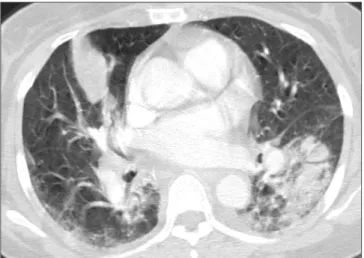
While he developed nausea and headache, which spontane- ously resolved without medication, he did not experience any respiratory symptoms. Two week later, he developed dyspnea on exertion. He visited his regional hospital presenting with fever and dyspnea and was diagnosed with CAP. However, he was referred to our hospital for leukopenia (leukocyte count, 300/µL; absolute neutrophil count, 0/µL) and thrombocyto- penia (platelet count, 3,000/µL) found on initial laboratory tests at the regional hospital. On admission to our hospital, his condition deteriorated rapidly and he was placed on mechanical ventilation for severe hypoxemia. Chest com- puted tomography (CT) showed consolidation and ground- glass opacity with cavitation in the left lower lobe which was compatible with necrotizing pneumonia (Figure 1). The patient was diagnosed with severe necrotizing pneumonia in a neutropenic patient and was administered vancomycin, piperacillin-tazobactam and levofloxacin. Aplastic anemia as- sociated with wild mushroom toxin was diagnosed with bone marrow biopsy which showed hypocellular marrow with suppressed trilineage hematopoiesis. While the Gram stain of respiratory specimens showed gram-positive cocci in pairs, chains and clusters, the urinary antigen test for Streptococcus pneumoniae was negative. The culture from sputum grew MRSA and while the strain was susceptible to gentamicin, ri-
fampicin, ciprofloxacin and trimethoprim/sulfamethoxazole, it was resistant to erythromycin and clindamycin. The patient recovered completely following a 2 week treatment course with vancomycin. In order to genotype the bacterial isolate, multilocus sequence typing (MLST) was performed using polymerase chain reaction (PCR) amplification and sequenc- ing of seven housekeeping genes (arcC, aroE, glpF, gmk, pta, tpi, and yqiL) as previously described9. SCCmec type was determined by the multiplex PCR method. The isolate was screened for the genes (lukF-PV and lukS-PV) encoding the components of the PVL toxin by PCR amplification10. Typing of the MRSA isolate from the patient revealed that the isolate belonged to MLST ST72, carried SCCmec type IV and was negative for PVL.
2. Case 2
A 57-year-old woman who had previously been healthy except for a history of pulmonary tuberculosis thirty years ago and who was on current medication for hypertension and de- pressive episodes, was admitted to our hospital with high fe- ver, cough and sputum for 3 days. On admission, dyspnea and chest pain developed. Chest CT showed multiple patchy con- solidations in both lower lobes and the right middle lobe of the lung (Figure 2). Laboratory tests revealed a leukocyte count of 1,820/µL, hemoglobin at 9.9 g/dL, and a platelet count of 192,000/µL. After 2 days, she rapidly deteriorated and was ad- mitted to the intensive care unit (ICU) following intubation for severe hypoxemia. She was diagnosed with severe CAP and ceftriaxone and azithromycin were administrated empirically.
While Gram stain of respiratory specimens revealed gram- positive cocci, the urinary antigen test for S. pneumoniae was negative. MRSA grew from sputum culture and the strain
Figure 1. Chest computed tomography of a 66-year-old man with community-associated methicillin-resistant Staphylococcus aureus pneumonia shows consolidation and ground-glass opacity with cavitation in the lower left lobe.
Figure 2. Chest computed tomography of a 57-year-old woman with community-associated methicillin-resistant Staphylococcus aureus pneumonia shows multiple patchy consolidations in both lower lobes and the middle right lobe.
CA-MRSA pneumonia
http://dx.doi.org/10.4046/trd.2013.75.2.75 77
www.e-trd.org
was susceptible to gentamicin, rifampicin, ciprofloxacin, trim- ethoprim/sulfamethoxazole, erythromycin and clindamycin.
Vancomycin was added to the empiric treatment on hospital day 5. Due to the persistent fever following administration of vancomycin for 7 days, vancomycin was replaced with line- zolid. Bilateral infiltration in the lungs with respiratory failure resulted in acute respiratory distress syndrome which was treated with adjunctive corticosteroid treatment. Ultimately, the patient recovered following linezolid treatment for 7 days in addition to vancomycin treatment for 7 days and corticoste- roid treatment for 4 weeks. Typing of the MRSA isolate from the patient revealed that the isolate belonged to MLST ST72, carried SCCmec type IV and was negative for PVL.
Discussion
To our knowledge, this is the first report of CAPs caused by ST72-SCCmec, type IV strain which is the predominant CA- MRSA strain in Korea. Although the first case developed in an immunocompromised individual with aplastic anemia associated with wild mushroom toxin, the patient had severe pneumonia requiring admission to the ICU and mechani- cal ventilation support, which are consistent with previously reported cases of CA-MRSA pneumonia3,5. Nonetheless, each isolate was negative for PVL which is a cytotoxin produced by approximately 5% of S. aureus strains and is associated with up to 85% of severe necrotizing pneumonia5,10,11. Some of these respiratory infections have been associated with sep- tic shock, hemoptysis, respiratory failure and intensive care admission for ventilatory or circulatory support12,13. However, recently reported case series have revealed that PVL-negative CA-MRSA may also cause severe necrotizing pneumonia sug- gesting the presence of other virulence factors responsible for necrotizing pneumonia caused by CA-MRSA14. While some data suggest an important pathogenic role of PVL in MRSA pneumonia, debate remains about the importance of this toxin in the pathogenesis of CA-MRSA pneumonia or whether PVL is merely a marker of CA-MRSA infections13.
CA-MRSA infections previously tended to arise largely from specific patient groups especially in high-risk settings such as military recruits, sports teams and individuals living in close communities or involved in activities resulting in skin abra- sions13. However, recent CA-MRSA infections have arisen in otherwise healthy individuals who did not have such risk fac- tors. Young age of patients has been a remarkable feature of CA-MRSA pneumonia in both European and US cases4,5,12,13. Severe cases of CA-MRSA pneumonia have been reported during influenza season or have been associated with a pre- ceding influenza or influenza-like illness in the majority of cases4,5,12,13. In our cases, a preceding influenza-like illness was mentioned in the first case but not in the second case. In con- trast to other bacterial pneumonia in which leukocytosis is a
prominent feature, leukopenia may be observed in a substan- tial proportion of cases and is predictive of poor outcome3,15. Although the patient in the first case developed cytopenia as- sociated with aplastic anemia, both of them had leukopenia.
In conclusion, we report the emergence of CA-MRSA in Ko- rea as a cause of CAP in otherwise healthy individuals. While CA-MRSA infections are not yet prevalent in Korea7,8, our cases suggest that CA-MRSA should be considered in cases of severe CAP, especially in those cases associated with necrotiz- ing pneumonia.
Acknowledgements
The authors would like to thank J.Y. Baek, Asia Pacific Foun- dation for Infectious Diseases, Seoul, Korea, for her technical assistance.
References
1. Fridkin SK, Hageman JC, Morrison M, Sanza LT, Como- Sabetti K, Jernigan JA, et al. Methicillin-resistant Staphylo- coccus aureus disease in three communities. N Engl J Med 2005;352:1436-44.
2. Moran GJ, Krishnadasan A, Gorwitz RJ, Fosheim GE, McDou- gal LK, Carey RB, et al. Methicillin-resistant S. aureus infec- tions among patients in the emergency department. N Engl J Med 2006;355:666-74.
3. Francis JS, Doherty MC, Lopatin U, Johnston CP, Sinha G, Ross T, et al. Severe community-onset pneumonia in healthy adults caused by methicillin-resistant Staphylococcus aureus carrying the Panton-Valentine leukocidin genes. Clin Infect Dis 2005;40:100-7.
4. Hageman JC, Uyeki TM, Francis JS, Jernigan DB, Wheeler JG, Bridges CB, et al. Severe community-acquired pneumonia due to Staphylococcus aureus, 2003-04 influenza season.
Emerg Infect Dis 2006;12:894-9.
5. Gillet Y, Issartel B, Vanhems P, Fournet JC, Lina G, Bes M, et al.
Association between Staphylococcus aureus strains carrying gene for Panton-Valentine leukocidin and highly lethal necro- tising pneumonia in young immunocompetent patients. Lan- cet 2002;359:753-9.
6. Patel M. Community-associated meticillin-resistant Staphy- lococcus aureus infections: epidemiology, recognition and management. Drugs 2009;69:693-716.
7. Kim ES, Song JS, Lee HJ, Choe PG, Park KH, Cho JH, et al.
A survey of community-associated methicillin-resistant Staphylococcus aureus in Korea. J Antimicrob Chemother 2007;60:1108-14.
8. Joo EJ, Chung DR, Ha YE, Park SY, Kang SJ, Kim SH, et al.
Community-associated Panton-Valentine leukocidin-nega- tive meticillin-resistant Staphylococcus aureus clone (ST72-
JW Hwang et al.
78 Tuberc Respir Dis 2013;75:75-78 www.e-trd.org
MRSA-IV) causing healthcare-associated pneumonia and surgical site infection in Korea. J Hosp Infect 2012;81:149-55.
9. Enright MC, Day NP, Davies CE, Peacock SJ, Spratt BG. Mul- tilocus sequence typing for characterization of methicillin- resistant and methicillin-susceptible clones of Staphylococ- cus aureus. J Clin Microbiol 2000;38:1008-15.
10. Lina G, Piemont Y, Godail-Gamot F, Bes M, Peter MO, Gaud- uchon V, et al. Involvement of Panton-Valentine leukocidin- producing Staphylococcus aureus in primary skin infections and pneumonia. Clin Infect Dis 1999;29:1128-32.
11. Micek ST, Dunne M, Kollef MH. Pleuropulmonary complica- tions of Panton-Valentine leukocidin-positive community- acquired methicillin-resistant Staphylococcus aureus: im- portance of treatment with antimicrobials inhibiting exotoxin production. Chest 2005;128:2732-8.
12. Rubinstein E, Kollef MH, Nathwani D. Pneumonia caused by methicillin-resistant Staphylococcus aureus. Clin Infect Dis 2008;46 Suppl 5:S378-85.
13. Hidron AI, Low CE, Honig EG, Blumberg HM. Emergence of community-acquired meticillin-resistant Staphylococcus aureus strain USA300 as a cause of necrotising community- onset pneumonia. Lancet Infect Dis 2009;9:384-92.
14. Thomas R, Ferguson J, Coombs G, Gibson PG. Community- acquired methicillin-resistant Staphylococcus aureus pneu- monia: a clinical audit. Respirology 2011;16:926-31.
15. Gillet Y, Vanhems P, Lina G, Bes M, Vandenesch F, Floret D, et al. Factors predicting mortality in necrotizing community- acquired pneumonia caused by Staphylococcus aureus containing Panton-Valentine leukocidin. Clin Infect Dis 2007;
45:315-21.