Introduction
Among causative organisms of community-acquired pneu- monia (CAP), Staphylococcus aureus accounts for about 1%
to 5% of all CAP infections
1. In addition, methicillin-resistant Staphylococcus aureus (MRSA) has been generally regarded as a major pathogen of hospital-acquired pneumonia (HAP) and ventilator-associated pneumonia (VAP)
2. However, the incidence of MRSA infection has increased worldwide among community-acquired (CA) as well as hospital-acquired patho- gens
3. Although CA-MRSA pneumonia is rare, it has been as- sociated historically with influenza outbreaks and multi-lobar cavitating necrosis
1.
As MRSA infection presents with significant morbidity and mortality in patients with community-onset (CO) pneumonia
Predictive Factors of Methicillin-Resistant Staphylococcus aureus Infection in Elderly
Patients with Community-Onset Pneumonia
Hyeyoung Jwa, M.D., Jong Wook Beom, M.D. and Jong Hoo Lee, M.D.
Department of Internal Medicine, Jeju National University Hospital, Jeju National University School of Medicine, Jeju, Korea
Background: Methicillin-resistant Staphylococcus aureus (MRSA) infection is a severe and life-threatening disease in patients with community-onset (CO) pneumonia. However, the current guidelines lack specificity for a screening test for MRSA infection.
Methods: This study was retrospectively conducted in elderly patients aged ≥65 years, who had contracted CO- pneumonia during hospitalization at the Jeju National University Hospital, between January 2012 and December 2014.
We analyzed the risk factors of MRSA in these patients and developed a scoring system to predict MRSA infection.
Results: A total of 762 patients were enrolled in this study, including 19 (2.4%) with MRSA infection. Healthcare- associated pneumonia (HCAP) showed more frequent MRSA infection compared to community-acquired pneumonia (4.4% vs. 1.5%, respectively; p=0.016). In a multivariate logistic regression analysis, admissions during the influenza season (odds ratio [OR], 2.896; 95% confidence interval [CI], 1.022–8.202; p=0.045), chronic kidney disease (OR, 3.555;
95% CI, 1.157–10.926; p=0.027), and intensive care unit admission (OR, 3.385; 95% CI, 1.035–11.075; p=0.044) were identified as predictive factors for MRSA infection. However, the presence of HCAP was not significantly associated with MRSA infection (OR, 1.991; 95% CI, 0.720–5.505; p=0.185). The scoring system consisted of three variables based on the multivariate analysis, and showed moderately accurate diagnostic prediction (area under curve, 0.790; 95% CI, 0.680–
0.899; p<0.001).
Conclusion: MRSA infection would be considered in elderly CO-pneumonia patients, with three risk factors identified herein. When managing elderly patients with pneumonia, clinicians might keep in mind that these risk factors are associated with MRSA infection, which may help in selecting appropriate antibiotics.
Keywords: Methicillin-Resistant Staphylococcus aureus ; Pneumonia; Community-Acquired Infections; Mortality
Address for correspondence: Jong Hoo Lee, M.D.
Department of Internal Medicine, Jeju National University Hospital, 15 Aran 13-gil, Jeju 63241, Korea
Phone: 82-64-717-1601, Fax: 82-64-717-1131 E-mail: [email protected]
Received: Oct. 19, 2016 Revised: Dec. 13, 2016 Accepted: Feb. 9, 2017
cc It is identical to the Creative Commons Attribution Non-Commercial License (http://creativecommons.org/licenses/by-nc/4.0/).
Copyright © 2017
The Korean Academy of Tuberculosis and Respiratory Diseases.
All rights reserved.
including CAP and healthcare-acquired pneumonia (HCAP)
4, it is important to predict the occurrence of MRSA infection in these patients. Recently, the 2016 the American Thoracic Society/Infectious Disease Society of America (ATS/IDSA) guidelines for management of HAP and VAP suggested that risk factors for MRSA infection included prior intravenous antibiotic use within 90 days, hospitalization in a unit where
>20% of Staphylococcus aureus isolates are methicillin resis- tant, or the prevalence of MRSA is not known, or who are at high risk for mortality
5. However, the determination for empir- ical treatment with anti-MRSA agents has not yet been estab- lished in patients with CO-pneumonia
6. According to the 2007 ATS/IDSA guidelines for CAP, necrotizing or lung abscess is a risk factor for CA-MRSA pneumonia
6. Although a recently published study in the United States investigated the use of a scoring system to predict MRSA infection in patients with CO- pneumonia, data on the prediction of MRSA infection in these patients are still limited
7.
MRSA infection requires treatment with anti-MRSA agents that are distinct from empirical antibiotic treatments used for CO-pneumonia. Delayed use of anti-MRSA agents may result in increased morbidity and mortality, whereas overuse of anti- MRSA agents may lead to more antibiotic resistance and side effects associated with antibiotic use such as nephrotoxicity.
In the elderly population, pneumonia is especially associ- ated with worse outcomes
8,9. In addition, the large number of elderly with decreased renal function requires careful use of anti-MRSA agents in this population. Therefore, we inves- tigated the risk factors for MRSA infection in elderly patients admitted with CO-pneumonia in order to guide the decision to prescribe an anti-MRSA agent.
Materials and Methods
1. Study design
We retrospectively investigated elderly patients aged ≥65 years admitted with CO-pneumonia at the Jeju National University Hospital (a 620-bed hospital in Jeju, South Korea) between January 2012 and December 2014. Based on culture results, we classified patients into MRSA or non-MRSA groups.
Using medical records, we compared clinical characteris- tics, co-morbidities, severity of pneumonia, identified patho- gens, antibiotics, and clinical outcomes between the two groups. The study protocol was approved by the Ethical Re- view Committee at Jeju National University Hospital (approval No. 2015-03-002). Informed consent was waived because of the retrospective nature of the study.
2. Definition and categorization of pneumonia
Pneumonia was defined as the presence of new infiltrate
on chest radiography and at least one of the following: fever (temperature ≥38.0°C) or hypothermia (temperature <35.0°C);
new-onset cough with or without sputum production; pleu- ritic chest pain; dyspnea; or altered breath sounds on auscul- tation. Multi-lobar involvement was defined as the presence of pneumonic infiltrates in two or more lobes on chest radio- graph or computed tomography.
HCAP was defined using the criteria established by the 2005 ATS/IDSA guidelines, which require one or more of the following: residence in a nursing home or long-term care facil- ity; recent history of hospitalization in an acute care hospital for ≥2 days in the past 90 days; recent outpatient intravenous therapy (such as antibiotic therapy or chemotherapy) or wound care within the past 30 days; and/or attendance at a hospital clinic or dialysis center in the last 30 days
10. CAP was defined as pneumonia diagnosed in patients who did not fit the criteria for HCAP. CO-pneumonia was defined as pneu- monia hat occurs in the community and up to 48 hours into hospital admission, and it includes both CAP and HCAP
11. 3. Microbiology
Microorganisms in samples obtained from sputum, tracheal aspirate, bronchial alveolar lavage fluid, or blood were inves- tigated. Sputum samples were cultured in a semi-quantitative manner, and pathogens were identified when a predominant microorganism was detected from group 4 or 5 sputum, ac- cording to Geckler’s grading system
12. Blood cultures were considered as an etiologic diagnosis if there was no other infection source for a positive blood culture. For Mycoplasma pneumoniae or Chlamydia pneumoniae , serum samples were evaluated. Serum samples in which particle agglutina- tion antibody titers were >64 or that were proven to have a 4-fold or greater increase of antibody titers in paired sera were regarded as positive. BinaxNOW (Binax Inc., Scarborough, ME, USA) was used to detect urinary antigens for Streptococ- cus pneumoniae. The BinaxNOW Legionella Urinary Antigen Test (Binax Inc.) for Legionella pneumophila serogroup 1 was performed according to clinical judgment by attending physicians. A positive urinary antigen was considered to be a bacterial infection. The antibiotic sensitivity of all isolates was determined using a disc diffusion method. MRSA, Pseu- domonas species, Acinetobacter species, Stenotrophomonas maltophilia, and extended-spectrum b-lactamase (ESBL) pro- ducing Enterobacteriaceae were considered to be potentially drug resistant (PDR) pathogens, as previously reported
13. 4. Clinical outcomes
Duration of antibiotic therapy, the rate of change of antibi-
otics, the use of inappropriate antibiotics, the rate of failure
of initial antibiotic therapy, length of hospital stay, and in-
hospital mortality rates were compared between each group.
Inappropriate antibiotic therapy was defined as inefficacy of the empirical antibiotics against the identified pathogens based on in vitro susceptibility testing. Failure of initial anti- biotic therapy was defined as death during initial treatment or change of antibiotics from initial agents to others after 48 hours due to clinical instability.
5. Statistical analyses
Data are presented as number (%) or median (range) un- less otherwise stated. Continuous variables were compared using Student’s t test for normally distributed variables and the Mann-Whitney U test for non-normally distributed variables.
Categorical variables were compared using the Pearson chi- square test, and the Fisher exact test was used where any cell contained less than 5. To identify independent factors predic- tive of MRSA infection, multivariate logistic regression analy- sis with variables found to be significantly different between the two groups by univariate analysis was used, as measured by the estimated odds ratio (OR) with 95% confidence inter- vals (CI). From logistic regression results, we created a scoring system to predict patients’ risk for infection with MRSA patho- gens. We converted the ORs from b coefficients into point values and measured the percentages of MRSA pathogens in each group relative to the total point score. We then evaluated the ability of the scoring system to predict patients with MRSA pathogens using the receiver operating characteristic (ROC) curve. p-values of <0.05 were considered statistically signifi- cant. Analyses were performed using SPSS version 14.0 (SPSS Inc., Chicago, IL, USA).
Results
1. Clinical characteristics
A total of 762 patients were assessed during the study pe- riod. According to culture results, there were 19 patients (2.4%) with MRSA infection and 743 (97.5%) with non-MRSA infec- tion. MRSA infection was more common in HCAP than CAP (4.4% vs. 1.5%, p=0.016).
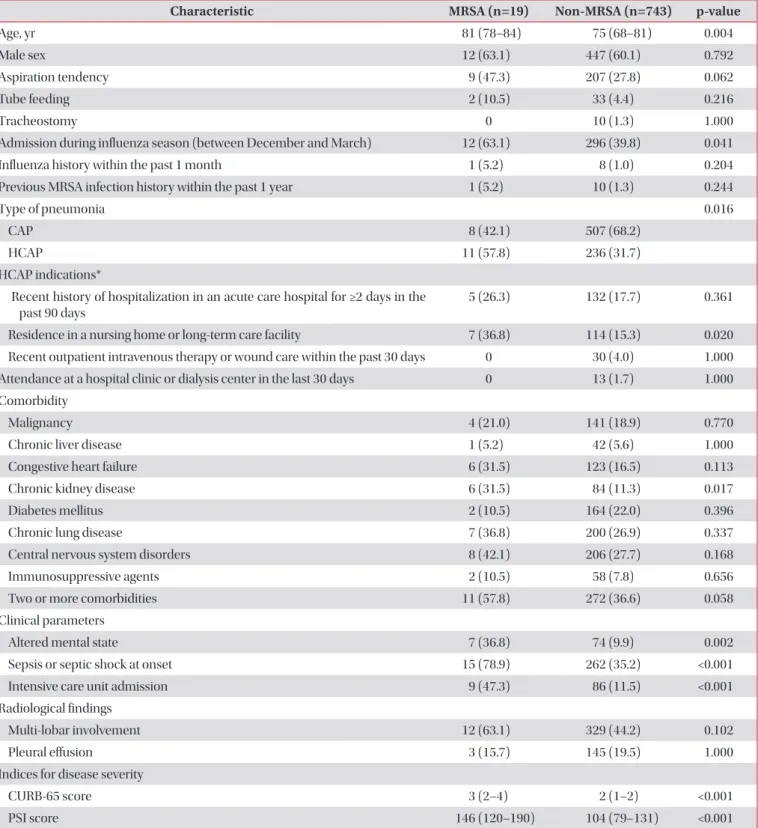
Table 1 shows the baseline characteristics of each group.
The median age of the MRSA group was 81 years (interquartile range [IQR], 78–84 years) and was higher than that of the non- MRSA group (75 years; IQR, 68–81 years; p=0.004). The rate of patients with HCAP was higher in the MRSA group compared to the non-MRSA group (57.8% vs. 31.7%, p=0.016). Among the category of HCAP, the rate of residence in a nursing home or long-term care facility was more frequently in the MRSA group (36.8% vs. 15.3%, p=0.020). And, the rate of patients with aspiration tendency tended to be higher in the MRSA group than the non-MRSA group (47.3% vs. 27.8%, p=0.062). Among several comorbidities, only chronic kidney disease was fre-
quently more reported in the MRSA group (31.5% vs. 11.3%, p=0.017).
The MRSA group showed worse clinical parameters than the non-MRSA group, including altered mental state, sepsis or septic shock, and intensive care unit (ICU) admission at onset.
In radiological findings, the rates of multi-lobar involvement and pleural effusions between the two groups were not signifi- cantly different. The median CURB-65 (confusion, urea, eespi- ratory rate, blood pressure, age ≥65) and Pneumonia Severity Index (PSI) scores, which are severity indices of pneumonia, were also higher in the MRSA group (3 vs. 2, p<0.001 and 146 vs. 104, p<0.001).
2. Microbiological etiology of the non-MRSA group MRSA was isolated from the specimens of the followings:
sputum (n=13), tracheal aspirates (n=4), blood (n=3), and bronchoalveolar lavage fluid (n=1). In two patients, MRSA were simultaneously isolated from the tracheal aspirates and blood.
The distribution of pathogens isolated in the non-MRSA group is shown in Table 2. In the non-MRSA group, there was a possible etiologic diagnosis for 271 patients (36.4%); the most frequent pathogen was Streptococcus pneumoniae followed by Klebsiella pneumoniae. The frequency of PDR pathogens was 7.8%, and the isolated rates of Pseudomonas aeruginosa, ESBL-producing K. pneumoniae, and Acinetobacter species were 5.2%, 0.4%, and 1.2%, respectively.
3. Clinical outcomes
Table 3 shows the clinical outcomes of patients with pneu- monia. The duration of anti-biotic administration (14 days vs.
10 days, p=0.027), the rates of antibiotic changes (73.6% vs.
20.8%, p<0.001), the use of inappropriate antibiotics (100% vs.
4.7%, p<0.001), and failure of initial antibiotic therapy (73.6%
vs. 20.5%, p<0.001) were higher in the MRSA group. In addi- tion, the MRSA group showed a trend toward a higher total in- hospital mortality rate than the non-MRSA group, although without statistical significance (31.2% vs. 11.4%, p=0.062).
4. Risk factors associated with MRSA infection and scoring system
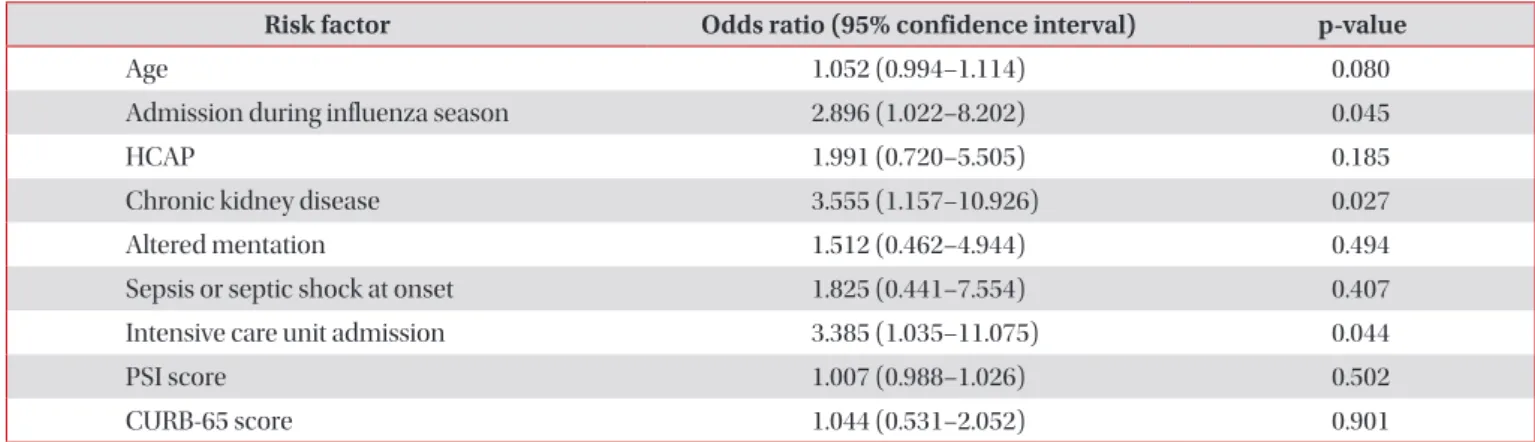
Multivariate logistic regression analysis identified three risk
factors related to MRSA pneumonia. Admission during influ-
enza season (OR, 2.896; 95% CI, 1.022–8.202; p=0.045), chron-
ic kidney disease (OR, 3.555; 95% CI, 1.157–10.926; p=0.027),
and ICU admission (OR, 3.385; 95% CI, 1.035–11.075; p=0.044)
were associated with increased risk for MRSA infection in el-
derly patients admitted with CO-pneumonia. Otherwise, the
presence of HCAP was not significantly associated with MRSA
infection (OR, 1.991; 95% CI, 0.720–5.505; p=0.185) (Table 4).
Table 1. Baseline characteristics of elderly patients admitted with community-onset pneumonia
Characteristic MRSA (n=19) Non-MRSA (n=743) p-value
Age, yr 81 (78–84) 75 (68–81) 0.004
Male sex 12 (63.1) 447 (60.1) 0.792
Aspiration tendency 9 (47.3) 207 (27.8) 0.062
Tube feeding 2 (10.5) 33 (4.4) 0.216
Tracheostomy 0 10 (1.3) 1.000
Admission during influenza season (between December and March) 12 (63.1) 296 (39.8) 0.041
Influenza history within the past 1 month 1 (5.2) 8 (1.0) 0.204
Previous MRSA infection history within the past 1 year 1 (5.2) 10 (1.3) 0.244
Type of pneumonia 0.016
CAP 8 (42.1) 507 (68.2)
HCAP 11 (57.8) 236 (31.7)
HCAP indications*
Recent history of hospitalization in an acute care hospital for ≥2 days in the past 90 days
5 (26.3) 132 (17.7) 0.361
Residence in a nursing home or long-term care facility 7 (36.8) 114 (15.3) 0.020 Recent outpatient intravenous therapy or wound care within the past 30 days 0 30 (4.0) 1.000 Attendance at a hospital clinic or dialysis center in the last 30 days 0 13 (1.7) 1.000 Comorbidity
Malignancy 4 (21.0) 141 (18.9) 0.770
Chronic liver disease 1 (5.2) 42 (5.6) 1.000
Congestive heart failure 6 (31.5) 123 (16.5) 0.113
Chronic kidney disease 6 (31.5) 84 (11.3) 0.017
Diabetes mellitus 2 (10.5) 164 (22.0) 0.396
Chronic lung disease 7 (36.8) 200 (26.9) 0.337
Central nervous system disorders 8 (42.1) 206 (27.7) 0.168
Immunosuppressive agents 2 (10.5) 58 (7.8) 0.656
Two or more comorbidities 11 (57.8) 272 (36.6) 0.058
Clinical parameters
Altered mental state 7 (36.8) 74 (9.9) 0.002
Sepsis or septic shock at onset 15 (78.9) 262 (35.2) <0.001
Intensive care unit admission 9 (47.3) 86 (11.5) <0.001
Radiological findings
Multi-lobar involvement 12 (63.1) 329 (44.2) 0.102
Pleural effusion 3 (15.7) 145 (19.5) 1.000
Indices for disease severity
CURB-65 score 3 (2–4) 2 (1–2) <0.001
PSI score 146 (120–190) 104 (79–131) <0.001
Value are presented as median (interquartile range) or number (%).
*Allowed for overlapping.
MRSA: methicillin-resistant Staphylococcus aureus; CAP: community-acquired pneumonia; HCAP: healthcare-associated pneumonia;
CURB-65: Confusion, Urea, Respiratory rate, Blood pressure, Age ≥65; PSI: Pneumonia Severity Index.
Based on the multivariate analysis, we created a scoring system to identify patients with MRSA infection. We assigned points as follows based on the logistic regression: 2 points for admission during influenza season; 3 points for chronic kid- ney disease; 3 points for ICU admission. Patients were divided into three groups by total scores. Figure 1 shows the associa-
tion between total score using the scoring system and the prevalence of MRSA infection. As scores increased, the preva- lence of MRSA pathogen in each group tended to increase (0.5% in the group with a score of 0, 2.2% in the group with a score 2–3, and 13.0% in the group with scores 5–8). Using ROC curves, the area under curve of the scoring system was 0.7900 (95% CI, 0.6801–0.8998; p<0.001) (Figure 2).
Discussion
MRSA infections are associated with worse outcomes than methicillin-sensitive Staphylococcus aureus infections
14. One meta-analysis including data on 3,963 patients reported that bloodstream infection due to MRSA showed approximately a twofold increase in mortality compared to patients with methicillin-sensitive Staphylococcus aureus
14. Traditionally, MRSA infection is common cause of HAP and VAP
15. Mean- while, MRSA infection in patients with CAP is rare, and CA- MRSA pneumonia represents about 2% of total CA-MRSA infections
16. Although the incidence of MRSA infection is low in patients with CO-pneumonia, MRSA infection is an emerg- ing problem in these patients
4.
The increased prevalence of MRSA infection in CAP has been reported in patients with recent or concomitant influen- za
17,18. During the 2003 to 2004 influenza season in the United States, 17 patients with Staphylococcus aureus infection in CAP were reported and 15 cases were CA-MRSA
17. All isolates had community-associated genetic characteristics. Among 13 available Staphylococcus aureus isolates, 12 had the Panton- Valentine leukocidin (PVL) gene, and in-hospital mortality was 29%
17. In a study of 627 patients admitted with CAP dur- ing the 2006 to 2007 influenza season in the United States, Staphylococcus aureus represented about 4% (24 patients) of causative organisms. Of these Staphylococcus aureus infec- tions, 14 cases (58%) were MRSA
19. Isolation of MRSA was as- sociated with the followings; a patient history of MRSA, nurs- ing home admission in the previous year, close contact with someone with a skin infection during the previous month, Table 2. Microorganisms isolated from elderly patients
admitted with community-onset pneumonia, non-MRSA group (n=743)
Variable No. (%)
Gram positive bacteria
Streptococcus pneumoniae 115 (15.4) Methicillin-sensitive Staphylococcus aureus 12 (1.6) Other gram-positive bacteria 12 (1.6) Gram-negative bacteria
Pseudomonas aeruginosa 39 (5.2)
Haemophilus influenza 8 (1.0)
Klebsiella pneumoniae 48 (6.4)
ESBL (+) 3 (0.4)
ESBL (–) 45 (6.0)
Acinetobacter species 9 (1.2)
Other gram-negative species* 14 (1.8)
Mycoplasma pneumonia 30 (4.0)
Identified pathogens 271 (36.4)
Polymicrobial pathogens 16 (2.1)
Potentially drug-resistant pathogens
†58 (7.8)
*Other gram negative species included Escherichia coli, Enterobacter species, Serratia marcescens , and Legionella pneumophilia .
†
Potentially drug-resistant pathogens included MRSA, Pseudomonas species, Acinetobacter species, Stenotrophomonas maltophilia, and ESBL-producing Enterobacteriaceae.
MRSA: methicillin-resistant Staphylococcus aureus ; ESBL:
extended-spectrum b-lactamase.
Table 3. Clinical outcomes of elderly patients admitted with community-onset pneumonia
Clinical outcomes MRSA (n=19) Non-MRSA (n=743) p-value
Duration of antibiotic therapy, day 14 (8–18) 10 (7–13) 0.027
Change of antibiotics 14 (73.6) 155 (20.8) <0.001
Use of inappropriate antibiotics 19 (100) 35 (4.7) <0.001
Failure of initial antibiotics therapy 14 (73.6) 153 (20.5) <0.001
Length of hospital stay, day 14 (7–22) 8 (5–12) 0.016
Total in-hospital mortality rate 5 (31.2) 85 (11.4) 0.062
Values are presented as median (interquartile range) or number (%).
MRSA: methicillin-resistant Staphylococcus aureus.
multiple infiltrates or cavities on a chest radiograph, comatose state, intubation, receipt of pressor agents, and death in the emergency department
19. Although we could not evaluate the direct relationship between MRSA infection and influenza due to the low frequency of testing for influenza infection, pa- tients who were hospitalized during the influenza season (De- cember to March) in the present study showed a significantly higher rate of isolation for MRSA.
Traditionally, CA-MRSA is also associated with severe necrotizing pneumonia
3,17,20. The tendency for necrotizing pneumonia seems to be mediated by PVL, which is typically present in CA-MRSA strains
17,20,21. Gillet et al.
21compared the clinical features of 16 patients with PVL-positive Staphylococ- cus aureus pneumonia to 36 cases of PVL-negative Staphy- lococcus aureus pneumonia
20. Hemoptysis occurred more
frequently in patients with PVL-positive strains compared with those with PVL-negative strains (38% vs. 3%)
21. The role of PVL was more directly demonstrated in a study using a mouse model of acute pneumonia, which found that PVL alone was sufficient to cause necrotizing pneumonia
22. PVL induced global changes in the transcriptional levels of genes encoding multiple staphylococcal proteins, including the lung inflammatory factor staphylococcal protein A
22. In contrast, some recent reports have denied the role of the PVL gene as a virulence factor in MRSA pneumonia
23,24. In our results, the radiological findings were not significant differences between two groups. Otherwise, due to nature of retrospective study design, we could not investigate the association between the MRSA infection and necrotizing pneumonia.
After the ATS/IDSA introduced guidelines in 2005 on HCAP
10, several studies have reported an association between Table 4. Multivariate analysis for risk factors associated with MRSA infection in elderly patients admitted with community- onset pneumonia
Risk factor Odds ratio (95% confidence interval) p-value
Age 1.052 (0.994–1.114) 0.080
Admission during influenza season 2.896 (1.022–8.202) 0.045
HCAP 1.991 (0.720–5.505) 0.185
Chronic kidney disease 3.555 (1.157–10.926) 0.027
Altered mentation 1.512 (0.462–4.944) 0.494
Sepsis or septic shock at onset 1.825 (0.441–7.554) 0.407
Intensive care unit admission 3.385 (1.035–11.075) 0.044
PSI score 1.007 (0.988–1.026) 0.502
CURB-65 score 1.044 (0.531–2.052) 0.901
MRSA: methicillin-resistant Staphylococcus aureus; HCAP: healthcare-associated pneumonia; PSI: Pneumonia Severity Index; CURB-65:
Confusion, Urea, Respiratory rate, Blood pressure, Age ≥65.
Figure 1. The percentages of identified methicillin-resistant Staphy- lococcus aureus (MRSA) pathogens in three different risk groups determined using the scoring system.
0 15
10
5
PatientswithMRSAinfection(%)
0
2-3 5-8
0.5
2.2
13.0
p=0.107
p<0.001 p<0.001 for trend
Scores
0 1.0
0.8
0.6
0.4
0.2
Sensitivity
0
0.2 0.4
1-Specificity 0.8
0.6 1.0