ISSN 2234-3806 • eISSN 2234-3814
http://dx.doi.org/10.3343/alm.2016.36.6.536
Prevalence of Major Methicillin-Resistant
Staphylococcus aureus Clones in Korea Between 2001 and 2008
Gi Su Kang, M.S., Yung Hee Jung, Ph.D., Hwa Su Kim, Ph.D., Yeong Seon Lee, Ph.D., Chan Park, Ph.D., Kwang Jun Lee, Ph.D., and Jeong Ok Cha, Ph.D.
Division of Antimicrobial Resistance, Center for Infectious Disease, National Research Institute of Health, Centers for Disease Control and Prevention (KCDC), Cheongju, Korea
Background: Methicillin-resistant Staphylococcus aureus (MRSA) are important patho- gens causing nosocomial infections in Korean hospitals. This study aimed to investigate the epidemiological and genetic diversity of clinical S. aureus isolates in healthcare set- tings from 2001 to 2008.
Methods: Samples and data were obtained from 986 individuals as part of the National Antimicrobial Surveillance Project, involving 10 regions nationwide. Molecular typing stud- ies, including multilocus sequence typing (MLST) and staphylococcal cassette chromo- some mec (SCCmec) typing were performed, and a representative clone of Korean MRSA was classified by combinational grouping using a DiversiLab (DL; bioMérieux, France) re- petitive element polymerase chain reaction (rep-PCR) system.
Results: Nine Korean MRSA clones (KMRSA-1 to -9) were identified by analysis of genetic backgrounds and molecular characteristics. KMRSA-1 to -3, expressing clonal complex (CC) 5 (carrying SCCmec II), CC8 (carrying SCCmec III), and CC72 (carrying SCCmec IV) were spread nationwide. In contrast, KMRSA-6 was highly prevalent in Gyeongsangnam- do, and KMRSA-4 was highly prevalent in Jeollanam-do and Jeollabuk-do.
Conclusions: Epidemic KMRSA clones were genetically similar to major clones identified from the USA, with the exception of KMRSA-2, which had the SCCmec III type. Our re- sults provide important insights into the distribution and molecular genetics of MRSA strains in Korea and may aid in the monitoring of MRSA spread throughout the country.
Key Words: Korean MRSA clones, Multilocus sequence typing, DiversiLab, Genetic diver- sity
Received: January 14, 2016 Revision received: April 24, 2016 Accepted: August 1, 2016
Corresponding author: Jeong Ok Cha Division of Antimicrobial Resistance, Center for Infectious Disease Research, National Research Institute of Health, Center for Disease Control and Prevention, Osong Health Technology Administration Complex, 187 Osongsaengmyeong 2-ro, Osong-eup, Heungdeok-gu, Cheongju 28159, Korea Tel: +82-43-719-8251
Fax: +82-43-719-8269 E-mail: [email protected]
© The Korean Society for Laboratory Medicine This is an Open Access article distributed under the terms of the Creative Commons Attribution Non-Commercial License (http://creativecom- mons.org/licenses/by-nc/4.0) which permits unrestricted non-commercial use, distribution, and reproduction in any medium, provided the original work is properly cited.
INTRODUCTION
Staphylococcus aureus is an important human pathogen, and methicillin-resistant S. aureus (MRSA) has become a major cause of hospital- and community-acquired infection. Methicil- lin resistance rates in Korean hospitals have increased during recent decades, and MRSA reportedly accounts for 60-70% of all S. aureus isolates in tertiary hospitals in Korea. In 2009, the
MRSA rate in Korea was reported to be as high as 81% in ter- tiary hospitals and 40% in non-tertiary hospitals [1].
In the United States of America (USA), Europe, and some parts of Asia, the incidence of MRSA has been monitored for prolonged periods to establish a national database of the multi- drug-resistant clones distributed worldwide [2]. In the USA, USA300 and USA400 are the major clones frequently isolated in community-associated (CA) MRSA, and monitoring has pro-
vided a basis for the identification of toxic genes in these clones.
Such monitoring allows for the recognition of outbreaks, and these clones provide a basis for monitoring the propagation and spread of domestic and international clones [3]. Monitoring ef- forts provide insights into the causes of increased resistance, which may be related to resistance obtained by various clones or to infection control measures, in which antibiotics select spe- cific resistant bacteria. Additionally, monitoring tracks the rapid spread of bacteria among hospitals or between hospitals and the community, and helps evaluate the effects of increasing in- ternational travel and trade exchanges on the appearance of new resistant strains. Therefore, for effective analysis of the propagation of multidrug-resistant strains, the molecular epide- miological characteristics of domestic strains must be deter- mined and compared with those of foreign strains.
Accordingly, the USA, Japan, Europe, and Denmark have es- tablished national organizations for compiling molecular epide- miologic information about multidrug-resistant strains of bacte- ria associated with infectious diseases, thereby allowing the monitoring of the prevalence of multidrug-resistant bacteria in the community or hospitals [4-6]. In Korea, specific analysis and monitoring have been performed only in some tertiary insti- tutions at the national level, which makes the analysis of propa- gation patterns or trends difficult. Therefore, the identification of clones through the molecular genetic analysis of major resistant bacteria would improve our understanding of the propagation of MRSA and facilitate the establishment of disease management measures.
In this study, we identified major clones by targeting S. aureus isolated from medical care hospitals, including a geriatric hospi- tal, in Korea. We analyzed the molecular genetic characteristics, classification, and characterization of MRSA isolates as well as the trends of national epidemic strains to identify resistant strains.
METHODS
1. Bacterial strains and their identification
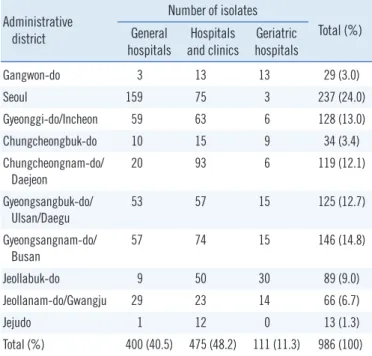
Samples were collected from hospitals that participated in the National Antimicrobial Surveillance Project; they were randomly and evenly selected from 10 districts (including Seoul, Gyeonggi- do/Incheon, Gangwon-do, Chungcheongbuk-do, Chungcheong- nam-do/Daejeon, Gyeongsangbuk-do/Daegu/Ulsan, Gyeong- sangnam-do/Busan, Jeollanam-do/Gwangju, Jeollabuk-do, and Jejudo) nationwide. A total of 986 S. aureus strains isolated from the surveillance cultures of clinical patients at general hospitals,
hospitals and clinics, and geriatric hospitals between 2001 and 2008 were analyzed in this study. Most of the general hospitals were sentinel surveillance hospitals, and some isolates were identified by hospital-affiliated laboratories before the specimens were sent to Division of Antimicrobial Resistance, Korea National Institute of Health (KNIH).
Bacterial identification and antimicrobial susceptibility testing in this study were carried out with a VITEK 2 system (bioMéri- eux, La Balme les Grottes, France) and confirmed by the detec- tion of mecA through PCR analysis. We used the following S.
aureus strains: ATCC 25923, ATCC 29213, and ATCC 43300 (mecA, positive control) from ATCC (Manassas, VA, USA). If needed, antimicrobial susceptibility testing was performed with the disc diffusion method according to the CLSI guidelines [7].
S. aureus ATCC 29213 was used as a quality control strain for the determination of minimum inhibitory concentrations (MICs).
2. Clinical and epidemiological information
We analyzed data collected during an 8-yr period. Formal ethi- cal approval for this study was obtained from Institutional Re- view Board of the Korea Centers for Disease Control and Pre- vention (KCDC). As part of this analysis, basic patient data were collected, including age ( ≥1 yr old), sex, and specimen type.
Hospitals also provided consecutive, nonduplicate isolates for molecular typing. Cases were described as CA if MRSA was iso- lated from patients within 48 hrs of hospital admission or from patients who had none of the following risk factors: (i) history of hospitalization or surgery in the preceding calendar year, or (ii) residence in a long-term care facility (LTCF). Otherwise, they were considered to be healthcare-associated (HA) MRSA.
3. Identification of staphylococcal cassette chromosome mec type and Panton-Valentine leukocidin
Staphylococcal cassette chromosome mec (SCCmec) types were determined with multiplex PCR [8]. PCR amplification for Panton-Valentine leukocidin (PVL)-encoding genes (lukS-PV and lukF-PV) was performed on representative isolates from each inferred from a multilocus sequence typing (MLST) clonal complex, as previously described [9].
4. Molecular typing
For molecular typing, MLST and DiversiLab (DL; bioMérieux, Mercy l’Etoile, France) microbial typing procedures were per- formed as previously described [10-12]. DL strain typing was determined via cluster analysis following the guidelines provided by the manufacturer. The isolates were categorized as indistin-
guishable, similar, or different according to bands interpreted using the DL analysis guide (software version 3.4).
5. Designation of Korean MRSA
For the strain typing of representative MRSA isolates, all MRSAs were categorized based on a combination of genetic differences determined through SCCmec typing and MLST, and the pres- ence of PVL was also analyzed. For comparisons of the desig- nated Korean MRSA (KMRSA) strains, the DL MRSA library da- tabase on the DL website (www.biomerieux-usa.com/diversilab) was used.
RESULTS
1. Identification of species and MRSA
The distributions of the 986 S. aureus isolates are shown in Ta- ble 1. All isolates were obtained in general hospitals (400 iso- lates, 40.6%), hospitals and clinics (475 isolates, 48.2%), or geriatric hospitals (111 isolates, 11.3%). Of these, 803 MRSA isolates (81.4% of the total isolates) were identified through oxa- cillin screening and with the mecA PCR method. Among all MRSA infections, 294 (36.6%) isolates were identified as CA- MRSAs with non-multidrug resistance (non-MDR; defined as susceptible to ≥2 tested non-β-lactam antibiotic drugs), and the rest (509 [63.4%]) were classified as HA-MRSAs. Most of the identified HA-MRSAs were recovered from invasive infections
(e.g., pus [n=150], wounds [n=129], sputum [n=97], blood [n=50], urine [n=36], ear fluid [n=14], pleural fluid [n=12]), although 47 isolates were recovered from nasal swabs (data not shown).
2. Clonal distribution and detection of PVL
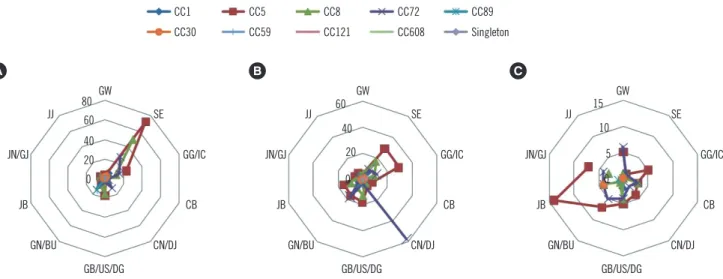
On MLST analysis, SCCmec types for all MRSAs were charac- terized by four major clones and the results are shown in Fig. 1 and 2: CC5 belonging to the SCCmec II type (including IIA and IIvariant), CC8 belonging to the SCCmec III type (including IIIA and IIIvariant), and CC72 and CC1 belonging to the SCCmec IV type (including IVA). All MRSAs were clonally distributed throughout the country and hospitals. Regionally, five clones- CC1, CC5, CC8, CC72, and CC89-made up the majority of the isolates, whereas CC30, CC59, CC121, and CC608 were less frequent. In general hospitals, CC5 and CC8 were distributed primarily in Seoul. CC72 was the main clone distributed in hos- pitals and clinics at Chungcheongnam-do/Daejeon (CN/DJ), and CC5 was widespread in geriatric hospitals at Jeollanam-do (JN) and Gyeongsangnam-do (GN). The presence of lukF-PV and lukS-PV genes encoding the components of the PVL toxin was detected in all isolates. CA-MRSA isolates most commonly had SCCmec II and IV type traits and no positive PVL genes (data not shown).
3. Categorization of KMRSA
The clones and mec types were classified as KMRSA-1 through KMRSA-9 and summarized in Table 2. KMRSA-1 was the most frequent, identified in 308 isolates (38.4% of all MRSAs), and has the genetic characteristics of CC5 and the SCCmec II type.
In contrast, 13 isolates (1.6%) had the genetic characteristics of CC5 and the SCCmec IV type; therefore, these were identified Table 1. Number of Staphylococcus aureus isolates collected in the
study Administrative district
Number of isolates
Total (%) General
hospitals Hospitals
and clinics Geriatric hospitals
Gangwon-do 3 13 13 29 (3.0)
Seoul 159 75 3 237 (24.0)
Gyeonggi-do/Incheon 59 63 6 128 (13.0)
Chungcheongbuk-do 10 15 9 34 (3.4)
Chungcheongnam-do/
Daejeon 20 93 6 119 (12.1)
Gyeongsangbuk-do/
Ulsan/Daegu
53 57 15 125 (12.7)
Gyeongsangnam-do/
Busan 57 74 15 146 (14.8)
Jeollabuk-do 9 50 30 89 (9.0)
Jeollanam-do/Gwangju 29 23 14 66 (6.7)
Jejudo 1 12 0 13 (1.3)
Total (%) 400 (40.5) 475 (48.2) 111 (11.3) 986 (100)
Fig. 1. Distribution of clonal complexes (CCs) by staphylococcal cassette chromosome mec (SCCmec) type. Singleton refers to se- quence types (STs) that could not be assigned to any group.
250
200 150 100
50 0
II IIA IIv III IIIA IIIv IV IVA IVv CC5 CC72 CC8 CC1 CC89 CC59 CC608 CC30 CC121 Singleton SCCmec
N of isolates
as KMRSA-8. A total of 161 isolates (20.0%) had the genetic characteristics of CC8 and the SCCmec III type, and thus were identified as KMRSA-2, whereas 20 isolates with the SCCmec IV type were designated KMRSA-7. KMRSA-3 was identified in 207 isolates (25.8%) with the genetic characteristics of CC72 and the SCCmec IV type, whereas 11 isolates (1.4%) with the SCCmec II type were designated KMRSA-5. KMRSA-4 (CC1 and the SCCmec IV type) comprised 48 isolates (6.0%).
KMRSA-6 was identified in 23 isolates (2.9%) with the genetic
characteristics of CC89 and the SCCmec II type, and KMRSA-9 was identified in two isolates (0.2%) with the genetic character- istics of CC30 and the SCCmec IV type.
4. Geographical distribution of KMRSA
KMRSA was distributed in 10 regions across the country in the following numbers: Seoul, n =222; Gyeonggi-do/Incheon, n =113; Gangwon-do, n =25; Chungcheongbuk-do, n =23;
Chungcheongnam-do/Daejeon, n=94; Jeollabuk-do, n=68; Je- ollanam-do/Gwangju, n=47; Gyeongsangbuk-do/Ulsan/Daegu, n=91; Gyeongsangnam-do/Busan, n=109; and Jejudo, n=11 (Fig. 3). KMRSA-1, KMRSA-2, and KMRSA-3 were prevalent Table 2. Classification of KMRSA
KMRSA CC Number of isolates by SCCmec type
Total (%)
II III IV
KMRSA-1 5 308 - - 308 (38.4)
KMRSA-2 8 - 161 - 161 (20.0)
KMRSA-3 72 - - 207 207 (25.8)
KMRSA-4 1 - - 48 48 (6.0)
KMRSA-5 72 11 - - 11 (1.4)
KMRSA-6 89 23 - - 23 (2.9)
KMRSA-7 8 - - 20 20 (2.5)
KMRSA-8 5 - - 13 13 (1.6)
KMRSA-9 30 - - 2 2 (0.2)
None 10 (1.2)
Total 803 (100)
Abbreviations: KMRSA, Korean methicillin-resistant S. aureus; CC, clonal complex; None, unclassified KMRSA type; SCCmec, staphylococcal cas- sette chromosome mec.
Fig. 2. Clonal distribution of all methicillin-resistant Staphylococcus aureus (MRSA) isolates by district. The prevalence of CCs in (A) gener- al hospitals, (B) hospitals and clinics, and (C) geriatric hospitals is shown. Singleton refers to STs that could not be assigned to any group.
Abbreviations: CB, Chungcheongbuk-do; CN/DJ, Chungcheongnam-do/Daejeon; GB/US/DG, Gyeongsangbuk-do/Ulsan/Daegu; GG/IC, Gyeonggi-do/
Incheon; GN/BU, Gyeongsangnam-do/Busan; GW, Gangwon-do; JB, Jeollabuk-do; JJ, Jejudo; JN/GJ, Jeollanam-do/Gwangju; SE, Seoul.
CC1
GW GW GW
JJ SE JJ SE JJ SE
JB CB JB CB JB CB
GN/BU CN/DJ GN/BU CN/DJ GN/BU CN/DJ
JN/GJ GG/IC JN/GJ GG/IC JN/GJ GG/IC
CC30
CC5 CC59
CC8 CC121
CC72 CC608
CC89 Singleton
A B C
GB/US/DG GB/US/DG GB/US/DG
80 15
60
60
40 40 10
20 20 5
0 0 0
Fig. 3. Geographical distribution of Korean MRSA (KMRSA).
Abbreviations: See Fig. 2.
KMRSA-1 KMRSA-2 KMRSA-3 KMRSA-4 KMRSA-5 KMRSA-6 KMRSA-7 KMRSA-8 KMRSA-9
throughout most of the country, including Seoul and Gyeonggi- do Province. KMRSA-3, KMRSA-4, and KMRSA-6 had higher distribution ratios in Daejeon, Jeollanam-do and Gwangju, and Gyeongsangnam-do, respectively.
5. Genetic relatedness of KMRSA strains
We analyzed the DL patterns of KMRSA strains by using the DL MRSA library STAT sheet, which comprises 70 samples with representative USA pulsed-field gel electrophoretic (PFGE) and SCCmec types. A DL typing dendrogram representing nine KMRSA strains is shown in Fig. 4. The average similarity among KMRSA-1 through KMRSA-8 was more than 84%; KMRSA-9 differed from the other strains.
DISCUSSION
In this study, we investigated the molecular and genetic charac- teristics and trends of national staphylococcal clones in hospital settings in Korea over an 8-yr period. We isolated an average of 124 strains per year nationally, and despite the limitation of the small sample numbers, we evaluated the clinical importance of the isolates.
The distribution ratio of the collected MRSA isolates (up to 81.4%) was relatively higher than that of foreign MRSA [13]. In particular, the average MRSA distribution for all medical set- tings, including hospitals, was more than 70% for all hospitals and more than 80% for LTCFs (data not shown). These results
are consistent with the resistance rates reported by the Korean Antimicrobial Resistance Monitoring System (KARMS) and the Korean Nationwide Surveillance of Antimicrobial Resistance (KONSAR) [14]. In clinics, MRSA rates were also relatively higher (60%) than the average of 40% reported by KARMS.
In this study, we categorized KMRSA strains according to se- quence type (ST), SCCmec type, and the presence of PVL.
From this classification, we categorized the strains of MRSA on the basis of the genetic characteristics and compared domestic MRSA with MRSA strains that are epidemic in the USA, United Kingdom (UK), and Canada. Frequently observed MRSA strains, including USA100, USA400, and eclone-1, have been identified in the USA and Europe. Of the epidemic MRSA strains designated in this study, KMRSA-1, which had the high- est distribution ratio, showed genetic characteristics identical to those of USA100 and Canada MRSA-2 (ST5 and SCCmec type II). This clone is distributed worldwide, including in Korea.
KMRSA-8, which has genetic similarity to KMRSA-1, was less frequently identified but was confirmed in some areas overseas.
KMRSA-3 was identical to USA700 and was derived from lo- cal communities. Moreover, this clone had genetic similarity to the USA300 clone of PVL-positive MRSA. However, only three isolates of this domestic clone were identified, which suggested that it is not a common type. KMRSA-2 (CC8 and the SCCmec III type) was the third epidemic clone and differed from epi- demic clones of the SCCmec IV type found overseas. KMRSA-7, which was genotypically identical to KMRSA-2, was uncom- monly distributed and was the same as USA500 and UK-CC8.
KMRSA-4 was identical to clones USA400 and UK-CC1, and KMRSA-9 was identical to USA200 and UK-CC30. KMRSA-4 and KMRSA-9 were also separated by the individual clonal types CC1 and CC30 in the community and hospitals.
KMRSA-1, KMRSA-2, and KMRSA-3 had the widest distribu- tion nationwide and were distributed evenly in several hospitals in Gyeongsangnam-do and Busan. In particular, KMRSA-3 had relatively wide distribution in Chungcheongnam-do and Dae- jeon. This result may be attributable to the concentration of KMRSA-3 in specific pediatric hospitals in Daejeon, but the pos- sibility that KMRSA-3 was trending in Daejeon at the time of the study also cannot be ruled out.
The most common lineages in the USA are CC1 (USA400) and CC8 (USA300), which usually carry SCCmec type IV and PVL-encoding genes and are becoming the subject of intense research [3, 15]. The four PVL-positive MRSA stains in this study had ST30 (one isolate) or ST8 (three isolates) characteris- tics. Of these, three isolates showed the molecular characteris- Fig. 4. Dendrogram analysis of nine representative Korean MRSA
(KMRSA) strains (circled) obtained by using the DiversiLab (DL;
bioMérieux, Mercy l’Etoile, France) MRSA library sheets. The gel- like image generated by the DL software illustrates band similarities.
% similarity
tics of an HA-MRSA of SCCmec III type with the staphylococcal enterotoxin genes sea and seb, and the other showed molecular characteristics of a CA-MRSA of SCCmec IV type with the staphylococcal enterotoxin genes seg and sei. These results were confirmed by the observation that the USA clone of a PVL- positive community epidemic was also identified in the Korean hospital environment during various periods. Thus, these strains exhibited some genetic differences from strains in dominant countries, including the USA, Canada, and Latin America [16].
In summary, the methicillin resistance rate of staphylococcal isolates in Korea was slightly higher than that in other countries.
Comparisons of domestic and foreign MRSA clones showed similarities in three types, and the genetic similarities to foreign clones were characterized. Some of these strains were related to those that had spread overseas, whereas others (e.g., KMRSA-2) had genetic traits, such as different SCCmec structures, that were nationally distributed. In addition, we confirmed that PVL- positive MRSA strains were not HA strains distributed in hospi- tals in Korea. Therefore, we believe that this comparative study of the genetic characteristics of epidemic MRSA clones will be a useful resource for the establishment of infection control mea- sures in future multidrug-resistant staphylococcal outbreaks and in cases of newly occurring resistant strains related to the influx of foreign strains. Our results have also identified additional tar- get strains that may be helpful in future monitoring efforts.
Authors’ Disclosures of Potential Conflicts of Interest
No potential conflicts of interest relevant to this article were re- ported.
Acknowledgments
This study was supported by a grant from the Korea Centers for Disease Control and Prevention (2012-N44001-00).
REFERENCES
1. Korea Centers for Disease Control and Prevention KCDC. Korean anti- microbial resistance monitoring system annual report. Cheongju, Korea:
The Centers, 2011.
2. Larsen AR, Stegger M, Böcher S, Sørum M, Monnet DL, Skov RL.
Emergence and characterization of community-associated methicillin- resistant Staphylococcus aureus infections in Denmark, 1999 to 2006.
J Clin Microb 2009;47:73-8.
3. McDougal LK, Steward CD, Killgore GE, Chaitram JM, McAllister SK, Tenover FC. Pulsed-field gel electrophoresis typing of oxacillin-resistant Staphylococcus aureus isolates from the United States: establishing a national database. J Clin Miocrob 2003;41:5113-20.
4. Johnson AP. Methicillin-resistant Staphylococcus aureus: the European landscape. J Antimicrob Chemother 2011;66(S4):iv43-8.
5. Kramer A, Wagenvoort H, Åhrén C, Daniels-Haardt I, Hartemann P, Ko- bayashi H, et al. Epidemiology of MRSA and current strategies in Eu- rope and Japan. GMS Krankenhhyg Interdiszip 2010;5:Doc01.
6. Centers for Diseases Control and Prevention. Antibiotic resistance threats in the United States, 2013. http://www.cdc.gov/drugresistance/
threat-report-2013/ (Updated on Jul 2014).
7. Clinical and Laboratory Standards Institute. Performance standards for antimicrobial susceptibility testing. Twenty-fourth informational supple- ment, M100-S24. Wayne, PA: Clinical and Laboratory Standards Insti- tute, 2014.
8. Oliveira DC and de Lencastre H. Multiplex PCR strategy for rapid identi- fication of structural types and variants of the mec element in methicil- lin-resistant Staphylococcus aureus. Antimicrob Agents Chemother 2002;46:2155-61.
9. Lina G, Piémont Y, Godail-Gamot F, Bes M, Peter MO, Gauduchon V, et al. Involvement of Panton-Valentine leukocidin-producing Staphylococ- cus aureus in primary skin infections and pneumonia. Clin Infect Dis 1999;29:1128-32.
10. Enright MC, Day NP, Davies CE, Peacock SJ, Spratt BG. Multilocus se- quence typing for characterization of methicillin-resistant and methicil- lin-susceptible clones of Staphylococcus aureus. J Clin Microbiol 2000;
38:1008-15.
11. Shutt CK, Pounder JI, Page SR, Schaecher BJ, Woods GL. Clinical eval- uation of the DiversiLab microbial typing system using repetitive-se- quence-based PCR for characterization of Staphylococcus aureus strains. J Clin Microb 2005;43:1187-92.
12. Tenover FC, Gay EA, Frye S, Eells SJ, Healy M, McGowan JE Jr. Com- parison of typing results obtained for methicillin-resistant Staphylococ- cus aureus isolates with the DiversiLab system and pulsed-field gel electrophoresis. J Clin Microb 2009;47:2452-7.
13. Köck R, Becker K, Cookson B, van Gemert-Pijnen JE, Harbarth S, Kluytmans J, et al. Methicillin-resistant Staphylococcus aureus (MRSA):
burden of disease and control challenges in Europe. Euro Surveil 2010;
15:19688.
14. Lee Y, Kim YA, Song W, Lee H, Lee HS, Jang SJ, et al. Recent trends in antimicrobial resistance in intensive care units in Korea. Korean J Noso- comial Infect Control 2014;19:29-36.
15. Jones MB, Montgomery CP, Boyle-Vavra S, Shatzkes K, Maybank R, Frank BC, et al. Genomic and transcriptomic differences in community acquired methicillin resistant Staphylococcus aureus USA300 and USA400 strains. BMC Genomics 2014;15:1145.
16. Nimmo GR. USA300 abroad: global spread of a virulent strain of com- munity associated methicillin-resistant Staphylococcus aureus. Clin Mi- crob Infect 2012;18:725-34.