Journal of Bacteriology and Virology 2009. Vol. 39, No. 2 p.71 – 78 DOI 10.4167/jbv.2009.39.2.71
Correlation Between Staphylococcal Cassette Chromosome mec Type and Coagulase Serotype of Methicillin-Resistant Staphylococcus aureus
Eui Kyung Cha, Kyung Soo Chang and Soo Myung Hwang
*Department of Clinical Laboratory Science, Catholic University of Pusan, Busan, Korea
Staphylococcal cassette chromosome mec (SCCmec) type and coagulase serotype are important epidemiologic factors in methicillin-resistant Staphylococcus aureus (MRSA). To investigate correlation between SCCmec type and coagulase serotype of MRSA, we analyzed SCCmec types of MRSA strains isolated from clinical sources and compared the results to coagulase serotypes and antimicrobial susceptibility patterns. A total of 108 MRSA isolates were classified into four SCCmec types: II (55.6%), IV (21.3%) III (13.0%) and IIIA (8.3%), and five coagulase serotypes: II (54.6%), IV (21.3%), V (18.5%) and VII (2.8%). All of coagulase type II, IV and V strains belonged to SCCmec type II, III/IIIA and IV, respectively. SCCmec types II, III and IIIA were multidrug resistant, whereas SCCmec type IV strains were non-multidrug resistant except beta-lactams and erythromycin. The data provide that there is a significant correlation between SCCmec types and phenotypic characteristic of coagulase serotypes.
Key Words: Staphylococcal cassette chromosome mec type, Methicillin-resistant Staphylococcus aureus, Coagulase
serotype
서 론
Staphylococcus aureus (S. aureus)는 화농성 감염증의 주 원인균으로서 인체에 광범위한 질환을 일으키는 병원성 세균이다. 1961년 영국병원에서 처음으로 S. aureus 감염 의 치료제로 광범위하게 사용하던 penicillinase-resistant 항생제인 methicillin에 내성을 가지는 methicillin-resistant S. aureus (MRSA) 균주가 출현하였으며, 1970년대 이르러 서는 병원내 감염을 일으키는 중요한 세균이 되었고, 현 재는 다약제 내성 MRSA의 증가로 전세계적으로 심각 한 문제로 인식되고 있다 (1, 2). 우리나라에서도 최근에
MRSA 분리율이 70% 이상에 이르고 있음이 보고되었 다 (3, 4). 일반적으로 MRSA 감염은 병원 입원환자에서 주로 발생하였으나, 최근에는 지역사회의 집단생활 환 경에서 쉽게 전파되어지고 있어, 지역사회 관련 MRSA (community associated, CA-MRSA) 감염에 따른 유행성균 주 출현에 대한 역학적 연구가 활발히 이루어지고 있 다 (5~7).
MRSA의 내성기전은 beta-lactam 계열 항생제에 대한 친화성이 낮은 penicillin-binding protein 2a (PBP2a)의 유도 생산에 의한 것으로서 S. aureus 유전체 중 staphylococcal cassette chromosome mec (SCCmec)이라는 이동성 유전자 에 위치한 mecA 유전자에 의하여 결정된다. SCCmec 유 전자 복합체는 약 20~67 kb 사이의 다양한 크기로 구성 되어 있으며, mecA 유전자 복합체와 chromosomal cassette recombinase (ccr) 유전자 복합체를 포함한 여러 인자의 조합에 따라 5가지 SCCmec형 (I-V)과 여러 가지 아형으 로 분류하고 있다 (8~10). 또한 SCCmec형의 특성에 따 라 병원감염 MRSA와 지역사회 관련 MRSA 균주의 연 관성이 알려져 있어, 이 균주의 역학적 연구에 SCCmec
71
Received: March 25, 2009/ Revised: April 15, 2009 Accepted: April 20, 2009
*Corresponding author: Soo Myung Hwang. Department of Clinical Laboratory Science, College of Health Sciences, Catholic University of Pusan, Busan 609-757, Korea.
Phone: +82-51-510-0563, Fax: +82-51-510-0568 e-mail: [email protected]
**This works was supported by research fund from Catholic University of Pusan in 2007.
유형 분석이 많이 이용되고 있다 (11, 12).
S. aureus는 세포외 분비 단백질 성분으로, coagulase, Panton-Valentine leukocidin (PVL), staphylococcal enterotoxin (SE), toxic shock syndrome toxin-1 (TSST-1) 등과 같은 여러 종류의 병독성 인자를 생성한다 (6, 13, 14). Coagulase는 사람이나 동물의 prothrombin을 활성화하여 섬유소원을 섬유소로 변환시켜 혈장응고에 관여하는 효소로서 S.
aureus의 분리동정에 결정적인 요인으로 잘 알려져 있다.
이 단백질의 구조적 차이에 따라 항원성이 다른 8종 (I-VIII)의 혈청형 (serotype)이 알려져 있으며 (15), 최근 에는 동물에서 분리된 S. aureus에서의 새로운 혈청형 2 종 (IX, X)이 추가되어 10종의 혈청형이 보고되었다 (16).
Coagulase의 혈청형과 유전자형 분석은 S. aureus의 역학 적 연구에 유용한 자료로 이용되고 있으며, 다약제 내성 균주, 분리검체에 따라 coagulase의 형별 특성을 나타내 고 있다 (17). 환경오염, 항생제 남용 등에 의한 생태계의 변화는 다약제 내성인자의 획득를 비롯한 병독성 인자의 변형으로 이어져 새로운 환경에 적응할 수 있는 변이균 주의 출현을 가져올 것이며, 변이균종에 의한 감염은 치 료에 어려움은 물론 치명적인 결과를 가져올 수 있으리 라 생각된다.
MRSA 유행균주에 대한 역학적 연구방법이 다양하게 보고되고 있으며, 내성인자 획득에 의한 변이균주의 생물 유전적 특성을 규명하기 위하여 많은 연구가 이루어지고 있다. 본 연구에서는 S. aureus의 주요 효소인 coagulase 항원성의 차이에 따른 약제내성율의 변화를 확인하고, methicillin 내성 유전자가 포함된 SCCmec형의 특성을 분 석하여 coagulase형별 특성과 항생제 감수성과의 상관 성을 비교하여 coagulase형별이 SCCmec 유전자 획득과 methicillin 및 다약제 내성에 어떠한 연계성이 있는지 연 구하고자 하였다.
재료 및 방법
실험균주
2005년 부산시 소재 3개 종합병원의 임상검체에서 분 리동정된 MRSA 108주를 수집하여 실험균주로 사용하였 다. MRSA 균이 분리된 검체의 종류는 농 (n=36), 귀분비 물 (n=25), 객담 (n=18), 혈액 (n=7), 피부 (n=6) 뇨 (n=3) 등을 포함한 12부위였으며, 화농성 검체가 대부분을 차 지하였다.
DNA 분리 및 methicillin 내성 유전자 (mecA) 확인 균주의 genomic DNA 분리는 AccuPrep Genomic DNA Extraction Kit (Bioneer Co. Ltd., Seoul, Korea)를 이용하여 추출하였다. Methicillin 내성 유전자인 mecA 유전자의 검 출은 Murakami 등 (18)의 방법을 응용하여 PCR법으로 실시하였다. PCR 반응 혼합액은 AccuPower PCR Premix Kit (Bioneer Co. Ltd.)를 사용하여, DNA 시료 (25 ng) 0.5 μl, primer (10 pmol)를 각각 1 μl 넣고 증류수로 총 20 μl 로 최종 부피를 맞추었다. PCR 반응조건은 94℃에서 5 분간 초기 반응, 94℃ 30초, 55℃ 30초, 72℃ 30분의 과정 으로 25회 반복하였고, 마지막으로 72℃에서 7분 연장으 로 PCR을 종결하였다. 증폭된 DNA 시료는 1.5% agarose gel을 통하여 전기영동을 실시하였고, 증폭산물의 크기를 확인하여 mecA 유전자를 확인하였다.
SCCmec 유전자형 분석
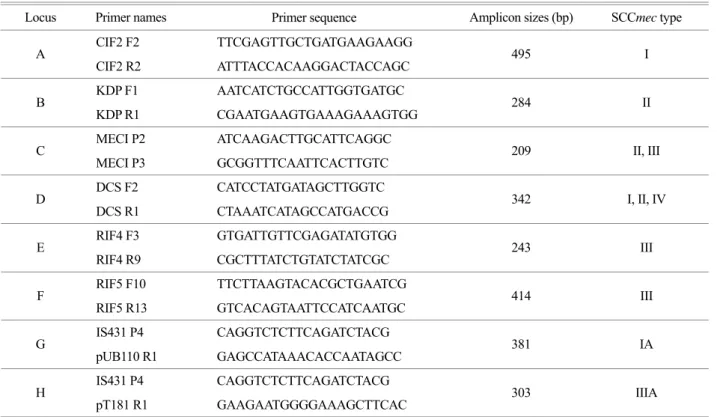
SCCmec 유전자형 분석은 Oliveira 등의 방법 (10)에 따 라 8 locus (A-H)의 primer를 사용하였고 (Table 1), 3조합 (AB, CD 및 E-H)으로 나누어 3번의 multiplex-PCR을 실 시하였다. PCR 반응 혼합액은 AccuPower PCR Premix Kit 를 사용하여, DNA 시료 (25 ng) 0.5 μl, 각 조합별 primer (10 pmol)를 각각 1 μl 넣고 증류수로 총 20 μl로 최종 부 피를 맞추었다. PCR 조건은 94℃에서 4분간 초기 반응, 94℃ 30초, 53℃ 30초, 72℃ 1분의 과정으로 30회 반복하 였고, 마지막으로 72℃에서 4분 연장으로 PCR을 종결하 였다. 증폭된 DNA 시료는 1.5% agarose gel을 통하여 전 기영동을 실시하였고, 각 증폭산물의 크기를 확인하여 SCCmec형을 결정하였다.
Coagulase 혈청형 시험
S. aureus의 coagulase 혈청형 분석은 8종 (Type I-VIII) 의 항혈청 (Denka Seiken Co, Tokyo, Japan)을 사용하여 Hwang 등 (19)의 방법으로 분석하였다. Nutrient agar 배 지에 자란 한 집락을 5 ml brain heart infusion broth (BHI) 에 접종하여 37℃ shaking incubator에서 하룻밤 배양한 후, 0.1 ml의 균배양액을 새로운 5 ml BHI broth에 접종하 여 4~5시간 배양하여 균의 농도가 108 CFU/ml 되게 조 정하고, 12000 rpm에서 20분 동안 원심분리하여 그 상층 액을 분석시료로 사용하였다. Coagulase 기질용액으로는 polyethylene-aminocarpronic acid-fibrinogen (PAF)를 사용하
였다. U-microplate 각 well에 항혈청 8종을 각각 10 μl 집 어넣고, 시료 10 μl를 각 항혈청이 들어 있는 well에 가하 여 가볍게 혼합한 다음 실온에서 5분 방치하였다. 그 다 음으로 PAF 기질용액을 각 well에 20 μl 넣은 후 37℃
incubator에서 2시간 이후 부터 30분 간격으로 형특이 coagulase와 항혈청간의 중화 반응에 의한 응고억제반응 여부를 관찰하였다.
항생제 감수성 시험
항생제 감수성 시험은 디스크 확산법으로 Clinical and Laboratory Standard Institute (CLSI) 기준에 따라 실시하였 다 (20). 항생제의 종류는 penicillin, oxacillin, clindamycin, ciprofloxacin, erythromycin, gentamicin, tetracycline, teicoplanin, trimethoprim-sulfamethoxazole (SXT), vancomycin을 사용하 였다.
결 과
Methicillin 내성균주로부터 mecA 유전자 확인
환자의 가검물에서 분리된 S. aureus 중 항생제 감수성
시험 결과에서 oxacillin 내성균주로 확인된 총 108 MRSA 균주를 대상으로 mecA 유전자에 대한 특이 primer를 이 용하여 PCR을 실시한 결과, 모든 MRSA 균주에서 533 bp 크기의 mecA 유전자가 검출되었다 (Fig. 1).
SCCmec 유전자형
Methicillin 내성 유전자가 확인된 MRSA의 SCCmec 유전자형을 8종의 primer를 조합하여 multiplex-PCR을 이용하여 분석한 결과, 4종류의 형이 확인되었다 (Fig. 2).
Table 1. Primers and predicted sizes of PCR products for SCCmec typing
Locus Primer names Primer sequence Amplicon sizes (bp) SCCmec type
CIF2 F2 TTCGAGTTGCTGATGAAGAAGG
A CIF2 R2 ATTTACCACAAGGACTACCAGC 495 I
KDP F1 AATCATCTGCCATTGGTGATGC
B KDP R1 CGAATGAAGTGAAAGAAAGTGG 284 II
MECI P2 ATCAAGACTTGCATTCAGGC
C MECI P3 GCGGTTTCAATTCACTTGTC 209 II, III
DCS F2 CATCCTATGATAGCTTGGTC
D DCS R1 CTAAATCATAGCCATGACCG 342 I, II, IV
RIF4 F3 GTGATTGTTCGAGATATGTGG
E RIF4 R9 CGCTTTATCTGTATCTATCGC 243 III
RIF5 F10 TTCTTAAGTACACGCTGAATCG
F RIF5 R13 GTCACAGTAATTCCATCAATGC 414 III
IS431 P4 CAGGTCTCTTCAGATCTACG
G pUB110 R1 GAGCCATAAACACCAATAGCC 381 IA
IS431 P4 CAGGTCTCTTCAGATCTACG
H pT181 R1 GAAGAATGGGGAAAGCTTCAC 303 IIIA
Reference, Oliveria et al. (10)
Figure 1. Detection of mecA genes from MRSA isolates by PCR. Lane 1: S. aureus (ATCC25923), Lanes 2 to 3: MRSA isolates, Lanes 4 to 5: MSSA isolates, M, molecular markers, 100 bp DNA ladder (Bioneer).
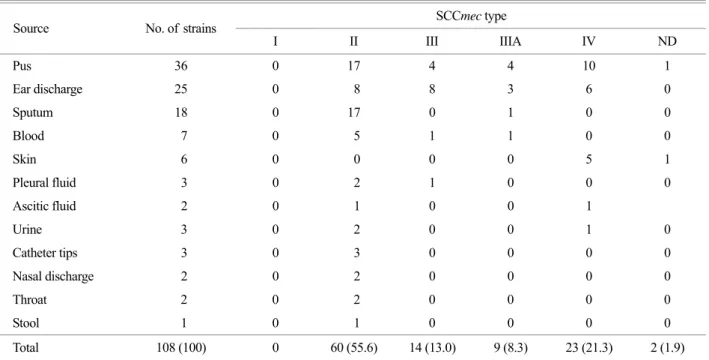
SCCmec II형은 loci B (284 bp), C (209 bp), D (342 bp) primer 에 의하여 결정되었으며, III형은 loci C (209 bp), E (243 bp), F (414 bp)로, IIIA형은 C (209 bp), E (243 bp), F (414 bp), H (303 bp), IV형은 locus D (342 bp)의 결과로 확인되 었다. SCCmec I형은 검출되지 않았다. 가장 분리율이 높 은 SCCmec형은 II형으로 60주 (55.6%)이었으며, III/IIIA 형이 각각 14주 (13%)와 9주 (8.3%), IV형이 23주 (21.3%) 이었으며, SCCmec형이 결정되지 않은 균주는 2주 (1.9%) 이었다 (Table 2). 임상검체별로 SCCmec 유형을 살펴보면, II형은 피부검체를 제외한 모든 검체에서 높은 빈도로 분리되었으며, III/IIIA형은 주로 농과 귀분비물에서, IV형 은 농과 귀분비물 및 피부검체에서 분리되었다. 호흡기 계통의 객담과 인후검체에서는 II형이 주로 분리됨으로 서, 검체의 종류에 따라 SCCmec 유형의 특성을 나타내 었다.
Coagulase 혈청형
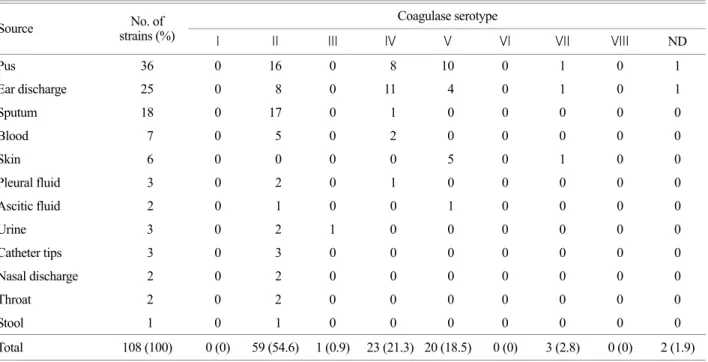
MRSA 균주의 coagulase 혈청형을 분석한 결과, I형, VI 형, VIII형을 제외한 5종의 coagulase형이 분리되었으며, 이중에서 coagulase II형이 59주 (54.6%)로 가장 분리율이 높았으며, IV형: 23주 (21.3%), V형: 20주 (18.5%), VII형: 3 주 (2.8%), III형: 1주 (0.9%)의 순이었으며, 혈청형이 결 정되지 않은 형 (ND)이 2주 (1.9%)이었다. 임상검체별로 coagulase형을 살펴보면, II형은 피부검체를 제외한 모든 검체에서 높은 빈도로 분리되었고, IV형은 주로 농과 귀 분비물에서, V형은 농과 귀분비물 및 피부 등의 표재성 화농검체에서 분리되는 것으로 확인하였다. 호흡기 계통 의 객담과 인후검체에서는 주로 II형이 분리됨으로서 검 체의 종류에 따라 coagulase형도 SCCmec형과 동일한 양 상을 나타내었다 (Table 3).
Table 2. SCCmec types of MRSA strains isolated from clinical sources SCCmec type
Source No. of strains
I II III IIIA IV ND
Pus 36 0 17 4 4 10 1
Ear discharge 25 0 8 8 3 6 0
Sputum 18 0 17 0 1 0 0
Blood 7 0 5 1 1 0 0
Skin 6 0 0 0 0 5 1
Pleural fluid 3 0 2 1 0 0 0
Ascitic fluid 2 0 1 0 0 1
Urine 3 0 2 0 0 1 0
Catheter tips 3 0 3 0 0 0 0
Nasal discharge 2 0 2 0 0 0 0
Throat 2 0 2 0 0 0 0
Stool 1 0 1 0 0 0 0
Total 108 (100) 0 60 (55.6) 14 (13.0) 9 (8.3) 23 (21.3) 2 (1.9) ND, Not Determined
Figure 2. SCCmec types identified by multiplex PCR. Lanes 1, 4, 7, 10 (loci A and B primers ): lanes 2, 5, 8, 11 (loci C and D): lanes 3, 6, 9, 12 (loci E to H): SCCmec type II, lanes 1 to 3 (284 bp, 209 bp, 342 bp): type III, lanes 4 to 6 (209 bp, 243 bp, 414 bp):
type IIIA, lanes 7 to 9 (209 bp, 243 bp, 303 bp, 414 bp): type IV, lanes 10 to 12 (342 bp). M, molecular markers, 100 bp DNA ladder (Bioneer).
SCCmec 형과 coagulase형의 상관성
SCCmec형과 coagulase형과 특성을 비교한 결과는 Table 4와 같다. 59주의 coagulase II형은 모두 SCCmec II형에 속하였고, 23주의 coagulase IV형은 SCCmec III/IIIA형, 20 주의 coagulase V형은 모두 SCCmec IV형으로 일치를 나타내었고, coagulase VII형 3주는 SCCmec IV형 1주와 ND 2주로 분류되어, 검체별 특성과 함께 SCCmec형과 coagulase형 두 유형간의 연계성이 있음을 확인하였다.
SCCmec형과 항생제 감수성
SCCmec형에 따른 MRSA 균주의 항생제 감수성 결과 는 Table 5와 같다. SCCmec II형과 III/IIIA형은 vancomycin, teicoplanin 및 trimethoprim-sulfamethoxazole (SXT)를 제외 한 penicillin, oxacillin, clindamycin, ciprofloxacin, erythro- Table 3. Distribution of coagulase serotypes of MRSA strains
Coagulase serotype
Source No. of
strains (%) I II III IV V VI VII VIII ND
Pus 36 0 16 0 8 10 0 1 0 1
Ear discharge 25 0 8 0 11 4 0 1 0 1
Sputum 18 0 17 0 1 0 0 0 0 0
Blood 7 0 5 0 2 0 0 0 0 0
Skin 6 0 0 0 0 5 0 1 0 0
Pleural fluid 3 0 2 0 1 0 0 0 0 0
Ascitic fluid 2 0 1 0 0 1 0 0 0 0
Urine 3 0 2 1 0 0 0 0 0 0
Catheter tips 3 0 3 0 0 0 0 0 0 0
Nasal discharge 2 0 2 0 0 0 0 0 0 0
Throat 2 0 2 0 0 0 0 0 0 0
Stool 1 0 1 0 0 0 0 0 0 0
Total 108 (100) 0 (0) 59 (54.6) 1 (0.9) 23 (21.3) 20 (18.5) 0 (0) 3 (2.8) 0 (0) 2 (1.9) ND, Not Determined
Table 4. Correlation between SCCmec type and coagulase serotype of MRSA
Coagulase serotype SCCmec
type No. of
strains II III IV V VII ND
II 60 59 0 0 0 0 1
III 14 0 0 14 0 0 0
IIIA 9 0 0 9 0 0 0
IV 23 0 1 0 20 1 1
ND 2 0 0 0 0 2 0
Total 108 59 1 23 20 3 2 ND, Not Determined
Table 5. Antimicrobial susceptibility profile of MRSA strains according to SCCmec
No. (%) of susceptible isolates Antimicrobial
agent Type II Type III Type IIIA Type IV Penicillin 0 (0) 0 (0) 0 (0) 0 (0) Oxacillin 0 (0) 0 (0) 0 (0) 0 (0) Clindamycin 7 (11.7) 1 (7.1) 1 (11.1) 22 (95.6) Ciprofloxacin 2 (3.3) 0 (0) 0 (0) 23 (100) Erythromycin 1 (1.7) 0 (0) 0 (0) 5 (21.7) Gentamycin 0 (0) 0 (0) 0 (0) 20 (86.9) Tetracycline 0 (0) 0 (0) 0 (0) 22 (96.8) Teicoplanin 57 (95.0) 14 (100) 9 (100) 23 (100) Trimethoprim-
Sulfamethoxazole 56 (93.3) 11 (78.6) 2 (22.2) 23 (100) Vancomycin 60 (100) 14 (100) 9 (100) 23 (100) Total 60 (100) 14 (100) 9 (100) 23 (100)
mycin, gentamicin, tetracycline 항생제에 대하여 내성을 나 타내어 거의 동일한 다약제 내성을 보였고, IV형의 경우 penicillin, oxacillin과 erythromycin을 제외한 나머지 항생 제에 대하여 감수성을 나타내었다. SCCmec II형에서 일 부 teicoplanin에 내성을 나타내었으며, SCCmec IIIA형은 SXT에 대한 내성율이 SCCmec II형과 III형 보다 높은 결 과로 SCCmec 유형에 따라 항생제 감수성 차이가 있음 을 확인하였다.
고 찰
SCCmec 유형 분석은 MRSA의 역학과 클론 상관성을 연구하는데 매우 중요한 지표로서 많은 연구가 이루어 지고 있다 (11, 21). SCCmec 유전자는 mecA 유전자와 cassette chromosome recombinase (ccr)를 갖고 있는 유일한 이동성 유전인자로서 ccr에 의하여 chromosome에 통합 되어 존재하며, mec 유전자 복합체 (IS431-mecA, IS1272- mecA, mecI-mecRI)와 ccr 유전자 복합체 (ccrA, ccrB, ccrC) 의 차이에 의하여 I형에서 V형으로 나누어진다 (8, 9, 17).
특히 다약제 내성인 병원감염의 MRSA인 경우 SCCmec I형, II형 및 III형의 분리율이 높으며, 상대적으로 유전자 크기가 작은 SCCmec IV형의 경우 지역사회 관련 MRSA 균주로 알려져 있다 (7, 22). 본 실험 결과에서 SCCmec II형 (55.6%)이 가장 많이 분리되었으며, 그 다음으로 IV 형 (21.3%), III형 (13%), IIIA형 (8.3%) 순으로 분리되었다.
이와 같은 결과는 우리나라와 일본에서 (23~25) SCCmec II형의 분리율이 높은 결과와 일치하였다. Kilic 등 (7)은 테네시주 지역 1315주 MRSA의 SCCmec형 분석에서 II 형 34.1%, IV형 64.4%로 보고하였고, Liu 등 (12)은 타이 완에서 분리된 187주 MRSA에서 III형 71.7%, IV형 24.1%
로 분리되어, SCCmec형의 지역간의 차이가 있음을 확 인하였다. 임상검체에 따른 SCCmec형을 살펴보면, 농과 귀분비물 검체에서 II형을 포함하여 III/IIIA형, IV형이 모 두 분리되었으며, 피부검체에서는 IV형이 분리되었다. 객 담과 인후검체에서는 II형이 분리되어, 임상검체에 따라 SCCme형의 차이를 나타내었다. SCCmec IV형 MRSA는 병력이나 다른 소인이 없는 집단인 지역사회 감염균으로 (CA-MRSA)로 알려지면서 독소생성능과 항생제 감수성 등의 특성에 따라 병원내 감염 MRSA와 구별된다 (26).
본 실험에서 SCCmec IV형 MRSA 균주는 주로 표재성 화농검체에서 분리되었으며, 환자병력과 함께 역학조사를
실시함으로써 유행균주의 특성을 확인할 수 있으리라 기 대한다.
S. aureus가 생성하는 coagulase는 그 구조적 차이에 의 하여 항원성이 다른 10종의 혈청형이 알려져 있으며, 일 본을 중심으로 많은 연구가 이루어지고 있다. 다약제 내 성 MRSA의 coagulase는 II형이 대부분을 차지하고 있는 것으로 알려져 있으나, 일본과 우리나라에서의 보고된 연구 결과를 비교하여 보면, II형을 제외한 나머지 형에 서 각 지역에 따라 혈청형의 차이가 있음이 보고되었다.
Ishino 등 (17)은 MRSA 472균주의 coagulase형을 분석한 결과, II형: 82.4%, IV형: 7.8%, VII형: 3.8%, III형: 2.3%, I형:
0.9%로 보고하였고, Ryu 등 (27)은 MRSA 86균주에서 II 형: 50%, IV형: 12.5%, III형: 6.8%, V형을 제외한 나머지 I, VI, VII, VIII형이 각각 4.5%임을 보고한 바 있다. Hwang 등 (28)은 1994년에서 2005년 분리된 MRSA 408주의 coagulase 혈청형 분석한 결과에서 II형 (54.4%)과 IV형 (24.8%)이 대부분을 차지하였으나, 시대의 변화에 따라 III형은 감소, V형은 새로이 출현, 증가됨을 확인하여, coagulase 항원성 변화를 보고하였다. 최근에 다약제 내성 S. aureus 증가는 이 균주의 생물학적 특성변화는 물론 내성인자 획득을 위한 환경적 적응력을 갖게 하는 유전 자 변이도 함께 이루어질 수 있다고 생각된다. Coagulase 항원성에 변화에 따른 혈청형의 특성과 methicillin 내성 유전자 복합체인 SCCmec 유전자형의 특성을 비교한 결 과 상당히 흥미로운 결과를 얻었다. Coagulase II형 균주는 모두 SCCmec II형에 속하였고, coagulase IV형은 SCCmec III/IIIA형, coagulase V형은 SCCmec IV형, 그리고 coagulase VII형은 SCCmec IV과 ND에 속함으로써, MRSA 내성균 주의 진화과정에서 coagulase 관련 유전자와 SCCmec 유 전자 사이에 분자생물학적 연관성이 있을 것으로 생각 된다.
다약제 내성 병원감염 MRSA와 지역사회 관련 MRSA 의 증가로 인하여 S. aureus의 내성획득기전과 전파경 로, 진화에 관한 많은 연구가 이루어지고 있다 (1, 8, 29).
본 연구 결과에서 SCCmec II형과 III/IIIA형은 teicoplanin, SXT, vancomycin을 제외한 약제에 내성을 나타내었으며, SCCmec IV형은 beta-lactam계와 erythromycin을 제외한 약제에 감수성을 나타내었다. SCCmec II형에서만 glyco- peptide 계열인 teicoplanin 약제에 일부 내성을 가지고 있 어 vancomycin resistant S. aureus (VRSA)로 될 가능성은 II 형이 높은 것으로 생각된다. 그리고 SCCmec III과 IIIA형
에서 SXT 항생제에 대한 감수성의 차이를 보임으로써 SCCmec III형의 subtype에서 생물학적 차이가 있음을 확 인하였다. VRSA을 포함한 새로이 진화된 MRSA 균주의 출현은 전세계적으로 심각한 문제로 다루어지고 있다. 우 리나라에서도 병원감염 MRSA 뿐 아니라 지역사회 관련 MRSA에 관한 관심과 역학적인 연구가 점차 증가하고 있다. 다양하고 첨단적인 분석기법을 통하여 새로이 출 현된 변이균주의 유전적 특성과 그 기작을 연구하고 있 으나, 보다 쉽게 분석 가능한 S. aureus의 coagulase형과 항생제 감수성 시험의 지속적인 분석 결과는 SCCmec형 분석과 함께 MRSA 변이균주의 출현과 그 특성을 확인 할 수 있으며, 또한 coagulase형과 SCCmec형의 연관성에 관한 본 실험 결과는 MRSA 균주의 내성 유전자를 비롯 한 분자역학적인 연구에 기초자료로 활용될 수 있으리라 기대한다.
참 고 문 헌
1) Chamber HF. The changing epidemiology of Staphylococcus aureus? Emerg Infect Dis 2001;7:178-82.
2)Eady EA, Cove JH. Staphylococcal resistance revisited:
community-acquired methicillin resistant Staphylococcus aureus-an emerging problem for the management of skin and soft tissue infections. Curr Opin Infect Dis 2003;16:103-24.
3) Lee YS, Kim HB, Yoo JI, Yang SJ, Sa CM, Choi YH, Kim BS.
Molecular epidemiology of methicillin resistant Staphylococcus aureus in Korea. The Report of National Institute of Health 1999;36:67-76.
4) Kim JS, Kim HS, Song WK, Cho HC, Lee KM, Kim EC.
Molecular epidemiology of methicillin-resistant Staphylo- coccus aureus isolates with toxic shock syndrome toxin and staphylococcal enterotoxin C genes. Korean J Lab Med 2007;
27:118-23.
5) Daum RS, Ito T, Hiramatsu K, Hussain F, Mongkolrattanothai K, Jamklang M, Boyle-Vavra S. A novel methicillin-resistance cassette in community-acquired methicillin-resistant Staphy- lococcus aureus isolates of diverse genetic backgrounds. J Infect Dis 2002;186:1344-7.
6) Diep BA, Carleton HA, Chang RF, Sensabaugh GF, Perdreau- Remington F. Roles of 34 virulence genes in the evolution of hospital-and community-associated strains of methicillin- resistant Staphylococcus aureus. J Infect Dis 2006;193:1495
-503.
7) Kilic A, Li H, Stratton CW, Tang YW. Antimicrobial suscep- tibility patterns and staphylococcal cassette chromosome mec types of as well as Panton-Valentine leukocidin occurrence among, methicillin-resistant Staphylococcus aureus isolates from children and adults in middle Tennessee. J Clin Microbiol 2006;44:4436-40.
8) Boyle-Vavra S, Ereshefsky B, Wang CC, Daum RS. Success- ful multiresistant community-associated methicillin-resistant Staphylococcus aureus lineage from Taipei, Taiwan, that carries either the novel Staphylococcal chromosome cassette mec (SCCmec) type VT or SCCmec type IV. J Clin Microbiol 2005;43:4719-30.
9) Ito T, Ma XX, Takeuchi F, Okuma K, Yuzawa H, Hiramatsu K.
Novel type V staphylococcal cassette chromosome mec driven by a novel cassette chromosome recombinase, ccrC.
Antimicrob Agents Chemother 2004;48:2637-51.
10)Oliveira DC, de Lencastre H. Multiplex PCR strategy for rapid identification of structural types and variants of the mec element in methicillin-resistant Staphylococcus aureus. Anti- microb Agents Chemother 2002;46:2155-61.
11) Hisata K, Kuwahara-Arai K, Yamanoto M, Ito T, Nakatomi Y, Cui L, Baba T, Terasawa M, Sotozono C, Kinoshita S, Yamashiro Y, Hiramatsu K. Dissemination of methicillin- resistant staphylococci among healthy Japanese children. J Clin Microbiol 2005;43:3364-72.
12) Liu Y, Wang H, Du N, Shen E, Chen H, Niu J, Ye H, Chen M.
Molecular evidence for spread of two major methicillin- resistant Staphylococcus aureus clones with a unique geo- graphic distribution in Chinese hospitals. Antimicrob Agents Chemother 2009;53:512-8.
13) Durand G, Bes M, Meugnier H, Enright MC, Forey F, Liassine N, Wenger A, Kikuchi K, Lina G, Vandenesch F, Etienne J.
Detection of new methicillin-resistant Staphylococcus aureus clones containing the toxic shock syndrome toxin 1 gene responsible for hospital- and community-acquired infections in France. J Clin Microbiol 2006;44:847-53.
14) Johnson WM, Tyler SD, Ewan EP, Ashton FE, Pollard DR, Rozee KR. Detection of genes for enterotoxins, exfoliative toxins, and toxic shock syndrome toxin 1 in Staphylococcus aureus by the polymerase chain reaction. J Clin Microbiol 1991;29:426-30.
15) Kanemitsu K, Yamamoto H, Takemura H, Kaku M, Shimada J. Relatedness between the coagulase gene 3'-end region and
coagulase serotypes among Staphylococcus aureus strains.
Microbiol Immunol 2001;45:23-7.
16) Watanabe S, Ito T, Takeuchi F, Endo M, Okuno E, Hiramatsu K. Structural comparison of ten serotypes of staphylocoa- gulases in Staphylococcus aureus. J Bacteriol 2005;187:3698 -707.
17) Ishino K, Tsuchizaki N, Ishikawa J, Hotta K. Usefulness of PCR-restriction fragment length polymorphism typing of the coagulase gene to discriminate arbekacin-resistant methicillin- resistant Staphylococcus aureus strains. J Clin Microbiol 2007;
45:607-9.
18) Murakami K, Minamide W, Wada K, Nakamura E, Teraoka H, Watanabe S. Identification of methicillin-resistant strains of staphylococci by polymerase chain reaction. J Clin Microbiol 1991;29:2240-4.
19) Hwang SM, Seki K, Sakurada J, Ogasawara M, Murai M, Ohmayu S, Kurosaka K, Masuda S. Improved methods for detection and serotyping of coagulase from Staphylococcus aureus. Microbiol Immunol 1989;33:175-82.
20)Clinical and Laboratory Standards Institute (CLSI). Perfor- mance standard for antimicrobial susceptibility testing; 15th informational supplement. M100-S15. Clinical and Laboratory Standards Institute, Wayne, PA. 2005.
21) Hanssen AM, Fossum A, Mikalsen J, Halvorsen DS, Bukholm G, Sollid J. Dissemination of Community-acquired methicillin- resistant Staphylococcus aureus clones in Northern Norway:
sequence type 8 and 80 predominate. J Clin Microbiol 2005;
43:2118-24.
22) Ko KS, Lee JY, Suh JY, Oh WS, Peck KR, Lee NY, Song JH.
Distribution of major genotypes among methicillin-resistant Staphylococcus aureus clones in Asian countries. J Clin
Microbiol 2005;43:421-6.
23) Kim JS, Song W, Kim HS, Cho HC, Lee KM, Choi MS, Kim EC. Association between the methicillin resistance of clinical isolates of Staphylococcus aureus, their staphylococcal cassette chromosome mec (SCCmec) subtype classification, and their toxin gene profiles. Diagn Microbiol Infect Dis 2006;56:289 -95.
24) Ma XX, Ito T, Chongtrakool P, Hiramatsu K. Predominance of clones carrying Panton-Valentine Leukocidin genes among methicillin-resistant Staphylococcus aureus strains isolated in Japanese hospitals from 1979 to 1985. J Clin Microbiol 2006;
44:4515-27.
25) Zaraket H, Otsuka T, Saito K, Dohmae S, Takano T, Higuchi W, Ohkubo T, Ozaki K, Takano M, Reva I, Baranovich T, Yamamoto T. Molecular characterization of methicillin- resistant Staphylococcus aureus in hospitals in Niigata, Japan:
Divergence and transmission. Microbiol Immunol 2007;51:
171-6.
26) File TM Jr. Impact of community-acquired methicillin-resistant Staphylococcus aureus in the hospital setting. Cleve Clin J Med 74, suppl 2007;4:S6-11.
27) Ryu JH, Lee HK. Coagulase typing and antibiotic resistance of methicillin resistant Staphylococcus aureus (MRSA) isolated from patients in Pusan. Kor J Microbiol 2000;36:216-20.
28)Hwang SM, Kim TU. Changes in coagulase serotype of Staphylococcus aureus isolates in Busan, 1994-2005. Korean J Microbiol 2007;43:346-50.
29) Enright MC, Robinson DA, Randle G, Feil EJ, Grundmann H, Spratt BG. The evolutionary history of methicillin-resistant Staphylococcus aureus (MRSA). Proc Natl Acad Sci USA 2002;99:7687-92.