Korean J Clin Microbiol Vol. 11, No. 2, October, 2008
A Fatal Case of Infective Endocarditis Caused by Community-Associated Methicillin-Resistant
Staphylococcus aureus ST72 in Korea
Seong-Ho Choi, Jin-Won Chung
Department of Internal Medicine, Chung-Ang University College of Medicine, Seoul, Korea
The advent of community-associated methicillin-re- sistant Staphylococcus aureus (CA-MRSA) has been a worldwide threat to public health for the past decade. We report a fatal case of infective endo- carditis caused by a non-USA300, Panton-Valentine leukocidin toxin-negative CA-MRSA clone. This is a serious case of CA-MRSA infection caused by a se-
quence type (ST) 72 clone, which is one of the com- mon CA-MRSA clones circulating in Korea where se- rious CA-MRSA infections have been rare. (Korean J Clin Microbiol 2008;11:129-131)
Key Words: Staphylococcus aureus, Endocarditis, Methi- cillin Resistant
Received 8 September, 2008, Accepted 25 September, 2008
Correspondence: Jin-Won Chung, Department of Internal Medicine, Chung-Ang University Medical Center, 224-1, Heukseok-dong, Dongjak-gu, Seoul 156-755, Korea. (Tel) 82-2-6299-1420, (Fax) 82- 2-825-7571, (E-mail) [email protected]
129 INTRODUCTION
Community-associated methicillin-resistant Staphylococcus aur- eus (CA-MRSA) has been a major threat to public health world- wide for the past decade[1,2]. Although more than 60% of noso- comial isolates of S. aureus have methicillin resistance, serious CA-MRSA infections have rarely been reported in Korea[3]. We describe a fatal case of CA-MRSA infective endocarditis (IE) caused by a sequence type (ST) 72 clone, which is very common in Korean.
CASE REPORT
A 43-year-old male patient visited the Emergency Department of Chung-Ang University Medical Center with general myalgia, weakness, and febrile sensation for 3 days prior to admission. He was a taxi driver and had no history of hospital visit, recent medi- cation, or injection drug use (IDU). On admission, his body tem- perature was 38.3oC, pulse rate was 102/min, and blood pressure was 100/72 mmHg. Multiple petechiae were found in both fore- arms and legs, and small hemorrhagic nodules were also observed in palms, soles, fingers, and toes. Blood examination showed a thrombocytopenia and an increase in serum troponin I.
Electrocardiography showed ST-segment elevation in several pre- cordial leads. However, transthoracic echocardiograms initially showed no regional wall motion abnormalities or vegetations. He was moved to the intensive care unit with the initial assessment
of acute myopericarditis, and ceftriaxone was administered empirically. On the next day, he had fever with mental deterioration. Vancomycin was added because there was a suspi- cion of bacterial meningitis. Cerebrospinal fluid examination showed white blood cell count, 100/mm3 (99% neutrophils); pro- tein, 48.8 mg/dL; and glucose, 101 mg/dL. Brain CT scans showed multiple cerebral hemorrhages in the left frontal lobe and a cerebral infarction in the right anterior corona radiata. On hospi- tal day 3, a continuous heart murmur was audible at the right ster- nal border. Follow-up echocardiograms showed a 1 cm-sized wall abscess of the sinus of Valsalva. The prolapsed abscess was ex- tended into the right atrium and ruptured with a resultant shunt flow from the aorta to the right atrium. He had a bicuspid aortic valve and severe aortic regurgitation due to a prolapse of the aort- ic cusp. On hospital day 4, MRSA was isolated from the 3 sets of blood cultures obtained on the admission day. MRSA was also isolated from blood cultures obtained on hospital days 5 and 6.
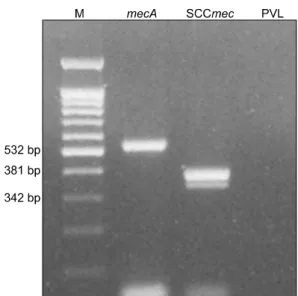
MRSA was not isolated from the CSF. Identification and determi- nation of antibiotic susceptibility were carried out with VITEK GPI Cards (bioMérieux, Hazelwood, MO, USA). This strain was susceptible to most antibiotics such as ciprofloxacin, trimetho- prim-sulfamethoxazole, clindamycin, erythromycin, fusidic acid, rifampin, and vancomycin (MIC 1 μg/mL), excluding beta-lac- tams and aminoglycosides. We stopped ceftriaxone and continued vancomycin. To determine whether the isolate would have the characteristic features of CA-MRSA, we conducted genetic studies. The detection of mecA gene and typing of staphylococcal cassette chromosome mec (SCCmec) were performed separately using PCR methods with each specific primer for mecA[4] and for SCCmec[5]. The isolate had mecA gene and SCCmec type IV A (Fig. 1). The presence of lukS-PV and lukF-PV genes coding for PVL in the isolate were identified, and multilocus sequence
Korean J Clin Microbiol 2008;11(2):129-131
130
Fig. 1. Molecular detection of type IV SCCmec and PVL virulence gene. PCR amplification with specific primers shows the presence of mecA and type IV SCCmec in the CA-MRSA isolate. However, PCR for detection of the PVL gene shows the absence of PVL gene in the isolate.
typing (MLST) was performed according to published protocols[6, 7]. PVL genes were absent in the isolate. It was a ST 72 clone by MLST analysis. Cardiac surgery could not be performed be- cause of the risk of recurrent cerebral hemorrhage, and 11 days after admission, he was expired by worsening cerebral hemor- rhage and disseminated intravascular coagulation in spite of a negative blood culture.
DISCUSSION
CA-MRSA typically causes skin and soft tissue infections (SSTIs) or necrotizing pneumonia in healthy patients without risk factors for MRSA acquisition. A few clones, such as pulsed field types USA300 and USA 400 (STs 8 and 1 by MLST analysis), are known to be associated with these serious community-ac- quired infections. PVL, a pore-forming toxin, produced mainly by CA-MRSA, is suggested to be one of the important virulence fac- tors in CA-MRSA infections[1,2]. PVL-positive USA 300 clone, and serious infections by this clone have rarely been observed in clinical practice in Korea. Therefore, CA-MRSA has not been considered a major threat, and empirical vancomycin therapy for community-acquired infections has not been recommended.
Recent epidemiological studies of CA-MRSA from Korean com- munity have reported a ST72-MRSA-IV A clone to be the most common CA-MRSA clone[3,8]. Our case caused by the PVL-neg- ative, ST 72-MRSA-IV A clone indicates that fatal infections by a common Korean CA-MRSA clone may develop. However, it is still difficult to agree with the empirical use of vancomycin for community-acquired infections because vancomycin-resistant en- terococci and glycopeptide-intermediate S. aureus are rapidly in- creasing in Korea. Subsequent reports on serious CA-MRSA in-
fections will change the spectrum of possible pathogens in com- munity-acquired infections and the initial choice of antibiotics in Korea in the near future.
Infective endocarditis (IE) caused by CA-MRSA was known to be a rare condition[9,10]. Several cases have been reported re- cently in developed countries. The PVL-positive USA 300 clone is found as a pathogen in the majority of cases of CA-MRSA IE[11]. The majority of CA-MRSA IE had preceding SSTIs, such as furunculosis or cellulitis, caused by the PVL-positive USA 300 clone. The PVL-positive USA 300 clone is thought to cause CA-MRSA SSTIs and subsequently CA-MRSA IE[9,11]. Also, there were a few cases without preceding SSTIs, however, they had previous histories of IDU[10]. Interestingly, our case is caused by a PVL-negative, non-USA300 clone and had neither SSTIs nor a history of IDU. Our case indicates that CA-MRSA has become a real threat and may be a warning sign of impending CA-MRSA infections in Korea, and the PVL-negative, non-USA 300 clone may cause fatal IE, even without preceding SSTIs or IDU. Persistent effort is needed to recognize the epidemiologic changes of CA-MRSA in Korea.
REFERENCES
1. Diederen BM and Kluytmans JA. The emergence of infections with community-associated methicillin resistant Staphylococcus aureus. J Infect 2006;52:157-68.
2. Zetola N, Francis JS, Nuermberger EL, Bishai WR. Community- acquired methicillin-resistant Staphylococcus aureus: an emerging threat. Lancet Infect Dis 2005;5:275-86.
3. Kim ES, Song JS, Lee HJ, Choe PG, Park KH, Cho JH, et al. A survey of community-associated methicillin-resistant Staphylococcus aureus in Korea. J Antimicrob Chemother 2007;60:1108-14.
4. Strommenger B, Kettlitz C, Werner G, Witte W. Multiplex PCR assay for simultaneous detection of nine clinically relevant antibiotic resistance genes in Staphylococcus aureus. J Clin Microbiol 2003;41:4089-94.
5. Oliveira DC and de Lencastre H. Multiplex PCR strategy for rapid identification of structural types and variants of the mec element in methicillin-resistant Staphylococcus aureus. Antimicrob Agents Chemother 2002;46:2155-61.
6. Lina G, Piémont Y, Godail-Gamot F, Bes M, Peter MO, Gauduchon V, et al. Involvement of Panton-Valentine leukocidin- producing Staphylococcus aureus in primary skin infections and pneumonia. Clin Infect Dis 1999;29:1128-32.
7. Enright MC, Day NP, Davies CE, Peacock SJ, Spratt BG.
Multilocus sequence typing for characterization of methicillin- resistant and methicillin-susceptible clones of Staphylococcus aureus. J Clin Microbiol 2000;38:1008-15.
8. Ko KS, Lee JY, Baek JY, Peck KR, Rhee JY, Kwon KT, et al.
Characterization of Staphylococcus aureus nasal carriage from children attending an outpatient clinic in Seoul, Korea. Microb Drug Resist 2008;14:37-44.
9. Bahrain M, Vasiliades M, Wolff M, Younus F. Five cases of bacterial endocarditis after furunculosis and the ongoing saga of community-acquired methicillin-resistant Staphylococcus aureus infections. Scand J Infect Dis 2006;38:702-7.
10. Tsigrelis C, Armstrong MD, Vlahakis NE, Batsis JA, Baddour LM.
131
Seong Ho Choi, Jin-Won Chung : CA-MRSA Infective Endocarditis
Infective endocarditis due to community-associated methicillin- resistant Staphylococcus aureus in injection drug users may be associated with Panton-Valentine leukocidin-negative strains. Scand J Infect Dis 2007;39:299-302.
11. Millar BC, Prendergast BD, Moore JE. Community-associated MRSA (CA-MRSA): an emerging pathogen in infective endocarditis. J Antimicrob Chemother 2008;61:1-7.
=국문초록=
국내에서 발생한 지역사회획득 메티실린내성 포도알균 ST72에 의한 감염성 심내막염 1예
중앙대학교 의과대학 내과학교실 최성호, 정진원
지역사회획득 메티실린내성 황색포도알균(Community-associated methicillin-resistant Staphylococcus aureus, CA-MRSA) 은 지난 10년 전부터 전세계적으로 공중보건에 심각한 위협이 되고 있다. 저자들은 Panton-Valentine leukocidin 독소 유전자가 없으면서 USA 300 클론이 아닌 CA-MRSA에 의한 감염성 심내막염으로 사망한 1예를 경험하였기에 보고하 고자 한다. 본 증례는 국내에서 가장 흔한 CA-MRSA 클론의 하나이면서도 위중한 감염의 원인으로 거의 알려지지 않았던 sequence type 72 클론에 의한 치명적인 감염 증례이다. [대한임상미생물학회지 2008;11:129-131]
교신저자 : 정진원, 156-755, 서울특별시 동작구 흑석동 224-1 중앙대학교병원 내과
Tel: 02-6299-1420, Fax: 02-825-7571 E-mail: [email protected]