Chemotherapy
Infect Chemother 2017;49(2):109-116
ISSN 2093-2340 (Print) · ISSN 2092-6448 (Online)
Received: January 6, 2017 Accepted: March 15, 2017 Publised online: May 26, 2017 Corresponding Author : Doo Ryeon Chung, MD, PhD
Division of Infectious Diseases, Department of Internal Medicine, Samsung Medical Center, Sungkyunkwan University School of Medicine, 81 Irwon-ro, Gangnam-gu, Seoul 06351, Korea
Tel: +82-2-3410-0323, Fax: +82-2-3410-0064 Email address: [email protected]
This is an Open Access article distributed under the terms of the Creative Commons Attribution Non-Commercial License (http://creativecommons.org/licenses/by-nc/3.0) which permits unrestricted non-commercial use, distribution, and repro- duction in any medium, provided the original work is properly cited.
Copyrights © 2017 by The Korean Society of Infectious Diseases | Korean Society for Chemotherapy
www.icjournal.org
Emergence of Community-Genotype Methicillin-
Resistant Staphylococcus aureus in Korean Hospitals:
Clinical Characteristics of Nosocomial Infections by Community-Genotype Strain
Eun-Jeong Joo
1, Doo Ryeon Chung
2,3, So Hyun Kim
3, Jin Yang Baek
3, Nam Yong Lee
4, Sun Young Cho
2, Young Eun Ha
2, Cheol-In Kang
2, Kyong Ran Peck
2, and Jae-Hoon Song
2,31Division of Infectious Diseases, Department of Internal Medicine, Kangbuk Samsung Hospital, Sungkyunkwan University School of Med- icine; 2Division of Infectious Diseases, Department of Internal Medicine, Samsung Medical Center, Sungkyunkwan University School of Medicine; 3Asia Pacific Foundation for Infectious Diseases (APFID); 4Department of Laboratory Medicine and Genetics, Samsung Medical Center, Sungkyunkwan University School of Medicine, Seoul, Korea
Background: As community-genotype methicillin-resistant Staphylococcus aureus (MRSA) strains spread into hospitals, the gen- otypes of the MRSA strains causing hospital-acquired (HA) infections have become more diverse. We describe clinical charac- teristics of nosocomial MRSA infections by a community-genotype of sequence type (ST) 72.
Materials and Methods: A case-control study was designed among patients with HA-MRSA infections. Forty patients with in- fections caused by ST72-MRSA SCCmec type IV were selected as cases. Cases were matched to the controls with 106 patients infected with ST5/ST239 MRSA, which are representative hospital genotypes in Korea.
Results: Patients infected with ST72 isolates were younger than those with ST5/ST239 isolates. Female gender predominated among ST72 MRSA group compared to ST5/ST239 MRSA group. Solid tumor was a more frequent underlying disease in MRSA infections by ST72 isolates, whereas underlying renal, lung, heart, and neurologic diseases were more frequently found in those by ST5/ST239 isolates. The most common type of infection was pneumonia in both ST72 and ST5/ST239 groups (45.0%
vs. 51.9%), followed by skin and soft tissue infection (SSTI). Female gender and underlying solid tumor were identified to be independent predictors for MRSA infections by ST72 isolates. All-cause mortality rates (20.0% vs. 30.2%) were not different be- tween the groups.
Conclusion: A community-genotype MRSA, ST72 isolate has emerged as a nosocomial pathogen presenting as hospital-ac- quired pneumonia and SSTI. Although differences in underlying disorders were found, the distribution of infection type and mortality rate did not differ between the groups.
Key Words: Methicillin-resistant Staphylococcus aureus; Nosocomial infections; Genotyping
Introduction
The hospital epidemiology of methicillin-resistant Staphylo- coccus aureus (MRSA) has changed in the past few years due to the emergence of community-associated MRSA (CA-MR- SA) strains in healthcare settings [1, 2]. Recently, communi- ty-genotype strains carrying SCCmec type IV have emerged as a significant cause of healthcare-associated (HCA) and hospi- tal-associated (HA) infection in the USA and European coun- tries [2-6]. CA-MRSA strain, ST72 MRSA has also emerged as a major cause of bloodstream infection (BSI) in healthcare set- tings in Korea [7-9].
Despite increasing trends in the annual incidence of noso- comial MRSA infections by community-genotype strain worldwide, there are few reports regarding clinical character- istics in nosocomial MRSA infections by community-geno- type strain [10, 11]. Furthermore, it is still questionable wheth- er clinical outcomes in patients with nosocomial MRSA infections would be adversely affected by the communi- ty-genotype strain. This study was performed to identify clini- cal characteristics and outcomes in patients with nosocomial infections due to the community-genotype ST72 MRSA.
Materials and Methods
1. Study design and patient selection
A case-control study was designed to identify clinical char- acteristics in patients with HA-MRSA infections by compari- son of outcomes in those with community-genotype strain, ST72-MRSA-SCCmec type IV, and hospital genotype strains, ST5- and ST239-MRSA-SCCmec type II and III. Databases and electronic medical charts were reviewed in S. aureus isolates that had been collected at Samsung Medical Center (a 1,950- bed tertiary care university hospital, Seoul, Korea) and stored in the Asian Bacterial Bank (Asia Pacific Foundation for Infec- tious Diseases, Seoul, Korea) during the period of January 2007 through December 2009. The study patients were en- rolled when they were clinically diagnosed with nosocomial MRSA infections by attending physicians, based on clinical presentation and manifestation with culture results of MRSA isolates. When the patients carried MRSA but showed no clin- ical signs or symptoms of infection, the isolates were deter- mined to be colonizer and excluded from this study.
To analyze clinical characteristics of nosocomial infection cases by community-genotype MRSA strain, ST72 isolates, we selected cases in a previous study [10], in which a total of 40
cases were finally identified to have nosocomial infections due to ST72 isolates. During the study period, a total of 675 patients were identified to carry MRSA isolates in Asian Bac- terial Bank (157 in 2007, 227 in 2008, and 291 in 2009). MRSA isolates were matched to ST72 at a 4-5 times ratio, based on the date of acquisition of ST72 isolates. For the selection of a candidate for ST5/ST239 MRSA, antibiotic susceptibility pat- terns were reviewed in MRSA isolates to determine whether these are multidrug-resistant (MDR) or not. MDR were de- fined as resistant to at least 3 antibiotics of fluoroquinolone, gentamicin (GEN), rifampicin (RIF), trimethoprim-sulfame- thoxazole (TMP/SMX), clindamycin (CLI) and erythromycin (ERY). The electronic medical records of the patients were also reviewed in order to discern true pathogens from colo- nizers. After reviewing antimicrobial susceptibility test results and medical chart, a total 145 patients were identified to have MDR-MRSA infections. Multilocus sequence typing (MLST) was performed in 145 MRSA isolates, which revealed 106 iso- lates were ST5 and ST239 (94 and 12, respectively). Further molecular analysis was not performed in remaining 39 MRSA isolates when at least one allele profile of housekeeping genes in those isolates was not compatible to that in ST5 and ST239.
2. Definition and data collection
HA, nosocomial S. aureus infection was defined as infection occurring in the 48 hours after hospital admission. Appropri- ateness of empiric therapy was defined in cases that initial empiric antimicrobial agents, given during the first 48-72 hours after the onset of infection, were active against MRSA.
As site of infection, skin and soft tissue infection (SSTI), surgi- cal site infection (SSI) were defined according to the previous report [10]. Pneumonia was defined as cases meeting the fol- lowing criteria. (1) “New or progressive” consolidation or cavi- tation. (2) At least one of the following: fever; leukocytosis; or leucopenia; for adults greater than or equal to 70 years, altered mental status with no other recognized cause. (3) New onset of purulent sputum or change in character of sputum or in- creased respiratory secretions; new-onset or worsening cough, dyspnea, or tachycardia; rales or bronchial breath sounds; or worsening gas exchange [12]. Relapse was evaluat- ed until one year after hospital discharge.
We collected the following demographic data from electron- ic medical records: age, gender, underlying disease, comorbid conditions, severity of illness, and conditions prone to MRSA acquisition. Clinical data included type of infection, well-de- fined healthcare-associated risk factors, in-hospital mortality, and length of hospital stay. All-cause mortality was defined to
all causes of death. Attributable mortality was defined to deaths secondary to MRSA infection. This study was approved by the Institute Review Board of Samsung Medical Center.
3. Microbiological identification, antimicrobial susceptibility, and molecular testing
The VITEK II automated system (bioMérieux, Marcy l’Etoile, France) was used for microbiological identification and anti- microbial susceptibility testing using a standard identification card and the modified broth microdilution method. Minimum inhibitory concentration breakpoints and quality-control pro- tocols were used according to standards established by the Clinical and Laboratory Standards Institute [13]. SCCmec typ- ing was performed for the controls, which had been verified to have MRSA infection. Multiplex polymerase chain reaction strategies for the rapid assignment of SCCmec types were ap- plied in selected isolates [14, 15]. Molecular typing of all MRSA isolates was performed by MLST [16]. Alleles of each locus were compared, and sequence types were assigned based on the S. aureus MLST database [16, 17].
4. Statistical analysis
Student’s t-test and the Mann-Whitney test were used to compare continuous variables, and the χ2 test or Fisher’s exact test was used to compare categorical variables. To identify the independent risk factors for mortality, a stepwise backward multivariable logistic regression analysis model was used to control for the effects of confounding variables. Variables with P <0.1 in the univariate analyses were candidates for inclusion in the multivariate analysis and variables for which P <0.05 in the multivariate analysis were retained in the final model. In- teractions between variables were not introduced in the mod- els. Odds ratios (ORs) and their 95% confidential intervals (CIs) were calculated. All P-values were two-tailed, and P-val- ues <0.05 were considered statistically significant. SPSS for Windows, PASW version 19.0 (SPSS Inc., Chicago, IL, USA) was used for these analyses.
Results
1. Comparison of clinical outcome by community- and hospital genotype strains
Clinical characteristics of nosocomial MRSA infections in cas- es and controls are shown in Table 1. Patients with ST72 MRSA infections were younger than those with ST5/ST239 MRSA (mean age ± SD; 51 ± 20 vs. 58 ± 19; P = 0.039). ST72 MRSA infec-
Table 1. Clinical characteristics of nosocomial MRSA infections caused by hospital- and community-genotype strains
Clinical characteristics
Community- ST72 (n = 40)
Hospital- ST5/ST239
(n = 106) P –value
Age, mean ± SD 51 ± 20 58 ± 19 0.039
Sex, female 26 (65.0) 21 (19.8) <0.001
Adult 38 (95.0) 98 (92.5) 0.728
Surgical department 30 (75.0) 56 (52.8) 0.015 Hospital stay before the
onset of infection
17 ± 17 20 ± 19 0.437
Underlying disease
Diabetes mellitus 6 (15.0) 11 (10.4)
IHD or HF 1 (2.5) 20 (19.0) 0.011
Hypertension 5 (12.5) 18 (17.0) 0.507 Hepatobiliary tract
disease
11 (27.5) 19 (17.9) 0.202
Liver cirrhosis 7 (17.5) 8 (7.5) 0.122 Renal disease 4 (10.0) 31 (29.2) 0.015 Lung disease 3 (7.5) 29 (27.4) 0.010 Solid tumor 23 (57.5) 40 (37.7) 0.032 Hematologic malignancy 5 (12.5) 6 (5.7) 0.290 Neurologic disease 3 (7.5) 34 (32.1) 0.002 Severity of illness
Charlson’s WIC, mean ± SD
3.35 ± 2.35 3.42 ± 2.27
Severe sepsis or septic shock
7 (17.5) 26 (24.5) 0.365
Care in the intensive care unit
8 (20.0) 50 (47.2) 0.003
Immunodeficiency Solid organ
transplantation
3 (7.5) 6 (5.7) 0.706
Receipt of chemotherapy or radiotherapy
7 (17.5) 11 (10.4) 0.265
Use of corticosteroids 8 (20.0) 21 (19.8) 0.980
Neutropenia 3 (7.5) 3 (2.8) 0.346
Conditions prone to MRSA acquisition Prior operation within
one month
25 (62.5) 61 (57.5) 0.587
Prior antibiotics within one month
33 (82.5) 101 (95.3) 0.019
Colonization of MRSA 9 (22.5) 33 (31.1) 0.304 Ventilator care 8 (20.0) 38 (35.8) 0.066 Catheterization 22 (55.0) 69 (65.1) 0.262
Dialysis 4 (10.0) 9 (8.5) 0.752
MRSA, methicillin-resistant Staphylococcus aureus; ST, sequence type; SD, stan- dard deviation; IHD, ischemic heart disease; HF, heart failure; WIC, weighted index of co-morbidity.
tions predominated in females, compared to ST5 and ST239 (65.0% vs. 19.8%; P <0.001). Solid tumors were more commonly found in patients with ST72 MRSA infections, whereas underly- ing renal, lung, and neurologic diseases were more significantly common in ST5/ST239 MRSA infections. The most common type of infection was pneumonia in both ST72 and ST5/ST239 groups, which accounted for 45.0% and 51.9%, respectively (Ta-
ble 2). SSTI was more common in the ST72 group compared to the group of ST5/ST239 (40.0% vs. 24.5%; P = 0.100). Twen- ty-eight patients died due to MRSA infections in the hospital (19.2%), and mortality rates were not significantly different be- tween the two groups with community- and hospital-strains.
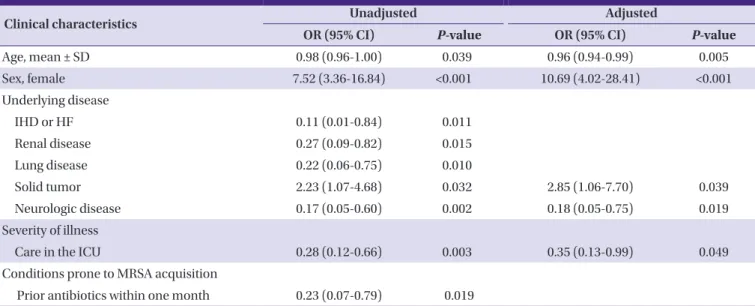
2. Predictor of infection by community-genotype MRSA Further analysis was performed to identify independent predictors of ST72 MRSA infections among nosocomial MRSA infections; the results are shown in Table 3. Female gender and underlying solid tumors were identified to be indepen- dent predictors for ST72 MRSA infections on multivariate analyses. Old age, underlying neurologic disease, and care in the intensive care unit (ICU) were negatively associated with ST72 MRSA infections, shown to be independent factors for ST5/ST239.
3. Antibiotic resistance in MRSA isolates by community- and hospital-genotypes
Antimicrobial activities were tested against 144 MRSA sam- ples acquired from hospitalized patients (Fig. 1). In this study, ST72 MRSA isolates were selected based on susceptibility pat- terns to RIF, TMP/SMX, ciprofloxacin (CIP), and GEN [10].
Thus, it is inevitable that ST72 MRSA was susceptible to all an- tibiotics tested. For CLI and ERY, resistance rates in ST72 iso- lates were 20% and 42.5%, respectively. High antimicrobial re- sistance rates for CIP, CLI, ERY, and GEN were demonstrated in both ST5 and ST239 isolates. ST5 MRSA was associated with a relatively low rate of resistance to RIF and TMP/SMX (6.4% and 0%), whereas ST239 had a low rate of resistance to fusidic acid (FUS) (25%).
Discussion
In this study, we identified clinical characteristics of nosoco- mial MRSA infections by community-genotype, ST72, and hospital-genotypes, ST5/ST239. Compared to infections caused by ST5/ST239 isolates, ST72 MRSA infections predom- inated in younger patients and females. The most common type of infection was pneumonia in both ST72 and ST5/ST239 groups. Female gender and underlying solid tumors were identified to be independent predictors for ST72 MRSA infec- tions. Twenty-eight patients died due to MRSA infections in the hospital (19.2%), and mortality rates were not statistically different between the two groups, community- and hospi- tal-strains (12.5% vs. 21.9%, respectively). This suggests that Table 2. Type of infection and outcome of patients with nosocomial
MRSA infections Clinical characteristics
Community- ST72 (n = 40)
Hospital- ST5/ST239
(n = 106)
P –value
Type of infection
Pneumonia 18 (45.0) 55 (51.9) 0.458
Skin and soft tissue infec- tion
16 (40.0) 26 (24.5) 0.100
Cellulitis, simple abscess
1 (2.5) 1 (0.9) 1.000
Surgical site infection 13 (32.5) 24 (22.6) 0.286 Pyomyositis or
necrotizing fasciitis
2 (5.0) 1 (0.9) 0.182
Catheter-related infec- tion
2 (5.0) 4 (3.8) 0.666
Intra-abdominal infec- tion
4 (10.0) 12 (11.3) 1.000
Primary bacteremia 0 (0) 1 (0.9)
Brain abscess 0 (0) 2 (1.9)
Infective endocarditis 0 (0) 1 (0.9)
Meningitis 0 (0) 2 (1.9)
Urinary tract infection 0 (0) 3 (2.8) Appropriateness of initial
empiric therapy
17 (42.5) 75 (51.4) 0.188
Clinical outcomes
All-cause mortality 8 (20.0) 32 (30.2) 0.218 Attributable mortality
due to MRSA infections
5 (12.5) 23 (21.7) 0.208
Cases with follow-up for over one year
27 56
Recurrence of infec- tion within a year
3 (11.1) 5 (8.9) 0.684
Interval to recurrence of infections, mean
± SD
157 ± 123 116 ± 53 0.626
Hospital stay, median days (range)
32 ± 42 52 ± 97 0.215 MRSA, methicillin-resistant Staphylococcus aureus; ST, sequence type; SD, stan- dard deviation.
the introduction of ST72 MRSA strain into the healthcare set- ting has fewer adverse effects with regard to disease distribu- tion and all-cause mortality in patients with nosocomial MRSA infections. This is the first clinical study to compare nosocomial MRSA infection outcomes between ST72 and ST5/ST239 isolates in the era of introduction of community genotype strain in the hospital.
In particular, pneumonia was found to be the most frequent infection in nosocomial settings caused by ST72 and ST5/
ST239 MRSA strains, and pneumonia significantly increased the odds of mortality compared to other types of infection.
Similar to results from a previous study [10], the mortality rate of patients with nosocomial pneumonia in the current study was 31.5% (23/73), and nosocomial pneumonia also in- creased the risk of deaths significantly in this study (OR: 4.48, 95% CI: 1.53-13.10, P = 0.006). Interestingly, in a subgroup analysis with patients with nosocomial pneumonia, the mor- tality rates between both groups of ST72 and ST5/ST239 were not different (38.9% vs. 43.6%); this suggests the specific clone does not affect the outcomes in nosocomial MRSA pneumo- nia. Despite many conflicting results regarding the role of Panton-Valentine leukocidin (PVL) in CA-MRSA infection, high mortality rates of pneumonia by CA-MRSA as a result of necrotizing infections were reported [18, 19]. In our study, the mortality rate in nosocomial pneumonia by PVL-negative ST72 MRSA was similar to that of the ST5/ST239 MRSA. Apart from the virulence of CA-MRSA, this might be explained by inappropriate empiric therapy in the ST72 MRSA group, as the same agents were used in the ST5/ST239 MRSA group (38.9%
and 41.8%, respectively), which is known to be major risk for mortality. In a prior study with nosocomial S. aureus bactere- mia, delayed treatment was found to be an independent pre- dictor of infection-related mortality [20, 21], and a meta-anal- ysis of MRSA bacteremia showed that appropriate empirical antibiotic treatment had a significant survival benefit [21].
Thus, the appropriateness of empiric therapy and underlying severity of illness may be significant factors for mortality in nosocomial pneumonia caused by MRSA, rather than the spe- Table 3. Predictors of community-genotype MRSA in nosocomial MRSA infections
Clinical characteristics Unadjusted Adjusted
OR (95% CI) P-value OR (95% CI) P-value
Age, mean ± SD 0.98 (0.96-1.00) 0.039 0.96 (0.94-0.99) 0.005
Sex, female 7.52 (3.36-16.84) <0.001 10.69 (4.02-28.41) <0.001
Underlying disease
IHD or HF 0.11 (0.01-0.84) 0.011
Renal disease 0.27 (0.09-0.82) 0.015
Lung disease 0.22 (0.06-0.75) 0.010
Solid tumor 2.23 (1.07-4.68) 0.032 2.85 (1.06-7.70) 0.039
Neurologic disease 0.17 (0.05-0.60) 0.002 0.18 (0.05-0.75) 0.019
Severity of illness
Care in the ICU 0.28 (0.12-0.66) 0.003 0.35 (0.13-0.99) 0.049
Conditions prone to MRSA acquisition
Prior antibiotics within one month 0.23 (0.07-0.79) 0.019
Age, female sex, IHD or HF, renal disease, lung disease, solid tumor, neurologic disease, care in the ICU, and receipt of prior antibiotics (all P ≤0.05) were included for multivariate analysis.
MRSA, methicillin-resistant Staphylococcus aureus; OR, odds ratio; CI, confidence interval; SD, standard deviation; ICU, intensive care unit; IHD, ischemic heart disease;
HF, heart failure.
Figure 1. Antibiotic resistance in MRSA isolates by ST72 and ST5/
ST239.
MRSA, methicillin-resistant Staphylococcus aureus; ST, sequence type; CIP, cip- rofloxacin; CLI, clindamycin; ERY, erythromycin; RIF, rifampicin; FUS, fusidic acid;
TMP/SMX, trimethoprim/sulfamethoxazole; GEN, gentamicin.
cific sequence types.
Female sex predominated in the ST72 MRSA infection (65%). The biased sex discrepancy was more distinct in the ST5/ST239 group (female sex, 19.8%). Underlying neurologic disease and care in ICU predominated in the male gender (25/34, 73.5% and 41/50, 82%), which were identified as inde- pendent predictors for ST5/ST239 MRSA infections. This may result in the male predominance in ST5/ST239 MRSA infec- tion, inversely affecting the female predominance in ST72 MRSA. Underlying solid tumors were found to be an indepen- dent risk factor for ST72 MRSA infections. In our study, twen- ty-three patients had underlying solid tumors among those with ST72 MRSA (23/40, 57.5%); of these, 18 patients under- went cancer surgery within a month of infection onset. It is possible that infection by ST72 MRSA occurs as a result of MRSA acquisition after a recent cancer surgery. In surveil- lance data for SSI from a single center in USA, USA300 geno- type, which belongs to CA-MRSA strain, accounted for 57% of MRSA strains [22]. A prospective study in Colombia showed the CA-MRSA presented as primary bacteremia and SSI as re- sult of nosocomial infection [23]. While the pathogenicity has not been fully elucidated, considering that the most superfi- cial incisional SSI develops due to contamination of the surgi- cal site by endogenous flora of the patient [24], and there is an increasing prevalence of colonization and infection by com- munity-genotype MRSA strains in healthcare settings [10, 25], operations for solid tumors may contribute to colonization of community-genotype MRSA and the subsequent develop- ment of infections. On the other hand, underlying neurologic disease and care in the ICU were found to be associated with MRSA infections by hospital-genotype strains. These states fa- cilitate HA-MRSA colonization on patients’ skin and respirato- ry system. Once acquired, MRSA colonization can be last months or years, especially during care in the ICU. As a result, it is an inevitable consequence that these patients at risk of MRSA colonization have an increased risk for hospital-geno- type associated MRSA infections.
The present study demonstrated that the community-geno- type MRSA strain, ST72 that appears to be localized in Korea, has emerged in hospital settings similar to hospital-genotype strains, ST5 and ST239. With an increase in the annual inci- dence of infections by ST72 MRSA [10], nosocomial infections accounted for 32% of infection cases by ST72-MRSA, and among them, nosocomial pneumonia was the most frequent type of infection. This phenomenon reflects that ST72 MRSA has emerged as a nosocomial pathogen in Korean hospitals,
similar to ST5/ST239 MRSA. The survival of ST72 MRSA in healthcare-settings is multi-factorial, dependent on a series of adhesions, toxins, immune evasion, and other determinants contributing to survival in various conditions [26]. It has been reported that ST72 MRSA showed a relatively lower virulence [9], because it generally does not produce PVL. Complete ge- nome analysis showed that other toxins may not substitute for the lack of PVL in ST72 [27]. Thus, it is supposed that virulence may not contribute to the emergence and increase of ST72 MRSA as a nosocomial pathogen. In addition to virulence, a crucial factor that allows the spread of ST72 MRSA in hospi- tals may be a tolerance to stressful environments such as hy- potonic water or desiccation [28]. Although further study should be performed, such phenotypic resistance to environ- ment stress would contribute the ability to survive and spread in hospital settings.
We note that our study had several other limitations. First, clinical data were collected retrospectively, so some data may be incorrect or missing. Secondly, this study was performed in PVL-negative community-genotype MRSA strains. Although the role of PVL has not been clearly shown in the pathogene- sis of the disease, it is presumed that clinical outcomes be- tween PVL-positive and negative genotype strains may be quite different, yet our clinical data were generalized to out- comes caused by infection with PVL-positive CA-MRSA strains. Third, antibiotic susceptibility patterns to non-be- ta-lactam antimicrobial agents were used to select MRSA can- didates of ST72 and ST5/ST239 in previous [10] and current studies. Although multidrug resistance to non-beta-lactam agents is the specific characteristics of ST5 and ST239 MRSA isolates in Korea [29], this approach based on antimicrobial susceptibility results may underestimate a substantial propor- tion of ST5/ST239 MRSA. Furthermore, such algorithm may affect the results of antimicrobial resistance to non-beta-lact- am agents in this study. Despite these limitations, this study is significant in that it is the first study to evaluate the clinical impact of introduction of community-genotype ST72 MRSA into hospitals on outcomes in nosocomial MRSA infections.
In conclusion, pneumonia was the most common type of nosocomial MRSA infection caused by ST72 and ST5/ST239 isolates. Female gender and solid tumors were associated with infections caused by ST72 MRSA. Despite the emergence of a community-genotype strain, ST72 MRSA into hospital set- tings, ST72 MRSA infections were not associated with adverse outcomes in HA-MRSA infections compared to ST5/ST239.
Acknowledgments
This study was supported by a grant from the Korean Health 21 R & D Project Ministry of Health, Welfare, & Family Affair, Republic of Korea (Grant No. A101011).
Conflicts of Interest
No conflicts of interest.
ORCID
Eun-Jeong Joo https://orcid.org/0000-0003-4741-4406 Doo Ryeon Chung https://orcid.org/0000-0001-9267-101X
References
1. Saiman L, O'Keefe M, Graham PL 3rd, Wu F, Saïd-Salim B, Kreiswirth B, LaSala A, Schlievert PM, Della-Latta P. Hospi- tal transmission of community-acquired methicillin-resis- tant Staphylococcus aureus among postpartum women.
Clin Infect Dis 2003;37:1313-9.
2. Valsesia G, Rossi M, Bertschy S, Pfyffer GE. Emergence of SCCmec type IV and SCCmec type V methicillin-resistant Staphylococcus aureus containing the Panton-Valentine leukocidin genes in a large academic teaching hospital in central Switzerland: external invaders or persisting circula- tors? J Clin Microbiol 2010;48:720-7.
3. Seybold U, Kourbatova EV, Johnson JG, Halvosa SJ, Wang YF, King MD, Ray SM, Blumberg HM. Emergence of com- munity-associated methicillin-resistant Staphylococcus aureus USA300 genotype as a major cause of health care-associated blood stream infections. Clin Infect Dis 2006;42:647-56.
4. Davis SL, Rybak MJ, Amjad M, Kaatz GW, McKinnon PS.
Characteristics of patients with healthcare-associated infec- tion due to SCCmec type IV methicillin-resistant Staphylo- coccus aureus. Infect Control Hosp Epidemiol 2006;27:1025- 31.
5. Strandén AM, Frei R, Adler H, Fluckiger U, Widmer AF.
Emergence of SCCmec type IV as the most common type of methicillin-resistant Staphylococcus aureus in a univer- sity hospital. Infection 2009;37:44-8.
6. Vidal PM, Trindade PA, Garcia TO, Pacheco RL, Costa SF, Reinert C, Hiramatsu K, Mamizuka EM, Garcia CP, Levin AS. Differences between "classical" risk factors for infec- tions caused by methicillin-resistant Staphylococcus au-
reus (MRSA) and risk factors for nosocomial bloodstream infections caused by multiple clones of the staphylococcal cassette chromosome mec type IV MRSA strain. Infect Control Hosp Epidemiol 2009;30:139-45.
7. Park SH, Park C, Yoo JH, Choi SM, Choi JH, Shin HH, Lee DG, Lee S, Kim J, Choi SE, Kwon YM, Shin WS. Emergence of community-associated methicillin-resistant Staphylo- coccus aureus strains as a cause of healthcare-associated bloodstream infections in Korea. Infect Control Hosp Epi- demiol 2009;30:146-55.
8. Kim ES, Lee HJ, Chung GT, Lee YS, Shin DH, Jung SI, Song KH, Park WB, Kim NJ, Park KU, Kim EC, Oh MD, Kim HB.
Molecular characterization of methicillin-resistant Staphylo- coccus aureus isolates in Korea. J Clin Microbiol 2011;49:1979- 82.
9. Park KH, Chong YP, Kim SH, Lee SO, Choi SH, Lee MS, Jeong JY, Woo JH, Kim YS. Community-associated MRSA strain ST72-SCCmecIV causing bloodstream infections:
clinical outcomes and bacterial virulence factors. J Antimi- crob Chemother 2015;70:1185-92.
10. Joo EJ, Chung DR, Ha YE, Park SY, Kang SJ, Kim SH, Kang CI, Peck KR, Lee NY, Ko KS, Song JH. Community-associat- ed Panton-Valentine leukocidin-negative meticillin-resis- tant Staphylococcus aureus clone (ST72-MRSA-IV) causing healthcare-associated pneumonia and surgical site infec- tion in Korea. J Hosp Infect 2012;81:149-55.
11. Joo EJ, Chung DR, Ha YE, Park SY, Kim HA, Lim MH, Kim SH, Kang CI, Lee NY, Ko KS, Peck KR, Song JH. Clinical predictors of community-genotype ST72-methicillin-resis- tant Staphylococcus aureus-SCCmec type IV in patients with community-onset S. aureus infection. J Antimicrob Chemother 2012;67:1755-9.
12. Horan TC, Andrus M, Dudeck MA. CDC/NHSN surveil- lance definition of health care-associated infection and criteria for specific types of infections in the acute care set- ting. Am J Infect Control 2008;36:309-32.
13. Clinical and Laboratory Standards Institutue (CLSI). Per- formance standards for antimicrobial susceptibility rest- ing; 19th Informational Supplement M100-S19. Wayne, PA:
CLSI; 2009.
14. Oliveira DC, de Lencastre H. Multiplex PCR strategy for rapid identification of structural types and variants of the mec element in methicillin-resistant Staphylococcus au- reus. Antimicrob Agents Chemother 2002;46:2155-61.
15. Milheirico C, Oliveira DC, de Lencastre H. Multiplex PCR strategy for subtyping the staphylococcal cassette chromo- some mec type IV in methicillin-resistant Staphylococcus
aureus: 'SCCmec IV multiplex'. J Antimicrob Chemother 2007;60:42-8.
16. Enright MC, Day NP, Davies CE, Peacock SJ, Spratt BG.
Multilocus sequence typing for characterization of methi- cillin-resistant and methicillin-susceptible clones of Staph- ylococcus aureus. J Clin Microbiol 2000;38:1008-15.
17. Alberti KG, Zimmet P, Shaw J. Metabolic syndrome--a new world-wide definition. A Consensus Statement from the In- ternational Diabetes Federation. Diabet Med 2006;23:469- 80.
18. Gillet Y, Issartel B, Vanhems P, Fournet JC, Lina G, Bes M, Vandenesch F, Piémont Y, Brousse N, Floret D, Etienne J.
Association between Staphylococcus aureus strains carry- ing gene for Panton-Valentine leukocidin and highly lethal necrotising pneumonia in young immunocompetent pa- tients. Lancet 2002;359:753-9.
19. Gillet Y, Vanhems P, Lina G, Bes M, Vandenesch F, Floret D, Etienne J. Factors predicting mortality in necrotizing com- munity-acquired pneumonia caused by Staphylococcus aureus containing Panton-Valentine leukocidin. Clin Infect Dis 2007;45:315-21.
20. Kim SH, Park WB, Lee KD, Kang CI, Kim HB, Oh MD, Kim EC, Choe KW. Outcome of Staphylococcus aureus bactere- mia in patients with eradicable foci versus noneradicable foci. Clin Infect Dis 2003;37:794-9.
21. Paul M, Kariv G, Goldberg E, Raskin M, Shaked H, Hazzan R, Samra Z, Paghis D, Bishara J, Leibovici L. Importance of appropriate empirical antibiotic therapy for methicillin-re- sistant Staphylococcus aureus bacteraemia. J Antimicrob Chemother 2010;65:2658-65.
22. Patel M, Kumar RA, Stamm AM, Hoesley CJ, Moser SA, Waites KB. USA300 genotype community-associated meth- icillin-resistant Staphylococcus aureus as a cause of surgical
site infections. J Clin Microbiol 2007;45:3431-3.
23. Alvarez CA, Yomayusa N, Leal AL, Moreno J, Mendez-Al- varez S, Ibañez M, Vanegas N. Nosocomial infections caused by community-associated methicillin-resistant Staphylococcus aureus in Colombia. Am J Infect Control 2010;38:315-8.
24. Mangram AJ, Horan TC, Pearson ML, Silver LC, Jarvis WR.
Guideline for prevention of surgical site infection, 1999.
Hospital Infection Control Practices Advisory Committee.
Infect Control Hosp Epidemiol 1999;20:250-78; quiz 279- 80.
25. Hermos CR, Sandora TJ, Williams LE, Mosammaparast N, McAdam AJ. Changing epidemiology of methicillin-resis- tant Staphylococcus aureus colonization in paediatric in- tensive-care units. Epidemiol Infect 2013;141:1983-92.
26. Otto M. MRSA virulence and spread. Cell Microbiol 2012;14:1513-21.
27. Chen Y, Chatterjee SS, Porcella SF, Yu YS, Otto M. Com- plete genome sequence of a Panton-Valentine leukoci- din-negative community-associated methicillin-resistant Staphylococcus aureus strain of sequence type 72 from Ko- rea. PLoS One 2013;8:e72803.
28. Joo EJ, Choi JY, Chung DR, Song JH, Ko KS. Characteristics of the community-genotype sequence type 72 methicil- lin-resistant Staphylococcus aureus isolates that underlie their persistence in hospitals. J Microbiol 2016;54:445-50.
29. Cha HY, Moon DC, Choi CH, Oh JY, Jeong YS, Lee YC, Seol SY, Cho DT, Chang HH, Kim SW, Lee JC. Prevalence of the ST239 clone of methicillin-resistant Staphylococcus aureus and differences in antimicrobial susceptibilities of ST239 and ST5 clones identified in a Korean hospital. J Clin Mi- crobiol 2005;43:3610-4.