Impact of the COVID-19 outbreak on adult out-of-hospital cardiac arrest outcomes in Daegu, South Korea: an observational study
Jae Yun Ahn
1, Hyun Wook Ryoo
1, Jae Wan Cho
1, Jung Ho Kim
2, Sang-Hun Lee
3, Tae Chang Jang
41Department of Emergency Medicine, Kyungpook National University School of Medicine, Daegu, Korea
2Department of Emergency Medicine, Yeungnam University Hospital, Yeungnam University College of Medicine, Daegu, Korea
3Department of Emergency Medicine, Dongsan Medical Center, Keimyung University School of Medicine, Daegu, Korea
4Department of Emergency Medicine, Daegu Catholic University School of Medicine, Daegu, Korea
Objective This study aimed to compare the outcomes of adult out-of-hospital cardiac arrest (OHCA) before and after the coronavirus disease 2019 (COVID-19) outbreak in a large metropoli- tan city.
Methods This before-and-after observational study used a prospective citywide OHCA registry.
Adult patients with emergency medical service-treated OHCA, with presumed cardiac etiology, pre- and post-COVID-19 outbreak were enrolled. The study period spanned 2 months, starting from February 18, 2020. The control period was 2 months from February 18, 2019. The primary and secondary outcomes were good neurologic outcome and survival to hospital discharge, re- spectively. The association between the COVID-19 outbreak and OHCA outcomes was assessed using multivariable logistic regression analysis.
Results This study analyzed 297 OHCA patients (control period, 145; study period, 152). The by- stander cardiopulmonary resuscitation rates were 64.8% and 60.5% during the control and study periods, respectively. Response and on-scene times increased by 2 minutes, supraglottic airway use increased by 35.6%, and mechanical chest compression device use increased by 13%
post-COVID-19 outbreak. Good neurologic outcome was significantly lower during the study pe- riod in overall OHCAs (adjusted odds ratio, 0.23; 95% confidence interval, 0.05–0.98) and in witnessed OHCAs (adjusted odds ratio, 0.14; 95% confidence interval, 0.02–0.90). No significant difference was found in the survival to hospital discharge of OHCA patients between the two periods.
Conclusion During the COVID-19 pandemic, the response and on-scene times were longer, and good neurologic outcome was significantly lower than that in the control period.
Keywords COVID-19; Out-of-hospital cardiac arrest; Cardiopulmonary resuscitation; Prognosis
eISSN: 2383-4625
Original Article
Received: 5 January 2021 Accepted: 9 March 2021
Correspondence to: Hyun Wook Ryoo Department of Emergency Medicine, Kyungpook National University School of Medicine, 680 Gukchaebosang-ro, Jung-gu, Daegu 41944, Korea E-mail: [email protected] ORCID
https://orcid.org/0000-0002-1361-9887
How to cite this article:
Ahn JY, Ryoo HW, Cho JW, Kim JH, Lee SH, Jang TC. Impact of the COVID-19 outbreak on adult out-of-hospital cardiac arrest outcomes in Daegu, South Korea: an observational study. Clin Exp Emerg Med 2021;8(2):137-144. https://doi.
org/10.15441/ceem.21.008
This is an Open Access article distributed under the terms of the Creative Commons Attribution Non-Commercial License (https://
creativecommons.org/licenses/by-nc/4.0/).
INTRODUCTION
The outbreak of coronavirus disease 2019 (COVID-19) has ad- versely impacted the resuscitation and outcome of out-of-hospi- tal cardiac arrest (OHCA) patients.
1,2Compared with previous dis- eases caused by coronaviruses, such as the severe acute respira- tory syndrome or the Middle East respiratory syndrome, COVID-19 has a higher transmission rate, and patients can either be asymp- tomatic or present with atypical symptoms including diarrhea.
3,4The high transmission rate of COVID-19 may hinder the execu- tion of cardiopulmonary resuscitation (CPR) by laypersons due to fear of transmission. Infectious disease disasters, particularly CO- VID-19, may temporarily lead to emergency department (ED) clo- sure due to the risk of infection in the ED and a lack of medical resources due to the overwhelming demand for emergency care.
COVID-19 may present challenges in the initial response to emer- gency calls, in the provision of on-scene resuscitation, and in the integrated hospital treatment for OHCA patients whose COVID-19 status has not been confirmed. Nonetheless, the effects of the COVID-19 outbreak on OHCA patients in South Korea remain most- ly unknown.
After Wuhan, Daegu was the second city in the world where the COVID-19 pandemic emerged, making it the COVID-19 epi- center of South Korea. An analysis of the key factors for resusci- tation and the outcomes of OHCA patients during the COVID-19 pandemic is warranted to identify and revise any weak links in response to OHCAs. This study aimed to compare resuscitation and outcomes of OHCA patients between the control and study periods in a large metropolitan city that experienced the COV- ID-19 pandemic.
METHODS
Study design and setting
This study employed a before-and-after observational design us- ing the Daegu Emergency Medical Service Registry, which is a
prospective citywide OHCA registry that retrieves data from the emergency medical service (EMS) run sheet, dispatcher CPR reg- istry, and hospital medical records according to the Utstein style guidelines.
5The study period spanned 2 months, starting from February 18, 2020, when the first COVID-19 case was detected in Daegu. The control period spanned from February 18, 2019 to April 17, 2019.
All emergency medical centers in this study were equipped with facilities, resources, and personnel that provide 24/7 advanced life support and postcardiac arrest care, including targeted tem- perature management (TTM) and coronary reperfusion. The EMS team comprised a level-1 emergency medical technician (EMT) (similar to an EMT-intermediate in the United States) and a lev- el-2 EMT (similar to an EMT-basic). A dual dispatch system was used for emergency calls involving cardiac arrest.
5Dispatcher-as- sisted CPR (DACPR) was attempted for OHCAs recognized by the emergency medical dispatcher. The emergency medical dispatcher provided compression only CPR instruction for OHCA patients with presumed cardiac etiology. The level-1 EMT performed ad- vanced airway insertion and intravenous (IV) access under the medical direction. Shortly after the COVID-19 outbreak, regional emergency institutions and the local EMS teams collectively agreed to prioritize the use of supraglottic airway (SGA) for air- way management and mechanical chest compression. The num- ber of mechanical chest compression devices did not change be- tween the control and study periods.
COVID-19 in Daegu
The first COVID-19 patient in Daegu, South Korea, was diagnosed on February 18, 2020, which was followed by an exponential in- crease in community cases.
6This resulted in Daegu experiencing a shortage of hospital beds, supplies, and healthcare workers, and this region was eventually declared a special disaster zone in South Korea.
7By April 18, 2020, a total of 6,830 COVID-19 cases were confirmed in Daegu, constituting 64.1% (6,830/10,653) of all CO- VID-19 cases in South Korea.
What is already known
The impact of the COVID-19 pandemic on out-of-hospital cardiac arrest patients in South Korea has not yet been re- ported.
What is new in the current study
During the COVID-19 pandemic, good neurological outcomes of out-of-hospital cardiac arrest patients significantly decreased in Daegu, South Korea.
Study participants and data collection
The study included all adults (aged 18 years or older) presenting with OHCA, with presumed cardiac etiology, during the control and study periods. The exclusion criteria were patients who did not receive resuscitation attempts by EMS, arrests that were wit- nessed by EMTs, and patients who did not receive resuscitation attempts from the in-hospital medical team owing to a dead on arrival (DOA) status after arriving at the ED.
Data of the following variables were collected from the Daegu Emergency Medical Service Registry: demographics, including age, sex, and arrest location; factors associated with OHCA in the prehospital phase, including witness status, bystander CPR provi- sion, first documented rhythm at the scene, prehospital advanced airway/mechanical chest compression device use, IV adrenaline use, response time (time interval from emergency call to EMS ar- rival at the scene), on-scene time (time interval from EMS arrival at the scene to departure for the hospital), and transport time (time interval from EMS departure to arrival at the ED); and fac- tors associated with OHCA in the in hospital phase, including ini- tial electrocardiogram rhythm at the ED, CPR duration, advanced airway management at the ED, TTM, percutaneous coronary in- tervention, extracorporeal membrane oxygenation, survived event, survival to hospital discharge, and good neurologic outcome. Sur- vived event and survival to hospital discharge definitions were based on the Utstein style guidelines. Good neurologic outcome was defined as Cerebral Performance Category 1 or 2.
Outcome measurements
The primary outcome was good neurologic outcome, while the secondary outcome was survival to hospital discharge.
Statistical analyses
All statistical analyses were conducted using IBM SPSS Statistics ver. 25.0 (IBM Corp., Armonk, NY, USA). The Mann-Whitney U- test was used for comparing continuous variables, while Pearson chi-square test was used for comparing categorical variables. To compare the clinical outcomes between the study and control periods, univariable and multivariable logistic regression analyses were performed and presented as an odds ratio (OR) with a 95%
confidence interval (CI). Multivariable logistic regression analysis was adjusted for analyzing age, sex, place of cardiac arrest, and initial documented rhythm. All statistical tests were two-tailed.
P-values of < 0.05 were considered statistically significant.
Ethics statement
This study was reviewed and approved by the institutional review board of Kyungpook National University Hospital (2016-03-027).
The requirement for informed consent was waived by the institu- tional review board due to the retrospective nature of the study.
RESULTS
The numbers of EMS-assessed OHCA patients during the control and study periods were 209 and 219, respectively. Patients aged
< 18 years old or with noncardiac etiology, cardiac arrest wit- nessed by EMS, or those declared DOA were excluded. After ex- clusion, 145 and 152 OHCA patients were enrolled in the control and study groups, respectively. A flow diagram of the study par- ticipant selection is shown in Fig. 1.
Fig. 1. Flow diagram of the study participant selection. EMS, emergency medical service; OHCA, out-of-hospital cardiac arrest; DOA, dead on arrival.
2019 209 EMS-assessed OHCA 0 Not resuscitated by EMS
4 Age < 18 years old
205 Adult OHCA 214 Adult OHCA
34 Noncardiac etiology 37 Noncardiac etiology
168 Presumed cardiac etiology 20 Witnessed by EMS
3 DOA
145 Study participants 152 Study participants
25 Witnessed by EMS 3 DOA 180 Presumed cardiac
etiology 209 EMS-treated OHCA 216 EMS-treated OHCA
2 Age < 18 years old 3 Not resuscitated by EMS 219 EMS-assessed OHCA
2020
Comparison of general and resuscitative characteristics of OHCA patients
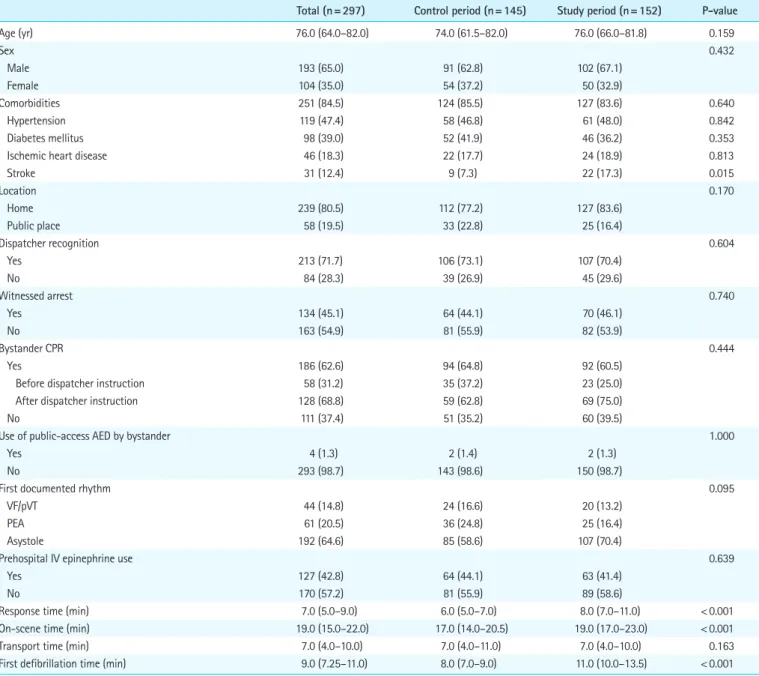
Table 1 shows the baseline and resuscitative characteristics of OHCA patients in the control and study periods. Patients’ median age was 76.0 years (interquartile range, 64.0–82.0 years), and 65.0% of the participants were male. The proportions of cardiac arrests occurring at home were 83.6% and 77.2% in the study and control periods, respectively. From the control period to the study period, the bystander CPR rate decreased from 64.8% to 60.5% (P=0.444), while OHCA patients receiving CPR initiated by
dispatcher instruction increased from 62.8% to 75.0%. Further- more, SGA use increased (40.7% to 76.3%) while endotracheal intubation use decreased (51.7% to 14.5%) from the control pe- riod to the study period. The use of mechanical chest compres- sion devices also significantly increased during the study period (74.5% to 87.5%, P= 0.004) (Fig. 2). The response time was pro- longed by 2 minutes, the first defibrillation of OHCA patients with initial shockable rhythm was delayed by 3 minutes, and the on- scene time increased by 2 minutes in the study period compared with those in the control period, respectively (P< 0.001).
Table 1. Comparison of general and resuscitative characteristics of OHCA patients
Total (n= 297) Control period (n= 145) Study period (n= 152) P-value
Age (yr) 76.0 (64.0–82.0) 74.0 (61.5–82.0) 76.0 (66.0–81.8) 0.159
Sex 0.432
Male 193 (65.0) 91 (62.8) 102 (67.1)
Female 104 (35.0) 54 (37.2) 50 (32.9)
Comorbidities 251 (84.5) 124 (85.5) 127 (83.6) 0.640
Hypertension 119 (47.4) 58 (46.8) 61 (48.0) 0.842
Diabetes mellitus 98 (39.0) 52 (41.9) 46 (36.2) 0.353
Ischemic heart disease 46 (18.3) 22 (17.7) 24 (18.9) 0.813
Stroke 31 (12.4) 9 (7.3) 22 (17.3) 0.015
Location 0.170
Home 239 (80.5) 112 (77.2) 127 (83.6)
Public place 58 (19.5) 33 (22.8) 25 (16.4)
Dispatcher recognition 0.604
Yes 213 (71.7) 106 (73.1) 107 (70.4)
No 84 (28.3) 39 (26.9) 45 (29.6)
Witnessed arrest 0.740
Yes 134 (45.1) 64 (44.1) 70 (46.1)
No 163 (54.9) 81 (55.9) 82 (53.9)
Bystander CPR 0.444
Yes 186 (62.6) 94 (64.8) 92 (60.5)
Before dispatcher instruction 58 (31.2) 35 (37.2) 23 (25.0)
After dispatcher instruction 128 (68.8) 59 (62.8) 69 (75.0)
No 111 (37.4) 51 (35.2) 60 (39.5)
Use of public-access AED by bystander 1.000
Yes 4 (1.3) 2 (1.4) 2 (1.3)
No 293 (98.7) 143 (98.6) 150 (98.7)
First documented rhythm 0.095
VF/pVT 44 (14.8) 24 (16.6) 20 (13.2)
PEA 61 (20.5) 36 (24.8) 25 (16.4)
Asystole 192 (64.6) 85 (58.6) 107 (70.4)
Prehospital IV epinephrine use 0.639
Yes 127 (42.8) 64 (44.1) 63 (41.4)
No 170 (57.2) 81 (55.9) 89 (58.6)
Response time (min) 7.0 (5.0–9.0) 6.0 (5.0–7.0) 8.0 (7.0–11.0) < 0.001
On-scene time (min) 19.0 (15.0–22.0) 17.0 (14.0–20.5) 19.0 (17.0–23.0) < 0.001
Transport time (min) 7.0 (4.0–10.0) 7.0 (4.0–11.0) 7.0 (4.0–10.0) 0.163
First defibrillation time (min) 9.0 (7.25–11.0) 8.0 (7.0–9.0) 11.0 (10.0–13.5) < 0.001
Values are presented as median (interquartile range) or number (%).
OHCA, out-of-hospital cardiac arrest; CPR, cardiopulmonary resuscitation; AED, automated external defibrillator; VF, ventricular fibrillation; pVT, pulseless ventricular tachy- cardia; PEA, pulseless electrical activity; IV, intravenous.
Table 2. Bystander cardiopulmonary resuscitation performance according to witness status and location of cardiac arrest
Total (n= 297) Control period (n= 145) Study period (n= 152) P-value Witness status
Witnessed 94/134 (70.1) 46/64 (71.9) 48/70 (68.6) 0.676
Before dispatcher instruction 40 (42.6) 26 (56.5) 14 (29.2)
After dispatcher instruction 54 (57.4) 20 (43.5) 34 (70.8)
Unwitnessed 92/163 (56.4) 48/81 (59.3) 44/82 (53.7) 0.471
Before dispatcher instruction 18 (19.6) 9 (18.8) 9 (20.5)
After dispatcher instruction 74 (80.4) 39 (81.3) 35 (79.5)
Location
Home 150/239 (62.8) 73/112 (65.2) 77/127 (60.6) 0.777
Before dispatcher instruction 39 (26.0) 23 (31.5) 16 (20.8)
After dispatcher instruction 111 (74.0) 50 (68.5) 61 (79.2)
Public place 36/58 (62.1) 21/33 (63.6) 15/25 (60.0) 0.468
Before dispatcher instruction 19 (52.8) 12 (57.1) 7 (46.7)
After dispatcher instruction 17 (47.2) 9 (42.9) 8 (53.3)
Witness status and location
Witnessed, home 77/106 (72.6) 36/48 (75.0) 41/58 (70.7) 0.620
Before dispatcher instruction 33 (42.9) 20 (55.6) 13 (31.7)
After dispatcher instruction 44 (57.1) 16 (44.4) 28 (68.3)
Witnessed, public 17/28 (60.7) 10/16 (62.5) 7/12 (58.3) 1.000
Before dispatcher instruction 7 (41.2) 6 (60.0) 1 (14.3)
After dispatcher instruction 10 (58.8) 4 (40.0) 6 (85.7)
Unwitnessed, home 73/133 (54.9) 37/64 (57.8) 36/69 (52.2) 0.514
Before dispatcher instruction 6 (8.2) 3 (8.1) 3 (8.3)
After dispatcher instruction 67 (91.8) 34 (91.9) 33 (91.7)
Unwitnessed, public 19/30 (63.3) 11/17 (64.7) 8/13 (61.5) 1.000
Before dispatcher instruction 12 (63.2) 6 (54.5) 6 (75.0)
After dispatcher instruction 7 (36.8) 5 (45.5) 2 (25.0)
Values are presented as number (%). The numerators and denominators indicate the number of bystander cardiopulmonary resuscitations and cardiac arrests, respectively.
Bystander CPR performance according to witness status and location of cardiac arrest
Table 2 shows the bystander CPR performance according to wit- ness status and the location of cardiac arrest during the control and study periods. No significant differences were observed be- tween the periods.
Comparison of in hospital resuscitative characteristics and clinical outcomes of OHCA patients
There were no significant differences in TTM (2.8% to 0.7%, P=
0.205) and percutaneous coronary intervention (2.1% to 2.0%, P= 1.000) between the control and study periods, respectively.
Extracorporeal membrane oxygenation was not used during ei- ther period. The in-hospital CPR duration was similar for control
Fig. 2. Prehospital advanced airway management and mechanical chest compression device use in the control and study periods. (A) Prehospital ad- vanced airway management and (B) prehospital mechanical chest compression device use.Control period Study period
Percentage (%)
P< 0.001
No Endotracheal intubation Supraglottic airway
A Control period Study period
Percentage (%)
P= 0.004
B 100
75
50
25
0
100
75
50
25
0
and study groups (20.0 vs. 21.0 minutes), respectively. Good neu- rologic outcome, survival to hospital discharge, and survived events decreased from 9.7% to 3.3% (P= 0.025), from 10.3% to 4.6%
(P= 0.059), and from 17.2% to 5.3% (P=0.001), in the control and study periods, respectively. These results show that the study pe- riod had poorer clinical outcomes than the control period (Table 3).
Logistic regression analyses of survival outcomes pre- and post-COVID-19 outbreak
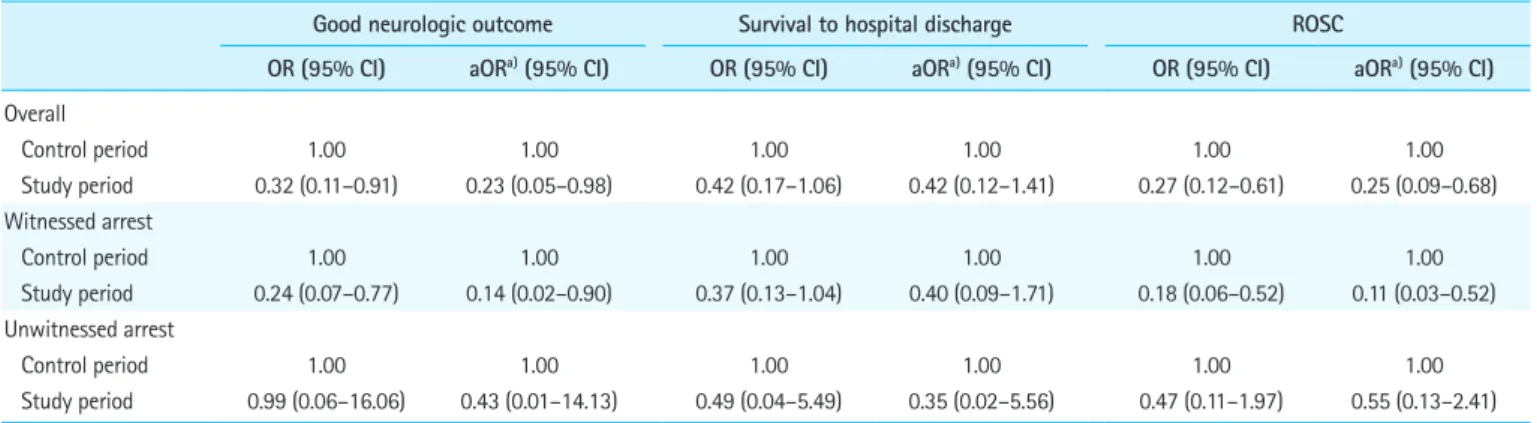
Table 4 shows the results of univariable and multivariable logistic regression analyses for survival outcomes pre- and post-COVID-19 outbreak. Univariable analysis revealed significantly lower good neurologic outcomes (OR, 0.32; 95% CI, 0.11–0.91) and survived events (OR, 0.27; 95% CI, 0.12–0.61) in the study period than in the control period. After adjusting for potential confounders, good neurologic outcomes (adjusted OR [aOR], 0.23; 95% CI, 0.05–
0.98) and survived events (aOR, 0.25; 95% CI, 0.09–0.68) were significantly lower in the study period than in the control period.
No significant differences in survival to hospital discharge were observed in the univariable and multivariable analyses. For wit- nessed arrest, in multivariable logistic regression analysis, good
Table 4. Logistic regression analysis of survival outcomes according to the COVID-19 outbreak
Good neurologic outcome Survival to hospital discharge ROSC
OR (95% CI) aORa) (95% CI) OR (95% CI) aORa) (95% CI) OR (95% CI) aORa) (95% CI) Overall
Control period 1.00 1.00 1.00 1.00 1.00 1.00
Study period 0.32 (0.11–0.91) 0.23 (0.05–0.98) 0.42 (0.17–1.06) 0.42 (0.12–1.41) 0.27 (0.12–0.61) 0.25 (0.09–0.68) Witnessed arrest
Control period 1.00 1.00 1.00 1.00 1.00 1.00
Study period 0.24 (0.07–0.77) 0.14 (0.02–0.90) 0.37 (0.13–1.04) 0.40 (0.09–1.71) 0.18 (0.06–0.52) 0.11 (0.03–0.52) Unwitnessed arrest
Control period 1.00 1.00 1.00 1.00 1.00 1.00
Study period 0.99 (0.06–16.06) 0.43 (0.01–14.13) 0.49 (0.04–5.49) 0.35 (0.02–5.56) 0.47 (0.11–1.97) 0.55 (0.13–2.41) COVID-19, coronavirus disease 2019; OR, odds ratio; aOR, adjusted odds ratio; CI, confidence interval; ROSC, prehospital return of spontaneous circulation.
a)Adjusted for age, sex, location of cardiac arrest, and first documented rhythm.
neurologic outcomes (aOR, 0.14; 95% CI, 0.02–0.90) and survived events (aOR, 0.11; 95% CI, 0.03–0.52) were significantly lower in the study period than in the control period, but no significant dif- ference was found in survival to hospital discharge (aOR, 0.40;
95% CI, 0.09–1.71).
DISCUSSION
An approximately 4.8% increase in the incidence of EMS-assessed OHCA was observed during the COVID-19 pandemic in Daegu, South Korea, which was less extreme than that observed in Italy and Paris.
1,2Although many patients who needed treatment avoid- ed hospital visits out of fear of exposure to COVID-19, only a slight increase was observed in the number of OHCA patients, which may have been due to the absence of lockdown, quarantine, or travel restriction measures in Daegu.
The rate of bystander CPR decreased by 4.3% following the COVID-19 outbreak, but this was not statistically significant. The high rate of human to human transmission of COVID-19 may negatively influence the willingness of a layperson to perform bystander CPR.
8The tendency to avoid outings may be related to
Table 3. Comparison of in-hospital resuscitative characteristics and clinical outcomes of OHCA patientsTotal (n= 297) Control period (n= 145) Study period (n= 152) P-value
Defibrillation 0.790
Yes 28 (9.4) 13 (9.0) 15 (9.9)
No 269 (90.6) 132 (91.0) 137 (90.1)
CPR duration (min) 20.0 (13.0–27.0) 20.0 (12.0–28.8) 21.0 (14.0–26.0) 0.801
Outcome
ROSC 33 (11.1) 25 (17.2) 8 (5.3) 0.001
Survival to hospital discharge 22 (7.4) 15 (10.3) 7 (4.6) 0.059
Good neurologic outcome 19 (6.4) 14 (9.7) 5 (3.3) 0.025
Values are presented as number (%) or median (interquartile range).
OHCA, out-of-hospital cardiac arrest; CPR, cardiopulmonary resuscitation; ROSC, prehospital return of spontaneous circulation.