• 검색 결과가 없습니다.

Association of Specific Immunoglobulin E to Staphylococcal Enterotoxin with Airway Hyperresponsiveness in Asthma Patients

N/A
N/A
Protected

Academic year: 2021

Share "Association of Specific Immunoglobulin E to Staphylococcal Enterotoxin with Airway Hyperresponsiveness in Asthma Patients"

Copied!
7
0
0

로드 중.... (전체 텍스트 보기)

전체 글

(1)

Association of Specific Immunoglobulin E to Staphylococcal Enterotoxin with Airway Hyperresponsiveness in Asthma Patients

Seong Han Kim, M.D.

1

, Seo Yeon Yang, M.D.

1

, Jihong You, M.D.

1

, Sang Bae Lee, M.D.

1

, Jin You, M.D.

2

, Yoon Soo Chang, M.D., Ph.D.

1

, Hyung Jung Kim, M.D., Ph.D.

1

,

Chul Min Ahn, M.D., Ph.D.

1

, Min Kwang Byun, M.D.

1

, Hye Jung Park, M.D., Ph.D.

1

and Jung-Won Park, M.D., Ph.D.

3

1

Department of Internal Medicine, Gangnam Severance Hospital, Yonsei University College of Medicine, Seoul,

2

Department of Internal Medicine, Kunkuk University School of Medicine, Seoul,

3

Division of Allergy and Immunology, Department of Internal Medicine, Severance Hospital, Yonsei University College of Medicine, Seoul, Korea

Background: Specific immunoglobulin E (IgE) sensitization to staphylococcal enterotoxin (SE) has been recently considered to be related to allergic disease, including asthma. Despite studies on specific IgE (sIgE) to SE and its relationship to asthma diagnosis and severity, the association of sIgE to SE with airway hyperresponsiveness (AHR) remains unclear.

Methods: We enrolled 81 asthma patients admitted to the Severance Hospital in Korea from March 1, 2013, to February 28, 2015 and retrospectively reviewed the electronic medical records of the enrolled subjects. The serum levels of sIgE to SE (A/

B) of all subjects was measured using the ImmunoCAP 250 (Phadia) system with SE-sIgE positive defined as >0.10 kU/mL.

Results: The SE-sIgE level was not significantly correlated with asthma severity (forced expiratory volume in 1 second [FEV

1

], FEV

1

/forced vital capacity, sputum eosinophils, and serum eosinophils), whereas the SE-sIgE level in patients with positive AHR (mean±standard error of the mean, 0.606±0.273 kU/mL) was significantly higher than that in patients with negative AHR (0.062±0.015 kU/mL, p=0.034). In regression analysis, SE sensitization (sIgE to SE ≥0.010 kU/mL) was a significant risk factor for AHR, after adjustment for age, sex, FEV

1

, and sputum eosinophils (odds ratio, 7.090; 95%

confidence interval, 1.180–42.600; p=0.032). Prevalence of SE sensitization was higher in patients with allergic rhinitis and non-atopic asthma patients, as compared to patients without allergic rhinitis and atopic asthma patients, respectively, but without statistical significance.

Conclusion: SE sensitization is significantly associated with AHR.

Keywords: Immunoglobulin E; Staphylococcus; Enterotoxins; Asthma

Copyright © 2016

The Korean Academy of Tuberculosis and Respiratory Diseases.

All rights reserved.

Address for correspondence: Hye Jung Park, M.D., Ph.D.

Department of Internal Medicine, Gangnam Severance Hospital, Yonsei University College of Medicine, 211 Eonju-ro, Gangnam-gu, Seoul 06273, Korea

Phone: 82-2-2019-4375, Fax: 82-2-3463-3882, E-mail: [email protected]

Received: Apr. 20, 2016 Revised: Jun. 23, 2016 Accepted: Aug. 9, 2016

cc

It is identical to the Creative Commons Attribution Non-Commercial License (http://creativecommons.org/licenses/by-nc/4.0/).

(2)

Introduction

Staphylococcus aureus is a human commensal microor- ganism, and frequent colonizer of airways and skin. S. aureus releases a wide range of enterotoxins

1

. While bacterial infec- tion commonly stimulates the innate immune system, staphy- lococcal enterotoxin (SE) can act as an antigen, in particular, a superantigen

2

. SE binds to the variable β-chain of the T-cell receptor, independent of the antigen-specific groove, so that it is called a “superantigen.” This allows the polyclonal activation of T cells and also B cells, resulting in the formation of specific immunoglobulin E (sIgE) to SE, called “SE sensitization”

2-4

. These superantigenic properties of SE are considered to have a role in the pathophysiology of allergic disease.

The first allergic disease to be studied for association with SE was atopic dermatitis

5

. Since then, evidence has been gath- ered that SE also has an important role in upper and lower airway disease

1,2,6

. The bacterial allergy, sensitization to SE, is considered to be more important than bacterial infection as a cause and aggravating factor for allergic airway disease

7

. Re- cent studies have revealed that SE sensitization is an indepen- dent risk factor for asthma and, especially, the severe asthma entity

4,8-10

. In severe asthmatics, inability to cope with S. aureus colonization in airways by impaired macrophages leads to impairment of mucosal immunity and sensitization to SE

11

. Asthma represents an inflammatory airway disease with fea- tures of mucosal edema and mucus secretion, after allergen stimulation. Airway hyperresponsiveness (AHR), which is measured as increased airway resistance following provoca- tion with stimuli, reflects impairment of mucosal immunity and might be associated with SE sensitization. However, the correlation of SE sensitization with AHR in common asthma patients has never been researched in human clinical studies.

We aimed to evaluate the correlation of SE sensitization with asthma severity, especially AHR, in asthma patients.

Materials and Methods

1. Study population

We retrospectively enrolled 81 asthma patients whose sIgE to SE data were available and admitted to the Severance Hos- pital in Korea from March 1, 2013, to February 28, 2015. We retrospectively reviewed the electronic medical records of the enrolled subjects. Asthma was diagnosed by an allergy spe- cialist, based on clinical guidelines, using a bronchodilator test and/or bronchial provocation test

12

. This study was approved by the Institutional Review Board of Yonsei University College of Medicine (approval number: 4-2013-0397). All enrolled pa- tients provided written informed consent.

2. Laboratory tests

The complete blood count test was performed using an automated analyzer to determine blood eosinophil counts.

The eosinophil percentages in induced sputum were assessed as follows. The obtained sputum was centrifuged, and the su- pernatant was collected. Samples were diluted in phosphate- buffered saline and centrifuged at 450 rpm for 6 minutes to prepare cytology slides. After staining the slides with Wright’s stain, a differential count was performed using a light micro- scope, as reported previously

13

. Forced expiratory volume in 1 second (FEV

1

) and FEV

1

/forced vital capacity (FVC) were evaluated by pulmonary function test using commercially available equipment (MS-IOS, Masterlab-IOS; Jaeger, Wurz- burg, Germany). AHR was assessed by methacholine chal- lenge test or mannitol challenge test, using a titration protocol as in previous reports. The methacholine challenge started with an inhalation of saline, followed by increasing the con- centration of methacholine serially, up to a maximum concen- tration of 25 mg/mL. We defined positive as the provocative concentration of methacholine required to decrease FEV

1

by 20% (PC

20

), being achieved at less than or equal to 25 mg/mL.

The mannitol challenge test ended when a cumulative dose of 635 mg had been inhaled. We defined positive as PD15, the provocative concentration of mannitol required to decrease FEV

1

by 15%, less than or equal to 635 mg. All of these tests were conducted before chart review. We retrospectively re- viewed the results of the tests.

3. Clinical parameters

Allergic rhinitis was clinically diagnosed, based on interna- tional guidelines which recommend identifying symptoms, including sneezing, rhinorrhea, nasal obstruction, and itching with specific IgE possession confirmed by skin prick test or ImmunoCAP 250 (Phadia, Uppsala, Sweden) system

14

. Atopy was defined as positive response to any one of the inhalant al- lergens (birch, oak, ragweed, mugwort, cat dander, house dust mite, etc.) by ImmunoCAP 250 (Phadia) system, as previously described

15

.

4. Serum preparation and measurement of sIgE to SE We measured the levels of sIgE to SE (A/B) in all subjects.

First, whole blood was collected in a vacuum tube for serum

separation. Serum was separated by centrifugation, and al-

lergen sIgE detection performed using ImmunoCAP 250

(Phadia) system. The system was operated according to the

manufacturer’s instructions. The sIgE to SE detection range

was 0.1 to 100 kU/L.

(3)

5. Statistical analysis

We assessed correlation between two continuous variables using Pearson’s test. The t test was used to compare levels of sIgE to SE according to AHR. We selected, as the parameters, sex and age, which are most commonly among the variables considered, and FEV

1

and sputum eosinophil count, which are known to be highly related to asthma severity. We deter- mined the odds ratio (OR) using logistic regression analysis, including univariate and multivariate analysis. Cross-correla- tion analysis was performed using chi-square tests to analyze the correlation between categorized variables in SPSS version 18.0 (SPSS Inc., Chicago, IL, USA). We considered a p<0.05 to be significant.

Results

1. Demographics of subjects

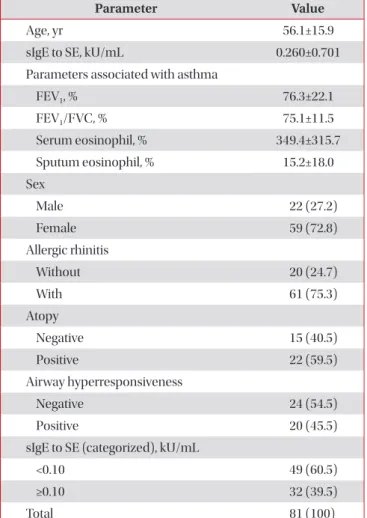
We enrolled a total of 81 asthma patients. The mean age of subjects and the standard deviation from the mean was 56.1 years old. The mean value of sIgE to SE and the standard de- viation from the mean was 0.260 kU/mL. The FEV

1

and FEV

1

/ FVC were assessed by pulmonary function tests and repre- sented a mildly obstructive pattern. The percentage of sputum eosinophils and the standard deviation was elevated beyond the normal range. There was a predominance of females. The prevalence of allergic rhinitis and atopy was 75.3% and 59.5%, respectively. Airway hyperresponsiveness was evaluated in 44 patients, and the results were positive in 45.5%. We defined positive to SE-sIgE as more than 0.10 kU/mL, so that the posi- tivity rate is about 40% (39.5% exactly) (Table 1).

2. Correlation of sIgE to SE with parameters associated with asthma

We evaluated the correlation of SE-sIgE with parameters Table 1. Demographics of subjects

Parameter Value

Age, yr 56.1±15.9

sIgE to SE, kU/mL 0.260±0.701

Parameters associated with asthma

FEV

1

, % 76.3±22.1

FEV

1

/FVC, % 75.1±11.5

Serum eosinophil, % 349.4±315.7

Sputum eosinophil, % 15.2±18.0

Sex

Male 22 (27.2)

Female 59 (72.8)

Allergic rhinitis

Without 20 (24.7)

With 61 (75.3)

Atopy

Negative 15 (40.5)

Positive 22 (59.5)

Airway hyperresponsiveness

Negative 24 (54.5)

Positive 20 (45.5)

sIgE to SE (categorized), kU/mL

<0.10 49 (60.5)

≥0.10 32 (39.5)

Total 81 (100)

Values are presented as mean±standard deviation or number (%).

sIgE: specific immunoglobulin E; SE: staphylococcal enterotoxin;

FEV

1

: forced expiratory volume in 1 second; FVC: forced vital capacity.

Table 2. Correlation of sIgE to SE with parameters associated with asthma

Parameter Pearson’s coefficient p-value

FEV

1

0.099 0.385

FEV

1

/FVC 0.149 0.206

Serum eosinophil, % 0.091 0.417

Sputum eosinophil, % 0.027 0.815

sIgE: specific immunoglobulin E; SE: staphylococcal enterotoxin;

FEV

1

: forced expiratory volume in 1 second; FVC: forced vital capacity.

Figure 1. Comparison of specific immunoglobulin E (sIgE) to staphylococcal enterotoxin (SE) levels according to airway hyper- responsiveness (AHR) (p=0.034). *p-value<0.05 obtained by t-test.

slgEtoSE(kU/mL)

0 AHR negative

1.0 0.8 0.6 0.4 0.2

*

AHR positive
(4)

representing asthma severity. The FEV

1

(%) and FEV

1

/FVC (%) were not significantly correlated with the levels of SE-sIgE (p=0.385 and p=0.206, respectively). The serum eosinophils (%) and sputum eosinophil (%) were also not significantly associated with the levels of SE-sIgE (p=0.417 and p=0.815, respectively) (Table 2).

3. Comparison of sIgE to SE levels according to AHR We compared the levels of sIgE to SE according to AHR as assessed by the mannitol challenge test or methacholine challenge test. The sIgE to SE levels in patients with positive AHR (sample size, 20; mean±standard error of the mean, 0.606±0.273 kU/mL) was significantly higher than that in pa- tients with negative AHR (sample size, 24; 0.062±0.015 kU/

mL; p=0.034) (Figure 1).

4. Univariate and multivariate analysis for airway hyperresponsiveness

We aimed to identify which parameters could be significant predictive factors for AHR, as assessed by logistic regression.

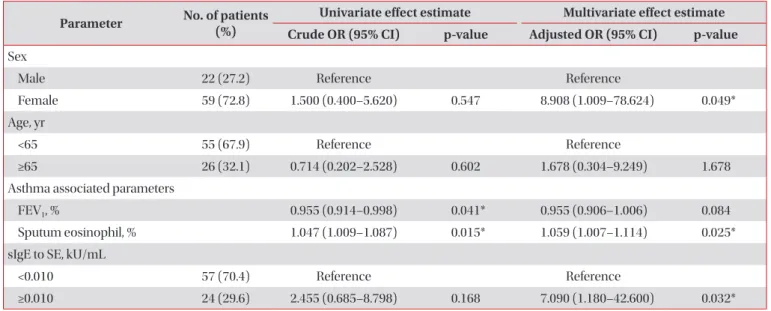
Using univariate analysis, sex (OR, 1.500; 95% confidence interval [CI], 0.400–5.620; p=0.547) and age (OR, 0.714; 95%

CI, 0.202–2.528; p=0.602) were not significant predictive fac- tors. The increase in FEV

1

(%), indicating better lung function status, was a significant preventive factor (OR, 0.955; 95% CI, 0.914–0.998; p=0.041). The increase in sputum eosinophils

(%), sputum eosinophilia, was a significant risk factor (OR, 1.047; 95% CI, 1.009–1.087; p=0.015). Being positive for sensi- tization to SE (≥0.010 kU/mL) was not statistically significant risk factor for AHR (OR, 2.455; 95% CI, 0.685–8.798; p=0.168).

Using multivariate analysis, to control for the other factors, being female was a significant risk factor for AHR (OR, 8.908;

95% CI, 1.009–78.624; p=0.049). The increase in FEV

1

, which univariate analysis showed to be significant, was not a signifi- cant protective factor after adjustment for the other variables (OR, 0.955; 95% CI, 0.906–1.006; p=0.084). The percentage of sputum eosinophils was an independent risk factor for AHR (OR, 1.059; 95% CI, 1.007–1.114; p=0.025). Although positive sensitization to SE was not a significant risk factor when the other factors were not taken into account, it was a significant risk factor for AHR (OR, 7.090; 95% CI, 1.180–42.600; p=0.032) after adjusting for age, sex, FEV

1

, and sputum eosinophils (Table 3).

When we adjust the cut-off value to 0.014 kU/mL to define 30% of patients as positive to SE sensitization, SE sensitization was a significant risk factor without adjustment (OR, 4.667;

95% CI, 1.037–21.010; p=0.045) and also with adjustment (OR, 14.096; 95% CI, 1.823–108.970; p=0.011).

5. Prevalence of positive to sIgE to SE according to allergic rhinitis and atopy

We assessed whether the prevalence of positive sensitiza- tion to SE will be different according to the presence of allergic rhinitis and atopy or not. The positive sensitization rate to

Table 3. Univariate and multivariate analysis for AHR of data from 44 patients Parameter No. of patients

(%)

Univariate effect estimate Multivariate effect estimate Crude OR (95% CI) p-value Adjusted OR (95% CI) p-value Sex

Male 22 (27.2) Reference Reference

Female 59 (72.8) 1.500 (0.400–5.620) 0.547 8.908 (1.009–78.624) 0.049*

Age, yr

<65 55 (67.9) Reference Reference

≥65 26 (32.1) 0.714 (0.202–2.528) 0.602 1.678 (0.304–9.249) 1.678

Asthma associated parameters

FEV

1

, % 0.955 (0.914–0.998) 0.041* 0.955 (0.906–1.006) 0.084

Sputum eosinophil, % 1.047 (1.009–1.087) 0.015* 1.059 (1.007–1.114) 0.025*

sIgE to SE, kU/mL

<0.010 57 (70.4) Reference Reference

≥0.010 24 (29.6) 2.455 (0.685–8.798) 0.168 7.090 (1.180–42.600) 0.032*

p-value was obtained by logistic regression.

*Significant value.

AHR: airway hyperresponsiveness; OR: odds ratio; CI: confidence interval; FEV

1

: forced expiratory volume in 1 second; sIgE: specific

immunoglobulin E; SE: staphylococcal enterotoxin.

(5)

SE in patients without allergic rhinitis was 30.0%, and that in patients with allergic rhinitis was 42.6% without statistically significant difference (p=0.431). The positive sensitization rate to SE in non-atopic asthma patients was 40.0%, whereas that in atopic asthma patients was 31.8% (p=0.730) (Table 4).

Discussion

The novel finding of this study is that SE sensitization might be significantly associated with AHR. Although some research- ers have shown the correlation of SE sensitization with asthma diagnosis and severity, effects of SE sensitization on AHR have not been well studied. An allergen-provocation test is a clear- cut way to prove the allergen causes the allergic disease. The direct cause of asthma can be proven by AHR induced by spe- cific allergens. Although the result presented in this study was not a measure of AHR with SE challenge, we revealed that SE sensitization is significantly associated with AHR. This finding, when considered against the significant correlation between SE sensitization and asthma diagnosis and severity described in the literature, more pointedly supports the hypothesis that SE sensitization might lead to asthma.

Actually, study of asthma in the mouse model has already shown that AHR was able to be induced following SE sensi- tization

16,17

. These studies have explained the mechanism by which SE sensitization induces AHR as follows. SE acts as a superantigen to activate T cells independent of the peptide- binding groove area. SE induces airway inflammation, char- acterized by increased numbers of lymphocytes and eosino- phils and by increased levels of the Th2 cytokine, interleukin 4, together with marked upregulation of tumor necrosis factor α production by macrophages. This inflammatory response may lead to AHR.

Although AHR was assessed in only 44 patients, we found that SE sensitization is significantly associated for AHR. We used a cut-off value of positive sensitization, 0.010 kU/mL,

which is widely used in analogous studies

8,18,19

. When we ad- just the cut-off value to 0.014 kU/mL, SE sensitization showed more significant power. SE sensitization might be shown to be a significant independent risk factor for AHR, when a larger number of subjects is examined.

Previous studies revealed that the SE positivity rate is higher in severe asthma than in control and non-severe asthma, but this is still controversial

4,19-22

. Rossi and Monesterolo

22

reported the significant correlation of SE sensitization with serum eo- sinophil cationic protein levels, indicating that SE sensitiza- tion might be correlated with asthma severity. Kowalski et al.

19

found that SE sensitization is significantly correlated with lung function parameters, following adjustment for age. Song et al.

10

indicated that SE sensitization may be correlated with sputum eosinophilia. However, the present study could not demonstrate a significant correlation of SE sensitization with asthma parameters, including sputum eosinophilia. We found SE sensitization is significantly correlated with AHR, regard- less of asthma parameters. SE sensitization might be more as- sociated with AHR rather than other asthma parameters, such as lung function and eosinophilia.

We found that SE sensitization was frequently observed in patients with allergic rhinitis (42.6%) compared to patients without (30.0%), but without statistical significance. The fail- ure of this result to reach statistical significance might be due to the small number of subjects studied. Further study with larger sample of allergic rhinitis patients should be performed to evaluate whether SE sensitization is frequently observed in patients with allergic rhinitis rather than patients without.

We also found that the prevalence of SE sensitization was lower in patients with atopic asthma, but without statistical significance. This unresolved association also might yield statistically significant results, were more subjects enrolled. In contrast to atopic asthma, non-atopic asthma is usually asso- ciated with elderly age, non-eosinophilic asthma, and severe refractory asthma. Song et al.

10

previously described a positive correlation of SE sensitization rate with aging, positive correla- Table 4. Prevalence of positive to sIgE to SE according to allergic rhinitis and atopy

sIgE to SE

Total p-value*

<0.10 kU/mL ≥0.10 kU/mL Allergic rhinitis

Without 14 (70.0) 6 (30.0) 20 (100)

With 35 (57.4) 26 (42.6) 61 (100) 0.431

Atopy

Negative 9 (60.0) 6 (40.0) 15 (100)

Positive 15 (68.2) 7 (31.8) 22 (100) 0.730

Values are presented as number (%).

*p-value was obtained by chi-square test.

sIgE: specific immunoglobulin E; SE: staphylococcal enterotoxin.

(6)

tion of total IgE with SE sensitization, and inverse correlation of SE sensitization with atopic status

9

. Our results concerning the inverse correlation of SE sensitization with atopic status are concordant with the previous study described by Song et al.

10

Although data are not shown, highly significant correla- tion between total IgE with SE sensitization (Pearson’s coef- ficient, 0.696; p<0.001) was also concordant with the preious study described by Song et al.

10

Further detailed study con- cerning total IgE and SE sensitization should be conducted to reveal this unresolved issue.

This study was limited to a small patient group. In addition, we could not conduct AHR test in the all enrolled subjects.

More significant conclusions concerning asthma severity and AHR will be achieved if we conduct a larger study. Assessment of AHR, when challenged by SE, is likely to reveal the direct as- sociation between SE and asthma development. Further basic study should be followed to reveal the mechanisms how the SE sensitization induce AHR and asthma. Although the data are not shown due to the insignificance of results, we found that total IgE (n=7, 713.8±345.9 kU/mL) in AHR positive pa- tients tend to be slightly higher than those (n=5, 182.5±132.3 kU/mL) in AHR negative patients (p=0.244). Further study concerning total IgE with AHR might be interesting. This study has additional limitation concerning severity parameters. The most important severity parameter, medication type and dose used in subjects to control symptoms, was not included in this study. This is due to the deviated distribution to the medium dose inhaled corticosteroid and long-acting β-agonist com- plex inhaler in almost subjects.

We have, for the first time, revealed that SE sensitization is significantly associated with AHR in common asthma patients, despite the small number of subjects studied. This result implies that SE sensitization might be associated with development of asthma. Further large-scale studies should be conducted to harden these results.

Conflicts of Interest

No potential conflict of interest relevant to this article was reported.

References

1. Bachert C, Zhang N. Chronic rhinosinusitis and asthma: nov- el understanding of the role of IgE ‘above atopy’. J Intern Med 2012;272:133-43.

2. Pastacaldi C, Lewis P, Howarth P. Staphylococci and staphy- lococcal superantigens in asthma and rhinitis: a systematic review and meta-analysis. Allergy 2011;66:549-55.

3. Bachert C, Zhang N, Patou J, van Zele T, Gevaert P. Role of staphylococcal superantigens in upper airway disease. Curr

Opin Allergy Clin Immunol 2008;8:34-8.

4. Bachert C, van Steen K, Zhang N, Holtappels G, Cattaert T, Maus B, et al. Specific IgE against Staphylococcus aureus enterotoxins: an independent risk factor for asthma. J Allergy Clin Immunol 2012;130:376-81.

5. Breuer K, Wittmann M, Bosche B, Kapp A, Werfel T. Severe atopic dermatitis is associated with sensitization to staphylo- coccal enterotoxin B (SEB). Allergy 2000;55:551-5.

6. Zhang N, Holtappels G, Gevaert P, Patou J, Dhaliwal B, Gould H, et al. Mucosal tissue polyclonal IgE is functional in re- sponse to allergen and SEB. Allergy 2011;66:141-8.

7. Bacigaluppi JE, Negroni R, de Severino HM. Bacterial allergy in allergic rhinitis and bronchial asthma. Ann Allergy 1979;42:

95-8.

8. Tomassen P, Jarvis D, Newson R, Van Ree R, Forsberg B, How- arth P, et al. Staphylococcus aureus enterotoxin-specific IgE is associated with asthma in the general population: a GA(2) LEN study. Allergy 2013;68:1289-97.

9. Song WJ, Chang YS, Lim MK, Yun EH, Kim SH, Kang HR, et al. Staphylococcal enterotoxin sensitization in a community- based population: a potential role in adult-onset asthma. Clin Exp Allergy 2014;44:553-62.

10. Song WJ, Sintobin I, Sohn KH, Kang MG, Park HK, Jo EJ, et al. Staphylococcal enterotoxin IgE sensitization in late-onset severe eosinophilic asthma in the elderly. Clin Exp Allergy 2016;46:411-21.

11. Liang Z, Zhang Q, Thomas CM, Chana KK, Gibeon D, Barnes PJ, et al. Impaired macrophage phagocytosis of bacteria in severe asthma. Respir Res 2014;15:72.

12. Boulet LP, FitzGerald JM, Reddel HK. The revised 2014 GINA strategy report: opportunities for change. Curr Opin Pulm Med 2015;21:1-7.

13. Lee JH, Park KH, Park JW, Hong CS. YKL-40 in induced spu- tum after allergen bronchial provocation in atopic asthma. J Investig Allergol Clin Immunol 2012;22:501-7.

14. Bousquet J, Reid J, van Weel C, Baena Cagnani C, Canonica GW, Demoly P, et al. Allergic rhinitis management pocket ref- erence 2008. Allergy 2008;63:990-6.

15. Park HJ, Lee JH, Park KH, Kim KR, Han MJ, Choe H, et al. A six-year study on the changes in airborne pollen counts and skin positivity rates in Korea: 2008-2013. Yonsei Med J 2016;

57:714-20.

16. Huvenne W, Callebaut I, Plantinga M, Vanoirbeek JA, Krysko O, Bullens DM, et al. Staphylococcus aureus enterotoxin B facilitates allergic sensitization in experimental asthma. Clin Exp Allergy 2010;40:1079-90.

17. Herz U, Ruckert R, Wollenhaupt K, Tschernig T, Neuhaus- Steinmetz U, Pabst R, et al. Airway exposure to bacterial superantigen (SEB) induces lymphocyte-dependent airway inflammation associated with increased airway responsive- ness: a model for non-allergic asthma. Eur J Immunol 1999;

29:1021-31.

18. Bachert C, Gevaert P, Howarth P, Holtappels G, van Cauwen-

(7)

berge P, Johansson SG. IgE to Staphylococcus aureus entero- toxins in serum is related to severity of asthma. J Allergy Clin Immunol 2003;111:1131-2.

19. Kowalski ML, Cieslak M, Perez-Novo CA, Makowska JS, Bach- ert C. Clinical and immunological determinants of severe/

refractory asthma (SRA): association with staphylococcal superantigen-specific IgE antibodies. Allergy 2011;66:32-8.

20. Lee JY, Kim HM, Ye YM, Bahn JW, Suh CH, Nahm D, et al. Role of staphylococcal superantigen-specific IgE antibodies in

aspirin-intolerant asthma. Allergy Asthma Proc 2006;27:341-6.

21. Lee JH, Lin YT, Yang YH, Wang LC, Chiang BL. Increased levels of serum-specific immunoglobulin e to staphylococcal enterotoxin a and B in patients with allergic rhinitis and bron- chial asthma. Int Arch Allergy Immunol 2005;138:305-11.

22. Rossi RE, Monasterolo G. Prevalence of serum IgE antibodies

to the Staphylococcus aureus enterotoxins (SAE, SEB, SEC,

SED, TSST-1) in patients with persistent allergic rhinitis. Int

Arch Allergy Immunol 2004;133:261-6.

수치

Table 2. Correlation of sIgE to SE with parameters associated  with asthma
Table 3. Univariate and multivariate analysis for AHR of data from 44 patients Parameter No

참조

관련 문서

A previous report demonstrated increased CD66+ neutrophils in patients with UA compared to those with controlled asthma CA, partly-controlled asthma PA, or healthy controls HCs.7

Although NERD pa- tients from our study group had only insignificantly higher se- rum periostin concentrations as compared to NSAIDs-tolerant asthmatics, those with a history of

Our study showed that patients admitted on weekends had higher in-hospital mortality rates compared to those admitted on weekdays, and this association was apparent for ER

We found that in the iKD group, IVIG non-responders showed worse prognosis of CALs over time compared to IVIG responders, as indicated by the higher prevalence of CALs in

9 However, not all asthmatic patients with se- vere clinical symptoms presented sulfite hypersensitivity in this study, due to their higher prevalence of severe asthma and