INTRODUCTION
Allergic rhinitis (AR) is a common inflammatory disease of the nasal mucosa that results from seasonal or perennial responses to allergens. AR is a global health problem and represents an important illness that interferes with daily activities and impairs sleep quality.1 The management of AR includes allergen avoid- ance, pharmacotherapy, specific immunotherapy (SIT), and patient education. As a hallmark of AR treatment, SIT is the only current medical intervention that can potentially affect the nat- ural course of allergic diseases.2
Research on and the clinical practice of SIT has shown re- markable progress3 since Noon first described immunotherapy for AR in 1911.4 The efficacy and safety of SIT have been estab- lished by many clinical trials, studies, and meta-analyses; in ad- dition, SIT has a long-term effect and can prevent the progres- sion of allergic diseases.5-8 SIT is a suitable but uncommon treatment option for AR in China that is available only in a few
Trends in Specific Immunotherapy for Allergic Rhinitis:
A Survey of Chinese ENT Specialists
Han Zhou,
1Qi-Lei Tao,
1,2Jun-Min Wei,
3Geng Xu,
4Lei Cheng
1,5*
1Department of Otorhinolaryngology, The First Affiliated Hospital, Nanjing Medical University, Nanjing, China
2Department of Otorhinolaryngology, Changzheng Hospital, The Second Military Medical University, Shanghai, China
3Editorial Office, Chinese Journal of Otorhinolaryngology Head and Neck Surgery, Chinese Medical Association, Beijing, China
4Institute of Otorhinolaryngology, Sun Yat-sen University, Guangzhou, China
5International Centre for Allergy Research, Nanjing Medical University, Nanjing, China
major cities. Factors that may account for this include the insuf- ficient extent of SIT acceptance by doctors and patients, the po- tential risk of anaphylaxis, and the relatively high cost of treat- ment.
ENT (ear, nose, and throat) specialists in China are responsi- ble for the primary management of AR. To investigate current trends to utilize SIT in AR management, we designed a detailed survey to assess the attitude and understanding of SIT among Chinese ENT specialists. The results of this survey will help pol- icy makers promote and standardize the usage of SIT in China.
Purpose: Specific immunotherapy (SIT) is a suitable but uncommon treatment option for allergic rhinitis (AR) in China. The current understanding and attitude of Chinese ENT (ear, nose, and throat) specialists in regards to SIT is unclear. This study investigates current trends in the awareness and application status of SIT among Chinese ENT specialists. Methods: We performed a nationwide, cross-sectional survey with a specially de- signed questionnaire given to 800 ENT specialists in China. A member of the trained research group conducted face-to-face interviews with each respondent. Results: Most of the respondents considered AR (96.0%) and allergic asthma (96.0%) the most suitable indications for SIT. Of all re- spondents, 77.0% recommended the application of SIT as early as possible; in addition, SIT was considered ‘relatively controllable and safe’ by most respondents (80.6%). The highest allergen-positive rate in AR was associated with house dust mite (47.7%) and obvious differences existed among geographical regions. Conventional subcutaneous immunotherapy was the most highly recommended treatment option (96.2%). ‘The high cost of SIT’ (86.6%) and ‘lack of patient knowledge of SIT’ (85.2%) were probably the main reasons for the lower clinical use of SIT in China. Conclu- sions: Most cases showed that the opinions of Chinese ENT specialists appeared to be in agreement with recent SIT progress and international guidelines; however, many areas still need to enhance the standardization and use of SIT in China. Clinical guidelines for SIT require improvement;
in addition, Chinese ENT specialists need continuing medical education on SIT.
Key Words: Allergic rhinitis; specific immunotherapy; data collection; Chinese otolaryngologists
This is an Open Access article distributed under the terms of the Creative Commons Attribution Non-Commercial License (http://creativecommons.org/licenses/by-nc/3.0/) which permits unrestricted non-commercial use, distribution, and reproduction in any medium, provided the original work is properly cited.
Correspondence to: Lei Cheng, MD, PhD, Department of
Otorhinolaryngology, The First Affiliated Hospital, Nanjing Medical University, 300 Guangzhou Road, Nanjing 210029, China.
Tel: +86-(0)25-6813-6031; Fax: +86-(0)25-8378-0934; E-mail: [email protected] Received: June 24, 2013; Revised: August 13, 2013
Accepted: September 24, 2013
•There are no financial or other issues that might lead to conflict of interest.
Allergy Asthma Immunol Res. 2014 July;6(4):296-303.
http://dx.doi.org/10.4168/aair.2014.6.4.296 pISSN 2092-7355 • eISSN 2092-7363
MATERIALS AND METHODS
We designed and distributed a questionnaire to 800 ENT spe- cialists in January and February of 2011 who were working in 18 provinces and municipalities representative of 4 different geo- graphical regions (east, south-central, west, and north) in Chi- na. Respondents were randomly selected from hospitals that perform SIT for allergic diseases. The survey included 22 ques- tions distributed across three sections (see Supplementary Ma- terial): (A) 3 questions on the description of SIT, (B) 16 questions covering the theoretical and practical knowledge of SIT, and (C) 4 questions about the prospect of SIT in China. The study pro- tocol was approved by the Chinese Medical Association and
the First Affiliated Hospital of Nanjing Medical University.
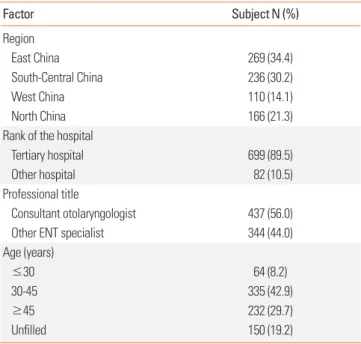
A total of 800 questionnaires were distributed with a complet- ed response rate of 781 (97.6%) surveys. Table 1 shows the char- acteristics of the voluntary participants. Each respondent re- ceived an explanatory statement at the beginning of the ques- tionnaire and completed individual questionnaires under the supervision of a member of the trained research group.
Data obtained from the study were entered into a database for analysis. Results were expressed as the percentage of responses to each question. All statistical analyses were performed using GraphPad Prism version 5.0 (GraphPad Inc., San Diego, CA, USA).
RESULTS
Questions on the descriptions of SIT
For all participants interviewed, the 3 most important factors for the implementation of SIT were a standardized diagnostic process (92.7%), professionally trained staff (92.0%), and a valid emergency rescue system (90.5%). Data revealed that only 15.8%
of Chinese ENT specialists believed SIT could be implemented in a primary hospital.
The majority of ENT specialists considered AR (96.0%) and al- lergic asthma (96.0%) the most suitable diseases for SIT treat- ment, and nearly two-thirds also considered atopic dermatitis (62.0%) appropriate for treatment. Furthermore, 77.0% of re- spondents recommended initiation of SIT as early as possible.
Questions regarding the theoretical and practical knowledge of SIT
Fig. 1 illustrates the allergen-positive rates in AR based on the past clinical practice experiences reported by ENT specialists.
The positive rate for house dust mite (Dermatophagoides ptero- nyssinus or Dermatophagoides farinae) was highest (47.7%), followed by a combination of D. pteronyssinus and D. farinae Table 1. General characteristics of the ENT specialists surveyed in the study
(N=781)
Factor Subject N (%)
Region
East China 269 (34.4)
South-Central China 236 (30.2)
West China 110 (14.1)
North China 166 (21.3)
Rank of the hospital
Tertiary hospital 699 (89.5)
Other hospital 82 (10.5)
Professional title
Consultant otolaryngologist 437 (56.0)
Other ENT specialist 344 (44.0)
Age (years)
≤30 64 (8.2)
30-45 335 (42.9)
≥45 232 (29.7)
Unfilled 150 (19.2)
Mean allergen-positive rate (%)
60
40
20
0
Total (781) North China (166) East China (269) South-Central China (236) West China (110)
House dust
mite Dermatophagoides pteronyssinus and Dermatophagoides
farinae
Single
pollen Multiple
pollens Combined dust
mite and pollen Other allergens
Fig. 1. Mean allergen-positive rates in AR reported by respondents.
(32.1%), and then single pollen (22.1%). The prevalence of house dust mite sensitization in East China was higher than that ob-
served in the other 3 regions; however, the highest prevalence of pollen allergy occurred in North China.
Table 2 summarizes the SIT experiences of ENT specialists.
Doctors in South China preferred SIT as ‘the treatment of first choice’ (69.1%); however, those in West China preferred the choice ‘pharmacotherapy is invalid’ (78.2%). Compared to the other 3 regions, more doctors in South China agreed with ‘con- ventional immunotherapy’ (96.2%) and more doctors in West China agreed with ‘rush immunotherapy’ (54.4%). In regard to the method of SIT administration, more doctors in West China chose ‘application of a single allergen’ (66.6%), more doctors in East China chose ‘a variety of allergens, itemized desensitiza- tion’ (45.3%), and more doctors in South China chose ‘a variety of allergens, mixed desensitization’ (40.6%).
Most ENT specialists preferred a standardized allergen diag- nosis (75.2%) and treatment (81.3%) in regard to allergen stan- dardization; however, many thought that the stability of con- centration (78.1%) and potency (75.6%) were also important factors. In descending order of preference, the 4 main evalua- tion methods of SIT were subjective symptoms (85.1%), serum IgE levels (68.0%), objective examination (65.5%), and inflam- matory markers (59.9%). In terms of the choice between subcu- taneous immunotherapy (SCIT) and sublingual immunothera- py (SLIT), doctors tended to choose SCIT for cases in which consultation is convenient (85.3%), in which patients have good financial status (84.1%), have high-efficacy expectations (82.5%), are adult (76.4%) or are well-educated (71.5%) (Fig. 2).
Questions about the prospects of SIT in China
ENT specialists in this survey generally believed that most representative approaches to immunotherapy were recombi- nant allergens (60.5%) and hypoallergenic allergens (60.9%) Table 2. Clinician-reported experience of SIT (N=781).
Factor Respondents (%)
The timing of SIT - multiple answers possible
The treatment of first choice 64.0
Pharmacotherapy is invalid 61.7
As a last resort, should not be used 10.3
Treatment programs of SIT - multiple answers possible
Conventional immunotherapy 90.4
Cluster immunotherapy 17.4
Rush immunotherapy 17.6
Description of SIT - multiple answers possible
Application of a single allergen 46.8
A variety of allergens, itemized desensitization 33.3 A variety of allergens, mixed desensitization 32.6 Dosing interval of SIT - multiple answers possible
Daily dosing 3.59
2 weeks 42.8
4 weeks 24.2
6 weeks 5.43
8 weeks 8.04
The longer the better 19.1
The treating course of SIT - multiple answers possible
At least 3-5 years 36.2
According to the efficacy, generally not less than 3 years 74.4 Terminate treatment for poor patient outcomes 59.8 Regular follow-up after SIT, application of appropriate
preventive measures when necessary 63.4
Fig. 2. Factors affecting the choice between subcutaneous immunotherapy (SCIT) and sublingual immunotherapy (SLIT) by Chinese ENT specialists.
SLIT Rejection of SCIT SCIT
Consultation is inconvenientAdverse reactions of SCIT Poor financial status
<5 years old Low level of education
>5 years old High level of education
Adult
High efficacy expectations Good financial status
Consultation is convenient
(%)
100
80
60
40
20
0
92.8 7.2
90.3 9.7
89.4 10.6 19.3
80.7 73.9 26.1
60.2 39.8
39.6 60.4
28.5 71.5
23.6 76.4
17.5 82.5
15.9 84.1
14.7 85.3
(Fig. 3). The majority of the respondents considered SIT ‘rela- tively controllable and safe’ (80.6%) and only a few regarded SIT ‘uncontrollable and unsafe’ (11.0%) (Fig. 4).
SIT dosing schedules (72.7%) and delivery method recom- mendations (72.3%) were the most-requested guidelines by Chinese ENT specialists (Fig. 5A). Most respondents consid- ered ‘the high cost of SIT’ (86.6%) and ‘lack of patient knowl- edge about SIT’ (85.2%) the main reasons for the low clinical use of SIT in China (Fig. 5B).
DISCUSSION
This questionnaire-based survey provided an updated de-
scription of knowledge and perception of SIT in Chinese oto- laryngologists. The results showed that the opinions of most doctors were in agreement with the recent progress and inter- national guidelines in regard to SIT; however, there are still many areas for improvement in the promotion and standardization of SIT in China. To our knowledge, this is the first nationwide survey of SIT conducted in China, and it provides useful insight on current SIT beliefs and future training requirements for Chi- nese ENT specialists.
The World Health Organization (WHO) and other academic organizations have published several guidelines and position papers over the past 2 decades on the SIT of inhalant aller- gens.1,2,8-10 These documents were the basis for the design of our Fig. 3. Questions about novel approaches to immunotherapy among Chinese
ENT specialists.
Recombinant allergensHypoallergenic allergens T-cell
peptide vaccines Th1-cell
immune stimulants Mixtures of
recombinant allergens Anti-IgE therapy
(%)
100
80
60
40
20
0
Fig. 4. Questions about the safety of SIT among Chinese ENT specialists.
With a clearly
defined grading system Relatively
controllable and safeUncontrollable and unsafe Possibility of local and systemic reactions
Possibility of
severe complications
(%)
100
80
60
40
20
0
Fig. 5. Questions regarding the aspects of SIT guidelines that need improvement (A), and the reasons for the low treatment rates of SIT in China (B).
No further improvement Indications
and contraidications Recommendation
of the delivery methodsDosing schedules for SIT Practical
aspects of immunotherapy Comparison of SIT and pharmacotherapy
(%)
100
80
60
40
20
0
A
Lack of professional traning for doctors Lack of patient
knowledge about SITThe high cost of SIT International guide does not provide clear recommendations
Domestic guide does not
provide clear recommendations Varieties of standardized
agents for SIT are too little The qualified
hospitals for SIT are few
(%)
100
80
60
40
20
0
B
questionnaire. The European Academy of Allergy and Clinical Immunology (EAACI) suggests that SIT be performed in spe- cialized allergy centers with valid emergency rescue systems and professionally trained staff. These professionally trained staff should have adequate knowledge of the standard diagnos- tic process as well as the ability to recognize and treat early symptoms and signs of anaphylaxis.2 Our survey results are in agreement with these principles. It is significant that most of the respondents recommended the application of SIT as early as possible. This suggestion shows that the vast majority of Chi- nese ENT specialists consider SIT a relatively safe and effica- cious treatment for allergic diseases. However, Chinese otolar- yngologists are increasingly open to the concept that SIT is ca- pable of inducing modifications in the immunological pattern of allergic patients.
The results of the present survey suggest that ENT specialists most commonly encounter patients with AR triggered by one or two kinds of inhalant allergens. One recent multicentre clini- cal study11 analyzed 6,304 patients suffering from asthma and/
or rhinitis in 17 cities in 4 regions of China. The study found that house dust mites were the major allergen among patients; in addition, those in northern China showed significantly greater sensitization to pollen than those from the other 3 regions. Con- sistent with previous observations,12 we found there were differ- ences in allergen-positive rates in AR reported by our interview- ers from different geographical areas.
Chinese guidelines recommend SIT for AR patients who are allergic to one or two aeroallergens (particularly house dust mite sensitization).13,14 British investigators also suggest the applica- tion of a mono-sensitized allergen during SIT and believe that a single-allergen vaccine is more effective than vaccines that con- tain allergen mixtures.10 However, AR is often induced by a vari- ety of allergens, and the safety and effectiveness of a multi-al- lergen SIT is still debatable. Some clinical trials have shown that multiple-allergen immunotherapy is effective in AR and asth- ma,15-17 but others have not.18,19 Multiple-allergen immunother- apy increases the risk of adverse reactions during SIT.20,21 In our survey, nearly half of the respondents supported the use of monotherapy and almost two-thirds of the respondents sup- ported multi-allergen SIT (itemized and mixed desensitiza- tion). This finding suggests that ENT specialists in China tend to treat patients for multiple clinically relevant sensitivities and is similar to the patient treatment used in the United States.22 Randomized controlled trials involving SIT with a variety of al- lergens are needed to determine the safety and efficacy of the multi-allergen mixture. In addition, only 3 kinds of standard- ized and licensed allergen extracts (of D. pteronyssinus and D.
farinae) are available for SIT in China. Other standardized aller- gens (such as grass and tree pollens) are currently unavailable and represent a significant limitation of SIT development in China.
The overwhelming majority of respondents preferred conven-
tional immunotherapy (i.e., SCIT) dosing schedules that re- quire several injections over 3 months to reach a maintenance dose; however, this relatively long up-dosing phase can affect patient compliance and acceptance.23 Doctors and patients both desire a shorter up-dosing schedule and a faster onset of symp- tom relief; subsequently, cluster immunotherapy and rush im- munotherapy have been developed as accelerated procedures to achieve the maintenance dose.24-28 The accelerated buildup of SITs have been proven to be efficient and convenient; how- ever, they are prescribed for only a small percentage of patients with AR in China.28 The relatively higher rate of systemic reac- tions produced by these immunotherapies is believed to be a major reason for this. This study also revealed that the aware- ness of cluster and rush immunotherapies (as well as treatment potential) is inadequate for Chinese otolaryngologists. More studies are required to evaluate the efficacy and safety of the 2 types of SCIT. Chinese ENT specialists should update their knowledge of various SIT treatment programs and select suitable dosing schedules for SIT according to risk factors for systemic re- actions, patient response, and choice as well as product.10,29
SIT has traditionally been administered as subcutaneous in- jections; however, the inconvenience and local or systemic ad- verse reactions associated with the subcutaneous approach are frequently cited concerns.23,30,31 Over the last 3 decades, the sub- lingual route (an alternative route for the delivery of immuno- therapy) has gained wide acceptance in many countries.9 This survey recognized SLIT as a more accessible and affordable treatment for AR. Chinese ENT specialists determine the ad- ministration route in accordance with the specific conditions of patients that include attitude and compliance, financial status, risk factors for systemic reactions, and age. In China, SLIT has gained increased acceptance and is considered an effective and safe treatment in clinical practice.13,14,32
Efforts to develop safer and more effective novel approaches to immunotherapy have resulted in several modifications of al- lergen extracts.22 In this survey, more than half of the ENT spe- cialists prefer recombinant allergens and hypoallergenic aller- gens as new molecular approaches to SIT. Both of these aller- gen formulations are composed of recombinant proteins, which are quantifiable, reproducible, and available in large quanti- ties.10 Recombinant hypoallergenic variants can reduce the risk of anaphylaxis and preserve antigenicity that allow for the ad- ministration of larger doses typically used in normal allergen extracts. Recent studies have shown that vaccination with re- combinant proteins demonstrated clinical efficacy with no IgE- mediated side effects.33,34 The present survey suggests that this kind of allergy vaccine may have a potential clinical application in China. In addition, most respondents voiced their consider- ation of other therapeutic strategies, such as T-cell peptide vac- cines, Th1-cell immune stimulants and anti-IgE therapy that represent important areas of research in the development of SIT.35 Chinese otolaryngologists may be interested in major
technological advances in SIT; however, relevant and current studies are still limited in China.
The present survey also explored the perceptions of the safety of SIT among Chinese ENT specialists. Most respondents had a positive image of SIT therapy, and the majority of experts (such as professors, consultant otolaryngologists, and doctors aged 45 or above) considered SIT a relatively safe treatment. A great- er percentage of respondents in West China (53.0%) expressed concern over severe complications from SIT. This concern may be attributable to differences in clinical experiences. Experi- enced clinicians have more opportunity to understand SIT and apply it to patients. They have a growing belief that SIT is safe and effective on the basis of first-hand experience gained from clinical practice. Our results suggest that SIT is not widely avail- able in West China. In addition, this survey also indicates that nearly 40% of ENT specialists lack SCIT systemic reaction grad- ing system knowledge;2,36 subsequently, continuing education and training in this field should be strengthened. The grading system is helpful to more accurately and effectively assess and deal with adverse SIT reactions that can enhance the safety of SIT. Allergen standardization could possibly guarantee the ef- fectiveness of SIT as well as maintain high safety standards.10 Most of the ENT specialists in this survey recommended the standardization of allergens for the diagnosis and treatment of respiratory allergic diseases. No uniform standards for the pro- duction of high-quality allergen extracts for SCIT have been de- veloped in China, and this remains an area of considerable im- portance to clinicians.
This study also examined why SIT is used less frequently in China, from the viewpoint of an otolaryngologist. The 3 most common reasons are the high cost of SIT, lack of patient SIT knowledge, and lack of professional training for doctors. A pos- sible explanation for this is the inadequate attention of patients, doctors, and public health policy-makers towards SIT. The treatment costs of SIT are relatively greater for the average fam- ily in a developing country. However, this therapy for allergic patients can improve the quality of life, reduce long-term costs, the physical burden of allergies, and change the course of the disease.37 SIT is cost-effective when compared to the increased costs of pharmacological treatments due to its efficacy and long-term benefits. Recent studies have shown a significant SIT cost-benefit versus the use of drugs alone for AR and asthma;38,39 however, the awareness of SIT and its treatment potential is in- adequate in Chinese doctors as well as the majority of ENT spe- cialists who consider SIT an expensive AR treatment. In most regions of China, the healthcare system does not cover the costs of SIT, or the Medicare payment for SIT is low. Both situations increase the burden of patients and are a direct consequence of negligence by healthcare policy makers. More healthcare poli- cies should be adopted to promote immunotherapy awareness and support the implementation of SIT for allergic disease.
Certain limitations of our survey should be mentioned. First,
most respondents were practicing in main tertiary hospitals in major cities and may not be representative of general practitio- ners and rural doctors; consequently, the results of our survey are limited to nationwide trends in SIT. The penetration rate of SIT might be lower than our results suggest due to the obvious differences between the medical resources of major cities and other parts of China. However, we maintain that our results are reliable, valid, and valuable because the majority of patients in China are treated in large general hospitals. It is possible that there are some errors in the results because of the methodology used. This was not a longitudinal study, and we could not ex- amine the findings by objective verification measures (i.e., through medical record review or tests of physician knowl- edge); consequently, a recall bias and overestimation are likely in the self-reported data and may contribute to a degree of in- accuracy.
In summary, the majority of otolaryngologists in China accept that SIT is of great value in the treatment of allergic diseases. In the survey, the majority of the respondents considered AR and allergic asthma the most suitable diseases for SIT, which is rela- tively controllable and safe. Conventional SCIT is the preferred treatment method in China; however, SLIT has continued to gain acceptance. House dust mites were the most prevalent al- lergens encountered by these respondents; however, ENT spe- cialists are also interested in other standardized allergens, multi- allergen mixtures, and recombinant allergens despite the fact that not all of them are currently available in China. SIT has re- ceived inadequate attention throughout China; subsequently, there is a need to improve Chinese SIT guidelines and provide continuing medical education for ENT specialists. The results of our survey are an important reference for government, in- dustry, and academic circles to promote and standardize the use of SIT in China.
ACKNOWLEDGMENTS
This work was supported by the Priority Academic Program Development of Jiangsu Higher Education Institutions (PAPD 2010-2013) and the Health Promotion Project of Jiangsu Prov- ince (RC2011071), the People’s Republic of China.
REFERENCES
1. Bousquet J, Khaltaev N, Cruz AA, Denburg J, Fokkens WJ, Togias A, Zuberbier T, Baena-Cagnani CE, Canonica GW, van Weel C, Agache I, Aït-Khaled N, Bachert C, Blaiss MS, Bonini S, Boulet LP, Bousquet PJ, Camargos P, Carlsen KH, Chen Y, Custovic A, Dahl R, Demoly P, Douagui H, Durham SR, van Wijk RG, Kalayci O, Kaliner MA, Kim YY, Kowalski ML, Kuna P, Le LT, Lemiere C, Li J, Lockey RF, Mavale- Manuel S, Meltzer EO, Mohammad Y, Mullol J, Naclerio R, O’Hehir RE, Ohta K, Ouedraogo S, Palkonen S, Papadopoulos N, Passalac- qua G, Pawankar R, Popov TA, Rabe KF, Rosado-Pinto J, Scadding GK, Simons FE, Toskala E, Valovirta E, van Cauwenberge P, Wang
DY, Wickman M, Yawn BP, Yorgancioglu A, Yusuf OM, Zar H, An- nesi-Maesano I, Bateman ED, Ben Kheder A, Boakye DA, Boucha- rd J, Burney P, Busse WW, Chan-Yeung M, Chavannes NH, Chuchal- in A, Dolen WK, Emuzyte R, Grouse L, Humbert M, Jackson C, Johnston SL, Keith PK, Kemp JP, Klossek JM, Larenas-Linnemann D, Lipworth B, Malo JL, Marshall GD, Naspitz C, Nekam K, Nigge- mann B, Nizankowska-Mogilnicka E, Okamoto Y, Orru MP, Potter P, Price D, Stoloff SW, Vandenplas O, Viegi G, Williams D; World Health Organization; GA2LEN; AllerGen. Allergic Rhinitis and its Impact on Asthma (ARIA) 2008 update (in collaboration with the World Health Organization, GA2LEN and AllerGen). Allergy 2008;
63 Suppl 86:8-160.
2. Alvarez-Cuesta E, Bousquet J, Canonica GW, Durham SR, Malling HJ, Valovirta E; EAACI, Immunotherapy Task Force. Standards for practical allergen-specific immunotherapy. Allergy 2006;61 Suppl 82:1-20.
3. Akkoc T, Akdis M, Akdis CA. Update in the mechanisms of aller- gen-specific immunotheraphy. Allergy Asthma Immunol Res 2011;
3:11-20.
4. Noon L. Prophylactic inoculation against hay fever. Lancet 1911;
177:1572-3.
5. Pajno GB, Barberio G, De Luca F, Morabito L, Parmiani S. Preven- tion of new sensitizations in asthmatic children monosensitized to house dust mite by specific immunotherapy. A six-year follow-up study. Clin Exp Allergy 2001;31:1392-7.
6. Jacobsen L, Niggemann B, Dreborg S, Ferdousi HA, Halken S, Høst A, Koivikko A, Norberg LA, Valovirta E, Wahn U, Möller C; (The PAT investigator group). Specific immunotherapy has long-term pre- ventive effect of seasonal and perennial asthma: 10-year follow-up on the PAT study. Allergy 2007;62:943-8.
7. Durham SR, Emminger W, Kapp A, Colombo G, de Monchy JG, Rak S, Scadding GK, Andersen JS, Riis B, Dahl R. Long-term clini- cal efficacy in grass pollen-induced rhinoconjunctivitis after treat- ment with SQ-standardized grass allergy immunotherapy tablet. J Allergy Clin Immunol 2010;125: 131-138.e1-7.
8. Allergen immunotherapy: therapeutic vaccines for allergic diseas- es. Geneva: January 27-29 1997. Allergy 1998;53:1-42.
9. Canonica GW, Bousquet J, Casale T, Lockey RF, Baena-Cagnani CE, Pawankar R, Potter PC, Bousquet PJ, Cox LS, Durham SR, Nel- son HS, Passalacqua G, Ryan DP, Brozek JL, Compalati E, Dahl R, Delgado L, van Wijk RG, Gower RG, Ledford DK, Filho NR, Valovir- ta EJ, Yusuf OM, Zuberbier T, Akhanda W, Almarales RC, Ansote- gui I, Bonifazi F, Ceuppens J, Chivato T, Dimova D, Dumitrascu D, Fontana L, Katelaris CH, Kaulsay R, Kuna P, Larenas-Linnemann D, Manoussakis M, Nekam K, Nunes C, O’Hehir R, Olaguibel JM, Onder NB, Park JW, Priftanji A, Puy R, Sarmiento L, Scadding G, Schmid-Grendelmeier P, Seberova E, Sepiashvili R, Solé D, Togias A, Tomino C, Toskala E, Van Beever H, Vieths S. Sub-lingual immu- notherapy: World Allergy Organization Position Paper 2009. Aller- gy 2009;64 Suppl 91:1-59.
10. Walker SM, Durham SR, Till SJ, Roberts G, Corrigan CJ, Leech SC, Krishna MT, Rajakulasingham RK, Williams A, Chantrell J, Dixon L, Frew AJ, Nasser SM; British Society for Allergy and Clinical Immu- nology. Immunotherapy for allergic rhinitis. Clin Exp Allergy 2011;
41:1177-200.
11. Li J, Sun B, Huang Y, Lin X, Zhao D, Tan G, Wu J, Zhao H, Cao L, Zhong N; China Alliance of Research on Respiratory Allergic Dis- ease. A multicentre study assessing the prevalence of sensitizations in patients with asthma and/or rhinitis in China. Allergy 2009;64:
1083-92.
12. Shi HB, Cheng L, Enomoto T, Takahashi Y, Sahashi N, Shirakawa T, Miyoshi A. Recent advances in pollen survey and pollinosis research in China. Jpn J Palynol 2002;48:109-27.
13. Zhu L, Lu JH, Xie Q, Wu YL, Zhu LP, Cheng L. Compliance and safety evaluation of subcutaneous versus sublingual immunother- apy in mite-sensitized patients with allergic rhinitis. Zhonghua Er Bi Yan Hou Tou Jing Wai Ke Za Zhi 2010;45:444-9.
14. Zhu L, Zhu LP, Chen RX, Tao QL, Lu JH, Cheng L. Clinical efficacy of subcutaneous and sublingual immunotherapy in mite-sensi- tized patients with allergic rhinitis. Zhonghua Er Bi Yan Hou Tou Jing Wai Ke Za Zhi 2011;46:986-91.
15. Calderón MA, Cox L, Casale TB, Moingeon P, Demoly P. Multiple- allergen and single-allergen immunotherapy strategies in polysen- sitized patients: looking at the published evidence. J Allergy Clin Immunol 2012;129:929-34.
16. Jutel M, Jaeger L, Suck R, Meyer H, Fiebig H, Cromwell O. Allergen- specific immunotherapy with recombinant grass pollen allergens.
J Allergy Clin Immunol 2005;116:608-13.
17. Nelson HS. Multiallergen immunotherapy for allergic rhinitis and asthma. J Allergy Clin Immunol 2009;123:763-9.
18. Amar SM, Harbeck RJ, Sills M, Silveira LJ, O’Brien H, Nelson HS.
Response to sublingual immunotherapy with grass pollen extract:
monotherapy versus combination in a multiallergen extract. J Al- lergy Clin Immunol 2009;124: 150-156.e1-5.
19. Adkinson NF Jr, Eggleston PA, Eney D, Goldstein EO, Schuberth KC, Bacon JR, Hamilton RG, Weiss ME, Arshad H, Meinert CL, Tonascia J, Wheeler B. A controlled trial of immunotherapy for asthma in allergic children. N Engl J Med 1997;336:324-31.
20. Eifan AO, Keles S, Bahceciler NN, Barlan IB. Anaphylaxis to multi- ple pollen allergen sublingual immunotherapy. Allergy 2007;62:
567-8.
21. Dunsky EH, Goldstein MF, Dvorin DJ, Belecanech GA. Anaphylax- is to sublingual immunotherapy. Allergy 2006;61:1235.
22. Cox L, Nelson H, Lockey R, Calabria C, Chacko T, Finegold I, Nel- son M, Weber R, Bernstein DI, Blessing-Moore J, Khan DA, Lang DM, Nicklas RA, Oppenheimer J, Portnoy JM, Randolph C, Schul- ler DE, Spector SL, Tilles S, Wallace D. Allergen immunotherapy: a practice parameter third update. J Allergy Clin Immunol 2011;127:
S1-55.
23. Cohn JR, Pizzi A. Determinants of patient compliance with aller- gen immunotherapy. J Allergy Clin Immunol 1993;91:734-7.
24. Cox L. Accelerated immunotherapy schedules: review of efficacy and safety. Ann Allergy Asthma Immunol 2006;97:126-37.
25. Finegold I. Allergen immunotherapy: present and future. Allergy Asthma Proc 2007;28:44-9.
26. Cox LS. Shooting for a faster approach to the immunotherapy tar- get: will cluster become conventional? Ann Allergy Asthma Immu- nol 2009;102:177-8.
27. Schubert R, Eickmeier O, Garn H, Baer PC, Mueller T, Schulze J, Rose MA, Rosewich M, Renz H, Zielen S. Safety and immunoge- nicity of a cluster specific immunotherapy in children with bron- chial asthma and mite allergy. Int Arch Allergy Immunol 2009;148:
251-60.
28. Zhang L, Wang C, Han D, Wang X, Zhao Y, Liu J. Comparative study of cluster and conventional immunotherapy schedules with der- matophagoides pteronyssinus in the treatment of persistent aller- gic rhinitis. Int Arch Allergy Immunol 2009;148:161-9.
29. Copenhaver CC, Parker A, Patch S. Systemic reactions with aeroal-
lergen cluster immunotherapy in a clinical practice. Ann Allergy Asthma Immunol 2011;107:441-7.
30. More DR, Hagan LL. Factors affecting compliance with allergen immunotherapy at a military medical center. Ann Allergy Asthma Immunol 2002;88:391-4.
31. Radulovic S, Wilson D, Calderon M, Durham S. Systematic reviews of sublingual immunotherapy (SLIT). Allergy 2011;66:740-52.
32. Wang DH, Chen L, Cheng L, Li KN, Yuan H, Lu JH, Li H. Fast onset of action of sublingual immunotherapy in house dust mite-in- duced allergic rhinitis: a multicenter, randomized, double-blind, placebo-controlled trial. Laryngoscope 2013;123:1334-40.
33. Valenta R, Linhart B, Swoboda I, Niederberger V. Recombinant al- lergens for allergen-specific immunotherapy: 10 years anniversary of immunotherapy with recombinant allergens. Allergy 2011;66:
775-83.
34. Larché M. Update on the current status of peptide immunothera- py. J Allergy Clin Immunol 2007;119:906-9.
35. Valenta R, Campana R, Marth K, van Hage M. Allergen-specific im-
munotherapy: from therapeutic vaccines to prophylactic approach- es. J Intern Med 2012;272:144-57.
36. Cox L, Larenas-Linnemann D, Lockey RF, Passalacqua G. Speaking the same language: the World Allergy Organization subcutaneous immunotherapy systemic reaction grading system. J Allergy Clin Immunol 2010;125:569-74, 574.e1-7.
37. Akdis C, Papadopoulos N, Cardona V. Fighting allergies beyond symptoms: the European Declaration on Immunotherapy. Eur J Immunol 2011;41:2802-4.
38. Ariano R, Berto P, Tracci D, Incorvaia C, Frati F. Pharmacoeconom- ics of allergen immunotherapy compared with symptomatic drug treatment in patients with allergic rhinitis and asthma. Allergy Asthma Proc 2006;27:159-63.
39. Omnes LF, Bousquet J, Scheinmann P, Neukirch F, Jasso-Mosque- da G, Chicoye A, Champion L, Fadel R. Pharmacoeconomic as- sessment of specific immunotherapy versus current symptomatic treatment for allergic rhinitis and asthma in France. Eur Ann Aller- gy Clin Immunol 2007;39:148-56.