INTRODUCTION
Allergic diseases including bronchial asthma can develop in individuals who are sensitized to indoor or outdoor allergens, and subsequently induce immunologic hypersensitivity reac- tions.1 This sensitization to allergens is affected by genetic fac- tors, age, exposure time, the degree of exposure to allergens, and concentrations of allergens.2 In addition, sensitization to indoor allergens and particular outdoor fungal spores increases the risk of bronchial hyperresponsiveness (BHR) and aggra- vates clinical symptoms in children. Patients sensitized to house dust mites (HDM), animal dander, or fungus show a relatively severe BHR.3 In contrast, investigators have reported that grass pollens, ragweed pollens, and geographically related pollens do not act as risk factors for bronchial asthma.4 Since the severity of asthmatic symptoms is related to the degree of allergen expo- sure,5 avoidance of HDM improves clinical symptoms and pul- monary function in patients with asthma who have been sensi- tized to HDM.6 The common allergens identified by skin prick tests in adult Korean patients with bronchial asthma are report-
Clinical Characteristics According to Sensitized Allergens in Adult Korean Patients With Bronchial Asthma
Jae Woo Jung, Jae Chol Choi, Jong Wook Shin, Jae Yeol Kim, In Won Park, Byoung Whui Choi*
Department of Internal Medicine, Chung-Ang University College of Medicine, Seoul, Korea
ed to be HDM and ragweed pollen.7,8 However, differences in the clinical features of bronchial asthma according to the of- fending allergens had not yet been elucidated. Therefore, this study was conducted to investigate the clinical characteristics and distributions of common offending allergens and to deter- mine the relationship between the type and number of sensi- tized allergens and clinical manifestations in adult Korean pa- tients with bronchial asthma.
MATERIALS AND METHODS Patients
This retrospective study included a total of 523 patients aged Allergy Asthma Immunol Res. 2010 April;2(2):102-107.
doi: 10.4168/aair.2010.2.2.102 pISSN 2092-7355 • eISSN 2092-7363
Purpose: Allergic sensitization is a risk factor for the development of bronchial asthma. This study was conducted to investigate clinical manifesta- tions according to sensitized allergens in adult Korean patients with bronchial asthma. Methods: In total, 523 adult patients who were diagnosed with bronchial asthma between March 2002 and March 2008 were included in the study. All patients underwent skin prick tests for approximately 45 allergens or a specific IgE test. Sensitized allergens were grouped into the following categories: house dust mites, fungus, pollen, and animal dander. Atopy was defined as a positive skin prick test response or the presence of a specific IgE to one or more allergens. Results: Of the 523 pa- tients, 295 (56%) were sensitized to one or more allergens. A younger median age, greater proportion of males, higher eosinophil counts, and higher total IgE levels were observed in the atopic asthma group compared to the non-atopic asthma group. The PC20 value was negatively correlated with eosinophil counts and total IgE in the atopic asthma group. In the subgroup analysis, patients sensitized to Cladosporium showed poorer pulmonary function and a higher response to bronchodilators. In addition, patients sensitized to Alternaria showed severer bronchial hyperresponsiveness than non-atopic patients with asthma. Finally, a gradual increase in the number of sensitized allergens was noted with increasing age, eosinophil counts, and total IgE levels. Conclusions: We suggest the need for identifying the existence of atopy and exact offending allergens at the time of asthma diagnosis, since significant differences in sex, age, blood test results, and lung function were observed according to atopy and sensitized allergens.
Key Words: Allergens; asthma; Asian Continental Ancestry Group; Koreans; skin tests
This is an Open Access article distributed under the terms of the Creative Commons Attribution Non-Commercial License (http://creativecommons.org/licenses/by-nc/3.0/) which permits unrestricted non-commercial use, distribution, and reproduction in any medium, provided the original work is properly cited.
Correspondence to: Byoung Whui Choi, MD, Department of Internal Medicine, Chung-Ang University College of Medicine, 65-207 Hangangro 3-ga, Youngsan-gu, Seoul 140-757, Korea.
Tel: +82-2-748-9878; Fax: +82-2-790-2068; E-mail: [email protected] Received: August 5, 2009; Accepted: December 16, 2009
•There are no financial or other issues that might lead to conflict of interest.
≥18 years who presented at Chung-Ang University Hospital with episodic breathlessness, wheezing, cough, and chest tight- ness and who were diagnosed with bronchial asthma between March 2002 and March 2008. The diagnosis of asthma was based on the presence of characteristic symptoms and lung function (reversibility or BHR). The degree of reversibility in FEV1 was accepted as ≥12% and ≥200 mL from the pre-bron- chodilator value. BHR was accepted as positive when the pro- vocative concentration of methacholine was ≤8 mg/mL, caus- ing a 20% fall in FEV1 (PC20).
Skin prick tests
Skin prick tests were performed on all patients using 45 aller- gens (Bencard, Brentford, UK) including HDM (3 allergens), pollen (27 allergens), animal dander (7 allergens), and fungus (8 allergens). A wheal was used to assess positive responses to allergens after 15 minutes. A wheal identical to or greater than histamine (1 mg/mL) was regarded as positive.
Allergen-specific IgE test
In some patients, serum-specific IgE levels against HDM and fungus were measured using a Pharmacia CAP system (Phar- macia, Uppsala, Sweden). A level of ≥0.35 KU/L was regarded as positive.
Definition of atopy and nonatopy
Atopy was defined as being positive for one or more allergens, whereas nonatopy was defined as being negative for all aller- gens in a skin prick test or using the CAP system.
Classification of offending allergens
Offending allergens were divided into four allergen groups:
HDM, pollen, fungus, and animal dander. Group positivity was defined as being positive for one or more individual allergens within each allergen group. Cockroaches were included in the HDM allergen group.
Statistical analysis
Age is expressed as the median, and other measurements are expressed as the mean. All statistical analyses were performed using SPSS version 12.0 (SPSS Inc., Chicago, IL, USA). Variables were compared using a chi-square test or Student’s t-test. Eo- sinophil counts, serum eosinophil cationic protein (ECP), and total IgE level were log-transformed for statistic analysis. Linear regression was used to eliminate the effects of age, sex, body mass index (BMI), and smoking amounts on the results of pul- monary function tests. The relationship between the number of offending allergens and clinical characteristics was analyzed using correlation coefficients and a regression analysis. A P val- ue of <0.05 was considered statistically significant.
RESULTS
Clinical characteristics and the distribution of common offending allergens
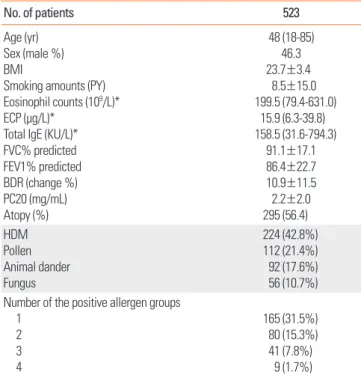
The median patient age was 48 years (range, 18-85 years), and 46.3% of patients were men. The mean value of serum total IgE was 158.5 KU/L. The mean FEV1 was 86.4% predicted and the mean FVC was 91.1% predicted. Of 523 patients, 295 (56.4%) showed positive responses to one or more allergens. In these patients, HDM comprised the most common offending aller- gen, followed by pollen, animal dander, and fungus. With re- spect to the number of allergic sensitizations, allergic sensitiza- tion to only one allergen group was most common (n=165, 31.5%; Table 1).
Differences in clinical characteristics between patients with atopic asthma and those with non-atopic asthma
Patients in the atopic asthma group were younger than those in the non-atopic asthma group (44 versus 55 years, P<0.05).
The ratio of males to females was higher in the atopic asthma group compared to that in the non-atopic asthma group. Pe- ripheral blood total eosinophil counts and serum total IgE level were also higher in the atopic asthma group (P<0.05). However, FEV1 percent predicted, bronchodilator responses (BDRs), and PC20 results were not significantly different between the two groups (Table 2). Linear regression of FEV1 percent predicted,
Table 1. Clinical characteristics of patients with bronchial asthma
No. of patients 523
Age (yr) Sex (male %) BMI
Smoking amounts (PY) Eosinophil counts (109/L)*
ECP (µg/L)*
Total IgE (KU/L)*
FVC% predicted FEV1% predicted BDR (change %) PC20 (mg/mL) Atopy (%)
48 (18-85) 46.3 23.7±3.4
8.5±15.0 199.5 (79.4-631.0)
15.9 (6.3-39.8) 158.5 (31.6-794.3)
91.1±17.1 86.4±22.7 10.9±11.5 2.2±2.0 295 (56.4) HDM
Pollen Animal dander Fungus
224 (42.8%) 112 (21.4%) 92 (17.6%) 56 (10.7%) Number of the positive allergen groups
1 2 3 4
165 (31.5%) 80 (15.3%) 41 (7.8%)
9 (1.7%) PY, pack-years; BDR, bronchodilator response; PC20, provocative concentration of methacholine causing a 20% fall in FEV1.
*Log transformation for statistical analysis.
PC20, and BDR percent adjusted for age, sex, BMI, and smok- ing amounts were not significantly different between the two groups.
Correlation between the PC20 value and laboratory test results The PC20 value was negatively correlated with eosinophil counts (r=-0.132, P<0.05) and total IgE levels (r=0.192, P<0.001).
In the subgroup analysis, these negative correlations were ob- served in atopic patients with asthma (eosinophil counts, r=- 0.156, P<0.05 and total IgE level, r=0.239, P<0.005), but not non- atopic patients.
Differences in clinical characteristics according to allergen group
Positive responses to each allergen group were more often ob- served in younger patients and males as compared to non-
atopic asthma (P<0.05). Serum total IgE levels were higher in patients who showed positive responses to each allergen groups compared to the non-atopic asthma group (P<0.05). In particular, mean eosinophil counts and serum ECP were high- er in positive responders to the animal dander group compared to the non-atopic asthma group (P<0.05; Table 3).
Clinical characteristics according to allergic sensitization to common allergens
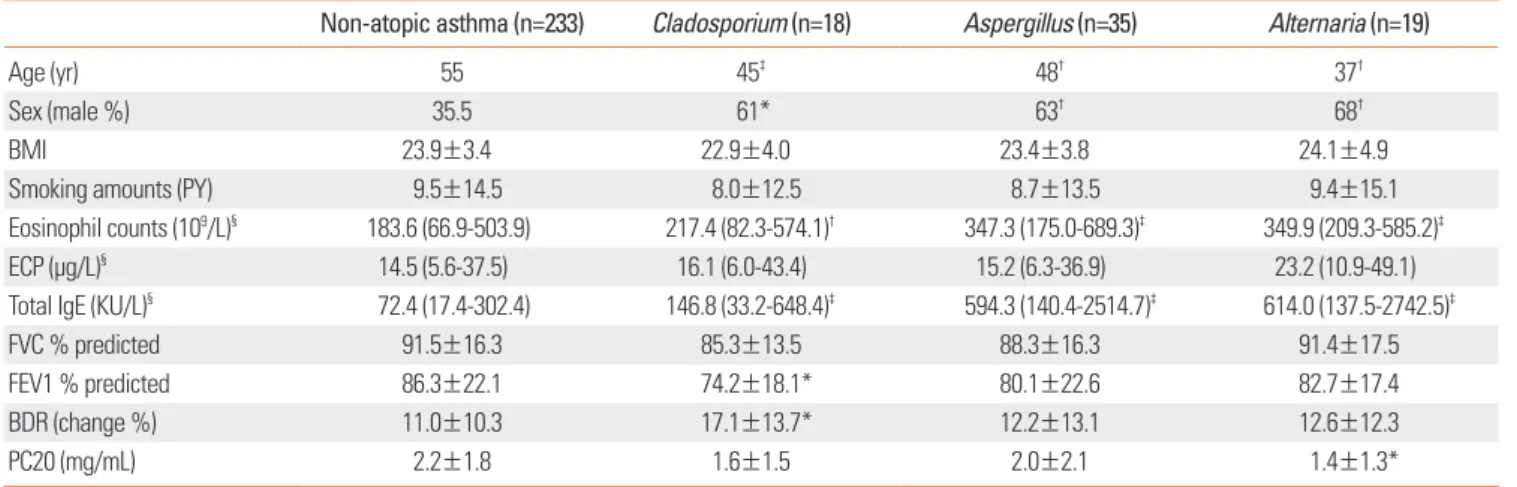
Positive responses to each allergen of Dermatophagoides pter- onyssinus (Dp), Dermatophagoides farinae (Df), cockroach, cat, dog (data not shown), Cladosporium, Aspergillus, and Alternaria (Table 4) were observed in younger patients and markedly more often in males than in non-atopic patients with asthma (P<0.05).
Higher mean eosinophil counts and serum total IgE levels (P<
0.05) were also observed. Patients allergic to the remaining aller-
Table 2. Clinical characteristics according to atopy
Atopic asthma (n=290) Non-atopic asthma (n=233) P value
Age (yr) 44 (18-85) 55 (19-85) <0.001
Sex (male %) 54.6 35.5 <0.001
BMI 23.6±3.5 23.9±3.4 NS
Smoking amounts (PY) 7.6±13.6 9.5±14.5 NS
Eosinophil counts (109/L)* 253.4 (102.2-628.3) 183.6 (66.9-503.9) <0.001
ECP (µg/L)* 17.0 (6.3-46.0) 14.5 (5.6-37.5) NS
Total IgE (KU/L)* 177.5 (44.5-707.5) 72.4 (17.4-302.4) <0.001
FVC % predicted 90.9±17.8 91.5±16.3 NS
FEV1 % predicted 86.4±23.2 86.3±22.1 NS
BDR (%change) 10.8±12.3 11.0±10.3 NS
PC20 (mg/mL) 2.2±2.1 2.2±1.8 NS
PY, pack-years; BDR, bronchodilator response; PC20, provocative concentration of methacholine causing a 20% fall in FEV1.
*Log transformation for statistical analysis.
Table 3. Clinical characteristics according to allergen groups compared with the non-atopic asthma group Non-atopic asthma
(n=233) HDM
(n=224) Pollen
(n=112) Fungus
(n=56) Animal dander
(n=92)
Age (median, yr) 55 40‡ 40‡ 46‡ 33‡
Sex (male %) 35.5 57‡ 55* 59* 60†
BMI 23.9±3.4 23.6±3.6 24.1±3.5 24.0±4.0 23.4±3.5
Smoking amounts (PY) 9.5±14.5 8.5±13.6 9.1±13.4 9.0±11.5 8.1±16.6
Eosinophil counts (109/L)§ 183.6 (66.9-503.9) 251.8 (103.8-611.1) 230.0 (90.1-587.5) 315.1 (149.0-666.4) 316.0 (140.2-712.5)‡
ECP (µg/L)§ 14.5 (5.6-37.5) 16.0 (5.8-44.2) 17.6 (7.7-40.2) 19.6 (7.8-49.1) 22.1 (8.3-58.4)*
Total IgE (KU/L)§ 72.4 (17.4-302.4) 284.6 (76.8-1054.5)‡ 272.8 (67.5-1102.5)‡ 351.1 (72.6-1696.8)‡ 319.7 (103.3-988.8)‡
FVC % predicted 91.5±16.3 90.4±17.8 92.4±17.6 89.7±17.9 91.6±19.4
FEV1 % predicted 86.3±22.1 85.9±22.9 89.1±21.2 82.2±23.3 88.2±22.9
BDR (% change) 11.0±10.3 11.2±13.1 10.1±10.5 12.8±12.9 10.4±11.9
PC20 (mg/mL) 2.2±1.8 2.9±2.0 2.5±2.2 1.8±1.8 2.4±2.2
PY, pack-years; BDR, bronchodilator response; PC20, provocative concentration of methacholine causing a 20% fall in FEV1.
*P<0.05, †P<0.01, ‡P<0.001. §Log transformation for statistical analysis.
gens showed no statistical differences (data not shown).
Specifically, patients sensitized to Cladosporium showed low- er FEV1 percent predicted than the non-atopic asthma group (74.2% versus 86.3%, P<0.05), and had a significantly increased BDR (% change; 17.1% versus 11.0%; P=0.05). The linear regres- sion of FEV1 percent predicted and BDR (% change) adjusted for age, sex, BMI, and smoking amounts was also significantly different between patients sensitized to Cladosporium and non-atopic patients with asthma, respectively (P<0.05, P<0.05).
Patients sensitized to Alternaria showed severer BHR than non- atopic patients with asthma (PC20, 1.4 versus 2.2 mg/mL, P<0.05; Table 4).
Correlation between the number of sensitized allergens and laboratory test results
The numbers of sensitized allergens were significantly corre- lated with patient age (r=-0.386, P<0.001), eosinophil counts
(r=0.15, P<0.05), and serum total IgE levels (r=0.221, P<0.001) (Fig. 1). However, no significant correlation was observed be- tween pulmonary function test results and the numbers of sen- sitized allergens.
DISCUSSION
The prevalence of atopy and allergic diseases has recently in- creased, probably due to environmental risk factors such as in- creased exposure to inhalant allergens, changes in lifestyle, and air pollution. According to the Global Initiative for Asthma (GINA) guidelines, etiologic factors for the development of bronchial asthma include both host and environmental risk factors. Among these factors, allergens play a crucial role in the development of asthma, and for this reason, the avoidance of sensitizing allergens is an important way of preventing and treating bronchial asthma.1
Table 4. Clinical characteristics according to sensitized allergens compared with the non-atopic asthma group
Non-atopic asthma (n=233) Cladosporium (n=18) Aspergillus (n=35) Alternaria (n=19)
Age (yr) 55 45‡ 48† 37†
Sex (male %) 35.5 61* 63† 68†
BMI 23.9±3.4 22.9±4.0 23.4±3.8 24.1±4.9
Smoking amounts (PY) 9.5±14.5 8.0±12.5 8.7±13.5 9.4±15.1
Eosinophil counts (109/L)§ 183.6 (66.9-503.9) 217.4 (82.3-574.1)† 347.3 (175.0-689.3)‡ 349.9 (209.3-585.2)‡
ECP (µg/L)§ 14.5 (5.6-37.5) 16.1 (6.0-43.4) 15.2 (6.3-36.9) 23.2 (10.9-49.1)
Total IgE (KU/L)§ 72.4 (17.4-302.4) 146.8 (33.2-648.4)‡ 594.3 (140.4-2514.7)‡ 614.0 (137.5-2742.5)‡
FVC % predicted 91.5±16.3 85.3±13.5 88.3±16.3 91.4±17.5
FEV1 % predicted 86.3±22.1 74.2±18.1* 80.1±22.6 82.7±17.4
BDR (change %) 11.0±10.3 17.1±13.7* 12.2±13.1 12.6±12.3
PC20 (mg/mL) 2.2±1.8 1.6±1.5 2.0±2.1 1.4±1.3*
PY, pack-years; BDR, bronchodilator response; PC20, provocative concentration of methacholine causing a 20% fall in FEV1.
*P<0.05, †P<0.01, ‡P<0.001. §Log transformation for statistical analysis.
Fig. 1. Correlation of the number of positive allergen groups and other factors.
Age (r=-0.386, P<0.001) (A), Log10 Total eosinophils (r=0.15, P<0.05) (B), Log10 Total IgE (r=0.221, P<0.001) (C).
Age
100 80 60 40 20
0 0 1 2 3 4
Number of positive allergen groups
Log total IgE
4
3
2
1
0 0 1 2 3 4
Number of positive allergen groups
Log total eosinophils
4
3
2
1
0 0 1 2 3 4
Number of positive allergen groups
A B C
Rackermann9 first introduced intrinsic and extrinsic concepts to bronchial asthma. He classified asthma according to skin test results into extrinsic/allergic asthma and intrinsic/non-allergic asthma. Thereafter, intrinsic asthma was considered to be a form of asthma that showed negative skin test results, late onset of symptoms, and idiopathic or infectious etiologies. Amin et al.10 demonstrated that no differences existed between atopic and non-atopic patients in terms of lung function, symptomat- ic scores, or PC20, but differences were observed in the patho- logic characteristics. For example, cellular patterns of inflam- mation in atopic patients are characterized by infiltration of eo- sinophils, mast cells, and T lymphocytes in bronchial biopsy.
The thickness of the reticular basement membrane is also sig- nificantly higher in atopic asthma.11 Just as importantly, some lung function reports have shown that the speed of bronchoc- onstriction and the speed of reversal of bronchoconstriction to methacholine after b2-agonist inhalation is higher in non- atopic patients with asthma as compared to atopic patients.12
Asthma is probably not a single disease, but rather a complex of multiple, separate syndromes.13 In this study, PC20 values were negatively correlated with eosinophil counts and total IgE in the atopic asthma group, but not in the non-atopic asthma group. This result suggests that atopic asthma and non-atopic asthma show different phenotypes and that eosinophilic in- flammation exerts a critical role in the pathogenesis of atopic asthma. Consistent with our results, Janseu et al.14 demonstrat- ed that since BHR is related to an increase in eosinophil counts and positive skin prick tests, elevated eosinophil counts play an important role in the pathogenesis of asthma.
In contrast, recent studies have proposed that no need exists to classify asthma into extrinsic and intrinsic types.15 Non-atopy may be attributable to insufficient skin test allergens, test tim- ing, testing techniques, and possible false negativity. All types of asthma may develop after allergic sensitization and show vari- ous clinical features according to genetic and environmental factors. Consistently, in our study, significant differences in sex, age, or blood test results were observed between the atopic asthma group and the non-atopic asthma group; however, pul- monary function tests, BHR, and BDR showed no significant differences (Tables 2, 3).
With respect to fungal allergens, patients sensitized to Cla- dosporium, Aspergillus and Alternaria showed characteristic findings in blood tests and clinical characteristics. In particular, patients sensitized to Cladosporium showed poorer pulmonary function and higher responses to bronchodilators than non- atopic patients with asthma, suggesting that patients showing positive responses to Cladosporium should be carefully as- sessed for the presence of asthma. In addition, patients sensi- tized to Alternaria presented severer BHR than non-atopic pa- tients with asthma. Since fungal spores are ubiquitous and small in size (usually <10 μm), they can easily penetrate the lower airways of the lung and induce allergic reactions.16 Sensi-
tivity to fungal allergens has been recognized as a risk factor for the development of asthma and may be related to persistent asthma, severe asthma, and potentially fatal asthma exacerba- tions.17 Many studies have reported that particular allergens, es- pecially HDM, cat, dog, Aspergillus and Alternaria are related to the development of asthma.18,19 In our study, patients sensitized to fungal allergen had decreased lung function and more se- vere BHR.
Additionally, as the number of offending allergens increased, the patients were found to be older, and peripheral blood eo- sinophil counts and serum total IgE levels increased; however, no significant differences were observed in pulmonary func- tion test results (Fig. 1). Neimeijer et al.20 reported that in pa- tients with asthma, the prevalence of atopy decreases as pa- tients become older, which is consistent with our result. In an animal model, Regal et al.21 demonstrated through an experi- mental study using Guinea pigs that asthma develops more fre- quently at a younger age.
The results of this study are subject to some limitations. First, since this study analyzed clinical and laboratory data at the time of initial diagnosis, we could not identify the prevalence of asthma, treatment outcomes, and changes in pulmonary func- tion test results after treatment. Second, since serum-specific IgE levels were not measured in all patients, the possibility of false positivity or false negativity of skin prick tests cannot be excluded.
Taken together, this study identified the clinical characteris- tics and common offending allergens contributing to asthma.
More than half of adult patients with bronchial asthma are sen- sitized to allergens. In addition, significant differences were ob- served in sex, age, blood test results, and a correlation between BHR severity with eosinophil counts and total IgE between the atopic asthma group and non-atopic asthma group. These re- sults suggest that atopic asthma and non-asthma are different phenotypes. Furthermore, patients sensitized to fungi showed a difference in lung function. In particular, patients sensitized to Cladosporium or Alternaria had severe BHR or poor lung function. As a result, we suggest the need to identify the exis- tence of atopy and the exact offending allergens at the time of asthma diagnosis.
ACKNOWLEDGMENTS
This study was supported by a grant of the Korea Healthcare technology R&D Project, Ministry for Health, Welfare and Fam- ily Affairs, Republic of Korea (A040153). The authors thank Hye Min Lee for her support during this study.
REFERENCES
Martinez FD. Toward asthma prevention - does all that really mat- 1.
ters happen before we learn to read? N Engl J Med 2003;349:1473-5.
Duffy DL, Mitchell CA, Martin NG. Genetic and environmental risk 2.
factors for asthma: a cotwin-control study. Am J Respir Crit Care Med 1998;157:840-5.
Chinn S, Jarvis D, Luczynska C, Burney P. Individual allergens as 3.
risk factors for bronchial responsiveness in young adults. Thorax.
1998;53:662-7.
Nelson HS. The importance of allergens in the development of 4.
asthma and the persistence of symptoms. J Allergy Clin Immunol 2000;105:S628-32.
Zock JP, Brunekreef B, Hazebroek-Kampschreur AA, Roosjen CW.
5.
House dust mite allergen in bedroom floor dust and respiratory health of children with asthmatic symptoms. Eur Respir J 1994;7:
1254-9.
Piacentini GL, Martinati L, Mingoni S, Boner AL. Influence of aller- 6.
gen avoidance on the eosinophil phase of airway inflammation in children with allergic asthma. J Allergy Clin Immunol 1996;97:
1079-84.
Kim CW, Lee JH, Jung HW, Choi SR, Cheong JW, Park JW, Hong 7.
CS. Changing patterns of skin reactivity to inhalant allergens in asthmatic patients. Korean J Asthma Allergy Clin Immunol 2001;
21:205-15. Korean.
Park HW, Kim SH, Kim SH, Chang YH, Chung H, Lee BJ, Kim YK, 8.
Cho SH, Min KU, Kim YY. Changes of atopy prevalence among asth- matics visiting tertiary referral hospital (1983, 1990, 1997). Korean J Asthma Allergy Clin Immunol 2000;20:99-105. Korean.
Swinburn CR, Hudspith BN, Brostoff J, Johnson NM. Intrinsic and 9.
extrinsic asthma, a shared lymphocyte abnormality. Clin Allergy 1983;13:571-6.
Amin K, Lúdvíksdóttir D, Janson C, Nettelbladt O, Björnsson E, 10.
Roomans GM, Boman G, Sevéus L, Venge P. Inflammation and structural changes in the airways of patients with atopic and non- atopic asthma. BHR Group. Am J Respir Crit Care Med 2000;162:
2295-301.
Sohn SW, Chang YS, Lee HS, Chung DH, Lee CT, Kim YH, Kim YK, 11.
Min KU, Kim YY, Cho SH. Atopy may be an important determinant of subepithelial fibrosis in subjects with asymptomatic airway hy-
perresponsiveness. J Korean Med Sci 2008;23:390-6.
Mochizuki H, Shigeta M, Tokuyama K, Morikawa A. Difference in 12.
airway reactivity in children with atopic vs non-atopic asthma.
Chest 1999;116:619-24.
Wenzel SE. Asthma: defining of the persistent adult phenotypes.
13.
Lancet 2006;368:804-13.
Jansen DF, Rijcken B, Schouten JP, Kraan J, Weiss ST, Timens W, 14.
Postma DS.The relationship of skin test positivity, high serum total IgE levels, and peripheral blood eosinophilia to symptomatic and asymptomatic airway hyperresponsiveness. Am J Respir Crit Care Med 1999;159:924-31.
Burrows B, Martinez FD, Halonen M, Barbee RA, Cline MG. Asso- 15.
ciation of asthma with serum IgE levels and skin-test reactivity to allergens. N Engl J Med 1989;320:271-7.
Kurup VP, Shen HD, Banerjee B. Respiratory fungal allergy. Mi- 16.
crobes Infect 2000;2:1101-10.
Semik-Orzech A, Barczyk A, Pierzchała W. [The influence of sensi- 17.
tivity to fungal allergens on the development and course of allergic diseases of the respiratory tract]. Pneumonol Alergol Pol 2008;76:
29-36. Polish.
Sears MR, Herbison GP, Holdaway MD, Hewitt CJ, Flannery EM, 18.
Silva PA. The relative risks of sensitivity to grass pollen, house dust mite and cat dander in the development of childhood asthma. Clin Exp Allergy 1989;19:419-24.
Henderson FW, Henry MM, Ivins SS, Morris R, Neebe EC, Leu SY, 19.
Stewart PW. Correlates of recurrent wheezing in school-age chil- dren. The Physicians of Raleigh Pediatric Associates. Am J Respir Crit Care Med 1995;151:1786-93.
Omenaas E, Bakke P, Eide GE, Elsayed S, Gulsvik A. Serum house- 20.
dust-mite antibodies and reduced FEV1 in adults of a Norwegian community. Am J Respir Crit Care Med 1995;152:1158-63.
Regal JF, Regal RR, Meehan JL, Mohrman ME. Primary prevention 21.
of asthma: age and sex influence sensitivity to allergen-induced airway inflammation and contribute to asthma heterogeneity in Guinea pigs. Int Arch Allergy Immunol 2006;141:241-56.