Yonsei Med J http://www.eymj.org Volume 55 Number 2 March 2014 542
Letter to the Editor
Two Major Phenotypes of Sulfite Hypersensitivity:
Asthma and Urticaria
Ga-Young Ban, Mi-Ae Kim, Hye-Soo Yoo, Young-Min Ye, and Hae-Sim Park
Department of Allergy & Clinical Immunology, Ajou University School of Medicine, Suwon, Korea.
Received: September 30, 2013 Revised: November 4, 2013 Accepted: November 26, 2013
Corresponding author: Dr. Hae-Sim Park, Department of Allergy & Clinical Immunology, Ajou University School of Medicine, 164 World cup-ro, Yeongtong-gu, Suwon 443-380, Korea.
Tel: 82-31-219-5150, Fax: 82-31-219-5154 E-mail: [email protected]
∙ The authors have no financial conflicts of interest.
© Copyright:
Yonsei University College of Medicine 2014 This is an Open Access article distributed under the terms of the Creative Commons Attribution Non- Commercial License (http://creativecommons.org/
licenses/by-nc/3.0) which permits unrestricted non- commercial use, distribution, and reproduction in any medium, provided the original work is properly cited.
The sulfites are widely used as anti-browning agents and preservatives in food, cosmetics and medicine. The use and amount of sulfites in products have recently been regulated by the Food and Drug Administration (FDA) and the Korean FDA;
however, sulfite hypersensitivity reactions, ranging from bronchoconstriction,1 ur- ticaria,2 contact dermatitis3 to life threatening anaphylaxis,4 are still being report- ed.5 To date, this is the first study to compare two major phenotypes of sulfite hy- persensitivity, asthma and urticaria, in this country. Moreover, we carefully ana- lyzed the clinical features of sulfite sensitive asthma, and compared them with those of sulfite tolerant asthma.
We retrospectively analyzed the medical records of 26 sulfite hypersensitivity subjects confirmed by a sulfite oral provocation test (OPT). As a control group, 61 asthmatic patients negative to sulfite OPT were enrolled from Ajou University Hospital, Suwon, Korea. We performed sulfite oral provocation test on the subjects who were resistant to conventional treatment of asthma/urticaria or who had histo- ries of allergy to sulfite containing food such as wine, dried fruits, or salads from buffet. To confirm sulfite sensitivity, we conducted single blind placebo controlled provocation test. After the asthmatic patients showed no response to gelatin cap- sule (EMBO CAPS lot. 051A51-22306, Suheung Capsule, Seoul, Korea) with 2 hours observation, they were administered sodium metabisulfite (Na2S2O5; Sigma Co., St. Louis, MO, USA) starting from 40 mg and increasing to 100-200 mg via gelatin capsule vehicle. The reactions were observed for 2 hours each until the hy- persensitivity reactions developed,1 maximally 6 hours. Especially for broncho- constriction reaction, 1) a decline in FEV1 of 20% or greater, or 2) a decline in FEV1 of 15% to 20% compared to the baseline with definite symptoms/signs of sulfite hypersensitivities (such as wheezing, cough or dyspnea) were considered positive. Pulmonary function tests were repeated at 30 minute intervals.6 In the case of urticarial reaction, sulfite OPT was defined as positive when hives arise;
however, it was classified as negative if subjective pruritus developed. Subjects were classified into group I: sulfite sensitive asthma, group II: sulfite sensitive urti- caria and group III: sulfite tolerant asthma according to their sulfite OPT reaction.
In addition, group I included two patients with concurrent sulfite anaphylaxis.
Sulfite sensitive asthma was a more common phenotype of sulfite hypersensitiv- ity than sulfite sensitive urticaria (69.2% vs. 30.8%). Chronic asthma was more common in group I, as previously reported;6 however, chronic urticaria was more
Correspondence
http://dx.doi.org/10.3349/ymj.2014.55.2.542pISSN: 0513-5796, eISSN: 1976-2437 Yonsei Med J 55(2):542-544, 2014
Two Major Phenotypes of Sulfite Hypersensitivity
Yonsei Med J http://www.eymj.org Volume 55 Number 2 March 2014 543
gested as one of the mechanisms.5 Most asthmatic patients could show a sensitivity to SO2 exposure due to bronchial hypersensitivity.9 However, not all asthmatic patients with se- vere clinical symptoms presented sulfite hypersensitivity in this study, due to their higher prevalence of severe asthma and more frequent episodes of acute exacerbation compared to sulfite tolerant asthma. We speculate that these findings are due to individual variability of sulfite oxidase inactivity.1 It would, therefore, be helpful to investigate individual fac- tors, including genetic factors, in order to better understand the mechanism of sulfite hypersensitivity.
We report herein two major phenotypes of sulfite hyper- sensitivity, asthma and urticaria in Korea. Considering high prevalence of severe asthma and frequent health care utili- zation rate in patients with sulfite sensitive asthma, sulfite OPT can be considered as a screening test to identify exac- erbating factors for severe asthma patients regardless of his- tory of hypersensitivity reaction.
ACKNOWLEDGEMENTS
This study was supported by a grant from the Korean Health 21 R&D Project, the Ministry of Health & Welfare, Repub- common in group II. Group II subjects required significant-
ly higher provocative dosage of sulfite (187.5±35.4 mg vs.
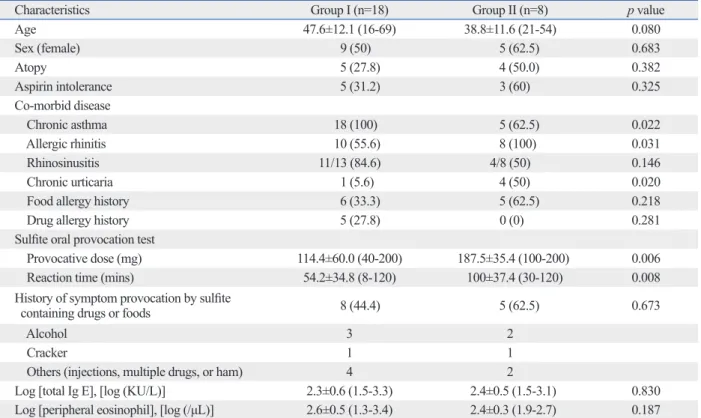
114.4±60.0 mg, p=0.006) and a longer time (100±37.4 min vs. 54.2±34.8 min, p=0.008) to induce hypersensitivity reac- tions compared with group I subjects. A previous history of adverse reactions was found in 44.4% of group I and 62.5%
of group II, being different from previous studies that en- rolled subjects with a history of sulfite hypersensitivities (Table 1).1,7
There were no significant differences in asthma-related parameters-such as atopic status, total IgE level, peripheral eosinophil count, FEV1% and metacholine PC20 level when the clinical characteristics were compared between group I and group III. The prevalence of severe asthma according to American Thoracic Society guidelines was significantly higher in group I than as previously reported in group III (44% vs. 16%, p=0.023).1,8 The asthma exacerbation relat- ed hospitalization rate (≥1 times/yr), emergency room visit (≥1 times/yr) and oral steroid burst (≥3 times/yr) were sig- nificantly higher in group I than in group III (66.7% vs.
24.6%, p=0.001; 66.7% vs. 24.6%, p=0.001; 55.6% vs.
17.3%, p=0.003).
Many potential mechanisms of sulfite hypersensitivity have been postulated. Sulfite oxidase deficiency has been sug-
Table 1. Comparison of Clinical Characteristics between Group I and II
Characteristics Group I (n=18) Group II (n=8) p value
Age 47.6±12.1 (16-69) 38.8±11.6 (21-54) 0.080
Sex (female) 9 (50) 5 (62.5) 0.683
Atopy 5 (27.8) 4 (50.0) 0.382
Aspirin intolerance 5 (31.2) 3 (60) 0.325
Co-morbid disease
Chronic asthma 18 (100) 5 (62.5) 0.022
Allergic rhinitis 10 (55.6) 8 (100) 0.031
Rhinosinusitis 11/13 (84.6) 4/8 (50) 0.146
Chronic urticaria 1 (5.6) 4 (50) 0.020
Food allergy history 6 (33.3) 5 (62.5) 0.218
Drug allergy history 5 (27.8) 0 (0) 0.281
Sulfite oral provocation test
Provocative dose (mg) 114.4±60.0 (40-200) 187.5±35.4 (100-200) 0.006
Reaction time (mins) 54.2±34.8 (8-120) 100±37.4 (30-120) 0.008
History of symptom provocation by sulfite
containing drugs or foods 8 (44.4) 5 (62.5) 0.673
Alcohol 3 2
Cracker 1 1
Others (injections, multiple drugs, or ham) 4 2
Log [total Ig E], [log (KU/L)] 2.3±0.6 (1.5-3.3) 2.4±0.5 (1.5-3.1) 0.830
Log [peripheral eosinophil], [log (/μL)] 2.6±0.5 (1.3-3.4) 2.4±0.3 (1.9-2.7) 0.187
Group I, sulfite sensitive asthma; group II, sulfite sensitive urticaria. Data are presented as n (%) or mean±SD (range). p-value was calculated by chi-square test and Mann-Whitney test.
Ga-Young Ban, et al.
Yonsei Med J http://www.eymj.org Volume 55 Number 2 March 2014 544
ries and literature review. Contact Dermatitis 2012;67:260-9.
4. Schwartz HJ. Sensitivity to ingested metabisulfite: variations in clinical presentation. J Allergy Clin Immunol 1983;71:487-9.
5. Vally H, Misso NL, Madan V. Clinical effects of sulphite addi- tives. Clin Exp Allergy 2009;39:1643-51.
6. Gunnison AF, Jacobsen DW. Sulfite hypersensitivity. A critical re- view. CRC Crit Rev Toxicol 1987;17:185-214.
7. Stevenson DD, Simon RA. Sensitivity to ingested metabisulfites in asthmatic subjects. J Allergy Clin Immunol 1981;68:26-32.
8. Bush RK, Taylor SL, Holden K, Nordlee JA, Busse WW. Preva- lence of sensitivity to sulfiting agents in asthmatic patients. Am J Med 1986;81:816-20.
9. Kim YY. Past, present, and future of allergy in Korea. Allergy Asthma Immunol Res 2010;2:155-64.
lic of Korea (A111218-11-PG01).
REFERENCES
1. Cho YS, Baik SH, Park HS, Rhu NS, Cho DI, Kim JW. Clinical features of sulfite-sensitive asthmatics. Tuberc Respir Dis 1992;
39:159-66.
2. Di Lorenzo G, Pacor ML, Mansueto P, Martinelli N, Esposito- Pellitteri M, Lo Bianco C, et al. Food-additive-induced urticaria: a survey of 838 patients with recurrent chronic idiopathic urticaria.
Int Arch Allergy Immunol 2005;138:235-42.
3. García-Gavín J, Parente J, Goossens A. Allergic contact dermatitis caused by sodium metabisulfite: a challenging allergen: a case se-