© 2017 The Korean Academy of Medical Sciences.
This is an Open Access article distributed under the terms of the Creative Commons Attribution Non-Commercial License (http://creativecommons.org/licenses/by-nc/4.0) which permits unrestricted non-commercial use, distribution, and reproduction in any medium, provided the original work is properly cited.
pISSN 1011-8934 eISSN 1598-6357
Clinical Evaluation of Techniques for Measuring Nasal-Specific Immunoglobulin E in Pediatric Patients
Currently used methods for collecting nasal-specific immunoglobulin E (IgE) require administration of a large amount of saline into the nostrils, which is difficult in children.
We designed two methods that are easy to use in children. We measured nasal-specific IgE and evaluated clinical characteristics of nasal-specific IgE in pediatric rhinitis. This study included 82 patients who visited Kyungpook National University Children’s Hospital from December 2014 to July 2016 with rhinitis symptoms. Thirty patients used the spray method, and 52 patients used the swab method. We examined nasal-specific IgE to Dermatophagoides farinae, Dermatophagoides pteronyssinus, Alternaria, birch, and weed mix. Thirty patients had nasal-specific IgE concentrations of ≥ 0.35 kIU/L. There was a positive correlation between nasal-specific IgE and serum-specific IgE to D. farinae and D. pteronyssinus (r = 0.548, P < 0.001; r = 0.656, P < 0.001). If we regard positivity of skin prick test as standard, cutoff point of nasal-specific IgE to D. farinae was 0.11 kIU/L and to D. pteronyssinus was 0.12 kIU/L. Based on these cutoff points, five patients would be considered to have local allergic rhinitis. The methods showed relatively high positivity for nasal-specific IgE, which reflected the serum-specific IgE as well. These methods can be considered to diagnose local allergic rhinitis in children.
Keywords: Rhinitis; Immunoglobulin E; Child Ji Young Ahn,1 Suk Jin Hong,2
and Bong Seok Choi1
1Department of Pediatrics, Kyungpook National University School of Medicine, Daegu, Korea;
2Department of Pediatrics, Catholic University of Daegu School of Medicine, Daegu, Korea Received: 16 June 2017
Accepted: 27 August 2017 Address for Correspondence:
Bong Seok Choi, MD
Department of Pediatrics, Kyungpook National University School of Medicine, 130 Dongdeok-ro, Jung-gu, Daegu 41944, Republic of Korea
E-mail: [email protected]
Funding: This research was supported by Kyungpook National University Research Fund, 2014.
https://doi.org/10.3346/jkms.2017.32.12.2005 • J Korean Med Sci 2017; 32: 2005-2008
INTRODUCTION
Rhinitis is classified as allergic rhinitis or nonallergic rhinitis based on systemic atopy to aeroallergens. Recently, the concept of local allergic rhinitis has been raised, and interest in this con- cept is increasing. Local allergic rhinitis is defined as a localized nasal allergic response and absence of systemic atopy. For di- agnosis, nasal-specific immunoglobulin E (IgE) should be de- tected or nasal allergen provocation test proved positive.
Currently used methods for detecting nasal-specific IgE re- quired administration of large amounts of isotonic saline into the nostrils, which is difficult in children.
We designed two methods that are easy to use in children: a spray method and a swab method. Using these methods, we measured nasal-specific IgE and evaluated the clinical charac- teristics of nasal-specific IgE in pediatric rhinitis.
MATERIALS AND METHODS
This study included 82 patients who visited Kyungpook Nation- al University Children’s Hospital from December 2014 to July 2016. They visited with rhinitis symptoms (rhinorrhea, nasal obstruction, nasal itching, and sneezing) and were diagnosed with allergic rhinitis or nonallergic rhinitis. We defined patients
with positive skin prick test as having allergic rhinitis. We used the methods described below for collecting nasal secretions with them. Thirty patients used the spray method (spray group), and 52 patients used the swab method (swab group). We used the swab method from December 2014 to December 2015 and the spray method from January to July 2016.
Measuring nasal sample
Measuring nasal sample came from methods of measuring vi- rus-specific IgA (1). The spray method involves slowly spraying 5 mL of isotonic saline as a fine mist into each nostril using an electronic nasal spray device named New Coclean (WelbuTech, Incheon, Korea) and collecting the diluted nasal secretions. The swab method involves inserting a cotton swab until resistance is met at turbinates and rotating the swab several times against nasal wall and then washing the cotton swab tip with 1.25 mL of isotonic saline in a tube. We then examined the fluid for the presence of nasal-specific IgE to Dermatophagoides farinae, Dermatophagoides pteronyssinus, Alternaria, birch, and weed mix via an ImmunoCAP radioallergosorbent technique (Uni- CAP; Pharmacia, Uppsala, Sweden). We also examined the flu- id for nasal total IgE.
ORIGINAL ARTICLE
Pediatrics
1 / 1 CROSSMARK_logo_3_Test
2017-03-16 https://crossmark-cdn.crossref.org/widget/v2.0/logos/CROSSMARK_Color_square.svg
Ahn JY, et al. • Nasal Specific Immunoglobulin E in Children
2006 http://jkms.org https://doi.org/10.3346/jkms.2017.32.12.2005 Serum total IgE, specific IgE, and eosinophil count
We measured serum-specific IgE for aeroallergens (D. farinae, D. pteronyssinus, Alternaria, Aspergillus, cat dander, and dog dander) and serum total IgE using the ImmunoCAP. Serum-spe- cific IgE concentrations ≥ 0.35 kIU/L were considered positive.
Peripheral blood total eosinophil counts were checked using an automated system.
Skin prick test
Skin prick tests for allergen were performed using 17 allergen extracts. Histamine was used as the positive control, and iso- tonic saline was used as the negative control. After 15 minutes, a wheal and flare reaction equal to the negative control was con- sidered negative. A wheal reaction of more than 3 mm was con- sidered positive.
Statistical analysis
Qualitative variables are expressed as percentages. Quantitative variables are expressed as means and standard deviations or as median from minimum to maximum. Ages are expressed as means. Serum total IgE, specific IgE, eosinophils and eosino- phil cationic protein (ECP) are expressed as median. The rela- tionships between serum specific IgE and nasal-specific IgE were examined using Pearson correlation analysis. Receiver operating characteristic (ROC) curve analysis was used to de- termine the nasal-specific IgE cutoff point with optimal sensi- tivity and specificity. All statistical analysis was performed using PASW Statistics version 18.0 (SPSS Inc., Chicago, IL, USA). Sta- tistical significance was set at P < 0.05.
Ethics statement
The present study protocol was reviewed and approved by the Institutional Review Board of Kyungpook National University School of Medicine (Registration No. knumc14-1071). Informed
consent was submitted by all subjects when they were enrolled.
RESULTS
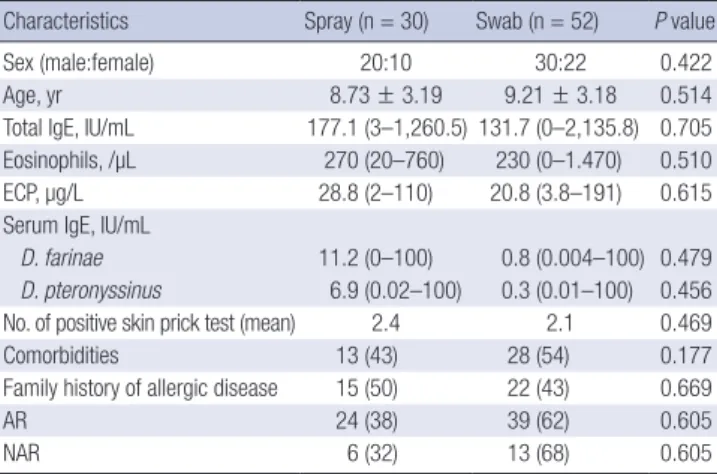
The average age of all 82 patients was 9.04 ± 3.17 years. Twenty of the spray group were boys, and ten were girls, with an aver- age age of 8.73 ± 3.19 years. Twenty-four patients in the spray group were allergic rhinitis patients, and six were nonallergic rhinitis patients. Thirty of the swab group were boys, and twen- ty-two were girls, with an average age of 9.21 ± 3.18 years. Thir- ty-nine patients of the swab group were allergic rhinitis patients, and thirteen were nonallergic rhinitis patients. There were no significant differences in serum total IgE, serum specific IgE, serum eosinophil counts, ECP, the numbers of positive skin prick test results, the numbers of comorbidities and the numbers of family history of allergic disease between the spray and the swab groups (Table 1).
Thirty of all patients, all of whom had allergic rhinitis, had nasal-specific IgE concentrations of ≥ 0.35 kIU/L. Twenty-one of these patients were boys, and nine were girls, with an average age of 9.17 ± 2.83 years.
There was a positive correlation between nasal-specific IgE and serum-specific IgE to D. farinae in all patients (r = 0.548, P < 0.001). Dividing two groups, there was a positive correlation between nasal-specific IgE and serum-specific IgE to D. farinae in the spray group (r = 0.585, P = 0.001) and there was a posi- tive correlation in the swab group (r = 0.554, P < 0.001) (Table 2). There was also a positive correlation between nasal-specific IgE and serum-specific IgE to D. pteronyssinus in all patients (r = 0.656, P < 0.001). There was a positive correlation between nasal-specific IgE and serum-specific IgE to D. pteronyssinus in the spray group (r = 0.610, P < 0.001) and there was a positive correlation in the swab group (r = 0.742, P < 0.001) (Table 2).
The proportion of patients with nasal-specific concentrations of IgE to D. farinae ≥ 0.35 kIU/L in the serum-specific IgE-posi- tive group was 66.7% as measured using the spray method and 46.7% using the swab method. The proportion of patients with nasal-specific concentrations of IgE to D. pteronyssinus ≥ 0.35 kIU/L in the serum-specific IgE-positive group was 38.1% using the spray method and 31.6% using the swab method. There was no statistically significant difference between the groups.
If we regard positivity of skin prick test as the standard, the Table 1. Demographics of subjects
Characteristics Spray (n = 30) Swab (n = 52) P value
Sex (male:female) 20:10 30:22 0.422
Age, yr 8.73 ± 3.19 9.21 ± 3.18 0.514
Total IgE, IU/mL 177.1 (3–1,260.5) 131.7 (0–2,135.8) 0.705 Eosinophils, /µL 270 (20–760) 230 (0–1.470) 0.510
ECP, µg/L 28.8 (2–110) 20.8 (3.8–191) 0.615
Serum IgE, IU/mL
D. farinae 11.2 (0–100) 0.8 (0.004–100) 0.479
D. pteronyssinus 6.9 (0.02–100) 0.3 (0.01–100) 0.456 No. of positive skin prick test (mean) 2.4 2.1 0.469
Comorbidities 13 (43) 28 (54) 0.177
Family history of allergic disease 15 (50) 22 (43) 0.669
AR 24 (38) 39 (62) 0.605
NAR 6 (32) 13 (68) 0.605
Values are presented as number (range) or number (%).
IgE = immunoglobulin E, ECP = eosinophil cationic protein, AR = allergic rhinitis, NAR = nonallergic rhinitis.
Table 2. Correlation of nasal-specific IgE and serum-specific IgE to D. farinae and D.
pteronyssinus in the spray and the swab group
Allergens Methods r P value
D. farinae Spray 0.585 0.001
Swab 0.554 < 0.001
D. pteronyssinus Spray 0.610 < 0.001
Swab 0.742 < 0.001
IgE = immunoglobulin E.
Ahn JY, et al. • Nasal Specific Immunoglobulin E in Children
http://jkms.org 2007
https://doi.org/10.3346/jkms.2017.32.12.2005
cutoff point of nasal-specific IgE to D. farinae was 0.11 kIU/L using the spray method and 0.10 kIU/L using the swab method.
The sensitivity of the spray method for D. farinae was 85.0%, and the specificity was 100%. The sensitivity of the swab method for D. farinae was 71.4%, and specificity was 70.8% (Table 3).
The cutoff point of nasal-specific IgE to D. pteronyssinus was 0.13 kIU/L using the spray method and 0.11 kIU/L using the swab method. The sensitivity of the spray method for D. pteron- yssinus was 88.9%, and the specificity was 91.7%. The sensitivity of the swab method for D. pteronyssinus was 66.7%, and the spec- ificity was 76.4% (Table 3).
Based on these cutoff points, five of our patients would be re- garded as having local allergic rhinitis. These patients were neg- ative for serum specific IgE and skin prick test result and their nasal specific IgE concentrations were higher than our cutoff point in more than one allergen.
DISCUSSION
Local allergic rhinitis is characterized by local production of na- sal-specific IgE without systemic atopy. The prevalence of local allergic rhinitis is unknown. Previous studies have reported the prevalence of local allergic rhinitis to be 47%–62.5% in patients with nonallergic rhinitis (2-4). In some studies reporting local allergic rhinitis in children and adolescents, 11% of the patients were aged < 14 years at clinical evaluation and 14% first report- ed symptoms in childhood (5-7). In our study, the prevalence of local allergic rhinitis based on our cutoff points was 6.1%.
Previous studies reported clinical characteristics of local al- lergic rhinitis (4,6,8,9). Local allergic rhinitis patients are young- er than nonallergic rhinitis patients and are predominantly wom- en (6). Patients with local allergic rhinitis had a family history of atopy and more frequent conjunctivitis and asthma among al- lergic diseases (4,6,8). The most common symptoms are rhinor- rhea, sneezing, and itching (4,8). A study of allergic rhinitis pa- tients reported no significant difference in age or sex between the nasal provocation test-positive group and nasal provocation test-negative group (9).
Many tests have been used to measure nasal-specific IgE and diagnose local allergic rhinitis (8-11). The nasal provocation test is considered the gold standard for diagnosing local allergic rhi- nitis (8,9). However, nasal provocation tests are time consum- ing and require a free interval between two allergens. Further-
more, there is a risk of anaphylactic shock (8,9). Nasal lavage for measuring nasal-specific IgE is another method for diagnosing local allergic rhinitis (8,10). This method is noninvasive, but the sensitivity is relatively low (8,10). One study reported that nasal IgE had a correlation rate of 90% with the nasal provocation test (11). However, the serum IgE and skin prick tests had correla- tion rates of 72.5% and 67.5% with the provocation test (11).
This study suggested that the high correlation rate of nasal IgE with the nasal provocation test indicates that the nasal test is a safe and practical alternative to the nasal provocation test (11).
Our study presents two methods to evaluate nasal-specific IgE that are neither time consuming nor expensive. These meth- ods came from methods of measuring virus-specific IgA (1).
Previous study reported that nasal washing method was good to collect nasal secretions and determine ECP (12). The spray and swab methods can be conducted easily in children and had relatively high positivity. Furthermore, the nasal-specific IgE collected using these methods reflected the serum-specific IgE relatively well.
Although we measured nasal total IgE and nasal-specific IgE to prevalent inhalant allergens including D. farinae, D. pteron- yssinus, Alternaria, birch and weed mix, only nasal-specific IgE to D. farinae and D. pteronyssinus were measured in all patients and other allergens showed very low positivity, so we only de- scribed about nasal-specific IgE to D. farinae and D. pteronyssi- nus.
A nasal-specific IgE-positive standard value has not yet been established. A study performed in Spain determined that the optimal cutoff point to discriminate local allergic rhinitis sub- jects from controls was 0.085 kIU/L (13). This study used the ImmunoCAP solid phase applied directly in the lower turbinate of each nostril (13). Our study examined the optimal cutoff point of the nasal-specific IgE value using the ROC curve. In our study, the cutoff point of nasal-specific IgE value for D. farinae was 0.11 kIU/L and D. pteronyssinus was 0.12 kIU/L. The previously mentioned study evaluated nasal-specific IgE in patients with allergic rhinitis, local allergic rhinitis, and healthy controls and identified a cutoff point to discriminate local allergic rhinitis from controls (13). However, our study evaluated nasal-specific IgE in patients with allergic rhinitis and nonallergic rhinitis and determined the cutoff point based on positivity of skin prick test.
The limitations of our study are as follows. First, we evaluated nasal-specific IgE only in nasal fluid and diagnosed local aller- Table 3. Cutoff points and AUCs for spray and swab methods
Nasal specific IgE Methods Cutoff, kIU/L Sensitivity Specificity AUC P value
Dermatophagoides farinae Spray 0.11 0.850 1.000 0.903 < 0.001
Swab 0.10 0.714 0.708 0.815 < 0.001
Dermatophagoides pteronyssinus Spray 0.13 0.889 0.917 0.970 < 0.001
Swab 0.11 0.667 0.764 0.742 0.027
AUC = area under the receiver operating characteristic curve, IgE = immunoglobulin E.
Ahn JY, et al. • Nasal Specific Immunoglobulin E in Children
2008 http://jkms.org https://doi.org/10.3346/jkms.2017.32.12.2005 gic rhinitis according to the results for the nasal-specific IgE. To
establish an exact cutoff value for diagnosing local allergic rhi- nitis, a nasal provocation test is needed. Second, we used only one of the two methods in each patient. If both of the methods could be conducted in the same patient, we could compare the results of the two methods and choose the better one. Third, we used each method during different periods. Although different periods may affect the results of the study, the results may be little affected because this study focused on the perennial aller- gens. Fourth, our study is a small-scale retrospective study. For exact evaluation of the prevalence of local allergic rhinitis in chil- dren and accuracy of the optimal cutoff value of nasal-specific IgE, a large-scale prospective study is needed.
In summary, our study presents two methods to evaluate na- sal-specific IgE. If we establish a positivity standard, these meth- ods can be used to diagnose local allergic rhinitis in children.
Further large-scale studies combined with nasal allergen prov- ocation tests are needed.
DISCLOSURE
The authors have no potential conflicts of interest to disclose.
AUTHOR CONTRIBUTION
Conceptualization: Choi BS. Data curation: Ahn JY, Choi BS. For- mal analysis: Ahn JY, Hong SJ, Choi BS. Funding acquisition: Choi BS. Investigation: Ahn JY, Choi BS. Writing - original draft: Ahn JY, Choi BS. Writing - review & editing: Ahn JY, Hong SJ, Choi BS.
ORCID
Ji Young Ahn https://orcid.org/0000-0003-2045-1629 Suk Jin Hong https://orcid.org/0000-0003-4844-5044 Bong Seok Choi https://orcid.org/0000-0002-2129-7232 REFERENCES
1. Walsh EE, Falsey AR. A simple and reproducible method for collecting
nasal secretions in frail elderly adults, for measurement of virus-specific IgA. J Infect Dis 1999; 179: 1268-73.
2. Carney AS, Powe DG, Huskisson RS, Jones NS. Atypical nasal challenges in patients with idiopathic rhinitis: more evidence for the existence of al- lergy in the absence of atopy? Clin Exp Allergy 2002; 32: 1436-40.
3. Powe DG, Jagger C, Kleinjan A, Carney AS, Jenkins D, Jones NS. ‘Entopy’:
localized mucosal allergic disease in the absence of systemic responses for atopy. Clin Exp Allergy 2003; 33: 1374-9.
4. Rondón C, Doña I, López S, Campo P, Romero JJ, Torres MJ, Mayorga C, Blanca M. Seasonal idiopathic rhinitis with local inflammatory response and specific IgE in absence of systemic response. Allergy 2008; 63: 1352-8.
5. Fuiano N, Fusilli S, Passalacqua G, Incorvaia C. Allergen-specific immu- noglobulin E in the skin and nasal mucosa of symptomatic and asymp- tomatic children sensitized to aeroallergens. J Investig Allergol Clin Im- munol 2010; 20: 425-30.
6. Rondón C, Campo P, Galindo L, Blanca-López N, Cassinello MS, Rodri- guez-Bada JL, Torres MJ, Blanca M. Prevalence and clinical relevance of local allergic rhinitis. Allergy 2012; 67: 1282-8.
7. Blanca-Lopez N, Campo P, Salas M, García Rodríguez C, Palomares F, Blanca M, Canto G, Feo Brito F, Rondon C. Seasonal local allergic rhinitis in areas with high concentrations of grass pollen. J Investig Allergol Clin Immunol 2016; 26: 83-91.
8. Rondón C, Romero JJ, López S, Antúnez C, Martín-Casañez E, Torres MJ, Mayorga C, R-Pena R, Blanca M. Local IgE production and positive nasal provocation test in patients with persistent nonallergic rhinitis. J Allergy Clin Immunol 2007; 119: 899-905.
9. Kim JH, Yoon MG, Seo DH, Kim BS, Ban GY, Ye YM, Shin YS, Park HS. De- tection of allergen specific antibodies from nasal secretion of allergic rhi- nitis patients. Allergy Asthma Immunol Res 2016; 8: 329-37.
10. Campo P, Rondón C, Gould HJ, Barrionuevo E, Gevaert P, Blanca M. Lo- cal IgE in non-allergic rhinitis. Clin Exp Allergy 2015; 45: 872-81.
11. Ozcan M, Ataman Gulbudak B, Olcay I, Tekin K, Unal A. Nasal specific IgE for Dermatophagoides in perennial allergic rhinitis and its correla- tion with serum specific IgE, prick test and nasal provocation test. KBB ve BBC Dergisi 2007; 15: 115-9.
12. Klimek L, Rasp G. Norm values for eosinophil cationic protein in nasal secretions: influence of specimen collection. Clin Exp Allergy 1999; 29:
367-74.
13. Campo P, Rondon C, Prado AP, Salas M, Galindo L, Aranda A, Mayorga C, Ruiz A, Bogas G, Herrero L, et al. A novel method of measuring nasal spe- cific IgE in systemic and local allergic rhinitis patients. J Allergy Clin Im- munol 2016; 137: AB284.