질소처리에 따른 여러 관엽식물의 생육반응
심명선1·길미정2*
1국립수목원 전시교육과 전시원조성관리연구실, 2국립원예특작과학원 원예작물부 화훼과
Growth Responses of Various Ornamental Foliage Plants According to the Amount of Nitrogen Application
Myung Syun Shim1 and Mi Jung Kil2*
1Department of Horticulture and Education, Korea National Arboretum, Pocheon 487-821, Korea
2Floriculture Research Division, National Institute of Horticultural & Herbal Science, Rural Development Administration, Suwon 440-706, Korea
Abstract. This study was carried out to investigate the plant growth of various foliage plants affected by the amount of nitrogen application. There was not an accurate criterion for fertilization to each foliage plant.
Moreover, the foliage plants grow slowly during the early stage and this period must be shortened for com- mercial production. Ficus benjamina, Hedera helix, Philodendron tatei, Rhapis excelsa, and Spathiphyllum spp. were used in this experiment. Nutrient nitrogen concentrations were 120, 150, 180, and 210 mg · L−1 (N1, N2, N3, N4)and they were based on the Sonneveld solution. Plant height and width, leaf number, leaf area, fresh and dry weights of shoots were measured for 8 weeks to compare the responses to the different treatments. The nitrogen contents of various plant parts were also analyzed. The growth of Ficus and Hed- era was improved at the N1 treatment and that of Philodendron, Rhapis and Spathiphyllum at N4 treatment.
The required amounts for nitrogen nutrients were different among the various foliage plants. The nitrogen treatments had no effects on SPAD values and there were no correlations between nitrogen treatments and nitrogen contents of plant parts. Therefore, the various foliage plants should supply with each proper nitro- gen treatments to grow faster with better quality. In this case, the plant growth played a more important role than nitrogen levels of plant parts in deciding the proper nitrogen levels for each foliage plant.
Key words : Ficus benjamina, Hedera helix, Philodendron tatei, Rhapis excelsa, Spathiphyllum spp.
서 론
관엽식물은 대부분 열대 및 아열대 원산으로 음지나 반음지 조건에서 잘 자라기 때문에 실내외 조경용이나 분화식물로 많이 이용되고 있고, 특히 도시 주거지역에 서 그 기호와 요구도는 증가하고 있다(Yoon, 1999).
최근 관엽식물에 대한 연구는 실내환경 연출 및 공기 정화(Bales, 1995; Hong, 2000), 온·습도의 조절(Son 등, 1998), 광조건에 따른 식물반응 등과 관련된 것들 이다. 관엽식물의 종류별 영양요구도에 대한 연구들은 많지 않으며, 적절한 시비관리 기준도 일부 식물들로
한정되어 있다.
산호수의 경우 1년생 묘는 질소농도에 따른 차이가 없었던 반면, 2년생 묘는 전생육기간 및 210mg · L−1 처리구에서 엽폭, 부피, 엽수 등의 생육이 가장 우수하 여 묘령 및 생장시기별로 알맞은 질소시비관리가 필요 한 것으로 판단되었다(Kil 등, 2010). 스파티필럼은 재 배시스템별 적합한 질소시비 수준들은 제시되었으나 (Campos와 Reed, 1993; Kent와 Reed, 1996), 이후 의 연구에서 질소처리에 따른 식물의 생육과 엽내 영 양진단도 고려해야하는 것으로 보고되었다(Mak와 Yeh,
2001). 관엽식물별 질소 시비관리 및 영양진단에 대한
보고는 거의 없어 이에 대한 연구들이 필요할 것으로 생각된다.
본 실험에서는 질소처리에 따른 여러 관엽식물의 생
*Corresponding author: [email protected]
*Received November 22, 2012; Revised November 27, 2012;
*Accepted November 28, 2012
육반응 및 엽내 질소 함량을 구명하여 초기 생육을 단축시키고 관엽식물의 영양관리에 있어 기초자료를 제 시하고자 하였다.
재료 및 방법
실험재료로는 벤자민고무나무(Ficus benjamina)
‘Star Light’, 관음죽(Rhapis excelsa) ‘능금’, 필로덴드 론(Philodendron tatei) ‘Congo’, 스파티필럼(Spathi- phyllum spp.), 아이비(Hedera helix) 등을 이용하였다.
각 식물의 묘를 원예용 상토[Sunshine Mix #4, Sungro, USA(perlite : peatmoss = 1 : 1, v/v)]를 채운 직경 10 cm 크기의 화분에 2009년 4월 8일 정식하였 다. Sonneveld 분화 전용양액(Sonneveld, 1989)을 토 대로 질소농도가 각각 120, 150, 180, 210mg · L−1 되도록 배양액을 조성하였으며, 양액 내 EC는 약 1~1.25 dS · m−1, pH는 약 6.3으로 하여 급액하였다 (Table 1). 2009년 8월부터 1일 4분간 저면관수하였다.
처리 8주 후 식물의 초장, 초폭, 엽수, 엽면적, 생체중 및 건물중 등을 조사하였다. 식물의 엽록소 함량을 위 해 SPAD 값을 측정하였다(SPAD502, Minolta).
실험 후에는 식물 부위별 질소 함량을 측정하기 위 해 잎, 줄기 뿌리 등을 채취하여 60oC에서 건조시킨 후 마쇄하였다. 마쇄된 건물시료 0.5g을 취한 후 sulfuric acid 1mL와 50% perchloric acid 10mL를
100mL의 플라스크에 넣고 300oC에서 분해하였다. 분
해액을 이용해 전질소 함량을 측정하였다. 잎의 전질소 (T-N) 분석은 Indolphenol-Blue(RDA, 1988)방법을 사 용하였다.
통계분석은 SAS system(Version 9.1, SAS Institute Inc., Cary, NC, USA)에 의해 최소유의차(LSD) 검정 법으로 5% 수준에서 유의성을 검정하였다. 그래프 작
업은 SigmaPlot(Ver 9.01, Systat Software Inc., San Jose, CA, USA)을 이용하였다.
결과 및 고찰
1. 질소처리에 따른 식물 생육
벤자민고무-나무와 아이비는 N1처리의 경우 생육이 가장 우수하였고, 특히 아이비는 질소수준이 높아질수 록 생육이 저하되는 경향을 보였다(Table 2). 아이비는 영양 요구도가 높지 않은 것으로 알려져 있고, 시비 수준은 엽면시비의 경우 750gN/L인 것으로 보고되었 다(Grower Books, 1983). 필로덴드론은 질소수준에 따라 영향받지 않는 것으로 보여졌으며, N4 처리의 경우 생육이 일부 향상되었으나 다른 처리들과 큰 차 이는 없었다. 관음죽은 생체중·건물중 등이 N4 처리 에서 가장 우수하였으나, 질소수준에 따라 일관된 경향 을 보이지는 않았다. 스파티필럼의 초장·생체중·건 물중 등은 N4 처리구가 가장 높은 값을 보였다. 스파 티필럼은 열대 관엽식물 중에 가장 인기 있는 종류 중의 하나이고(Stamps와 Evans, 1999), 다비성 식물 이나 용해성 염분에 민감하여 고농도의 비료는 피하는 것이 좋다고 권고되고 있다(RDA, 2007).
각 식물별로 두달 동안 초장 및 엽수의 증가량을 조사하였다(Fig. 2). 벤자민 고무나무는 N1 처리에서 초장 및 엽수의 증가량이 가장 컸으며, 질소수준이 높 아질수록 증가량이 감소하였다. 아이비도 N1 처리에서 초장 및 엽수의 증가량이 가장 컸으며, 질소수준이 높 아질수록 증가량이 감소하였다. 필로덴드론은 초장이 N4 처리구에서 가장 증가하였으나 질소수준에 따라 일 관된 결과를 보이지 않았다. 필로덴드론은 다비성 식물 로 많은 양의 고형 비료나 액비가 필요하며, 시비량이 적으면 잎의 크기가 작아지는 것으로 보고되었다
Table 1. Composition of nutrient solution used to investigate the effect of nitrogen application on plant growth of various ornamental foliage plants.
Con. of nitrogenz (mg · L−1)
Macro-element (mmol · L−1) Micro-element (µmol · L−1) EC
(dS · m−1) pH
NO3 NH4 P K Ca Mg S Fe Mn Zn B Cu Mo
120 (N1) 07.80 0.80 1.50 5.50 3.0 0.75 2.25 20 10 3 20 0.5 0.5 1.08 6.32 150 (N2) 09.90 0.90 1.50 5.50 3.0 0.75 1.25 20 10 3 20 0.5 0.5 1.09 6.28 180 (N3) 11.50 1.50 1.50 5.50 3.0 0.75 0.75 20 10 3 20 0.5 0.5 1.16 6.28 210 (N4) 12.50 2.50 1.50 5.50 3.0 0.75 0.75 20 10 3 20 0.5 0.5 1.25 6.26
zConcentrations of nitrogen are based on the standard Sonneveld solution for pot plants in the Netherlands.
(RDA, 2008). 관음죽은 초장 및 엽수 증가가 거의 없었다. 시비에 의해 생육 및 품질이 향상되었다는 다 른 보고(Mukarami와 Rauch, 1995)도 있었지만, 일반 적으로 관음죽은 생장이 느리기 때문에 비료 요구도가 낮은 것으로 보고되고 있다(RDA, 2007). 스파티필럼 은 초장이 N3과 N4 처리에서 많이 증가하였고, 엽수 는 N4 처리의 경우 가장 많았다. 이전의 연구에서 양 액에 의해 관엽식물의 생육 및 품질이 우수해지지만, 식물별 영양요구도가 다름을 알 수가 있었으며(Shim과 Kwon, 2010), 본 연구에서도 식물별 질소요구도가 다 르다고 판단되었다.
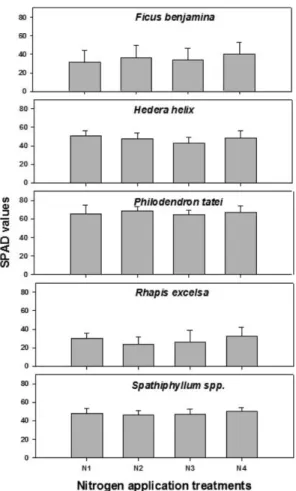
2. 질소처리에 따른 식물체 질소 및 엽록소 함량 관엽식물별로 질소처리에 따른 SPAD 값을 측정하 였다(Fig. 2). 벤자민고무나무는 질소수준이 증가함에
따라 SPAD 값들이 증가하였다. 아이비, 관음죽, 스파 티필럼 등은 SPAD 값이 감소하다가 N4 처리에서 다 시 증가하는 경향을 보였다. 필로덴드론은 SPAD 값들 이 질소수준과 관계없이 일정하게 유지되었다. 질소는 식물의 영양생장에 크게 관여하며, 그 외 단백질 및 핵산, 가용성 아민류, 엽록소와 효소 등의 주요성분으 로 식물생육에 중요한 요소로써 작용하지만(Gilslero와 Selmer-Olsen, 1980; Williams와 Nelson, 1992), 본 연구결과에서는 엽록소 함량에 크게 영향을 주지 않는 것으로 판단되었다.
질소처리에 따른 식물 부위별 질소함량을 분석하였 다(Fig. 3). 벤자민고무나무는 잎에서는 질소수준이 높 아질수록 질소함량이 낮아졌고, 줄기와 뿌리는 질소수 준에 따라 일관된 결과를 보이지는 않았지만 N4 처리 구의 경우 낮아지는 것을 알 수가 있었다. 아이비는 Table 2. Plant growth of various ornamental foliage plants according to the amount of nitrogen application.
Con. of nitrogenz
Plant height (cm)
Plant width (cm)
Number of leaves (ea)
Fresh weight (g) Dry weight (g)
Leaves Stems Roots Leaves Stems Roots
Ficus benjamina
N1 33.0a y 36.0a 191.38a 23.65a 15.99ab 16.87b 5.63a 4.67ab 3.92b
N2 31.8a 36.6a 163.25a 18.56ab 14.06ab 12.87b 4.49ab 4.25b 3.38b
N3 30.1ab 33.5a 174.38a 20.78ab 17.39a 22.61a 4.98ab 5.51a 5.08a
N4 27.9b 35.2a 162.50a 17.78b 13.51b 14.99b 3.84b 4.35b 3.84b
Hedera helix
N1 33.3a 41.0a 093.4a 14.5a 09.0a 19.5a 3.7a 1.7a 1.6a
N2 27.3b 31.1b 080.5b 11.4b 06.5b 13.9b 3.0b 1.3ab 1.3ab
N3 24.5b 30.3b 074.0b 11.6b 05.8b 13.4b 3.1ab 1.2b 1.4ab
N4 18.8c 23.5b 070.1b 09.9b 05.1b 11.7b 2.7b 1.1b 1.2b
Philodendron tatei
N1 38.3a 40.8a 012.1ab 30.4a 37.2a 25.6ab 3.6a 2.6a 2.2a
N2 38.3a 41.3a 014.3a 31.0a 36.7a 23.2bc 3.6a 2.5a 1.7b
N3 36.9a 39.6a 012.0ab 29.6a 35.9a 21.0c 3.6a 2.4a 1.6b
N4 38.5a 42.4a 010.0b 31.3a 38.2a 27.2a 3.9a 2.7a 2.5a
Rhapis excelsa
N1 25.4a 34.5a 010.9a 13.5ab 17.3ab 26.3ab 5.3ab 4.8ab 9.4a
N2 24.4a 32.5a 009.8a 11.7b 12.3c 27.3ab 4.5b 3.5b 8.7ab
N3 23.4a 34.1a 010.9a 12.3ab 12.9bc 23.7b 4.8ab 3.9b 7.2b
N4 25.1a 34.2a 011.9a 14.6a 19.6a 32.0a 5.8a 5.3a 9.5a
Spathiphyllum spp.
N1 34.88b 38.00a 031.75a 24.16b 21.08a 46.81a 3.68a 2.42a 7.16a
N2 38.69a 37.69a 032.50a 25.76ab 24.80a 45.90a 3.63a 2.86a 6.96a
N3 40.25a 38.69a 031.00a 28.50ab 25.20a 47.68a 4.24a 2.55a 8.72a
N4 40.25a 39.00a 037.25a 29.66a 25.06a 50.97a 4.37a 2.42a 7.95a
z N1, 120 mg · L−1; N1, 150 mg · L−1; N1, 180 mg · L−1; N1, 210 mg · L−1.
y Mean separation within columns by LSD at P = 0.05.
잎의 경우 질소수준이 높아질수록 질소함량이 증가하 였고, 줄기와 뿌리의 경우 N2 처리구부터 질소함량이 감소하였다. 필로덴드론은 잎, 줄기와 뿌리의 경우 질 소함량이 감소하다가 N4 처리에서 다시 증가하거나 일정하게 유지되었다. 관음죽은 잎과 뿌리의 질소함량 이 N4 처리에서 감소하였으나 줄기는 증가하는 경향 을 보였다. 스파티필럼은 잎의 경우 질소수준이 높아질 수록 질소함량이 증가되는 경향을 보였다. 줄기는 N4 처리에서 질소함량이 감소하였고 뿌리는 증가하는 경 향을 보였다. Shim과 Kwon(2010)에 따르면, 관엽식 물은 종류에 따라 영양요구 수준이 다르며, 엽내 무기 이온을 정량한 결과 N, P, K 등이 생육에 가장 영향 을 준 것으로 판단되었다. 본 연구에서는 관엽식물별로 식물부위별 질소함량을 고려할 때 질소수준에 따른 일 관된 경향은 보여지지 않았다. 야자류의 경우 종류별 엽내 무기이온 함량 기준들은 여러 연구자들에 의해 보고되었는데(von Uexkull와 Fairhust, 1991), 식물의 실제 반응은 이와 일치하지 않는 경우도 있어 잎의
진단보다 식물의 반응으로 영양상태를 판단하는 것이 더 바람직하다는 의견도 제시되었다(Elliot 등, 2004).
관엽식물들은 관수와 시비에 대한 정확한 기준들이 제시되지 않았고, 영양진단에 대한 보고도 거의 없어 이에 대한 연구들이 필요한 실정이다. 본 실험에서는 질소처리에 따른 여러 관엽식물의 생육반응 및 엽내 질소 함량을 구명하고 초기 생육을 단축시켜 관엽식물 의 영양관리에 대한 기초자료를 제시하고자 하였다. 벤 자민고무나무와 아이비는 N1 처리에서 식물의 생육이 우수하고, 초장 및 엽수의 증가량이 가장 큰 것으로 나타났다. 필로덴드론과 관음죽은 N4 처리의 경우 식 물 생육이 일부 향상되었으나, 초장 및 엽수의 증가량 은 다른 질소수준들간에 큰 차이는 없었다. 특히 관음 Fig. 1. Plant height and leaf number of various ornamental
foliage plants according to the amount of nitrogen appli- cation (N1, 120 mg · L−1; N2, 150 mg · L−1; N3, 180 mg · L−1; N4, 210 mg · L−1). Vertical bars indicate ± S.D. of means (n = 12).
Fig. 2. SPAD values in leaves of various ornamental foli- age plants according to the amount of nitrogen applica- tion (N1, 120 mg · L−1; N2, 150 mg · L−1; N3, 180 mg · L−1; N4, 210 mg · L−1). Vertical bars indicate ± S.D. of means (n = 8).
죽은 식물이 거의 생장하지 않았다. 스파티필럼은 N4 처리에서 식물의 생육이 우수하고, 초장 및 엽수의 증 가량도 가장 큰 것으로 보여져 각 식물별 적합한 질 소수준이 다른 것으로 판단되었다. 질소는 식물의 영양 생장에 크게 관여하며, 엽록소의 주요성분으로 식물생 육에 중요한 요소로 작용하는 것으로 알려져 있지만, 본 연구에서는 엽록소 함량에 크게 영향을 주지 않는 것으로 판단되었다. 관엽식물별로 식물 부위별 함량을 고려할 때 질소수준에 따른 일관된 경향은 보여지지 않았고, 잎 등 식물체 부위별 영양 상태보다 식물의 생육반응으로 영양상태를 진단하는 것이 더 적합한 것 으로 판단되었다.
적 요
질소처리에 따른 여러 관엽식물의 생육반응 및 엽내 질소 함량을 구명하여 초기 생육을 단축시키고 관엽식 물의 영양관리에 있어 기초자료를 제시하고자 하였다.
실험재료로 벤자민고무나무, 관음죽, 필로덴드론, 스파 티필럼, 아이비 등 많이 이용되고 있는 관엽식물들을 선택하였다. 화분에 식재한 관엽식물에 질소량을 각각 120, 150, 180, 210mg · L−1로 처리하고, 8주 후 식물 의 초장, 폭, 엽수, 엽면적, 생체중 및 건물중 등을 측 정하였다. 식물 부위별 질소 함량도 분석하였다. 벤자 민고무나무와 아이비는 N1 처리에서 식물의 생육이 우수하고, 초장 및 엽수의 증가량이 가장 큰 것으로 나타났다. 필로덴드론과 관음죽은 N4 처리의 경우 식 물 생육이 일부 향상되었으나, 초장 및 엽수의 증가량 은 다른 질소수준들간에 큰 차이는 없었다. 특히 관음 죽은 식물의 생장량이 거의 없었다. 스파티필럼은 N4 처리에서 식물의 생육이 우수하고, 초장 및 엽수의 증 가량도 가장 큰 것으로 보여졌다. 각 식물별 적합한 질소수준이 다른 것으로 판단되었다. 질소수준별 처리 가 엽록소 함량에 크게 영향을 주지 않았고, 식물 부 위별 질소함량도 일관된 경향을 보여지지 않았다. 그러 므로, 관엽식물에서는 잎 등 식물체 부위별 영양 상태 보다 식물의 생육반응으로 영양상태를 진단하는 것이 더 적합한 것으로 판단되었다.
주제어 : 관음죽, 벤자민 고무나무, 스파티필럼, 아이비, 필로덴드론
사 사
본 논문은 2009년 농촌진흥청 국립원예특작과학원 원예작물부 화훼과 기관프로젝트인 ‘수출용 Ardisia 고 품질 분화생산 및 상품 디자인 기술개발’ 과제중 박사 후연구원 계약과제 지원으로 수행된 것입니다.
인 용 문 헌
1. Bales, S.F. 1995. The kitchen garden: Raised beds and electric chairs. Horticulture 73:34-39.
2. Campos, R. and D.W. Reed. 1993. Determination of constant-feed liquid fertilization levels for Spathiphyl- Fig. 3. Nitrogen mineral nutrient contents in plant parts of
various ornamental foliage plants according to the amount of nitrogen application (N1, 120 mg · L−1; N2, 150 mg · L−1; N3, 180 mg · L−1; N4, 210 mg · L−1). Vertical bars indicate ± S.D. of means (n = 12).
lum ‘Petite’ and Dieffenbachia ‘Camille’. J. Environ.
Hort. 11:22-24.
3. Elliott, M.L., T.K. Broschat, J.Y. Uchida, and G.W.
Simone. 2004. Compendium of ornamental palm dis- eases and disorders. APS Press, St. Paul, MN.
4. Gilslerod, H.R. and A.R. Selmerolsen. 1980. The responses of chrysanthemum to variations in salt con- centration when grown in recirculated nutrient solu- tion. Acta Hort. 98:201-209.
5. Grower Books. 1983. Foliage pot plant manual.
Grower Books, London.Efficiency of fertigation pro- grams for Baltic ivy and Asiatic lily. HortTechnology 2:43-46.
6. Hong, J. 2000. Benzene and formaldehyde removal by indoor foliage plants. Ph. D. Diss. Korea Univ. Seoul.
7. Kent, M.W. and D.W. Reed. 1996. Nitrogen nutrition of New Guinea impatiens ‘Barbados’ and Spathiphyl- lum ‘Petite’ in a subirrigation system. J. Amer. Soc.
Hort. Sci. 121:816-819.
8. Kil, M.J., Y.J. Huh, S.Y. Choi, J.H. Lim, S.K. Park, and M.S. Shim. 2010. Journal of Bio-Envrironment Control. 19:257-265.
9. Mak, A.T.Y. and D.M. Yeh. 2001. Nitrogen nutrition of Spathiphyllum ‘Sensation’ grown in sphagnum peat- and coir-based media with two irrigation methods.
HortScience 36:645-649.
10. Murakami, P.K. and F.D. Rauch. 1995. Controlled release urea fertilizers affect the growth and quality of
selected foliage plants. HortScience 30:867.
11. RDA. 1988. Soil chemical analysis method. 2nd ed.
RDA, Suwon, Korea.
12. RDA. 2007. Growing of foliage plants I. RDA, Suwon, Korea.
13. RDA. 2008. Growing of foliage plants II. RDA, Suwon, Korea.
14. Shim, M.S. and O.K. Kwon. 2010. Growth responses of various ornamental foliage plants to nutrient solu- tion strength. Journal of Bio-Envrironment Control.
19:210-216.
15. Son, K.C., M.K. Kim, S.H. Park, and M.K. Chang.
1998. Effect of foliage plant Pachira aquatica on the change of indoor temperature and humidity. Kor. J.
Hort. Sci. & Tech. 16:377-380.
16. Sonneveld, C. (ed.) 1989. A method for calculating the composition of nutrient solutions for soilless cultures.
3rd translated ed. Glass house Crops Research Station, Naaldwijk, The Netherlands.
17. Williams, K.A. and P.V. Nelson. 1992. Growth of chry- santhemum at low relatively steady nutrient levels in a commercial-style substrate. HortScience 27:877-880.
18. Von Uexkull, H.R. and T.H. Fairhurst. 1991. Fertiliz- ing for high yield and quality the oil palm, Intl. Potash Inst., Berne, Switzerland.
19. Yoon, P.S. 1999. The recent situation and vision of foli- age plant for indoor landscape. J. Kor. Indoor Land- scape 1:1-12.