Kor. J. Hort. Sci. Technol. 29(3):187-194, 2011
Ebb and Flow 저면관수 시스템에서 광강도와 양액농도에 따른 칼랑코에( Kalanchoe blossfeldiana ‘Marlene’)
생육 및 양분흡수 특성
노은희1ㆍ전하준2ㆍ손정익1*
1서울대학교 식물생산과학부 및 농업생명과학연구원, 2대구대학교 원예학과
Growth Characteristics and Nutrient Uptake of Kalanchoe Plants (Kalanchoe blossfeldiana ‘Marlene’) at Different Light Intensities
and Nutrient Strengths in Ebb and Flow Subirrigation Systems
Eun Hee Noh
1, Ha Joon Jun
2, and Jung Eek Son
1*1Department of Plant Science and Research Institute for Agriculture and Life Sciences, Seoul National University, Seoul 151-921, Korea
2Department of Horticulture, Daegu University, Gyungsan 712-714, Korea
Abstract. The objective of this study was to determine the effects of light intensity and electrical conductivity (EC) of nutrient solution on the growth and nutrient uptake of potted kalanchoe plants (Kalanchoe blossfeldiana
‘Marlene’) with growth stage in ebb and flow subirrigation systems. The plants were grown at four ECs of 0.5, 1.0, 1.5, and 2.0 dS・m
-1for seedling stage and four ECs of 1.0, 1.5, 2.0, and 3.0 dS・m
-1for short day stage under three daily photosynthetic photon flux (PPF) of 6.5, 10.3, 18.2 mol・m
-2・ d
-1. At seedling stage, plant height was the longest under the lowest light intensity, and particularly dry weights and leaf areas were the highest at PPF 10.3 mol・m
-2・d
-1. Dry weights and leaf areas were the highest at EC 1.5 dS・m
-1regardless of light intensity. At short day exposure, plant height was the longest under the lowest light intensity.
Dry weights, leaf areas, and number of pedicels of the plants significantly increased as light intensity increased.
Under all light intensity conditions, dry weights, leaf areas, and number of pedicles increased until EC becomes to 1.0 - 2.0 dS・m
-1. And after reached the highest at EC 2.0 dS・m
-1, they decreased at EC 3.0 dS・m
-1. By comparing the ion uptakes at EC 1.5 dS・m
-1of seedling stage and EC 2.0 dS・m
-1of short day stage in which the plants grew better, we confirmed that ion balance of nutrient solution among NO
3--N, H
2PO
4-, K
+, Ca
2+, and Mg
2+were significantly changed at short day stage compared to seedling stage. For better growth of the plants, both ion balance and EC of nutrient solution should be considered under different light intensities at short day stage while control of EC is enough at seedling stage.
Additional key words: electrical conductivity (EC), ion concentration, nutrient composition, photosynthetic photon flux (PPF), seedling stage, short day exposure, substrate
*Corresponding author: [email protected]
※ Received 15 November 2010; Accepted 22 March 2011. 이 논문은 농림수산식품부 농림기술개발사업의 지원으로 수행되었음.
서 언
분화 칼랑코에는 화색이 풍부하고 소화수가 많으며 개화기 간이 길어 광조건이 다양한 한국, 일본, 네덜란드, 미국 등의 여러 지역에서 많이 재배되고 있고(Dole and Wilkins, 1999;
Mortensen, 2000; Kim, 2001; Kim et al., 2007; Verberkt
et al., 1996), 비교적 고부가가치 작물로 평가되고 있다. 이
러한 분화 칼랑코에의 생산을 위해서 저면관수 방식의 ebb
and flow(EBB) 시스템이 많이 사용되고 있다(Hwang et al.,
2008; Lu and Son, 2005; Son et al., 2006). EBB 저면관수
시스템은 식물체에 물리적인 자극을 주지 않으면서 양분과
수분을 근권부에 공급하기 때문에 기존의 두상관수에 비해
50%이상 비료를 절약할 수 있고 꽃이나 잎에 수분이 묻지 않아 다습 시 발생하는 병충해를 줄일 수 있기 때문에 고품질 작물을 생산할 수 있다(Rouphael and Colla, 2005; Rouphael et al., 2004; Uva et al., 1998; van Os, 1999). 일반적으로 배양액의 농도는 분화의 생육과 품질에 영향을 미치며, 대 부분의 분화 농가에서는 높은 농도로 관리하면 높은 수확량 을 얻을 것으로 생각하지만(Rouphael and Colla, 2009), 실 제로 EBB 저면관수시스템에서 Cui(2002)은 도리테높시스, Jeon(2003)은 제라니움, James(2001)는 페튜니아와 베고니 아, Noh and Son(2010)은 칼랑코에에 대하여 배양액 농도 가 높을수록 식물의 생장에 유리한 것이 아니라 작물 별 최 적의 배양액 농도가 있다는 것을 밝힌 바 있다.
배양액의 적정 농도와 조성에 영향을 미치는 환경요인은 온 도, 습도, 광도 등이 있다. 그 중 지역과 계절에 따라 온실 내의 광환경은 차이가 매우 크며 광환경이 달라짐에 따라 식물의 증산량이 다르고(Kim et al., 2008) 이에 따라 양분흡수 특성 이 변하게 된다(Alexander and Conelly, 1995; Cedergreen and Madsen, 2003; Israeli et al., 1996; Mankin and Fynn, 1996; Pardossi et al., 2005). 특히 저면관수 시스템을 사용 한 분화재배에서는 배지 표면으로부터의 증발, 식물의 증산 이 달라지면 근권의 염류 집적이 다르게 되므로(Sonneveld and Voogt, 2009). 효율적인 배양액 농도와 조성의 관리를 위해 광조건이 고려되어야 한다. 따라서 상이한 광조건에서 식물의 생장에 적합한 배양액의 농도는 다를 것으로 추정된 다. 최근 상이한 광조건에 대한 적정 배양액의 조성과 농도 조정에 관한 연구가 연구자들의 관심을 끌고 있다. 실제로 계절에 따라 제라니윰 생장에 최적인 배양액의 농도는 상이 하며(Rouphael et al., 2008), 광강도와 배양액의 농도를 조 합하여 분화 베고니아에 적용하였을 때 광강도가 증가함에 따라 질소의 소요량도 증가되었다(Nemali and van Iersel, 2004a). 한편, 베고니아와 페튜니아의 적정 EC의 범위는 광 강도에 무관하게 나타나기도 하였다(Nemali and van Iersel, 2004b). 이상의 연구들은 대부분 광강도에 따른 배양액 농 도를 EC수준에서 검토하였기 때문에 보다 상세한 검토를 위해서는 각 이온 별 흡수율 특성의 구명이 필요하다.
따라서 본 연구는 EBB 저면관수 시스템에서 광강도와 배 양액 농도 처리에 따른 분화 칼랑코에 생육 및 양분흡수특 성을 조사하여 광강도 별 적정 배양액 농도와 양수분 흡수 율을 구명하고자 수행하였다.
재료 및 방법
작물 및 재배조건
실험은 2001년 3월부터 5월까지 서울대학교 농업생명과
학대학 부속농장에 설치되어 있는 벤로형 유리온실에서 수 행하였다. 칼랑코에(Kalanchoe blossfeldiana ‘Marlene’)의 삽수는 실험 장소에서 재배된 모주 중에서 균일한 것을 채 취하여 피트모스와 펄라이트 5:5(v/v)가 혼합된 6cm화분에 정식하였다 . 0.5 × 0.3m 크기의 ebb and flow(EBB) 저면관 수시스템 24개에 각각 화분 7개씩 배치하였고, 각각의 벤치 에 16L의 탱크를 각각 사용하였다. 관수는 각 양액탱크에 수중펌프를 사용하여 매일 동일한 시간에 배양액을 15분간 씩 1회 관수하였다. 실험 시작 후 처음 2주는 유묘기 영양생 장을 위해 보광을 통해 장일 조건을 조성하였으며(광주기 15시간), 제 3주부터는 개화를 유도하기 위하여 단일 조건 (광주기 10시간)으로 재배하였다. 실험기간 동안 낮 평균온 도는 26.1 ± 1.6℃이고 밤 평균온도는 15.7 ± 1.4℃였다. 광 처리별 다소 차이는 있었지만 평균 상대습도는 55%에서 61% 사이였다.
배양액 농도 처리
배양액은 네덜란드 온실 작물연구소(PBG)의 분화용 표 준 배양액을 사용하였다. 다량 원소NO
3-N 10.6, NH
4-N 1.1, H
2PO
44.5, K 5.5, Ca 3.0, Mg 0.75mmol・L
-1, 미량원소의 농도는 Fe 20, Mn 10, Zn 3, B 20, Cu 0.5, Mo 0.5μmol・L
-1로 조성하였다. 1배액의 전기전도도(EC)는 1.6dS・m
-1였고 이를 기준으로 유묘기에는 EC 0.5, 1.0, 1.5, 2.0dS・m
-1의 4 수준으로 처리를 하였고, 유묘기 후에 단일처리 시작 후에 는 EC 1.0, 1.5, 2.0, 3.0dS・m
-1의 4수준으로 처리하였다. 배 양액의 pH는 NaOH와 H
2SO
4를 이용하여 5.5-6.5로 조절하 여 관리하였다.
광강도 처리
광강도는 처리는 차광망을 이용하였고, 60%차광, 40%차 광, 무차광의 3수준으로 하였고, 실험기간 내의 광강도는 하 루의 광합성유효광양자속(PPF)을 적산한 값으로 각각 평균 6.5, 10.3, 18.2mol・m
-2・d
-1이었다. PPF는 광량자센서(PAR LITE, Kipp & Zonen B.V., Netherlands)를 설치하여 측정 하였고 자료수집은 데이터로거(DA-100, Yokogawa, Japan) 로 실시간 수집하였다.
조사 및 분석 방법
배양액 탱크 내의 배양액 pH는 pH미터(HM-14P, TOA,
Japan), EC는 매주 EC미터(CM-14P, TOA, Japan)로 측정
하였다 . 실험 시작 후2주(유묘기)와 8주(단일처리기)후에 칼
랑코에 생육을 조사하기 위하여 각 EBB저면관수시스템에
서 2개의 식물체를 채취하여 초장, 엽면적, 건물중, 분지수
0 2 4 6 8 10
Plant height (cm)
0 50 100 150 200
6.5mol
.
m-2.
d-110.3mol
.
m-2.
d-118.2mol
.
m-2.
d-1Leaf area (cm2 /plant)
0.5 1.0 1.5 2.0
0.0 .5 1.0 1.5 2.0
Shoot dry weight (g/plant)
0.5 1.0 1.5 2.0
0 5 10 15 20 25
Number of pedicels
Electrical conductivity of nutrient solution (dS.m
-1)
* * **
*
*
**
* **
*
* *
6.5 mol・m-2・d-1 10.3 mol・m-2・d-1 18.2 mol・m-2・d-1
Fig. 1. Leaf area, dry weight, plant height, and number of pedicels of kalanchoe plants grown in ebb and flow subirrigation systems under different nutrient strengths and light intensities at seedling stage (for two weeks). Vertical bars represent SE of the means (n = 4). * or ** means significant at p ≤ 0.05 or p ≤ 0.01, respectively.
를 조사하였다. 건물중은 식물체를 70℃건조기에 넣고 72 시간 건조시킨 후에 측정하였다. 엽면적은 엽면적 측정기 LI-3100(Li-Cor Inc., USA)로 측정하였다. 양수분 흡수율은 매 2주 간격으로 식물이 흡수한 배양액 양과 그 중 함유되어 있는 각 원소를 측정하여 실험기간에 흡수한 비료를 n(mmol) 이라 하고, 동시에 흡수된 물량은 w(L)라고 하였으며 그 비 율인 n/w를 계산하여 산출하였다(Cabrera et al., 1995). 이 온 분석은 처리 별 일정간격으로 채취한 배양액을 여과지(No.
2)로 거른 후 NO
3-N은 Kjeldahl steam distillte(Eastin, 1978) 방법으로 측정하였고, P, K, Ca, Mg는 ICP(ISPS-1000IV, Shimadzu, Japan)로 측정하였다. 각 광도 별 식물 생장에 가 장 적합한 양수분 흡수율을 구명하기 위하여, 모든 생육단 계와 광 조건 하에서 생육이 가장 우수하였던 EC처리구에 대하여 n/w를 비교 분석하였다.
실험설계 및 통계분석
완전임의배치 방법을 사용하였고 각 처리당 EBB저면관 수시스템 2개씩을 사용하였으며, 각 시스템에 칼랑코에 7개
체씩 배치하였다. 양분흡수율을 조사하기 위한 자료는 매2 주에 1회 2반복 측정하였고 생육조사를 위하여 유묘기 종료 (실험 2주 후), 단일처리 종료 후(실험 8주 후) 매회 1개 시 스템 당 2개체씩 샘플링 하여 처리구 당4반복 측정하였다.
통계분석은 SAS 8.2(Statistical Analysis Software, USA)를 이용하였고, P≤0.05 수준에서 검증하였다.
결과 및 고찰
작물생육 특성
광강도와 배양액의 농도는 칼랑코에 유묘기 초장, 엽면적, 건
물중 및 분지수에 유의한 영향을 주었다 (Fig. 1). 초장은 광강도
6.5mol・m
-2・ d
-1와 10.3mol・m
-2・ d
-1에서 EC 1.5dS・m
-1일 때
8.4cm로 가장 높은 값을 나타냈다. 광강도 18.2mol・m
-2・ day
-1에서는 배양액 농도가 증가해도 초장의 변화 없이 모두 6.0-
6.4cm였다. 엽면적은 광강도 10.3mol・m
-2・ day
-1일 때 EC
1.5-2.0dS・m
-1에서 140-150cm
2로 가장 높았다. 이는 Lu and
Son(2005)이 발표한 결과와 유사하였다. 광강도 6.5mol・m
-2・ d
-1Electrical conductivity of nutrient solution (dS m
-1)
1.0 1.5 2.0 3.0
Number of pedicels
0 10 20 30 40
Leaf area (cm2 /plant)
0 100 200 300 400 500 600
Plant height (cm)
0 5 10 15 20
1.0 1.5 2.0 3.0
Shoot dry weight (g/plant)
0 1 2 3 4 5
6.5mol.m-2.d-1 10.3mol.m-2.d-1 18.2mol.m-2.d-1
•
6.5 mol・m-2・d-1 10.3 mol・m-2・d-1 18.2 mol・m-2・d-1
Fig. 2. Leaf area, dry weight, plant height, and number of pedicels of kalanchoe plants grown in ebb and flow subirrigation systems under different nutrient strengths and light intensities for six weeks of short day stage. Vertical bars represent SE of the means (n = 4).
에서 엽면적은 EC가 0.5dS・m
-1에서 1.5dS・m
-1까지 증가함 에 따라 증가하여 EC 1.5dS・m
-1에서 104cm
2로 가장 크게 나타났고, EC 2.0dS・m
-1에서는 63cm
2로 엽면적이 오히려 작은 값을 나타내었다. 광강도 18.2mol・m
-2・d
-1에서는 EC 1.5-2.0dS・m
-1에서 98cm
2로 유사한 값을 보였다. 건물중은 엽면 적과 비슷한 경향을 나타냈다. 이는 광강도 10.3mol・m
-2・day
-1일 때 최고 값은 EC 1.5-2.0dS・m
-1에서 나타났고 기타 광조 건에서는 EC 1.5dS・m
-1에서 최고값을 나타냈다. 분지수는 배양액 농도가 증가함에 따라 증가하는 경향이 있지만 유의 한 차이는 없었다.
단일처리기 생육 즉 실험 처리 8주 후에 조사한 초장, 엽 면적, 건물중 및 분지수는 광강도와 배양액의 농도에 따른 차이가 매우 현저하였다(Fig. 2). 단일 처리기 엽면적, 건물 중, 분지수는 광강도가 증가함에 따라 현저하게 증가하였고 초장은 반대로 광강도가 높을수록 낮게 나타났다. 각 광도에 서 배양액 농도에 따른 생육의 수치는 다소 다른 경향을 보였 다. 초장은 광강도 6.5mol・m
-2・d
-1에서 EC가 1.0dS・m
-1에서 2.0dS・m
-1으로 증가함에 따라 증가하였고 EC가 3.0dS・m
-1까지 증가하면 오히려 감소하였다. 같은 배양액 농도일 경 우 두 생육단계에서 모두 칼랑코에 초장의 신장이 고광도에 서 저광도보다 억제되었다. 분화 작물에서 초장을 줄이는 것 은 전체적인 품질 향상에 기여하기 때문에 (Mortensen, 1994), 칼랑코에 초장을 위해 광강도가 높을수록 유리함을 알 수 있다. 엽면적, 건물중, 분지수는 모든 광조건에서 모두 EC 1.0-2.0dS・m
-1까지 증가하다 EC 3.0dS・m
-1에서 현저히 감 소하는 경향을 보였고 , EC 2.0dS・m
-1에서 가장 높게 나타났 다. EBB 시스템에서 재배된 아이비 분화 작물은 광강도가 높을수록 높은 건물중을 얻었다(Pennisi et al., 2005). 본 실 험결과에서도 칼랑코에 유묘기와 단일처리기 재배에 있어 서 건물중, 엽면적의 증대를 위해서는 높은 광조건이 유리 하였다.
각 생육단계 별, 광도 별 다소 차이는 있지만, 최대 생장을
나타낸 배양액 농도는 EC 1.5dS・m
-1이었다. 아이비 분화 작
물의 경우, 본 연구 결과와 마찬가지로 다양한 광조건에서
배양액 농도처리를 하였을 때, 고품질 분화는 100mg・L
-1N
조건에서 제일 많이 얻었다는 보고를 한 바 있다 (Pennisi et
Weeks after treatment
0 2 4 6 8 10
0.0 .5 1.0 1.5 2.0
Electrical conductivity of nutrient solution (dS.m-1)
.5 1.0 1.5 2.0 2.51.0 1.5 2.0 2.5 3.01.5 2.0 2.5 3.0 3.5 4.0 4.5
EC 0.5~1.0 dS.m-1 EC 1.0~1.5 dS.m-1 EC 1.5~2.0 dS.m-1 EC 2.0~3.0 dS.m-1
Stage I Stage II Stage III Stage IV 6.5 mmol.m-2.d-1 10.3 mmol.m-2.d-1 18.2 mmol.m-2.d-1
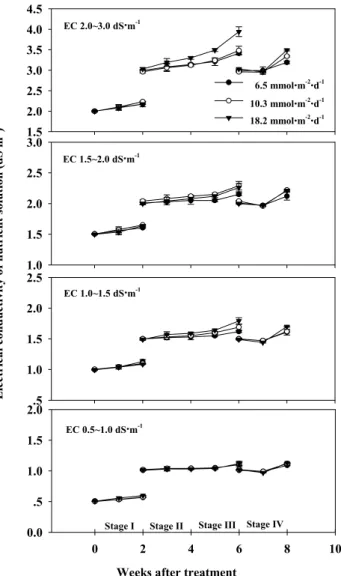
Fig. 3. Changes in electrical conductivity (EC) of nutrient solutions under different nutrient strengths and light intensity during the growth periods of kalanchoe plants. Stages I, I, III, and IV are two weeks for seedling stage, the 1st, 2nd and, 3rd two weeks of short day exposure, respectively. Vertical bars represent SE of the means (n = 2).
al., 2005). 분지수는 출하 시 소화경수와 직접적인 관계가 있 는 생장지표로 매우 중요하다. 분지수는 높은 광강도인 18.2 mol・m
-2・day
-1처리에서 34.5개로 낮은 광강도 6.5mol・m
-2・d
-1에서 최고치 14.5개와 중 광강도인 10.3mol・m
-2・day
-1의 최 고치 23.4개보다 훨씬 더 많은 수치를 나타냈다. 각 광도에 서 최대 분지수는 EC 1.5와 2.0dS・m
-1에서 나타났다. Kang and van Iersel(2009)은 베고니아와 페튜니아를 EC 0.52dS・m
-1와 1.24dS・m
-1에서 재배하였을 때 생육이 좋았고 배양액의 농도가 필요 이상으로 높을 때는 생육에 지장을 초래하여 작물 별 적정 농도 범위 유지의 필요성을 제시하였다.
배양액 EC의 변화
배양액 EC의 변화는 Fig. 3에 나타난 바와 같이 전체적인
재배기간 동안 증가하는 경향을 나타냈고, 특히 고농도 처 리구에서는 더 크게 증가하였다. 시작 후 4주(Stage I, II)까 지는 광도 별 차이가 크지 않았지만, 4주 후부터(Stage III, IV)는 같은 배양액 농도 처리에서 광도 차이에 따라 EC의 변화폭의 차이가 비교적 크게 나타났다. 이런 현상은 배양 액 농도를 높게 처리하였을 때 더 선명하게 나타났다. 이는 장기간 EC가 높은 배양액을 공급하였을 경우 식물체에 의 한 선택적인 흡수와 무기이온의 불균형 및 배지 내 양분 집 적 등에 의한 현상으로 해석될 수 있다(Kim et al., 2008;
Sonneveld and Voogt, 2009). 낮은 농도에서는 광도 별 EC 차이가 0.1dS・m
-1정도이었고 높은 광도에서는 0.3dS・m
-1까 지 차이가 났다. 이는 Yu et al.(2003)과 Rouphael et al.
(2008)의 연구결과와 일치하였다. 이런 결과는 광환경의 변 화에 따라 배지 내 양분과 수분함량이 달라지고 식물의 양 분 및 수분흡수 특성이 민감하게 반응하기에 효율적인 배양 액 농도 관리를 위해 광조건이 고려되어야 함을 의미한다.
양분흡수(n/w) 특성
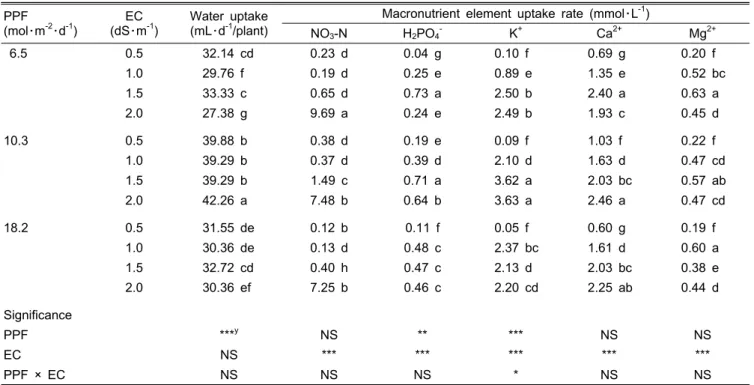
광강도와 배양액 농도가 칼랑코에의 유묘기(Stage I) 양 분흡수율에 주는 영향은 Table 1과 같다. 배양액의 농도는 NO
3-N, H
2PO
4, K
+, Ca
2+, Mg
2+이온의 흡수율에 유의한 영 향을 주었으며, 배양액 농도가 증가함에 따라 양분 흡수율 도 증가하는 경향을 보였다. 광강도는 H
2PO
4, K
+의 이온 흡수율에 유의한 영향을 주었고 NO
3-N, Ca
2+, Mg
2+에 대해 서는 유의한 차이를 보이지 않았다.
단일처리기(Stage II, III, IV) 전체기간 동안에 광강도와 배양액 농도가 칼랑코에 평균 양분흡수율에 미치는 영향은 Table 2와 같다. 유묘기와 마찬가지로 배양액 농도는 NO
3-N, H
2PO
4, K
+, Ca
2+, Mg
2+각 이온의 흡수율에 유의한 영향을 주었다 . 광강도는 NO
3-N, Mg
2+이온에 대해 유의한 영향을 주었고 기타 이온에 대해서는 유의한 영향을 주지 않았다.
유묘기와 단일처리기에서 양분흡수에 대한 배양액 농도의 영향이 광강도의 영향에 비해 더욱 크게 나타났음을 확인하 였다 . 광강도 역시 양분 별 흡수패턴에 뚜렷한 영향을 미쳤 음을 확인하였다. Nemali and van Iersel(2004a)는 PPF가 4.4mol・m
-2・d
-1에서 9.9 mol・m
-2・d
-1로 증가할 때 베고니아 의 질소 소요량이 157mg・L
-1에서 203mg・L
-1로 증가하였다 고 보고하여 본 연구결과와 마찬가지로 광도에 따라 배양액 의 조성을 조절할 필요성을 밝힌 바 있다.
생육 단계별로 각 광조건에서 작물 생장에 적절한 배양액
의 EC 범위는 유사하였다(Figs. 1 and 2). 유묘기 각 광조건
별 작물 생장이 양호했던 배양액 농도는 EC 1.5dS・m
-1이며
단일처리기에는 EC 2.0dS・m
-1처리구이었다. 다양한 배양
Table 1. Effect of photosynthetic photon flux and electrical conductivity of nutrient solution on macronutrient element uptake rate (mmol・L-1) in ebb and flow subirrigation systems for kalanchoe plants at seedling stage.
PPF (mol・m-2・d-1)
EC (dS・m-1)
Water uptake (mL・d-1/plant)
Macronutrient element uptake rate (mmol・L-1)
NO3-N H2PO4- K+ Ca2+ Mg2+
6.5 0.5 32.14 cd 0.23 d 0.04 g 0.10 f 0.69 g 0.20 f
1.0 29.76 f 0.19 d 0.25 e 0.89 e 1.35 e 0.52 bc
1.5 33.33 c 0.65 d 0.73 a 2.50 b 2.40 a 0.63 a
2.0 27.38 g 9.69 a 0.24 e 2.49 b 1.93 c 0.45 d
10.3 0.5 39.88 b 0.38 d 0.19 e 0.09 f 1.03 f 0.22 f
1.0 39.29 b 0.37 d 0.39 d 2.10 d 1.63 d 0.47 cd
1.5 39.29 b 1.49 c 0.71 a 3.62 a 2.03 bc 0.57 ab
2.0 42.26 a 7.48 b 0.64 b 3.63 a 2.46 a 0.47 cd
18.2 0.5 31.55 de 0.12 b 0.11 f 0.05 f 0.60 g 0.19 f
1.0 30.36 de 0.13 d 0.48 c 2.37 bc 1.61 d 0.60 a
1.5 32.72 cd 0.40 h 0.47 c 2.13 d 2.03 bc 0.38 e
2.0 30.36 ef 7.25 b 0.46 c 2.20 cd 2.25 ab 0.44 d
Significance
PPF ***y NS ** *** NS NS
EC NS *** *** *** *** ***
PPF × EC NS NS NS * NS NS
zMean separation within columns by Duncan’s multiple range test at 5% level (n = 4).
yNS, *,**, ***Nonsignificant or significant at p ≤ 0.05, p ≤ 0.01, or p ≤ 0.001, respectively.
Table 2. Effect of photosynthetic photon flux and electrical conductivity of nutrient solution on macronutrient element uptake rate (mmol・L-1) in ebb and flow subirrigation systems for kalanchoe plants at short day stage.
PPF (mol・m-2・d-1)
EC (dS・m-1)
Water uptake (mL・d-1/plant)
Macronutrient element uptake rate (mmol・L-1)
NO3-N H2PO4- K+ Ca2+ Mg2+
6.5 1.0 30.51 f 3.4 ij 0.4 e 2.0 e 1.3 f 0.4 e
1.5 29.15 f 7.4 g 0.8 d 4.1 cd 1.9 e 0.5 d
2.0 27.03 g 14.3 d 1.1 c 4.1 cd 3.6 b 0.6 c
3.0 27.33 g 37.4 a 1.6 a 5.0 b 4.7 a 0.8 b
10.3 1.0 35.26 cd 4.6 hi 0.5 e 2.4 e 2.1 e 0.4 e
1.5 31.57 e 7.5 g 1.1 c 4.1 cd 3.0 d 0.5 d
2.0 36.18 cd 9.4 f 1.1 c 4.3 c 3.1 cd 0.5 d
3.0 31.11 e 21.6 c 1.4 b 6.9 a 4.8 a 0.8 b
18.2 1.0 37.65 b 2.6 j 0.7 d 2.3 e 2.3 e 0.3 e
1.5 39.98 a 5.2 h 1.1 c 3.7 d 3.3 bcd 0.6 c
2.0 37.63 b 11.4 e 1.2 c 4.2 c 3.4 bc 0.8 b
3.0 38.21 bc 23.3 b 1.6 a 6.8 a 4.7 a 1.0 a
Significance
PPF ***y ** NS NS NS *
EC NS *** *** ** *** ***
PPF × EC NS ** NS NS NS NS
zMean separation within columns by Duncan’s multiple range test at 5% level (n = 4).
yNS, *,**, ***Nonsignificant or significant at p ≤ 0.05, p ≤ 0.01, or p ≤ 0.001, respectively.
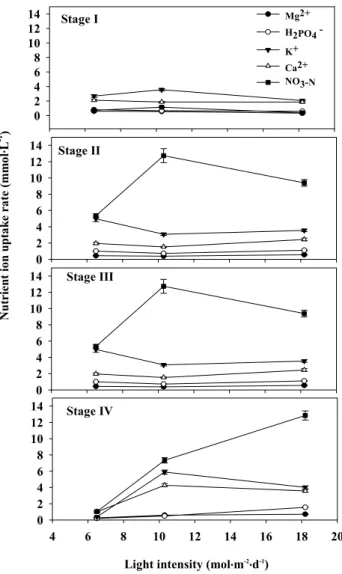
액 농도 처리조건 중에서 생육이 가장 양호하였던 유묘기 (Stage I)의 EC 1.5dS・m
-1, 단일처리기(Stage II, III, IV)의 EC 2.0dS・m
-1처리구에 대하여 각 생육단계별 광조건에 따
른 각 이온들의 양분흡수율 (n/w)의 차이를 분석한 결과는 Fig.
4와 같다. Stage I(유묘기)에서 NO
3-N, H
2PO
4, K
+, Ca
2+, Mg
2+흡수율은 광강도에 따라 큰 차이를 나타내지 않았다. Stage
0 2 4 6 8 10 12 14
0 2 4 6 8 10 12 14
Light intensity (mol.m-2.d-1)
4 6 8 10 12 14 16 18 20
0 2 4 6 8 10 12 14
Stage I
Stage II
Stage III
Stage IV
Nutrient ion uptake rate (mmol
-1. L) 0 2 4 6 8 10 12
14 Mg2+
H2PO4 - K+
Ca2+
NO3-N
Fig. 4. Nutrient uptake rates of kalanchoe plants grown in ebb and flow subirrigation systems at electrical conductivity of 1.5-2.0 dS・m-1 during the experimental period. Stages I, I, III, and IV are two weeks for seedling stage, the 1st, 2nd and, 3rd two weeks of short day exposure, respectively. Vertical bars represent SE of the means (n = 2).
II에서는 NO
3-N는 광강도가 증가함에 따라 증가하다가 다 시 감소되는 경향을 보였고, 광강도에 따른 NO
3-N, H
2PO
4, K
+, Ca
2+, Mg
2+의 상호간 비율은 현저한 차이를 나타내었다.
Stage III은 Stage II와 비슷한 경향을 나타냈다. 마지막 단계 인 Stage IV는 NO
3-N가 광강도가 증가함에 따라 계속적으 로 증가하는 경향을 보였다. 이러한 결과는 NO
3-N, H
2PO
4, K
+, Ca
2+, Mg
2+이온 간의 흡수비율은 생육이 진전됨에 따라 증산량이 증가하는 특성(Nemali and van Iersel, 2004a)과 동시에 양분 흡수율도 증가하는 특성(Nemali and van Iersel, 2004b)에 따라 양분 흡수패턴의 차이가 나타났음을 추정할 수 있다.
이상의 결과에서 실제 재배 시 이온의 비율을 결정함에 있어서 광강도가 중요한 요인으로 작용함을 나타내고 있다.
따라서 작물의 양분흡수는 계절에 따라 다르며(Le Bot et
al., 1998), 작물의 생육 단계에 따라 배양액 조성을 달리해 야 할 필요가 있다(Cabrera et al., 1995; Kim et al., 2008).
본 연구에서는 각 광강도 별 칼랑코에 최적 생육을 위한 적 정 배양액 농도(EC) 범위는 비슷하지만, 광강도에 따른 양 분흡수율은 다양한 차이를 나타내어 광강도 별 적정 배양액 조성을 조절할 필요성을 확인하였다.
초 록
광강도와 배양액 농도에 따른 칼랑코에 (Kalanchoe blossfeldiana
‘Marlene’)의 생육단계별 양수분 흡수율과 작물생육을 조사 하였다. 광강도는 일적산 광합성유효광양자속(PPF)이 6.5, 10.3, 18.2mol・m
-2・ d
-1의 3수준으로, 배양액의 농도는 유묘 기 EC 0.5, 1.0, 1.5, 2.0dS・m
-1의 4수준, 단일처리 후 EC 1.0, 1.5, 2.0, 3.0dS・m
-1의 4수준으로 처리하였다. 유묘기 초 장은 저광 조건에서 가장 길었고, 엽면적과 건물중은 PPF 10.3mol・m
-2・ d
-1에서 가장 높았다. 유묘기 모든 광조건에서 EC 1.5dS・m
-1일 경우에 최대 건물중과 엽면적이 나타났다.
단일처리기 초장 역시 저광 조건에서 길었고, 엽면적, 건물 중, 분지수는 광강도가 증가함에 따라 현저하게 증가하였다.
모든 광조건에서 엽면적, 건물중, 분지수는 배양액농도가 EC 1.0-2.0dS・m
-1까지 증가하다가 EC 3.0dS・m
-1에서 현저 히 감소하였고, EC 2.0dS・m
-1에서 가장 높았다. 생육이 양 호하였던 EC 처리구(유묘기 EC 1.5dS・m
-1, 단일처리기 EC 2.0dS・m
-1)의 NO
3-N, H
2PO
4-, K
+, Ca
2+, Mg
2+이온간의 상 호간 비율을 분석한 결과 육묘단계에서는 광강도에 따라 큰 차이가 없었지만, 단일처리기에서는 큰 차이가 확인되었다.
따라서 작물의 최적의 생장을 위해 유묘기에는 광도 별 EC 조절로 충분하지만, 단일처리기에는 광강도에 따른 배양액 조성과 EC조절이 필요하다.
추가 주요어 : 전기전도도 (EC), 이온농도, 양액조성, 광합성유 효광량자속(PPF), 유묘기, 단일처리기, 배지
인용문헌
Alexander, J.D. and J.R. Donnelly. 1995. Photosynthetic and transpirational responses of red spruce under-storey trees to light and temperature. Tree Physiol. 15:393-398.
Cabrera, R.I., R.Y. Evans, and J.L. Paul. 1995. Cyclic nitrogen uptake by greenhouse roses. Sci. Hort. 63:57-66.
Cedergreen, N. and T.V. Madsen. 2003. Light regulation of root and leaf NO3- uptake and reduction in the floating macrophyte Lemna minor. New Phytol. 161:449-457.
Cui, Y.Y., E.J. Hahn, X.C. Piao, Y.B. Lee, and K.Y. Paek. 2002.
Effect of nutrient solution strength on growth of doritaenopsis
‘Tinny Tender’ in an ebb and flow system. J. Kor. Soc. Hort.
Sci. 43:86-90.
Dole, J.M. and H.F. Wilkins. 1999. Floriculture. Prentice Hall, New Jersey, U.S.A. p. 403-408.
Eastin, E.F. 1978. Total nitrogen determination for plant material containing nitrate. Annal. Biochem. 85:591-594.
Hwang, S.J., M.Y. Lee, and B.R. Jeong. 2008. Suppression of stem growth in pot kalanchoe ‘Gold Strike’ by recycled subirrigational supply of plant growth retardants. African J.
Biotechnol. 7:1487-1493.
Israeli, Y., A. Schwartz, Z. Plaut, and D. Yakir. 1996. Effects of light regime on C, photosynthesis and yield of field-grown banana (Musa sp., Musaceae). Plant Cell Environ. 19:225-230.
James, E.C. and M.W. van Iersel. 2001. Fertilizer concentration affects growth and flowering of subirrigated petunias and begonias. HortScience 36:40-44.
Jeon, M.W., E.J. Hahn, and K.Y. Paek. 2003. Effect of nutrient solution strength on growth of potted pelargonium hortorum
‘Pinto White’ and ‘Pinto Pink’ cultured in an ebb and flood irrigation system. J. Kor. Soc. Hort. Sci. 44:518-522.
Kang, J.G. and M.W. van Iersel. 2009. Managing fertilization of bedding plants: A comparison of constant fertilizer concentrations versus constant leachate electrical conductivity. HortScience 44:151-156.
Kim, K.S. 2001. High quality cuttings and pot plant production of Kalanchoe blossfeldiana. Res. Agr. Life Sci. 5:29-35.
Kim, S.H., W. Oh, and K.S. Kim. 2007. Effects of nitrogen concentration and NO3-:NH4+ ratio of nutrient solution on stock plant growth, cutting yield, and quality in Kalanchoe blossfeldiana. Hort. Environ. Biotechnol. 48:52-59.
Kim, W.S., M.Y. Roh, and J.H. Lieth. 2008. Nutrient uptake potential of cut roses (Rosa hybrida L.) in soilless culture.
Acta Hort. 7:45-52.
Le Bot, J., S. Adamowicz, and P. Robin. 1998. Enzymatic methods for detection of mineral element deficiencies in citrus leaves:
a mini-review. J. Plant Nutr. 22:139-150.
Lu, Y.J. and J.E. Son. 2005. Effects of nutrient strength and light intensity on nutrient uptake and growth of young kalanchoe plants (Kalanchoe blossfeldiana ‘Marlene’) at seedling stage.
J. Bio-Environment Control. 14:149-154.
Kim, K.D, E.H. Lee, J.W. Lee, I.H. Cho, B.H. Moon, B.Y. Lee, J.E. Son, and C. Chun. 2008. Daily changes in rates of nutrient and water uptake, xylem sap exudate, and sapflow of hydro- ponically grown tomatoes. Hort. Environ. Biotechnol. 49:209-215.
Mankin, K.R. and R.P. Fynn. 1996. Modelling individual nutrient uptake by plants: relating demand to microclimate. Agric. Syst.
50:101-114.
Mortensen, L.M. 1994. Effects of day/night temperature variations on growth, morphogenesis and flowering of Kalanchoe bloss- feldiana v. Poelln. At different CO2 concentrations, daylengths and photon flux densities. Sci. Hort. 59:233-241.
Mortensen, L.M. 2000. Effects of air humidity on growth, flowering, keeping quality and water relation of four short-day greenhouse species. Sci. Hort. 86:299-310.
Nemali, K.S. and M.W. van Iersel. 2004a. Light intensity and fertilizer concentration: Optimal fertilizer solution concentration from water-use efficiency of wax begonia. HortScience 39:
1287-1292.
Nemali, K.S. and M.W. van Iersel. 2004b. Light intensity and fertilizer concentration: II. Optimal fertilizer solution concent- ration for species differing in light requirement and growth rate. HortScience 39:1293-1297.
Noh, E.H. and J.E. Son. 2010. Plant growth and nutrient uptake of Kalanchoe plants (Kalanchoe blossfeldiana ‘New Alter’) and nutrient accumulation of growing media with growth stage at different nutrient strengths in ebb and flow subirrigation systems. Kor. J. Hort. Sci. Technol. 28:973-979.
Pardossi, A., F. Falossi, F. Malorgio, L. Incrocci, and G. Bellocchi.
2005. Empirical models of macronutrient uptake in melon plants grown in recirculating nutrient solution culture. J. Plant Nutr. 27:1261-1280.
Rouphael, Y., G. Colla, A. Battistelli, S. Moscatello, S. Proietti, and E. Rea. 2004. Yield, water requirement, nutrient uptake and fruit quality of zucchini squash grown in soil and closed soilless culture. J. Hort. Sci. Biotechnol. 79:423-430.
Rouphael, Y. and G. Colla. 2005. Growth, yield, fruit quality and nutrient uptake of hydroponically cultivated zucchini squash as affected by irrigation systems and growing seasons.
Sci. Hort. 105:177-195.
Rouphael, Y., M.T. Cardarelli, E. Rea, and G. Colla. 2008. The influence of irrigation system and nutrient solution concent- ration on potted geranium production under various conditions of radiation and temperature. Sci. Hort. 118:328-337.
Rouphael, Y. and G. Colla. 2009. The influence of drip irrigation or subirrigation on zucchini squash grown in closed-loop substrate culture with high and low nutrient solution concentrations.
HortScience 44:306-311.
Son, J.E., M.M. Oh, Y.J. Lu, K.S. Kim, and G.A. Giacomelli.
2006. Nutrient-flow wick culture system for potted plant pro- duction: System characteristics and plant growth. Sci. Hort.
107:392-398.
Sonneveld, C. and W. Voogt. 2009. Plant Nutrition of Greenhouse Crops. Springer, Dordrecht.
Uva, W.L., T.C. Weiler, and R.A. Milligan. 1998. A survey on the planning and adoption of zero runoff subirrigation systems in greenhouse operations. HortScience 33:193-196.
van Os, E.A., 1999. Closed soilless growing systems: a sustainable solution for Dutch greenhouse horticulture. Water Sci. Technol.
39:105-112.
Verberkt, H.D., M.A. Jongh, and R. Schaefer. 1996. Invloed van voeding sconcentratie (EC) op groeien kwaliteit kalanchoe.
Proefstation voor Bloemisterij en Glasgroente, Aalsmeer, Rapport 61:47.
Yu, S.J., J.S. Lee, S.J. Jeong, and B.S. Yoo. 2003. Nutrient uptake patterns of native Rhododendron species in Korea and China under ebb and flow subirrigation. J. Kor. Soc. Hort. Sci.
44:824-828.