Citation: Liang X, Lee SI, Lee IS, Cho JH, Kim IH. 2017. Effects of saccharin (sweetener) supplementation on growth performance, fecal moisture and litter performance of lactating sows. Korean Journal of Agricultural Science 44:228-234.
DOI: https://doi.org/10.7744/kjoas.20170022
Editor: Jung Min Heo, Chungnam National University, Korea
Received: October 26, 2016
Revised: February 27, 2017
Accepted: March 10, 2017 Copyright: © 2017 Korean Journal of Agricultural Science.
This is an Open Access article distributed under the terms of the Creative Com- mons Attribution Non-Commercial License (http:
OPEN ACCESS
ANIMAL
Effects of saccharin (sweetener) supplementation on growth performance, fecal moisture and litter performance of lactating sows
Xiangxue Liang
1, Sang In Lee
1, Il Seok Lee
2, Jin Ho Cho
3, In Ho Kim
1*1
Department of Animal Resource and Science, Dankook University, Cheonan 31116, Korea
2
Department of General Education, Dankook University, Cheonan 31116, Korea
3
Department of Animal Science, Chungbuk National University, Cheongju 28644, Korea
*Corresponding author: [email protected]
Abstract
Feed intake (FI) of sows during lactation is a serious problem because sows require a large amount of energy for high milk production during lactation. Providing a palatable diet is important for lactating sows to cope with the stress of breast-feeding. Palatability can be increased by adding sweeteners to diets. This study was conducted to evaluate the effects of saccharin (sweetener) on growth performance, fecal moisture, and litter performance of lactating sows. Sixteen sows were randomly allotted to one of two dietary treatments in a 27-day trial starting from lactation. The two dietary treatments were supplemented with 0 and 0.2% saccharin (sweetener), respectively. Average daily feed intake (ADFI) was increased (p < 0.05) and back fat loss (BFL) was decreased (p < 0.05) in sows fed saccharin supplementation diets compared with sows fed control diet during lactation. However, sows’ body weight loss, body condition score (BCS), fecal score, and the number of piglet survival were not different (p > 0.05) among dietary treatments. The two dietary treatments also had no significantly different effect (p > 0.05) on litter weight and average daily gain (ADG) of piglets. Taken together, saccharin has no significant effect on growth performance of piglets but it can increase FI and reduce BFL of lactating sows.
Keywords: fecal score, growth performance, lactating sows, litter performance, saccharin
Introduction
Taste modifiers are now regularly used in feed to improve palatability. They help ensure that feed is appetizing and that optimum feed intake (FI) is achieved (Clément, 2015; Cho et al., 2016).
During the first week post-weaning, piglets have to adjust to receiving dry feed only and this
change often leads to diarrhea, reduced FI, and a decrease in weight gain (Munro et al., 2000; Park
et al., 2016). It will take long time to reach slaughter weight and farm productivity will be reduced.
The consumption of sweetened feeds increases intake and reduces stress. The results of the present post-weaning study showed that the addition of high intensity sweeteners to diets for weaning pigs can affect FI characteristics to a limited extent (Sterk et al., 2008). In the 1980s, sweeteners such as saccharin and aspartame started to become popular in food (Clément, 2015). Saccharin is an artificial sweetener, which is about 300 - 400 times as sweet as sucrose or table sugar, but with effectively no food energy. The main advantage of this synthetic sweetener is its favorable price while its disadvantage is the metallic aftertaste, which occurs when high doses are used (Hof, 1999). The pigs generally preferred a diet containing some level of saccharin compared to no saccharin (Aldinger et al., 1959). This study was conducted to evaluate the effects of saccharin on growth performance, fecal moisture and litter performance of lactating sows. Thereby evaluating the effects of saccharin on the productivity of sows.
Materials and Methods
The experimental protocols describing the management and care of animals were reviewed and approved by the Animal Care and Use Committee of Dankook University (DKU-A1989323).
Animals, Housing, and Experimental Design
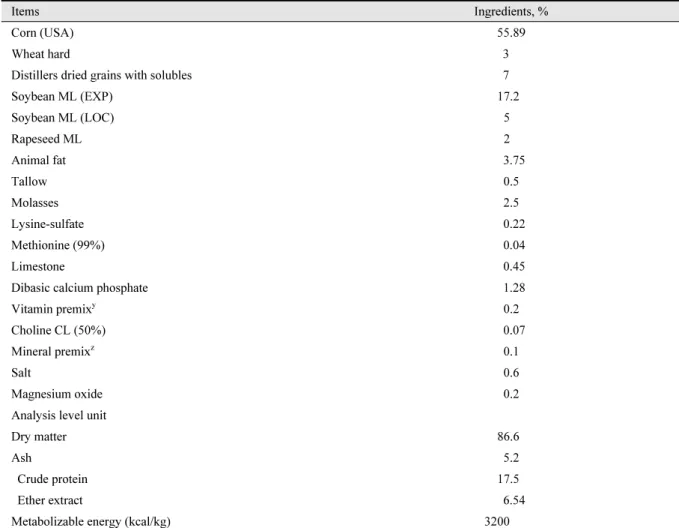
A total of 16 sows (Landrace × Yorkshire) were used in this experiment. On day 110 of gestation, sows were weighed and moved into the farrowing facility, randomly allotted to one of two dietary treatments, and fed 2.5 kg/day feed to allow for adjustment to the lactation diets before parturition. Experimental treatments contained two levels of saccharin: (i) CON, basal diet; (ii) NS, CON + 0.2% Saccharin. Diets were formulated to meet or exceed the NRC (National Research Council 2012) nutrient requirements for sows (Table 1). Sows were housed in farrowing crates (2.1 m × 0.6 m) which contained an area (2.1 m × 0.6 m) for newborn piglets on each side, and the temperature in the farrowing house was maintained at a minimum of 20 ℃. Heat lamps were provided for piglets. Piglets were treated according to routine management practices that included teeth clipping, tail docking, ear notching and subcutaneous iron dextran injections (1 mL per pig) within 24 h of birth. On the day of parturition, sows were not offered any feed.
On the first day after farrowing, sows were fed with 1.0 kg lactation diet and 2.0 kg on the second day. The daily feed allowance was increased gradually by 1.0 kg per day. One week after farrowing, sows were provided with free access to drinking water throughout the experimental period.
Sampling and Measurements
The body weight (BW) of sows was checked at after farrowing, during weaning and 5 d after weaning. Individual
piglet BW was assessed on d 0 (birth weight) and 22 (weaning). The back fat thickness (BFT) of sows was measured
6 cm off the midline at the 10th rib using a real-time ultrasound instrument (Piglot 105, SFK Technology, Herlev,
Denmark) after farrowing, weaning, and 5 d after weaning. The number of piglets for every sow was recorded on the
farrowing day and the weaning day to evaluate the survival rate of piglets. FI of sows were recorded daily to determine
the daily FI during lactation and 5 d after weaning. Fecal score of sows was observed and recorded daily during
Statistical Analysis
All experimental data were analyzed using the GLM procedure of SAS (2001) as a randomized complete block design (SAS Inst. Inc., Cary, NC, USA) according to their BW. The sow or litter of piglets was used as the experimental unit. The analysis of sow BFT and change during lactation used fat depth at farrowing as covariates.
Piglet birth weight was used as covariate for weaning weights during lactation. Lactation length was used as a covariate for piglet survivability, sow and piglet weaning weight, sow FI, and weaning-to-oestrus interval (WOI) and BFT depth change. Variability in the data was expressed as the pooled standard error (SE) and a p < 0.05 was considered as significant.
Table 1. Basal diet composition, g/kg (as-fed basis).
Items Ingredients, %
Corn (USA) 55.89
Wheat hard 3
Distillers dried grains with solubles 7
Soybean ML (EXP) 17.2
Soybean ML (LOC) 5
Rapeseed ML 2
Animal fat 3.75
Tallow 0.5
Molasses 2.5
Lysine-sulfate 0.22
Methionine (99%) 0.04
Limestone 0.45
Dibasic calcium phosphate 1.28
Vitamin premix
y0.2
Choline CL (50%) 0.07
Mineral premix
z0.1
Salt 0.6
Magnesium oxide 0.2
Analysis level unit
Dry matter 86.6
Ash 5.2
Crude protein 17.5
Ether extract 6.54
Metabolizable energy (kcal/kg) 3200
y
Provided per kilogram of diet: all-trans-retinyl acetate, 2.0 mg; cholecalciferol, 0.025 mg; all-rac-α-tocopherol acetate,1.75 mg;
menadione (menadione sodium bisulphate), 1.9 mg; riboflavin, 7 mg; thiamine (thiamine mononitrate), 2.1 mg; pyridoxine, 3.2 mg;
niacin, 55 mg; capantothenate, 15 mg; cobalamin, 0.04 mg; folic acid, 0.85 mg; D-biotin, 0.1 mg.
z
Provided per kilogram of complete diet: Fe (as FeSO4·7H2O), 90 mg; Cu (as CuSO4·5H2O), 15 mg; Zn (as ZnSO4), 50 mg; Mn
(as MnO2), 54 mg; I (as KI), 0.99 mg; and Se (as Na2SeO3·5H2O), 0.25 mg.
Results
Growth performance of sows
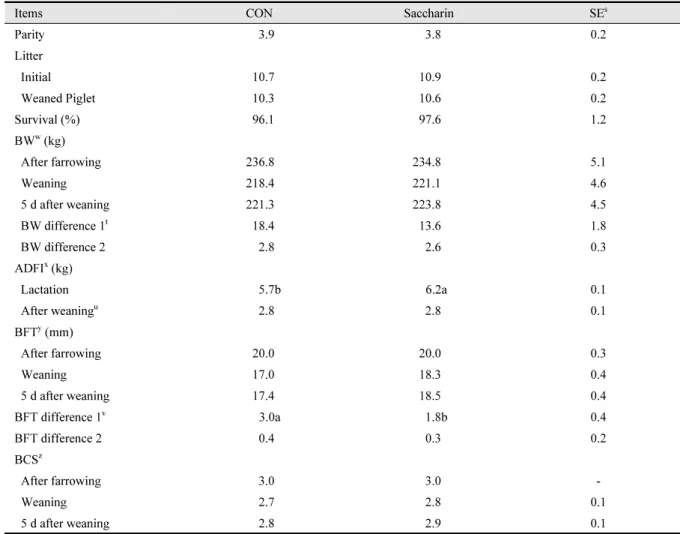
During lactation, average daily feed intake (ADFI) was increased (p < 0.05) and BFL was decreased (p < 0.05) in sows fed saccharin supplementation diets compared with sows fed CON diet (Table 2). Sow’s BW, body weight loss, the number of piglets’ survivals and BCS were not different (p > 0.05) among dietary treatments (Table 2).
Table 2. Effect of saccharin (sweetener) supplementation on growth performance in lactating sows
r.
Items CON Saccharin SE
sParity 3.9 3.8 0.2
Litter
Initial 10.7 10.9 0.2
Weaned Piglet 10.3 10.6 0.2
Survival (%) 96.1 97.6 1.2
BW
w(kg)
After farrowing 236.8 234.8 5.1
Weaning 218.4 221.1 4.6
5 d after weaning 221.3 223.8 4.5
BW difference 1
t18.4 13.6 1.8
BW difference 2 2.8 2.6 0.3
ADFI
x(kg)
Lactation 5.7b 6.2a 0.1
After weaning
u2.8 2.8 0.1
BFT
y(mm)
After farrowing 20.0 20.0 0.3
Weaning 17.0 18.3 0.4
5 d after weaning 17.4 18.5 0.4
BFT difference 1
v3.0a 1.8b 0.4
BFT difference 2 0.4 0.3 0.2
BCS
zAfter farrowing 3.0 3.0 -
Weaning 2.7 2.8 0.1
5 d after weaning 2.8 2.9 0.1
a, b: Means in the same row with different superscripts differ (p < 0.05).
r
Abbreviation: CON, basal diet; NS, CON + 0.2% Saccharin.
s
SE: Standard error.
t
BW difference: 1, after farrowing to weaning; 2, weaning to 5 d after weaning.
u
After weaning: for 5 days from weaning.
v
BFT difference: 1, after farrowing to weaning; 2, weaning to 5 d after weaning.
w
BW: body weight.
x
ADFI: average daily feed intake.
y
BFT: back fat thickness.
z
BCS: body condition score.
Growth performance of piglets
The two dietary treatments had no significantly different effect (p > 0.05) on the piglets BW (Table 3). Also no difference (p > 0.05) was observed in total average daily gain (ADG) of piglets (Table 3).
Table 3. Effect of saccharin (sweetener) supplementation on growth performance in suckling piglets
w.
Items CON Saccharin SE
xBW
y(kg)
Initial 1.310 1.334 0.032
Weaning 5.702 6.086 0.185
ADG
z(g)
Total ADG 200 216 8
w
Abbreviation: CON, basal diet; NS, CON+ 0.2% Saccharin.
x
SE: Standard error.
y
BW: body weight.
z
ADG: average daily gain.
Each treatment has 8 replications.
Fecal score of sows
The two dietary treatments had no significantly different effect (p > 0.05) on fecal scores of sows (Table 4).
Table 4. Effect of saccharin (sweetener) supplementation on fecal score in lactating sows
y.
Items CON Saccharin SE
zFecal Score
After farrowing 3.1 3.1 0.0
Weaning 3.2 3.2 0.0
5 d after weaning 3.0 3.1 0.0
y
Abbreviation: CON, basal diet; NS, CON + 0.2% Saccharin.
z