1-Deoxynojirimycin을 생산하는 Bacillus subtilis S10 배양액의 혈당강하 효과
조용석1․박영식1․이재연1․강경돈1․황교열1․성수일1,2†
1(주)바이오토피아 부설생명과학연구소
2수원대학교 자연과학대학 생명과학과
Hypoglycemic Effect of Culture Broth of Bacillus subtilis S10 Producing 1-Deoxynojirimycin
Yong Seok Cho1, Young Shik Park1, Jae Yeon Lee1, Kyung-Don Kang1, Kyo Yeol Hwang1, and Su Il Seong1,2†
1R&D Center for Life Science, Biotopia Co., Ltd., Gyeonggido 456-853, Korea
2Dept of Life Science, The University of Suwon, Gyeonggido 445-743, Korea
Abstract
1-Deoxynojirimycin (DNJ) is a strong α-glucosidase inhibitor which inhibits hyperglycemia in animals. To select the Bacillus strains highly producing DNJ, 4,000 strains were isolated from soil and grain samples.
By the inhibitory activity against α-glucosidase, nine Bacillus strains were selected and then identified by 16S rDNA sequencing. B. subtilis S10 was finally selected as the best strain for the production of DNJ. Various carbon sources and nitrogen sources in culture medium were evaluated for the highest production of DNJ.
As the results, the optimized concentration of carbon source and nitrogen source was 1.0% galactose and 1.6%
polypeptone and the concentration of DNJ produced was 0.75 g/L. The effect of culture supernatant of B. subtilis S10 on lowering blood glucose level was investigated in streptozotocin (STZ)-induced diabetic mice model.
Mice were randomly assigned to control group (saline) and three test groups such as acarbose group, silkworm powder group and B. subtilis S10 group. After eight-week oral feeding, blood glucose levels of the B. subtilis S10 and silkworm powder groups were respectively 209.1±19.6 mg/dL (59.1%) and 208.6±39.8 mg/dL (59.0%) lower than 510±10 mg/dL of the control group. These results indicated that the culture supernatant of B.
subtilis S10 was able to reduce the blood glucose level in STZ-induced diabetic mice.
Key words: Bacillus subtilis S10, 1-deoxynojirimycin (DNJ), polyhydroxylated alkaloids, α-glucosidase inhibitor, hyperglycemic mice
†Corresponding author. E-mail: [email protected]
†Phone: 82-31-220-2483, Fax: 82-31-220-2483
서 론
현대는 식생활의 변화, 생활스트레스, 운동부족, 노령화 등 여러 사회적 요인으로 인하여 각종 성인병이 급증하는 추세에 있으며 그 중에서도 특히 당뇨병은 신증, 백내장, 망 막변증 등 각종 합병증을 유발시키는 성인성 질환으로 최근 심각한 사회문제가 되고 있다. 임상학적으로 당뇨환자는 인 슐린 의존형(Type Ⅰ)과 인슐린 비의존형(Type Ⅱ)의 2개 군으로 구별되는데 이 중 Type Ⅱ 환자는 식이요법이나 운 동 또는 혈당강하제의 복용 등을 통해 혈당을 조절하고 있 다(1,2).
혈당강하제의 한 부류인 α-glucosidase 억제제는 장내 소 화산물인 소당류와 이당류의 단당으로의 분해 억제를 통해 식후 혈당의 급속한 상승을 저지시키는 작용을 하는 것으로
acarbose와 voglibose 등이 그 대표적인 물질이다(3,4).
Acarbose는 방사선균을 배양한 후 여과하여 얻어진 2차대 사산물이며, voglibose는 Streptomyces hygroscopicus var.
limoneus균의 배양산물인 valiolamine을 변형시킨 약물로 acarbose와 voglibose 두 성분 모두 식후혈당강하에 효과가 있는 것으로 알려지고 있다(5-8). 이 밖에 뽕잎과 누에 (Bombyx mori L.) 건조분말에 α-glucosidase의 억제제로 작용하는 1-deoxynojirimycin(DNJ)이 존재하는 것으로 보 고되고 있는데(9,10), DNJ는 이당류인 maltose, sucrose, lactose 등을 포도당으로 분해하는 α-glucosidase-Ⅰ, α- glucosidase-Ⅱ 및 mannose dehydrogenase 등의 효소작용 을 억제하는 것으로 밝혀지고 있다(11).
DNJ는 동식물이나 미생물에 널리 분포하고 있는 poly- hydroxylated alkaloid계 물질로 식물로부터의 추출(12-14)
또는 Streptomyces나 Bacillus 등의 미생물 배양산물 (15-18)로부터 얻고 있다. 이러한 DNJ 생산기법 가운데 식 물추출법은 식물체 안에 함께 존재하는 다수의 DNJ 유사성 분으로 인해 정제과정이 복잡하고, 한편 Streptomyces 배양 법은 균의 성장속도가 느려 발효 및 생산 공정상의 비경제성 이 지적되어 왔다. 이에 비해 Bacillus 배양에 의한 DNJ 생산 은 이상의 결점들이 적을 뿐만 아니라 균주 개량이 용이하고 인축에 대한 병원성이 낮은 점 등으로 인해 산업적 이용 가 치가 높은 것으로 평가되고 있다.
본 연구에서는 곡류 및 토양 Bacillus 균으로부터 α-glu- cosidase 저해능이 우수한 DNJ 생산균주를 분리, 동정하고, 선발 균주에 대한 안전성 조사, DNJ 생산 최적화 배양조건 확립 및 균 배양액으로부터 DNJ 성분의 분리 및 정제를 시 도하였다. 아울러 최적화 조건에서 생산된 균주 배양액을 고혈당 유도 마우스에 경구 투여하여 현재 혈당강하제로 시 판 중인 acarbose 및 누에 건조분말과의 혈당강하 효과를 비교함으로써 새로운 혈당강하제 개발을 위한 가능성에 대 해 고찰하였다.
재료 및 방법
α-Glucosidase 저해 균주의 선발
곡류와 토양 등에서 채취한 시료 1 g을 0.85% NaCl 9 mL 에 현탁하여 실온에서 10분간 정치한 후 연속 희석한 상등액 100 μL를 YM(Difco) agar 배지에 도말하고 이후 37oC에서 배양하면서 생성된 colony들의 외부형태 및 광학현미경의 관찰을 통해 Bacillus 균의 전형적인 간균 형태 및 포자 형성 유무 등을 기준으로 선발하였다. 선발된 각 균주들은 CSB배 지[1% corn starch, 0.5% soybean meal, 0.5% yeast extract, 0.05% KH2PO4, 0.05% (NH4)2SO4, pH 7.5]가 1.5 mL씩 분주 된 24 well plate(SPL, Korea)에 well당 1 loop씩 접종하여 37oC에서 7일간 정치 배양하였다. 배양된 시료는 100oC에서 열처리 및 원심분리(10,000 rpm×20 min)한 후 배양액 500 배 희석에서 α-glucosidase 저해활성이 50% 이상을 나타내 는 균주들을 1차로 선발하고, 다음 250 mL Erlenmyer flask 에 멸균한 CSB 배지 100 mL을 넣고 여기에 1차로 선발된 균주들을 1 loop씩 접종하여 37oC에서 180 rpm으로 7일간 진탕 배양한 후 배양액 500배 희석에서 80% 이상의 α-glu- cosidase 저해활성을 보이는 균주들을 2차로 선발하였다.
α-Glucosidase 저해활성 분석
α-Glucosidase 저해활성 측정은 시험관에 100 μL의 배양 상등액과 900 μL의 증류수를 넣은 후 여기에 0.1 M potas- sium phosphate buffer(pH 6.8) 900 μL와 기질로 12 mM p-nitrophenyl-α-glucopyranoside 1 mL을 가하고 이 혼합 액에 rat intestinal acetone powder(Sigma, USA) 0.8 g를 100 mL의 0.1 M potassium phosphate buffer에서 1시간 추출하
고 12,000 rpm에서 10분간 원심 분리하여 얻은 효소액 100 μL을 첨가하였다. 이 혼합액을 37oC에서 45분간 반응시킨 후 1 mL의 200 mM sodium carbonate로 효소반응을 정지시 키고 UV/vis spectrophotometer(Shimadzu, Japan)를 사용 하여 405 nm에서의 흡광도를 측정하였다. 효소 저해능(%) 은 Scofield 등(19)의 방법을 변형하여 다양한 농도로 희석된 시료에서의 상대적 저해활성을 아래 식에 의하여 산출하였다.
Inhibition (%)= A405 (inhibition)-A405 (control) A405 (enzyme)-A405 (blank) ×100
이렇게 각각의 희석배수 별로 산출된 α-glucosidase 저해 활성(%)은 IC50 결정 프로그램인 BioDataFit 1.02 soft- ware(Molecular device, USA)에 대입하여 α-glucosidase 의 IC50을 결정하고 logGIU/mL로 나타내었다(20)(GIU; α- glucosidase inhibitory unit).
α-Glucosidase 저해균주의 동정
균주 동정을 위하여 AccuPrep Genomic DNA Extraction kit(Bioneer Co., Ltd., Korea)를 이용한 genomic DNA를 분 리하였다. 분리된 genomic DNA를 primer 27F(5'-AGAGT TTGATCMTGGCTCAG-3')와 1492R(5'-TACGGYTAC CTTGTTACGACTT-3')을 사용하여 16S rDNA를 증폭하 였고, AccuPrep PCR Purification kit(Bioneer Co., Ltd, Korea)를 사용하여 이 PCR 산물을 정제하였다. 다음 Cycle Sequencing(SEQ)과 Automated DNA Sequencer(ABI 3100, Applied Biosystem Inc., USA)를 이용하여 16S rDNA 염기서열을 분석하였고 이후 염기서열을 조합하여 NCBI (The National Center for Biotechnology Information)에서 제공하는 Advanced Blast search를 이용하여 Genebank의 염기서열을 비교한 다음 작성된 dendrogram을 통해 Bacillus 균주들 간의 유연관계를 비교하였다.
DNJ의 분리 및 정제
5 L Jar fermenter(KFC, Korea)내에 3 L의 CSB 배지를 조성하여 준비된 선발 균주를 접종하고 37oC, 300 rpm, 0.3 vvm의 조건에서 3일 동안 배양하였다. 배양액은 100oC에서 10분간 열처리하고 10,000 rpm에서 원심분리한 후 얻어진 상등액 1 L을 감압 농축기(Büchi, Switzerland)를 사용하여 10 mL로 농축하였다. 농축액은 Amberlyst 15(Sigma A-5647, USA)가 충진된 column (20×400 mm, H+ form)에 흡착시켜 2차 증류수로 수세한 다음 0.5 N NH4OH 300 mL 로 용출한 후 다시 10 mL로 농축하였다. 얻은 농축액은 Dowex 1×2-100(Sigma-aldrich 21,739-7, USA)이 충진된 column(20×400 mm, OH- form)에 흡착시킨 후 2차 증류수 로 8 mL씩 분획 용출하였다. 각각의 분획물들은 TLC plate(Merck, Silica gel 60 F254)에 1 μL씩 점적한 후 prop- anol-acetic acid-water(4:1:1)의 용매조건에서 전개하고 chlorine-o-tolidine reagent로 발색하였다. 각 분획의 Rf 값
을 비교하여 표준 DNJ와 같은 위치의 분획만을 모아 Amberlite CG-50(Sigma-aldrich 21,635-6, USA)이 충진된 column(20×400 mm, NH3+
form)에 흡착시켜 2차 증류수로 용출한 후 일정량으로 농축하였다. 정제된 농축 DNJ는 LC-MS(100LC/MSD trap classic Agilent)에 1분당 400 μL 로 direct injection하여 분석하였으며 이때의 표준 DNJ는 농업과학기술원으로부터 분양 받은 누에의 DNJ를 사용하 였다.
DNJ 정량
DNJ 함량은 Kim 등(21)의 1-deoxynojirimycin 검출법에 준하여 측정하였다. 우선 eppendorf tube에 시료 10 μL, 0.4 M potassium borate buffer(pH 8.5) 10 μL와 10 mM 9-flur- enylmethyl chloroformate(FMOC-Cl) 20 μL을 첨가하여 20oC에서 20분간 반응시킨 후 0.1 M glycine을 10 μL 첨가하 여 반응을 정지시켰다. 이 반응액에 0.1% acetic acid를 950 μL 첨가해 1 mL로 조정하고 0.2 μm syringe filter(Nalgene, nylon filter)로 여과하였다. 이 여과액 10 μL을 HPLC (Column: Capcell Pak C18 MG, φ: 4.60×250 mm, mobile phase: acetonitrile-0.1% acetic acid(1:1, v/v), flow rate: 1 mL min-1 FL3000 fluorescence detector: excitation 254 nm, emission 322 nm)로 분석하여 최종 DNJ 함량을 측정하였다.
DNJ의 대량생산 최적화
DNJ의 대량생산을 위한 탄소원 최적화는 250 mL Erlenmyer flask에 0.7% K2HPO4, 0.15% KH2PO4, 0.05%
MgSO4․7H2O, 0.004% MnCl2․4H2O, 0.03% CaCl2․H2O, 0.00025% FeSO4․7H2O의 미네랄 조성과 1% yeast extract 로 구성된 배지에 탄소원으로 corn starch, glucose, xylose, maltose, galactose, sucrose, fructose, lactose 등을 각각 2%(w/v)씩 첨가하여 37oC, 180 rpm으로 7일간 진탕 배양한 후 먼저 α-glucosidase 저해활성이 우수한 탄소원을 선발하 고 선발된 탄소원을 다시 농도별로 배양하여 효소 저해활성 이 가장 우수한 농도를 확인하였다. 질소원 최적화는 상기 미네랄 조성과 최적화된 탄소원으로 구성된 배지에 질소원 으로 polypeptone, yeast extract, malt extract, beef extract, soybean meal, fish meal, (NH4)2SO4, whey powder, NaNO3
등을 각각 1%(w/v)씩 첨가하여 37oC, 180 rpm으로 7일간 진탕 배양 후 α-glucosidase 저해활성이 가장 우수한 질소원 과 그의 농도를 확인하였다. 인원의 최적화는 상기 미네랄 조성과 최적화된 탄소원 및 질소원으로 구성된 배지에 K2HPO4, KH2PO4, (NH4)2PO4, Na2HPO4, phytic acid 등을 각각 0.2%(w/v)씩 첨가하여 37oC, 180 rpm으로 7일간 진탕 배양한 후 α-glucosidase의 저해활성에 영향을 미치는 인원 을 조사하였다.
이상에서 확인된 최적화 배양 조건으로 5 L Jar fermenter 에 3 L의 배지를 조제하고 여기에 YM 배양액에서 1일간 미리 배양한 균주 100 mL을 접종한 후 37oC, 300 rpm, 0.3
vvm 조건에서 배양하면서 12시간 간격으로 채취한 시료의 생균수, α-glucosidase 저해활성, 잔당량 및 질소 변화량 등 을 조사하였다. 또한 배양이 종료된 균주 배양액으로부터 DNJ를 정제한 후 HPLC 분석에 의해 DNJ의 생산량을 조사 하였다.
In vivo 혈당강하 실험
균주 배양액의 혈당강하 효과는 고혈당을 유발시킨 마우 스(ICR계) 실험을 통해 확인하였다. 우선 생후 3 주령인 암, 수 마우스를 동물사육실(온도 23±1oC, 습도 55±5%)에서 1주일간 사육 적응시킨 후 이들 암수 마우스 사이에서 태어 난 생후 3일된 수컷 마우스에 고혈당 유도제인 streptozoto- cin(Sigma S-0130, USA)을 복강에 주사하고(60 mg/kg), 4 주령이 되었을 때 혈당치가 200 mg/dL 이상인 고혈당 유도 마우스 40마리를 선발하였다.
선발된 마우스는 무처리군, acarbose 처리군, 누에분말 처 리군, 균 배양액 처리군 등 4개 시험구로 나누어 각 처리구 당 10마리씩 실험에 배당하였다. 각 시험구별 처리내용은 무처리군의 경우 0.3 mL 멸균수를, 그리고 acarbose 처리군 은 글루코바이 정(바이엘코리아) 내의 acarbose 함량을 기 준하여 5 mg/kg 용량으로 0.3 mL을 경구 투여하였다. 누에 분말 처리군은 냉동 건조한 누에분말(예천 양잠농업협동조 합) 40 g를 800 mL의 80% 메탄올로 추출한 후 40 mL로 감압 농축하여 2 g/kg 용량으로 0.3 mL을 경구 투여하였으 며, 균 배양액 처리군은 선발된 균을 최적화 배지에서 배양 한 후 100oC에서 10분간 열처리한 후 10,000 rpm에서 원심 분리하여 얻어진 상등액 1 L을 40 mL로 농축한 다음 DNJ 용량을 기준으로 38 mg/kg의 양을 0.3 mL에 희석하여 경구 투여하였다.
경구투여는 매일 일정한 시간에 7주간 계속하였으며, 1주 일 단위로 12시간 절식 후 1시간 동안 사료를 섭취하게 하고, 사료급여 2시간 후에 꼬리 정맥으로부터 혈액을 채취하여 혈당측정기(Accu-Chek® Active, Switzerland)로 혈당을 계측하였다.
결과 및 고찰
α-Glucosidase 저해 균주의 선발 및 동정
잡곡류와 토양 시료로부터 YM agar plate 상에 형성된 colony의 형태와 그리고 광학현미경 상에 나타난 균주 형태 및 포자형성 유무를 기준으로 하여 약 4천 개의 Bacillus 균주를 선발하였다. 이들 균주들은 CSB 배지가 첨가된 24 well plate에서 배양하여 그 배양산물의 α-glucosidase 저해 활성이 50% 이상인 100개의 균주를 우선 1차로 선발하고, 이렇게 선발된 균주들을 다시 250 mL Erlenmyer flask에 100 mL CSB 배지에서 배양하여 α-glucosidase 저해능이 80% 이상을 나타내는 S3(α-glucosidase 저해능, 86%), S4
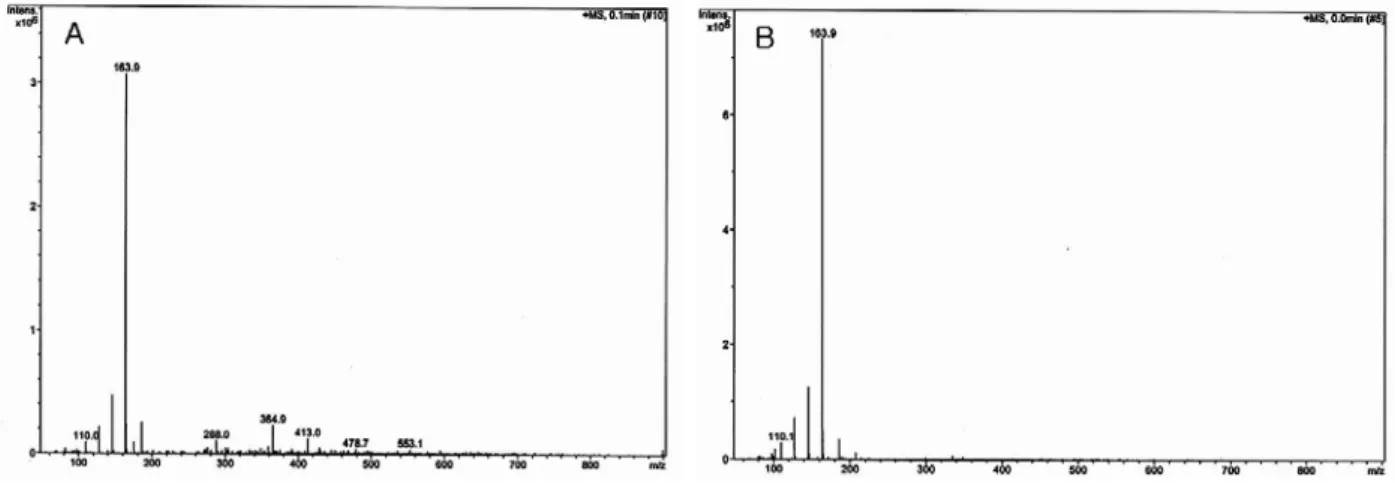
Fig. 1. LC-MS analysis of deoxynojirimycin purified from Bombyx mori L. (A) and B. subtilis S10 (B).
(94%), S6(91%), S9(97%), S10(89%), S16(86%), S17(93%), S18(95%), S19(91%) 등 9개의 균주를 2차로 선발하였다.
이 균주들은 16S rDNA의 염기서열과 NCBI의 Genebank 염기서열 비교를 통해 Bacillus subtilis, Paenibacillus per- oiae, Bacillus fusiformis, Paenibacillus ehimensis, Paenibacillus polymyxa 등의 균과 98%이상의 높은 homol- ogy를 보이는 것으로 나타났다. 그러나 Paenibacillus 속으 로 보이는 S4, S9, S16, S17, S18, S19 등 6개 균주들은 GRAS(General Recognizable As Safe)에 속하지 않는 균으 로서 2차 대사산물의 독성에 의한 안전성 문제로 목적하는 균 선발에서 제외하였다.
따라서 남은 S3, S6, S10 등 3개 균주 배양액을 대상으로 DNJ의 생산 여부를 HPLC 분석을 통해 확인한 결과 DNJ 생산균주는 S3과 S10의 2개 균주로 밝혀졌고 나머지 S6 균 주는 DNJ가 아닌 다른 물질에 의해 α-glucosidase가 저해되 는 것으로 확인되었다. 결국 배양산물의 안전성이 검증되고 α-glucosidase 저해능이 80% 이상이면서 DNJ를 생산하는 균으로는 Bacillus subtilis계의 S3, S10의 2개 균주로 압축 되었다. 이렇게 선발된 2개 균주의 배양액을 농축하고 DNJ 를 분리, 정제하여 HPLC로 DNJ의 함량을 비교한 결과 S10 균이 S3균에 비해 DNJ 생산성이 2배 정도 높은 것으로 나타 났다. 이 S10 균주 배양액으로부터 DNJ를 분리, 정제하여 LC-MS로 분자량을 측정한 결과 농촌진흥청에서 발표한 누 에(Bombyx mori L.) DNJ와 동일한 물질임이 확인됨으로써 우리는 S10 균주를 최종 목적균주로 결정하였다(Fig. 1). 이 렇게 최종 선발된 S10 균주는 16S rDNA 염기서열을 기준으 로 작성한 dendrogram을 통해 Bacillus subtilis subsp. sub- tilis 및 Bacillus subtilis subsp. spizizenii 균주와 매우 가까 운 유전적 유연성을 갖는 균으로 판명되었다(Fig. 2).
DNJ의 대량생산 최적화
DNJ의 대량생산을 위한 S10균 배양의 최적 탄소(C)원을 조사한 결과 galactose 첨가구가 α-glucosidase 저해활성
Fig. 2. Phylogenetic relationships between the selected strain S10 and various types of Bacillus strains.
The neighbour-joining tree was generated on the basis of 16S rDNA sequences. The length of the bar represents 0.01 sub- stitutions per nucleotide position. Bootstrap values (expressed as a percentage of 1,000 replications) that are greater than 50% are shown at branch-points.
(logGIU/mL)이 3.9 unit로 가장 높았으며 이어서 sucrose 3.8 unit, maltose 3.7 unit, corn starch, glucose, xylose, fructose, lactose 등이 3.6 unit의 순으로 나타나 탄소원으로 galactose가 가장 효과적임이 확인되었다(Table 1). 선택된 galactose의 농도(w/v)별 효소 저해활성을 조사한 결과 0.5%에서 4.1 unit, 1.0%에서 4.4 unit, 1.5%와 2.0%에서 각각
Table 1. Effect of different carbon sources on inhibitory ac- tivity against α-glucosidase by the culture broth of Bacillus subtilis S10
Carbon source1) α-Glucosidase inhibitory unit (logGIU/mL)2) Corn starch
Glucose Xylose Maltose Galactose
Sucrose Fructose
Lactose
0.0 3.1 3.4 3.7 3.9 3.8 2.9 3.6
All tests were incubated at 37oC in a rotary shaking incubator operated at 180 rpm for 7 days.
1)The basal medium was consisted of 1% (w/v) yeast extract and various mineral components [0.7% (w/v) K2HPO4, 0.15%
(w/v) KH2PO4, 0.05% (w/v) MgSO4․7H2O, 0.004% (w/v) MnCl2․6H2O, 0.03% (w/v) CaCl2․H2O, 0.00025% (w/v) FeSO4․7H2O]. 2% (w/v) of each carbon source was added into the basal medium.
2)α-Glucosidase inhibitory unit (logGIU/mL) was defined as the amount of culture supernatant which inhibits two glucosi- dase units to the extent of 50%.
Table 2. Effect of various concentrations of galactose on inhibitory activity against α-glucosidase by the culture broth of B. subtilis S10
Galactose1) (%) α-Glucosidase inhibitory unit (logGIU/mL)2) 0.5
1.0 1.5 2.0 2.5
4.1 4.4 4.0 3.9 3.8
All tests were incubated at 37oC in a rotary shaking incubator operated at 180 rpm for 7 days.
1)The basal medium was consisted of 1% (w/v) yeast extract and various mineral components.
2)See Table 1.
4.0 unit과 3.9 unit 그리고 2.5%에서 3.8 unit으로 나타나 galactose의 최적 농도는 1.0%로 결정하였다(Table 2).
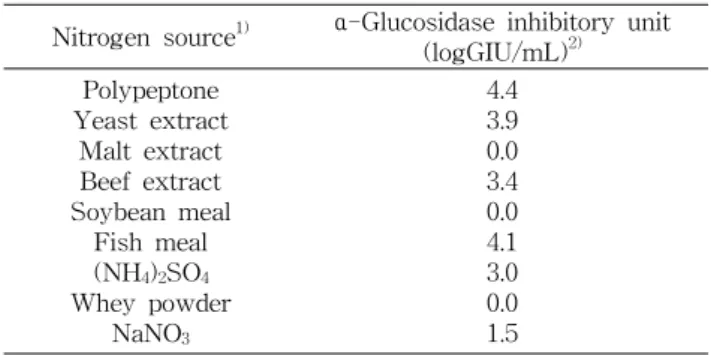
질소(N)원을 달리하는 여러 배양액 가운데 α-glucosi- dase 저해활성은 polypeptone이 4.4 unit로 가장 높았고 이어 서 fish meal 4.1 unit, yeast extract 3.9 unit, 그리고 malt extract, beef extract, soybean meal, (NH4)2SO4, whey powder, NaNO3 등이 3.4 unit 이하의 순으로 나타났다 (Table 3). 가장 높은 효소 저해활성을 보인 polypeptone의 농도 별 효소 저해활성은 1.6%에서의 4.5 unit에 비해 그 밖의 농도에서는 모두 그 이하의 값을 나타냄으로써 S10균 배양액의 최적 질소원은 polypeptone 1.6%로 결정하였다 (Table 4).
인(P)원에 따른 α-glucosidase 저해활성을 조사한 결과 K2HPO4, KH2PO4, (NH4)2PO4, Na2HPO4, phytic acid 등을 첨가한 시험구는 인이 첨가되지 않은 대조구와 거의 같은 효소 저해활성을 나타냄으로써 무기인 성분은 S10균주의
Table 3. Effect of different nitrogen sources on inhibitory activity against α-glucosidase by the culture broth of B.
subtilis S10
Nitrogen source1) α-Glucosidase inhibitory unit (logGIU/mL)2) Polypeptone
Yeast extract Malt extract Beef extract Soybean meal
Fish meal (NH4)2SO4
Whey powder NaNO3
4.4 3.9 0.0 3.4 0.0 4.1 3.0 0.0 1.5
All tests were incubated at 37oC in a rotary shaking incubator operated at 180 rpm for 7 days.
1)The basal medium was consisted of 1% (w/v) galactose and various mineral components. 1% (w/v) of each nitrogen source was added into basal medium.
2)See Table 1.
Table 4. Effect of various concentrations of polypeptone on inhibitory activity against α-glucosidase by the culture broth of B. subtilis S10
Polypeptone1) (%) α-Glucosidase inhibitory unit (logGIU/mL)2) 0.0
0.4 0.8 1.2 1.6 2.0
0.0 2.4 4.2 4.4 4.5 4.3
All tests were incubated at 37oC in a rotary shaking incubator operated at 180 rpm for 7 days.
1)The basal medium was consisted of 1% (w/v) galactose and various mineral components.
2)See Table 1.
α-glucosidase 저해물질 생산에 별다른 영향을 미치지 않는 것으로 확인되었다(data not shown).
S10균주의 배양특성 및 DNJ 생산성
위에서 확립된 최적화 배지에서의 DNJ 생산량 및 배양특 성을 조사하기 위해 S10균주 배양액으로부터 일정량 시료 를 채취하여 생균수, α-glucosidase의 저해도, 잔여당량, 질 소량 등의 변화를 조사하였다(Fig. 3). 생균수는 접종 후 24 시간까지 급격히 증가하였으며 24시간 이후 균수의 큰 변화 를 보이지 않았다. α-Glucosidase 저해활성은 12시간까지 3.7 unit으로 급증한 후 24시간에 4.6 unit까지 소폭 증가하였 으며 이후 같은 수준의 저해활성을 유지하였다. 잔여당량은 배양 초기 1.8%에서 이후 배양의 진행과 함께 감소를 나타 내 48시간에는 0.53%까지 감소하였으며 총질소량 역시 배 양시간의 경과와 함께 꾸준한 감소 경향을 나타냈다(data not shown).
다음, S10균주의 DNJ 생산성에 대해 조사하였다. S10 균 주 배양액내의 DNJ 함량을 HPLC로 측정한 결과 배양 48시 간대에서 가장 많은 0.75 g/L의 DNJ를 얻었으며 이러한
0 1 2 3 4 5 6
0 12 24 36 48 60 72
Culture time (hrs)
0 1 2 3 4 5 6 7 8 9 10 11
α-Glucosidase inhibition unit (logGIU/mL) Cell growth (CFU/mL)
Fig. 3. Time course of α-glucosidase inhibitory unit (logGIU/
mL) (●) and cell growth of B. subtilis S10 (▲).
DNJ 생산성은 배양 60시간과 72시간대에서도 거의 같았다 (data not shown). 이러한 결과는 방선균 Streptomyces sp.
SID9135의 5일 동안 배양을 통해 0.64 g/L의 DNJ를 얻은 Paek 등(18)의 결과와 비교할 때 S10균주가 2일간이라는 짧 은 배양기간에도 불구하고 17.2% 더 높은 DNJ 생산성을 보 이고 있음을 말해주고 있다.
In vivo 혈당강하 효과
S10균주 배양액의 혈당강하 효과를 확인하기 위하여 신 생쥐에 streptozotocin을 처리하여 고혈당 마우스를 유도하 고 시중에서 혈당강하제로 판매되고 있는 acarbose, 누에 건조분말, S10균주 배양액을 투여한 후 처리구간의 혈당치 를 비교하였다(Fig. 4). 7주에 걸친 혈당조사 결과, 먼저 무처 리군은 이미 1주째에 380.1±79.8 mg/dL의 높은 혈당치를 시작으로 이후 계속 혈당상승이 지속되어 마지막 7주째에는 510±110.9 mg/dL의 고혈당 증세를 나타냈다.
이에 비해 혈당강하제 acarbose는 무처리군과 달리 1주째 부터 혈당치의 감소를 나타내기 시작하여 2주 이후 거의 정 상에 가까운 혈당을 유지하였으며 혈당 측정 마지막 7주째 의 혈당치는 139.4±33.1 mg/dL로서 무처리군에 비해 72.7%의 혈당 억제율을 나타냈다. 누에분말 처리구는 1주째 에 acarbose보다는 혈당치가 높았지만 무처리군에 비해 150 mg/dL 적은 200 mg/dL을 약간 상회하는 혈당을 보였으며 이후 같은 수준의 혈당을 유지하였다. 마지막 7주째에 측정 한 혈당치는 209.1±19.6 mg/dL로서 59.0%의 혈당 억제율 을 나타냈는데 이상의 결과는 acarbose와 누에분말이 혈당 강하에 효과적이라는 Kim 등(22), Kim 등(23), Lee 등(24)의 보고와 일치하고 있다. 한편, S10균주 배양액 처리구는 전 시험기간을 통해 누에분말 처리구와 유사한 혈당량 변화 패 턴을 보였으며 7주째에 측정한 혈당치는 208.6±39.8 mg/dL 로서 무처리군에 비해 59.1%의 혈당 억제율을 나타냈다. 즉, S10균주 배양액 역시 acarbose의 혈당강하 효과에는 미치지 못하였지만 누에분말과 같은 수준의 고혈당의 억제 및 완화
0 100 200 300 400 500 600
0 1 2 3 4 5 6 7
Week Blood glucose (mL/dL) Control
Acarbose Silkworm S10
Fig. 4. Effect of the culture broth of B. subtilis S10 on blood glucose levels in STZ-induced diabetic mice.
Control-saline (●), acarbose (○), silkworm powder (▲), con- centrated culture broth of B. subtilis S10 (△).
효과가 있음이 확인되었다. 이러한 혈당강하 효과는 S10 균 주가 생산하는 DNJ 성분이 마우스 소장 내벽 융모막에 존재 하는 α-glucosidase 활성을 억제함으로써 소장 안으로의 포 도당 흡수의 지연에 따른 결과로 해석된다(11).
요 약
본 연구는 α-glucosidase의 강력한 효소저해제인 1-de- oxynojirimycin(DNJ)을 고효율로 생산하는 균주의 선발 및 동정, 배양최적화 및 균 배양액의 혈당강하효과 등에 관하여 조사하였다. 먼저 토양으로부터 α-glucosidase에 대해 강력 한 저해능을 나타내는 9균주를 대상으로 이 중에서 DNJ 생 산성이 가장 우수한 한 개 균주를 최종 선발하였고, 이 균주 를 16S rDNA 염기서열분석으로 균주동정을 하여 Bacillus subtilis S10이라 명명하였다. 본 균주의 배양액을 이온교환 수지법(Amberlyst 15 H+ form, Dowex 1×2-100 OH- form, Amberlite CG-50 NH3+
form)에 의해 DNJ를 정제하고, 정 제된 DNJ를 LC-MS로 분석한 결과 표준 DNJ와 동일한 물 질임을 확인하였다. DNJ 대량생산을 위한 S10균주의 배양 최적탄소원 및 최적질소원과 이들의 최적농도를 조사한 결 과 각각 1% galactose, 1.6% polypeptone임이 밝혀졌으며, 확립된 최적화 조건에서의 DNJ 생산량은 0.75 g/L이었다.
고혈당 유도 마우스를 대상으로 각종 혈당강하제의 효과를 알아보기 위해 혈당치를 비교한 결과 무처리구의 혈당치 510±10.9 mg/dL에 비해 acarbose 처리구는 139.4±33.1 mg/dL, 누에분말 처리구는 209.1±19.6 mg/dL, 그리고 S10 균주 배양액 처리구는 208.6±39.8 mg/dL로써 무처리구에 비해 각각 72.7%, 59.0%, 그리고 59.1%의 혈당 억제율을 나 타냈다. 이상의 연구결과 S10균주 배양액은 누에분말과 같 은 수준의 고혈당 억제 및 완화효과가 있음이 확인되었으며 향후 S10균주의 대량생산을 통해 식후혈당조절을 위한 건 강기능식품 개발이 기대된다 하겠다.
문 헌
1. Schmidt DD, Frommer W, Müller L, Truscheit E. 1979.
Glucosidase-inhibitoren aus Bazillen. Naturwissenshaften 66: 584-585.
2. Yagi M, Kouno T, Aoyagi Y, Murai H. 1976. The structure of moranoline a piperidine alkaloid from Morus species.
Nippon Nogeikagaku Kaish 50: 571-572.
3. Bischoff H. 1995. The mechanism of α-glucosidase in- hibition in the management of diabetes. Chin Invest Med 18: 303-311.
4. Lembcke B, Folsch UR, Creutzfeldt W. 1985. Effect of 1-deoxynojirimycin derivatives on small intestinal dis- accharidase activities and on active transport in vitro.
Digestion 31: 120-127.
5. Asano N, Nash RJ, Molyneux RJ, George WJ. 2000.
Sugar-mimic glycosidase inhibitors: natural occurrence, biological activity and prospects for therapeutic application.
Tetrahedron: Asymmetry 11: 1645-1680.
6. Breitmeier D, Gunther S, Heymann H. 1997. Acarbose and 1-deoxynojirimycin inhibit maltose and maltooligo- saccharide hydrolysis of human small intestinal glucoamy- lase-maltase in two different substrate-induced modes.
Arch Biochem Biophys 346: 7-14.
7. Park SW, Song YD, Lee EJ, Lim SK, Kim KR, Lee HC, Huh KB, Chung YS. 1994. Effect of acarbose in NIDDM insufficiently treated with diet alone. Korean Diabetes J 18: 263-269.
8. Watanabe K, Uchino H, Ohmura C, Tanaka Y, Onuma T, Kawamori R. 2004. Different effects of two α-glucosidase inhibitors, acarbose and voglibose, on serum 1,5-anhy- droglucitol (1,5AG) level. J Diabetes Complications 18:
183-186.
9. Asano N, Kato A, Kizu H, Matsui KM, Watson A, Nash RJ. 1996. Calystegine B4, a novel trehalase inhibitor from Scopolia japonica. Carbohydr Res 293: 195-382.
10. Aasno N, Yamashita T, Yasuda K, Ikeda K. 2001.
Polyhydroxylated alkaloids isolated from mulberry trees (Morus alba L.) and silkworms (Bombyx mori L.). J Agric Food Chem 49: 4208-4213.
11. Aasno N, Nishida M, Miyauchi M, Ikeda K. 2000.
Polyhydroxylated pyrrolidine and piperidine alkaloids from Adenophora triphylla var. japonica (Campanulaceae).
Phytochemistry 53: 397-382.
12. Evans SV, Fellow LE, Shing TKM, Fleet GWJ. 1985.
Glycosidase inhibition by plant alkaloids which are struc-
tural analogues of monosaccharides. Phytochemistry 24:
1953-1955.
13. Murao S, Miyata S. 1980. Isolation and characterization of a new trehalase inhibitor, S-GI. Agric Biol Chem 44:
219-221.
14. Yamada H, Oya I, Nagai T. 1993. Screening of α-glucosi- dase Ⅱ inhibitor from Chinese herbs and its application on the quality control of mulberry bark. Shoyakugaku Zasshi 47: 47-55.
15. Ezure Y, Maruo S, Miyazaki K, Kawamata M. 1985.
Moranoline (1-deoxynojirimycin) fermentation and its im- provement. Agric Biol chem 49: 1119-1125.
16. Hardick DJ, Hutchinson DW, Trew SJ, Wellington EMH.
1992. Glucose is a precursor of 1-deoxynojirimycin and 1-deoxymannonojirimycin in Streptomyces subrutilus.
Tetrahedron 48: 6285-6296.
17. Hardick DJ, Hutchinson DW. 1993. The biosynthesis of 1-deoxynojirimycin in Bacillus subtilis var niger. Bio- chemistry 49: 6707-6716.
18. Paek NS, Kang DS, Choi YJ, Lee JJ, Kim TH, Kim KW.
1997. Production of 1-deoxynojirimycin by Streptomyces sp. SID9135. J Microbiol Biochnol 7: 262-266.
19. Scofield AM, Fellow LE, Nash RJ, Fleet GWJ. 1986.
Inhibition of mammalian digestive disaccharidases by poly- hydroxy alkaloids. Life Sci 39: 29-32.
20. Werner F, Lutz M, Delf S, Krause HP. 1981. Inhibitors, ob- tained from bacilli, for glycoside hydrolases. US Patent 4307194.
21. Kim JW, Kim SU, Lee HS. 2003. Determination of 1-deoxy- nojirimycin in Morus alba L. leaves by derivatization with 9-fluorenylmethyl chloroformate followed by reversed- phase high-performance liquid chromatography. Chroma- tography 1002: 93-99.
22. Kim MS, Choue RW, Chung SH, Koo SJ. 1998. Blood glu- cose lowering effects of mulberry leaves and silkworm ex- tracts on mice fed with high-carbohydrate diet. Korean J Nutrition 31: 117-125.
23. Kim SH, Kim KS, Lee JH, Chung EK, Park YS, Park YJ, Lee HY. 1997. Comparison of glucose-lowering activity of the extracts from Kangwon-do mountain mulberry leaves (Mori Folium) and silk worm. Kor J Appl Microbiol Biotechnol 25: 391-395.
24. Lee HS, Chung KS, Kim SY, Ryu KS, Lee WC. 1998. Effect of several sericultural products on blood glucose lowering for alloxan-induced hyperglycemic mice. Korean J Seric Sci 40: 38-42.
(2008년 1월 30일 접수; 2008년 10월 9일 채택)