This is an Open Access article distributed under the terms of the Creative Commons Attribution Non-Commercial License (http: //creativecommons.org/licenses/by- nc/4.0/) which permits unrestricted non-commercial use, distribution, and reproduction in any medium, Copyright: © 2020 Korean Journal of Agrcultural Science
ANIMAL
Comparative evaluation of nutritional values in different forage sources using in vitro and in vivo rumen fermentation in Hanwoo cattle
Hu Seong Lee
1, Sung Dae Lee
2, Seul Lee
2, Sangsoo Sun
1, Minseok Kim
1, Hyuck Choi
3, Yookyung Lee
2, Youl-Chang Baek
2,*1
Department of Animal Science, Chonnam National University, Gwangju 61186, Korea
2
Animal Nutrition and Physiology Team, National Institute of Animal Science, Wanju 55365, Korea
3
Department of Pet Science, Seojeong College, Yangju 11429, Korea
*
Corresponding author: [email protected]
Abstract
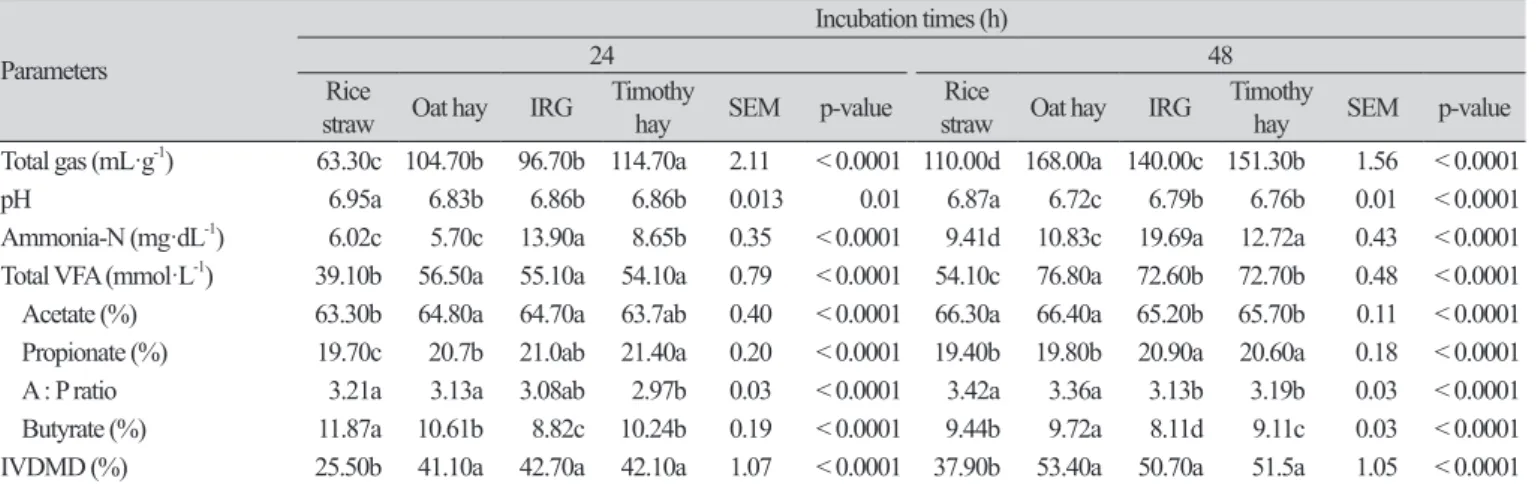
This study evaluated the nutritional value of Italian ryegrass (IRG) as a forage source for Hanwoo. The nutritional value of IRG was assessed and compared to that of rice straw, oat hay, and timothy hay using two different methods: 1) in vitro ruminal fermentation 2) in vivo total tract digestibility. In vitro DM digestibility was lower in rice straw compared to the other three forage sources after both 24 and 48 h of incubation (p < 0.01). Among the four forage sources, IRG had a higher NH
3-N concentration after both 24 and 48 h of incubation (p <
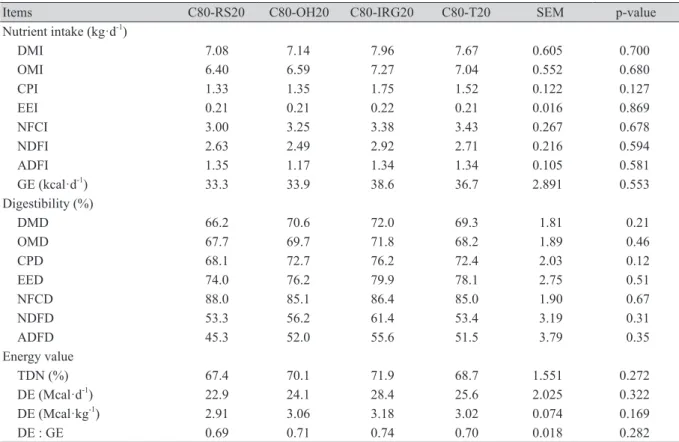
0.01). In the in vivo digestibility trials, four different substrates were used: 1) 80% concentrate with 20% rice straw, 2) 80% concentrate with 20% oat hay, 3) 80% concentrate with 20%
IRG, and 4) 80% concentrate with 20% timothy hay. The dry matter, crude protein, non-fiber carbohydrate, and detergent fiber digestibility were the greatest in the C80-IRG20 among the four forage groups. In summary, IRG had a similar level of energy efficiency compared to oat hay and timothy hay. Furthermore, the result of the chemical composition analysis showing a higher ammonia concentration in the in vitro fermentation experiment and the high protein digestibility in the in vivo experiment indicate that IRG is a good source of protein compared to oat hay and timothy hay.
Keywords: feed-value evaluation, forage, Hanwoo, In vitro rumen fermentation, In vivo digestibility
Introduction
The livestock industry in Korea, which relies mostly on imported feed resources, is facing many problems. These include increases in production costs arising from rapidly changing international grain prices and logistics costs. Research on domestic forage is also important for the health of ruminants. Forage is an important factor in the development of the rumen and the healthy growth of ruminants (Cho et al., 1997).
OPEN ACCESS
Accepted: October 28, 2020 Revised: October 23, 2020 Received: September 12, 2020 Citation: Lee HS, Lee SD, Lee S, Sun S, Kim M, Choi H, Lee Y, Baek YC. 2020.
Comparative evaluation of nutritional values in different forage sources using in vitro and in vivo rumen fermentation in Hanwoo cattle. Korean Journal of Agricultural Science 47:941-949. https://
doi.org/10.7744/kjoas.20200078
High quality forage involves a high concentration feed to forage ratio and is needed to maintain the physiology of Hanwoo cattle (Hanwoo) ruminants. Hanwoo farmers still primarily use concentrate feed, with rice straw as the forage. However, rice straw is a low-quality feed that may lack some specific nutrients (Seo et al., 2005).
Oat hay and timothy hay are commonly used imported forages in Korea. Farmers have a tendency to believe that domestic forages are not as good as those that are imported, which is not always the case (Lee and Lee, 2000). Moreover, good quality domestic forages can benefit Hanwoo production in ways that imported forages cannot, such as reducing production costs and adverse environmental impacts (Sung et al., 2010).
Interest in domestic forages such as Italian ryegrass, whole-crop barely, whole-crop rice, and oat hay has increased in recent years. Italian ryegrass could be grown domestically and could replace imported forages. It grows well in wet ground, such as drained paddy fields in winter, and is widely used as a second crop after the summer harvest, making it very suitable for growth in Korea (Kim et al., 1998; Kim and Cho, 2018). Italian ryegrass is used in a variety of ways �e.g., as hay, silage, and grazing �because of the total volume of dry matter (DM) production per area and its high total digestible nutrients (Kim et al., 2001). In addition, Italian ryegrass has good palatability and its high sugar content (15.15% DM) makes it suitable for high-quality silage production. A previous comparison between Italian ryegrass and rice straw found that the former has a higher average daily growth rate, Rate of appearance 1 quality grade in beef, and marbling score (Kim et al., 2018).
Although the TDN, crude protein (CP), neutral detergent fiber (NDF), and acid detergent fiber (ADF) of IRG have been analyzed, there is still a lack of information regarding the feed values of domestic IRG in Korea. Furthermore, one of the problems of using IRG is that there is no nutri tional information on domestic IRG forages.
Evaluating the nutritional value of feed resources is very important for both animal nutrition and economic considerations.
However, to the best of our knowledge, no study has collectively examined the efficacy of IRG, rice straw, oat hay, and timothy hay on feed quality, ruminal fermentation, and digestibility in Hanwoo. In this study, a comparative analysis of the energetic value of IRG was conducted in vitro and in vivo along with the chemical analyses of three commonly used forages (rice straw, oat hay, and timothy hay) in Korea.
Materials and Methods
The protocols used for the animal experimental procedures were reviewed and approved by the Institutional Animal Care and Use Committee of the National Institute of Animal Science (No. 2018-301).
Chemical analysis
IRG, rice straw, oat hay, and timothy hay were used for chemical analysis. Before nutrient analysis, all the samples were dried at 60 ℃ for 48 h and ground in a cyclone mill (Foss, Hillerød, Denmark) fitted with a 1-mm screen. Dry matter (DM;
930.15), acid detergent fiber (ADF; 973.18), ash (942.05), and ether extract (EE; 2003.05) was determined as described by
the AOAC (2016). Neutral detergent fiber was analyzed using a heat-stable amylase and was expressed inclusive of residual
ash (aNDF) as described by Van Soest (1991). Crude protein was calculated as 6.25 times nitrogen content, and total nitrogen
was measured using the Dumas combustion method, using an elemental combustor (Vario Max Cube, Elementar Gmbh,
Frankfurt, Germany). The acid detergent-insoluble crude protein (ADICP) and neutral detergent-insoluble crude protein
(NDICP) levels in each sample were also determined as described by Licitra et al. (1996). Non-fiber carbohydrates (NFC) were calculated as 100 – ash – EE – CP – (aNDF – NDICP) based on the guidelines of NRC (2001). Mineral contents were determined using appropriate AOAC methods (Horwitz, 2000).
In vitro rumen fermentation
Rumen fluid was used for in vitro experiments in Hanwoo, which was collected one hour before the morning feed using the stomach tubing method. Rumen pH was measured immediately, using a portable pH meter (Mettler-Toledo AG, Schwerzenbach, Switzerland). After collection, the fluid was filtered through four layers of cheesecloth. The rumen fluid was mixed with McDougall ’s buffer solution (McDougall, 1948) in a 1 : 4 ratio under anaerobic conditions (Lima et al., 2010) and flushed with O
2-free CO
2for 20 min. Next, 50 mL of rumen inoculum was dispensed into each 125-mL serum bottle containing 0.5 g of the sample substrate. To maintain anaerobic conditions in the serum bottles, O
2-free CO
2was injected every 10 sec. The bottles were then sealed with a butyl rubber stopper and aluminum seal and incubated at 39 ℃ for 24 and 48 h in a shaking incubator at 120 rpm.
After each incubation time point (24 h and 48 h), the serum bottles were removed from the incubator and immediately stored in an ice bucket to prevent further fermentation due to residual heat. After the upper part of the aluminum seal was removed, total gas production was measured by pricking the butyl rubber stopper using a glass syringe (TRUTH 100 mL; Top Syringe Mfg. Co. Pvt. Ltd., Mumbai, India). The rumen inoculum was transferred into a 50-mL conical tube and centrifuged at 6,000 × g for 15 min at 20℃. After centrifugation, the pH was measured using a pH meter (Mettler- Toledo AG, Schwerzenbach, Switzerland). The supernatant was used for the analysis of volatile fatty acids (VFAs) and the concentration of ammonia nitrogen (NH
3-N). The remaining digestion residue was used to calculate in vitro dry matter digestibility (DMD).
The feed residues left in the 50-mL conical tubes and 125-mL serum bottle were washed with distilled water, and collected on a 125-mm diameter Whatman filter paper. The liquid part was removed using a vacuum pump, and solid part was used for the dry matter digestion calculation after drying. Filter papers containing the residues were dried at 105 ℃ for 48 h, and the amount of residue was measured.
The rumen inoculum samples were stored in a deep freezer at - 80 ℃ until VFA and NH
3-N analyses. After being thawed, 10 mL of sample was mixed with 1 mL of 2% HgCl
2(wt·vol
-1) solution and briefly centrifuged at 2,000 × g for 10 min
at 4 ℃ to remove the feed particles. NH
3-N concentration was determined using a Multiplate spectrophotometer (Bio-Rad, Benchmark Plus
TM, Tokyo, Japan) at 630 nm (Chaney and Marbach, 1962). VFA concentration was determined using gas chromatography (Varian CP-3800; Varian, Walnut, Creek, CA, USA) as described by Erwin et al (Erwin et al., 1961),
In vivo apparent digestibility
Four Hanwoo steers (32 months old, 562 ± 91 kg initial body weight [BW]) were used for in vivo studies. Each animal
was housed in a metabolic cage (127 cm width × 250 cm depth × 200 cm height) individually to collect remaining feed
and excretions. The animals were fed twice a day (09:00 and 16:00) and given free access to water. According to the Korean
Feeding Standard for Hanwoo, experimental diets based on 1.5% BW (DM basis) were supplied by separate feeding, and
concentrate mix:forage ratio in the feed was 80:20. All excretions were collected for the measurement of total digestible
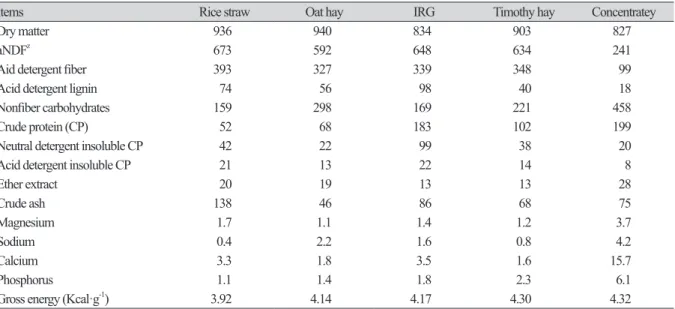
Table 1. Chemical composition of four forage sources and concentrate (g·kg
-1dry matter or as stated).
Items Rice straw Oat hay IRG Timothy hay Concentratey
Dry matter 936 940 834 903 827
aNDF
z673 592 648 634 241
Aid detergent fiber 393 327 339 348 99
Acid detergent lignin 74 56 98 40 18
Nonfiber carbohydrates 159 298 169 221 458
Crude protein (CP) 52 68 183 102 199
Neutral detergent insoluble CP 42 22 99 38 20
Acid detergent insoluble CP 21 13 22 14 8
Ether extract 20 19 13 13 28
Crude ash 138 46 86 68 75
Magnesium 1.7 1.1 1.4 1.2 3.7
Sodium 0.4 2.2 1.6 0.8 4.2
Calcium 3.3 1.8 3.5 1.6 15.7
Phosphorus 1.1 1.4 1.8 2.3 6.1
Gross energy (Kcal·g
-1) 3.92 4.14 4.17 4.30 4.32
IRG, Italian ryegrass.
y
Ground corn, 40.2%; Corn gluten feed, 21.2%; Wheat bran, 13.1%; Coconut meal, 4.1%; Rapeseed meal, 4.2%; Palm-kernel meal, 4.2%;
Soybean meal, 9.8%; Limestone, 1.9%; Salt, 0.5%; Sodium bicarbonate, 0.5%; Vitamin-mineral mix, 0.3% (Vit. A, 2,650,000 IU; Vit. D3, 530,000 IU; Vit E, 1,050 IU; Niacin, 10,000 mg; Mn, 4,400 mg; Fe, 13,200 mg; I, 440 mg; Co, 440 mg).
z