두릅 순에서 분리된 화합물의 항산화 활성
이기호1, 정지욱2, 안은미1*1)
1: 대구한의대학교 한방식품약리학과 2: 대구한의대학교 한약재약리학과
Antioxidant Activity of Isolated Compounds from the Shoot of Aralia elata Seem
Gi Ho Lee1, Ji Wook Jung2, Eun MI Ahn1*
1: Department of Herbal Foodceutical Science, Daegu Haany University 2: Department of Herbal Medicinal Pharmacology, Daegu Haany University.
ABSTRACT
Objectives : This study was performed to investigate the antioxidant activities of isolated compounds from the shoot of Aralia elata.
Methods : The methanol extract from the shoot of Aralia elata was fractionated into ethyl acetate, n-BuOH and H2O layers through solvent fractionation. Repeated silica gel, ODS column chromatography of n-BuOH layer afforded four flavonol glycosides. Their antioxidant activity was determined by measuring free radical scavenging activity by DPPH, ABTS and superoxide dismutase (SOD) like activity assay.
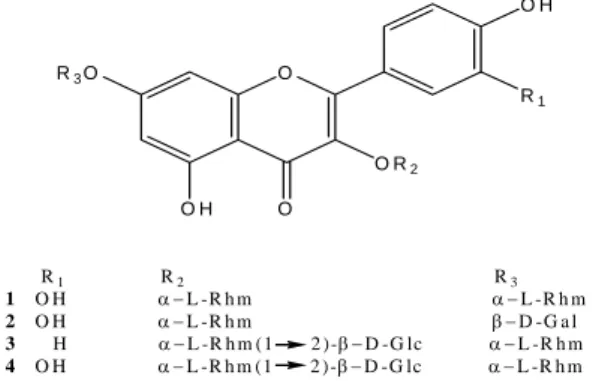
Results : They were identified as quercetin 3,7-di-O-α-rhamnopyranoside (1), quercetin 3-O-β- D-galactoside-7-O-α-L-rhamnoside (2), kaempferol 3-O-β-glucosyl(1→2)-α-rhamnoside-7-O-α- rhamnoside (3) and quercetin 3-O-β-glucosyl(1→2)-α-rhamnoside-7-O-α-rhamnoside (4) on the basis of spectroscopic data. The result showed that 1 is the most active compound in the DPPH and ABTS radical scavenging test.
Conclusions : Isolated Compounds from the shoot of Aralia elata showed anti-oxidative effect.
Key words : Aralia elata, antioxidant activity, flavonol glycosides
서 론
最近 食生活 變化에 따른 癌, 腦疾患, 高血壓 및 糖尿 病 등 만성적인 生活 習慣病이 증가하고, 生體 防禦, 疾 病의 예방 및 老化방지 등 健康機能性에 관한 관심이 증 가하고 있다1). 이러한 疾病과 老化는 代謝 과정 중에 생 성되는 活性산소와 過酸化脂質 등 산화반응에 기인하는 것으로 알져지면서 天然物 유래의 抗酸化物質 開發에 관 한 硏究가 活潑히 진행되고 있다2-4). 最近에는 각종 生藥, 食用植物 抽出物 등에서 보다 안전하고 抗酸化 效果가 뛰어난 天然 抗酸化劑를 開發하기 위한 많은 硏究가 활 발히 이루어지고 있으며, 특히 植物줄기의 抗酸化 活性을 가지는 生理活性 物質을 잎, 꽃, 열매, 줄기 등 식물 전체
부분에 대한 연구가 이루어지고 있다5). 지금까지 天然 抗 酸化劑로 硏究 開發된 것들로는 phenolic compounds, flavonoids, carotenoids 등의 식물화합물이 주류를 이루 고 있다5-7).
두릅나무(Aralia elata Seem)는 두릅나무과(Araliaceae)에 속하는 낙엽관목으로 전국 산지에 자생하며 예로부터 民 間과 韓方에서 糖尿病, 腎臟病, 급만성 肝炎, 胃腸疾患 개선 과 强壯劑로 이용되어져 왔으며8,9) 性味는 맛은 매우며 性 質은 평하고 약간의 독이 있다. 氣를 보하고 정신을 안정시 키며 精을 강하게 하고 풍을 제거하며 血液 循環을 促進시 키는 效能이 있다. 두릅은 또 신경쇠약, 류머티스성 關節炎, 糖尿病 등을 치료한다고 알려져 있다. 민간에서는 4월에 새 순을 채취하여 나물로 식용하며 오가피(Acanthopanax
* 교신저자 : 안은미, 경북 경산시 유곡동 290번지 대구한의대학교 한방식품약리학과
․ Tel : 053-819-1462 ․ E-mail : [email protected]
․ 접수:2009년 11월 22일 ․ 수정:2009년 12월 11일 ․ 채택:2009년 12월 21일
sessiliflorus), 인삼(Panax ginseng), 음나무(Kalopanax pictus var. magnificus) 등과 같이 두릅나무에 속하는 藥用植物로 주로 藥材로서 사용되고 있으며10,11) 주요 藥理成分으로 triterpenoid saponin, 3,4-dihydroxybenzoic acid, araloside 등 다수의 化合物이 보고된 바 있다12-15). 어린잎과 줄기는 특유의 향과 약간 쓴 맛이 있어 嗜好食品으로 각광받고 있 는 가운데 食用 가능한 野生植物들의 새로운 食品學的 가치 가 인정되면서 농가소득 增大를 위한 代替 作物로 생산량이 점차 증가 추세에 있는 실정이다.
두릅에는 polyphenol 등 다양한 화합물이 많이 함유되 어 있어 두릅 순 및 잎 추출물의 抗酸化 效果에 관한 硏 究가 진행된바 있으나16) 두릅나무 순에서 분리된 生理活 性 物質의 抗酸化 效果에 대한 硏究가 거의 없는 실정으 로 본 硏究에서는 두릅나무 순에서 식물 화학적 성분 연 구 결과로 4종의 flavonol glycoside를 분리하였으며 이들 화합물은 두릅 순에서 처음 분리된 것이다. 이 化合物들 에 대하여 DPPH, ABTS및 SOD를 이용하여 抗酸化 活 性을 검토하였다.
재료 및 방법
1. 시료
두릅 순은 제주도 지역의 재배 두릅을 제주도의 시장 에서 구입하여 제주대학교 생물학과 김문홍 교수가 동정 하여 사용하였으며, 표품은 대구한의대학교 한방식품약리 학과 실험실에 보관하였다.
2. 시약 및 기기
시료의 추출과 분획에 사용한 유기 용매는 대정화학주 식회사에서 생산한 1급 시약을 사용하였다. Column chromatography용 silica gel은 Kiesel gel 60 (Merck, Germany)을, octadecylsilica gel (ODS)은 LiChroprep RP-18 (Merck, Germany)을 사용하였다. TLC는 Kieselgel 60 F254와 RP-18 F254s를 사용하였고, TLC상의 물질 검출 에는 UV lamp와 10% aq. H2SO4를 사용하였다. NMR 스펙트럼은 Varian Inova AS 400 (Varian, USA)으로 측 정하였다.
3. 추출 및 분획
잘 건조된 두릅 3kg을 분쇄기로 분쇄한 후 80%
methanol (MeOH) 수용액(10 l)에 12시간 담가서 실온에서 추출하였다. 추출물을 여과하고 남은 것은 동일한 방법으로 1회 더 반복 추출하였다. 얻어진 여액은 모두 합쳐 40도 이 하에서 감압 농축하여 MeOH 추출물을 얻었다. MeOH 추 출물을 ethyl acetate (EtOAc, 1.5 l × 2)와 물(1.5 l)로 분배 추출하고, 다시 물층은 n-butanol (n-BuOH, 1l × 2)로 분
배 추출하였다. 얻어진 각층을 감압 농축하여 EtOAc 가 용분획(2.7g), n-BuOH (46.2g) 및 물분획을 얻었다.
4. 화합물의 분리
n-BuOH 분획 46 g을 silica gel column chromatography (CHCl3: MeOH : H2O = 7 : 3 : 1→ 6 : 4 : 1)를 실시하 여 7개의 분획물(AEB1~AEB7)을 얻었다. AEB5 (5.7 g) 분획에 대하여 CHCl3: MeOH : H2O (7 : 3 : 1→ 65 : 35 : 10)로 silica gel column chromatography (c.c)를 실 시하여 5개의 소분획(AEB5-1~AEB5-5)으로 나누고 그 중 AEB5-3을 ODS c.c (H2O: MeOH = 6 : 4)를 이용하 여 화합물 1 (109mg)을 분리하였다. 분획 AEB6 (14.14g) 분획에 대하여 CHCl3: MeOH: H2O (7 : 3 : 1→ 65 : 35 : 10)을 기울기용리 방식으로 silica gel c.c를 실시하여 5개 의 소분획물(AEB6-1~AEB6-5)을 얻었다. 소분획 AEB6-3 (6.72g)에 대하여 CHCl3: MeOH : H2O (7 : 3 : 1→ 65 : 35 : 10)의 용매로 silica gel c.c를 실시하여 소분획 (AEB6-3-1~AEB6-3-5)을 얻었다. 이 중 AEB6-3-2(3.45g) 에 대하여 ODS c.c (H2O : MeOH = 6 : 4)의 용매를 이 용하여 화합물 2 (47.8mg )와 화합물 3 (60mg)을 분리하 였고 AEB6-3-4(350mg)에 대하여 ODS c.c (H2O : MeOH = 6 : 4)을 이용하여 화합물 4 (22mg)를 분리하 였다.
Aralia elata (3 kg)
EtOAc/ H2O
EtOAc fr. (27g) H2O fr.
n-BuOH (46.2g) H2O fr.
SiO2 c.c.
CHCl3: MeOH: H2O =7:3:1-65:35-10:6:4:1
AEB1 2 3 4 5 6 7
AEB5-1 5-2 5-3 5-4 5- 5 SiO2 c.c
CHCl3: MeOH: H2O 7:3:1-65:35:10
com. 1 (193 mg ) AEB-6-1 -2 -3 -4 -5
YJB-6-3-1 -2 -3 -4 -5
com. 2 (47.8 mg) com. 3 (60 mg) ODS
H2O:MeOH=6:4
SiO2 c.c CHCl3: MeOH: H2O 7:3:1-65:35:10 80% aq. MeOH
MeOH ext.
n-BuOH/H2O
SiO2 c.c CHCl3: MeOH: H2O 7:3:1-65:35:10
com. 4 (22 mg) ODS
H2O:MeOH=6:4
ODS H2O:MeOH=6:4
Fig. 1. Isolation procedure of flavonol glycosides from the shoot of Aralia elata Seem
화합물 1 (Quercetin 3,7-di-O-α-rhamnopyranoside) yellow amorphous powder(MeOH); 1H-NMR (400MH, CD3OD, δH): 7.30 (s, H-2'), 7.24 (d, J=7.6 Hz, H-6'), 6.85 (d, J=7.6 Hz, H-5'), 6.60 (br. s, H-8), 6.36 (br. s, H-6), 5.51 (br s. H-1'''), 5.32 (br. s, H-1''), 4.21∼3.31 (8H, m, sugar moieties), 1.22 (d, J=6.0 Hz, H-6''), 0.91 (d, J=6.0 Hz, H-6'''). 13C-NMR (100MHz, CD3OD, δC):
179.41 (C-4), 163.19 (C-7), 162.64 (C-5), 159.49 (C-2), 157.68 (C-10), 149.86 (C-4'), 146.22 (C-3'), 136.28 (C-3), 122.89 (C-1'), 122.47 (C-6'), 116.83 (C-2'), 116.30 (C-5'), 100.38 (C-6), 103.37 (C-1''), 99.68 (C-1'''), 95.42 (C-8), 73.54 (C-4'''), 73.19 (C-4''), 71.99 (C-3''), 71.99 (C-5''), 71.99 (C-3'''), 71.82 (C-2''), 71.60 (C-2'''), 71.16 (C-5'''), 18.13 (C-6'''), 17.70 (C-6'').
화합물 2 (Quercetin 3-O-β-D-galactoside-7-O-α- L-rhamnoside) yellow amorphous powder(MeOH); 1H- NMR (400Mz, CD3OD, δH): 7.83 (s, H-2'), 7.56 (d, J=8.4 Hz, H-6'), 6.84 (d, J=8.4 Hz, H-5'), 6.69 (br s, H-8), 6.40 (br s, H-6), 5.55 (br s, H-1'''), 5.18 (d, J=7.6 Hz, H-1''), 4.03 (br s, H-2'''), 3.86∼3.43 (m, sugar moieties), 1.23 (d, J=6.0Hz, H-6'''). 13C-NMR (100MHz, CD3OD, δC): 179.46 (C-4), 163.39 (C-7), 162.47 (C-5), 159.04 (C-2), 157.68 (C-9), 149.99 (C-4'), 145.63 (C-3'), 135.80 (C-3), 122.99 (C-6'), 122.50 (C-1'), 117.65 (C-2'), 116.30 (C-5'), 107.14 (C-10), 104.98 (C-1''), 100.51 (C-6), 99.74 (C-1'''), 95.41 (C-8), 77.12 (C-5''), 74.96 (C-3''), 73.55 (C-4'''), 73.10 (C-2''), 72.00 (C-3'''), 71.62 (C-2'''), 71.20 (C-5'''), 69.88 (C-4''), 61.94 (C-6''), 18.12 (C-6''').
화합물 3 (Kaempferol 3-O-β-glucosyl(1→2)-α- rhamnoside-7-O-α-rhamnoside) yellow amorphous powder (MeOH); 1H-NMR (400Mz, CD3OD, δH): 7.74 (d, J=8.4 Hz, H-2'), 7.74 (d, J=8.4 Hz, H-6'), 6.90 (d, J=8.4 Hz, H-3'), 6.90 (d, J=8.4 Hz, H-5'), 6.65 (d, J=2.0 Hz, H-8), 6.39 (d, J=2.0 Hz, H-6), 5.70 (s, H-1''), 5.55 (s, H-1''''), 4.30 (s, H-2''), 4.42 (d, J=7.6 Hz, H-1'''), 4.03 (s, H-2''''), 3.84 (s, H-3''''), 3.82 (s, H-3''), 3.68∼
3.22 (m, sugar moieties), 1.25 (d, J=6.0 Hz, H-6''''), 0.94 (d, J=6.4 Hz, H-6''). 13C-NMR (100MHz, CD3OD, δC): 179.33 (C-4), 163.24 (C-7), 162.62 (C-5), 162.18 (C-4'), 159.63 (C-2), 157.76 (C-9), 136.47 (C-3), 131.91 (C-2'), 131.91 (C-6'), 121.76 (C-1'), 116.69 (C-3'), 116.69 (C-5'), 107.40 (C-10), 106.95 (C-1'''), 102.40 (C-1''), 100.54 (C-6), 99.67 (C-1''''), 95.45 (C-8), 82.60 (C-2''), 77.76 (C-3'''), 77.76 (C-5'''), 75.25 (C-2'''), 73.53 (C-4''''), 73.37 (C-4''), 71.98 (C-3''''), 71.93 (C-5''), 71.70 (C-2''''), 71.61 (C-3''), 71.19 (C-5''''), 70.82 (C-4'''), 62.24 (C-6'''), 18.13 (C-6''''), 17.68 (C-6'').
화합물 4 (Quercetin 3-O-β-glucosyl(1→2)-α-rhamnoside- 7-O-α-rhamnoside) yellow amorphous powder(MeOH);
1H-NMR(400MH, CD3OD, δH): 7.35 (s, H-2'), 7.30 (d, J=8.0 Hz, H-6'), 6.89 (d, J=8.0 Hz, H-5'), 6.65 (br s, H-8), 6.40 (br s, H-6), 5.62 (s, H-1''), 5.54 (br s, H-1'''), 4.38 (d, J=7.6 Hz, H-1''''), 4.28 (br s, H-2''), 4.03 (br s, H-2'''), 3.90∼3.16 (m, sugar moieties), 1.25 (d, J=6.0 Hz, H-6'''), 0.97 (d, J=6.4 Hz, H-6'').
13C-NMR (100MHz, CD3OD, δC): 179.39 (C-4), 163.22 (C-7), 162.61 (C-5), 159.44 (C-2), 157.70 (C-9), 150.16 (C-4'), 146.39 (C-3'), 136.55 (C-3), 122.85 (C-6'), 122.21 (C-1'), 116.68 (C-2'), 116.39 (C-5'), 107.30 (C-10), 107.04 (C-1'''), 102.40 (C-1''), 100.48 (C-6), 99.64 (C-1''''), 95.38 (C-8), 82.80 (C-2''), 77.62 (C-3'''), 77.62 (C-5'''), 75.21 (C-2'''), 73.78 (C-4''''), 73.40 (C-4''), 71.93 (C-3''''), 71.93 (C-5''), 71.60 (C-2''''), 71.17 (C-5''''), 71.17 (C-3''), 70.55 (C-4'''), 61.99 (C-6'''), 18.15 (C-6''''), 17.72 (C-6'').
5. 화합물의 항산화능 측정
1) DPPH 라디칼 소거능 측정
전자공여능(Electron donating ability, EDA)은 Blois17) 방 법에 따라 측정하였다. 각 시료 용액 100 μL에 0.15 mM 로 에탄올 희석한 2,2-diphenyl-2-picrylhydrazyl (DPPH) 용액 100 μL를 넣고 교반한 후 30분간 방치한 다음 microplate reader를 이용해 517 nm에서 흡광도를 측정 하였다. 전자공여능은 시료용액의 첨가군과 무첨가군의 흡광 도 차이를 백분율로 나타내었다. 대조군으로는 L-Ascorbic Acid와 BHA(butylated hydroxyanisole)을 사용하였다.
2) ABTS 라디칼 소거능 측정
전자공여능(Electron donating ability, EDA)은 7 mM 2,2-Azino-bis 용액과 2.4 mM potassium per sulfate 용 액을 동량 혼합 후 암실에서 12시간 방치하여 ABTS+양 이온을 형성시킨 후 이 용액을 700 nm에서 흡광도 값이 0.5~0.6이 되도록 EtOH로 희석하여 사용하였다18). 희석 된 ABTS+ 용액 100 ㎕와 농도별 희석된 시료 100 ㎕를 96-well plate에 혼합하여 7분간 암실 방치한 후 microplate reader를 이용해 700 nm에서 흡광도를 측정하였다. 전자 공여능은 시료용액의 첨가군과 무첨가군의 흡광도 차이를 백 분율로 나타내었다. 대조군으로는 L-ascorbic Acid와 BHA (butylated hydroxyanisole)을 사용하였다.
3) SOD 유사활성 측정
Superoxide dismutase(SOD) 유사활성은 pyrogallol 자 동 산화의 저해를 관찰하는 Marklund의 방법19)을 사용하 였다. 각 시료용액 40 μL에 Tris-HCl의 완충용액(50 mM Tris +10 mM EDTA, pH 8.5) 130 μL와 7.2 mM
pyrogallol 10 μL를 가하여 25℃에서 10분간 반응시킨 후 1.0 N HCl 20 μL를 가하여 반응을 정지시키고 반응액 중 산화된 pyrogallol의 양을 420 nm에서 측정하였다.
SOD 유사활성은 시료용액의 실험군과 대조군의 흡광도 차이를 백분율로 나타내었다. 대조군으로는 L-Ascorbic Acid를 사용하였다.
결과 및 고찰
두릅 잎으로부터 얻어진 MeOH 추출물에 대하여 용매 의 극성에 따라 EtOAc, n-BuOH 및 H2O로 순차 분획하 고 각 분획은 감압 농축하여 3개의 분획물을 얻었다.
n-BuOH 분획으로부터 silica gel과 ODS column chromatography 를 이용하여 화합물 1, 2, 3, 4를 분리하였다.
화합물 1 (yellow amorphous powder: MeOH)은 TLC 에 전개시켜 관찰한 결과 UV 흡수가 뚜렷하고 10% aq. H2SO4로 분무, 건조 및 가열하여 노란색으로 발색되었다.
1H-NMR (400 MHz, CD3OD) spectrum에서 flavonoid A ring의 H-6과 H-8의 signal이 각각 δH 6.60 및 6.36에서 broad singlet으로 관측되었으며, B ring 의 ABX type의 H-2', H-5', H-6'의 signal이 각각 δH 7.30 (s), 7.24 (d, J=7.6 Hz), 6.85 (d, J=7.6 Hz)에서 나타나 B환의 3', 4'이 치환된 quercetin골격을 갖는 것으로 추정하였다. 또한
13C-NMR spectrum에서 quercetin의 특징적인 피크들인 δC 136.28, 179.41, 146.22, 149.86이 관찰되었다. 또한 1H-NMR spectrum에서 δH 5.32 및 5.51에서 broad singlet의 signal 및 1.22 (3H, d, J=6.0 Hz) 0.91 (3H, d, J=6.0 Hz)에서 doublet의 signal, 그리고 3.43∼3.86에서 다수의 signal이 관측되어 두 분자의 L-rhamnose가 결합 된 화합물임을 확인하였다. 이들의 결합 위치는 2D-NMR의 HMBC에서 C-3', C-7'과 δH 5.51, 5.32의 correlation peak과 관측되어 각 결합위치를 확인하였다. 이상의 결과 및 문헌상의 data와의 비교를 통해 화합물 1은 quercetin 3,7-di-O-α-rhamnopyranoside로 동정하였다20).
화합물 2는 화합물 1의 NMR spectrum과 매우 유사한 양상을 보였으며 화합물 1의 spectrum과 비교한 결과 δH
5.18의 anomeric proton의 coupling constant가 J=7.6 Hz 로 관측되어 당이 β결합하고 있는 것을 확인하였다. 당 부의 signal들을 조사한 결과 당은 galactose임을 확인하 였고, 당의 결합 위치는 2D-NMR spectrum에서 δC 135.80 (C-3)과 δH 5.18 (C-1'')의 correlation peak 관측 되어 C-3에 galactose가 결합한 quercetin 3-O -β-D- galactoside-7-O-α-L-rhamnoside로 결정하였다21).
화합물 3은 1H-NMR specrtrum에서 δH 7.74와 6.90에 서 2 H분 각각의 doublet (J=8.4 Hz)이 관측되어 flavonoid B-ring의 H-2', 6' 및 H-3', 5'에 의한 것임을 알 수 있 으며, δH 6.39와 6.65에 나타나는 J=2.0 Hz의 각각의 doublet은 A-ring의 H-6과 H-8에 의한 것임을 알 수 있
었다. 또한 δH 4.42에서(d, J=7.6 Hz)에서 관측된 signal 및 5.70, 5.55에서 관측된 signal, 그리고 3.22∼4.30 ppm 부근에서 산소와 결합된 다수의 signal들이 관측되어 당 의 존재를 확인하였으며, 각각의 signal들은 4.42 ppm에 서 glucose가 J=7.6 Hz로 β 결합하고 있으며 5.70 및 5.55 ppm에서 두 분자의 rhamnose가 α결합하고 있는 것 을 확인하였으며 각각의 chemical shift들을 문헌과 비교 하여 화합물 3은 kaempferol 3-O -β-glucosyl (1→2)-α- rhamnoside-7-O -α-rhamnoside로 구조 동정하였다22).
화합물 4는 화합물 3과 매우 유사한 양상을 보였으며
1H-NMR spectrum에서 δH 7.35 (s, H-2'), 6.89 및 7.30 에서 각각의 duublet (J=8.0 Hz)이 관측되어 flavonoid B-ring의 H-2' 및 H-5', 6'에 의한 것임을 확인하여 quercetin 골격을 갖는 화합물임을 확인하였고, 당부분의 chemical shift들은 화합물 3과 유사하여 각각의 chemical shift들을 문헌과 비교하여 화합물 4는 quercetin 3-O-β- glucosyl(1→2)-α-rhamnoside-7-O-α-rhamnoside로 구조 동정하였다23).
두릅 순으로부터 4종[quercetin 3,7-di-O-α-rhamnopyranoside(1), quercetin 3-O-β-D-galactoside-7-O-α-L-rhamnoside(2), kaempferol 3-O-β-glucosyl(1→2)-α-rhamnoside-7-O-α- rhamnoside(3), quercetin 3-O-β-glucosyl(1→2)-α-rhamnoside- 7-O-α-rhamnoside (4)]의 화합물을 분리하여 구조를 동 정하였으며 이들 화합물은 본 식물에서 처음 분리 보고 되었다.
O R2 O
O H
R3O O
O H
R1
R1 R2 R3 1 O H α − L -R hm α − L -R h m 2 O H α − L -R hm β − D -G al 3 H α − L -R hm (1 2)-β − D -G lc α − L -R hm 4 O H α − L -R hm (1 2)-β − D -G lc α − L -R hm
Fig. 2. Structures of compounds 1-4 from the shoot of Aralia elata
Table 1. DPPH Radical Scavenging Effect of Isolated Compounds from the Shoot of Aralia elata
Samples Radical scavenging activitya (%)
100㎍/㎖ 50㎍/㎖ 10㎍/㎖
1 91.0 ± 0.25 90.9 ± 0.14 37.8 ± 1.49 2 47.9 ± 0.61 27.2 ± 1.10 8.30 ± 1.55 3 69.1 ± 0.37 38.8 ± 0.41 12.3 ± 0.24 4 88.3 ± 0.28 67.2 ± 0.47 17.7 ± 0.65 L-ascorbic Acidb 96.9 ± 0.34 77.4 ± 0.34 21.5 ± 0.60 BHAb 95.3 ± 0.10 71.5 ± 0.88 22.2 ± 1.16 a : Data represent the mean±SD three replications.
b : Positive control.
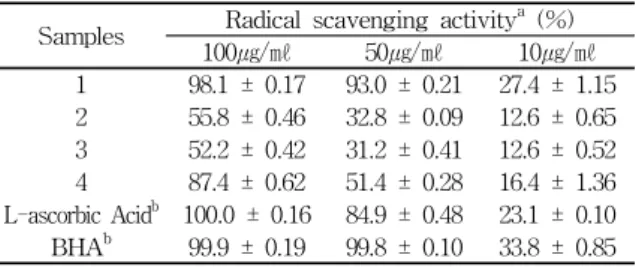
Table 2. ABTS Radical Scavenging Effect of Isolated Compounds from the Shoot of Aralia elata
Samples Radical scavenging activitya (%)
100㎍/㎖ 50㎍/㎖ 10㎍/㎖
1 98.1 ± 0.17 93.0 ± 0.21 27.4 ± 1.15 2 55.8 ± 0.46 32.8 ± 0.09 12.6 ± 0.65 3 52.2 ± 0.42 31.2 ± 0.41 12.6 ± 0.52 4 87.4 ± 0.62 51.4 ± 0.28 16.4 ± 1.36 L-ascorbic Acidb 100.0 ± 0.16 84.9 ± 0.48 23.1 ± 0.10 BHAb 99.9 ± 0.19 99.8 ± 0.10 33.8 ± 0.85 a : Data represent the mean±SD three replications.
b : Positive control.
Table 3. Superoxide Dismutase(SOD)-like Activity of Isolated Compounds from the Shoot of Aralia elata
Samples SOD-like activitya (%)
1000㎍/㎖ 500㎍/㎖ 100㎍/㎖
1 48.3 ± 4.49 46.4 ± 2.51 36.9 ± 0.95 2 25.2 ± 3.30 23.9 ± 1.90 23.5 ± 1.60 3 54.9 ± 2.35 47.2 ± 1.64 34.2 ± 1.08 4 51.2 ± 3.06 46.0 ± 2.24 36.1 ± 2.24 L-ascorbic Acidb 99.4 ± 0.00 97.9 ± 1.47 85.2 ± 2.36 a : Data represent the mean±SD three replications.
b : Positive control.
이들 플라보노이드 화합물은 식물화학물질 중 가장 주 목을 받고 있는 생리활성물질군의 하나로 항산화24), 항암25), 항혈전26), 항염증27), 항균작용28) 등 다양한 생리활성을 보 여주고 있다. 이와 같이 플라보노이드 화합물들의 생리활 성이 널리 알려지면서 이들 물질을 이용한 식품 및 의약 품 개발에 관심과 연구가 지속적으로 증가하고 있다. 따 라서 두릅에서 분리한 플라보노이드 화합물의 항산화 활 성을 확인화기 위하여 DPPH, ABTS 라디칼 소거능 활 성 및 SOD 유사 활성을 측정하였다.
두릅에서 분리된 화합물들의 항산화 활성을 측정한 결 과 DPPH 라디칼 소거능 활성은 화합물 1과 4는 50 ㎍/
㎖의 농도에서 50% 이상의 라디칼 소거 활성을 나타내 었으며 화합물 1은 91% 이상의 높은 활성을 나타내었다.
ABTS 라디칼 소거능 활성 역시 시료의 농도 의존적으로 활성이 증가되었으며 100 ㎍/㎖의 농도에서 화합물 모두 50% 이상의 소거 활성을 나타내었으며 그 중에서도 화합 물 1, 4가 가장 높은 활성을 보였으며 대조구인 BHA의 소거능과 거의 유사한 정도의 활성을 나타내었다. SOD를 이용한 항산화 활성 테스트에서는 Table 3에 나타낸 바와 같이 화합물 3이 positive control인 L-ascorbic acid보다는 약하지만 두릅에서 분리한 화합물 중 가장 강한 활성을 나타내었다.
이상의 결과로 보아 두릅에서 분리된 flavonoid 배당체 화합물은 높은 항산화 활성을 나타내었으며, 두릅은 매우 쉽게 구할 수 있으며 식용으로 쓰이고 있다는 점에서 두릅 의 폭넓은 이용 가능성을 시사하고 있다. 이들 flavonoid 화합물에 대한 다양한 생리적 및 약리적 활성이 검토됨 으로써 건강기능성 식품 또는 의약품의 소재로서의 개발
가능성이 있다고 여겨지며, 추후 이와 관련된 연구가 활 발히 추진 될 것으로 기대된다.
감사의 글
본 연구는 지식경제부 지역혁신센터사업(대구한의대학교 한방생명자원연구센터)의 지원에 의하여 이루어졌음
참고문헌
1. Creager MA, Luscher TF, Cosentino F, Beckman JA.
Diabetes and vascular disease: pathophysiology, clinical consequences and medical therapy: Part Ⅰ.
Circulation. 2003 ; 108 : 1527-32.
2. Jialal I, Grundyl S. Effect of dietary supplementation with alpha-tocopherol on the oxidative modification of low density lipoprotein. J Lipid Res. 1992 ; 33 : 899-06.
3. Vinson JA, Hontz BA. Phenol antioxidative index:
Comparative antioxidant effectiveness of red and white wines. J Agric Food Chem. 1984 ; 43 : 401-3.
4. Wong SF, Holliwell B, Richimond R, Skowroneck WR. The role of superoxide and hydroxyl radical in the degradation of hyaluronic acid induced by metal ions and ascorbic acid. J Toxical Pub Health. 1981 ; 14 : 127-34.
5. Park JC, Choi JS, Cho JW. Effect of the fraction from the leaves, fruits, stems and roots of Cudrania tricuspidata and flavonoids on lipid peroxidation. Kor J Pharmacogn. 1995 ; 26 : 377-84.
6. Cha JY, Cho YS. Effect of potato polyohenolics on lipid peroxidation in rats. J korean Soc Food Sci Nutr. 1999 ; 28 : 1131-6.
7. Chen YT, Zheng RL, Jia ZJ, Ju J. Flavonoids as superoxide scavengers and antioxidants. Free Radical Biol. 1990 ; 9 : 19-21.
8. Terao J. Autoxidation activity of β-carotene-related carotenoids in solution. Lipids. 1989 ; 24 : 657-61.
9. 육창수. 한국약품식물자원도감. 서울 : 진명출판사.
1981 ; 272.
10. 이창복. 대한식물도감. 서울: 향문사. 1985 ; 575.
11. 김창민, 신민교, 안덕균, 이경순 외. 중약대사전. 서울 : 정담출판사. 1997 : 3548.
12. Kim NH, Yang DC, Eom AH. A phylogenetic relationships of Araliaceae based on PCR-RAPD and ITS sequences. Korean J Plant Res. 2004 ; 17 : 82-93.
13. Ma SJ, Ko BS, Park KH. Isolation of 3,4- dihydroxybenzoic acid with antimicrobial activity from bark of Aralia elata. Korean J Food Sci Technol. 1995 ; 27 : 807-12.
14. Song SJ, Nakamura N, Ma CM, Hattori M, Xu SX. Five saponins from the root bark of Aralia elata. Phytochemistry. 2001 ; 56 : 491-7.
15. Lee EB, Kim OJ, Kanf SS, Jeong CS. Araloside A, an antiulcer constituent from the root bark of Aralia elata. Biol Pharm Bull. 2005 ; 28 : 523-6.
16. Cha JY, Ahn HY, Eom KE, Park BK, Jun BS, Cho YS, Antioxidative activity of Aralia elata shoot and leaf extracts. J Life Sci. 2009 ; 19 : 652-8. . 17. Blois MS. Antioxidant activity determination by
the use of a stable free radical. Nature. 1958 ; 181 : 1199-200.
18. Pellegrin ReRN, Proteggente RA, Pannala A, Yang M, Catherine RE. Antioxidant activities applying an approved ABTS radical caution decolorization assay. Free radical Biology & medicine. 1999 ; 26 : 1231-7.
19. Stefan M, Gudrun M. Involvement of the superoxide anion radical in the autooxidation of pyrogallol and a convenient assay for superoxide dismutase. Eur J Biochem. 1974 ; 47 : 469-74.
20. Toker G, Memisoglu M, Yesilada E, Aslan M.
Maim flavonoids of Tilia argentea DESF ex DC.
leaves. Turk J Chem. 2004 ; 28 : 745-9.
21. Tomas Lorente F, Garcia Grau MM, Nieto JL, Tomas Barberan FA. Flavonoids from Cistus ladanifer bee pollen. Phytochemistry. 1992 ; 31 :
2027-9.
22. Ibrahim LF, Kawashty SA, Baiuomy AR, Shabana MM, El-Eraky WI, El-Negoumy SI. A comparative study of the flavonoids and some biological activities of two Chenopodium Species. Chemistry of Natural Compounds. 2007 ; 43 : 24-8.
23. Barakat HH, El-Mousallamy AMD, Souleman AMA, Awadalla S. Flavonoids of Ochradenus baccatus. Phytochemistry. 1991 ; 30 : 3777-9.
24. Lee MW, Lee YA, Park HM, Toh SH, Lee EJ, Jang HD, Kim YH. Antioxidative phenolic compounds from the roots of Rhodiola sachalinensis A. Bor.
Arch Pharm Res. 2000 ; 23 : 455-8.
25. Kashiwada Y, Nonada G, Nishioka I, Chang JJ, Lee KH. Antitumor agents, 129 tannins and related compounds as selective cytotoxic agents. J Nat Prod. 1992 ; 55 : 1033-43.
26. Choo MK, Park EK, Yoon HK, Kim DH.
Antithrombotic and antiallergic activities of daidzein, a metabolite of puerarin and daidzin produced by human intestinal microflora. Biol Pharm Bull. 2002 ; 25 : 1328-32.
27. Theoharides TC, Alexandrakis M, Kempuraj D, Lytinas M. Anti-inflammatory actions of flavonoids and structural requirments for new design. Int Immunopathol Pharmacol. 2001 ; 14 : 119-27.
28. Middleton R, Drzewiecki G. Flavonoid inhibition of human basophil histamine release stimulated by various agents. Biochem Pharmacol. 1984 ; 32 : 3333-8.