Tea Tree Oil의 여드름균에 대한 항균활성
Antimicrobial Activity of Tea Tree Oil against Pathogens relate to Acne
설 재 원* 송 근 호** 이 광 래***
Seol, Jae-Won Song, Kun-Ho Lee, Kwang-Rae
Abstract
The purpose of this study is to determine the antimicrobial effect of tea tree oil a against pathogens relate to acne. Tea tree oil extracted from Australian Melaleuca alterifolia has been studied extensively for their antimicrobial properties against different type of bacteria and fungi. Tea tree oil has been reported to have antibacterial, antiinflammatory and antitumor activities, among others. By evaluating the antibacterial effect of Tea Tree Oil of Australia, the MIC value of Tea Tree oil against P. acnes was 0.05% and 0.5% against aerobic bacteria. This study showed that Tea Tree Oil has antibacterial effect against bacteria which induce acne. Tea Tree Oil had better antibacterial effect against P. acnes compared to aerobic bacteria. It is promising to develop a nature-based functional material for makeup product, which can cure and prevent acne.
키워드 : 항균, Tea Tree Oil, 여드름균 Keywords : antibacterial, Tea Tree Oil, acne
1. 서론1)
최근에 식물성 천연물질을 이용하여 생리활성을 조절하고, 기존의 항생제에서 나타나는 여러 가지 부작용이 없으며, 항균효과가 좋은 물질을 찾기 위한 연구가 활발히 진행되고 있다[1]~[5]. 일반 적인 피부 상재균 중 피부에 염증을 유발할 수 있 는 세균으로는 Staphylococcus epidermidis, Staphyloccus aureus, Streptococcus pyogens 등이 보고되어 있으며, 피부 여드름 유발 원인세균으로 는 Propionibacterium acnes가 알려져 있다[6]. P.
acnes가 분비하는 리파아제와 leukocyte chemotatic
* 강원대학교 대학원 화학공학과 석사과정
** 강원테크노파크강원선도산업지원단, 공학박사
*** 강원대학교 화학공학과 교수, 공학박사, 교신 저자
인자들이 피지를 지방산으로 분해하고 모낭벽을 자극하여 여드름을 형성하게 되며, 이들의 상호작 용에 의해 여러 경로를 거쳐 최종적으로 염증반응 을 유도하여 피부에 구진, 농포, 낭종, 결절 및 반 흔(scar)을 형성하게 한다[7].
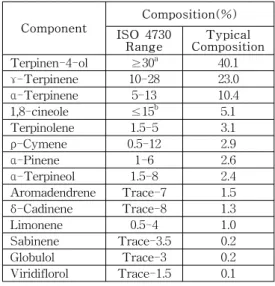
Tea Tree Oil은 허브(herb)의 일종으로 학명은 Melaleuca alternifolia이다. 일반적으로 호주에서 자 라는 식물인 Melaleuca alternifolia(tea tree)의 잎에 서 추출한 정유를 Tea Tree Oil이라고 하며, 오래전 부터 호주 원주민들의 전통적인 민간요법에서 치료제 로 사용되었던 것이 현재는 다양한 치료제로 사용되 고 있다. Tea Tree Oil는 100여가지의 다른 물질들 이 구성되어 있는 복합물이며, 특유의 생리적 효과 에 영향을 주는 주 구성성분은 terpinen-4-ol(30∼
40%)이다. 그 외의 구성성분으로 -Terpinene, -Terpinene 등이 있다[8] (Table 1). Tea Tree Oil은 여러 연구에서 항미생물(항여드름균), 항염증, 항암 작용 등에 효과가 있는 것으로 보고되고 있다
Table1. Composition of M. alternifolia (Tea Tree) Oil
Component
Composition(%) ISO 4730
Range Typical Composition
Terpinen-4-ol ≥30a 40.1
-Terpinene 10-28 23.0
-Terpinene 5-13 10.4
1,8-cineole ≤15b 5.1
Terpinolene 1.5-5 3.1
ρ-Cymene 0.5-12 2.9
-Pinene 1-6 2.6
-Terpineol 1.5-8 2.4
Aromadendrene Trace-7 1.5
δ-Cadinene Trace-8 1.3
Limonene 0.5-4 1.0
Sabinene Trace-3.5 0.2
Globulol Trace-3 0.2
Viridiflorol Trace-1.5 0.1 [9]∼[11].
Tea Tree Oil은 강한 살균 작용이 있으며 천연 방부제로 사용되기도 한다. 벌레에 쏘인 상처, 화 상, 외상과 피부 감염 완화에 효과적이며, 강한 항 균, 거담 작용, 발한제로도 사용된다. 이러한 여러 생리적 작용은 인체의 면역 시스템을 강화하고 히 스타민이 유발한 피부 염증, 세균과 진균에 의한 대부분의 감염에 효과가 있는 것으로 보고되고 있 다[12].
Tea tree essential oil은 다른 여러 박테리아와 진균에 대한 항미생물 특성이 광범위하게 연구되고 있으며, 그중 에서 Tea tree oil은 disc diffusion과 broth microdilution method 두 방법을 사용하여 모든 66개의 단리된 methicillin-resistant Stapylococcus aureus (MRSA)에서 antibacterial activity를 가지며, 이러한 antibacterial activity는 1-terpinen-4-ol 이 주성분인 것으로 밝혀졌다.
1-terpinen-4-ol의 농도가 낮을수록(30%이하) Tea Tree Oil의 antibacterial activity 뿐만 아니라 다른 주요 작용들 이 저하되는 것으로 보고 되었다 [8][12][13].
본 연구에서는 항균, 항바이러스, 항산화 같은 생리활성 효과를 보이는 것으로 알려져 있는 Tea Tree Oil(Australia)을 사용하여 여드름 유발균주에 대한 항균활성을 확인하기 위하여, Tea Tree Oil 의 항균성능에 대한 실험을 수행하였다.
a No upper limit is set, although 48% has been proposed.
b
No lower limit is set.
2. 실험
2.1. Materials
Australia 제품인 Tea Tree Essential Oil 12ml
를 렌따멘떼에스테틱(소재지: 원주)에서 구매하여 냉장(8℃)보관하여 사용하였다.
본 실험에서는 3종의 균주(Propionibacterium acnes (KCTC 3314), Staphylococcus aureus subsp. (KCTC 1927), Staphylococcus epidermidis (KCTC 1917))를 사용하였으며, 한국생명공학연구 원 생물자원센터에서 분양받아 사용하였다(Table 2), 각 균주의 배지 조성은 Table 3와 4에 나타내 었다.
Table 2. The microorganisms for the experiments
균주명 배지 생육
조건 Pro pi on iba cterium
acnes (KCTC 3314)
Reunforced Clostridial
Medium
37℃
S t a p h y l o c o c c u s aureus subsp.(KCTC 1927)
Nutrient agar 37℃
Staphylococcus epidermidis (KCTC 1917)
Nutrient
agar 37℃
Table 3. The composition of Reinforced Clostridial culture medium.
Composition Contents
Tryptone 5.0g
Proteose penptone No. 3 5.0g
Beef extract 10.0g
Yeast extract 3.0g
Dextrose 5.0g
Sodium chloride 5.0g
Soluble starch 1.0g
Cysteine hydrochloride 0.5g
sodium acetate 3.0g
Agar 15.0g
Distilled water 1.0L
pH 6.8
Table 4. The composition of Nutrient Agar culture medium.
Composition Contents
Beef extract 3.0g
Peptone 5.0g
Agar 15.0g
Distilled water 1.0L
pH 6.8
시험균 조제 및 OD(Optical Density) 측정을 통한
미생물의 생육 곡선 측정에는 UV-Vis
Spectrophotometer (Hewlett Packard, 8452A)를 사 용하였으며, 실험기구 및 균 배양 배지 멸균에는 고압증기멸균기(Autoclave)를 사용하였다. 균 접종, 배지의 도말작업 및 균 배양은 멸균상태를 유지한 Glove Box, 진탕 배양기(Shaking incubator) 및 GasPakTM EZ Standard Incubation Container(BD Co., USA)를 사용하였다.
2.2 Tea Tree Oil의 항균성 평가를 위한 균 배양 조건
P. acnes의 배양 배지는 Reinforced Clostridial (RC) 배지(Becton & Dickinson, USA)를 사용하였 다. 동결 건조된 P. acnes는 실험 3일전에 활성화 시켰으며, 균을 배양 배지에 접종한 후 Anaerobic Standard Incubation Cntainer(Becton & Dickinson, USA)에서 GasPakTM EZ(Anaerobe Container System, USA)를 사용하였다. Incubation Container를 밀봉하여 37℃ Incubator에서 3일 동안 혐기성 상 태에서 배양하였다. Container 내부의 혐기성 (anaerobic) 상태는 Microbiology AnaerotestⓇ (Merck, Germany)를 사용하여 확인하였다. 호기성 균주들은 Nutrient Agar 배지(Becton&Dickinson, USA)를 사용하였으며, 균을 접종한 후 37℃
Incubator에서 24시간 배양하여 사용하였다.
2.3 항균성 평가
2.3.1 Paper Disc Diffusion Method
Tea Tree Oil을 0.5% Tween80을 이용해 농도 별로 희석하여 현탁액을 만들었으며, P. acnes 균 주를 RC 액체배지에서 3일간 배양한 후, 균 현탁 액을 일정한 농도(optical density 620nm에서 흡광 값 0.5)로 조절한 후 멸균된 면봉을 이용하여 RC agar plate에 균일하게 균을 도말해 주었다. Plate 를 건조시킨 후, paper disc (: 8mm, Adventec, USA)를 균주가 접종된 plate 표면 위에 올려놓고 프로폴리스 추출물을 농도별로 희석하여(0.00625∼
10% of DMSO) 50µL씩 흡수시켰다. 시료가 처리 된 plate를 Anaerobic Standard Incubation Container에서 GasPakTM EZ를 이용하여 3일간 배 양한 후 disc 주위의 Clear zone의 크기로 항균활 성을 측정하였다. 호기성 균주에 대한 항균활성 평 가는 Nutrient Agar 배지를 사용하여 여드름균과 동일한 방법을 사용하였으며 37℃ Incubatior에서 24h 배양 후 측정하였다.
2.3.2 Minimum Inhibitory Concentration (MIC) Test
Tea Tree Oil은 액상배지 9mL을 가압멸균한 후 배지가 굳기 전에 0.5% Tween80으로 농도를 조절 한 각각의 Tea Tree Oil 현탁액을 1mL씩 첨가하
여 농도별 평판 배지를 만들어 여드름 유발균주들 을 접종하여 37℃에서 3일간 배양하면서 균의 집 락 형성 유무를 현미경(Olympus SZ6045)을 통해 관찰하여 균이 자라지 않는 최소발육억제농도 (MIC)를 측정하였다. 동일한 방법으로 4회 반복 실험하여 그 평균값을 이 실험의 MIC로 결정하였 다.
3. 결과 및 토의
3.1 여드름 유발균주에 대한 Tea Tree Oil의 항균활성 평가
여드름 유발균주에 대한 Tea Tree Oil의 항균활 성을 Paper Disc Diffusion Method에 평가하여 다 음과 같은 결과를 얻었다. 0.5% Tween 80을 이용 해 희석한 Tea Tree Oil은 P. acnes에 대하여 0.125%의 농도부터 11∼12mm의 증식억제대(clear zone)를 보였으며, 호기성균(S. aureus, S.
epidermidis)의 경우 동일한 농도에서 9mm의 clear zone을 보이며 증식억제 성능을 나타내었다 (Table 5).
실험에서 사용한 농도범위(0.025∼05%)에서는 농도의 증가에 따라 균 증식억제효과가 증가하는 것으로 나타났으나, 일정 농도이상(0.25%)에서는 그 효과가 현저한 차이를 보이지는 않았다.
3.2 여드름 유발균주에 대한 Tea Tree Oil의 MIC 평가
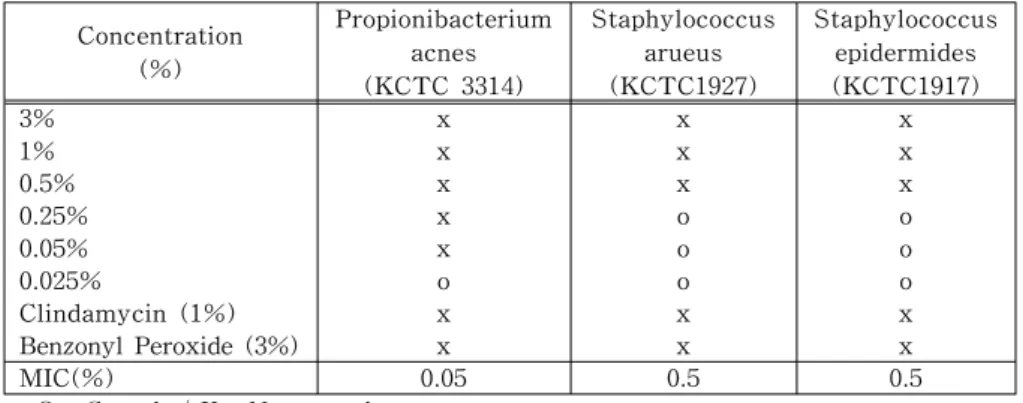
Paper disc diffusion method에 의한 실험 결과 를 바탕으로 여드름 유발균에 대한 Tea Tree Oil 의 MIC를 측정한 결과들이 paper disc법에 의한 실험결과와 약간의 차이를 보였으나(Table 5 &6), 이는 두 실험방법에 따른 살균원리의 차이에서 생 겨나는 오차이기 때문에 큰 유의성을 갖고 있지는 않는 것으로 여겨진다. Paper disc diffusion법과 MIC 평가에서 Tea Tree Oil이 여드름 국소치료제 에 쓰이는 Clindamycin 1%와 Benzoyl peroxide 3%보다 낮은 농도에서(P. acnes: 0.05%, S.
arueus: 0.5%, S. epidermidis: 0.5%) 여드름 유발
균주들에 대한 항균효과가 있었다. 그러나,
Clindamycin과 Benzoyl peroxide의 농도는 여드름 피부에 적용했을 때 복합적 치료효과를 얻기 위한 농도이므로, Tea Tree Oil이 더 뛰어난 여드름 치 료제로 쓰일 수 있다고 확인하기 위해서는 더 많 은 연구가 필요할 것으로 보이며, 여드름 치료제로 서의 가능성은 확인할 수 있었다.
Concentration (%)
Propionibacterium acnes (KCTC 3314)
Staphylococcus arueus (KCTC1927)
Staphylococcus epidermidis (KCTC1917)
5% ++++ ++++ ++++
3% ++++ ++++ ++++
1% +++ +++ +++
0.5% +++ ++ ++
0.25% +++ + +
0.125% ++ + +
0.025% - - -
Clindamycin (1%) ++++ ++++ +++
Benzonyl Peroxide (3%) ++++ +++ ++++
Table 5. Antimicrobial activity of Tea Tree Oil (Paper disc diffusion method)
Concentration (%)
Propionibacterium acnes (KCTC 3314)
Staphylococcus arueus (KCTC1927)
Staphylococcus epidermides (KCTC1917)
3% x x x
1% x x x
0.5% x x x
0.25% x o o
0.05% x o o
0.025% o o o
Clindamycin (1%) x x x
Benzonyl Peroxide (3%) x x x
MIC(%) 0.05 0.5 0.5
Table 6. Minimum Inhibitory Concentration (MIC) of Tea Tree Oil against various bacteria
* Inhibition zone size: +<10mm, 10mm<++<15mm, 15mm<+++ <20mm, 20mm<++++
* O : Growth / X : Not growth
4. 결론
본 연구에서는 여드름 유발균주에 대한 항균활 성이 우수한 천연물질을 탐색하기 위하여 여드름 유발균주에 대한 항균효과가 있는 것으로 연구 보 고된 Tea Tree Essential Oil(오스트레일리아산)의 항균효과를 평가하는 실험을 수행하였다.
Tea Tree Oil의 항균활성 실험에서 paper disc diffusion method는 P. acnes에 대하여 0.125%의 농도부터 11∼12mm의 증식억제대(clear zone)를 보였으며, 호기성균(S. aureus, S. epidermidis)의 경우 동일한 농도에서 9mm의 clear zone을 보이 며 증식억제 성능을 나타내었다. P. acnes에 대한 MIC 값은 0.05%로 측정되었으며, 호기성 세균인 S. epidermidis와 S. arueus에 대한 MIC 값은 각 각 0.5%로 측정되었다. Tea Tree Oil은 여드름 유 발균주에 대하여 좋은 항균활성을 보여 주었으며, 호기성 균주들보다 P. acnes에 대한 항균활성 효 과가 좋았다.
Tea Tree Oil은 직접적으로 인체 피부와 접촉하 여 반응시키는 치료를 목적으로 하는 여드름 억제 제 및 치료제 그리고 천연물 기능성 화장품 원료 로서의 개발 가능성이 높을 것으로 기대된다.
참 고 문 헌
[1] K. Yasunaka, F. Abe, A. Nagayama, H. Okabe, L.
Lozada-Perez, E. Lopez-Villafranco, E.E. Muniz, A.
Aguilar, R. Reyes-Chilpa, Antibacterial activity of crude extracts from Mexican medicinal plants and
purified counmarins and xanthones. J.
Ethnopharmaco. 97: 293-299, 2005.
[2] J. Park, J. Lee, E. J, Y. Park, K. Kim, B.
Park, K. J, E. Park, J. Kim, and D. Park, In vitro antibacterial and anti-inflammatory effects of honokiol and magnolol against Propionibacterium sp. Europ. J. Pharmacol.
496: 189-195, 2004.
[3] M. T. Chomnawang, s. Surassmo, V. S.
Nukoolkarn, and W. Gritsanapan, Antimicrobial
effects of Thai medicinal plants against acne-inducing bacteria. J. Ethnopharmaco. 101:
330-333, 2005.
[4] M. T. Chomnawang., Suvimol Surassmo, Veena S. Nukoolkarn, Wandee Gritsanapan, Synergism and postantibiotic effect of tobramycin and Melaleuca alternifolia(tea tree) oil against Staphylococcus aureus and Escherichia coli.
Phytomedicine. 17: 317-322, 2010.
[5] Antimicrobial effect of ethanol extract of
dryopteris crassirhizoma nakai on propionibacterium acnes. J. Soc. Cosmet.
Sientists Korea. 32(3): 2001-208, 2006.
[6] J. Ayer, N. Burrows, Acne: more than skin deep. Postgrad Med. J. 81: 500-506, 2006.
[7] A. M. Layton, A review on the treatment of cne vulgaris. Int. J. Clin. Pract. 60(1):
64, 2006.
[8] A. Raman, U. Weir, S.F. Bloomfield, Antimicrobial effects of tea-tree oil and its major components on staphylococcus
aureus, staph. epidermidis and propionibacterium acnes. L. A.
Microbiology. 21: 242-245, 1995.
[9] S. Messager, K.A. Hammer, C.F. Carson, T.V. Riley. Assessment of the antibacterial activity of tea tree oil using the European EN 1276 and EN 12054 standard suspension tests. J. Hospital Infection. 59: 113-125, 2005.
[10] F. Pisseri, Bertoli, S. Nardoni, L. Pinto, L.
Pistelli, G. Guidi, F. Mancianti. Antifungal activity of tea tree oil from Melaleuca alternifolia against Trichophyton equinum:
An in vivo assay. Phytomedicine 16:
1056-1058, 2009
[11] L. Halcon, K. Milkus, Staphylococcus aureus and wounds: a Review of tea tree oil as a promising antimicrobial. AM J.
Infect Control. 32: 402-408, 2004.
[12] C.F. Carson, T.V. Riley. A Review Antimicrobial activity of the essential oil of Melaleuca alternifolia. LAM. 16: 49-55, 1993.
[13] Xia Liu, Yuangang Zu, Yujie Fu, Liping Yao., Chengbo Gu, Wei Wang, thomas Efferth. Antimicrobial activity and cytotoxicity towards cancer cells of Melaleuca alternifolia (tea tree) oil. Eur.
food res. Technol. 229: 247-253, 2009.