9
Copyright © 2021 The Korean Society of Fisheries and Aquatic Science pISSN:0374-8111, eISSN:2287-8815
서 론
활성산소
(reactive oxygen species, ROS)
는유기호흡과생체이물및미생물침입에대한세포반응중에생성된다
(Ray et
al., 2012).
활성산소는superoxide radical (O
2-), peroxyl radical (ROO
-), hydroxyl radical (•OH)
과같은산소중심의라디칼과hydroperoxide (ROOH), hydrogen peroxide (H
2O
2)
와같은비 라디칼종들을포함한다.
이러한활성산소가증가하거나세포 항산화능력이감소하게되면활성산소의생성과세포항산화 능력사이가불균형을일으키어산화스트레스가발생하게된다(Sies, 2000).
이는심혈관질환,
신경장애,
비만,
노화,
암및만성염증을포함한다양한퇴행성질환을유발한다
(Chakraborty
et al., 2015).
따라서산화스트레스는다양한질병과밀접한관 계가있기때문에free radical
의발생을억제시키고산화작용으로부터생체를보호할수있는항산화작용이중요하다
.
페 놀계화합물은라디칼소거활성과항산화효소수준을유도하 여항산화활성을갖는것으로알려져있다.
해양자원과관련 해서는해양조류에서다양한항산화화합물이풍부하게존재 한다(Kadam et al., 2013).
이러한해양조류는영양적가치가 풍부하여기능성식품및식의약품으로서널리사용되고있다(Wells et al., 2017). Sargassum
은갈조류로Sargassacae
과에 속하며전세계적으로약400
종을포함하고있다. Sargassum
속 은meroterpenoids, polyphenols, fucoxanthins, sargaquinoic acids, sargachromanol
을포함한다양한생리활성화합물이항 산화,
신경보호,
항암,
항염증및간보호활성과같은유익한특 성을가지고있다고알려져있다(Yende et al., 2014).
톱니모자 반(Sargassum serratifolium)
은모자반속에속하며국내에서는 제주도해역과남해에분포하고있으며국외로는중국,
일본,
홍톱니모자반(Sargassum serratifolium) 추출물의 항산화 활성 증가를 위한 추출공정 최적화
김성희·고지윤·김형락
1·이양봉*
부경대학교 식품공학과, 1부경대학교 식품영양학과
Optimization of Extraction Process to Increase the Antioxidant Activity of Sargassum serratifolium Extracts
Seong-Hee Kim, Ji-Yun Ko, Hyeung-Rak Kim1 and Yang-Bong Lee*
Department of Food Science and Technology, Pukyong National University, Busan 48513, Korea
1Department of Food Science and Nutrition, Pukyong National University, Busan 48513, Korea
Sargassum serratifolium is a rich source of antioxidant meroterpenoids. The optimal extraction temperature and time for obtaining maximal antioxidant yield, antioxidant activity, and phenolic content from Sargassum serratifolium were determined using response surface methodology (RSM). The ranges of the independent variables for extrac- tion temperature and time were 30-70°C and 12-36 h, respectively. With increasing temperature and time, the yield increased significantly, while DPPH (2,2-dipheny-1-picrylhydrazyl) radical-scavenging activity and total phenolic content decreased significantly. The optimal extraction temperature and time obtained by RSM were 54°C and 7 h, respectively, providing a yield of 8.2%, DPPH radical-scavenging activity of 60%, and total phenolic content of 163 mg GAE/g. The findings of this study provide useful information for the development of Sargassum serratifolium extraction processes for the food and cosmetic industries.
Keywords: Sargassum serratifolium , Sargahydroquinoic acid, Antioxidant activity, Optimization, Response surface methodology
*Corresponding author: Tel: +82. 51. 629. 5829 Fax: +82. 51. 629. 5824 E-mail address: [email protected]
This is an Open Access article distributed under the terms of the Creative Commons Attribution Non-Commercial Licens (http://creativecommons.org/licenses/by-nc/3.0/) which permits unrestricted non-commercial use, distribution, and reproduction in any medium, provided the original work is properly cited.
Received 27 January 2021; Revised 10 February 2021; Accepted 19 February 2021 저자 직위: 김성희(대학원생), 고지윤(대학원생), 김형락(교수), 이양봉(교수) https://doi.org/10.5657/KFAS.2021.0009
Korean J Fish Aquat Sci 54(1), 9-15, February 2021
콩등에분포하고있다
.
최근톱니모자반의기능성에대한연구 로는톱니모자반의에탄올추출물에항산화능을갖는sargahy- droquinoic acid, sargaquinoic acid
그리고sargachromanol
을 포함한isoprenoid quinone
과chromanol
이많이함유되어있으 며,
강한저색소침착효과,
항염증및항비만활성에대하여보고 하였다(Azam et al., 2017).
이러한주요항산화물질이많이함 유되어있어천연항산화제와화장품의원료로서활용할수있 는가능성을가지고있다.
하지만원료에서기능성을나타내는 성분을추출하기까지에는오랜시간이소요된다.
이런경우에 제조공정의효율을증가시키기위하여반응표면분석법을사용 하여효율을증가시킬수있는데,
이는실험후얻은데이터를 통계적분석방법을통해최소의실험횟수로어떻게최적의효 과를얻을수있을지계획하는것이다(Lee, 2014).
이에본연구에서는반응표면분석법의중심합성설계법을사 용하여
2
가지독립변수인추출온도와추출시간을이용하여톱 니모자반의추출수율,
항산화능과총폴리페놀함량에대한최 적의추출조건에대해연구하고자한다.
재료 및 방법
실험재료
실험에사용된톱니모자반
(S. serratifolium)
은부산인근해 안에서채취한것을구입하였다.
구입한모자반은담수로깨끗이세척하고열풍건조한후잘게분쇄하여
-20°C
에서동결저장하여사용하였다
. 추출물 제조
톱니모자반 추출물의 용매로는 추출 용매별 톱니모자반의 항산화능을분석한
Lim et al. (2019)
의연구에서보고된결과 를바탕으로에탄올을추출용매로사용하였다.
톱니모자반시 료20 g
에추출용매200 mL
를가하여진탕항온수조(BS-11, Lab companion, Korea)
에서추출조건에따른시간과온도를 유지하여추출하였다.
추출이끝난후여과지(Qualitative fil- ter paper, No. 10, HM, Korea)
를이용하여여과하였다.
여과 액은회전증발농축기(Laborota 4000, Heidolph, Schwabach, German)
를이용하여40°C
에서농축액을얻은후,
드라이오븐 을이용하여20°C
에서24
시간동안건조하였다.
건조된시료 는-20°C
에서냉동보관하며실험에사용하였다.
또한,
추출수 율은건조후얻은추출물의함량을통하여각실험조건에따 라산출하였다.
Yield (%)= Weight of extract
×100Initial weight of dry sample
반응표면분석법을 이용한 실험설계
톱니모자반의수율
,
항산화능,
총폴리페놀함량의최적화를위하여반응표면분석법을사용하였다
.
실험설계는두가지의 독립변수(independent variables)
로추출온도(X
1, °C)
와추출시 간(X
2, h)
을사용한중심합성설계법(central composite design)
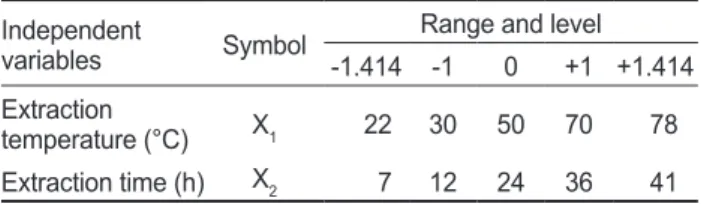
을이용하여설계하였다(Table 1). 2
개의인자와3
개의수준으 로이루어진중심합성설계법으로요인점22
개,
축점(α=1.414) 4
개와중심점이5
개로총13
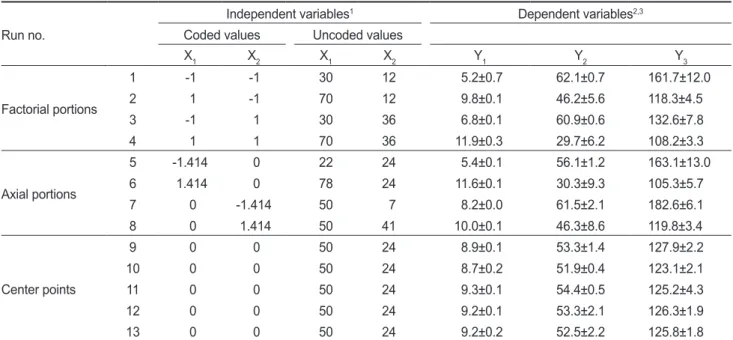
번의실험으로설계하였다(Table 2).
두독립변수의범위및중심점값은예비실험결과를바 탕으로설정하였다.
종속변수(dependent variables)
는수율(Y
1, g), DPPH
라디칼소거능(Y
2, %)
과총폴리페놀함량(Y
3, mg
GAE/mL)
으로설정하였으며, 3
회반복측정하여그평균값을회귀분석에사용하였다
. DPPH 라디칼 소거능 측정
DPPH (2,2-dipheny-1-picrylhydrazyl)
라디칼소거능(DPPH radical-scavenging activity)
은Blois (1958)
의방법을약간변 형하여측정하였다.
조건별로추출한추출물을1 mg/mL
농도 로용매에희석하여시료로사용하였으며,
각시료용액2 mL
에0.2 mM DPPH
용액2 mL
를가한후암실에서30
분간반응시 켰다.
대조군은시료대신용매를사용하여동일한방법으로반 응시켰다.
반응액을분광광도계(UV1800, Shimadzu, Kyoto, Japan)
를이용하여517 nm
에서흡광도를측정하였으며,
다음 계산식에따라라디칼소거능(%)
을계산하였다.
Scavenging activity (%)=
A
517of control-A
517of sample
×100
A
517of control
총 페놀 함량 측정
모자반추출물의총페놀함량
(total phenolic content, TPC)
은Folin and Denis (1912)
를변형하여측정하였다.
각각의시 료들을1 mg/mL
농도로에탄올에녹인다음,
시료용액100 μL
에증류수900 μL
를가하여총부피가1 mL
가되도록희석하였 다.
여기에Folin-Ciocalteu reagent 100 μL
를가한후실온에4
분간방치하였다.
이후7.5% Na
2CO
3용액200 μL
를가하여혼 합하고,
증류수700 μL
를가하고암실에서1
시간반응시켰다.
반응시킨 후분광광도계(UV1800, Shimadzu, Kyoto, Japan)
를 이용하여
700 nm
에서반응액의흡광도를 측정하였다.
추Table 1. Coded and actual values of independent variables in cen- tral composite design used for optimization of extraction condition from Sargassum serratifolium
Independent
variables Symbol Range and level
-1.414 -1 0 +1 +1.414 Extraction
temperature (°C) X1 22 30 50 70 78
Extraction time (h) X2 7 12 24 36 41
출물의총페놀함량의정량을위해농도별
gallic acid (Sigma Chemical Co., St. Louis, MO, USA)
표준용액을시료와동일 한방법으로실험한후표준검량선을작성하여mg gallic acid equivalent per mL (mg GAE/mL)
로나타내었다.
데이터 분석 및 추출조건 최적화
통계분석및처리는
Minitab 17 software (Minitab Inc., State College, PA, USA)
를사용하였다(P<0.05).
Y= ∑
2i=1
β
iX
i+ ∑
2i=1
β
iiX
i2+ ∑
2i=1
∑
2 j=i+1β
ijX
iX
j3
차원반응표면그래프는Design-Expert software (Version 13, Stat-Ease Inc., Minneapolis, MN, USA)
를이용하여나타 내었다.
반응표면모델의 검증
2
차다항방정식은최적추출조건을찾는과정으로정지점(sta- tionary point)
을통하여반응표면모델이최대점,
최소점,
안장 점및능선형태인지를판단하였다.
그후Minitab software
를 사용하여최적추출조건을예측하였고,
예측된최적추출조건 에서실제실험을통해예측값의정확도를검증하였다.
즉,
예측 된최적추출조건에서실제로추출공정과실험을수행하여예측 된반응값과실험으로얻은반응값을비교하였다.
예측값과실 험값의정확도는오차(%)
를통해검증하였다.
최적 추출물의 항산화 성분 분석
최적조건에서 추출한추출물에 함유되어 있는
sargahydro- quinoic acid (SHQA), sargachromanol (SCM), sargaquinoic acid (SQA)
를 분석하기 위해HPLC
를 사용하였다.
분석 시료에메탄올로녹이고원심분리한후상층액
100 μL
를취하여
,
그중3 μL
을HPLC
에주입하여Lim et al. (2019)
의조건 에따라분석하였다.
분석시스템은펌프(LC-6AD, Shimadzu, Kyoto, Japan),
광다이오드배열검출기(SPD-M20A, Shimad- zu, Kyoto, Japan),
온라인탈기장치(DUG-20A3, Shimadzu, Kyoto, Japan),
자동시료주입기(SIL-20A)
및시스템컨트롤 러(CBM- 20A)
로구성되었으며,
데이터는Shimadzu LC solu- tion (ver. 1.22sp, Shimadzu, Kyoto, Japan)
으로분석하였다.
칼럼은Phenomenex Luna RP-18 (2) column [Luna C18 (2), 3 μm particle size, 150×3.0 mm I.D.]
을사용하여추출물의성 분을분석하였다.
이동상으로는A
는0.1% formic acid
가함유 된메탄올, B
는0.1% formic acid
가포함된물을사용하였다. A/B (90/10)
에서A/B (94/6)
의농도로33
분, A/B (94/6)
에서A/B (100/0)
의농도로2
분, A/B (100/0)
로10
분동안세척한후A/B (90/10)
의농도로평형화하였다.
유속은0.34 mL/min
이었 으며,
피크는270 nm
에서확인하였으며,
각화합물은retention time
으로확인하였다.
표준곡선작성을위해SHQA, SQA
그리 고SCM
의표준시약을메탄올을이용하여1.0, 5.0, 10.0, 25.0, 50.0, 100.0 μg/mL
의농도로희석한후시료와같은HPLC
분 석조건에서분석하였다(Gwon et al., 2018).
Table 2. Matrix and values of independent and dependent variables of central composite design used for optimization of extraction condition from Sargassum serratifolium
Run no.
Independent variables1 Dependent variables2,3 Coded values Uncoded values
X1 X2 X1 X2 Y1 Y2 Y3
Factorial portions
1 -1 -1 30 12 5.2±0.7 62.1±0.7 161.7±12.0
2 1 -1 70 12 9.8±0.1 46.2±5.6 118.3±4.5
3 -1 1 30 36 6.8±0.1 60.9±0.6 132.6±7.8
4 1 1 70 36 11.9±0.3 29.7±6.2 108.2±3.3
Axial portions
5 -1.414 0 22 24 5.4±0.1 56.1±1.2 163.1±13.0
6 1.414 0 78 24 11.6±0.1 30.3±9.3 105.3±5.7
7 0 -1.414 50 7 8.2±0.0 61.5±2.1 182.6±6.1
8 0 1.414 50 41 10.0±0.1 46.3±8.6 119.8±3.4
Center points
9 0 0 50 24 8.9±0.1 53.3±1.4 127.9±2.2
10 0 0 50 24 8.7±0.2 51.9±0.4 123.1±2.1
11 0 0 50 24 9.3±0.1 54.4±0.5 125.2±4.3
12 0 0 50 24 9.2±0.1 53.3±2.1 126.3±1.9
13 0 0 50 24 9.2±0.2 52.5±2.2 125.8±1.8
1X1, Extraction temperature (°C); X2, Extraction time (h). 2Y1, Yield (%); Y2, DPPH (2,2-dipheny-1-picrylhydrazyl) radical-scavenging activity (%); Y3, Total phenolic content (mg GAE/mL). 3Mean±SD (n=2).
결과 및 고찰
추출 수율
식품공정에서유효성분의추출수율을최대로하는조건을 연구하는것은중요한요소이다
.
본연구에서는추출수율을최 대로가질수있는추출조건을최적화하고자하였다.
중심합성 설계법(central composite design)
에의해설계된실험조건에 대한반응값을Table 2
에나타내었다.
추출수율에대한실험값 중에서30°C, 12
시간추출한경우에가장낮은수율인5.2%
를 보였으며, 70°C
온도에서36
시간을추출한경우에가장높은수 율인11.9%
를나타내었다.
추출온도(x)
와추출시간(y)
에대한 추출수율(Y
1)
의관계를데이터통계분석에의한2
차다항방정 식은다음과같이나타내었다.
Y
1=9.060+2.309x+0.781y-0.374x
2-0.074y
2+0.125xy 2
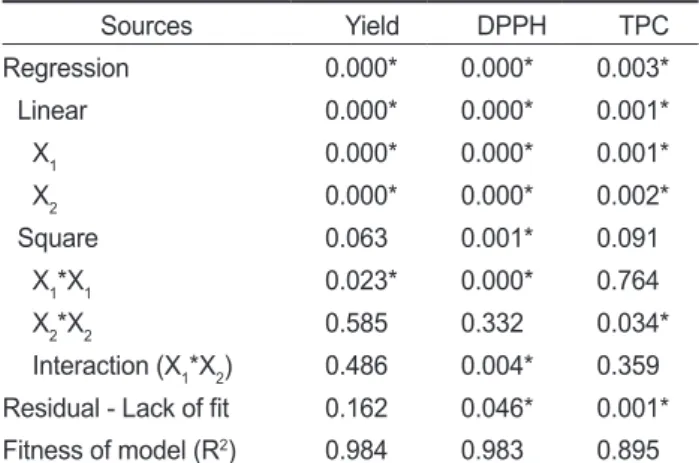
차 다항방정식에 대한P-value
값은Table 3
에 나타내었 다.
반응모델회귀분석의적합도를나타내는R
2(
결정계수)
는0.984
였으며,
이2
차다항방정식의P-value
는0.000
으로유의 적의미가있었다.
이를통해2
차다항방정식이반응값을예측 하는데적합하다고판단하였다.
온도가증가하고시간이길어 짐에따라수율이증가하는경향을보였으며,
특히추출온도가 반응모델에가장유의적인영향을주는조건으로예측되었다.
추출수율에대한3
차원반응표면그래프는Fig. 1A
에나타내 었다.
반응표면그래프는온도와시간이증가함에따라상승하 는능선의형태를보였는데,
이런경우최대값이설정된실험 조건밖에서나타나는것을의미한다.
즉,
추출수율의최대값 은온도70°C
이상, 36
시간이상에서나타날것으로예측되었 다.
이는Sargassum latifolium
에서의알긴산추출최적화에대Table 3. Results of statistical analyses on extraction yield, DPPH radical-scavenging activity, TPC from Sargassum serratifolium extracts
Sources Yield DPPH TPC
Regression 0.000* 0.000* 0.003*
Linear 0.000* 0.000* 0.001*
X1 0.000* 0.000* 0.001*
X2 0.000* 0.000* 0.002*
Square 0.063 0.001* 0.091
X1*X1 0.023* 0.000* 0.764
X2*X2 0.585 0.332 0.034*
Interaction (X1*X2) 0.486 0.004* 0.359 Residual - Lack of fit 0.162 0.046* 0.001*
Fitness of model (R2) 0.984 0.983 0.895 DPPH, 2,2-dipheny-1-picrylhydrazyl; TPC, total phenolic content.
*Significant at P<0.05
Fig. 1. Response surface plot showing the effects of extraction temperature (X1) and time (X2) on extraction yield (A; Y1), DPPH radical-scavenging activity (B; Y2) and TPC (C; Y3). DPPH, 2,2-dipheny-1-picrylhydrazyl; TPC, total phenolic content.
한선행연구에서도추출공정에서온도가높아질수록추출수 율이증가하였으며
,
추출수율의반응표면그래프와등고선도 가능선형을나타내고있음을확인하였다(Fawzy et al., 2017).
추출물의 DPPH 라디칼 소거능
DPPH
라디칼소거능측정은빠르고간단하게시료의항산화효과를측정할수있어식물이나식품추출물등에많이사용되
고있는방법이다
. DPPH
는비교적안정한라디칼화합물로항산화활성을가지고있는물질에의해비가역적으로환원되어 짙은보라색이노란색으로옅어지는데
,
이러한색차를비색정 량하여시료의항산화활성을측정한다(Wisanu et al., 2009).
본실험조건에따른
DPPH
라디칼소거능은Table 2
에나타내 었다.
실험조건중추출온도70°C
에서36
시간추출하는경우 에29.7%
로가장낮은DPPH
라디칼소거능을나타냈으며,
추 출온도30°C
에서12
시간추출하는경우에최대값인62.1%
를 가지는것으로측정되었다.
추출온도(x)
와추출시간(y)
에대한DPPH
라디칼소거능(Y
2)
의관계에대한결과는다음의2
차다 항방정식으로나타내었다.
Y
2=53.080-10.448x-4.900y-4.646x
2+0.704y
2-3.825xy 2
차다항방정식에대한P-value
값은Table 3
에나타냈다. R
2값은
0.983
을나타냈으며, 2
차다항방정식에서독립변수에대한통계분석의결과로
P<0.05
에서의미가있으므로,
이를적용 한2
차다항방정식이반응값을예측하는데적합하다고판단하였다
. DPPH
라디칼소거능에대한3
차원반응표면그래프는Fig. 1B
에나타내었다. DPPH
라디칼소거능은온도가낮아지 고,
시간이짧아짐에따라증가하는경향을보였다.
통계분석결과추출온도가
DPPH
라디칼소거능에가장유의적인영향을주는요인으로예측되었다
.
이러한결과를통해높은온도 와오랜시간동안추출한추출물은라디칼소거활성을갖는 항산화활성을나타내는폴리페놀등의성분들대신항산화활성을갖지않는성분들이많이추출된것으로판단된다
(Ha et
al., 2015).
추출물의 총 페놀 함량
다양한추출물에서항산화능과총페놀함량사이의긍정적인 관계에대해서알려져있다
(Balboa et al., 2013).
여러연구에 서페놀화합물은갈조류에서가장효과적인항산화제중하나라고보고하였다
(Nagai and Yukimoto, 2003; Chandini et al., 2008).
최근연구에서톱니모자반에meroterpenoids (SHQA, SQA, SCM), phlorotannins
그리고fucoxanthin
등다양한페 놀화합물을가지고있다고알려져있다(Yende et al., 2014).
이 에각추출물의총페놀함량을분석하여항산화능을판단하였 다.
실험조건에따른추출물의총페놀함량은Table 2
에나타 내었다.
실험조건중추출온도78°C
에서24
시간추출하는경우에
105.3 mg GAE/mL
로가장낮은폴리페놀함량이추출되었으며
,
추출온도50°C
에서7
시간추출하는경우에는182.6
mg GAE/mL
로가장많은폴리페놀함량이추출되었다.
추출온도
(x)
와추출시간(y)
에대한추출물의총페놀함량(Y
3)
의관 계식을데이터분석에의한얻은2
차다항방정식은다음과같 이나타내었다.
Y
3=125.66-18.69x-16.00y+1.14x
2+9.64y
2+4.75xy 2
차다항방정식에대한회귀분석과분산분석결과는Table 3
에나타냈다. R
2값은0.895
를나타냈으며, 2
차다항방정식은P<0.05
에서유의하므로, 2
차다항방정식이반응값예측에적 합하다고판단하였다.
총폴리페놀함량에대한3
차원반응표 면그래프는Fig. 1C
에나타내었다.
총폴리페놀함량은온도가 낮아지고,
시간이짧아짐에따라증가하는경향을보였으며,
이는
DPPH
라디칼소거능의결과와유사한경향을보였다.
통계분석결과에서추출시간이반응모델에가장유의적으로영향 을주는요인으로예측되었다
.
최적 추출조건의 결정 및 모델 검증
본연구에서의각
2
차다항방정식에서예측한최대값은설정 한범위의밖에존재하는것으로예측되었다.
또한, 3
차원반응 표면그래프를이용한반응변수에서는최대점이나최소점을찾 지못하였으며,
추출온도와추출시간에따른반응값의증가와 감소하는 경향만을확인하였다.
이에반응변수의최대값이나 최소값을갖는최적추출조건이아닌실험조건내에서의최적 의추출조건을예측하였다.
각반응변수에대한최적추출조건 은Table 4
에나타내었다.
예측된각각의반응변수별최적의추 출조건으로실제추출및실험을수행하였고그실험값을예측 값과비교하여모델의정확도를검증하였다.
실험값과예측값 의차이는오차를통해표현하였다.
추출수율에서가장낮은오 차(2.3%)
를나타내었고,
다음으로총페놀함량(total phenolic
Table 4. Optimum conditions and comparison of predicted and observed values for verificationResponses Optimum extract condition
Predicted Observed1 Error(%) Temperature (°C) Time (h)
Yield (%) 78 41 12.8 12.5±0.1 2.3
DPPH (%) 39 7 62.8 66.1±3.3 5.3
TPC (mg GAE/mL) 22 7 205.8 212.6±8.7 3.3
1Mean±SD (n=2). DPPH, 2,2-dipheny-1-picrylhydrazyl; TPC, total phenolic content; GAE, gallic acid equivalent.
content, TPC) (3.3%), DPPH
라디칼소거능(5.3%)
순으로나 타났다(Table 4).
각각의반응변수들의2
차다항식들이유의하 고,
실험값과예측값사이의오차가크지않다는점을통해모 델이반응을설명하는데 적합하다고 판단하였다.
이에수율,
DPPH
라디칼소거능, TPC
에대한최적추출조건을설계한실험조건범위내에서예측하였다
.
중심합성설계법을통해예측 된최적추출조건은추출온도53.7°C,
추출시간7
시간으로나 타났다.
예측된최적추출조건에대한반응변수의예측값은수 율8.2%, DPPH
라디칼소거능60.3%, TPC 162.9 mg GAE/
mL
이었다.
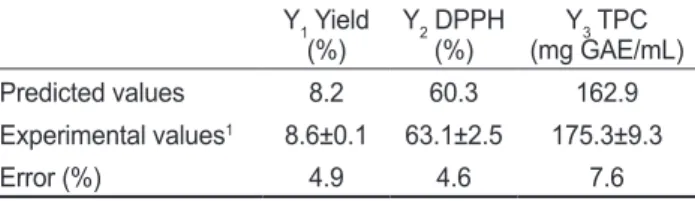
예측된반응값의 정확도를검증하기위해최적추출조건에서추출및실험을수행하였으며
,
그결과수율8.6%, DPPH
라디칼소거능63.1%, TPC 175.3 mg GAE/mL
로예측 값과유사한결과를보였다(Table 5).
최적 추출물의 항산화 성분 함량
톱니모자반에탄올추출물은항산화
,
항염증및항비만과같 은효능을가지는meroterpenoid
를 함유하고 있다.
특히모 자반에함유되어있는SHQA
는항산화(Lim et al., 2019),
항 암(Jiaqi et al., 2019),
항비만(Kwon et al., 2019)
의효능을나 타내며, SCM
은항산화(Lim et al., 2019),
항염증(Lee et al., 2013; Yoon et al., 2012)
효능을나타내며마지막으로SQA
는 세가지성분중가장높은항산화능을가지고있으며(Lim et al., 2019),
저색소침착효과(Azam et al., 2018),
항염증(Joung et al., 2015),
항비만(Kwon et al., 2020)
등의효능을나타내는 것으로알려져있다.
이에톱니모자반에함유되어있는SHQA, SCM, SQA
를분리하여HPLC
를이용하여분석하였다.
최적 조건에서추출한톱니모자반추출물의세가지성분의농도는Table 6
에나타내었다.
톱니모자반의세가지성분은SHQA 50.41 mg/100g, SCM 3.28 mg/100g, SQA 9.69 mg/100g
으로 세가지성분의총량은63.39 mg/100g
이었다. SHQA, SQA,
SCM
순으로많이함유되어있었으며,
이는톱니모자반의추출 용매별항산화성분을측정한Lim et al. (2019)
의연구에서나 타난경향과같았다.
고 찰
본연구에서는식품공정에서주요한반응조건인추출수율과 기능성을나타내는항산화능
,
총폴리페놀함량의최적화를위 하여중심합성설계법을사용하여최적추출조건을예측하였다. 2
가지인자(
추출온도와추출시간)
와축점을적용한5
가지의수 준으로총13
번의실험을3
번반복하였다.
최적화하기위한반 응변수로는총3
가지인자(
추출수율, DPPH
라디칼소거능,
총 폴리페놀함량)
가설정되었다.
실험데이터의분석결과,
추출온 도와추출시간모두3
가지인자에유의적으로영향을주는것 을알수있었다.
이에톱니모자반의최적추출조건은추출온도53.7°C,
추출시간7
시간으로예측되었으며,
이에대한반응값 은추출수율8.2%, DPPH
라디칼소거능60.3%,
총폴리페놀 함량162.9 mg GAE/mL
로예측되었다.
예측된조건에서실제 로추출및실험하여얻은실험값과유사한결과를보였다.
본 연구의결과는톱니모자반추출물을식품및화장품원료로개 발하기위한제조공정에서유용한정보를제공할것으로기대 된다.
사 사
이논문은부경대학교자율창의학술연구비
(2019
년)
에의하 여연구되었음.
References
Azam MS, Joung EJ, Choi J and Kim HR. 2017. Ethanolic extract from Sargassum serratifolium attenuates hyper- pigmentation through CREB/ERK signaling pathways in α-MSH-stimulated B16F10 melanoma cells. J Appl Phycol 29, 2089-2096. https://doi.org/10.1007/s10811-017-1120-8.
Azam MS, Kwon M, Choi J and Kim HR. 2018. Sargaqui- noic acid ameliorates hyperpigmentation through cAMP and ERK-mediated downregulation of MITF in α-MSH- stimulated B16F10 cells. Biomed Pharmacother 104, 582- 589. https://doi.org/10.1016/j.biopha.2018.05.083.
Balboa EM, Conde E, Moure A, Falque E and Dominguez H.
2013. In vitro antioxidant properties of crude extracts and compounds from brown algae. Food Chem 138, 1764-1785.
https://doi.org/10.1016/j.foodchem.2012.11.026.
Blois MS. 1958. Antioxidant determinations by the use of a stable free radical. Nature 181, 199-1200. https://doi.
org/10.1038/1811199a0.
Chakraborty K, Joseph D and Praveen NK. 2015. Antioxidant activities and phenolic contents of three red seaweeds (Di- Table 6. Identification and quantification of three major antioxi-
dants from Sargassum serratifolium in the optimum condition Sargahydroquinoic
acid (mg/100g) Sargachromanol
(mg/100g) Sargaquinoic acid (mg/100g)
50.41±3.90 3.28±0.07 9.69±0.16
Table 5. Experimental and predicted results of verification under optimized condition
Y1 Yield
(%) Y2 DPPH
(%) Y3 TPC (mg GAE/mL)
Predicted values 8.2 60.3 162.9
Experimental values1 8.6±0.1 63.1±2.5 175.3±9.3
Error (%) 4.9 4.6 7.6
Optimized condition: Extraction temperature=54°C; Extraction time=7 h. 1Mean±SD (n=2). DPPH, 2,2-dipheny-1-picrylhydrazyl;
TPC, total phenolic content; GAE, gallic acid equivalent.
vision: Rhodophyta) harvested from the gulf of mannar of peninsular India. J Food Sci Technol 52, 1924-1935. https://
doi.org/10.1007/s13197-013-1189-2.
Chandini SK, Ganesan P and Bhaskar N. 2008. In vitro anti- oxidant activities of three selected brown seaweeds of India.
Food Chem 107, 707-713. https://doi.org/10.1016/j.food- chem.2007.08.081.
Fawzy MA, Gomaa M, Hifney AF and Abdel-Gawad KM.
2017. Optimization of alginate alkaline extraction technol- ogy from Sargassum latifolium and its potential antioxidant and emulsifying properties. Carbohydr Polym 157, 1903- 1912. https://doi.org/10.1016/j.carbpol.2016.11.077.
Folin O and Denis W. 1912. On phosphotungstic-phosphomo- lybdic compounds as color reagents. J Biol Chem 12, 239- 243. https://doi.org/10.1016/S0021-9258(18)88697-5.
Gwon WG, Joung EJ, Shin T, Utsuki T, Wakamatsu N and Kim HR. 2018. Meroterpinoid-rich fraction of the ethanol extract from Sargassum serratifolium suppresses TNF-α- induced monocytes adhesion to vascular endothelium and vascular inflammation in high cholesterol-fed C57BL/6J mice. J Funct Foods 46, 384-393. https://doi.org/10.1016/j.
jff.2018.05.013.
Ha JH, Jeong YJ, Seong JS, Kim KM, Kim AY, Fu MM, Suh JY, Lee NH, Park J and Park SN. 2015. Antioxidant and an- tibacterial activities of glycyrrhiza uralensis fisher (Jecheon, Korea) extracts obtained by various extract conditions.
J Soc Cosmet Scientists Korea 41, 361-373. https://doi.
org/10.15230/SCSK.2015.41.4.361.
Jiaqi Z, Shin T and Yun JM. 2019. Sargahydroquinoic acid, a meroterpenoid in brown seaweed, induces apoptosis in high glucose treated-human colon cancer HCT116 cells. In: Pro- ceedings of the 70th Annual Meeting of the Korean Society of Food Science and Nutrition, Jeju, Korea, 453.
Joung EJ, Lee B, Gwon WG, Shin T, Jung BM, Yoon NY, Choi JS, Oh CW and Kim HR. 2015. Sargaquinoic acid attenuates inflammatory responses by regulating NF-κB and Nrf2 pathways in lipopolysaccharide-stimulated RAW 264.7 cells. Int Immunopharmacol 29, 693-700. https://doi.
org/10.1016/j.intimp.2015.09.00.
Kadam SU, Tiwari BK and O'Donnell CP. 2013. Application of novel extraction technologies for bioactives from ma- rine algae. J Agric Food Chem 61, 4667-4675. https://doi.
org/10.1021/jf400819p.
Kwon M, Lee B, Lim SJ, Choi JS and Kim HR. 2019. Sargahy- droquinoic acid, a major compound in Sargassum serratifo-
lium (C. Agardh) C. Agardh, widely activates lipid catabolic
pathways, contributing to the formation of beige-like adipo- cytes. J Funct Foods 58, 355-366. https://doi.org/10.1016/j.jff.2019.04.045.
Kwon M, Lee B, Lim S and Kim HR. 2020. Effects of sargaqui- noic acid in Sargassum serratifolium on inducing brown ad- ipocyte-like phenotype in mouse adipocytes in vitro. Planta
Med 86, 45-54. https://doi.org/10.1055/a-1023-7385.
Lee JH, Ko JY, Samarakoon K, Oh JY, Heo SJ, Kim CY, Nah JW, Jang MK, Lee JS and Jeon YJ. 2013. Preparative isola- tion of sargachromanol E from Sargassum siliquastrum by centrifugal partition chromatography and its anti-inflam- matory activity. Food Chem Toxicol 62, 54-60. https://doi.
org/10.1016/j.fct.2013.08.010.
Lee SB. 2014. Example-based DOE using Minitab. Eretec Inc, Gunpo, Korea, 227-261.
Lim S, Choi AH, Kwon M, Joung EJ, Shin T, Lee SG, Kim NG and Kim HR. 2019. Evaluation of antioxidant activities of various solvent extract from Sargassum serratifolium and its major antioxidant components. Food Chem 278, 178-184.
https://doi.org/10.1016/j.foodchem.2018.11.058.
Nagai T and Yukimoto T. 2003. Preparation and functional prop- erties of beverages made from sea algae. Food Chem 81, 327-332. https://doi.org/10.1016/S0308-8146(02)00426-0.
Ray PD, Huang BW and Tsuji Y. 2012. Reactive oxygen species (ROS) homeostasis and redox regulation in cellular signal- ing. Cell Signal 24, 981-990. https://doi.org/10.1016/j.cell- sig.2012.01.008.
Sies H. 2000. What is oxidative stress?. In: Oxidative stress and vascular disease. Springer, 1-8. https://link.springer.com/
chapter/10.1007/978-1-4615-4649-8_1.
Wells ML, Potin P, Craigie JS, Raven JA, Merchant SS, Helli- well KE, Smith AG, Camire ME and Brawley SH. 2017.
Algae as nutritional and functional food sources: revisiting our understanding. J Appl Phycol 29, 949-982. https://doi.
org/10.1007/s10811-016-0974-5.
Wisanu T, Boonsom L and Saisunee L. 2009. Flow injection analysis of total curcuminoids in turmeric and antioxi- dant capacity using 2,2-diphenyl-1-picrylhydrazyl assay.
Food Chem 112, 494-499. https://doi.org/10.1016/j.food- chem.2008.05.083.
Yende SR, Harle UN and Chaugule BB. 2014. Therapeutic po- tential and health benefits of Sargassum species. Pharma- cogn Rev 8, 1-7. https://doi.org/10.4103/0973-7847.125514.
Yoon WJ, Heo SJ, Han SC, Lee HJ, Kang GJ, Kang HK, Hyun JW, Koh YS and Woo ES. 2012. Anti-inflammatory effect of sargachromanol G isolated from Sargassum siliquastrum in RAW 264.7 cells. Arch Pharm Res 35, 1421-1430. https://
doi.org/10.1007/s12272-012-0812-5.