39(3) : 255 259 (2008)
255
민들레 추출물의 항산화 활성 및 세포독성 효과
허성일·왕명현*
강원대학교생명공학부
Antioxidant Activity and Cytotoxicity Effect of Extracts from Taraxacum mongolicum H.
Seong-Il Heo and Myeong-Hyeon Wang*
School of Biotechnology, Kangwon National University, Chuncheon, 200-701, Republic of Korea
Abstract −This study was investigated antioxidant and anticancer activity of water, methanol extract from upper and root part of Taraxacum mongolicum H. Total phenolic compound contents of methanol and water extracts from upper part were 51.95±0.18 mg/g and 48.16±0.89 mg/g respectively, and total flavonoid compound contents were estimated as 20.57±1.12 mg/
g in methanol extract and 6.55±1.20 mg/g in water extract. EC50 values for DPPH radical scavenging activity of methanol and water extract from upper part were 138.47±3.78µg/mL and 204.38±5.32µg/mL, and methanol and water extracts from root part were as 512±8.11µg/mL in methanol extract and 1315.05±11.98µg/mL in water extract. Reducing power and hydroxyl radical (·OH) scavenging activity estimated that methanol extract of each part were higher than water extracts. The cell viability showed that the methanol extract from upper part had a cytotoxicity in the growth of colon carcinoma cell (44.58%). Both water extract (51.97±11.43%) from upper part and methanol (53.46±19.77%), water (52.79±13.53%) extracts from root part had quite higher cytotoxicity than that of methanol extract (88.25±2.02%) from upper part. Based on the results, It was suggested that the methanol extract of Taraxacum mongolicum H. were potential materials for use as functional food and medicine.
Keywards −Antioxidant activity, Ancticancer activity, Total phenolic content, Taraxacum mongolicum H.
산소는지구상에서가장많은원소로서건조대기중의
21%를차지하고있으며, 호기성생물은이렇게풍부한산
소를전자수용체로하는호흡을통해에너지를획득한다.
그러나, 이와같이생명유지에절대적으로필요한산소이지
만안정한분자상태인기저삼중항산소(ground state triplet oxyzen)가체내효소계, 환원대사, 화학약품, 공해물질, 광화
학반응등의물리적, 화학적, 환경적요인등에의하여수
퍼옥사이드라디칼 (superoxide radical, O2·-), 과산화수소 (hydrogen oxyzen, H2O2), 하이드록실 라디칼 (hydroxyl radical, ·OH), 일중항산소 (singlet oxyzen, 1O2)와같은반
응성이매우큰활성산소 (active oxyzen)로전환되면생체
에치명적인산소독성을일으키는양면성을지니고있다.1-2)
즉, 이들활성산소는세포구성성분들인지질, 단백질, 당, DNA 등에대하여비선택적, 비가역적인파괴작용을함으
로써노화는물론암을비롯하여뇌졸중, 파킨슨병등의노
질환과심장질환, 동맥경화, 피부질환, 소화기질환, 염증, 류
마티스, 자가면역질환등의각종질병을일으키는것으로
보고되었다.3-4)
정상적인세포에서도대사과정중어느정도의자유라디 칼 (free radical)과기타활성산소및과산화물이생성되고
있으나 생체 내에는 이들에 대한 방어기구로서 SOD (superoxide dismutase), catalase, peroxidase 등의항산화효
소와함께 vitamin C, vitamin E, glutathione과같은항산화
물질이존재하여스스로를보호하고있다.5)그러나이와같
은생체방어기구에이상이초래되거나각종물리적, 화학적
요인들에의하여활성산소의생성이생체방어계의용량을 초과하게될경우산화적스트레스 (oxidative stress)가야
기된다. 이와같은활성산소종 (ROS)을제거하기위한항
산화제의중요성이부각되고있으며, 현재우리주변에서접
할수있는항산화제에는 vitamin E류, Vitamin C, tocopherol, flavonoid류등천연항산화제가있으며, BHA, BHT 등합
성항산화제가있다. 하지만 BHA, BHT 등의합성항산화
*교신저자(E-mail):[email protected] (FAX):033-241-6480
제가체내에너지생산과세포대사및호흡작용을방해하 며발암성이있고독성이강하다는문제점이보고되고있 다. 이러한합성항산화제의문제점에따라식용이가능한
천연자원으로부터유용활성물질을찾는것이주요하다.
민들레 (Taraxacum mongolicum H.)는국화과 (Compositae)
에속하는여러해살이풀로써잎은거꾸로세운바소꼴이 며, 깃꼴로깊이패어들어간모양이며톱니가있다.6-7)이
는한방에서포공영 (浦公英)이라하며독이없고, 열을내리
고해독과이뇨에효과가있으며, 염증이나종기를낫게하
며, 간과담낭질환에효과가있다고알려져있다. 하지만토
종민들레는서양민들레의왕성한번식력에밀려토종민들 레를찾아보기매우어려운실정이다. 이에토종민들레의
항산화및항암효과를평가하여활용가치를높이며, 그우
수성을알리고자한다.
재료 및 방법
실험재료 −본실험에사용한민들레는 2007년 10월에
정선군에서채취된것을구입하여사용하였으며, 시료의추
출방법은시료중량대비 20배의증류수및메탄올을가하
여 24 시간동안실온에서침지하여추출하였으며, 각추출
물은 Advantec No. 2 여과지로여과하여감압농축하여본
실험의시료로사용하였다.
총 페놀성 화합물 함량 −총페놀성함량은페놀성물질 이 phosphomolybdic acid와반응하여청색으로발색되는것
을이용한 Folin-Denis 방법에따라분석하였다.8-9)즉, 1 mg/
mL로조제한추출물 1 mL에 Folin-Denis 시액 2 mL을잘
넣고, 35%의탄산나트륨 (Na2CO3) 용액을 2 mL을넣은다
음 잘 혼합하여 실온에서 30 분간 반응 후, 분광도계 (ELx800, Biotec, USA)를이용하여 750 nm에서흡광도를
측정하였다. 측정된흡광도는탄닌산 (tannic acid)을이용하
여작성된표준곡선을이용하여검량선을작성하여총페 놀성화합물의함량을계산하였다.
총 플라보노이드 화합물 함량 − 1 mg/mL의농도로추출
물을제조하여, 20 mg/mL의 aluminum trichloide을함유하
는 100% 에탄올 (ethanol)용액잘혼합하여 40 분동안실
온에서반응시킨후 UV/VIS 분광도계 (Optizen 2120UV, Mecasys, Korea)를이용하여 415 nm에서흡광도를측정하
였다. 이때총플라보노이드함량은 quercetin을이용하여
작성한표준곡선으로부터함량을구하였다.9)
전자공여능 측정 − 시료의전자공여능은 1,1-diphenyl-2- pycrylhydrazyl (DPPH, Sigma)을이용한방법으로측정하
였다.10)즉, 10, 50, 100, 500, 1000µg/mL의농도로준비한
추출물 1 mL에 0.2 mM DPPH 용액 1 mL을잘혼합하여 25 분간 실온에 방치하고 multiplate spectrophotometer (ELx800TM, BioTek, USA)를이용하여 515 nm 흡광도를
측정하고아래와같이계산하여 EC50값으로나타내었다.
전자공여능 (%) = (1− 시료첨가군의흡광도/무첨가군의
흡광도) × 100
환원력의 측정 − Moreni 등11)방법에 의거하여시료의
환원력을 측정하였다. 즉, 각각의농도별로조제한 시료 0.1 mL에 0.2 M 인산 완충액 (pH 6.8) 0.25 mL과 1%
potassium ferricyanide [K3Fe(CN)6] 0.25 mL을넣은 다음, 50oC에서 20 분간 반응시킨다. 반응 후, 0.25 mL의 10%
trichloroacetic acid를첨가하고 1000 rpm 10 분간의원심분
리를통하여얻어진상등액에 0.1%의 FeCl3 0.05 mL을넣
어서발색반응을유도시킨다음, multiplate spectrophotometer (ELx800TM, BioTek, USA)를사용하여 750 nm에서흡광도
를측정하였다.
·OH 소거능 측정 − Hydroxyl radical 소거능 측정은
Fenton 반응으로생성된 ·OH에 의해핵산의 구성당인
deoxyribose가분해되는정도를 TBA 발색법을이용하여측
정한다. 시험관에 각 부위별 추출물 0.2 mL에 10 mM
FeSO4/EDTA 용액 0.2 mL, 10 mM 2-deoxyribose 0.2 mL, 0.1 M phosphate buffer (pH 7.4) 1 mL를 잘 혼합한 후, 10 mM H2O2 0.2 mL를가하고 37oC에서 4 시간반응시킨
후 2.8% TCA (trichloroacetic acid)용액 1 mL과 1.0%
TBA (Thiobarbituric acid)를첨가하여 100oC에서 10 분가
열한후급속냉각시켜 532 nm에서 UV-Visible spectrophotometer (Optizen 2120UV, Mecasys, Korea)에서흡광도를측정하였다.
암세포주 및 배양조건 −항암활성실험에이용된 HT-29 (colon carcinoma cell, 결장암세포), NCI-N87 (stomach carcinoma cell, 위암세포), 293 (normal kidney cell, 정상신
장세포)은 10% FBS (fetal bovine serum, Gibco, Rocville, MD, USA)와 1% penicillin-streptomycin (100 IU-100µg/
mL)이첨가된 RPMI 1640 medium에접종하여 37oC, 5%
CO2, humidified atmosphere에서배양하였다. 각각의세포
들은 2~3 일간배양한후배지를제거하고 PBS (pH7.4)로
세척한뒤 0.25% trypsin-EDTA 용약을처리하여부착된세
포를분리시켜원심분리하고, 상등액을제거후모아진세
포에새로운배지를넣어 1×10⁵ cells/mL로접종하여계대
배양하였다.
MTT assay에 의한 항암효과 측정− 3-(4,5-dimetylthiazol- 2-yl)-2,5-diphenyl tetrazolium bromide (MTT)를이용한방
법은 Athukorala가제시한방법에따라실시하였다.13) 96well plate의각 well에세포부유액 0.1 mL (105 cells/mL)을접
종하여 37oC의 CO2배양기에서 24 시간배양한후 0.3 mg/
mL 농도의추출물 0.1 mL를넣고 48 시간배양한후상등
액을 제거하고, PBS (pH 7.4)에 5 mg/mL의농도로녹인 MTT 용액 10µL에배지 90µL를더하여각각 well에넣어
주고, 빛을차단하고 3 시간반응후상층액을버리고 DMSO
를 100µL씩넣고 10 분동안실온에서방치한후 ELISA reader (ELx800, Bio-Tek, USA)를이용하여 550 nm에서흡
광도를측정하여대조군과비교하여 cell viability를측정하
였다.
결과 및 고찰
민들레 부위별 추출물의 총 페놀성 및 플라보노이드 화 합물 함량 − 민들레는지상부와 뿌리로나누어메탄올
(methanol)과 물 (distilled water)을 이용하여추출하였다
(Table I). 추출수율은 지상부메탄올, 물추출물이 각각
8.54%, 19.28%로나타났으며, 뿌리메탄올, 물추출물이각
각 8.45%, 31.94%로나타났다. 부위별메탄올추출물에비
해물추출물에서추출수율은높았으며뿌리추출물이지 상부추출물에비해비교적높았다. 총페놀성화합물은항
산화효과와밀접한관계가있으며, 식물계에널리분포되
어있는페놀성물질은다양한구조와분자량을가지며이 것은단백질처럼거대분자와결합하여항산화, 항균, 항암
등의생리활성기능을가지는것으로보고되었다.14)
민들레지상부메탄올추출물의페놀성화합물의함량은
51.95±0.18 mg/g으로가장높게나타났으며, 지상부물추
출에서 48.16±0.89 mg/g으로나타났다 (Table I). 민들레뿌
리메탄올추출물에서 23.35±0.24 mg/g, 물추출물에서 8.16
±0.16 mg/g으로가장낮게나타났다. 민들레의지상부가뿌
리보다페놀성화합물을많이함유하는것으로보여지며,
각부위별메탄올추출물에서페놀성함량이더높은것으 로나타났다. 페놀성화합물에속하는플라보노이드함량은
지상부의메탄올추출물에서 20.57±1.12 mg/g으로다른부
위및다른용매 추출물보다높게나타났으며지상부물 추출물 (6.55±1.20 mg/g), 뿌리 메탄올 추출물 (0.54± 0.03 mg/g), 뿌리물추출물 (0.38±0.05 mg/g)순으로나타났
다. 이는추출물의페놀성함량에비례적으로지상부의메
탄올추출물에서가장높게나타났으며, 뿌리보다는지상
부추출물에서높게나타났다.
민들레 추출물의 항산화 효과 −환경, 화학약품, 광등에
생성된활성산소종 (reactive oxygen species, ROS)에의해
유발되는산화적스트레스는체내에서노화, 암, 심혈관계
질환을비롯그외의병리적문제를야기시키므로 ROS를
차단하거나제거하기위한방법을식물체내에서찾고자노 력하였으며, 민들레에관한연구도이런항산화활성이나
라디칼소거활성에관하여많이진행되고있다. 하지만토
종민들레로알려진Taraxacum mongolicum H.에대한연
구는희귀성때문에아직미미한실정이다.15)부위별민들
레추출물의항산화효과는 DPPH radical 소거능, 환원력, ·OH
radical 소거능의총 3가지방법에의해측정되어결과를
Table I. The yield, total phenolic and flavonoid content of methanol and water extracts from upper part and root part of Taraxacum mongolicum H.
Sample Yield (%) Total phenolic content
(mg Tana/g) Total flavonoid content (mg Queb/g)
Upper part MeOH ext. 8.54 51.95±0.18 20.57±1.12
Water ext. 19.28 48.16±0.89 26.55±1.20
Root part MeOH ext. 8.45 23.35±0.24 20.54±0.03
Water ext. 31.94 28.16±0.16 20.38±0.05
aTannic acid (Tan) was used as a standard for measuring of the total phenolic content.
bQuercetin (Que) was used as a standard for measuring of the total flavonoid content.
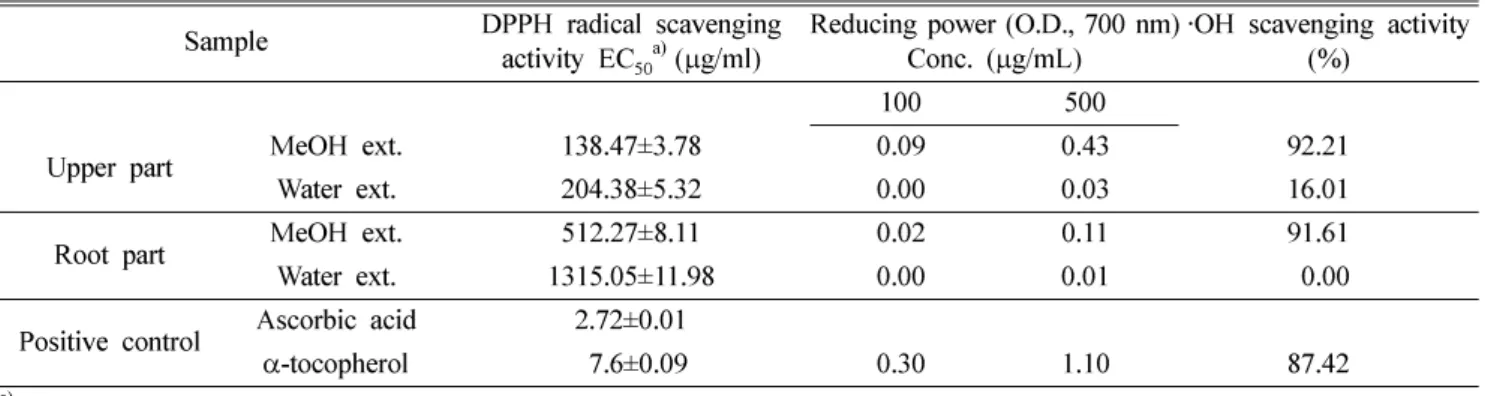
Table II. Antioxidant activities of extracts from Taraxacum mongolicum H.
Sample DPPH radical scavenging
activity EC50a) (µg/ml) Reducing power (O.D., 700 nm)
Conc. (µg/mL) ·OH scavenging activity
100 500 (%)
Upper part MeOH ext. 138.47±3.78 0.09 0.43 92.21
Water ext. 204.38±5.32 0.00 0.03 16.01
Root part MeOH ext. 512.27±8.11 0.02 0.11 91.61
Water ext. 1315.05±11.98 0.00 0.01 0.00
Positive control Ascorbic acid 2.72±0.01
α-tocopherol 27.6±0.09 0.30 1.10 87.42
a)Amount required for 50% reduction of DPPH(0.2 mM) after 25 min.
Table II에나타내었다. DPPH radical 소거능은지상부메탄
올추출물에서 EC50값이 138.47±3.78µg/mL로가장높게
나타났으며, 지상부물추출물이 204.38±5.32µg/mL로나
타났으며, 뿌리메탄올, 물추출물에서 512.27±8.11µg/mL, 1315.05±11.98µg/mL로나타났다. 이와같은결과는페놀
성및플라보노이드함량과비례적으로나타났는데이같
은결과는 DPPH radical 소거능이페놀성화합물의함량과
밀접한관계를나타낸것이라고사료된다.
환원력은흡광도수치로써발색정도가높을수록높은환 원력을나타내며, 환원력은항산화활성과밀접한관련이
있는것으로보고되었다.16)민들레의부위별추출물 100µg/
mL, 500µg/mL의농도에대한환원력측정결과는 Table II와같다. 전자공여능즉 DPPH radical 소거능과유사한경
향으로추출물의농도가증가할수록환원력도증가하였다.
지상부메탄올추출물 500µg/mL의농도에서 0.43으로환
원력이가장높게나타났으며, 부위와관계없이메탄올추
출물에서비교적높게나타났으며, 물추출물에서낮게나
타났다. Hydroxyl radical (·OH)은활성산소중에서반응
성이강하여생체내각종조직및세포막등의산화에중 요한역할을하는것으로알려져있다. 민들레부위별추출
물의·OH radical 소거능은 Table II에나타내었다. 지상부
의메탄올추출물에서 92.21%, 뿌리의메탄올추출물에서
91.61%로높게 나타났으며, 이는대조군으로사용된 α-
tocopherol (87.42%)에비해더높은소거능을나타났다.
민들레 추출물의 항암활성 – 민들레의항암및항종양활
성에관한보고는토종민들레 (Taraxacum mongolicum H.)
의에틸아세테이트분획물에서간암세포에대한항암효과 가있다고보고되었으며,17)그밖에, 서양민들레의물추출
물이항종양효과를나타낸다는보고도있다.18)
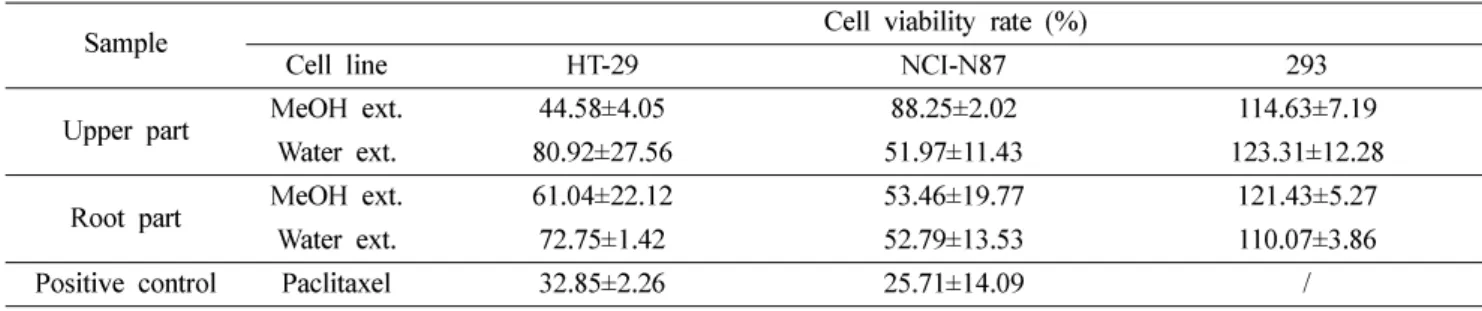
민들레의부위별추출물 (300µg/mL)의결장암과위암세
포에 대한 항암활성은 Table III과 같고 대조군으로는 paclitaxel 5µg/mL을사용하였다. HT-29 (결장암세포)에대
해민들레추출물의항암효과는지상부의메탄올추출물에 서세포생존율 44.58±4.05%로가장높게나타났으며, 뿌
리메탄올추출물에서 61.04±22.12%로나타났다. NCI-N87 (위암세포)에대한항암효과는지상부물추출물, 뿌리메탄
올, 물 추출물에서 세포 생존율 51.97±11.43%–53.46±
19.77%로비슷하게나타났으며, 결장암세포에서높은항암
활성을나타낸지상부메탄올추출물에서는 88.25±2.02%
로낮게나타났다. 각추출물들은 293 (정상신장세포) 세
포를이용하여세포에대한독성을나타내는지를검토하였 다. 지상부, 뿌리의메탄올, 물추출물모두에서정상신장
세포는세포생존율 110.07–123.31%로나타났으며, 이는추
출물이세포독성을갖지않는다는것을나타낸다. 민들레
추출물은정상세포에대해독성을나타내지않았으며, 지상
부메탄올추출물은결장암세포에대해높은항암효과를나 타냈다. 또한위암세포에대해서는지상부의메탄올, 물추
출물이항암활성을나타내었으며, 이는민들레가결장암및
위암에대해항암효과를갖고있다고사료된다.
결 론
민들레 (Taraxacum mongolicum H.)는생리활성을나타내
는페놀성화합물을많이함유하고있으며, 생체내여러병
인으로작용되는 ROS를소거및차단하는높은항산화효
과를나타내었다. 또한현대인이높은발병률을나타내는
결장암및위암에 대해항암효과를나타내고있다. 하지만
유럽을비롯한서양에서는예전부터식품및약용으로민 들레를이용하여왔으나, 국내에서는민들레의우수한효능
에도불구하고이용가치가낮게평가되고있다. 추출물단
위가아닌민들레의생리활성및약리성을갖는물질의연 구가더욱더요구되며, 또한이를통해기능성식품및의
약품소재로개발할수있는다방면의연구가필요할것이다.
인용문헌
1. Halliwell, B. and Gutteridge, J. M. C. (1991) Free radicals in biology and medicine. Third ed. Oxford University Press, New York.
2. Pokorny, J., Yanishlieva, N. and Gordon, M. (2000) Anti- oxidants in food. CRC press, Boca Raton, USA.
3. Branen, A. L. (1975) Toxicological and biochemistry of buty- lated hydroxyanisole and butylated hydroxytolune. J. Am.
Table III. Cell viability of methanol and water extracts from upper part and root part of Taraxacum mongolicum H.
Sample Cell viability rate (%)
Cell line HT-29 NCI-N87 293
Upper part MeOH ext. 44.58±4.05 88.25±2.02 114.63±7.19
Water ext. 80.92±27.56 51.97±11.43 123.31±12.28
Root part MeOH ext. 61.04±22.12 53.46±19.77 121.43±5.27
Water ext. 72.75±1.42 52.79±13.53 110.07±3.86
Positive control Paclitaxel 32.85±2.26 25.71±14.09 /
Oil Chem. Soc. 52: 59-65.
4. Farag, R. S., Badei, A. Z. M. A. and Baroty, G. S. A. (1989) Influence of thyme and clove essential oils in cotton seed oil oxidation. J. Am. Oil Chem. Soc.66: 800-806.
5. Park, S. N. (1997) Skin aging and antioxidants. J. Soc. Cos.
Chem. Kor. 23: 75-132.
6. 한용봉 (2003) 한국야생식용식물자원Ⅰ. 고려대학교출 판부, 서울.
7. 이영노 (1996) 한국식물도감. 교학사, 서울.
8. Birt, D. F., Hendrich, S. and Wang, W. Q. (2001) Dietary agents in cancer prevention: flavonoids and isoflavonoids.
Pharmacol. Ther. 90: 157-177.
9.Lin, J. Y. and Tang, C. Y. (2007) Determination of total phenolic and flavonoid contents in selected fruits and vegetables, as well as their stimulatory effects on mouse splenocyte proliferation. Food Chem. 101: 140-147.
10.Kilani, S., Ammar, R. B., Bouhlel, I., Hayder, N., Mahmoud, A., Ghedira, K. and Chekir-Ghedira, L. (2005) Investigation of extracts from (Tunisian) Cyperus rotundus as antimu- tagens and radical scavengers. Environ. Toxicol. Phar. 20: 478-484.
11.Moreni, M. I., Isla, M. I., Sampietro, A. R. and Vattuone, M.
A. (2000) Comparison of the free radical scavenging activity of propolis from several regions of Argentina. J. Ethnop- harmacol. 71: 109-114.
12. Chung, S. K. (1997) Hydroxyl radical scavenging effects of
spices and scavengers from brown mustard. Biosci. Biotech.
Biochem. 61: 118-123.
13. Athukorala, Y., Kim, K. N. and Jeon, Y. J. (2006) Anti- proliferative and antioxidant properties of an enzymatic hydrolysate from brown alga, Ecklonia cava. Food Chem.
Toxicol. 44: 65-1074.
14. Park, C. S. (2005) Component and quality characteristics of powdered green tea cultivated in Hwagae area. Kor. J. Food Preserv.12: 36-42.
15.Kang, M. J. and Kim, K. S. (2001) Current trends of research and biological activities of Dandelion. Food Ind. Nutri.6: 60- 16.Shiddhuraju, P., Monhan, P. S. and Becker, K. (2002) Studies67.
on the antioxidant activity of Indian Laburnum (Cassia fis- tula L.): a reliminary assessment of crude extracts from stem bark, leaves, flowers and fruit pulp. Food Chem. 79: 61-67.
17.Kim, D. H. (1995) Antitumor activity of fractions of Taraxaci Herba synergistic effect with acticancer drugs. M.S. thesis, Taejon University.
18. Baba, K., Abe, S. and Mizuno, D. (1981) Antitumor activity of hot water extract of dandelion, Taraxacum officinale cor- relation between antitumor activity and timing of admin- istration. Yakugaku Zasshi. 101: 538-543.
(2008년 8월 20일 접수)