Print ISSN: 2288-4637 / Online ISSN 2288-4645 doi:10.13106/jafeb.2021.vol8.no7.0181
Cost Management of Ecotourism Programs: A Case Study of the Community Enterprises in Thailand*
Wilawan DUNGTRIPOP
1, Praphada SRISUWAN
2Received: March 20, 2021 Revised: May 22, 2021 Accepted: June 01, 2021
Abstract
Thailand’s tourism industry contributed to over three trillion baht in 2019. Tourist attractions across Thailand attract tourists around the world with their natural scenery, lifestyles, and cultures, especially in those called “second-tier cities”. Community enterprises play a vital role to drive the tourism industry to local areas. However, most community enterprises lack professional accounting knowledge. This research aims to provide guidelines for ecotourism cost management of community enterprises in Thailand. Participatory Action Research (PAR) was employed to investigate the current circumstances of the Banlaem enterprise by using in-depth interviews to identify problems in cost management. Then, the focus and small group meetings were organized to monitor and evaluate solutions. The results reveal that the cost of VIP-Two Days trip was generating the highest net profit and margin, followed by VIP-One Day trip, but net losses were detected on the Students-One Day trip, even though income was greater than the variable costs, revenues didn’t cover fixed costs. Thus, accounting knowledge could be a major concern of these enterprises. They should systematically record revenues and expenses, set appropriate labor costs, reduce production costs by using seasonal seafood and make use of vegetables in their gardens, and price products according to their production costs.
Keywords: Community Enterprise, Contribution Margin, Cost Management, Ecotourism, Food Cost JEL Classification Code: M41, Z33, M11, D24
seriously to set various measurements to improve tourism management for decades (Henkel, Henkel, Agrusa, Agrusa,
& Tanner, 2006). The largest proportion of tourism income came from international tourism. Thus, several mainstream studies put more effort into international tourism. However, domestic tourism has been gaining popularity. The Fundamental Economic Analysis of Government Savings Bank Research Center provides evidence that the number of domestic tourists increased rapidly. In 2019, 84 percent of tourists in Thailand wanted to travel like local people and spend more than 1.7 billion baht on local restaurants. In addition, they preferred to travel to second-tier cities such as Nakhon Si Thammarat, Trang, or Chumphon (GSB, 2017).
The number of tourists increased by more than 50 percent compared to 2017. It reflects that tourism focusing on traditional local lifestyles, unique environment, and culture are increasingly popular among tourists.
The Banlaem Community Enterprise encountered problems related to mangrove encroachment. As a result, many areas in the community became degraded fishing areas.
In 2009, Ban Na Thap subdistrict administrative organization was the first area in Thailand to adopt local regulations on
*Acknowledgements:
We would like to express our sincere gratitude to the president of Nakhon Si Thammarat Tourism Association and the entrepreneurs of Ligor City Hotel for sharing their expertise and motivation. We are extremely grateful to the members of Banlaem Homestay Community for spending time with us and for their encouragement on this research preparation.
1 First Author. Assistant Professor of Accounting, Logistics and Business Analytics Center of Excellence (LOGBIZ), School of Management, Walailak University, Thailand.
Email: [email protected]
2 Corresponding Author. Lecturer, Department of Accountancy, School of Management, Walailak University, Thailand [Postal Address:
School of Management, Academic Building 3, Walailak University, 222, Thai Buri, Tha Sala, Nakhon Si, Thammarat, 80160, Thailand]
Email: [email protected]
© Copyright: The Author(s)
This is an Open Access article distributed under the terms of the Creative Commons Attribution Non-Commercial License (https://creativecommons.org/licenses/by-nc/4.0/) which permits unrestricted non-commercial use, distribution, and reproduction in any medium, provided the original work is properly cited.
1. Introduction
As the tourism industry is the main economic contributor
in many countries, the tourism industry in Thailand took it
the coast. The organization adopted strategies to promote mangrove planting activities, mud spa treatment, and tourist communication using electronic word of mouth (eWOM) on social networking platforms (Aprilia & Kusumawati, 2021;
Panyaem, Niemchai, & Tawatnagul, 2018).
During the first three years, fewer tourists visited the Banlaem Homestay as it was not well known. Later, a group of students came to do activities such as planting mangrove forests, making soap from mud, cooking with local ingredients, and conducting research projects. The community enterprise became more popular when they won the 1st prize of the Community Tour Invitation, Chuan Chim Community in 2018 from the Tourism Authority of Thailand. Moreover, they also won the 3rd prize from the GSB Smart Homestay Stylish Competition. These confirm that the Banlaem Homestay is a must-visit cultural and natural attraction.
Plenty of tourists visited the community enterprise that reflects the economic improvement (Mustafa, 2019).
Though the enterprise was successful in its operation, the community found its accounting system cannot catch up with the enterprise growth. The Banlaem Homestay encountered problems in calculating costs and setting reasonable prices for its products and services. Therefore, this research is called upon to solve these problems.
2. Literature Review 2.1. Cost Classification
Understanding cost classification and calculating costs accurately are crucial for any enterprise to manage costs and set prices for its products and services (Dittmer & Keefe, 2009).
This research explores the accounting literature as follows:
2.1.1. Production Costing
Production cost consists of material costs, labor costs, and overhead costs (Davis, Lockwood, Alcott, & Pantelidis, 2012). Davis et al. (2012) found that material costs are the cost of food and beverage for customers’ consumption.
The cost of staffs’ food and beverages should be deducted from material costs and added to labor costs. Labor costs are salaries and wages for employees, and miscellaneous expenses, such as taxes, employee compensation, food and beverage, and pension. Overhead costs are all expenses except for direct materials and labor costs, such as rental, insurance, depreciation, maintenance costs, and office expenses.
2.1.2. Cost Behavior
Three types of costs include fixed costs, variable costs, and step costs. Fixed costs are not dependent on the level of
goods or services produced, but it is the cost of equipment and lecturers. Variable costs are costs that change as the quantity of the good or service produced, such as food and drink, wages of waiters, accommodation, and life insurance per person for the program. Step costs do not change during a given level of activity and increase in the next level of activity, such as temporary wages, which remain consistent during certain services. When the level of customer is exceeded, the business needs to hire more staff (Whitecotton, Libby, & Phillips, 2014).
2.2. Research on Tourism Costing
Prior studies have examined the costs of the tourism industry in various forms. Many studies often classify costs regarding their behavior. Jitpakdee et al. (2017) note that the food and beverage division is the main source of income after the room division (Jitpakdee, Khurana, & Pota, 2017).
Thus, it is worth paying attention to the issue. Mandelbaum (2017) points out that the labor costs were the majority of operating costs. The cost reduction of raw materials is highly practical (Mandelbaum, 2017).
Prior studies have explored methods for managing food and beverage costs. Food and beverage pricing is presented in various forms. As shown in Table 1, food is classified into four categories: matrix, adjusted matrix, profitability, and multi-dimensional. The food should have low costs and a high volume of sales. It should make a high profit with low labor costs (Ozdemir, 2012).
Understanding cost classification and calculating costs accurately are crucial for any enterprise to manage costs and set prices for its products and services (Dittmer & Keefe, 2009). This research explores the accounting literature as follows:
2.2.1. Production Costing
Production cost consists of material costs, labor costs, and overhead costs (Davis, Lockwood, Alcott, & Pantelidis, 2012). Davis et al. (2012) found that material costs are the cost of food and beverage for customers’ consumption.
The cost of staffs’ food and beverages should be deducted from material costs and added to labor costs. Labor costs are salaries and wages for employees, and miscellaneous expenses, such as taxes, employee compensation, food and beverage, and pension. Overhead costs are all expenses except for direct materials and labor costs, such as rental, insurance, depreciation, maintenance costs, and office expenses.
2.2.2. Cost Behavior
Based on the Database of Thai Journal Online (ThaiJO),
costing research in Thailand mostly focuses on the cost of
economic crops, heavy industrial goods, service businesses, and health care. In 2014, the study on cost analysis for the development of community enterprise was first conducted.
It focused on community enterprise in various issues, such as local fruits and plants, basketry, souvenirs, pets, and herbs but rarely studied the cost of community tourism.
Wongadisai et al. (2020) confirm that community enterprises in northeastern Thailand lacked financial and marketing management (Naipinit, Sakolnakorn, & Kroeksakul, 2016;
Wongadisai, Chanchalor, & Murphy, 2020). Although the
Cooperative Auditing Department prepared a guideline manual for the Community Enterprise Development Project in 2017, it found that 79% of community enterprises in Chiang Mai are still unable to prepare a financial statement because of its lack of accounting management system (Manotham, 2015). Research on cost management began with activity- based management (ABM). It found that the cost of food was the highest among operating costs. Food is also an essential factor of competitiveness in Soc Trang ecotourism (Long, 2020). Therefore, it is recommended to reduce the
Table 1: Food Analysis MethodMethod Researchers Year Details
Matrix Miller, J. 1980 The first matrix analyst considered the percentage of food cost and sales volume.
Kasavana, M. &
Smith, D. 1982 Programming the engineering matrix using sales volume and contribution margin which is calculated from revenues deduct variable costs.
Uman, D. 1983 Proposed the Menu engineering by using weighted contribution margin and contribution margin of each menu.
Pavesic, D. 1983 Improved the previous matrix by using weighted contribution margin with sales instead of contribution margin. Together with the consideration of the percentage of food cost, that method is known as Cost / margin analysis.
Adjusted
Matrix Pavesic, D. 1985 Profit factor analysis comparing excess contribution margin and the weighted average contribution margin of all menus. If the value exceeds 100% can be considered that the menu is good.
Kasavana, M. and
Smith, D. 1990 Added a profit factor to the matrix.
Beran, B. 1994 Considered contribution margin and the cumulative contribution margin of all menus.
LeBruto, S., Quain, W. &
Ashley, A. 1995 Added the labor costs into the matrix.
Horton, B. 2001
Annaraud, K. 2007 Proposed the use of an index to determine the changes in contribution margin as a result of changes in the contribution margin of each menu.
The proportion and quantity of menu change over time.
Raab,C., & Mayer, K. 2007 Used Activity-Based Costing (ABC) to allocate costs other than food costs into each instead of the assumption that all food is the same allocation.
Profitability Hayes, D. & Huffman, L. 1985 Proposed the profitability analysis, which also considered the proportion of fixed costs and variable costs and proposed a Goal Value Analysis (GVA) of all menus and each menu. This is based on the percentage of food cost, popularity, contribution margin, selling price, and variable cost percentage.
Hayes, D. & Huffman, L. 1995 Goal Value Analysis (GVA) is a comparable measure of profitability.
Bayou, M. E., & Bennett,
L. B. 1992 Proposes a measure of profitability by analyzing the segment margin which is calculated from contribution margin deduct total direct fixed cost.
Multi-
Dimensional Cohen, E., Mesika, R. &
Schwartz, Z. 2007 Used five factors to analyze: Food cost, Popularity, Contribution margin, Selling price, and Weighted contribution margin.
Taylor, J., Reynolds, D.,
& Brown, M. 2009 Introduced the Multi-Factor Menu Analysis (MFMA) to categories of food menus and analyzed separately.
variety of food to offer customers lower price products. The better services would result in a greater number of tourists to visit and a greater volume of fruit can be directly sold to customers (Khermkhan & Mankeb, 2017).
3. Research Methodology 3.1. Research Method
According to participatory action research, the members of community enterprises participated in problem identification, data collection, data analysis, and consideration of solutions.
The data collection and data analysis procedure below was employed to discover the new information and to create a better understanding of cost management at Baan Laem Homestay Community Enterprise Network in Nakhon Si Thammarat, Thailand.
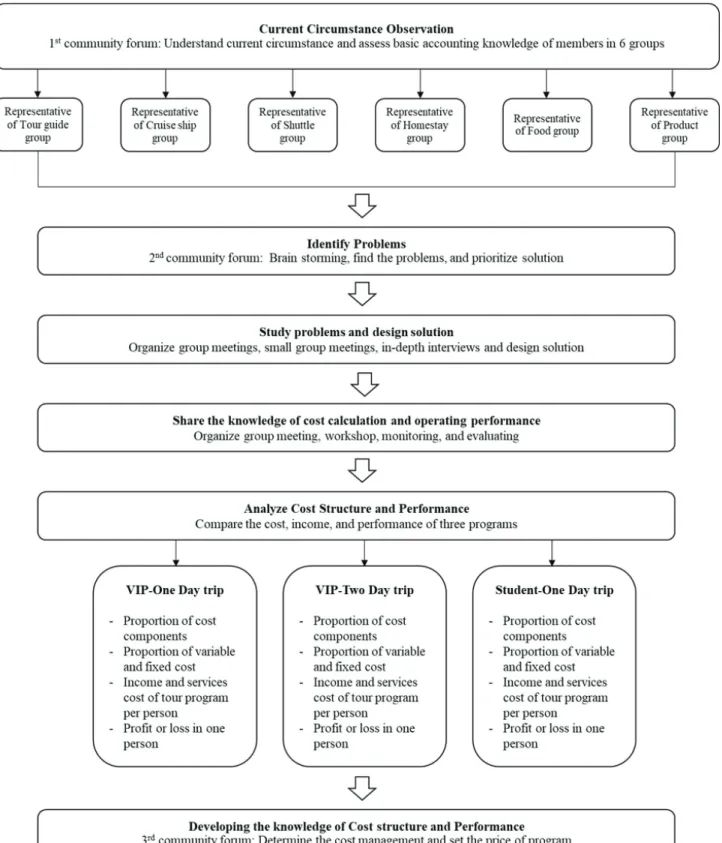
The method to understand and manage costs of tour programs at the Banlaem Homestay Community was participatory action research. The researchers strictly shadow the procedure as shown in Figure 1. The procedure is detailed as follows.
(1) The group of the Banlaem Homestay entrepreneurs had a meeting with the research team to observe current circumstances. The researchers assessed the basic accounting knowledge of the entrepreneurs.
(2) The researchers identified problems by organizing the second community forum. Then the researchers used the information obtained from the community enterprise and the results of the measurement of the accounting knowledge of the community entrepreneurs from six groups to identify and rank the importance of problems and draft a model for improving accounting knowledge for those groups who still lack accounting knowledge.
(3) The researchers studied and designed practical solutions by exploring theories and related studies with community enterprise members by group meetings and in-depth group interviews. Then the group brought solutions to present in the accounting workshop where everyone worked together to solve problems for community enterprise.
(4) The researchers shared accounting knowledge to community enterprise by organizing group meetings and small group meetings to perform accounting workshops, cost calculation of tour programs, cost classification of programs, set the selling prices of tour programs, and evaluate tour arrangements. Then the group got practiced. They were monitored and assessed the level of accounting knowledge both during and after the workshops.
(5) The researchers analyzed cost structure and performance from the tour programs presented
in stage 4. The researchers used data from the workshops to calculate the cost of three programs and divided the costs of tour services into variable cost and fixed cost. The researchers compared the proportion of the costs and income and analyzed the operating performance of each tour program whether they create a profit or loss.
(6) The researchers provided community entrepreneurs with knowledge of cost structure analysis and operating performance of tour programs by organizing the third community forum. Then the researchers used the results of cost structure analysis and the performance of those tour programs to determine the appropriate guidelines for cost management and set the prices for those tour programs.
3.2. Population and Sample
One-hundred and eight members of Banlaem Homestay Community were divided into six groups, which include tour guide, boat, shuttle, homestay, food, and product.
The researchers conducted a forum by selecting 58 representatives from different groups who were willing to give information and improve accounting knowledge in the community forums and group meetings to identify problems and find solutions.
3.3. Data Collection and Analysis
The researchers used community forums, group meetings, small group meetings, in-depth interviews, and participant observation to provide the members of the Banlaem Homestay with training about costing and pricing in the tourism industry. Then, members of the Banlaem Homestay were evaluated accounting knowledge after the forums. The researchers surveyed the current circumstances of the Banlaem Homestay by organizing the first community forum to understand the current situations. The members were divided into six groups and brainstormed ideas using a question card to write answers and oral tests. The test aims at measuring basic accounting knowledge. The criteria for assessing the accounting knowledge were suggested by the experts in accounting and tourism.
Below are criterion-referenced score ranges of an accounting knowledge assessment including five questions based on tourism cost management. It included cost components, cost classification, cost management, results of the tour program, and accounting records.
• Grade A, 80–100 points means Excellent
• Grade B, 70–79 points means Good
• Grade C, 60–69 points means Neutral
• Grade D, 50–59 points means Poor
• Grade F, 0–49 points means Very poor
Figure 1: Conceptual Framework and Research Method
4. Research Results and Discussion 4.1. Current Circumstances
The Banlaem Homestay offers three tour programs:
(1) VIP-One-Day Trip. The price is 900 baht per person.
It is a half-day tour. The activity starts at 5:30 am and ends no later than 1 pm. The tourists can have sunrise breakfast on a boat in the morning at the Golden Bay, observe the fisherman lifestyle, and plant mangrove trees. The most important activity of this tour program is a natural spa made from sea mud. The tour ends with a fresh seafood lunch. The signature dishes are sea mud rice and fried mangrove leaves.
(2) VIP-Two-Day Trip. This overnight trip costs 1,750 baht per person. The activities for the first day starts at 1:00 pm to visit the various professional groups in the community, such as the curry paste making group, the Pak Gud Teen Thip group, the palm leaf weaving group, and the net weaving group. Then the tourists can ride a bike to see local lifestyles, have dinner, and take a rest. The second-day activities are similar to the VIP-One-Day Trip program.
(3) Student One-Day Trip. The price is 300 baht per person. This is a one-day trip for students. The activity starts at 8.00 am and ends no later than 6.00 pm. The tourists can take a boat to see the sunrise and fisherman lifestyle, plant mangrove trees, try a natural spa from sea mud, and have lunch. In the afternoon, the tourists can join a vocational training session in the community and finish the program with dinner.
4.2. Costing Comprehension
The level of basic accounting knowledge of tour guides group is excellent as they arranged all trips. The food group had a poor level of basic accounting knowledge was poor as they were responsible only for food. They prepared the ingredients and cleaned up the kitchen, so the members of this group knew only the cost of the ingredients in each dish. Besides, the food group added that the main ingredient, which was seafood caused problems, such as seasonal restrictions, species, size, quantity, and price. This makes them unable to forecast and control costs and quantities of the ingredients. The Banlaem Homestay did not appropriately record accounting entries as they recorded all income but did not record all expenses. Moreover, there was no record of financial transactions. The level of basic accounting knowledge and accounting comprehension of the members of the Banlaem Homestay are shown in Table 2.
4.3. Problems in Costing and Proposed Solutions Analyzing the current circumstance of the six groups, the researchers can identify and prioritize problems, and propose solutions as described below.
4.3.1. Bookkeeping
The Banlaem Homestay did not appropriately record accounting entries as they recorded all income, but did not record all expenses. There was no record of financial transactions as well. Therefore, the Banlaem Homestay could not effectively manage their accounting records. To solve this problem, the Banlaem Homestay should make
Table 2: The Level of Basic Accounting Knowledge and Accounting Comprehension of the Members of the Banlaem Homestay
Questions
The Level of Accounting Comprehension Tour Guide
Group (N = 4)
Boat Group (N = 18)
Shuttle Group (N = 6)
Homestay Group (N = 16)
Food Group (N = 8)
Products Group (N = 6) Score Level Score Level Score Level Score Level Score Level Score Level
1. Cost Components 95 A 70 B 70 B 75 B 55 D 80 A
2. Variable Costs 90 A 75 B 70 B 75 B 65 C 75 B
3. Fixed Costs 95 A 75 B 75 B 75 B 65 C 75 B
4. Cost Calculation 85 A 70 B 70 B 70 B 55 D 70 B
5. The solution when the costs of some items are increasing
80 A 75 B 70 B 75 B 55 D 75 B
Average 89 A 73 B 71 B 74 B 59 D 75 B
accounting records to make it easier to track down its income and expenses. Moreover, financial transactions for monthly income and expenses should be recorded with evidence to make it easier to calculate costs. Then, it is suggested to record income and expenses to know the profit and loss of each tour program.
4.3.2. Accounting Knowledge
The cost of food was the main cost of the trip. The accounting knowledge of the members of the food group was poor. The main ingredients have problems, such as seasonal restrictions, species, size, quantity, and price making the members unable to forecast and control costs and quantities of the ingredients. To solve this problem, the enterprise should determine the formats and contents of training especially for members from the food group. It is suggested to include:
• Determination of the number of ingredients and standard costs for each dish.
• Food cost calculation.
• Giving training to a treasurer on how to calculate the operating costs of each trip.
4.4. The Food and Tour Program Costing
The main accounting knowledge used to solve costing problems for the Banlaem Homestay was cost accounting and cost management, especially the cost of food and tour programs, cost classification, and the calculation of the performance of the tour program. The group workshops to share knowledge were divided into two parts as follows:
4.4.1. The First Part of Workshops
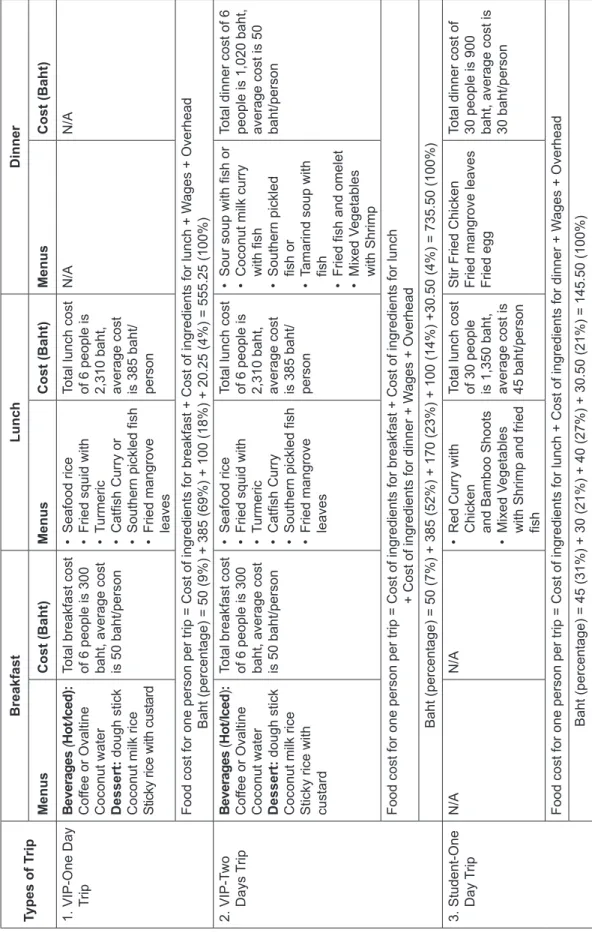
The hotel entrepreneurs were invited to share their experiences in setting the menu for each meal and the ingredients for each dish. Meat and vegetables must be weighed to determine food costs in each tour program as shown in Table 3. These allowed members of the food group to clarify the calculation of food costs in each tour program.
The ingredients took a significant portion of food costs in the three programs, which were 78 percent, 82 percent, and 52 percent, respectively. The chefs’ wages were at a fixed rate of 200 baht per person per day. The lowest cost proportion of food costs was overhead costs.
4.4.2. The Second Part of Workshops
The accounting workshop was offered to the homestay’s treasurer to provide knowledge about costing and the calculation of the tour performance. Moreover, the monthly revenue and expenditure records of tour programs and transaction evidence were documented. Then, the information obtained from records was used to calculate the cost of each
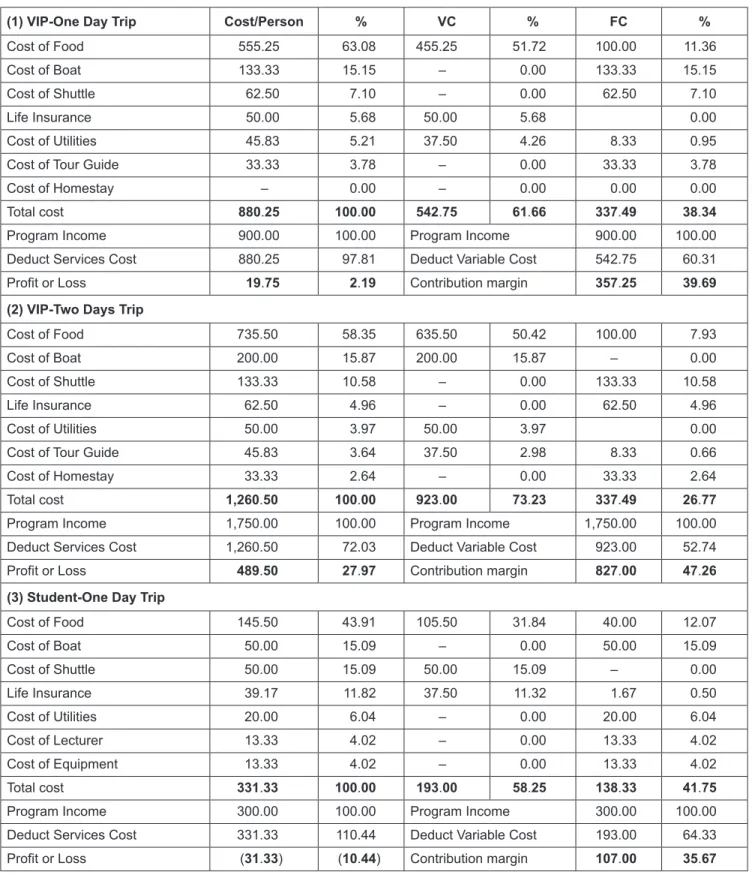
program. The analysis of cost structures and the performance of tour programs can be found in Table 4.
(1) Two following equations were used to compute tour program costs including the programs for general guests and the program for students.
Cost of VIP trip = Food cost + Tour guide cost + Boat cost + Shuttle cost + Homestay cost (Overnight) + Life Insurance + Others
(1)
Cost of Students trip = Food cost + Boat cost + Life Insurance + Lecturer fee + Equipment cost + Others (2)
• VIP one-day trip is a half-day tour program for 6 people per trip.
• VIP two-day trip is an overnight tour program for 6 people per trip, the program is similar to VIP one- day trip but there is an additional cost for dinner and homestay.
• Students one-day trip is a one-day program for 30 students per trip. The cost of the program is the same as VIP one-day trip. There is a free shuttle service. However, there is a lecturer and equipment cost for activities.
In the VIP one-day trip, VIP two-day trip, and Student one-day trip, we can see that food cost was the main cost of all three tour programs, 63.08 percent, 58.35 percent, and 43.91 percent, respectively. The variable cost was also the main cost, 61.66 percent, 73.23 percent, and 58.25 percent, respectively.
It was reported that 81-86 percent of VIP programs and 70 percent for student one-day trip costs were the variable cost of food. In the VIP program, the cost of ingredients was 80 percent, which was a variable cost. The cost was high as the ingredients for lunch were seafood, which was more expensive than other types of meat. The chefs’ wages were a step cost, which was 16 percent. The overhead cost was 4 percent, which was accounted as a variable cost. Unlike the VIP program, the food ingredients were the only variable cost, which was 50 percent as they were beef, chicken, fish, and vegetables. The chefs’ wages, which were a step cost, was 30 percent and the overhead cost, which was a variable cost, was 20 percent, respectively. This was higher than the labor and overhead costs of the VIP program because of the employment of several chefs and the higher consumption of cooking gas.
(2) The performance of tour programs can be calculated
by deducting the cost of tour programs from the
selling price of the tours to show profit or loss.
Table 3: Determining Menus, Cost of Ingredients, and Standard Cost of Menu in Three Programs Types of TripBreakfastLunchDinner MenusCost (Baht)MenusCost (Baht)MenusCost (Baht) 1. VIP-One Day Trip Beverages (Hot/Iced): Coffee or Ovaltine Coconut water Dessert: dough stick
Coconut milk rice Sticky rice with custard Total breakfast cost of 6 people is 300 baht, average cost is 50 baht/person
• Seafood rice • Fried squid with • Turmeric • Catfish Curry or • Southern pickled fish • Fried mangrove leaves
Total lunch cost of 6 people is 2,310 baht, average cost is 385 baht/ person
N/AN/A Food cost for one person per trip = Cost of ingredients for breakfast + Cost of ingredients for lunch + Wages + Overhead Baht (percentage) = 50 (9%) + 385 (69%) + 100 (18%) + 20.25 (4%) = 555.25 (100%) 2. VIP-Two Days TripBeverages (Hot/Iced): Coffee or Ovaltine Coconut water Dessert: dough stick
Coconut milk rice Sticky rice with custard Total breakfast cost of 6 people is 300 baht, average cost is 50 baht/person
• Seafood rice • Fried squid with • Turmeric • Catfish Curry • Southern pickled fish • Fried mangrove leaves
Total lunch cost of 6 people is 2,310 baht, average cost is 385 baht/ person
• Sour soup with fish or • Coconut milk curry with fish • Southern pickled fish or • Tamarind soup with fish • Fried fish and omelet • Mixed Vegetables with Shrimp
Total dinner cost of 6 people is 1,020 baht, average cost is 50 baht/person
Food cost for one person per trip = Cost of ingredients for breakfast + Cost of ingredients for lunch + Cost of ingredients for dinner + Wages + Overhead Baht (percentage) = 50 (7%) + 385 (52%) + 170 (23%) + 100 (14%) +30.50 (4%) = 735.50 (100%) 3. Student-One Day T
ripN/AN/A• Red Curry with Chicken
and Bamboo Shoots • Mixed Vegetables with Shrimp and fried fish Total lunch cost of 30 people is 1,350 baht, average cost is 45 baht/person Stir Fried Chicken Fried mangrove leaves Fried egg Total dinner cost of 30 people is 900 baht, average cost is 30 baht/person
Food cost for one person per trip = Cost of ingredients for lunch + Cost of ingredients for dinner + Wages + Overhead Baht (percentage) = 45 (31%) + 30 (21%) + 40 (27%) + 30.50 (21%) = 145.50 (100%)
Table 4: Cost Calculation, Cost Structure, and Performance of the Three Programs
(1) VIP-One Day Trip Cost/Person % VC % FC %
Cost of Food 555.25 63.08 455.25 51.72 100.00 11.36
Cost of Boat 133.33 15.15 – 0.00 133.33 15.15
Cost of Shuttle 62.50 7.10 – 0.00 62.50 7.10
Life Insurance 50.00 5.68 50.00 5.68 0.00
Cost of Utilities 45.83 5.21 37.50 4.26 8.33 0.95
Cost of Tour Guide 33.33 3.78 – 0.00 33.33 3.78
Cost of Homestay – 0.00 – 0.00 0.00 0.00
Total cost 880.25 100.00 542.75 61.66 337.49 38.34
Program Income 900.00 100.00 Program Income 900.00 100.00
Deduct Services Cost 880.25 97.81 Deduct Variable Cost 542.75 60.31
Profit or Loss 19.75 2.19 Contribution margin 357.25 39.69
(2) VIP-Two Days Trip
Cost of Food 735.50 58.35 635.50 50.42 100.00 7.93
Cost of Boat 200.00 15.87 200.00 15.87 – 0.00
Cost of Shuttle 133.33 10.58 – 0.00 133.33 10.58
Life Insurance 62.50 4.96 – 0.00 62.50 4.96
Cost of Utilities 50.00 3.97 50.00 3.97 0.00
Cost of Tour Guide 45.83 3.64 37.50 2.98 8.33 0.66
Cost of Homestay 33.33 2.64 – 0.00 33.33 2.64
Total cost 1,260.50 100.00 923.00 73.23 337.49 26.77
Program Income 1,750.00 100.00 Program Income 1,750.00 100.00
Deduct Services Cost 1,260.50 72.03 Deduct Variable Cost 923.00 52.74
Profit or Loss 489.50 27.97 Contribution margin 827.00 47.26
(3) Student-One Day Trip
Cost of Food 145.50 43.91 105.50 31.84 40.00 12.07
Cost of Boat 50.00 15.09 – 0.00 50.00 15.09
Cost of Shuttle 50.00 15.09 50.00 15.09 – 0.00
Life Insurance 39.17 11.82 37.50 11.32 1.67 0.50
Cost of Utilities 20.00 6.04 – 0.00 20.00 6.04
Cost of Lecturer 13.33 4.02 – 0.00 13.33 4.02
Cost of Equipment 13.33 4.02 – 0.00 13.33 4.02
Total cost 331.33 100.00 193.00 58.25 138.33 41.75
Program Income 300.00 100.00 Program Income 300.00 100.00
Deduct Services Cost 331.33 110.44 Deduct Variable Cost 193.00 64.33
Profit or Loss (31.33) (10.44) Contribution margin 107.00 35.67
In a comparison of the performance of the three programs, the VIP two-day trip made the highest profit of 27.97 percent, the VIP one-day trip made a low profit of 2.19 percent, whereas the student’s one-day trip recorded a 10.44 percent loss. This happened when the community enterprise provided services and did not record and calculate cost appropriately so they could not track down their profit and loss. In short- term operations, the business could survive because the profit from the VIP programs could cover loss from the student program, but it could cause more problems in the long run.
In addition, the performance of the tour program can be analyzed based on the selling prices and variable costs. As shown in Table 4, it was found that the three programs could generate a contribution margin for the community enterprise, especially the VIP two-day trip, which generates the highest contribution margin of 827 baht per person or 47.26 percent.
The VIP one-day trip generated a contribution margin of 357.25 baht per person or 39.69 percent, whereas the student one-day trip generated the lowest contribution margin of 107 baht per person or 35.67 percent. Through this, the community enterprise should set the selling prices and have legit variable cost management so that the contribution margin could cover the fixed cost. Therefore, the enterprise can make a profit from tour programs.
4.5. Cost Structure Analysis and Performance The results of the cost calculation, cost structure, and performance of the three tour programs can help the enterprise better understand how to manage cost and set a selling price as follows:
(1) Food cost was the main cost of organizing a tour program, especially the cost of lunch meals where seafood was the main ingredient. However, the cost of seafood depends on the season, type, size, quantity, and price, so the community could not estimate the cost of ingredients in advance. However, the cost of seafood is a variable cost that varies according to the number of tourists. The members of the food group then experimented by weighing seafood used in each dish according to the number of tourists. Therefore, they knew the standard weight of different types of seafood per tourist and can estimate the quantity of seafood in advance. Besides, the types of seafood (shrimp, crayfish, shellfish, crab, fish, and squid) were recorded each month. Hence, it is possible to change some types of seafood when they were not available in certain months or too expensive. So, it is possible to manage the cost of seafood ingredients.
(2) The Banlaem Homestay aims at creating ecotourism and generating income for local people. All members expect to operate a successful business and to create
more income for the community. The members of the enterprise agreed that the tourism programs must be managed to be profitable with these principles:
• Managing variable costs is essential, but can adjust according to the number of tourists. For example, the food group bought local ingredients from the community or grew vegetables to reduce ingredient costs. Additionally, the tour guide group negotiated with the Life Insurance Company and received better deals for tourist life insurance.
• Managing step cost is supplement cost management of inventory and insurance charge. The wage cost was reduced from 800 baht to 500 per boat by having the tour guide group agreed to reduce their guide wages rate of 200 baht for six tourists to ten tourists for the student one-day trip.
• Setting the profitable selling prices of tour programs is the way to increase the enterprise’s income.
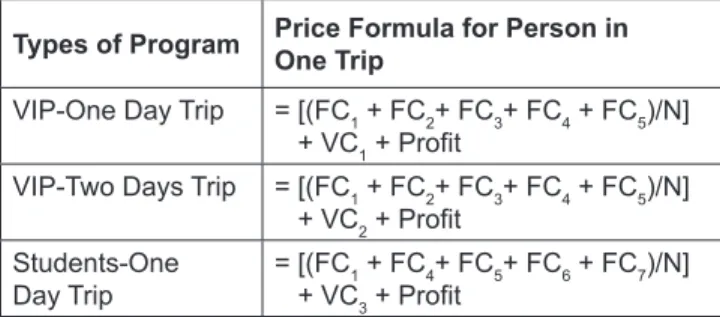
The community enterprise should understand the accounting so that they can calculate the cost of tour arrangements and classify and analyze the cost structure of tour arrangements. The cost accounting knowledge will be useful for pricing tour programs to make them profitable (as shown in Table 5).
FC
1= Boat costs 800 baht per 6 VIP tourists. Boat costs 500 baht per 10 students.
FC
2= Tour guide costs, 1 tour guide per 6 VIP tourists, and 1 tour guide per 10 students Tour guide rate is 200 baht.
FC
3= Shuttle costs 375 baht per 6 VIP tourists.
FC
4= Chef wages, 1 chef per 4 VIP tourists, and 1 chef per 6 students. The wages rate is 200 baht.
FC5 = Disposal fee 50 baht per trip.
FC6 = Lecturer fee, 1 lecturer per 10 students.
The rate is 200 baht.
FC7 = Equipment and materials cost 400 baht per activity.
VC
1= Variable cost of the VIP one-day trip is 538 baht per person.
Table 5: The Equation for Pricing the Three Tour Programs
Types of Program Price Formula for Person in One Trip VIP-One Day Trip = [(FC1 + FC2+ FC3+ FC4 + FC5)/N]
+ VC1 + Profit
VIP-Two Days Trip = [(FC1 + FC2+ FC3+ FC4 + FC5)/N]
+ VC2 + Profit Students-One
Day Trip = [(FC1 + FC4+ FC5+ FC6 + FC7)/N]
+ VC3 + Profit
VC
2= Variable cost of the VIP two-day trip is 918 baht per person.
VC
3= Variable cost of the student one-day trip is 188 baht per person.
Profit = Expected profit
N = Number of tourists5. Conclusion
This research shows that the accounting knowledge of entrepreneurs remains a weakness in community enterprise business operations. The community enterprises should improve in four key points:
• Setting up an accounting system, recording, updating accounting transactions, and being clear about the duties of the treasurer.
• Determining the cost of housekeepers according to working hours, recording the cost of food provided to the housekeeper as part of the labor cost, and negotiating to reduce the cost of boat and tour guide.
• Managing cost of food and beverage.
• Setting the selling price according to the cost of ingredients while still well-serving tourists’ needs.
The community enterprise purchased the ingredients from local people and local grocery stores, but they did not receive receipts as evidence for subsequent accounting purposes.
To solve this problem, the community enterprise members, especially those of the food group, should always record expenses when they purchased any goods. However, it is clear how much they gained because the trip bookings were recorded every time the tourists reserved. The community enterprise should update the accounting records and reconcile the revenues and expenses on the periodic cash inflows and outflows. The completeness and consistency of accounting records and their usage are factors affecting the success of the community enterprise (Do, Le, Luong, & Tran, 2020; Ruengdet
& Wongsurawat, 2010). Moreover, a legit accounting system and the ability of accountants to prepare financial statements on a monthly, quarterly, and annual basis are in need.
The labor and food costs are the main expenditures of the hotel business (Daly, 2008; Mandelbaum, 2017; Mun
& Jang, 2018). The community enterprise cannot afford the high wage rate of chefs as a hotel. However, they hired housekeepers who are members of the enterprise to cook in their free time and provided them with food and a flat rate lump-sum payment for each trip. This is inappropriate as the number of working hours and meals were not the same on each trip and the workload of housekeepers was different to chefs. Therefore, the community enterprise should consider a fair labor cost according to the number of working hours and systematically set the wages for the chef and sous chef,
which should be different. Moreover, the food provided to the housekeepers should be separated from the cost of the food for tourists. Besides, the community enterprise can negotiate with other groups to reduce a step cost, such as boat and tour guide costs in some trips to help students and to save costs during the low season.
This research found that the main cost of the tour programs was the cost of food, which can be reduced easily.
However, the chefs prefer to estimate ingredients rather than measure as it made them work faster. Likely, the portion size for each dish is not consistent. Due to the sense of camaraderie of local people, the members of the community enterprise did not ask for discounts from the local sellers when they bought the ingredients. Daly (2008) states that these factors make it difficult to control production costs. However, the community enterprise can still control and reduce costs by other methods, such as finding some substitute ingredients with lower costs (Krishnamoorthy & Kapadia, 1999), reducing storage and logistic costs of ingredients by buying in local communities, eliminating the middlemen by directly purchasing from fishermen or farmers (Givens & Dunning, 2019), and using natural ingredients or vegetables in their gardens such as mangrove leaves, coconut, basil, and sugar banana. Additionally, the group members agreed to grow papaya, mango, potted chili, lemongrass, and lime in their garden to reduce costs in the future.
The community enterprise should provide the service to meet customers’ expectations and set reasonable prices for the meals provided accordingly (Ahmed, 2005; Nemeschansky, 2020). During the off-season, the entrepreneurs should decide to raise the prices of seafood dishes (Daly, 2008).
For the student trip, the portion size and types of food should make them full to do activities for the whole day.
The community enterprise can consider using alternative ingredients to control per capita costs (Krishnamoorthy
& Kapadia, 1999). For further research, it is suggested to study the needs or expectations of tourists toward the services of the community enterprises or to conduct menu analysis by other methods, such as activity-based costing, weighted contribution margin. Due to the limitations of the entrepreneurs’ accounting knowledge, this study only considered net profit, loss, and contribution margin.
References
Ahmed, Z. (2005). Identify your constraints to optimize your processes. Food Management, 40(6).
Annaraud, K. (2007). Restaurant menu analysis: can we go further?
Journal of Foodservice Business Research, 10(4), 25–37.
Aprilia, F., & Kusumawati, A. (2021). Influence of electronic word of mouth on visitor’s interest in tourism destinations. Journal of Asian Finance, Economics and Business, 8(2), 993–1003.
https://doi.org/10.13106/jafeb.2021.vol8.no2.0993
Bayou, M. E., & Bennett, L. B. (1992). Profitability analysis for table-service restaurants. The Cornell Hotel and Restaurant Administration Quarterly, 33(2), 49–55.
Beran, B. (1994). Menu sales mix analysis revisited: An economic approach. Hospitality Research Journal, 18(3–1), 125–141.
Cohen, E., Ghiselli, R., & Schwartz, Z. (2007). The effect of loss leader pricing on restaurant menus’ product portfolio analysis.
Journal of Foodservice Business Research, 9(1), 21–38.
Davis, B., Lockwood, A., Alcott, P., & Pantelidis, I. S. (2012). Food and beverage management (5th ed.). London: Routledge.
Dittmer, P. R., & Keefe, J. D. (2009). Principles of food, beverage, and labor cost controls (9th ed.). Hoboken, NJ: John Wiley &
Sons, Inc.
Do, T. H., Le, H. M., Luong, D. T. T., & Tran, Q. T. (2020).
Relationship between the management accounting information usage, market orientation and performance: Evidence from Vietnamese tourism firms. Journal of Asian Finance, Eco- nomics and Business, 7(10), 707–716. https://doi.org/10.13106/
jafeb.2020.vol7.no10.707
Givens, G., & Dunning, R. (2019). Distributor intermediation in the farm to food service value chain. Renewable Agriculture and Food Systems, 34(3), 268–270.
GSB. (2017). Ecotourism Programs for sustainability. Retrieved September 24, 2020 from https://www.gsbresearch.or.th/gsb/
economics/grassroots-economics/6318/?fbclid=IwAR0RB qy 55s1WPoWFgrWhCDxGFSBa3jJfVJeT3uwHRTSHw1pK- vlUr8DUh3M
Hayes, D. K., & Huffman, L. (1985). Menu analysis: a better way.
Cornell Hotel and Restaurant Administration Quarterly, 25(4), 64–70.
Hayes, D. K., & Huffman, L. M. (1995). Value pricing: How low can you go? Cornell Hotel and Restaurant Administration Quarterly, 36(1), 51–56.
Henkel, R., Henkel, P., Agrusa, W., Agrusa, J., & Tanner, J. (2006).
Thailand as a tourist destination: Perceptions of international visitors and Thai residents. Asia Pacific Journal of Tourism Research, 11(3), 269–287.
Horton, B. (2001). Menu analysis: The effect of labor and menu category on menu classifications. FIU Hospitality Review, 19(2), 35–46.
Jitpakdee, P., Khurana, P., & Pota, S. (2017). Hotel Procurement, Considerations, and Implication and Recommendation for Hoteliers and Spirits Suppliers. APHEIT Journal, 6(2), 83–95.
Kasavana, M. L., & Smith, D. J. (1982). Menu Engineering.
Lansing, MI: Hospitality Publications Inc.
Khermkhan, J., & Mankeb, P. (2017). A Comparison of Cost and Return between Fruit Farm Only and Agro Tourism. Burapha Journal of Business Management Burapha University, 6(2), 43–55.
Krishnamoorthy, S., & Kapadia, M. (1999). A methodology of enhancing profitability through the utilization of experimental design: a catering business case study. Total Quality Management, 10(7), 1027–1036.
LeBruto, S. M., Quain, W. J., & Ashley, R. A. (1995). Menu engineering: a model including labor. Hospitality Review, 13(1), 5.
Long, N. T. (2020). The Competitiveness of Soc Trang Ecotourism Associated with Khmer Culture. Journal of Asian Finance, Economics and Business, 7(10), 1107–1117. https://doi.org/
10.13106/ jafeb.2020.vol7.no10.1107
Mandelbaum, R. (2017). Shifts In Revenue and Expenses Improve Hotel Food And Beverage Profits - By Robert Mandelbaum. Retrieved 17 February 2020, from https://www.
hotelnewsresource.com/article97392.html
Manotham, C. (2015). A Study of Bookkeeping of Community Enterprises in Chiang Mai Province According to the Guide- lines of the Cooperative Auditing Department. Payap University Journal, 25(1), 133–148.
Miller, J. E. (1980). Menu pricing and strategy. Boston, MA: CBI Publishing.
Mun, S. G., & Jang, S. S. (2018). Restaurant operating expenses and their effects on profitability enhancement. International Journal of Hospitality Management, 71, 68–76.
Mustafa, A. M. M. (2019). Contribution of tourism and foreign direct investment to gross domestic product: Econometric analysis in the case of Sri Lanka. Journal of Asian Finance, Economics and Business, 6(4), 109–114. https://doi.org/10.13106/jafeb.2019.
vol6.no4.109
Naipinit, A., Sakolnakorn, T. P. N., & Kroeksakul, P. (2016).
Strategic management of community enterprises in the upper northeast region of Thailand. Journal of Enterprising Communities: People and Places in the Global Economy, 10(4), 346–362.
Nemeschansky, B. (2020). Listen to your customer-how to manage your restaurant more effectively. Journal of Foodservice Business Research, 23(1), 17–45.
Ozdemir, B. (2012). A review on menu performance investigation and some guiding propositions. Journal of Foodservice Business Research, 15(4), 378–397.
Panyaem, K., Niemchai, S., & Tawatnagul, T. (2018). Integrating of Menu Engineering and Electronic Word of Mouth Towards Restaurant Business. Dusit Thani College Journal, 12(Special), 405–418.
Pavesic, D. V. (1983). Cost/margin analysis: a third approach to menu pricing and design. International Journal of Hospitality Management, 2(3), 127–134.
Raab, C., Hertzman, J., Mayer, K., & Bell, D. (2007). Activity- based costing menu engineering: A new and more accurate way to maximize profits from your restaurant menu. Journal of Foodservice Business Research, 9(1), 77–96.
Ruengdet, K., & Wongsurawat, W. (2010). Characteristics of successful small and micro community enterprises in rural Thailand. Journal of Agricultural Education and Extension, 16(4), 385–397.
Taylor, J., Reynolds, D., & Brown, D. M. (2009). Multi-factor menu analysis using data envelopment analysis. International Journal of Contemporary Hospitality Management, 21(2), 213–225.
Uman, D. (1983). Pricing for profits. Restaurant Business, 1(4), 157–170.
Whitecotton, S., Libby, R., & Phillips, F. (2014). Managerial Accounting (2nd ed.). New York: McGraw-Hill Education.
Wongadisai, W., Chanchalor, S., & Murphy, E. (2020). Rural community enterprises in Thailand: a case study of participation. World Review of Entrepreneurship, Manage- ment and Sustainable Development, 16(3), 276–298.